REVIEW 3 major objections 5 minor 1 cited by
SN 2023ixf: The Closest Supernova of the Decade
T0 review · 3 major / 5 minor · reviewed 2026-08-06 · deepseek-v4-flash
Pith's one-line read SN 2023ixf, the closest supernova in a decade, was a Type II explosion whose ejecta slammed into a dense shell of gas that its red supergiant progenitor shed in the final few years before death, a review of more than 80 studies concludes.
desk verdict A solid, honest review of a landmark event, but its own quantitative synthesis of the CSM density scale is not as settled as Figure 7 implies. read the letter →
The pith
A machine-rendered reading of the paper's core claim, the machinery that carries it, and where it could break.
The reading
What carries the argument
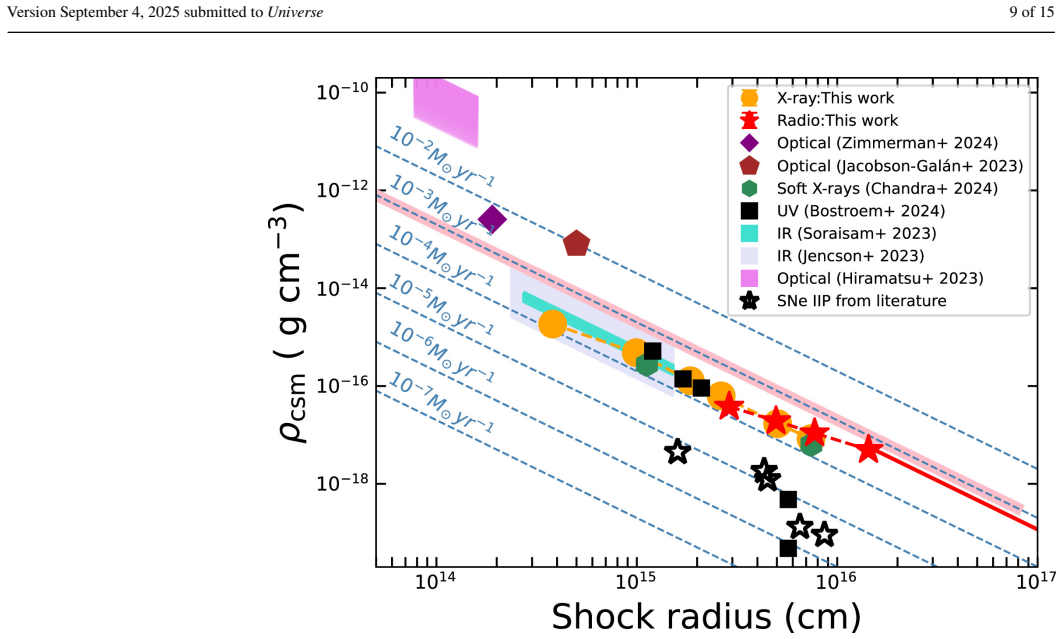
The central object is the dense, confined circumstellar material (CSM): gas ejected by the red supergiant in its final years and still within $\sim 10^{15}$ cm of the star at explosion. The interaction of the supernova shock with this CSM is the mechanism that carries the argument. Photo-ionization of the CSM produces narrow flash emission lines; electron scattering in the optically thick gas broadens them into Lorentzian wings whose duration marks when the shock exits the thick region; photoelectric absorption of X-rays and free-free absorption of radio emission trace the same density structure; and light-curve models require the CSM to power the early peak. The review's synthesis converts these independent probes into a single circumstellar density profile, from $\sim 10^{-12}$ g cm$^{-3}$ near $10^{14}$ cm to a wind-like $10^{-4}\,M_\odot$ yr$^{-1}$ profile beyond $10^{15}$ cm.
What would settle it
A reanalysis of SN 2023ixf's earliest photometry using independent model assumptions that moves the explosion time by more than about half a day would change the inferred shock radius and the lookback time of the mass loss; if that shift makes the seven-day electron-scattering phase inconsistent with the $\sim 6\times 10^{14}$ cm radius and the X-ray and radio densities, then the dense, confined-CSM conclusion would be called into question.
Extended reading notes
Core claim
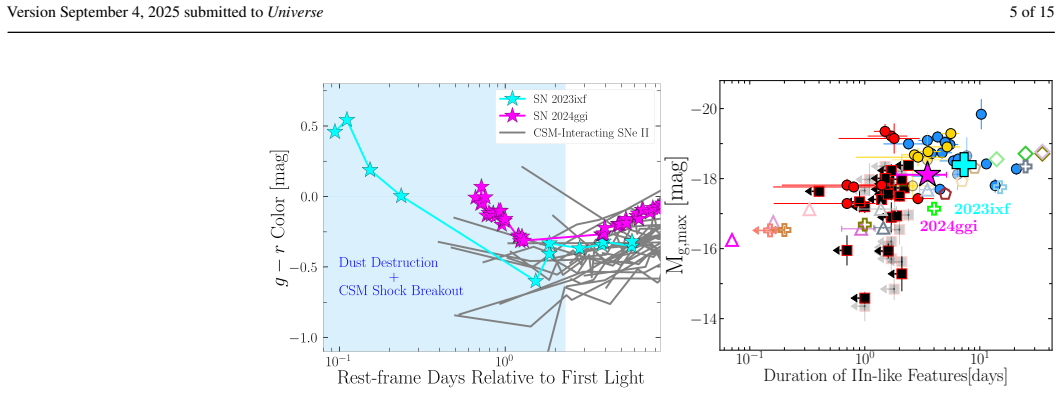
The central discovery is that SN 2023ixf was, at the moment of explosion, surrounded by dense circumstellar material concentrated within roughly $\sim 5\times 10^{14}$ cm of the star. The early optical spectra show transient narrow emission lines of H, He, C, and N with Lorentzian wings from electron scattering, requiring an optical depth $\tau\approx 3$–$10$ and a density near $10^{-12}$ g cm$^{-3}$ at $10^{14}$ cm. The electron-scattering phase lasted about seven days, after which the shock had reached a radius near $6\times 10^{14}$ cm, corresponding to a lookback time of about eight years for a measured wind velocity of $25$ km s$^{-1}$. Independent modeling of the X-ray luminosity, radio free-free suppression, and the multi-band light curve converges on a mass-loss rate near $10^{-2}\,M_\odot$ yr$^{-1}$ inside $\sim 5\times 10^{14}$ cm and $\sim 10^{-4}\,M_\odot$ yr$^{-1}$ beyond, with a total CSM mass of $0.04$–$0.07\,M_\odot$. Pre-explosion imaging identifies a dust-enshrouded red supergiant with roughly 1000-day variability and no detected optical outburst, so the enhanced final mass loss must be explained by a mechanism such as a convection-driven enhanced wind or binary interaction rather than an eruption.
Load-bearing premise
The load-bearing premise is the assumed explosion time, estimated from model fits to the first hours of light rather than measured directly; all of the review's radii, phase labels, and mass-loss rates shift if that time is off by even half a day.
Editorial extensions
If this is right
- Early spectra of Type II supernovae should be searched routinely for flash emission lines, because SN 2023ixf shows that a normal-looking SN II can carry a strong, short-lived CSM-interaction signature.
- Red supergiants can lose mass at $\sim 10^{-2}\,M_\odot$ yr$^{-1}$ in their final years without a detectable optical outburst, so progenitor mass-loss histories must include quiescent or quasi-continuous enhanced winds, not only eruptions.
- Continued ejecta interaction with more distant CSM keeps the late-time light curve brighter than radioactive decay, implying that late-time observations of SNe II can reveal CSM even when early-time flash features were missed.
- SN 2023ixf's X-ray and radio evolution becomes a benchmark for interpreting other CSM-interacting SNe II, since the same shock physics must reproduce the observed peak luminosity and spectral evolution.
- Non-detections of neutrinos and gravitational waves from SN 2023ixf, interpreted with its CSM parameters, place the strongest current limits on cosmic-ray acceleration and proto-neutron-star ellipticity in a core-collapse supernova.
Reading between the lines
- If the confined-CSM picture is generic, then SNe II observed only after their first week will have lost the flash signatures, so current samples may underestimate the fraction of Type II supernovae with significant pre-explosion mass loss.
- The progenitor's roughly 1000-day variability, combined with the absence of precursor outbursts, suggests the enhanced mass loss tracks pulsation or convection cycles; a testable extension is that other SNe II with confined CSM should show similar periodicity in pre-explosion photometry.
- The spectropolarimetric asymmetry implies that spherically symmetric mass-loss rates from early spectra may be biased; multi-dimensional radiative transfer may be needed to turn flash spectroscopy into reliable mass-loss measurements.
- Because the explosion time is model-dependent, the 'final 3–6 years' statement should be read as an order-of-magnitude constraint until an independent epoch measurement exists; a half-day shift in the epoch changes the inferred CSM radius and mass-loss lookback time by roughly the same fraction.
Editorial analysis
A structured set of objections, weighed in public.
Referee Report
Summary. This invited review synthesizes the first year of multi-wavelength observations of SN 2023ixf, a nearby Type II supernova in M101. It covers the early flash-spectroscopy phase, photospheric and nebular evolution, X-ray and radio observations, multi-messenger constraints, and the progenitor system inferred from pre-explosion imaging. The paper's central claim is that SN 2023ixf is a Type II supernova that exploded inside dense, confined circumstellar material (CSM) lost by a red supergiant progenitor in the final years before explosion, and that this event now serves as the prototype for CSM-interacting SNe II. The review draws on more than 80 published studies and presents a synthesis in which a high mass-loss rate near 10^-2 solar masses per year inside about 5 x 10^14 cm transitions to a wind-like profile near 10^-4 solar masses per year at larger radii.
Significance. If the synthesis is correct, the paper provides a valuable reference for one of the most intensively observed core-collapse supernovae in decades. The review is unusually broad, covering optical, UV, X-ray, radio, neutrino, gamma-ray, and gravitational-wave constraints, and it usefully tabulates the disparate progenitor-mass and mass-loss-rate estimates from the literature. The qualitative picture—dense, confined CSM around an RSG progenitor—is robust and independently corroborated by many groups. The main quantitative claim, however, depends on merging density estimates that the paper itself reports as mutually inconsistent, so the significance of the review's headline numbers is currently limited by an unresolved tension.
major comments (3)
- [§7.3, Fig. 7, Table 1, §8] The paper's central quantitative claim is that the progenitor shed mass at ~10^-2 solar masses per year inside ~5 x 10^14 cm and ~10^-4 solar masses per year outside this radius. Yet the text explicitly states that the optical IIn-like features require a larger CSM density at the same epoch than the X-ray data imply, and that the earliest radio observations [55] are inconsistent with the X-ray-derived density. The proposed reconciliation—'CSM asymmetries such as a clumpy progenitor wind'—is asserted without a model, a test, or a quantitative demonstration that the claimed profile can reproduce the optical, X-ray, and radio data simultaneously. Figure 7 nevertheless plots one continuous profile as though the tension were resolved, and the conclusions repeat the 10^-2/10^-4 numbers as established. Because this density scale is load-bearing for the abstract and conclusions, the review needs to either provide a concrete clumpy/asymmetric CSM model that reproduces all bands, or explicitly present the density profile as a working hypothesis with the full one-to-two-order-of-magnitude uncertainty reflected in Figures 7 and the conclusions.
- [§1, §3] The explosion epoch t0 = MJD 60082.757 +/- 0.097 days is adopted from early photometry and is load-bearing for every phase label, shock radius, CSM extent, and lookback time in Sections 2-7. The review notes that model fits to the earliest light curve give slightly different values (e.g., MJD 60082.788+0.02/-0.05 from [6]) and that the earliest detection/upper limit bracket only constrains first light to a 0.19-day window. The paper does not quantify how a shift of even half a day changes the inferred CSM radius and the derived lookback time of the enhanced mass loss. Since the tightest constraints are model-dependent, the review should include a short propagation-of-uncertainty statement or at least explicitly acknowledge that the CSM radii and mass-loss lookback times are quoted to a precision that may exceed what t0 supports.
- [§2.3, §4, §7.2] Several statements that support the review's narrative are attributed to unpublished or non-public sources: the SiO emission in JWST spectra is described as 'private communication' (§2.3), the flattening of the optical light curve at >600 days is supported by 'Jacobson-Galán et al., in prep' (§4), and the possible emergence of the reverse shock is cited as 'private communication' (§4). For a review article, these claims cannot be independently checked. They should either be removed, labeled as unpublished personal communications rather than evidence, or replaced with citations to publicly available papers or telegrams.
minor comments (5)
- [Abstract] The abstract contains a duplicated article: 'in addition to the the uncertain mass-loss histories.'
- [§1] The sentence 'SN 2023ixf was classified as as a type II supernova' contains a duplicated 'as'.
- [§7.1] The word 'occurance' should be 'occurrence'.
- [§7.3] The phrase 'hydrid shock cooling plus CSM-interaction analytic model' should read 'hybrid shock cooling plus CSM-interaction analytic model'.
- [Throughout] Many reference callouts and equations are missing spaces (e.g., 'Best-matchedCMFGEN spectral model' in the Figure 2 caption, 'CMFGENmodel spectra' in the Figure 3 caption). A careful copyedit for spacing and formatting consistency is needed.
Circularity Check
No material circularity: the review's central CSM-interaction conclusions are independently corroborated; self-citations and in-prep items are supportive, not load-bearing.
full rationale
This review is a synthesis rather than a derivation: it contains no new equations and no step in which a quantity is defined in terms of the quantity it is supposed to predict. The central conclusion—that SN 2023ixf interacted with dense, confined CSM lost from an RSG in the final years before explosion—is supported by many independent analyses from different teams: optical flash spectroscopy and light-curve modeling (e.g., refs [6,9,11,29,34,83,88,89]), X-ray spectroscopy ([51,52,53,54]), and radio observations ([54,55,58]). Even if the author's own CMFGEN-based works ([8,27,31,87]) were removed, the same picture is established by these external groups, so the self-citations are not load-bearing. The one argument that uses a same-group modeling paper to exclude high-CSM-mass fits ([30] in Sec. 7.3) is a general spectral-modeling result, and the preferred ~1e-2 Msun/yr inner CSM is independently reproduced by other light-curve models and X-ray/radio work. The manuscript does contain weak-support passages: a 'Jacobson-Galan et al., in prep.' citation in Sec. 3 and a 'private communication' for JWST SiO detection in Sec. 2.3; these are missing public evidence but are peripheral, not load-bearing. Section 7.3 explicitly reports the unresolved factor-of-10-100 discrepancy between optical and X-ray/radio density estimates and labels the clumpy-wind resolution as a possibility ('potentially reconciled'), which is an honest limitation rather than a circular move. The explosion-epoch uncertainty noted in Sec. 1 affects inferred radii and lookback times but is a model-dependent input, not a self-referential one. Overall, no prediction reduces by construction to a fitted value or to the author's own prior conclusions; any circularity is limited to minor, non-load-bearing self-citation.
Assumptions & free parameters
free parameters (5)
- Distance to M101 =
6.85 +/- 0.15 Mpc
- Explosion epoch (t0) =
MJD 60082.757 +/- 0.097
- Inner CSM mass-loss rate (Mdot) =
~1e-2 solar masses per year
- CSM radius (R_CSM) =
~5e14 cm
- Progenitor wind velocity (v_w) =
~25 km/s
assumptions (4)
- domain assumption Flash-ionized emission lines in early spectra trace photo-ionization of dense CSM ahead of the forward shock.
- domain assumption Radiative transfer models (CMFGEN and similar) can map observed spectra and light curves to CSM density, radius, and mass-loss rate.
- domain assumption The adopted distance and explosion epoch are accurate enough to convert observed fluxes and times to physical luminosities, radii, and masses.
- ad hoc to paper A clumpy or asymmetric wind can reconcile the discrepant CSM densities inferred from optical, X-ray, and radio observations.
Cite this review
Pith. "Pith review of SN 2023ixf: The Closest Supernova of the Decade." pith.science (2026). https://pith.science/paper/YJR2DD6N
@misc{pith2026250708078,
  author       = {Pith},
  title        = {Pith review of: SN 2023ixf: The Closest Supernova of the Decade},
  year         = {2026},
  howpublished = {\url{https://pith.science/paper/YJR2DD6N}},
  note         = {Machine review of arXiv:2507.08078}
}
read the original abstract
Supernova 2023ixf occurred on May 18th 2023 in the nearby galaxy Messier 101 (D ~ 6.85 Mpc), making it the closest supernova in the last decade. Following its discovery, astronomers around the world rushed to observe the explosion across the electromagnetic spectrum in order to uncover its early-time properties. Based on multi-wavelength analysis during its first year post-explosion, supernova 2023ixf is a type II supernova that interacted with dense, confined circumstellar material in its local environment -- this material being lost from its red supergiant progenitor in the final years before explosion. In this article, we will review the findings of >80 studies already published on this incredible event as well as explore how the synthesis of SN 2023ixf observations across the electromagnetic spectrum can be used to constrain both type II supernova explosion physics in addition to the the uncertain mass loss histories of red supergiant stars in their final years.
Figures


Figures from the paper (4 more)


Forward citations
Cited by 1 Pith paper
-
SN 2023ixf in M101: physical parameters from bolometric light curve modeling
SN 2023ixf produced 0.046 ± 0.007 solar masses of nickel and ejected less than 9 solar masses, based on bolometric light curve modeling.
Reference graph
Works this paper leans on
-
[55]
Millimeter Observations of the Type II SN2023ixf: Constraints on the Proximate Circumstellar Medium
Berger, E.; Keating, G.K.; Margutti, R.; Maeda, K.; Alexander, K.D.; Cendes, Y.; Eftekhari, T.; Gurwell, M.; Hiramatsu, D.; Ho, A.Y.Q.; et al. Millimeter Observations of the Type II SN 2023ixf: Constraints on the Proximate Circumstellar Medium.ApJL 2023, 951, L31, [arXiv:astro-ph.HE/2306.09311]. https://doi.org/10.3847/2041-8213/ace0c4
work page Pith review arXiv 2023
-
[6]
A shock flash breaking out of a dusty red supergiant
Li, G.; Hu, M.; Li, W.; Yang, Y.; Wang, X.; Yan, S.; Hu, L.; Zhang, J.; Mao, Y.; Riise, H.; et al. A shock flash breaking out of a dusty red supergiant. Nature2024, 627, 754–758, [arXiv:astro-ph.HE/2311.14409]. https://doi.org/10.1038/s41586-023-06843-6
-
[1]
Transient Discovery Report for 2023-05-19.Transient Name Server Discovery Report 2023, 2023-1158, 1
Itagaki, K. Transient Discovery Report for 2023-05-19.Transient Name Server Discovery Report 2023, 2023-1158, 1
2023
-
[2]
Riess, A.G.; Yuan, W.; Macri, L.M.; Scolnic, D.; Brout, D.; Casertano, S.; Jones, D.O.; Murakami, Y.; Anand, G.S.; Breuval, L.; et al. A Comprehensive Measurement of the Local Value of the Hubble Constant with 1 km s−1 Mpc−1 Uncertainty from the Hubble Space Telescope and the SH0ES Team.ApJL2022, 934, L7, [arXiv:astro-ph.CO/2112.04510]. https://doi.org/10...
-
[3]
LT Classification of SN 2023ixf as a Type II Supernova in M101.Transient Name Server AstroNote2023, 119, 1
Perley, D.A.; Gal-Yam, A.; Irani, I.; Zimmerman, E. LT Classification of SN 2023ixf as a Type II Supernova in M101.Transient Name Server AstroNote2023, 119, 1
-
[4]
Sgro, L.A.; Esposito, T.M.; Blaclard, G.; Gomez, S.; Marchis, F.; Filippenko, A.V.; Peluso, D.O.; Lawrence, S.S.; Verveen, A.; Wagner, A.; et al. Photometry of Type II Supernova SN 2023ixf with a Worldwide Citizen Science Network.Research Notes of the American Astronomical Society2023, 7, 141, [arXiv:astro-ph.HE/2307.14347]. https://doi.org/10.3847/2515-5...
-
[5]
Onset of SN 2023ixf observed over East Asian longitudes
Mao, Y.; Zhang, M.; Cai, G.; Chen, J.; Chen, J.; Gao, X.; Li, K.; Lyu, X.; Qin, Y.; Sun, G.; et al. Onset of SN 2023ixf observed over East Asian longitudes. Transient Name Server AstroNote2023, 130, 1
-
[7]
Hosseinzadeh, G.; Farah, J.; Shrestha, M.; Sand, D.J.; Dong, Y.; Brown, P.J.; Bostroem, K.A.; Valenti, S.; Jha, S.W.; Andrews, J.E.; et al. Shock Cooling and Possible Precursor Emission in the Early Light Curve of the Type II SN 2023ixf.ApJL 2023, 953, L16, [arXiv:astro-ph.HE/2306.06097]. https://doi.org/10.3847/2041-8213/ace4c4
arXiv 2023
Show all 93 references
-
[8]
SN2023ixfinMessier101: Photo-ionizationofDense,Close-inCircumstellarMaterialinaNearbyTypeIISupernova
Jacobson-Galán, W.V.; Dessart, L.; Margutti, R.; Chornock, R.; Foley, R.J.; Kilpatrick, C.D.; Jones, D.O.; Taggart, K.; Angus, C.R.; Bhattacharjee,S.; etal. SN2023ixfinMessier101: Photo-ionizationofDense,Close-inCircumstellarMaterialinaNearbyTypeIISupernova. ApJL2023, 954, L42...
-
[9]
Early Spectroscopy and Dense Circumstellar Medium Interaction in SN 2023ixf.ApJL 2023, 956, L5, [arXiv:astro-ph.HE/2306.10119]
Bostroem, K.A.; Pearson, J.; Shrestha, M.; Sand, D.J.; Valenti, S.; Jha, S.W.; Andrews, J.E.; Smith, N.; Terreran, G.; Green, E.; et al. Early Spectroscopy and Dense Circumstellar Medium Interaction in SN 2023ixf.ApJL 2023, 956, L5, [arXiv:astro-ph.HE/2306.10119]. https://doi....
2023 arXiv
-
[10]
Far-ultraviolet to Near-infrared Observations of SN 2023ixf: A High-energy Explosion Engulfed in Complex Circumstellar Material.ApJL 2023, 954, L12, [arXiv:astro-ph.HE/2306.10284]
Teja, R.S.; Singh, A.; Basu, J.; Anupama, G.C.; Sahu, D.K.; Dutta, A.; Swain, V.; Nakaoka, T.; Pathak, U.; Bhalerao, V.; et al. Far-ultraviolet to Near-infrared Observations of SN 2023ixf: A High-energy Explosion Engulfed in Complex Circumstellar Material.ApJL 2023, 954, L12, ...
2023 arXiv
-
[11]
Circumstellar material ejected violently by a massive star immediately before its death
Zhang, J.; Lin, H.; Wang, X.; Zhao, Z.; Li, L.; Liu, J.; Yan, S.; Xiang, D.; Wang, H.; Bai, J. Circumstellar material ejected violently by a massive star immediately before its death. Science Bulletin 2023, 68, 2548–2554, [arXiv:astro-ph.HE/2309.01998]. https: //doi.org/10.101...
2023 arXiv
-
[12]
A Wolf- Rayet-like progenitor of SN 2013cu from spectral observations of a stellar wind.Nature2014, 509, 471–474, [arXiv:astro-ph.HE/1406.7640]
Gal-Yam, A.; Arcavi, I.; Ofek, E.O.; Ben-Ami, S.; Cenko, S.B.; Kasliwal, M.M.; Cao, Y.; Yaron, O.; Tal, D.; Silverman, J.M.; et al. A Wolf- Rayet-like progenitor of SN 2013cu from spectral observations of a stellar wind.Nature2014, 509, 471–474, [arXiv:astro-ph.HE/1406.7640]. ...
-
[13]
Confined dense circumstellar material surrounding a regular type II supernova.Nature Physics2017, 13, 510–517, [arXiv:astro-ph.HE/1701.02596]
Yaron,O.;Perley,D.A.;Gal-Yam,A.;Groh,J.H.;Horesh,A.;Ofek,E.O.;Kulkarni,S.R.;Sollerman,J.;Fransson,C.;Rubin,A.;etal. Confined dense circumstellar material surrounding a regular type II supernova.Nature Physics2017, 13, 510–517, [arXiv:astro-ph.HE/1701.02596]. https://doi.org/10...
-
[14]
Explosion of red-supergiant stars: Influence of the atmospheric structure on shock breakout and early-time supernova radiation.A&A 2017, 605, A83, [arXiv:astro-ph.SR/1704.01697]
Dessart, L.; John Hillier, D.; Audit, E. Explosion of red-supergiant stars: Influence of the atmospheric structure on shock breakout and early-time supernova radiation.A&A 2017, 605, A83, [arXiv:astro-ph.SR/1704.01697]. https://doi.org/10.1051/0004-6361/201730942
2017 arXiv
-
[15]
Flash Spectroscopy: Emission Lines from the Ionized Circumstellar Material around <10-day-old Type II Supernovae.ApJ 2016, 818, 3, [arXiv:astro-ph.HE/1512.00846]
Khazov, D.; Yaron, O.; Gal-Yam, A.; Manulis, I.; Rubin, A.; Kulkarni, S.R.; Arcavi, I.; Kasliwal, M.M.; Ofek, E.O.; Cao, Y.; et al. Flash Spectroscopy: Emission Lines from the Ionized Circumstellar Material around <10-day-old Type II Supernovae.ApJ 2016, 818, 3, [arXiv:astro-p...
2016 arXiv
-
[16]
A Large Fraction of Hydrogen-rich Supernova Progenitors Experience Elevated Mass Loss Shortly Prior to Explosion.ApJ 2021, 912, 46, [arXiv:astro-ph.HE/2008.09986]
Bruch, R.J.; Gal-Yam, A.; Schulze, S.; Yaron, O.; Yang, Y.; Soumagnac, M.; Rigault, M.; Strotjohann, N.L.; Ofek, E.; Sollerman, J.; et al. A Large Fraction of Hydrogen-rich Supernova Progenitors Experience Elevated Mass Loss Shortly Prior to Explosion.ApJ 2021, 912, 46, [arXiv...
2021 arXiv
-
[17]
ThePrevalence and Influence of Circumstellar Material around Hydrogen-rich Supernova Progenitors.ApJ 2023, 952, 119, [arXiv:astro-ph.HE/2212.03313]
Bruch,R.J.;Gal-Yam,A.;Yaron,O.;Chen,P.;Strotjohann,N.L.;Irani,I.;Zimmerman,E.;Schulze,S.;Yang,Y.;Kim,Y.L.;etal. ThePrevalence and Influence of Circumstellar Material around Hydrogen-rich Supernova Progenitors.ApJ 2023, 952, 119, [arXiv:astro-ph.HE/2212.03313]. https://doi.org/...
2023 arXiv
-
[18]
Broad emission lines from the opaque electron-scattering environment of SN 1998S.MNRAS 2001, 326, 1448–1454, [arXiv:astro-ph/astro-ph/0106234]
Chugai, N.N. Broad emission lines from the opaque electron-scattering environment of SN 1998S.MNRAS 2001, 326, 1448–1454, [arXiv:astro-ph/astro-ph/0106234]. https://doi.org/10.1111/j.1365-2966.2001.04717.x
2001 arXiv
-
[19]
Electron scattering wings on lines in interacting supernovae.MNRAS 2018, 475, 1261–1273, [arXiv:astro- ph.HE/1712.01237]
Huang, C.; Chevalier, R.A. Electron scattering wings on lines in interacting supernovae.MNRAS 2018, 475, 1261–1273, [arXiv:astro- ph.HE/1712.01237]. https://doi.org/10.1093/mnras/stx3163
2018 arXiv
-
[20]
Probing red supergiant atmospheres and winds with early-time, high-cadence, high-resolution type II supernova spectra.A&A 2025, 694, A132, [arXiv:astro-ph.HE/2410.20486]
Dessart, L. Probing red supergiant atmospheres and winds with early-time, high-cadence, high-resolution type II supernova spectra.A&A 2025, 694, A132, [arXiv:astro-ph.HE/2410.20486]. https://doi.org/10.1051/0004-6361/202452769
2025 arXiv
-
[21]
Dickinson, D.; Milisavljevic, D.; Garretson, B.; Dessart, L.; Margutti, R.; Chornock, R.; Subrayan, B.; Hillier, D.J.; Golub, E.; Li, D.; et al. The Immediate, Exemplary, and Fleeting Echelle Spectroscopy of SN 2023ixf: Monitoring Acceleration of Slow Progenitor Circumstellar ...
-
[22]
Early Emission from the Type IIn Supernova 1998S at High Resolution
Shivvers, I.; Groh, J.H.; Mauerhan, J.C.; Fox, O.D.; Leonard, D.C.; Filippenko, A.V. Early Emission from the Type IIn Supernova 1998S at High Resolution. ApJ2015, 806, 213, [arXiv:astro-ph.HE/1408.1404]. https://doi.org/10.1088/0004-637X/806/2/213
-
[23]
Interacting Supernovae: Types IIn and Ibn
Smith, N. Interacting Supernovae: Types IIn and Ibn. InHandbook of Supernovae ; Alsabti, A.W.; Murdin, P., Eds.; 2017; p. 403. https://doi.org/10.1007/978-3-319-21846-5_38
2017 doi
-
[24]
High-resolution Spectroscopy of SN 2023ixf’s First Week: Engulfing the Asymmetric Circumstellar Material.ApJ 2023, 956, 46, [arXiv:astro-ph.HE/2306.07964]
Smith, N.; Pearson, J.; Sand, D.J.; Ilyin, I.; Bostroem, K.A.; Hosseinzadeh, G.; Shrestha, M. High-resolution Spectroscopy of SN 2023ixf’s First Week: Engulfing the Asymmetric Circumstellar Material.ApJ 2023, 956, 46, [arXiv:astro-ph.HE/2306.07964]. https: //doi.org/10.3847/15...
2023 arXiv
-
[25]
Early Time Spectropolarimetry of the Aspherical Type II Supernova SN 2023ixf.ApJL2023, 955, L37, [arXiv:astro-ph.HE/2307.01268]
Vasylyev, S.S.; Yang, Y.; Filippenko, A.V.; Patra, K.C.; Brink, T.G.; Wang, L.; Chornock, R.; Margutti, R.; Gates, E.L.; Burgasser, A.J.; et al. Early Time Spectropolarimetry of the Aspherical Type II Supernova SN 2023ixf.ApJL2023, 955, L37, [arXiv:astro-ph.HE/2307.01268]. htt...
-
[26]
Spectropolarimetric Evolution of SN 2023ixf: an Asymmetric Explosion in a Confined Aspherical Circumstellar Medium.arXiv e-prints 2025, p
Vasylyev, S.S.; Dessart, L.; Yang, Y.; Filippenko, A.V.; Patra, K.C.; Brink, T.G.; Wang, L.; Chornock, R.; Margutti, R.; Gates, E.L.; et al. Spectropolarimetric Evolution of SN 2023ixf: an Asymmetric Explosion in a Confined Aspherical Circumstellar Medium.arXiv e-prints 2025, ...
-
[27]
Final Moments
Jacobson-Galán, W.V.; Dessart, L.; Davis, K.W.; Kilpatrick, C.D.; Margutti, R.; Foley, R.J.; Chornock, R.; Terreran, G.; Hiramatsu, D.; Newsome, M.; et al. Final Moments. II. Observational Properties and Physical Modeling of Circumstellar-material-interacting Type II Supernova...
-
[28]
BrightTypeIIsupernova2023ixfinM101: Aquickanalysisoftheearly-stagespectraandnear-infrared light curves
Yamanaka,M.;Fujii,M.;Nagayama,T. BrightTypeIIsupernova2023ixfinM101: Aquickanalysisoftheearly-stagespectraandnear-infrared light curves. PASJ2023, 75, L27–L31, [arXiv:astro-ph.SR/2306.00263]. https://doi.org/10.1093/pasj/psad051
-
[29]
The complex circumstellar environment of supernova 2023ixf
Zimmerman, E.A.; Irani, I.; Chen, P.; Gal-Yam, A.; Schulze, S.; Perley, D.A.; Sollerman, J.; Filippenko, A.V.; Shenar, T.; Yaron, O.; et al. The complex circumstellar environment of supernova 2023ixf. Nature 2024, 627, 759–762, [arXiv:astro-ph.HE/2310.10727]. https://doi.org/1...
2024
-
[30]
Using spectral modeling to break light-curve degeneracies of type II supernovae interacting with circumstellar material
Dessart, L.; Jacobson-Galán, W.V. Using spectral modeling to break light-curve degeneracies of type II supernovae interacting with circumstellar material. A&A2023, 677, A105, [arXiv:astro-ph.SR/2307.08584]. https://doi.org/10.1051/0004-6361/202346754
-
[31]
SN 2024ggi in NGC 3621: Rising Ionization in a Nearby, Circumstellar-material-interacting Type II Supernova.ApJ 2024, 972, 177, [arXiv:astro-ph.HE/2404.19006]
Jacobson-Galán, W.V.; Davis, K.W.; Kilpatrick, C.D.; Dessart, L.; Margutti, R.; Chornock, R.; Foley, R.J.; Arunachalam, P.; Auchettl, K.; Bom, C.R.; et al. SN 2024ggi in NGC 3621: Rising Ionization in a Nearby, Circumstellar-material-interacting Type II Supernova.ApJ 2024, 972...
2024 arXiv
-
[32]
SN 2024ggi: detection of X-ray emission by EP-FXT.The Astronomer’s Telegram2024, 16588, 1
Zhang, J.; Li, C.K.; Cheng, H.Q.; Wu, Q.Y.; Jia, S.M.; Chen, Y.; Cui, W.W.; Feng, H.; Guan, J.; Han, D.W.; et al. SN 2024ggi: detection of X-ray emission by EP-FXT.The Astronomer’s Telegram2024, 16588, 1
-
[33]
Science with the Ultraviolet Explorer (UVEX).arXiv e-prints 2021, p
Kulkarni, S.R.; Harrison, F.A.; Grefenstette, B.W.; Earnshaw, H.P.; Andreoni, I.; Berg, D.A.; Bloom, J.S.; Cenko, S.B.; Chornock, R.; Christiansen, J.L.; et al. Science with the Ultraviolet Explorer (UVEX).arXiv e-prints 2021, p. arXiv:2111.15608, [arXiv:astro- ph.GA/2111.1560...
-
[34]
Unravelling the Asphericities in the Explosion and Multifaceted Circumstellar Matter of SN 2023ixf.ApJ 2024, 975, 132, [arXiv:astro-ph.HE/2405.20989]
Singh, A.; Teja, R.S.; Moriya, T.J.; Maeda, K.; Kawabata, K.S.; Tanaka, M.; Imazawa, R.; Nakaoka, T.; Gangopadhyay, A.; Yamanaka, M.; et al. Unravelling the Asphericities in the Explosion and Multifaceted Circumstellar Matter of SN 2023ixf.ApJ 2024, 975, 132, [arXiv:astro-ph.H...
2024 arXiv
-
[35]
OpticalSignaturesofCircumstellarInteractioninTypeIIPSupernovae
Chugai,N.N.;Chevalier,R.A.;Utrobin,V.P. OpticalSignaturesofCircumstellarInteractioninTypeIIPSupernovae. ApJ2007, 662,1136–1147, [arXiv:astro-ph/astro-ph/0703468]. https://doi.org/10.1086/518160
-
[36]
Modeling the signatures of interaction in Type II supernovae: UV emission, high-velocity features, broad-boxy profiles
Dessart, L.; Hillier, D.J. Modeling the signatures of interaction in Type II supernovae: UV emission, high-velocity features, broad-boxy profiles. A&A 2022, 660, L9, [arXiv:astro-ph.SR/2204.00446]. https://doi.org/10.1051/0004-6361/202243372. Version September 4, 2025 submitte...
2022 arXiv
-
[37]
SN 2023ixf in the Pinwheel Galaxy M101: From Shock Breakout to the Nebular Phase.arXiv e-prints 2025, p
Zheng, W.; Dessart, L.; Filippenko, A.V.; Yang, Y.; Brink, T.G.; De Jaeger, T.; Vasylyev, S.S.; Van Dyk, S.D.; Patra, K.C.; Jacobson-Galan, W.V.; et al. SN 2023ixf in the Pinwheel Galaxy M101: From Shock Breakout to the Nebular Phase.arXiv e-prints 2025, p. arXiv:2503.13974, [...
-
[38]
Circumstellar Interaction in the Ultraviolet Spectra of SN 2023ixf 14–66 Days After Explosion.ApJL 2024, 973, L47, [arXiv:astro- ph.HE/2408.03993]
Bostroem, K.A.; Sand, D.J.; Dessart, L.; Smith, N.; Jha, S.W.; Valenti, S.; Andrews, J.E.; Dong, Y.; Filippenko, A.V.; Gomez, S.; et al. Circumstellar Interaction in the Ultraviolet Spectra of SN 2023ixf 14–66 Days After Explosion.ApJL 2024, 973, L47, [arXiv:astro- ph.HE/2408....
2024 arXiv
-
[39]
Spectropolarimetry of SN 2023ixf Reveals Both Circumstellar Material and an Aspherical Helium Core.ApJL 2025, 982, L32, [arXiv:astro-ph.HE/2410.08199]
Shrestha, M.; DeSoto, S.; Sand, D.J.; Williams, G.G.; Hoffman, J.L.; Smith, P.S.; McCall, C.; Maund, J.R.; Steele, I.A.; Wiersema, K.; et al. Spectropolarimetry of SN 2023ixf Reveals Both Circumstellar Material and an Aspherical Helium Core.ApJL 2025, 982, L32, [arXiv:astro-ph...
2025 arXiv
-
[40]
Diversity in Hydrogen-rich Envelope Mass of Type II Supernovae
Fang, Q.; Moriya, T.J.; Ferrari, L.; Maeda, K.; Folatelli, G.; Ertini, K.Y.; Kuncarayakti, H.; Andrews, J.E.; Matsumoto, T. Diversity in Hydrogen-rich Envelope Mass of Type II Supernovae. II. SN 2023ixf as Explosion of Partially Stripped Intermediate Massive Star.ApJ 2025, 978...
2025 arXiv
-
[41]
Signatures of the shock interaction as an additional power source in the nebular spectra of SN 2023ixf.MNRAS2025, 538, 659–670, [arXiv:astro-ph.HE/2412.03509]
Kumar, A.; Dastidar, R.; Maund, J.R.; Singleton, A.J.; Sun, N.C. Signatures of the shock interaction as an additional power source in the nebular spectra of SN 2023ixf.MNRAS2025, 538, 659–670, [arXiv:astro-ph.HE/2412.03509]. https://doi.org/10.1093/mnras/staf312
-
[42]
SN 2023ixf: interaction signatures in the spectrum at 445 days.arXiv e-prints2025, p
Folatelli, G.; Ferrari, L.; Ertini, K.; Kuncarayakti, H.; Maeda, K. SN 2023ixf: interaction signatures in the spectrum at 445 days.arXiv e-prints2025, p. arXiv:2502.10534, [arXiv:astro-ph.SR/2502.10534]. https://doi.org/10.48550/arXiv.2502.10534
-
[43]
ThenebularspectraofSN2023ixf: alowermass,partiallystrippedprogenitor may be the result of binary interaction.MNRAS 2025, 539, 633–649, [arXiv:astro-ph.HE/2503.13017]
Michel,P.D.;Mazzali,P.A.;Perley,D.A.;Hinds,K.R.;Wise,J.L. ThenebularspectraofSN2023ixf: alowermass,partiallystrippedprogenitor may be the result of binary interaction.MNRAS 2025, 539, 633–649, [arXiv:astro-ph.HE/2503.13017]. https://doi.org/10.1093/mnras/staf443
2025 arXiv
-
[44]
Evidence of Weak Circumstellar Medium Interaction in the Type II SN 2023axu.ApJ 2024, 961, 247, [arXiv:astro-ph.HE/2310.00162]
Shrestha, M.; Pearson, J.; Wyatt, S.; Sand, D.J.; Hosseinzadeh, G.; Bostroem, K.A.; Andrews, J.E.; Dong, Y.; Hoang, E.; Janzen, D.; et al. Evidence of Weak Circumstellar Medium Interaction in the Type II SN 2023axu.ApJ 2024, 961, 247, [arXiv:astro-ph.HE/2310.00162]. https://do...
2024 arXiv
-
[45]
NEOWISE-R Caught the Luminous SN 2023ixf in Messier 101.ApJ 2024, 977, 98, [arXiv:astro-ph.SR/2406.18005]
Van Dyk, S.D.; Szalai, T.; Cutri, R.M.; Kirkpatrick, J.D.; Grillmair, C.J.; Fajardo-Acosta, S.B.; Masiero, J.R.; Mainzer, A.K.; Gelino, C.R.; Vinkó, J.; et al. NEOWISE-R Caught the Luminous SN 2023ixf in Messier 101.ApJ 2024, 977, 98, [arXiv:astro-ph.SR/2406.18005]. https://do...
2024 arXiv
-
[46]
Inferring CSM PropertiesofTypeIISNeUsingaMagnitude-LimitedZTFSample
Hinds, K.R.; Perley, D.; Sollerman, J.; Miller, A.; Fremling, C.; Moriya, T.; Das, K.; Qin, Y.J.; Bellm, E.; Chen, X.T.; et al. Inferring CSM PropertiesofTypeIISNeUsingaMagnitude-LimitedZTFSample. arXiv e-prints2025,p. arXiv:2503.19969,[arXiv:astro-ph.HE/2503.19969]. https://d...
-
[47]
Multiband Simultaneous Photometry of Type II SN 2023ixf with Mephisto and the Twin 50 cm Telescopes.ApJ 2024, 969, 126, [arXiv:astro-ph.HE/2405.08327]
Yang, Y.P.; Liu, X.; Pan, Y.; Er, X.; Liu, D.; Fang, Y.; Du, G.; Cai, Y.; Xu, X.; Chen, X.; et al. Multiband Simultaneous Photometry of Type II SN 2023ixf with Mephisto and the Twin 50 cm Telescopes.ApJ 2024, 969, 126, [arXiv:astro-ph.HE/2405.08327]. https: //doi.org/10.3847/1...
2024 arXiv
-
[48]
One Year of SN 2023ixf: Breaking Through the Degenerate Parameter Space in Light-Curve Models with Pulsating Progenitors.arXiv e-prints2024, p
Hsu, B.; Smith, N.; Goldberg, J.A.; Bostroem, K.A.; Hosseinzadeh, G.; Sand, D.J.; Pearson, J.; Hiramatsu, D.; Andrews, J.E.; Beasor, E.R.; et al. One Year of SN 2023ixf: Breaking Through the Degenerate Parameter Space in Light-Curve Models with Pulsating Progenitors.arXiv e-pr...
-
[49]
Modeling Supernova 2023ixf: Lightcurve Degeneracies and Morphological Differences.arXiv e-prints 2025, p
Forde, S.; Goldberg, J.A. Modeling Supernova 2023ixf: Lightcurve Degeneracies and Morphological Differences.arXiv e-prints 2025, p. arXiv:2504.12421, [arXiv:astro-ph.SR/2504.12421]. https://doi.org/10.48550/arXiv.2504.12421
-
[50]
Optical and Near-infrared Observations ofSN 2023ixf for over 600 daysafter the Explosion.arXiv e-prints 2025, p
Li, G.; Wang, X.; Yang, Y.; Pastorello, A.; Reguitti, A.; Valerin, G.; Ochner, P.; Cai, Y.; Iijima, T.; Munari, U.; et al. Optical and Near-infrared Observations ofSN 2023ixf for over 600 daysafter the Explosion.arXiv e-prints 2025, p. arXiv:2504.03856, [arXiv:astro-ph.HE/2504....
-
[51]
Early Hard X-Rays from the Nearby Core-collapse Supernova SN 2023ixf
Grefenstette, B.W.; Brightman, M.; Earnshaw, H.P.; Harrison, F.A.; Margutti, R. Early Hard X-Rays from the Nearby Core-collapse Supernova SN 2023ixf. ApJL 2023, 952, L3, [arXiv:astro-ph.HE/2306.04827]. https://doi.org/10.3847/2041-8213/acdf4e
2023 arXiv
-
[52]
Chandra’s Insights into SN 2023ixf.ApJL2024, 963, L4, [arXiv:astro- ph.HE/2311.04384]
Chandra, P.; Chevalier, R.A.; Maeda, K.; Ray, A.K.; Nayana, A.J. Chandra’s Insights into SN 2023ixf.ApJL2024, 963, L4, [arXiv:astro- ph.HE/2311.04384]. https://doi.org/10.3847/2041-8213/ad275d
-
[53]
Probing the soft X-ray properties and multi-wavelength variability of SN2023ixf and its progenitor.PASA2024, 41, e059, [arXiv:astro-ph.HE/2308.13101]
Panjkov, S.; Auchettl, K.; Shappee, B.J.; Do, A.; Lopez, L.; Beacom, J.F. Probing the soft X-ray properties and multi-wavelength variability of SN2023ixf and its progenitor.PASA2024, 41, e059, [arXiv:astro-ph.HE/2308.13101]. https://doi.org/10.1017/pasa.2024.66
-
[54]
J., N.; Margutti, R.; Wiston, E.; Chornock, R.; Campana, S.; Laskar, T.; Murase, K.; Krips, M.; Migliori, G.; Tsuna, D.; et al
A. J., N.; Margutti, R.; Wiston, E.; Chornock, R.; Campana, S.; Laskar, T.; Murase, K.; Krips, M.; Migliori, G.; Tsuna, D.; et al. Dinosaur in a Haystack: X-Ray View of the Entrails of SN 2023ixf and the Radio Afterglow of Its Interaction with the Medium Spawned by the Progeni...
2025 doi
-
[56]
VLA 10 GHz Observations of SN2023ixf.Transient Name Server AstroNote2023, 146, 1
Matthews, D.; Margutti, R.; Alexander, K.D.; Bright, J.; Cendes, Y.; Berger, E.; Lasker, T.; Drout, M.; Milisavljevic, D. VLA 10 GHz Observations of SN2023ixf.Transient Name Server AstroNote2023, 146, 1
-
[57]
LOFAR Non-detections of SN 2023ixf in its First Year Post-explosion.Research Notes of the American Astronomical Society 2024, 8, 311, [arXiv:astro-ph.HE/2412.14275]
Timmerman, R.; Arias, M.; Botteon, A. LOFAR Non-detections of SN 2023ixf in its First Year Post-explosion.Research Notes of the American Astronomical Society 2024, 8, 311, [arXiv:astro-ph.HE/2412.14275]. https://doi.org/10.3847/2515-5172/ad9eae. Version September 4, 2025 submi...
2024 arXiv
-
[58]
Radio Follow-up Observations of SN 2023ixf by Japanese and Korean Very Long Baseline Interferometers.ApJ 2025, 978, 138, [arXiv:astro-ph.HE/2411.07542]
Iwata, Y.; Akimoto, M.; Matsuoka, T.; Maeda, K.; Yonekura, Y.; Tominaga, N.; Moriya, T.J.; Fujisawa, K.; Niinuma, K.; Yoon, S.C.; et al. Radio Follow-up Observations of SN 2023ixf by Japanese and Korean Very Long Baseline Interferometers.ApJ 2025, 978, 138, [arXiv:astro-ph.HE/...
2025 arXiv
-
[59]
EVN 5 GHz e-VLBI Observations of SN2023ixf in M101.Research Notes of the American Astronomical Society 2024, 8, 121
Lee, D.; Lee, S.Y.; Paragi, Z.; Orosz, G.; Oh, J.; Kim, J.Y. EVN 5 GHz e-VLBI Observations of SN2023ixf in M101.Research Notes of the American Astronomical Society 2024, 8, 121. https://doi.org/10.3847/2515-5172/ad454e
2024 doi
-
[60]
Early-time𝛾-ray constraints on cosmic-ray acceleration in the core-collapse SN 2023ixf with the Fermi Large Area Telescope.A&A 2024, 686, A254, [arXiv:astro-ph.HE/2404.10487]
Martí-Devesa, G.; Cheung, C.C.; Di Lalla, N.; Renaud, M.; Principe, G.; Omodei, N.; Acero, F. Early-time𝛾-ray constraints on cosmic-ray acceleration in the core-collapse SN 2023ixf with the Fermi Large Area Telescope.A&A 2024, 686, A254, [arXiv:astro-ph.HE/2404.10487]. https:/...
2024 arXiv
-
[61]
Low- and High-energy Neutrinos from SN 2023ixf in M101.ApJL2023, 955, L9, [arXiv:astro-ph.HE/2306.14717]
Guetta, D.; Langella, A.; Gagliardini, S.; Della Valle, M. Low- and High-energy Neutrinos from SN 2023ixf in M101.ApJL2023, 955, L9, [arXiv:astro-ph.HE/2306.14717]. https://doi.org/10.3847/2041-8213/acf573
-
[62]
New constraints on the gamma-ray and high energy neutrino fluxes from the circumstellar interaction of SN 2023ixf.JCAP2024, 2024, 083, [arXiv:astro-ph.HE/2307.08744]
Sarmah, P. New constraints on the gamma-ray and high energy neutrino fluxes from the circumstellar interaction of SN 2023ixf.JCAP2024, 2024, 083, [arXiv:astro-ph.HE/2307.08744]. https://doi.org/10.1088/1475-7516/2024/04/083
2024 arXiv
-
[63]
Kimura, S.S.; Moriya, T.J. High-energy Gamma-Ray and Neutrino Emissions from Interacting Supernovae Based on Radiation Hydrodynamic Simulations: A Case of SN 2023ixf.ApJ 2025, 984, 103, [arXiv:astro-ph.HE/2409.18935]. https://doi.org/10.3847/1538-4357/adc716
2025 arXiv
-
[64]
Constraining MeV-scale axionlike particles with Fermi-LAT observations of SN 2023ixf
Ravensburg, E.; Carenza, P.; Eckner, C.; Goobar, A. Constraining MeV-scale axionlike particles with Fermi-LAT observations of SN 2023ixf. PRD2024, 109, 023018, [arXiv:astro-ph.HE/2306.16397]. https://doi.org/10.1103/PhysRevD.109.023018
-
[65]
High-Energy Neutrinos by Hydrogen-rich Supernovae interacting with low-massive Circumstellar Medium: The Case of SN 2023ixf.MNRAS2025
Cosentino, S.P.; Pumo, M.L.; Cherubini, S. High-Energy Neutrinos by Hydrogen-rich Supernovae interacting with low-massive Circumstellar Medium: The Case of SN 2023ixf.MNRAS2025. https://doi.org/10.1093/mnras/staf861
-
[66]
Search for Gravitational Waves Emitted from SN 2023ixf.ApJ 2025, 985, 183, [arXiv:astro-ph.HE/2410.16565]
Abac, A.G.; Abbott, R.; Abouelfettouh, I.; Acernese, F.; Ackley, K.; Adhicary, S.; Adhikari, N.; Adhikari, R.X.; Adkins, V.K.; Agarwal, D.; et al. Search for Gravitational Waves Emitted from SN 2023ixf.ApJ 2025, 985, 183, [arXiv:astro-ph.HE/2410.16565]. https: //doi.org/10.384...
2025 arXiv
-
[67]
SN 2023ixf in Messier 101: A Variable Red Supergiant as the Progenitor Candidate to a Type II Supernova.ApJL 2023, 952, L23, [arXiv:astro-ph.SR/2306.04722]
Kilpatrick, C.D.; Foley, R.J.; Jacobson-Galán, W.V.; Piro, A.L.; Smartt, S.J.; Drout, M.R.; Gagliano, A.; Gall, C.; Hjorth, J.; Jones, D.O.; et al. SN 2023ixf in Messier 101: A Variable Red Supergiant as the Progenitor Candidate to a Type II Supernova.ApJL 2023, 952, L23, [arX...
2023 arXiv
-
[68]
A Luminous Red Supergiant and Dusty Long-period Variable Progenitor for SN 2023ixf.ApJL 2023, 952, L30, [arXiv:astro-ph.SR/2306.08678]
Jencson, J.E.; Pearson, J.; Beasor, E.R.; Lau, R.M.; Andrews, J.E.; Bostroem, K.A.; Dong, Y.; Engesser, M.; Gomez, S.; Guolo, M.; et al. A Luminous Red Supergiant and Dusty Long-period Variable Progenitor for SN 2023ixf.ApJL 2023, 952, L30, [arXiv:astro-ph.SR/2306.08678]. http...
2023
-
[69]
The Dusty Red Supergiant Progenitor and the Local Environment of the Type II SN 2023ixf in M101.ApJL 2023, 955, L15, [arXiv:astro-ph.SR/2308.04677]
Niu, Z.; Sun, N.C.; Maund, J.R.; Zhang, Y.; Zhao, R.; Liu, J. The Dusty Red Supergiant Progenitor and the Local Environment of the Type II SN 2023ixf in M101.ApJL 2023, 955, L15, [arXiv:astro-ph.SR/2308.04677]. https://doi.org/10.3847/2041-8213/acf4e3
2023 arXiv
-
[70]
The SN 2023ixf Progenitor in M101
Soraisam, M.D.; Szalai, T.; Van Dyk, S.D.; Andrews, J.E.; Srinivasan, S.; Chun, S.H.; Matheson, T.; Scicluna, P.; Vasquez-Torres, D.A. The SN 2023ixf Progenitor in M101. I. Infrared Variability. ApJ 2023, 957, 64, [arXiv:astro-ph.SR/2306.10783]. https: //doi.org/10.3847/1538-4...
2023 arXiv
-
[71]
The SN 2023ixf Progenitor in M101
Van Dyk, S.D.; Srinivasan, S.; Andrews, J.E.; Soraisam, M.; Szalai, T.; Howell, S.B.; Isaacson, H.; Matheson, T.; Petigura, E.; Scicluna, P.; et al. The SN 2023ixf Progenitor in M101. II. Properties.ApJ 2024, 968, 27, [arXiv:astro-ph.SR/2308.14844]. https: //doi.org/10.3847/15...
2024 arXiv
-
[72]
The progenitor star of SN 2023ixf: a massive red supergiant with enhanced, episodic pre-supernova mass loss.MNRAS 2024, 534, 271–280, [arXiv:astro-ph.SR/2309.10022]
Qin, Y.J.; Zhang, K.; Bloom, J.; Sollerman, J.; Zimmerman, E.A.; Irani, I.; Schulze, S.; Gal-Yam, A.; Kasliwal, M.; Coughlin, M.W.; et al. The progenitor star of SN 2023ixf: a massive red supergiant with enhanced, episodic pre-supernova mass loss.MNRAS 2024, 534, 271–280, [arX...
2024 arXiv
-
[73]
Possible Detection of the Progenitor of the Type II Supernova SN 2023ixf.ApJL2023, 953, L14, [arXiv:astro- ph.SR/2305.14447]
Pledger, J.L.; Shara, M.M. Possible Detection of the Progenitor of the Type II Supernova SN 2023ixf.ApJL2023, 953, L14, [arXiv:astro- ph.SR/2305.14447]. https://doi.org/10.3847/2041-8213/ace88b
-
[74]
Xiang, D.; Mo, J.; Wang, L.; Wang, X.; Zhang, J.; Lin, H.; Wang, L. The dusty and extremely red progenitor of the type II supernova 2023ixf in Messier 101.Science China Physics, Mechanics, and Astronomy 2024, 67, 219514, [arXiv:astro-ph.SR/2309.01389]. https: //doi.org/10.1007...
2024 arXiv
-
[75]
SN 2023ixf in Messier 101: The Twilight Years of the Progenitor as Seen by Pan-STARRS.ApJ 2024, 965, 93, [arXiv:astro-ph.SR/2312.04426]
Ransome, C.L.; Villar, V.A.; Tartaglia, A.; Gonzalez, S.J.; Jacobson-Galán, W.V.; Kilpatrick, C.D.; Margutti, R.; Foley, R.J.; Grayling, M.; Ni, Y.Q.; et al. SN 2023ixf in Messier 101: The Twilight Years of the Progenitor as Seen by Pan-STARRS.ApJ 2024, 965, 93, [arXiv:astro-p...
2024 arXiv
-
[76]
Final Moments
Jacobson-Galán, W.V.; Dessart, L.; Jones, D.O.; Margutti, R.; Coppejans, D.L.; Dimitriadis, G.; Foley, R.J.; Kilpatrick, C.D.; Matthews, D.J.; Rest, S.; et al. Final Moments. I. Precursor Emission, Envelope Inflation, and Enhanced Mass Loss Preceding the Luminous Type II Super...
2022 arXiv
-
[77]
Bright, Months-long Stellar Outbursts Announce the Explosion of Interaction-powered Supernovae
Strotjohann, N.L.; Ofek, E.O.; Gal-Yam, A.; Bruch, R.; Schulze, S.; Shaviv, N.; Sollerman, J.; Filippenko, A.V.; Yaron, O.; Fremling, C.; et al. Bright, Months-long Stellar Outbursts Announce the Explosion of Interaction-powered Supernovae. ApJ 2021, 907, 99, [arXiv:astro-ph.H...
2021 arXiv
-
[78]
Constraints on pre-SN outbursts from the progenitor of SN 2023ixf using the large binocular telescope
Neustadt, J.M.M.; Kochanek, C.S.; Smith, M.R. Constraints on pre-SN outbursts from the progenitor of SN 2023ixf using the large binocular telescope. MNRAS2024, 527, 5366–5373, [arXiv:astro-ph.HE/2306.06162]. https://doi.org/10.1093/mnras/stad3073. Version September 4, 2025 sub...
-
[79]
A Comprehensive Optical Search for Pre-explosion Outbursts from the Quiescent Progenitor of SN 2023ixf.ApJ 2023, 957, 28, [arXiv:astro-ph.HE/2307.02539]
Dong, Y.; Sand, D.J.; Valenti, S.; Bostroem, K.A.; Andrews, J.E.; Hosseinzadeh, G.; Hoang, E.; Janzen, D.; Jencson, J.E.; Lundquist, M.; et al. A Comprehensive Optical Search for Pre-explosion Outbursts from the Quiescent Progenitor of SN 2023ixf.ApJ 2023, 957, 28, [arXiv:astr...
2023 arXiv
-
[80]
ATClean: A Novel Method for Detecting Low-luminosity Transients and Application to Pre-explosion Counterparts from SN 2023ixf.ApJ 2025, 979, 114, [arXiv:astro-ph.HE/2405.03747]
Rest, S.; Rest, A.; Kilpatrick, C.D.; Jencson, J.E.; von Coelln, S.; Strolger, L.; Smartt, S.; Anderson, J.P.; Clocchiatti, A.; Coulter, D.A.; et al. ATClean: A Novel Method for Detecting Low-luminosity Transients and Application to Pre-explosion Counterparts from SN 2023ixf.A...
2025 arXiv
-
[81]
NoUV-brightEruptionsfromSN2023ixfinGALEXImaging15-20yrBeforeExplosion
Flinner,N.;Tucker,M.A.;Beacom,J.F.;Shappee,B.J. NoUV-brightEruptionsfromSN2023ixfinGALEXImaging15-20yrBeforeExplosion. Research Notes of the American Astronomical Society2023, 7,174,[arXiv:astro-ph.HE/2308.08403]. https://doi.org/10.3847/2515-5172/acefc4
-
[82]
https://doi.org/10.1051/0004-6361/202348183
Bersten,M.C.;Orellana,M.;Folatelli,G.;Martinez,L.;Piccirilli,M.P.;Regna,T.;RománAguilar,L.M.;Ertini,K.TheprogenitorofSN2023ixf from hydrodynamical modeling.A&A2024, 681, L18, [arXiv:astro-ph.SR/2310.14407]. https://doi.org/10.1051/0004-6361/202348183
-
[83]
Progenitor and explosion properties of SN 2023ixf estimated based on a light-curve model grid of Type II supernovae
Moriya, T.J.; Singh, A. Progenitor and explosion properties of SN 2023ixf estimated based on a light-curve model grid of Type II supernovae. PASJ2024, 76, 1050–1058, [arXiv:astro-ph.HE/2406.00928]. https://doi.org/10.1093/pasj/psae070
-
[84]
The nebular spectra of SN 2012aw and constraints on stellar nucleosynthesis from oxygen emission lines
Jerkstrand, A.; Smartt, S.J.; Fraser, M.; Fransson, C.; Sollerman, J.; Taddia, F.; Kotak, R. The nebular spectra of SN 2012aw and constraints on stellar nucleosynthesis from oxygen emission lines. MNRAS 2014, 439, 3694–3703, [arXiv:astro-ph.SR/1311.2031]. https://doi.org/10.10...
2014 arXiv
-
[85]
The explosion of 9−29𝑀⊙ stars as Type II supernovae : results from radiative-transfer modeling at one year after explosion.arXiv e-prints 2021, p
Dessart, L.; Hillier, D.J.; Sukhbold, T.; Woosley, S.; Janka, H.T. The explosion of 9−29𝑀⊙ stars as Type II supernovae : results from radiative-transfer modeling at one year after explosion.arXiv e-prints 2021, p. arXiv:2105.13029, [arXiv:astro-ph.SR/2105.13029]
2021 arXiv
-
[86]
Progenitor mass and ejecta asymmetry of supernova 2023ixf from nebular spectroscopy
Ferrari, L.; Folatelli, G.; Ertini, K.; Kuncarayakti, H.; Andrews, J.E. Progenitor mass and ejecta asymmetry of supernova 2023ixf from nebular spectroscopy. A&A2024, 687, L20, [arXiv:astro-ph.SR/2406.00130]. https://doi.org/10.1051/0004-6361/202450440
-
[87]
Final Moments III: Explosion Properties and Progenitor Constraints of CSM-Interacting Type II Supernovae.arXiv e-prints2025, p
Jacobson-Galán, W.V.; Dessart, L.; Davis, K.W.; Bostroem, K.A.; Kilpatrick, C.D.; Margutti, R.; Filippenko, A.V.; Foley, R.J.; Chornock, R.; Terreran, G.; et al. Final Moments III: Explosion Properties and Progenitor Constraints of CSM-Interacting Type II Supernovae.arXiv e-pr...
-
[88]
Circumstellar interaction models for the early bolometric light curve of SN 2023ixf
Martinez, L.; Bersten, M.C.; Folatelli, G.; Orellana, M.; Ertini, K. Circumstellar interaction models for the early bolometric light curve of SN 2023ixf. A&A2024, 683, A154, [arXiv:astro-ph.SR/2310.08733]. https://doi.org/10.1051/0004-6361/202348142
-
[89]
A Shock Crashing into Confined Dense Circumstellar Matter Brightens the Nascent SN 2023ixf.ApJ 2025, 984, 44, [arXiv:astro-ph.HE/2411.06351]
Hu, M.; Wang, L.; Wang, X. A Shock Crashing into Confined Dense Circumstellar Matter Brightens the Nascent SN 2023ixf.ApJ 2025, 984, 44, [arXiv:astro-ph.HE/2411.06351]. https://doi.org/10.3847/1538-4357/adc802
2025 arXiv
-
[90]
From Discovery to the First Month of the Type II Supernova 2023ixf: High and Variable Mass Loss in the Final Year before Explosion
Hiramatsu, D.; Tsuna, D.; Berger, E.; Itagaki, K.; Goldberg, J.A.; Gomez, S.; Kishalay, D.; Hosseinzadeh, G.; Bostroem, K.A.; Brown, P.J.; et al. From Discovery to the First Month of the Type II Supernova 2023ixf: High and Variable Mass Loss in the Final Year before Explosion....
-
[91]
SN 2023ixf: An average-energy explosion with circumstellar medium and a precursor
Kozyreva, A.; Caputo, A.; Baklanov, P.; Mironov, A.; Janka, H.T. SN 2023ixf: An average-energy explosion with circumstellar medium and a precursor. A&A 2025, 694, A319, [arXiv:astro-ph.HE/2410.19939]. https://doi.org/10.1051/0004-6361/202452758
2025 arXiv
- [92]
-
[93]
A Pre-explosion Effervescent Zone for the Circumstellar Material in SN 2023ixf.Research in Astronomy and Astrophysics 2023, 23, 081002, [arXiv:astro-ph.HE/2306.15270]
Soker, N. A Pre-explosion Effervescent Zone for the Circumstellar Material in SN 2023ixf.Research in Astronomy and Astrophysics 2023, 23, 081002, [arXiv:astro-ph.HE/2306.15270]. https://doi.org/10.1088/1674-4527/ace51f. Disclaimer/Publisher’s Note:The statements, opinions and ...
2023 arXiv
Reviewed August 6, 2026 · model on record in the stance chip above.
Discussion (0). Sign in to comment.