REVIEW 3 major objections 4 minor 37 references
On the Birkhoff conjecture for Kepler billiards
T0 review · 3 major / 4 minor · reviewed 2026-08-06 · deepseek-v4-flash
Pith's one-line read This paper establishes that high-energy analytic Kepler billiards are integrable only on elliptic tables with the attraction center at a focus.
desk verdict Genuinely new and likely correct, but the high-energy asymptotic estimates that carry the non-integrability theorem are compressed and need referee scrutiny. read the letter →
The pith
A machine-rendered reading of the paper's core claim, the machinery that carries it, and where it could break.
The reading
What carries the argument
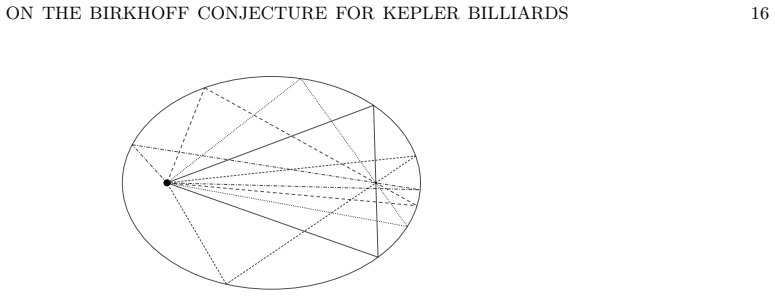
The argument is carried by the high-energy asymptotics of the Jacobi length: a direct Keplerian arc between two boundary points has length $\sqrt{h}\lvert p_0-p_1\rvert + O(\mu/\sqrt{h})$, and an indirect arc through the center has length $\sqrt{h}(\lvert p_0\rvert + \lvert p_1\rvert) + O(\mu/\sqrt{h})$ plus a logarithmic term, with variants for antipodal pairs. These expansions turn the multi-valued generating function of the Kepler billiard into $\sqrt{h}$ times a perimeter function $\Psi(\xi,\eta)=\lvert\gamma(\xi)\rvert+\lvert\gamma(\eta)\rvert+\lvert\gamma(\eta)-\gamma(\xi)\rvert$, whose critical points are punctured Birkhoff triangles. The persistence of these critical points under the high-energy perturbation is controlled by topological degree, and shadowing periodic words in the resulting symbolic system is extended to all bi-infinite sequences by a diagonal argument.
What would settle it
Find a real-analytic strictly convex non-elliptic domain admitting two distinct focal points of the second kind; the polynomial $P(t)$ derived in Lemma 4.5 constrains such points to one orthogonal chord and forces the domain to be an ellipse, so exhibiting such a pair would refute Theorem 4.1 and the rigidity half of Theorem 1.1. Equivalently, exhibit an analytic first integral for a high-energy Kepler billiard in a non-elliptic analytic table with a non-focal center.
Extended reading notes
Core claim
The central discovery is a rigidity theorem: for a strictly convex bounded planar domain with real-analytic boundary, at sufficiently high energy the Kepler billiard map cannot be analytically integrable unless the boundary is an ellipse and the center of attraction is one of its foci. For non-elliptic domains, the theorem allows at most one exceptional center position, and for ellipses the only exceptions are the two foci. This is proved by showing that, for every non-exceptional center, the high-energy first-return map contains a subsystem semi-conjugate to a Bernoulli shift, which implies positive topological entropy and the absence of analytic first integrals. A companion geometric rigidity result says that real-analytic non-elliptic domains admit at most one focal point of the second kind, while ellipses are the only domains admitting two, namely their classical foci.
Load-bearing premise
The paper relies on high-energy asymptotic expansions of the Jacobi length holding uniformly with controlled remainders and with the Keplerian arcs staying inside the strictly convex domain, so that the true generating function can be replaced by $\sqrt{h}$ times a perimeter function without losing critical points.
Editorial extensions
If this is right
- If the central claim is correct, any strictly convex real-analytic non-elliptic table at high energy has positive topological entropy for the Kepler billiard map for all but possibly one center position.
- At those centers, the first-return map admits no analytic first integral, so the system is not analytically integrable in the sense used here.
- The only analytically integrable high-energy Kepler billiards among analytic convex tables are elliptic tables with the center at a focus, matching Panov's known integrable examples.
- The rigidity theorem implies that a table with two focal points of the second kind must be an ellipse, giving a sharp geometric obstruction to the symbolic-dynamics construction.
- The paper exhibits an infinite-dimensional family of non-elliptic analytic tables with a focal point of the second kind, so the exceptional case in Theorem 1.1 is real and not vacuous.
Reading between the lines
- The same triangle-shadowing mechanism may extend to finite energies if quantitative bounds on the Jacobi-length remainders can be obtained; the paper only claims the high-energy regime.
- The numerical simulations reported for a focal point of the second kind suggest that chaotic behavior persists even where the proof does not apply, so the exceptional one-center case may be a limitation of the method rather than true integrability.
- The geometric part of the result—at most two focal points of the second kind, with two forcing an ellipse—stands independently of Keplerian dynamics and can be tested directly on the Birkhoff billiard map.
- A natural testable extension is to push the shadowing construction to the zero-energy case, which the paper notes is conjugate to an ordinary Birkhoff billiard on the double cover of the domain.
Editorial analysis
A structured set of objections, weighed in public.
Referee Report
Summary. The paper studies analytic integrability of Kepler billiards in strictly convex real-analytic planar domains at high energies. The main result (Theorem 1.1) states that, apart from at most one position of the attraction center (two for an ellipse, namely its foci), the Kepler billiard is not analytically integrable; the mechanism is the construction, for all centers of the first kind or non-focal centers, of a subsystem of the first-return map that is semi-conjugate to a Bernoulli shift (Theorem 3.4 and Corollary 3.11), yielding positive topological entropy and no analytic first integral. The shadowing is based on high-energy asymptotics of the Jacobi length of direct/indirect/clockwise/anticlockwise Keplerian arcs, with limiting perimeter functionals Psi, Psi_a, Psi_c; critical points are propagated by topological degree. The second half of the paper classifies focal points of the second kind, showing that there are at most two, with equality only for ellipses at their foci, and constructs an infinite-dimensional family of non-elliptic domains with one focal point, supported by numerics.
Significance. If the central arguments are completed, this is a substantial contribution to the Keplerian analogue of the Birkhoff-Poritsky conjecture. It introduces a clean three-case shadowing strategy, uses topological-degree persistence in an essential way, and separates a rigidity problem about focal points that is interesting in its own right. The paper is honest about the dependence on [3] for the first-kind case and about the limitation to high energies; the exceptional focal case is explicitly identified rather than hidden. The main weaknesses are that two load-bearing analytic steps are compressed (uniform asymptotic remainder estimates and the passage from an invariant-graph identity to ellipsoidal rigidity) and that the claimed construction of non-elliptic focal domains is not actually proved. The result is, in my assessment, likely correct in broad outline, but the manuscript needs a substantial revision before it can be accepted.
major comments (3)
- [Section 2, Lemma 2.3 and Appendix A] The proof of Lemma 2.3 does not fully establish the uniform first-order asymptotic used in Lemma 3.10. The statement requires g_a and g_c to be C^1 and uniformly bounded in p0,p1, and the derivation in Appendix A obtains the leading term of \nabla_{p1} L(z_a) from an expansion y = y0 + sqrt(h') g with y0 piecewise defined at <w0,w1>=0. The passage "by regularity of the involved functions" from this expansion to uniform C^1 bounds for the remainder is not justified near that switching locus, where the chosen square-root branch w1 = +/- sqrt(p1) changes; and the uniform control for h' -> 0 is only sketched. Since the degree-persistence argument in Lemma 3.10 requires the remainder in (15) to be uniformly O(1) (i.e., o(sqrt(h))) on the whole product of the neighborhoods I_m, I_M, I_P, I_Q and for every periodic word s, this is a load-bearing point. Please provide a complete proof or a precise reference for the uniform C^1 estimate across det(p0,p1)=0.
- [Section 4.1, Proposition 4.10] The construction of non-elliptic domains with a focal point of the second kind is not proved. After defining gamma as a level set of f(x)=|x-c|+d(x,tau), the proof asserts that "clearly" phi_c is constant because all chords orthogonal to T have the same length; this does not follow, since phi_c is defined by two consecutive reflections on gamma and involves the three distances |gamma(xi)-c|, |gamma(xi)-gamma(xi')| and |gamma(xi')-c|, not the chord lengths of tau. The intermediate claim that gamma has a unique periodic trajectory through c is also insufficient. This gap affects the advertised infinite-dimensional family and the sharpness discussion of Theorem 1.1, so it should either be fixed with a real proof or the corresponding claims should be weakened.
- [Section 4, Lemma 4.9 and proof of Theorem 4.1] The rigidity step at the end of Lemma 4.9 and in the proof of Theorem 4.1 is too compressed. From the identity delta_+(S^1) = delta^c_-(S^1) the manuscript concludes that partial Omega is an ellipse with foci 0 and c, saying that the family of invariant lines consists of the two pencils through the foci and draws triangles of equal perimeter. This is a nontrivial characterization and no proof is supplied. Because Theorem 4.1 is what limits the exceptional center positions in Theorem 1.1, this step is load-bearing; it should be stated as a lemma with a complete argument or an explicit reference.
minor comments (4)
- [Abstract and Section 3] The notation "focal points of the second kind" is used in the abstract before its definition in Definitions 3.1 and 3.3; consider adding a forward reference.
- [Section 3.2.2, Lemma 3.10] The derivative formula (15) is stated only for k=1,2; the analogous formula for the third coordinate u_{i,3} is needed for the critical-point equation and should be included.
- [Throughout] There are several typos ("critival" in Appendix B, "anergy" in Corollary 1.5, "world" in Section 3.3), and the reference to Figure 15 in Section 4.1 does not mention the numerical integration method; these should be corrected.
- [Section 3.1, Lemma 3.5] The function B in the proof is introduced without specifying its domain and regularity; a brief justification (or a local version via the implicit function theorem) would improve readability.
Circularity Check
No definitional circularity or fitted-input prediction is present; the paper's new symbolic-dynamics and rigidity arguments are derived in-paper, and reliance on [3] is a disclosed prior-theorem dependency rather than a reduction to its own inputs.
full rationale
The high-energy symbolic-dynamics mechanism for non-focal centers is self-contained: Lemmas 2.2 and 2.3 supply asymptotic expansions of Jacobi lengths, and Lemmas 3.9 and 3.10 prove persistence of critical points of the total generating function by comparing the gradient of the true action with sqrt(h) times the gradient of the limiting perimeter functional and applying topological-degree homotopy arguments. No parameter is fitted to integrability data, and no quantity that is meant to be predicted is built into the assumptions. The focal-point counting in Section 4 is an independent geometric and rigidity argument, leading to the at-most-one / exactly-two classification. The main self-citations are Lemma 3.2 (importing the first-kind case from [3]), the indirect-arc C^2 estimate in Lemma 2.2, and the diagonal extension in the proof of Theorem 3.4. These are prior published results by overlapping authors, but they have stated assumptions that do not include the present integrability conclusion and are not equivalent by construction to the claimed theorems; the paper explicitly discloses that the first construction was already carried out in [3]. A failure of the uniform remainder estimates in Lemmas 2.2/2.3 would be a correctness gap, not a circularity. Under the hard rules, such theorem citations count as real evidence and do not raise the circularity score.
Assumptions & free parameters
assumptions (6)
- standard math Panov's theorem: elliptic Kepler billiards with center at a focus are integrable at all energy levels
- standard math Lemma 3.2 from [3]: a center of the first kind yields symbolic dynamics at high energy
- standard math Positive topological entropy of a subsystem implies the absence of nonconstant analytic first integrals
- standard math Hopf index theorem and topological degree product and homotopy invariance
- domain assumption Analyticity of the Birkhoff billiard map and unique continuation for analytic curves
- standard math Jacobian formula for the Birkhoff map at a 2-periodic orbit
Cite this review
Pith. "Pith review of On the Birkhoff conjecture for Kepler billiards." pith.science (2026). https://pith.science/paper/RZHAJE55
@misc{pith2026250708446,
  author       = {Pith},
  title        = {Pith review of: On the Birkhoff conjecture for Kepler billiards},
  year         = {2026},
  howpublished = {\url{https://pith.science/paper/RZHAJE55}},
  note         = {Machine review of arXiv:2507.08446}
}
read the original abstract
We investigate the integrability of Kepler billiards-mechanical billiard systems in which a particle moves under the influence of a Keplerian potential and reflects elastically at the boundary of a strictly convex planar domain. Our main result establishes that, except possibly for one location of the gravitational center, analytic integrability at high energies occurs only when the domain is an ellipse and the center is placed at one of its foci. This provides a partial affirmative answer to a Keplerian analogue of the classical Birkhoff-Poritsky Conjecture. Our approach is based on the construction of symbolic dynamics arising from chaotic subsystems that emerge in the high-energy regime. Depending on the geometric configuration of the boundary and the location of the attraction center, we construct three types of symbolic dynamics by shadowing chains of punctured Birkhoff-type trajectories. These constructions yield subsystems conjugated to Bernoulli shifts, implying positive topological entropy and precluding analytic integrability. We further analyze the notion of focal points of the second kind, showing that in real-analytic, non-elliptic domains there can be at most one such point, while ellipses are the only domains admitting two-coinciding with their classical foci. Finally, we demonstrate the existence of an infinite-dimensional family of non-elliptic domains possessing a focal point of the second kind, and conclude with numerical simulations illustrating chaotic behavior in such cases.
Figures


Figures from the paper (15 more)




Reference graph
Works this paper leans on
-
[3]
V. L. Barutello, I. De Blasi, and S. Terracini. Chaotic dynamics in refraction galactic billiards.Nonlinearity, 36(8):4209, 2023
work page 2023
- [1]
-
[2]
V. L. Barutello, A. M. Cherubini, and I. De Blasi. Exploration of billiards with keplerian potential.Non- linearity, 38(5):055004, 2025
work page 2025
-
[4]
R. H. Battin.An introduction to the mathematics and methods of astrodynamics. AIAA Education Series. American Institute of Aeronautics and Astronautics (AIAA), Reston, VA, revised edition, 1999. With a foreword by J. S. Przemieniecki
work page 1999
-
[5]
M. Bialy. Convex billiards and a theorem by E. Hopf.Math. Z., 214(1):147–154, 1993
work page 1993
-
[6]
M. Bialy and A. E. Mironov. The Birkhoff-Poritsky conjecture for centrally-symmetric billiard tables.Ann. Math. (2), 196(1):389–413, 2022
work page 2022
-
[7]
G. D. Birkhoff. On the periodic motions of dynamical systems.Acta Mathematica, 50 (1):359–379, 1927
work page 1927
-
[8]
S. V. Bolotin. Degenerate billiards in celestial mechanics.Regul. Chaotic Dyn., 22(1):27–53, 2017
work page 2017
Show all 37 references
-
[9]
S. V. Bolotin and R. S. Mackay. Periodic and chaotic trajectories of the second species for the n-centre problem. Celestial Mechanics and Dynamical Astronomy, 77(1):49–75, 2000
2000
-
[10]
Boltzmann
L. Boltzmann. Lösung eines mechanichen problems.Wiener Berichte, 58:1035–1044, 1868
-
[11]
R. L. Devaney.An introduction to chaotic dynamical systems. Studies in Nonlinearity. Westview Press, Boulder, CO, 2003. Reprint of the second (1989) edition
1989
-
[12]
Y. N. Fedorov. An ellipsoidal billiard with a quadratic potential.Functional Analysis and Its Applications, 35(3):199–208, 2001
2001
-
[13]
G. Felder. Poncelet property and quasi-periodicity of the integrable boltzmann system.Lett. Math. Phys., 111(1):12, Feb. 2021
2021
-
[14]
Gallavotti and I
G. Gallavotti and I. Jauslin. A theorem on ellipses, an integrable system and a theorem of boltzmann. ArXiv preprint arXiv:2008.01955, 2020
2008 arXiv
-
[15]
Gasiorek and M
S. Gasiorek and M. Radnović. Periodic trajectories and topology of the integrable boltzmann system. Contemporary Mathematics, 807:111–130, 2024
2024
-
[16]
Guillemin and A
V. Guillemin and A. Pollack.Differential Topology. AMS Chelsea Publishing: An Imprint of the American Mathematical Society, 1974
1974
-
[17]
Hasselblatt and A
B. Hasselblatt and A. Katok.A first course in dynamics. Cambridge University Press, New York, 2003
2003
-
[18]
Huang, V
G. Huang, V. Kaloshin, and A. Sorrentino. Nearly circular domains which are integrable close to the boundary are ellipses.Geom. Funct. Anal., 28(2):334–392, 2018
2018
-
[19]
C. G. J. Jacobi. Zur theorie der variations-rechnung und der differential-gleichungen.Journal für die reine und angewandte Mathematik, 1837. ON THE BIRKHOFF CONJECTURE FOR KEPLER BILLIARDS 30
-
[20]
Kaloshin and A
V. Kaloshin and A. Sorrentino. On the integrability of Birkhoff billiards. Philos. Trans. Roy. Soc. A, 376(2131):20170419, 16, 2018
2018
-
[21]
Kaloshin and A
V. Kaloshin and A. Sorrentino. On the local Birkhoff conjecture for convex billiards.Ann. of Math. (2), 188(1):315–380, 2018
2018
-
[22]
Katok and J.-M
A. Katok and J.-M. Strelcyn.Invariant manifolds, entropy and billiards. Smooth maps with singularities, volume 1222. Springer, 2006
2006
-
[23]
O. Knill. On nonconvex caustics of convex billiards.Elem. Math., 53(3):89–106, 1998
1998
-
[24]
V. Kozlov. Integrability and nonintegrability in Hamiltonian mechanics.Uspekhi Mat. Nauk, 38(1 (229)):3– 67, 240, 1983
1983
-
[25]
V. Kozlov. Some integrable extensions of jacobi’s problem of geodesics on an ellipsoid.Journal of Applied Mathematics and Mechanics, 59(1):1–7, 1995
1995
-
[26]
Krawcewicz and J
W. Krawcewicz and J. Wu.Theory of degrees with applications to bifurcations and differential equations. Series of Monographs and Advanced Texts. Canadian Mathematical Society, John Wiley & Sons, New York, 1997
1997
-
[27]
Levi-Civita
T. Levi-Civita. Sur la résolution qualitative du problème restreint des trois corps.Acta Math., 30(1):305– 327, 1906
1906
-
[28]
Montgomery
R. Montgomery. Minimizers for the Kepler problem.Qual. Theory Dyn. Syst., 19(1):31, 2020
2020
-
[29]
A. A. Panov. Elliptical billiard table with newtonian potential.Mathematical Notes, 55(3):334–334, 1994
1994
-
[30]
Poritsky
H. Poritsky. The billiard ball problem on a table with a convex boundary - An illustrative dynamical problem. I. The invariant integral.Ann. Math. (2), 51:446–470, 1950
1950
-
[31]
S. E. Pustovoitov. Topological analysis of a billiard in elliptic ring in a potential field.Fundamentalnaya i Prikladnaya Matematika, 22(6):201–225, 2019
2019
-
[32]
S. E. Pustovoitov. Topological analysis of a billiard bounded by confocal quadrics in a potential field. Sbornik: Mathematics, 212(2):211, 2021
2021
-
[33]
Tabachnikov.Geometry and billiards, volume 30 ofStudent Mathematical Library
S. Tabachnikov.Geometry and billiards, volume 30 ofStudent Mathematical Library. American Mathemat- ical Society, Providence, RI, 2005
2005
-
[34]
Takeuchi and L
A. Takeuchi and L. Zhao. Conformal transformations and integrable mechanical billiards.Advances in Mathematics, 436:109411, 2024
2024
-
[35]
Takeuchi and L
A. Takeuchi and L. Zhao. Projective integrable mechanical billiards.Nonlinearity, 37(1), 2024
2024
-
[36]
A. Wintner. The Analytical Foundations of Celestial Mechanics. Princeton Mathematical Series, vol.5. Princeton University Press, Princeton, N.J., 1941
1941
-
[37]
L. Zhao. Projective dynamics and an integrable Boltzmann billiard model.Communications in Contempo- rary Mathematics, 24(10):2150085, 2022. University of Turin, Department of Mathematics, via Carlo Alberto 10, Turin, Italy
2022
Reviewed August 6, 2026 · model on record in the stance chip above.
Discussion (0). Continue with ORCID to comment.