REVIEW 4 major objections 4 minor 1 cited by
Beyond LambdaCDM: How the Hubble tension challenges early universe physics
T0 review · 4 major / 4 minor · reviewed 2026-08-06 · deepseek-v4-flash
Pith's one-line read Early dark energy can lift the Hubble constant only with finely tuned parameters
desk verdict A broken EDE parameterization sinks the central claim; the evidence comparison is invalid and the conclusion is not new. read the letter →
The pith
A machine-rendered reading of the paper's core claim, the machinery that carries it, and where it could break.
The reading
What carries the argument
The load-bearing object is the early dark energy density term of equation (7), written $\Omega_{\mathrm{EDE}}$ and controlled by two parameters: the critical redshift $z_c$, where the EDE density peaks, and the fraction $f$ of the total energy that EDE carries at that moment, plus an exponent $w_n$ in the redshift dependence. This term is inserted into the Friedmann expansion inside the sound-horizon integral of equation (6), so that a higher EDE contribution before recombination shrinks the sound horizon and, with the measured CMB angular scale held fixed, raises the inferred present-day expansion rate. The argument is carried by Monte Carlo sampling over $(H_0, z_c, f)$, by likelihood slices through that parameter cube, and by a nested-sampling calculation of Bayesian evidence that compares the EDE model against LambdaCDM with two data choices.
What would settle it
Compute the full CMB temperature and polarization power spectra at the best-fit EDE parameters ($f \approx 0.80$, $z_c \approx 60{,}000$, $H_0 \approx 73.56$) and compare them with the measured spectra in the lensing-sensitive multipole range around $80 < l < 400$; a deviation at current error levels would exclude this finely tuned solution. A future measurement that pins the EDE fraction at recombination below roughly $f < 0.1$ would also falsify the specific solution, independent of any model choice.
Extended reading notes
Core claim
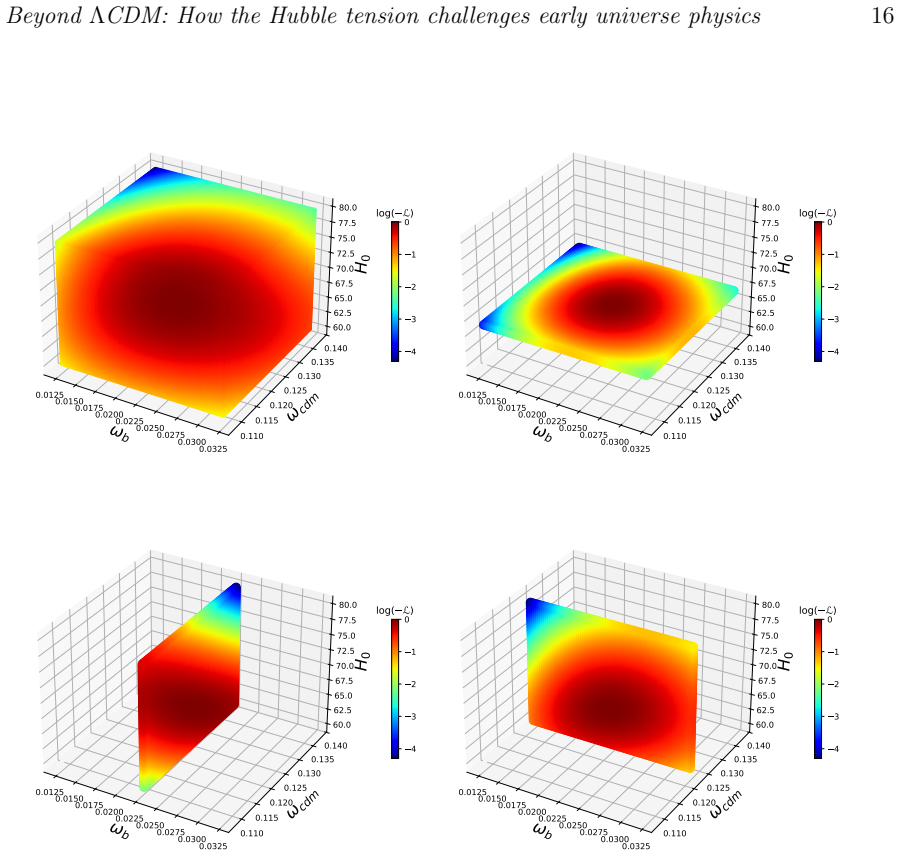
On its own terms, the paper's central claim is that early dark energy can reduce the Hubble tension, but only under finely tuned conditions. Adding the EDE term shrinks the sound horizon and raises the inferred $H_0$; the Monte Carlo fits prefer a large EDE fraction ($f = 0.798^{+0.15}_{-0.28}$) acting at very early times ($z_c = 60467^{+95043}_{-40204}$), giving $H_0 = 73.56^{+0.67}_{-0.67}$ km/s/Mpc, in agreement with local-universe measurements. Yet the likelihood occupies a narrow ridge in the $(H_0, f, z_c)$ volume, and while the raw Bayesian evidence for the EDE model ($\log Z = -8.276$) is higher than for the CMB-only LambdaCDM run ($\log Z = -23.975$), the LambdaCDM model is viable across a much wider parameter space. The authors read this combination as a sign that EDE alone is not a good general model; if the tension is genuinely an early-universe problem, they argue, the solution is more sophisticated than a single EDE fluid, and EDE can serve as a window onto the physics of that era.
Load-bearing premise
The entire $H_0$ shift rests on the assumed functional form of the early dark energy density in equation (7), a phenomenological curve whose parameters are chosen rather than derived from a physical theory; if that curve does not describe the real pre-recombination fluid, the fitted parameters and evidence comparison do not transfer to actual EDE models.
Editorial extensions
If this is right
- If a single EDE fluid is responsible for the tension, its fraction must be large and its peak must lie well before recombination, with the fit driving $z_c$ toward ever larger values.
- The narrow high-likelihood ridge means a generic EDE model is not enough; the parameters that relieve the tension are highly specific.
- The Bayesian evidence comparison gives the EDE model a higher raw score, but the wide LambdaCDM likelihood volume implies that the case for EDE depends on how strongly the prior volume penalizes fine tuning.
- Future data that rule out the narrow EDE parameter region would leave LambdaCDM as the preferred description and push the resolution of the tension toward combined early- and late-universe physics.
- If the tension is genuinely early-universe physics, even this fine-tuned EDE model provides a concrete target for what the pre-recombination universe would have to look like.
Reading between the lines
- The same $H_0$ shift could be produced by any pre-recombination component with a similar peak-then-decay density profile, so the fine tuning found here may be a property of the assumed functional form rather than of early dark energy itself.
- A direct testable extension would repeat the identical evidence calculation with several standard EDE parameterizations; if all of them require a narrow peak region, the fine-tuning conclusion is generic, and if one has wide support, the conclusion would need revision.
- The comparison between a narrow high peak and a broad low plateau is effectively a statement about model complexity: the paper's interpretation leans on parameter-space volume as much as on the raw evidence difference, and a future analysis that formalizes that volume penalty would sharpen the conclusion.
Editorial analysis
A structured set of objections, weighed in public.
Referee Report
Summary. This paper proposes a phenomenological Early Dark Energy (EDE) extension to LambdaCDM, parameterized by an EDE fraction f and a critical redshift z_c, and uses an MCMC analysis (emcee) plus Bayesian evidence (dynesty) to ask whether such a component can resolve the Hubble tension. The authors report that their EDE model yields H0 = 73.56 km/s/Mpc with f = 0.798 and z_c = 60467, that the likelihood is high only in a narrow parameter region, and that the Bayesian evidence values are mixed: log(Z) = -8.276 for EDE, -2269.147 for LambdaCDM with Planck+Pantheon, and -23.975 for LambdaCDM with Planck only. They conclude that EDE can resolve the tension only with fine-tuned parameters and that more sophisticated models are needed.
Significance. If the analysis were sound, the claim that a simple EDE component resolves the Hubble tension only in a finely tuned parameter region would be of interest to the cosmology community. The paper has some positive features: it uses public packages (CAMB, emcee, dynesty), performs LambdaCDM sanity checks that recover Planck-like parameters, and surveys the EDE literature. However, the central numerical claims rest on an unvalidated EDE density parameterization, the likelihood as described cannot constrain H0, and the Bayesian evidence comparison uses inconsistent datasets. These are load-bearing issues, not presentation problems.
major comments (4)
- [Section 2.1, Eq. (7)] The EDE density parameterization is introduced without derivation, and as printed it is not usable: the exponent w_n is never defined in the text (it appears only as a label 'n=' in Figure 4), and the normalization is not checked against the defining condition f = Omega_EDE(z_c)/Omega_tot(z_c). Substituting z = z_c does not manifestly yield the required fraction, and the factor containing '1/f 1-f' is ambiguous. Every downstream result—the MCMC posteriors f ~ 0.8 and z_c ~ 6e4, the H0 = 73.56 value, and the evidence log(Z) = -8.276—inherits this unvalidated formula. The authors must either derive Eq. (7) from a physical model, match it to a standard EDE parameterization (e.g., Poulin et al.), or explicitly demonstrate its normalization and dimensional consistency; otherwise the analysis cannot be reproduced.
- [Section 2.1, Eqs. (5)-(6), and Section 3, Fig. 8] The likelihood is described as comparing the predicted theta_s to the Planck value using theta_s = r_s/D_A. Because both r_s from Eq. (6) and D_A from Eq. (5) carry the same prefactor c/H0, the ratio r_s/D_A is independent of H0. The stated likelihood therefore cannot constrain H0, so the tight posterior H0 = 73.56(+0.67/-0.67) shown in Figure 8 cannot follow from the described analysis unless an additional H0-dependent dataset, distance, or informative prior is included. The paper must specify exactly which data or prior constrains H0; as written, the headline result is not an output of the stated model.
- [Section 3, Bayesian evidence] The evidence values log(Z) = -8.276 for EDE, -2269.147 for LambdaCDM with Planck+Pantheon, and -23.975 for LambdaCDM with Planck only are not comparable because the models are evaluated with different datasets and likelihood constructions. The statement that the EDE model is 'favoured' for a narrow, finely tuned region while LambdaCDM is 'good over a wide parameter space' also conflates posterior volume with model evidence; a higher log(Z) already penalizes complexity. If the EDE evidence exceeds the Planck-only LambdaCDM evidence by Delta log Z ~ 15.7, the evidence actually favors EDE by a standard Jeffreys-scale interpretation. A valid comparison requires identical data and likelihoods for both models.
- [Section 4, Conclusion] The paper states that the MCMC 'shows' EDE can increase H0 to 73.56 and that this requires finely tuned parameters. However, f and z_c are fit to CMB sound-horizon constraints, so the resulting H0 is a fitted value rather than a prediction of the EDE model. The claim that EDE resolves the tension only in a narrow parameter region is essentially a restatement of the posterior/likelihood volume, not an independent falsifiable result. This circularity should be acknowledged explicitly, or the analysis should be reframed as parameter estimation rather than model testing.
minor comments (4)
- [Figure 4] The legend label 'Early Dark Energy, n=' is incomplete; the parameter w_n should be defined in the text and the label completed.
- [Equations (4)-(7)] Notation is inconsistent and often garbled (e.g., 'Nef f', 'OM', 'witPlanck Collaborationh' in reference [32]); please standardize cosmological symbols and fix typos throughout.
- [Figures 9, 11, and 13] The color scale is labelled only as 'log(...)'; please specify whether this is the log-likelihood and provide its normalization or units.
- [Abstract] The phrase 'the Bayesian evidence favours our EDE model for very narrow, finely-tuned parameter space' is confusing because Bayesian evidence is a global model comparison quantity; please separate the evidence value from the posterior volume in the wording.
Circularity Check
H0 = 73.56 is a fitted MCMC parameter, not an independent prediction: the CMB angular scale used in the likelihood is H0-independent by construction, so the SH0ES 'agreement' is built into the fit.
-
fitted input called prediction
[Section 3, Figure 8 paragraph and Eqs. (5)-(7)]
"To achieve a value of the Hubble constant that is in agreement with observations from the local universe, such as SH0ES, a fraction as high as f = 0.798+0.15−0.28 and a median critical redshift zc = 60467+95043−40204 was found to be the best fit, resulting in H0 = 73.56 km s−1 Mpc−1."
In the MCMC, H0, f, and zc are jointly sampled, while the likelihood is built from the Planck value of θs = rs/DA. With Eq. (5) and Eq. (6) as written, both DA and rs contain exactly the same overall factor c/H0, so θs is independent of H0. Fixing θs and ωb to Planck therefore does not constrain H0; the reported median H0 = 73.56 is produced by the fitting setup rather than derived from the early-universe physics. Presenting this fitted value as 'consistent with SH0ES' is a fitted input renamed as a consistency result: the agreement with local measurements is not an independent prediction of the EDE model.
full rationale
The paper's central 'prediction-like' claim is that EDE raises H0 to 73.56 km/s/Mpc while remaining viable only in a finely tuned parameter region. The corner plot shows H0, f, and zc all as MCMC parameters, and the likelihood uses θs = rs/DA with θs fixed to Planck. Since Eqs. (5) and (6) both carry the same c/H0 prefactor, θs is independent of H0 under the stated fixed ΩM setup, so the Planck angular-scale constraint cannot determine H0. The reported H0 = 73.56 is therefore a fitted value rather than a model prediction. The wording 'To achieve a value ... in agreement with observations from the local universe ... was found' makes this explicit. The fine-tuning conclusion and Bayesian evidence comparison are internal to the model and are not themselves circular; however, they inherit the unvalidated EDE parameterization of Eq. (7), which contains an undefined exponent w_n and is not checked against the stated definition f = ΩEDE(zc)/Ωtotal(zc). That is a validation/correctness issue rather than a circularity. There are no load-bearing self-citations and no uniqueness-theorem argument; the ΛCDM sanity checks reproduce Planck values and anchor the pipeline externally. The partial circularity is confined to presenting the fitted H0 as an early-universe consistency result, which warrants a score of 6.
Assumptions & free parameters
free parameters (4)
- f =
0.798 (median)
- zc =
60467 (median)
- Omega_M =
0.27 (chosen)
- wn =
not specified
assumptions (3)
- domain assumption The universe is spatially flat with density components matter, radiation, cosmological constant, and EDE following the specific form of Eq. (7).
- domain assumption The Planck measurements of theta_s and omega_b are fixed inputs that fully characterize the CMB constraints.
- ad hoc to paper Bayesian evidence values from different datasets and likelihoods can be directly compared.
Cite this review
Pith. "Pith review of Beyond LambdaCDM: How the Hubble tension challenges early universe physics." pith.science (2026). https://pith.science/paper/G6G6N7AB
@misc{pith2026250708479,
  author       = {Pith},
  title        = {Pith review of: Beyond LambdaCDM: How the Hubble tension challenges early universe physics},
  year         = {2026},
  howpublished = {\url{https://pith.science/paper/G6G6N7AB}},
  note         = {Machine review of arXiv:2507.08479}
}
read the original abstract
Differences in the values of the Hubble constant obtained from the local universe and the early universe have resulted in a significant tension. This tension signifies that our understanding of cosmology (physical processes and/or cosmological data) is incomplete. Some of the suggested solutions include physics of the early Universe. In this paper we aim to investigate common features of various early universe solutions to the Hubble constant tension. The physics of the early universe affects the size of the sound horizon which is probed with the Cosmic Microwave Background (CMB) data. Within the standard model, the size of the horizon (within limits of current measurements) is affected by processes that could occur between (approximately) 1 day after the Big Bang and the last scattering instant. We focus on simple extensions incorporating Early Dark Energy (EDE) and show how such a model affects the inferred values of the Hubble constant. We compare this model to LambdaCDM models using MCMC analysis, likelihoods over the parameter space and Bayesian evidence. The MCMC analysis shows that EDE leads to a decrease in the size of the sound horizon that is consistent with H0 = 73.56 km/s/Mpc but we also show that MCMC analysis favours increasing redshift and proportion of EDE. The Bayesian evidence favours our EDE model for very narrow, finely-tuned parameter space. The LambdaCDM model used for comparison has good evidence across a wide parameter space. We interpret this as an indication that more sophisticated models are required. We conclude that if the Hubble tension were to be related to the physics of the early universe, EDE could be used as a window to explore conditions of the early universe and extend our understanding of that era.
Figures


Figures from the paper (10 more)






Forward citations
Cited by 1 Pith paper
-
BAO miscalibration cannot rescue late-time solutions to the Hubble tension
Even after rescaling BAO data to prefer H0≈73 km/s/Mpc, none of six tested late-time dark-energy models can resolve the Hubble tension once unanchored SNeIa and CMB geometry are included.
Reference graph
Works this paper leans on
-
[1]
Introduction Georges Lema ˆ ıtre and Edwin Hubble discovered the expansion of the universe in 1927 and 1929 respectively, and each derived an expansion rate of the universe which has been called the Hubble constant. While the value has since been revised down significantly, there is now some disagreement, or tension, in the current measured value. There a...
arXiv 1927
-
[2]
The Sound Horizon and the Hubble Constant The pre-CMB universe consisted primarily of a plasma of baryons, photons and other particles such as neutrinos. Interactions between photons and baryons in this fluid created perturbations in the plasma which propagated at the speed of sound. At recombination, matter and radiation decoupled and the fluctuations ar...
-
[3]
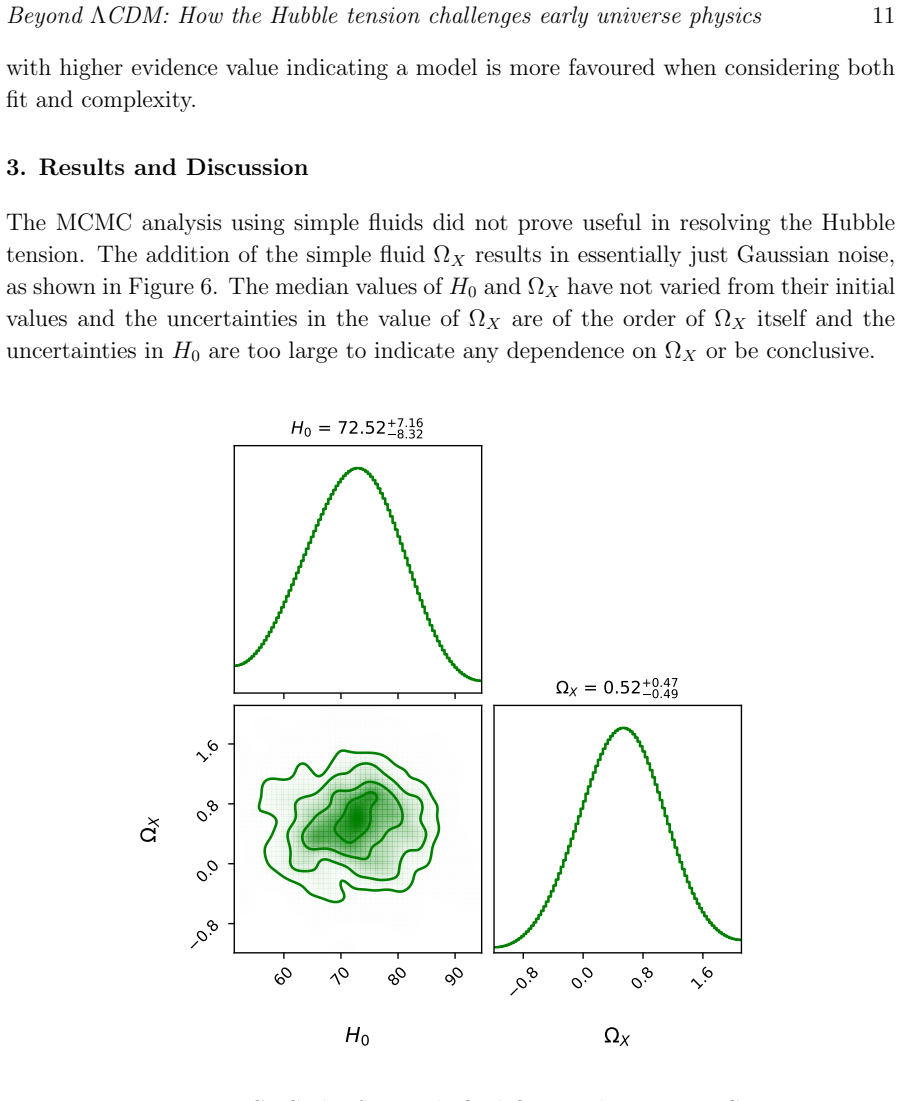
Results and Discussion The MCMC analysis using simple fluids did not prove useful in resolving the Hubble tension. The addition of the simple fluid Ω X results in essentially just Gaussian noise, as shown in Figure 6. The median values of H0 and ΩX have not varied from their initial values and the uncertainties in the value of Ω X are of the order of Ω X ...
-
[4]
Conclusion While observations of the early universe are only possible as far back as the CMB, various theoretical models have been proposed to vary the state of the pre-CMB universe to resolve the Hubble tension. In this paper we have reviewed a number of papers that each modified the conditions in the early universe, reducing the sound horizon and raisin...
-
[5]
Erminia Calabrese, J. Colin Hill, Hidde T. Jense, et al. The Atacama Cosmology Telescope: DR6 Constraints on Extended Cosmological Models. arXiv e-prints , page arXiv:2503.14454, March 2025
arXiv 2025
-
[6]
Neutrino-Assisted Early Dark Energy is a Natural Resolution of the Hubble Tension
Mariana Carrillo Gonz´ alez, Qiuyue Liang, Jeremy Sakstein, and Mark Trodden. Neutrino-Assisted Early Dark Energy is a Natural Resolution of the Hubble Tension. arXiv e-prints , page arXiv:2302.09091, February 2023
arXiv 2023
-
[7]
Michele Cicoli, Matteo Licheri, Ratul Mahanta, Evan McDonough, Francisco G. Pedro, and Marco Scalisi. Early Dark Energy in Type IIB String Theory. Journal of High Energy Physics , 2023(6):52, June 2023
work page 2023
-
[8]
Cruz, Steen Hannestad, Emil Brinch Holm, Florian Niedermann, Martin S
Juan S. Cruz, Steen Hannestad, Emil Brinch Holm, Florian Niedermann, Martin S. Sloth, and Thomas Tram. Profiling cold new early dark energy. Physical Review D , 108(2):023518, July 2023
work page 2023
Show all 55 references
-
[9]
Sen, and M
¨Ozg¨ ur Akarsu, Eoin ´O Colg´ ain, Anjan A. Sen, and M. M. Sheikh-Jabbari. ΛCDM Tensions: Localising Missing Physics through Consistency Checks. Universe, 10(8):305, July 2024
2024
-
[10]
Emergent Unparticles Dark Energy can restore cosmological concordance
Ido Ben-Dayan and Utkarsh Kumar. Emergent Unparticles Dark Energy can restore cosmological concordance. arXiv e-prints , page arXiv:2302.00067, January 2023
2023 arXiv
-
[11]
H. B. Benaoum, Luz ´Angela Garc ´ ıa, and Leonardo Casta˜ neda. Early dark energy induced by non-linear electrodynamics. arXiv e-prints , page arXiv:2307.05917, July 2023
2023 arXiv
-
[12]
Riess, et al
Dillon Brout, Dan Scolnic, Brodie Popovic, Adam G. Riess, et al. The Pantheon+ Analysis: Cosmological Constraints. The Astrophysical Journal , 938(2):110, October 2022
2022
-
[13]
Feroz, M
F. Feroz, M. P. Hobson, and M. Bridges. MULTINEST: an efficient and robust Bayesian inference tool for cosmology and particle physics. Monthly Notices of the Royal Astronomical Society , 398(4):1601–1614, October 2009
2009
-
[14]
corner.py: Scatterplot matrices in python
Daniel Foreman-Mackey. corner.py: Scatterplot matrices in python. The Journal of Open Source Software, 1(2):24, jun 2016
2016
-
[15]
The values of θs and its uncertainty, along with a calculated DA were used in the probability of acceptance in the MCMC analysis, with constraints 0 < f < 1 and zc > 1100
for these values of ΩM and H0, using equations 5 to 7 and fixing the values of θs and ωb to the Planck data [34]. The values of θs and its uncertainty, along with a calculated DA were used in the probability of acceptance in the MCMC analysis, with constraints 0 < f < 1 and zc...
-
[16]
Colin Hill, Vid Irˇ siˇ c, and Blake D
Samuel Goldstein, J. Colin Hill, Vid Irˇ siˇ c, and Blake D. Sherwin. Canonical Hubble-Tension- Resolving Early Dark Energy Cosmologies are Inconsistent with the Lyman- α Forest. arXiv e-prints, page arXiv:2303.00746, March 2023
2023 arXiv
-
[17]
Diogo H. F. de Souza and Rogerio Rosenfeld. Can neutrino-assisted early dark energy models ameliorate the H0 tension in a natural way? arXiv e-prints , page arXiv:2302.04644, February 2023
2023 arXiv
-
[18]
COLOSSUS: A Python Toolkit for Cosmology, Large-scale Structure, and Dark Matter Halos
Benedikt Diemer. COLOSSUS: A Python Toolkit for Cosmology, Large-scale Structure, and Dark Matter Halos. The Astrophysical Journal Supplement Series , 239(2):35, December 2018
2018
-
[19]
This is in tension with the value of H0 derived from SNIa observations, which is H0 = 73.30 ± 1.04 km s −1 Mpc−1 [37]
measured the power spectrum of the cosmic microwave background radiation temperature anisotropy to significant accuracy, yielding measurements of the physical baryon density, the physical cold dark matter density and the dark energy density, and derived a value for H0 = 69.33 ...
2000
-
[20]
Escamilla, William Giar` e, Eleonora Di Valentino, Rafael C
Luis A. Escamilla, William Giar` e, Eleonora Di Valentino, Rafael C. Nunes, and Sunny Vagnozzi. The state of the dark energy equation of state circa 2023. arXiv e-prints, page arXiv:2307.14802, July 2023
2023 arXiv
-
[21]
Eskilt, Laura Herold, Eiichiro Komatsu, Kai Murai, Toshiya Namikawa, and Fumihiro Naokawa
Johannes R. Eskilt, Laura Herold, Eiichiro Komatsu, Kai Murai, Toshiya Namikawa, and Fumihiro Naokawa. Constraint on Early Dark Energy from Isotropic Cosmic Birefringence.arXiv e-prints, page arXiv:2303.15369, March 2023
2023 arXiv
-
[22]
Toward early dark energy and n s=1 with P l a n c k , ACT, and SPT observations
Jun-Qian Jiang and Yun-Song Piao. Toward early dark energy and n s=1 with P l a n c k , ACT, and SPT observations. Physical Review D , 105(10):103514, May 2022
2022
-
[23]
Hogg, Dustin Lang, and Jonathan Goodman
Daniel Foreman-Mackey, David W. Hogg, Dustin Lang, and Jonathan Goodman. emcee: The MCMC Hammer. Publications of the Astronomical Society of the Pacific , 125(925):306, March 2013
2013
-
[24]
Hubble tension as a guide for refining the early Universe: Cosmologies with explicit local Lorentz and diffeomorphism violation
Mohsen Khodadi and Marco Schreck. Hubble tension as a guide for refining the early Universe: Cosmologies with explicit local Lorentz and diffeomorphism violation. Physics of the Dark Universe, 39:101170, February 2023
2023
-
[25]
Harris, K
Charles R. Harris, K. Jarrod Millman, et al. Array programming with NumPy. Nature, 585(7825):357–362, September 2020
2020
-
[26]
Laura Herold and Elisa G. M. Ferreira. Resolving the Hubble tension with early dark energy. Physical Review D , 108(4):043513, August 2023
2023
-
[27]
Hinshaw, D
G. Hinshaw, D. Larson, E. Komatsu, D. N. Spergel, C. L. Bennett, J. Dunkley, M. R. Nolta, M. Halpern, R. S. Hill, N. Odegard, L. Page, K. M. Smith, J. L. Weiland, B. Gold, N. Jarosik, A. Kogut, M. Limon, S. S. Meyer, G. S. Tucker, E. Wollack, and E. L. Wright. Nine- year Wilki...
2013
-
[28]
Hubble Tension: The Evidence of New Physics
Jian-Ping Hu and Fa-Yin Wang. Hubble Tension: The Evidence of New Physics. Universe, 9(2):94, February 2023
2023
-
[29]
J. D. Hunter. Matplotlib: A 2d graphics environment. Computing in Science & Engineering , 9(3):90–95, 2007
2007
-
[30]
Colin Hill, and Wayne Hu
Meng-Xiang Lin, Evan McDonough, J. Colin Hill, and Wayne Hu. Dark matter trigger for early dark energy coincidence. Physical Review D , 107(10):103523, May 2023
2023
-
[31]
They discussed triggers at a microscopic level, either an ultralight scalar field or a dark sector temperature
argued that NEDE offers a natural framework to extend ΛCDM in order to address the H0 tension. They discussed triggers at a microscopic level, either an ultralight scalar field or a dark sector temperature. Poulin, Smith and Karwal [35] reviewed various EDE models, emphasizing...
-
[32]
Marc Kamionkowski and Adam G. Riess. The Hubble Tension and Early Dark Energy. Annual Review of Nuclear and Particle Science , 73:153–180, September 2023
2023
-
[33]
joshspeagle/dynesty: v2.1.4, June 2024
Sergey Koposov, Josh Speagle, Kyle Barbary, Gregory Ashton, Ed Bennett, Johannes Buchner, Carl Scheffler, Ben Cook, Colm Talbot, James Guillochon, Patricio Cubillos, Andr´ es Asensio Ramos, Matthieu Dartiailh, Ilya, Erik Tollerud, Dustin Lang, Ben Johnson, jtmendel, Edward Hig...
2024
-
[34]
V. E. Kuzmichev and V. V. Kuzmichev. The Hubble tension from the standpoint of quantum cosmology. arXiv e-prints , page arXiv:2211.16394, November 2022
2022 arXiv
-
[35]
What It Takes to Solve the Hubble Tension through Modifications of Cosmological Recombination
Nanoom Lee, Yacine Ali-Ha ¨ ımoud, Nils Sch¨ oneberg, and Vivian Poulin. What It Takes to Solve the Hubble Tension through Modifications of Cosmological Recombination. Physical Review Letters, 130(16):161003, April 2023
2023
-
[36]
Ruchika, Carvalho, and Jailson Alcaniz
Thais Lemos, Joel C. Ruchika, Carvalho, and Jailson Alcaniz. Low-redshift estimates of the absolute scale of baryon acoustic oscillations. European Physical Journal C , 83(6):495, June 2023
2023
-
[37]
Figure 1 is a simple illustration of various physical models briefly reviewed in Section 1
are indicated. Figure 1 is a simple illustration of various physical models briefly reviewed in Section 1. The aim of introducing new physics process into the standard model of the early universe aims to decrease the size of the sound horizon at the CMB. Below, we review stand...
-
[38]
CAMB: Code for Anisotropies in the Microwave Background
Antony Lewis and Anthony Challinor. CAMB: Code for Anisotropies in the Microwave Background. Astrophysics Source Code Library, record ascl:1102.026, February 2011
2011
-
[39]
Florian Niedermann and Martin S. Sloth. New Early Dark Energy as a solution to the H0 and S8 tensions. arXiv e-prints , page arXiv:2307.03481, July 2023
2023 arXiv
-
[40]
Odintsov, V
Sergei D. Odintsov, V. K. Oikonomou, and German S. Sharov. Early dark energy witPlanck Collaborationh power-law F(R) gravity. Physics Letters B , 843:137988, August 2023
2023
-
[41]
Odintsov, Diego S´ aez-Chill´ on G´ omez, and German S
Sergei D. Odintsov, Diego S´ aez-Chill´ on G´ omez, and German S. Sharov. Analyzing the H0 tension in F(R) gravity models. Nuclear Physics B , 966:115377, May 2021
2021
-
[42]
Planck 2018 results
Planck Collaboration et al. Planck 2018 results. VI. Cosmological parameters. Astronomy & Astrophysics, 641:A6, September 2020
2018
-
[43]
Smith, and Tanvi Karwal
Vivian Poulin, Tristan L. Smith, and Tanvi Karwal. The Ups and Downs of Early Dark Energy solutions to the Hubble tension: a review of models, hints and constraints circa 2023. arXiv e-prints, page arXiv:2302.09032, February 2023
2023 arXiv
-
[44]
Smith, and Tanvi Karwal
Vivian Poulin, Tristan L. Smith, and Tanvi Karwal. The Ups and Downs of Early Dark Energy solutions to the Hubble tension: A review of models, hints and constraints circa 2023. Physics of the Dark Universe , 42:101348, December 2023
2023
-
[45]
Riess, Wenlong Yuan, Lucas M
Adam G. Riess, Wenlong Yuan, Lucas M. Macri, Dan Scolnic, Dillon Brout, Stefano Casertano, David O. Jones, Yukei Murakami, Gagandeep S. Anand, Louise Breuval, Thomas G. Brink, Alexei V. Filippenko, Samantha Hoffmann, Saurabh W. Jha, W. D’arcy Kenworthy, John Mackenty, Benjamin...
2022
-
[46]
Nested Sampling
John Skilling. Nested Sampling. In Rainer Fischer, Roland Preuss, and Udo Von Toussaint, editors, Bayesian Inference and Maximum Entropy Methods in Science and Engineering: 24th Beyond ΛCDM: How the Hubble tension challenges early universe physics 22 International Workshop on ...
2004
-
[47]
Nested sampling for general Bayesian computation
John Skilling. Nested sampling for general Bayesian computation. Bayesian Analysis, 1(4):833 – 859, 2006
2006
-
[48]
Joshua S. Speagle. DYNESTY: a dynamic nested sampling package for estimating Bayesian posteriors and evidences. Monthly Notices of the Royal Astronomical Society, 493(3):3132–3158, April 2020
2020
-
[49]
Impact of big bang nucleosynthesis on the H0 tension
Tomo Takahashi and Yo Toda. Impact of big bang nucleosynthesis on the H0 tension. arXiv e-prints, page arXiv:2306.00454, June 2023
2023 arXiv
-
[50]
S. X. Tian and Zong-Hong Zhu. Gravitation with modified fluid Lagrangian: Variational principle and an early dark energy model. Physical Review D , 107(10):103507, May 2023
2023
-
[51]
Seven Hints That Early-Time New Physics Alone Is Not Sufficient to Solve the Hubble Tension
Sunny Vagnozzi. Seven Hints That Early-Time New Physics Alone Is Not Sufficient to Solve the Hubble Tension. Universe, 9(9):393, August 2023
2023
-
[52]
Oliphant, et al
Pauli Virtanen, Ralf Gommers, Travis E. Oliphant, et al. SciPy 1.0: Fundamental Algorithms for Scientific Computing in Python. Nature Methods, 17:261–272, 2020
2020
-
[53]
A fraction of dark matter faded with early dark energy ? arXiv e-prints, page arXiv:2209.09685, September 2022
Hao Wang and Yun-Song Piao. A fraction of dark matter faded with early dark energy ? arXiv e-prints, page arXiv:2209.09685, September 2022
2022 arXiv
-
[54]
Testing dark energy after pre-recombination early dark energy
Hao Wang and Yun-Song Piao. Testing dark energy after pre-recombination early dark energy. Physics Letters B , 832:137244, September 2022
2022
-
[55]
Shape of CMB lensing in the early dark energy cosmology
Gen Ye, Jun-Qian Jiang, and Yun-Song Piao. Shape of CMB lensing in the early dark energy cosmology. arXiv e-prints , page arXiv:2305.18873, May 2023
2023 arXiv
Reviewed August 6, 2026 · model on record in the stance chip above.
Discussion (0). Sign in to comment.