REVIEW 4 major objections 5 minor 50 references
Search for a Dark Gauge Boson Within Einstein-Cartan Theory at the ILC Using Multivariate Analysis
T0 review · 4 major / 5 minor · reviewed 2026-08-06 · deepseek-v4-flash
Pith's one-line read Machine-learning analysis finds 8 of 10 dark-boson points discoverable
desk verdict A solid MVA sensitivity projection for an Einstein-Cartan dark gauge boson at the ILC, but the quoted significances rest on an undefined A'->mu+mu- coupling; worth refereeing with a required revision. read the letter →
The pith
A machine-rendered reading of the paper's core claim, the machinery that carries it, and where it could break.
The reading
What carries the argument
The carrying object is the signal topology $e^+e^- \to ST \to \chi\bar{\chi} \to \chi\bar{\chi} A' \to \chi\bar{\chi} \mu^+\mu^-$, in which a heavy scalar torsion field $ST$ produces two dark fermions $\chi$, one of which radiates $A'$ that decays to a muon pair. The discriminating engine is a boosted decision tree trained on nine observables: missing transverse energy, di-muon invariant mass, di-muon angular separation, azimuthal angle between the di-muon system and missing momentum, pseudorapidities and transverse momenta of the two muons, and the cosine of the 3D angle between the di-muon vector and missing momentum. The di-muon invariant mass has the largest separating power of any single variable.
What would settle it
Search for a di-muon resonance plus missing transverse energy in 500 fb$^{-1}$ of 500 GeV electron-positron collisions; if no excess appears at invariant masses from 50 to 80 GeV, the paper's discovery claim for the benchmark points is contradicted.
Extended reading notes
Core claim
Within the Einstein-Cartan model, the paper's central claim is that the dark gauge boson $A'$ is visible above Standard Model backgrounds in the muon-pair-plus-missing-energy final state. Using a boosted decision tree, the analysis quotes discovery significances at 500 fb$^{-1}$ of 19.33, 17.07, 14.42, 11.20, 8.72, 7.01, and 5.87 $\sigma$ for the benchmark points with $A'$ masses of 50, 60, 70, 80 GeV at mediator mass 1.5 TeV and 50, 60, 70 GeV at mediator mass 2 TeV. The two points with $A'$ at 90 GeV, where the di-muon invariant mass sits close to the $Z$ pole, fall below 5 $\sigma$, and the heaviest point (90 GeV $A'$, 2 TeV mediator) is effectively unreachable.
Load-bearing premise
The entire signal rate rests on unpublished model implementation files and on the assumption that $A'$ decays to muon pairs with the implied branching fraction; if either is wrong, every quoted cross-section and significance changes.
Editorial extensions
If this is right
- If the central claim is correct, a 500 GeV electron-positron collider can probe Einstein-Cartan dark matter in a mass range that hadron colliders struggle to reach.
- The required luminosity for 5-sigma discovery ranges from about 33 to 363 fb$^{-1}$ across the eight discoverable points, so most of the parameter space opens up before the full 500 fb$^{-1}$ dataset is collected.
- $A'$ masses near the $Z$ mass are the difficult corner of the model, needing several times more luminosity or new discriminating variables to reach 5 sigma.
- Before the boosted decision tree cut the signal is entirely hidden; the multivariate step is what actually makes the search sensitive.
Reading between the lines
- The paper leaves the $A'$-muon kinetic-mixing term unspecified and the model implementation files unavailable, so re-deriving the cross-sections from the stated Lagrangian would be a direct check of whether the quoted significances survive.
- The same classifier pipeline could be exported to other proposed lepton colliders, and the accessible $A'$ mass window would likely shift with center-of-mass energy while the analysis logic stays unchanged.
- If the dark fermion mass were lowered so that $A'$ could decay invisibly, the clean muon-pair tag would disappear and the search would have to rely on missing-energy-only signatures such as mono-photon events.
Signed reviews
Editorial analysis
A structured set of objections, weighed in public.
Referee Report
Summary. The paper presents a Monte Carlo study of the process e+e− → χχA′, A′ → μ+μ− at the ILC (√s = 500 GeV, L = 500 fb−1) within an Einstein-Cartan theory model with a torsion mediator. The authors generate SM backgrounds (Drell-Yan, WW, ZZ, t-tbar) and ten signal benchmark points with M_ST = 1500/2000 GeV and M_A′ = 50–90 GeV, apply Fisher, DNN, and BDT classifiers using nine kinematic variables, and report statistical significances between 1.22σ and 19.33σ after an optimized BDT cut. They conclude that most benchmark points are discoverable within 500 fb−1 and provide required luminosities for 5σ discovery.
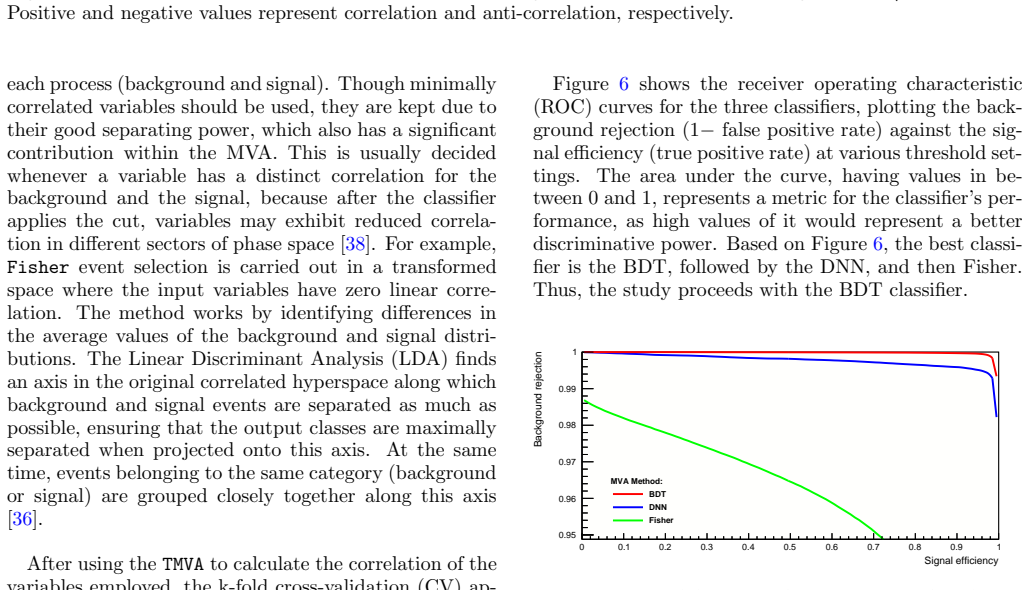
Significance. If the model input and significance calculation were self-contained, this would be a useful projection for a low-mass dark gauge boson at a lepton collider. The MVA pipeline is conventional and reasonably documented: the paper gives a hyperparameter table, k-fold cross-validation, KS overtraining checks, ROC curves, and variable-ranking information. However, the central numerical claim currently rests on an unspecified A′→μμ branching ratio, on a statistical-only significance with an in-sample or unspecified cut-optimization procedure, and on an incomplete SM background list. These issues must be resolved before the quoted significances can be considered reliable; with the present text the discovery claim is not independently checkable.
major comments (4)
- [Section II, Eqs. (1)–(3) and Table II] No coupling of A′ to muons is defined. Equation (2) couples A′ only to the dark fermion χ through g_D, and Eq. (1) couples the torsion field to SM fermions; the kinetic mixing mentioned in the Introduction is never given a parameter, mass-mixing term, or numerical value. Table II nonetheless quotes σ×BR for A′→μ+μ−, and Table VI converts these numbers into discovery significances. Unless a kinetic-mixing coupling and the resulting BR(A′→μ+μ−) are specified, computed, and constrained, the signal rates and every significance in Table VI are not determined by the model as presented.
- [Section V, Eq. (6), and Table VI] The significance is computed as S = N_S / sqrt(N_S + N_B) using numbers of events after a BDT 'optimized cut,' but the paper does not describe how BDT_opt is selected or whether it is evaluated on an independent sample. If the cut is chosen to maximize the same quantity on the events that are then used for counting, the quoted significances are in-sample estimates and are biased upward. In addition, no systematic uncertainties are propagated into Eq. (6), despite the statement in Section III that systematic uncertainties were considered; the background counts after the BDT cut are as low as 70 events, so a modest systematic uncertainty or a background fluctuation would change several points by more than 1σ. The authors should use a likelihood-based or profile-likelihood significance, quantify all relevant systematic uncertainties, and validate the cut choice on a held-out sample.
- [Section III, Table I] The SM background list omits e+e− → τ+τ− with both taus decaying leptonically to muons (τ → μνν). This process has the same μ+μ− + missing transverse energy signature as the signal and is not included in the total background. At √s = 500 GeV its contribution after the muonic branching fractions is expected to be comparable to or larger than the listed ZZ background and non-negligible relative to the signal rates in Table II. The authors should add this process to the background samples or provide a quantitative argument for its negligibility.
- [Section III and Data Availability Statement] The ECT signal is generated with UFO files 'requested from the author of [13]' that are not included in the paper, and the Data Availability Statement says the manuscript has no associated data. Consequently the σ×BR values in Table II cannot be reproduced or cross-checked by a reader. The authors should provide the model files or, at minimum, a complete Lagrangian with all parameters, the derived BR(A′→μ+μ−), and a validation of the generator output against an independent calculation of the production cross-section.
minor comments (5)
- [Section II] The text calls S_μ the 'scalar torsion field (ST)' while Eq. (1) treats it as an axial-vector coupling (γ^μ γ^5 S_μ); the terminology is inconsistent and should be corrected.
- [Throughout] There are several typos and spacing issues, e.g. 'MV A' for MVA, 'psuedo-rapidity', 'proved discoverable' (should be 'shown to be discoverable'), and 'Finally' in the Table VI caption.
- [Figure 3] The y-axis labels such as '6.22 GeV / (1/N) dN' appear to be misplaced bin-width annotations; the axes should be labeled as normalized event counts per bin.
- [Figure 9] The legend entries 'S+B' and 'S/0' are not defined in the caption or text; presumably one is S/√(S+B), but this should be stated explicitly.
- [Section V] The statement that BMPs 5 and 9 may be reachable at √s = 1000 GeV and L = 1000 fb−1 is an extrapolation, since no simulation at that energy is presented; this should be phrased as a conjecture or supported by a dedicated study.
Circularity Check
No circular derivation: the discovery projections follow from simulated event counts, with only a non-load-bearing self-citation.
full rationale
The paper's central claim is an expected discovery projection, not a derived first-principles result. The signal cross-sections in Table II are generated by WHIZARD from the ECT UFO implementation supplied by the author of [13]; the background rates in Table I are generated from SM processes; and the significances in Table VI are computed from Eq. (6) using the simulated event counts N_S and N_B that survive the BDT cut. No significance value is used to define g_eta, g_D, M_chi, M_ST, or M_A', and no fitted parameter is renamed as a prediction. The only self-citation is [32], the authors' previous fixed-mass A' = 10 GeV ILC study, which is used only to motivate the 50-90 GeV mass window; the numerical projection for the new benchmark points does not depend on [32] for its values. The absence of an explicit kinetic-mixing parameter and branching-ratio formula is a genuine reproducibility gap, because the A' -> mu+mu- rate is inherited from the UFO files rather than derived from the Lagrangian shown in Eqs. (1)-(2), but that is an unstated input, not a circular re-derivation. The BDT 'optimized cut' is selected on the simulated samples, so the quoted significances are in-sample optima; this is a statistical overfitting concern, not a circular equivalence. For these reasons, no circular step is identified; the non-load-bearing self-citation is the only reason the score is not zero.
Assumptions & free parameters
free parameters (6)
- g_eta (lepton-ST coupling) =
0.125 for leptons; 0 for quarks
- g_D (A'-DM fermion coupling) =
1.2
- M_chi (DM fermion mass) =
90 GeV
- M_ST (torsion field mass) =
1500 GeV and 2000 GeV
- M_A' (dark gauge boson mass) =
50 to 90 GeV in 10 GeV steps
- A' to mu+mu- branching ratio (kinetic mixing coupling) =
not stated
assumptions (4)
- domain assumption The UFO files implementing the ECT model, obtained from the author of Ref. [13], correctly encode the model interactions used in WHIZARD.
- domain assumption A' decays to mu+mu- with the branching ratio assumed in Ref. [13], mediated by an unspecified kinetic-mixing coupling.
- domain assumption The SM background processes in Table I are complete for the mu+mu- plus missing energy signature.
- ad hoc to paper Statistical uncertainty alone is sufficient to characterize the significance; systematic uncertainties are negligible.
Cite this review
Pith. "Pith review of Search for a Dark Gauge Boson Within Einstein-Cartan Theory at the ILC Using Multivariate Analysis." pith.science (2026). https://pith.science/paper/KU5SAQIU
@misc{pith2026250708678,
  author       = {Pith},
  title        = {Pith review of: Search for a Dark Gauge Boson Within Einstein-Cartan Theory at the ILC Using Multivariate Analysis},
  year         = {2026},
  howpublished = {\url{https://pith.science/paper/KU5SAQIU}},
  note         = {Machine review of arXiv:2507.08678}
}
abstract
Multivariate analysis (MVA) is employed to probe the dark matter candidate A$^{\prime}$, a gauge boson of a model rooted within Einstein-Cartan Theory, at the International Linear Collider (ILC). \texttt{WHIZARD} package is used as the event generator to simulate electron-positron interactions at the ILC, at a 500 GeV center-of-mass energy ($\sqrt s$) and a 500 fb$^{-1}$ detector's integrated luminosity ($\mathcal{L}$), to produce the A$^{\prime}$ signal and the expected standard model background. The study focuses on the muonic decay channel of A$^{\prime}$, utilizing several MVA classifiers such as Fisher, Deep Neural Network (DNN), and the Boosted Decision Tree (BDT), aiming to discriminate between the signal of several benchmark points, within theoretical and experimental limits, and the standard model background, and to explore their discovery potential at the ILC. Most benchmark points were proved discoverable at the ILC within $\mathcal{L}= 500$ fb$^{-1}$.
Figures


Figures from the paper (7 more)




Reference graph
Works this paper leans on
-
[13]
R. W. Tucker and C. Wang, Class. Quantum Grav. 15, 933 (1998)
work page 1998
-
[1]
Emiss T , the missing energy in the transverse direc- tion
-
[2]
Mµ+µ− , The di-muon’s invariant mass
-
[3]
∆ ϕµ+µ−, ⃗Emiss T , The azimuthal angle difference be- tween the di-muon system and the missing energy in the transverse direction
-
[4]
∆ Rµ+µ− , the angular separation of the two muons
-
[5]
ηµ1 , the psuedo-rapidity of the first muon
-
[6]
ηµ2 , the psuedo-rapidity of the second muon
-
[7]
pµ1 T , the momentum of the first muon in the trans- verse direction
Show all 50 references
-
[8]
pµ2 T , the momentum of the second muon in the transverse direction
-
[9]
Figure 3 shows the normalized distributions of the in- put variables for the signal BMP6 versus all of the SM background, where the Y-axis represents the bin size
cos(θ3D), the cosine of the 3D angle between the di-muon system vector and the missing transverse energy vector. Figure 3 shows the normalized distributions of the in- put variables for the signal BMP6 versus all of the SM background, where the Y-axis represents the bin size. ...
2000
-
[10]
M. K. Gaillard, P. D. Grannis, and F. J. Sciulli, Rev. Mod. Phys. 71, S96 (1999)
1999
-
[11]
Crivellin and B
A. Crivellin and B. Mellado, Nat. Rev. Phys. 6, 294 (2024)
2024
-
[12]
J. A. Frieman, M. S. Turner, and D. Huterer, Annu. Rev. Astron. Astrophys. 46, 385 (2008)
2008
-
[14]
Clowe, M
D. Clowe, M. Bradaˇ c, A. H. Gonzalez, et al., Astrophys. J. 648, L109 (2006)
2006
-
[15]
Lage and G
C. Lage and G. R. Farrar, J. Cosmol. Astropart. Phys. 02, 038 (2015)
2015
-
[16]
Langacker, The Standard Model and Beyond (CRC Press, Boca Raton, FL, 2010)
P. Langacker, The Standard Model and Beyond (CRC Press, Boca Raton, FL, 2010)
2010
-
[17]
Holdom, Phys
B. Holdom, Phys. Lett. 166B, 196 (1986)
1986
-
[18]
Galison and A
P. Galison and A. Manohar, Phys. Lett. 136B, 279 (1984)
1984
-
[19]
T. W. B. Kibble, J. Math. Phys. 2, 212 (1961)
1961
-
[20]
F. W. Hehl, P. von der Heyde, G. D. Kerlick, et al., Rev. Mod. Phys. 48, 393 (1976)
1976
-
[21]
Shaposhnikov, A
M. Shaposhnikov, A. Shkerin, I. Timiryasov, et al., Phys. Rev. Lett. 127, 169901 (2021)
2021
-
[22]
C. H. Nam, Phys. Rev. D 105, 075015 (2022)
2022
-
[23]
CMS Collaboration, Phys. Rev. D 97, 092005 (2018)
2018
-
[24]
High Energy Phys
ATLAS Collaboration, J. High Energy Phys. 10, 180 (2018)
2018
-
[25]
CMS Collaboration, Eur. Phys. J. C 81, 13 (2021); Eur. Phys. J. C 81, 333 (2021)
2021
-
[26]
High Energy Phys
CMS Collaboration, J. High Energy Phys. 10, 073 (2017)
2017
-
[27]
High Energy Phys
ATLAS Collaboration, J. High Energy Phys. 02, 226 (2021)
2021
-
[28]
High Energy Phys
CMS Collaboration, J. High Energy Phys. 03, 025 (2020)
2020
-
[29]
High Energy Phys
ATLAS Collaboration, J. High Energy Phys. 11, 209 (2021)
2021
-
[30]
High Energy Phys
ATLAS Collaboration, J. High Energy Phys. 10, 013 (2021)
2021
-
[31]
Cvetiˇ c and S
M. Cvetiˇ c and S. Godfrey, in Electroweak Symmetry Breaking and New Physics at the TeV Scale, edited by T. Barklow, S. Dawson, H. E. Haber, and J. L. Siegrist (World Scientific, Singapore, 1996), p. 383
1996
-
[32]
Leike, Phys
A. Leike, Phys. Rep. 317, 143 (1999)
1999
-
[33]
Cvetiˇ c, P
M. Cvetiˇ c, P. Langacker, and B. Kayser, Phys. Rev. Lett. 68, 2871 (1992)
1992
-
[34]
Dimopoulos and H
S. Dimopoulos and H. Georgi, Nucl. Phys. B 193, 150 (1981)
1981
-
[35]
High Energy Phys
CMS Collaboration, J. High Energy Phys. 07, 208 (2021)
2021
-
[36]
ATLAS Collaboration, Phys. Lett. B 796, 68 (2019)
2019
- [37]
- [38]
-
[39]
H. Baer, T. Barklow, K. Fujii, et al., arXiv:1306.6352
-
[40]
CMS Collaboration, Phys. Rev. Lett. 124, 131802 (2020)
2020
-
[41]
H. Taha, E. A. El-Dahshan, and S. Elgammal, Nucl. 11 Phys. B 1015, 116898 (2025)
2025
-
[42]
Kilian, T
W. Kilian, T. Ohl, and J. Reuter, Eur. Phys. J. C 71, 1742 (2011)
2011
-
[43]
Sj¨ ostrand, S
T. Sj¨ ostrand, S. Mrenna, and P. Skands, J. High Energy Phys. 05, 026 (2006)
2006
-
[44]
de Favereau, C
J. de Favereau, C. Delaere, P. Demin, et al., J. High Energy Phys. 02, 057 (2014)
2014
- [45]
-
[46]
Brun and F
R. Brun and F. Rademakers, Nucl. Instrum. Methods Phys. Res., Sect. A 389, 81 (1997)
1997
-
[47]
Bhardwaj, J
A. Bhardwaj, J. Dutta, P. Konar, et al., J. High Energy Phys. 10, 083 (2020)
2020
-
[48]
Refaeilzadeh, L
P. Refaeilzadeh, L. Tang, and H. Liu, in Encyclopedia of Database Systems, edited by L. Liu and M. T. ¨Ozsu (Springer, Boston, MA, 2009)
2009
-
[49]
Arlot and A
S. Arlot and A. Celisse, Stat. Surv. 4, 40 (2010)
2010
-
[50]
F. J. Massey, J. Am. Stat. Assoc. 46, 68 (1951)
1951
Reviewed August 6, 2026 · model on record in the stance chip above.
Discussion (0). Continue with ORCID to comment.