REVIEW 4 major objections 4 minor 57 references
The role of dissipation distance on reconnection-driven multi-messenger signals from blazar jets
T0 review · 4 major / 4 minor · reviewed 2026-08-06 · deepseek-v4-flash
Pith's one-line read The distance from the black hole at which magnetic reconnection dissipates a blazar jet's energy controls both the electromagnetic and neutrino appearance of the source, bridging BL Lac–like and FSRQ–like behavior within a single model.
desk verdict A careful, thorough distance-dependent reconnection model that maps dissipation location to blazar SED type and makes a testable PeV neutrino prediction; the main caveat is the unphysically large acceleration efficiency required for low-synchrotron-peaked sources. read the letter →
The pith
A machine-rendered reading of the paper's core claim, the machinery that carries it, and where it could break.
The reading
What carries the argument
The load-bearing machinery is the distance-dependent jet model combined with a homogeneous (one-zone) leptohadronic radiation code. The jet's bulk Lorentz factor is prescribed as Gamma(z) = Gamma_0 + (Gamma_max - Gamma_0)($z^{{1/2}}$ - $z_0^{{1/2}}$)/($z_acc^{{1/2}}$ - $z_0^{{1/2}}$) up to z_acc, and the constant energy-per-baryon mu = Gamma(1+$\sigma$) then fixes the magnetization $\sigma$(z) at every height. External photon energy densities from the accretion disc, broad-line region, and dusty torus are computed as functions of z with a Doppler boost from Gamma(z). Reconnection injects power-law particles whose index p($\sigma$) is taken from particle-in-cell simulations of relativistic reconnection, and the maximum proton and electron energies follow from balancing acceleration against radiation and escape losses. Feeding these distance-dependent inputs into the kinetic code yields steady-state photon and neutrino spectra for each dissipation distance, and the paper scans over sigma_0, dimensionless accretion rate, jet power efficiency, and acceleration efficiency to map out the resulting SED families.
What would settle it
Measure the bulk Lorentz factor profile Gamma(z) in a well-resolved jet using VLBI apparent motions at several distances and compare it with Eq. (1); a profile that rises significantly faster, slower, or saturates earlier than the square-root law would directly shift the model's mapping from dissipation distance to SED family and to the sub-parsec neutrino hotspot. Alternatively, a neutrino flare associated with a dissipation site at or beyond the broad-line region with efficiency comparable to the sub-parsec case would contradict the central claim.
Extended reading notes
Core claim
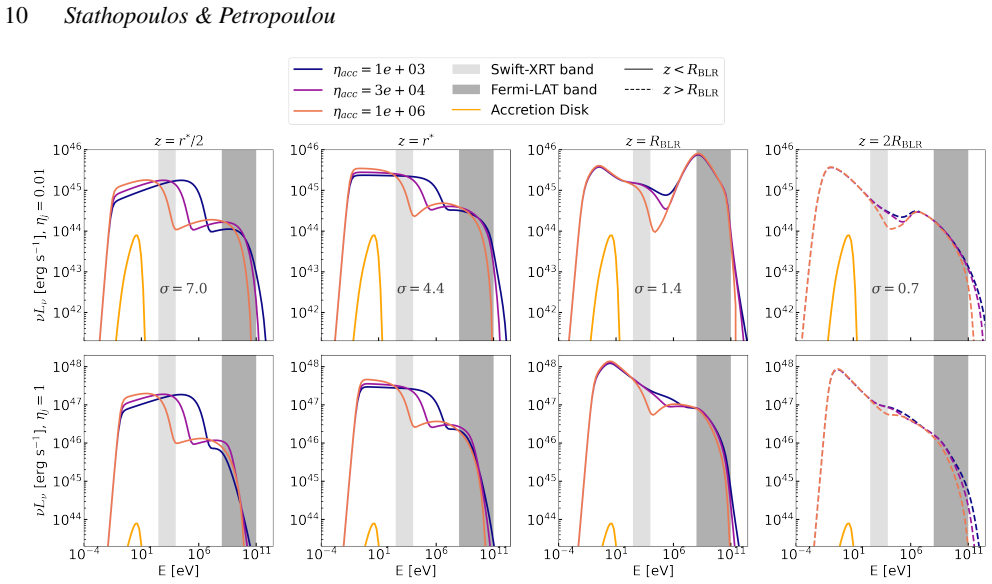
The central discovery is that the ratio z/R_BLR, the dissipation distance normalized to the broad-line region radius, is the parameter that organizes blazar phenomenology. Close to the black hole, where the jet is still highly magnetized (sigma > about 5), the non-thermal particle spectra are hard (p < 1.5) and the SED is dominated by synchrotron and synchrotron self-Compton with keV synchrotron peaks, matching high-synchrotron-peaked BL Lacs. Around z about R_BLR, boosted external BLR photons make external Compton the leading high-energy process, producing bright GeV emission and FSRQ-like spectra, but also softening the injected particle distribution. Neutrino emission peaks just upstream of the BLR: the authors find E_nu L_nu approximately (3/8) f_pi L_p with observed peak energies around 4 PeV, and the neutrino-to-gamma ratio Y_nu_gamma can reach about 10 when internal gamma-gamma absorption is included because the gamma-ray luminosity is attenuated while neutrinos are not. Beyond the BLR, both the external photon targets and the proton hardness drop, so photopion efficiency collapses and neutrino emission falls well below the gamma-ray band.
Load-bearing premise
The bulk Lorentz factor is assumed to grow as the square root of distance up to a saturation point (Eq. 1) rather than being derived from magnetohydrodynamics; every distance-dependent prediction, including magnetization, Doppler boosting, external-photon boosting, and neutrino efficiency, inherits this assumed acceleration law.
Editorial extensions
If this is right
- Moving the dissipation site along a single jet can reproduce the two canonical blazar classes, low-luminosity high-synchrotron-peaked BL Lacs for small distances and luminous Compton-dominated FSRQs for distances near the broad-line region, without changing the jet's base parameters.
- Neutrino production peaks on sub-parsec scales just upstream of the broad-line region, with all-flavor peak energies of a few PeV, placing the brightest predicted neutrino emission inside the sensitivity windows of current and next-generation neutrino telescopes.
- For dissipation close to the black hole, internal gamma-gamma absorption suppresses the observed gamma-ray luminosity, so the neutrino-to-gamma ratio can exceed unity even when the calorimetric neutrino output is comparable to the injected proton power.
- Reproducing the most luminous FSRQs requires high Eddington ratios (about 0.1 or higher), small viewing angles (about 0.2 degrees), and black hole masses of at least 2 times 10^9 solar masses, with the emitting region sitting near the broad-line region.
- Compton dominance grows with dissipation distance and with higher accretion rate or lower jet power efficiency, so the model can populate the high-Compton-dominance, low-synchrotron-peak part of the blazar parameter plane.
Reading between the lines
- If the dissipation-distance map is right, much of the observed blazar sequence in luminosity and peak energy could be a dissipation-and-viewing effect rather than an intrinsic sequence of jet power; a single source should slide along the gamma-ray-luminosity versus synchrotron-peak plane as its flare location changes across epochs.
- The assumed square-root acceleration law (Eq. 1) is the main structural assumption; substituting acceleration profiles from magnetohydrodynamic jet simulations would directly test whether the distance-to-SED-family mapping survives and would quantify how the neutrino-peak location shifts.
- The paper's need for acceleration efficiencies around 10^4 to 10^6, far above the value near 10 found in particle-in-cell reconnection simulations, suggests that unresolved physics such as guide-field reconnection, turbulence, or particle escape may regulate effective acceleration; resolving that tension would sharpen or revise the inner-jet neutrino predictions.
- A targeted test: if a neutrino flare is associated with an emission region at or beyond the broad-line region (parsec scale), the predicted collapse of neutrino efficiency there would be violated, pointing toward additional target photon fields not included in this model.
Editorial analysis
A structured set of objections, weighed in public.
Referee Report
Summary. The paper presents a one-zone leptohadronic model of blazar jets in which magnetic reconnection dissipates energy at a variable distance z from the supermassive black hole. The jet acceleration is prescribed by a Lorentz-factor profile, and the jet magnetization is derived from a constant energy-per-baryon condition; external photon fields from the accretion disc, broad-line region, and dusty torus are included as functions of z. Using the public LeHaMoC code, the authors compute steady-state photon and neutrino spectra for a grid of dissipation distances and parameter variations (initial magnetization, mass accretion rate, jet power, particle acceleration efficiency). They identify three SED families (synchrotron/SSC-dominated close to the black hole, EC-dominated near the BLR, and synchrotron-dominated beyond the BLR), find that neutrino production is most efficient on sub-parsec scales upstream of the BLR with peak energies around a few PeV, and compare their model tracks with Fermi-detected blazars in the synchrotron-peak versus gamma-ray-luminosity plane.
Significance. If its main conclusions hold, the paper offers a useful unifying framework for connecting the location of magnetic dissipation in a blazar jet to the observed blazar sequence and to neutrino predictions. Notable strengths are the use of an open-source, documented code (LeHaMoC), a systematic parameter study, and quantitative comparisons against a large Fermi sample. The neutrino efficiency analysis in Sec. 5 and Appendix B is a valuable forward-modeling step. However, the central distance-to-class mapping is conditional on two prescribed ingredients: the Lorentz-factor profile of Sec. 2.1 and an acceleration efficiency that is 3–5 orders of magnitude above PIC-simulation values. Because the observed-synchrotron-peak comparison is the main validation, these assumptions are load-bearing rather than cosmetic.
major comments (4)
- [Sec. 2.2, Eq. (17); Sec. 4.2.3, footnote 7] The paper adopts eta_acc = 10^4 for the baseline and eta_acc = 10^6 to reproduce intermediate- and low-synchrotron-peaked blazars, while PIC simulations cited in the same section give eta_acc around 10. The synchrotron peak energy, which controls the classification in Figs. 15–17, is set by the radiation-limited maximum electron Lorentz factor and therefore depends inversely on eta_acc. With eta_acc ~ 10, high-sigma dissipation regions would produce burnoff-limited peaks near 100 MeV and low-sigma regions would peak in the IR, so the observed HSP population peaking at 0.1–10 keV would not be reproduced at any distance. The footnote acknowledges this 'strong tension' but does not provide a validated mechanism to raise eta_acc by orders of magnitude. The central claim that dissipation distance alone bridges BL Lacs and FSRQs is therefore not robust to this microphysical uncertainty; the paper should either derive a physically motivated distance-dependent effective eta_acc (e.g., from guide-field reconnection, turbulence, or particle escape) or explicitly present the observational comparison as conditional on this ad hoc parameter and show what the model predicts for PIC-consistent eta_acc.
- [Sec. 2.1, Eq. (1); Sec. 7] The bulk Lorentz factor profile in Eq. (1) is prescribed as a sqrt(z) interpolation between Gamma0 and Gamma_max and is not derived from an MHD jet model. Through Eq. (6) this profile fixes the magnetization sigma(z), and through Eqs. (2)–(3) it sets the Doppler factor and blob radius at every distance. Consequently, the distance-dependent SED families in Fig. 6, the neutrino efficiency curves in Fig. 14, and the observational tracks in Figs. 15–17 all inherit this assumed profile. The statement in Sec. 7 that the model 'self-consistently links the microphysics of particle acceleration to the macroscopic jet structure' is therefore overstrong. A sensitivity study with alternative acceleration profiles, or an explicit statement that the profile is a phenomenological input, is needed before the distance-to-class mapping can be assessed.
- [Sec. 6, Figs. 15–17] The conclusion that different emission locations 'bridge' BL Lacs and FSRQs is partially obtained by changing additional parameters rather than distance alone. In Fig. 17 the FSRQ region is reached only after increasing the mass accretion rate to mdot = 0.5, reducing the viewing angle to 0.2 deg, and increasing the black hole mass to 2e9 Msun, while the text in Sec. 6 notes that full coverage of the FSRQ population still requires further model adaptations. The paper should separate, in the comparison plots, the part of the track that is purely driven by dissipation distance from the part that is driven by simultaneous changes in mdot, theta_obs, and M_BH; otherwise the 'distance as the key control' claim is stronger than the evidence.
- [Appendix B, Eq. (B2)] Equation (B2) appears dimensionally inconsistent: with q expressed in cgs units, the right-hand side has dimensions of cm^{-1} s^{3/2} (or similar) rather than being dimensionless. Since Eqs. (B3) and Fig. B1 are derived from this expression and are used to support the analytical neutrino-threshold argument, the derivation should be checked and corrected. If this is simply a typographical omission of a factor, the correction is straightforward, but as written the analytical appendix cannot be verified.
minor comments (4)
- [Sec. 4.3, Fig. 11 caption] The caption states that the left panel is the low-sigma case (z = R_BLR) and the right panel is the high-sigma case (z = 0.1 R_BLR), but the text in Sec. 4.3 describes the opposite assignment and the physical discussion indicates that the high-sigma (hard-proton) case should show the distinctive leptohadronic features. Please correct the caption.
- [Sec. 5, Eq. (22)] The sentence contains a duplicated phrase: 'where we assume that we assume that the protons energy is connected...'.
- [Data Availability] The Data Availability section contains only the MNRAS boilerplate text rather than an actual statement describing where the model outputs or input parameter files can be obtained; a concrete statement would be helpful given the code is public.
- [Throughout] There are scattered typographical errors, including 'Schwarchild radius' in Sec. 2.1 and 'yiedls' in the caption of Fig. 5; a light copy edit is recommended.
Circularity Check
No significant circularity: the distance-to-multi-messenger mapping is a forward radiative calculation from stated assumptions, not a reduction to its inputs.
full rationale
The paper's derivation chain is a forward model: it prescribes the jet Lorentz factor profile (Eq. 1), derives the magnetization profile from the constant energy-per-baryon assumption (Eq. 6), computes external photon fields as functions of distance (Appendix C), and then solves the kinetic equations with LeHaMoC. The distance-dependent SED and neutrino outputs are genuine numerical consequences of these inputs, not quantities that were inserted to force the conclusion. The comparison with Fermi blazar loci in Figs. 15-17 is a parameter-space exploration in which parameters such as mdot, theta_obs, MBH, and eta_acc are varied to see where model points land; this is model calibration and sensitivity analysis, not a fit of the predicted synchrotron peak to itself. The paper is explicit that the adopted eta_acc values (10^4 and 10^6) are in tension with PIC-based estimates (footnote 7, Sec. 7), and that the choice is necessary to shift synchrotron peaks for high-magnetization regions. This is an acknowledged physical robustness limitation, not a circular step: the synchrotron peak is not defined in terms of the observed peak, and the central claim that dissipation distance controls the EM/neutrino appearance is computed from independent distance-dependent ingredients. Self-citations to Petropoulou et al. (2023) and Stathopoulos et al. (2024) supply model ingredients and the open-source code, but they are not invoked as an external proof of the paper's central result. The assumed Gamma(z) profile is a stated ansatz, not something derived from the conclusions, so the derivation chain remains self-contained. No circular reduction of the type Eq. X = Eq. Y by construction, or a fitted parameter renamed as a prediction, is present.
Assumptions & free parameters
free parameters (11)
- sigma_0 (initial magnetization) =
30 (baseline); 10, 60 (varied)
- mdot (dimensionless mass accretion rate) =
0.01 (baseline); 0.001, 0.1 (varied)
- eta_j (jet-to-accretion power ratio) =
0.1 (baseline); 0.01, 1 (varied)
- eta_acc (particle acceleration efficiency) =
10^4 (baseline); 10^3, 3x10^4, 10^6 (varied)
- z_acc (distance where bulk acceleration ends) =
10^3 R_s
- theta_obs (viewing angle) =
2 deg (reduced to 0.2 deg in Sec. 6)
- M_BH (black hole mass) =
10^9 M_sun (2x10^9 in Sec. 6)
- f_rec (dissipated energy fraction to relativistic particles) =
0.25
- kappa_p (pair-to-proton number ratio) =
10
- Gamma_0 (initial bulk Lorentz factor) =
1.1
- Sixth-order polynomial coefficients a0..a6 for p(log10 sigma) =
a0=2.584913, a1=-0.388311, a2=-0.833513, a3=-0.315536, a4=0.962786, a5=-0.434136, a6=0.059452
assumptions (6)
- domain assumption Bulk Lorentz factor follows the square-root profile of Eq. (1)
- domain assumption Total energy per baryon mu = Gamma(1+sigma) is conserved (Eq. 6)
- domain assumption Injected particle index p depends only on local sigma via a polynomial fit to PIC data, with the same index for pairs and protons
- domain assumption External fields (AD, BLR, DT) follow the prescriptions of Ghisellini and Tavecchio (2009) and Ghisellini and Madau (1996) with reprocessing fractions 0.1
- domain assumption Emitting region is a spherical blob with radius equal to the jet cross-section and magnetic field equal to the unperturbed jet field at that distance
- domain assumption Reconnection parameters beta_rec = 0.06 and f_rec = 0.25 are constants from prior reconnection simulations
Cite this review
Pith. "Pith review of The role of dissipation distance on reconnection-driven multi-messenger signals from blazar jets." pith.science (2026). https://pith.science/paper/OA6ECZLG
@misc{pith2026250708680,
  author       = {Pith},
  title        = {Pith review of: The role of dissipation distance on reconnection-driven multi-messenger signals from blazar jets},
  year         = {2026},
  howpublished = {\url{https://pith.science/paper/OA6ECZLG}},
  note         = {Machine review of arXiv:2507.08680}
}
read the original abstract
Blazars are characterized by relativistic jets that are closely aligned with our line of sight. This results in relativistic beaming, making blazars among the most luminous extragalactic sources across the electromagnetic spectrum, from radio waves to gamma-rays and, potentially, in high-energy neutrinos. We present a comprehensive study of multi-messenger emission from blazar jets powered by magnetic reconnection occurring at varying distances from the supermassive black hole (SMBH). By generalizing previous models, we explore how the emission characteristics depend self-consistently on the spatial evolution of key jet properties, including magnetization, bulk Lorentz factor, and external photon fields (accretion disc, broad-line region, and dusty torus). Using numerical simulations, we examined the impact of the initial jet magnetization, particle acceleration efficiency, jet-to-accretion power ratio, and mass accretion rate on the broadband photon spectra and neutrino emission. Our findings reveal distinct emission regimes characterized by different dominant radiative processes: synchrotron and synchrotron self-Compton dominate closer to the SMBH where magnetization is high, while external Compton (EC) processes become significant near the broad-line region (BLR). Neutrino production efficiency is highest upstream of the BLR, driven by enhanced photon target densities from synchrotron and external photons available for photopion interactions, whereas the proton particle distribution is hard. Our model predictions are compared with observations of gamma-ray luminosities and synchrotron peak energies of Fermi-detected blazars, highlighting magnetic reconnection as a potential mechanism driving both electromagnetic and neutrino emissions in astrophysical jets.
Figures


Figures from the paper (12 more)




Reference graph
Works this paper leans on
-
[1]
write newline
" write newline "" before.all 'output.state := FUNCTION fin.entry write newline FUNCTION new.block output.state before.all = 'skip after.block 'output.state := if FUNCTION new.sentence output.state after.block = 'skip output.state before.all = 'skip after.sentence 'output.state := if if FUNCTION not #0 #1 if FUNCTION and 'skip pop #0 if FUNCTION or pop #1...
-
[2]
Aartsen M. G., et al., 2021, @doi [Journal of Physics G Nuclear Physics] 10.1088/1361-6471/abbd48 , https://ui.adsabs.harvard.edu/abs/2021JPhG...48f0501A 48, 060501
-
[3]
Abdollahi S., et al., 2020, @doi [ ] 10.3847/1538-4365/ab6bcb , https://ui.adsabs.harvard.edu/abs/2020ApJS..247...33A 247, 33
-
[4]
Aiello S., et al., 2019, @doi [Astroparticle Physics] 10.1016/j.astropartphys.2019.04.002 , https://ui.adsabs.harvard.edu/abs/2019APh...111..100A 111, 100
-
[5]
Alves E. P., Zrake J., Fiuza F., 2018, @doi [ ] 10.1103/PhysRevLett.121.245101 , https://ui.adsabs.harvard.edu/abs/2018PhRvL.121x5101A 121, 245101
-
[6]
Atoyan A. M., Dermer C. D., 2003, @doi [ ] 10.1086/346261 , https://ui.adsabs.harvard.edu/abs/2003ApJ...586...79A 586, 79
doi:10.1086/346261 2003
-
[7]
Atoyan A. M., Dermer C. D., 2004, @doi [ ] 10.1016/j.newar.2003.12.046 , https://ui.adsabs.harvard.edu/abs/2004NewAR..48..381A 48, 381
-
[8]
Ball D., Sironi L., \"O zel F., 2018, The Astrophysical Journal, 862, 80
work page 2018
Show all 57 references
-
[9]
Barniol Duran R., Tchekhovskoy A., Giannios D., 2017, @doi [ ] 10.1093/mnras/stx1165 , https://ui.adsabs.harvard.edu/abs/2017MNRAS.469.4957B 469, 4957
2017 doi
-
[10]
C., Fabian A
Begelman M. C., Fabian A. C., Rees M. J., 2008, @doi [ ] 10.1111/j.1745-3933.2007.00413.x , https://ui.adsabs.harvard.edu/abs/2008MNRAS.384L..19B 384, L19
2008
-
[11]
S., Nokhrina E
Beskin V. S., Nokhrina E. E., 2006, @doi [ ] 10.1111/j.1365-2966.2006.09957.x , https://ui.adsabs.harvard.edu/abs/2006MNRAS.367..375B 367, 375
2006
-
[12]
D., K \"o nigl A., 1979, @doi [ ] 10.1086/157262 , https://ui.adsabs.harvard.edu/abs/1979ApJ...232...34B 232, 34
Blandford R. D., K \"o nigl A., 1979, @doi [ ] 10.1086/157262 , https://ui.adsabs.harvard.edu/abs/1979ApJ...232...34B 232, 34
1979 doi
-
[13]
D., Znajek R
Blandford R. D., Znajek R. L., 1977, @doi [ ] 10.1093/mnras/179.3.433 , https://ui.adsabs.harvard.edu/abs/1977MNRAS.179..433B 179, 433
1977 doi
-
[14]
Castignani G., Haardt F., Lapi A., De Zotti G., Celotti A., Danese L., 2013, @doi [ ] 10.1051/0004-6361/201321424 , https://ui.adsabs.harvard.edu/abs/2013A&A...560A..28C 560, A28
2013 doi
-
[15]
Chen Y., Gu Q., Fan J., Yu X., Ding N., Xiong D., Guo X., 2023, @doi [ ] 10.3847/1538-4357/acb4e8 , https://ui.adsabs.harvard.edu/abs/2023ApJ...944..157C 944, 157
2023 doi
-
[16]
D., Menon G., 2009, High Energy Radiation from Black Holes
Dermer C. D., Menon G., 2009, High Energy Radiation from Black Holes. Princeton University Press, Princeton, NJ
2009
-
[17]
Drenkhahn G., 2002, @doi [ ] 10.1051/0004-6361:20020390 , https://ui.adsabs.harvard.edu/abs/2002A&A...387..714D 387, 714
2002 doi
-
[18]
A., 2023, @doi [ ] 10.3847/1538-4357/acb7dd , https://ui.adsabs.harvard.edu/abs/2023ApJ...948...19F 948, 19
French O., Guo F., Zhang Q., Uzdensky D. A., 2023, @doi [ ] 10.3847/1538-4357/acb7dd , https://ui.adsabs.harvard.edu/abs/2023ApJ...948...19F 948, 19
2023 doi
-
[19]
Ghisellini G., Madau P., 1996, @doi [ ] 10.1093/mnras/280.1.67 , https://ui.adsabs.harvard.edu/abs/1996MNRAS.280...67G 280, 67
1996 doi
-
[20]
Ghisellini G., Tavecchio F., 2009, @doi [ ] 10.1111/j.1365-2966.2009.15007.x , https://ui.adsabs.harvard.edu/abs/2009MNRAS.397..985G 397, 985
2009
-
[21]
A., 2019, @doi [ ] 10.1093/mnras/stz082 , https://ui.adsabs.harvard.edu/abs/2019MNRAS.484.1378G 484, 1378
Giannios D., Uzdensky D. A., 2019, @doi [ ] 10.1093/mnras/stz082 , https://ui.adsabs.harvard.edu/abs/2019MNRAS.484.1378G 484, 1378
2019 doi
-
[22]
Guo F., Li H., Daughton W., Liu Y.-H., 2014, @doi [ ] 10.1103/PhysRevLett.113.155005 , https://ui.adsabs.harvard.edu/abs/2014PhRvL.113o5005G 113, 155005
2014 doi
-
[23]
Guo F., Liu Y.-H., Daughton W., Li H., 2015, @doi [ ] 10.1088/0004-637X/806/2/167 , https://ui.adsabs.harvard.edu/abs/2015ApJ...806..167G 806, 167
2015 doi
-
[24]
Guo F., et al., 2016, @doi [ ] 10.3847/2041-8205/818/1/L9 , https://ui.adsabs.harvard.edu/abs/2016ApJ...818L...9G 818, L9
2016 doi
-
[25]
Guo F., Liu Y.-H., Zenitani S., Hoshino M., 2024, @doi [ ] 10.1007/s11214-024-01073-2 , https://ui.adsabs.harvard.edu/abs/2024SSRv..220...43G 220, 43
2024 doi
-
[26]
Hakobyan H., Petropoulou M., Spitkovsky A., Sironi L., 2021, @doi [ ] 10.3847/1538-4357/abedac , https://ui.adsabs.harvard.edu/abs/2021ApJ...912...48H 912, 48
2021 doi
-
[27]
IceCube Collaboration 2018, @doi [Science] 10.1126/science.aat2890 , 361, 147
2018 doi
-
[28]
IceCube Collaboration et al., 2018, @doi [Science] 10.1126/science.aat1378 , 361, eaat1378
2018 doi
-
[29]
Janiak M., Sikora M., Moderski R., 2015, @doi [ ] 10.1093/mnras/stv200 , https://ui.adsabs.harvard.edu/abs/2015MNRAS.449..431J 449, 431
2015 doi
-
[30]
Kadowaki L. H. S., de Gouveia Dal Pino E. M., Medina-Torrej \'o n T. E., Mizuno Y., Kushwaha P., 2021, @doi [ ] 10.3847/1538-4357/abee7a , https://ui.adsabs.harvard.edu/abs/2021ApJ...912..109K 912, 109
2021 doi
- [31]
-
[32]
S., Barkov M
Komissarov S. S., Barkov M. V., Vlahakis N., K \"o nigl A., 2007, @doi [ ] 10.1111/j.1365-2966.2007.12050.x , https://ui.adsabs.harvard.edu/abs/2007MNRAS.380...51K 380, 51
2007
-
[33]
Li X., Guo F., Liu Y.-H., Li H., 2023, @doi [ ] 10.3847/2041-8213/acf135 , https://ui.adsabs.harvard.edu/abs/2023ApJ...954L..37L 954, L37
2023 doi
-
[34]
L., et al., 2013, @doi [ ] 10.1088/0004-6256/146/5/120 , https://ui.adsabs.harvard.edu/abs/2013AJ....146..120L 146, 120
Lister M. L., et al., 2013, @doi [ ] 10.1088/0004-6256/146/5/120 , https://ui.adsabs.harvard.edu/abs/2013AJ....146..120L 146, 120
2013 doi
-
[35]
Mannheim K., 1995, @doi [Astroparticle Physics] 10.1016/0927-6505(94)00044-4 , https://ui.adsabs.harvard.edu/abs/1995APh.....3..295M 3, 295
1995 doi
-
[36]
J., Engel R., Rachen J
M \"u cke A., Protheroe R. J., Engel R., Rachen J. P., Stanev T., 2003, @doi [Astroparticle Physics] 10.1016/S0927-6505(02)00185-8 , https://ui.adsabs.harvard.edu/abs/2003APh....18..593M 18, 593
2003 doi
-
[37]
Padovani P., et al., 2017, @doi [ ] 10.1007/s00159-017-0102-9 , https://ui.adsabs.harvard.edu/abs/2017A&ARv..25....2P 25, 2
2017 doi
-
[38]
Padovani P., Oikonomou F., Petropoulou M., Giommi P., Resconi E., 2019, @doi [ ] 10.1093/mnrasl/slz011 , https://ui.adsabs.harvard.edu/abs/2019MNRAS.484L.104P 484, L104
2019 doi
-
[39]
Padovani P., Boccardi B., Falomo R., Giommi P., 2022, @doi [ ] 10.1093/mnras/stac376 , https://ui.adsabs.harvard.edu/abs/2022MNRAS.511.4697P 511, 4697
2022 doi
-
[40]
Petropoulou M., Sironi L., Spitkovsky A., Giannios D., 2019, @doi [ ] 10.3847/1538-4357/ab287a , https://ui.adsabs.harvard.edu/abs/2019ApJ...880...37P 880, 37
2019 doi
-
[41]
Petropoulou M., Psarras F., Giannios D., 2023, @doi [ ] 10.1093/mnras/stac3190 , https://ui.adsabs.harvard.edu/abs/2023MNRAS.518.2719P 518, 2719
2023 doi
-
[42]
B., Kovalev Y
Pushkarev A. B., Kovalev Y. Y., Lister M. L., Savolainen T., 2017, @doi [mnras] 10.1093/mnras/stx854 , https://ui.adsabs.harvard.edu/abs/2017MNRAS.468.4992P 468, 4992
2017 doi
-
[43]
M., Harrison A
Rueda-Becerril J. M., Harrison A. O., Giannios D., 2021, @doi [ ] 10.1093/mnras/staa3925 , https://ui.adsabs.harvard.edu/abs/2021MNRAS.501.4092R 501, 4092
2021 doi
-
[44]
I., Sunyaev R
Shakura N. I., Sunyaev R. A., 1973, , https://ui.adsabs.harvard.edu/abs/1973A&A....24..337S 24, 337
1973
-
[45]
Sironi L., Spitkovsky A., 2014, @doi [ ] 10.1088/2041-8205/783/1/L21 , https://ui.adsabs.harvard.edu/abs/2014ApJ...783L..21S 783, L21
2014 doi
-
[46]
Sironi L., Petropoulou M., Giannios D., 2015, @doi [ ] 10.1093/mnras/stv641 , https://ui.adsabs.harvard.edu/abs/2015MNRAS.450..183S 450, 183
2015 doi
-
[47]
A., Giannios D., 2025, @doi [arXiv e-prints] 10.48550/arXiv.2506.02101 , https://ui.adsabs.harvard.edu/abs/2025arXiv250602101S p
Sironi L., Uzdensky D. A., Giannios D., 2025, @doi [arXiv e-prints] 10.48550/arXiv.2506.02101 , https://ui.adsabs.harvard.edu/abs/2025arXiv250602101S p. arXiv:2506.02101
-
[48]
I., Petropoulou M., Vasilopoulos G., Mastichiadis A., 2024, @doi [ ] 10.1051/0004-6361/202347277 , https://ui.adsabs.harvard.edu/abs/2024A&A...683A.225S 683, A225
Stathopoulos S. I., Petropoulou M., Vasilopoulos G., Mastichiadis A., 2024, @doi [ ] 10.1051/0004-6361/202347277 , https://ui.adsabs.harvard.edu/abs/2024A&A...683A.225S 683, A225
2024 doi
-
[49]
W., Done C., Salamon M
Stecker F. W., Done C., Salamon M. H., Sommers P., 1991, @doi [ ] 10.1103/PhysRevLett.66.2697 , https://ui.adsabs.harvard.edu/abs/1991PhRvL..66.2697S 66, 2697
1991 doi
-
[50]
Tavecchio F., 2021, @doi [Galaxies] 10.3390/galaxies9020037 , https://ui.adsabs.harvard.edu/abs/2021Galax...9...37T 9, 37
2021 doi
-
[51]
M., Padovani P., 1995, @doi [ ] 10.1086/133630 , https://ui.adsabs.harvard.edu/abs/1995PASP..107..803U 107, 803
Urry C. M., Padovani P., 1995, @doi [ ] 10.1086/133630 , https://ui.adsabs.harvard.edu/abs/1995PASP..107..803U 107, 803
1995 doi
-
[52]
Vlahakis N., K \"o nigl A., 2004, @doi [ ] 10.1086/382670 , https://ui.adsabs.harvard.edu/abs/2004ApJ...605..656V 605, 656
2004 doi
-
[53]
Wang Z.-R., Liu R.-Y., Petropoulou M., Oikonomou F., Xue R., Wang X.-Y., 2022, @doi [ ] 10.1103/PhysRevD.105.023005 , https://ui.adsabs.harvard.edu/abs/2022PhRvD.105b3005W 105, 023005
2022 doi
-
[54]
R., Uzdensky D
Werner G. R., Uzdensky D. A., 2024, @doi [ ] 10.3847/2041-8213/ad2fa5 , https://ui.adsabs.harvard.edu/abs/2024ApJ...964L..21W 964, L21
2024 doi
-
[55]
R., Uzdensky D
Werner G. R., Uzdensky D. A., Cerutti B., Nalewajko K., Begelman M. C., 2016, @doi [ ] 10.3847/2041-8205/816/1/L8 , https://ui.adsabs.harvard.edu/abs/2016ApJ...816L...8W 816, L8
2016 doi
-
[56]
Zhang H., Sironi L., Giannios D., 2021, @doi [The Astrophysical Journal] 10.3847/1538-4357/ac2e08 , 922, 261
2021 doi
-
[57]
Zhang H., Sironi L., Giannios D., Petropoulou M., 2023, @doi [ApJL] 10.3847/2041-8213/acfe7c , https://ui.adsabs.harvard.edu/abs/2023ApJ...956L..36Z 956, L36
2023 doi
Reviewed August 6, 2026 · model on record in the stance chip above.
Discussion (0). Sign in to comment.