REVIEW 3 major objections 3 minor 38 references
Carbon-Aware Workflow Scheduling with Fixed Mapping and Deadline Constraint
T0 review · 3 major / 3 minor · reviewed 2026-08-06 · deepseek-v4-flash
Pith's one-line read The paper establishes a complexity dichotomy: carbon-aware scheduling with a fixed task mapping is polynomial on one processor and strongly NP-complete on two or more processors, and its greedy-plus-local-search heuristics cut median…
desk verdict Solid NP-hardness and heuristic contributions, but the single-processor DP drops idle power and its polynomial-time claim is not established. read the letter →
The pith
A machine-rendered reading of the paper's core claim, the machinery that carries it, and where it could break.
The reading
What carries the argument
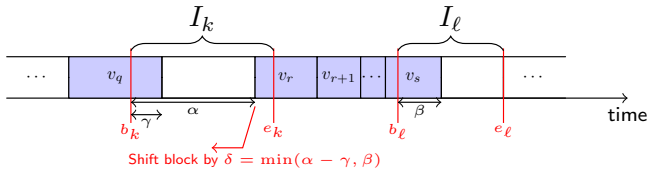
The argument is carried by the communication-enhanced DAG $G_c$, which replaces every inter-processor communication with a fictional task on a fictional link-processor, so that all scheduling decisions reduce to placing tasks on a timeline. The polynomial result uses the notion of an E-schedule: a single-processor schedule in which every block of consecutive tasks starts or ends at an interval boundary; Lemma 4.2 shows an optimal E-schedule always exists, which restricts the dynamic program's candidate end times to $O(n^3J)$ values. For the heuristics, the load-bearing mechanisms are the task scores (slack $s(v)$, pressure $\rho(v)=\omega(v)/(s(v)+\omega(v))$, and their power-weighted variants), the refinement of intervals into subintervals induced by blocks of up to $k=3$ tasks, and a local-search hill climber that moves tasks within $[\mathrm{EST}(v), \mathrm{LST}(v)]$.
What would settle it
Take a known unsolvable 3-Partition instance, build the multi-processor reduction instance from Theorem 4.3, and ask an exact ILP whether a zero-carbon schedule exists; a 'yes' answer would refute the strong NP-completeness proof. Alternatively, run CaWoSched with realized green budgets that differ from the forecast budgets and check whether its carbon cost stays below ASAP's; a case where it exceeds ASAP would show the exact-budget assumption is load-bearing.
Extended reading notes
Core claim
On the paper's own terms, the central discovery is a complexity dichotomy: with one processor and a fixed task order, an optimal carbon-minimizing schedule can be computed in polynomial time via a dynamic program that only needs to consider task end times aligned with interval boundaries (E-schedules); with at least two processors, the problem is strongly NP-complete, so no polynomial exact algorithm exists unless P=NP. In the hard regime, the paper's CaWoSched framework combines slack- and pressure-based greedy scores, refined interval subdivisions, and local search to produce schedules whose carbon cost is close to the best known and, on small workflows, close to the ILP optimum.
Load-bearing premise
That the green power budget in every time interval is known exactly and stays constant within the interval; if the forecast is wrong, the shifted schedule may no longer be better than ASAP, and the complexity results do not cover stochastic budgets.
Editorial extensions
If this is right
- On a single processor, carbon-aware scheduling with a fixed order is tractable, so exact schedules can replace heuristics in that setting.
- On clusters with two or more processors, the problem is strongly NP-complete, which justifies heuristic approaches and rules out a general polynomial exact algorithm.
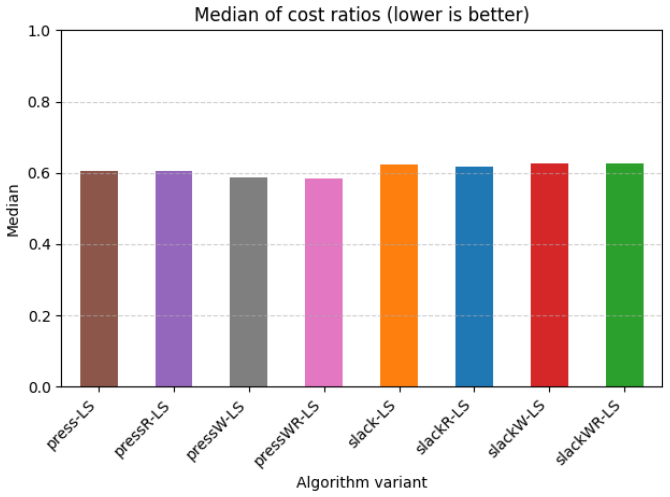
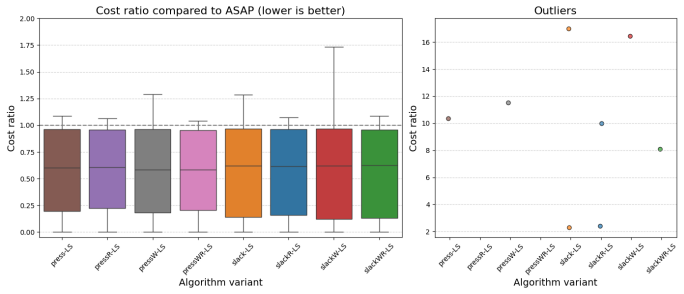
- CaWoSched's median carbon cost is about 0.58–0.6 times the ASAP baseline, roughly a 40 percent reduction, and the saving grows when the deadline is looser.
- Several heuristic variants match the ILP-optimal cost on a meaningful share of small instances while running orders of magnitude faster than the exact solver.
- Running times stay in seconds for most workflows and a few minutes for the largest tested workflows (up to 30,000 tasks), making the approach usable in planning tools.
Reading between the lines
- Editorial inference: because mapping and ordering are taken as given, the reported savings are relative to a mapping chosen without carbon in mind; a carbon-aware mapping pass could push savings beyond the 0.58–0.6 ratio.
- Editorial inference: the E-schedule lemma exploits exact interval boundaries, so extending the one-processor result to uncertain green budgets would likely require a stochastic or robust reformulation rather than a direct adaptation of the dynamic program.
- Editorial inference: the local-search refinement accounts for a large share of the carbon improvement, so a cheaper stand-alone hill climber starting from an ASAP schedule might capture most of the benefit on very large DAGs.
Editorial analysis
A structured set of objections, weighed in public.
Referee Report
Summary. The paper studies carbon-aware workflow scheduling with a fixed mapping and ordering of tasks on a heterogeneous cluster, where each processor has idle and work power, and the green energy budget varies over time. The total carbon cost is the time-integrated excess of total power over the green budget. The authors claim a polynomial-time dynamic program for the single-processor case, strong NP-completeness for the multiprocessor case, an ILP formulation, and a family of heuristics (CaWoSched) with experimental evaluation against an ASAP baseline and exact solutions on small instances. The theoretical claims are central to the paper: the uniprocessor polynomial-time result rests on a dynamic program (Theorem 4.1) and an E-schedule structural lemma (Lemma 4.2), and the multiprocessor hardness claim is Theorem 4.3.
Significance. If the theoretical claims were correct, the paper would provide a clean complexity dichotomy for a natural scheduling problem and a practical heuristic framework with strong experimental support. The paper's strengths include a rigorous 3-Partition reduction (for a variable number of processors), a correct time-indexed ILP that includes idle power, and an extensive, reproducible experimental study with public code and data. However, the central uniprocessor polynomial-time result is not established under the paper's own cost model because the dynamic program omits idle-power costs, and the hardness claim as stated for 'at least two processors' is stronger than what the reduction actually proves. These issues are load-bearing and require substantial revision.
major comments (3)
- [Section 4.1, Eq. (1)] The dynamic programming recurrence Opt(i,t) = min_{s ≤ t-ω(vi)} {Opt(i-1,s) + cc(vi,t)} charges only cc(vi,t), the cost of executing task vi during [t-ω(vi), t[, and never charges the idle intervals between the end of vi-1 and the start of vi, nor idle time after the last task. Under the cost model of Section 3 (CC_t = max(P_t - G_j, 0) with P_t = sum_i P_i(t), including idle power), this omitted idle cost is not a constant offset because G_j varies across intervals. For example, take P_idle = 2, P_work = 2, T = 6, one task of length 3, and G = (3,3,3,0,5,5). The true optimal schedule starts at time 3 with total cost 4 (idle cost 0, active cost 4), while the DP comparing only active costs returns start time 0 (active cost 3, true total cost 5). Thus Theorem 4.1 is not established by the published recurrence.
- [Appendix A.2, Lemma 4.2] The proof of Lemma 4.2 claims that shifting a block of tasks to an interval with a higher green power budget 'cannot have increased' the carbon cost. This argument moves only the active load and ignores the idle power that moves in the opposite direction. Since idle power contributes to P_t and the green budget varies, the net change in cost includes a term for the idle intervals vacated and occupied by the shift. The proof therefore does not establish the existence of an optimal E-schedule under the paper's cost model. This undermines the restriction to the polynomial-size set E' that is used to make the DP polynomial-time.
- [Section 4.2, Theorem 4.3] The 3-Partition reduction constructs an instance with P = 3n processors, one processor per task. This proves strong NP-completeness for the class of instances where the number of processors is part of the input, but it does not prove NP-hardness for any fixed number of processors P ≥ 2, such as P=2. The abstract and introduction claim the problem is NP-hard 'for at least two processors,' which is a stronger statement than the reduction supports. Please either revise the claim to 'when the number of processors is part of the input' or provide a separate reduction for fixed P ≥ 2.
minor comments (3)
- [Figure 4 caption] The caption says 'cost ratios obtained by dividing heuristics carbon cost by the carbon cost of the deadline'; this should read 'by the carbon cost of the baseline' (or similar), since the text describes a comparison against the ASAP baseline.
- [Section 5.2] The description of the block subdivision says every task starts at the beginning of an interval 'when we look at the special case of one processor.' This is motivated by Lemma 4.2, but since Lemma 4.2 is not established under the full cost model (see major comment 2), the heuristic's design rationale should be reworded or supported independently.
- [Section 6.1] The power values for communication links are drawn randomly between 1 and 2, but the exact seed or distribution is not specified; the paper states the data are available, so this is a minor reproducibility note.
Circularity Check
No circularity found: the complexity proofs and the ILP benchmark are self-contained, and the few self-citations are not load-bearing.
full rationale
The paper's central results are derived from first principles rather than from the authors' prior work. Theorem 4.1 is proven by a dynamic program whose recurrence (Eq. 1) is built directly on the interval structure and task execution costs, and Lemma 4.2 is argued by an explicit block-shifting construction over the interval boundaries; neither step invokes a prior result by the same authors. Theorem 4.3 is proven by a self-contained reduction from 3-Partition with an explicit interval construction, so the strong NP-completeness claim does not reduce to an imported uniqueness or equivalence result. The ILP in Section 4.3 independently encodes the cost model of Eq. (2) and is used only as an external optimal benchmark for small instances, not as a fitted predictor of the heuristics' performance. Self-citations appear in non-load-bearing places: [22] is cited for deleting Nextflow pseudo-tasks in experimental preprocessing, and [23] appears in the related-work discussion of partitioning-based heuristics; neither citation supplies the paper's complexity or optimality claims. The heuristic parameters k and mu are fixed tuning choices, not fitted values renamed as predictions, and the reported cost ratios are computed against the ASAP baseline and the ILP, so the savings claim is not circular. One reviewer concern is that the DP in Theorem 4.1 charges only cc(vi,t) and omits idle power between tasks, even though idle power is part of the paper's own cost model in Eq. (2). That is a correctness or soundness gap in the proof, not circularity: the recurrence does not equate its output with its input by construction, it simply may optimize a different objective than the stated one. Since the required circularity patterns (self-definitional equivalence, fitted input called prediction, load-bearing self-citation, or renamed known results) are absent, the appropriate finding is no significant circularity.
Assumptions & free parameters
free parameters (2)
- k (block size for interval subdivision) =
3
- mu (local search window) =
10
assumptions (4)
- standard math 3-Partition is strongly NP-complete
- domain assumption Carbon cost is the integral over time of max(total_power - green_budget, 0)
- domain assumption Green power budget G_j is exactly known and constant within each interval I_j
- domain assumption Communications are modeled as tasks on fictional processors assuming a fully connected, full-duplex network
invented entities (1)
-
Fictional communication processors p_{P+1}...p_{P^2}
Cite this review
Pith. "Pith review of Carbon-Aware Workflow Scheduling with Fixed Mapping and Deadline Constraint." pith.science (2026). https://pith.science/paper/3E4GFZEL
@misc{pith2026250708725,
  author       = {Pith},
  title        = {Pith review of: Carbon-Aware Workflow Scheduling with Fixed Mapping and Deadline Constraint},
  year         = {2026},
  howpublished = {\url{https://pith.science/paper/3E4GFZEL}},
  note         = {Machine review of arXiv:2507.08725}
}
read the original abstract
Large data and computing centers consume a significant share of the world's energy consumption. A prominent subset of the workloads in such centers are workflows with interdependent tasks, usually represented as directed acyclic graphs (DAGs). To reduce the carbon emissions resulting from executing such workflows in centers with a mixed (renewable and non-renewable) energy supply, it is advisable to move task executions to time intervals with sufficient green energy when possible. To this end, we formalize the above problem as a scheduling problem with a given mapping and ordering of the tasks. We show that this problem can be solved in polynomial time in the uniprocessor case. For at least two processors, however, the problem becomes NP-hard. Hence, we propose a heuristic framework called CaWoSched that combines several greedy approaches with local search. To assess the 16 heuristics resulting from different combinations, we also devise a simple baseline algorithm and an exact ILP-based solution. Our experimental results show that our heuristics provide significant savings in carbon emissions compared to the baseline.
Figures


Figures from the paper (14 more)





Reference graph
Works this paper leans on
-
[1]
D. Abts, M. R. Marty, P. M. Wells, P. Klausler, and H. Liu. Energy proportional datacenter networks. InProc. of the 37th Annual International Symposium on Computer Architecture, page 338–347, 2010
work page 2010
-
[2]
M. Adhikari, T. Amgoth, and S. N. Srirama. A survey on scheduling strate- gies for workflows in cloud environment and emerging trends. ACM Com- put. Surv. , 52(4), aug 2019
work page 2019
-
[3]
K. M. U. Ahmed, M. H. J. Bollen, and M. Alvarez. A review of data cen- ters energy consumption and reliability modeling. IEEE Access, 9:152536– 152563, 2021
work page 2021
-
[4]
E. Angriman, A. van der Grinten, M. von Looz, H. Meyerhenke, M. N¨ ollen- burg, M. Predari, and C. Tzovas. Guidelines for experimental algorithmics: A case study in network analysis. Algorithms, 12(7):127, 2019
work page 2019
-
[5]
H. Arabnejad and J. G. Barbosa. List scheduling algorithm for heteroge- neous systems by an optimistic cost table. IEEE Transactions on Parallel and Distributed Systems , 25(3):682–694, 2013
work page 2013
- [6]
-
[7]
J. Bader, K. West, S. Becker, S. Kulagina, F. Lehmann, L. Thamsen, H. Meyerhenke, and O. Kao. Predicting the performance of scientific work- flow tasks for cluster resource management: An overview of the state of the art, 2025. https://arxiv.org/abs/2504.20867
work page Pith review arXiv 2025
-
[8]
J. G. Barbosa and B. Moreira. Dynamic scheduling of a batch of parallel task jobs on heterogeneous clusters. Parallel computing, 37(8), 2011
work page 2011
Show all 38 references
-
[9]
Breukelman, S
E. Breukelman, S. Hall, G. Belgioioso, and F. D¨ orfler. Carbon-aware computing in a network of data centers: A hierarchical game-theoretic approach. In 2024 European Control Conference (ECC) , pages 798–803. IEEE, 2024
2024
-
[10]
Z. Cao, X. Zhou, H. Hu, Z. Wang, and Y. Wen. Toward a systematic survey for carbon neutral data centers. IEEE Communications Surveys & Tutorials, 24(2):895–936, 2022
2022
-
[11]
Coleman, H
T. Coleman, H. Casanova, L. Pottier, M. Kaushik, E. Deelman, and R. Fer- reira da Silva. Wfcommons: A framework for enabling scientific workflow research and development. Future Generation Computer Systems , 128:16– 27, 2022. 24
2022
-
[12]
Di Tommaso, M
P. Di Tommaso, M. Chatzou, E. W. Floden, P. P. Barja, E. Palumbo, and C. Notredame. Nextflow enables reproducible computational workflows. Nature biotechnology, 35(4):316–319, 2017
2017
-
[13]
J. J. Durillo, V. Nae, and R. Prodan. Multi-objective energy-efficient work- flow scheduling using list-based heuristics. Future Generation Computer Systems, 36:221–236, July 2014
2014
-
[14]
J. J. Durillo, R. Prodan, and J. G. Barbosa. Pareto tradeoff scheduling of workflows on federated commercial Clouds. Simulation Modelling Practice and Theory, 58:95–111, Nov. 2015
2015
-
[15]
M. R. Garey and D. S. Johnson. Computers and Intractability, a Guide to the Theory of NP-Completeness . W.H. Freeman and Company, 1979
1979
-
[16]
Gurobi Optimizer Reference Manual, 2024
Gurobi Optimization, LLC. Gurobi Optimizer Reference Manual, 2024
2024
-
[17]
A. A. Hagberg, D. A. Schult, and P. J. Swart. Exploring network structure, dynamics, and function using networkx. In G. Varoquaux, T. Vaught, and J. Millman, editors, Proceedings of the 7th Python in Science Conference , pages 11 – 15, Pasadena, CA USA, 2008
2008
-
[18]
S. Hall, F. Micheli, G. Belgioioso, A. Radovanovi´ c, and F. D¨ orfler. Carbon- aware computing for data centers with probabilistic performance guaran- tees. arXiv preprint arXiv:2410.21510 , 2024
2024
-
[19]
W. A. Hanafy, Q. Liang, N. Bashir, D. Irwin, and P. Shenoy. CarbonScaler: Leveraging Cloud Workload Elasticity for Optimizing Carbon-Efficiency. Proc. ACM Meas. Anal. Comput. Syst. , 7(3):57:1–57:28, Dec. 2023
2023
-
[20]
Measuring Processor Power - TDP vs
Intel Corporation. Measuring Processor Power - TDP vs. ACP. White paper, Intel Corporation, 2011
2011
-
[21]
A. B. Kahn. Topological sorting of large networks. Communications of the ACM, 5(11):558–562, Nov. 1962
1962
-
[22]
Kulagina, A
S. Kulagina, A. Benoit, and H. Meyerhenke. Memory-aware adaptive scheduling of scientific workflows on heterogeneous architectures, 2025. https://arxiv.org/abs/2503.22365
2025 arXiv
-
[23]
Kulagina, H
S. Kulagina, H. Meyerhenke, and A. Benoit. Mapping large memory- constrained workflows onto heterogeneous platforms. In 53rd Int. Con- ference on Parallel Processing (ICPP) , 2024
2024
-
[24]
H. Lavi. Measuring greenhouse gas emissions in data cen- tres: the environmental impact of cloud computing, 2023. https://www.climatiq.io/blog/measure-greenhouse-gas-emissions-carbon- data-centres-cloud-computing. 25
2023
-
[25]
J. Liu, E. Pacitti, and P. Valduriez. A survey of scheduling frameworks in big data systems. International Journal of Cloud Computing , 7(2):103–128, 2018
2018
-
[26]
A. H. Mahmud and S. S. Iyengar. A distributed framework for carbon and cost aware geographical job scheduling in a hybrid data center infrastruc- ture. In IEEE Int. Conference on Autonomic Computing (ICAC) , pages 75–84, 2016
2016
-
[27]
M. Y. ¨Ozkaya, A. Benoit, B. U¸ car, J. Herrmann, and¨U. V. C ¸ ataly¨ urek. A scalable clustering-based task scheduler for homogeneous processors using DAG partitioning. In 33rd IEEE Int. Parallel and Distributed Processing Symp., 2019
2019
-
[28]
P. Pop, K. H. Poulsen, V. Izosimov, and P. Eles. Scheduling and volt- age scaling for energy/reliability trade-offs in fault-tolerant time-triggered embedded systems. In Proceedings of the 5th IEEE/ACM International Conference on Hardware/Software Codesign and System Synthesis...
2007
-
[29]
Radovanovi´ c, R
A. Radovanovi´ c, R. Koningstein, I. Schneider, B. Chen, A. Duarte, B. Roy, D. Xiao, M. Haridasan, P. Hung, N. Care, et al. Carbon-aware computing for datacenters. IEEE Transactions on Power Systems , 38(2):1270–1280, 2022
2022
-
[30]
Samadi, M
Y. Samadi, M. Zbakh, and C. Tadonki. E-heft: Enhancement hetero- geneous earliest finish time algorithm for task scheduling based on load balancing in cloud computing. In 2018 International Conference on High Performance Computing & Simulation (HPCS) , pages 601–609, 2018
2018
-
[31]
Sandokji and F
S. Sandokji and F. Eassa. Dynamic Variant Rank HEFT Task Schedul- ing Algorithm Toward Exascale Computing. Procedia Computer Science, 163:482–493, 2019
2019
-
[32]
Shi and J
Z. Shi and J. J. Dongarra. Scheduling workflow applications on proces- sors with different capabilities. Future Generation Computer Systems , 22(6):665–675, 2006
2006
-
[33]
O. Sinnen. Task scheduling for parallel systems , volume 60. John Wiley & Sons, 2007
2007
-
[34]
Topcuoglu, S
H. Topcuoglu, S. Hariri, and M.-Y. Wu. Performance-effective and low- complexity task scheduling for heterogeneous computing. IEEE Transac- tions on Parallel and Distributed Systems , 13(3):260–274, 2002
2002
-
[35]
Versluis and A
L. Versluis and A. Iosup. Taskflow: An energy-and makespan-aware task placement policy for workflow scheduling through delay management. In Proc. of the 2022 ACM/SPEC Int. Conference on Performance Engineer- ing, pages 81–88, 2022. 26
2022
-
[36]
Viil and S
J. Viil and S. N. Srirama. Framework for automated partitioning and exe- cution of scientific workflows in the cloud. The Journal of Supercomputing, 74:2656–2683, 2018
2018
-
[37]
Z. Wen, S. Garg, G. S. Aujla, K. Alwasel, D. Puthal, S. Dustdar, A. Y. Zomaya, and R. Ranjan. Running Industrial Workflow Applications in a Software-Defined Multicloud Environment Using Green Energy Aware Scheduling Algorithm. IEEE Transactions on Industrial Informatics , 17(8...
2021
-
[38]
Wiesner, I
P. Wiesner, I. Behnke, D. Scheinert, K. Gontarska, and L. Thamsen. Let’s wait awhile: How temporal workload shifting can reduce carbon emissions in the cloud. In Proc. of the 22nd Int. Middleware Conference , pages 260– 272, 2021. 27 A Appendix A.1 Cost of a Schedule In this s...
2021
Reviewed August 6, 2026 · model on record in the stance chip above.
Discussion (0). Continue with ORCID to comment.