REVIEW 4 major objections 4 minor 79 references
Probing periodic trends in the TESS light curves of the seventeen known Double White Dwarf systems
T0 review · 4 major / 4 minor · reviewed 2026-08-06 · deepseek-v4-flash
Pith's one-line read TESS photometry finds Doppler and ellipsoidal signals in two double white dwarfs
desk verdict Honest TESS data mining with two conditional detections whose significance estimates are undermined by an asymmetric FAP pipeline. read the letter →
The pith
A machine-rendered reading of the paper's core claim, the machinery that carries it, and where it could break.
The reading
What carries the argument
The analysis chain is: Singular Spectrum Analysis to decompose and reconstruct each light curve from a chosen set of principal components, Lomb-Scargle periodograms to locate the most dominant periodic feature, and False Alarm Probabilities computed from simulated Gaussian noise light curves generated with the reported photometric errors. For interpretation, the paper uses the Morris & Naftilan (1993) analytical relation for ellipsoidal variation amplitude as a function of inclination, masses, radii, and orbital period, and a Doppler boosting amplitude computed by integrating the Planck spectrum against the TESS bandpass while shifting wavelengths by the line-of-sight velocity. These two models are what turn the detected periods into physical claims about inclination and mass.
What would settle it
Generate the same simulated pure-noise light curves used for the LP400-22 and J2132+0754 false alarm probabilities, apply the identical SSA de-noising and periodogram search to them, and count how often a peak appears at the claimed periods; if the fraction of SSA-processed noise sets with such peaks is comparable to or greater than 3.68% and 8.82%, the detections lose their support. A second check: high-speed photometric monitoring of LP400-22 to measure the trend amplitude and phase against the spectroscopic orbit, which would distinguish Doppler boosting from a nearby variable star not caught by Gaia-based blending checks.
Extended reading notes
Core claim
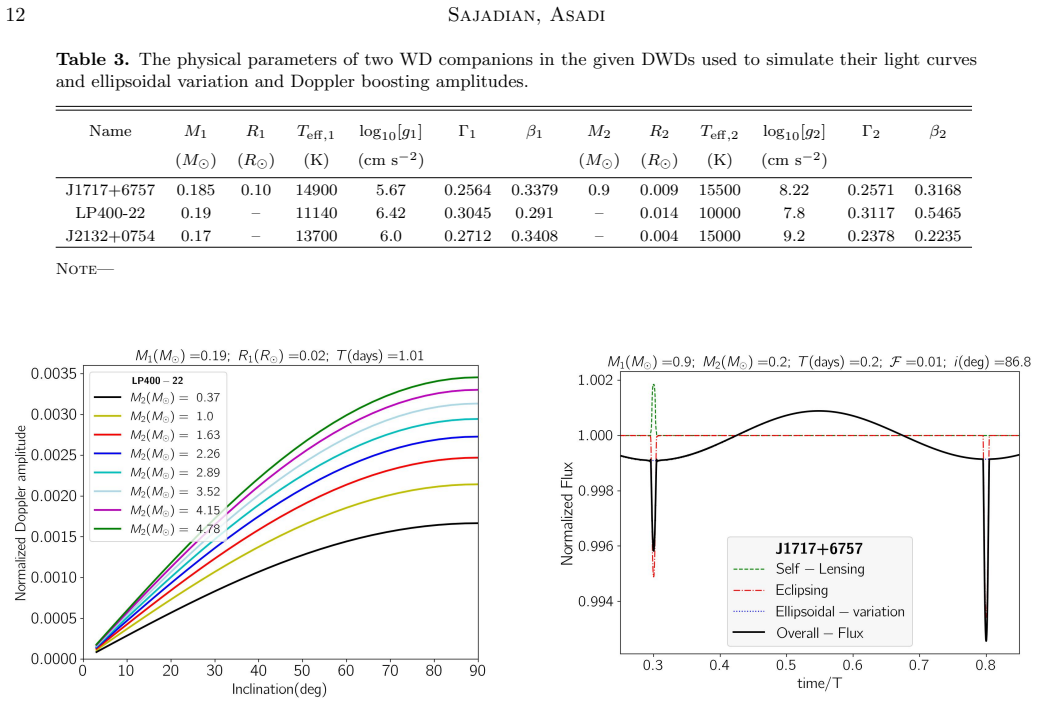
For the seventeen known DWD systems with available TESS data, periodic sinusoidal trends appear in six light curves. The paper establishes that in LP400-22 the trend period (1.0255 days) matches the orbital period (1.0102 days) within the periodogram peak width and repeats twice per 2T, consistent with Doppler boosting of the low-mass companion's orbital motion. In J2132+0754, folding the data on the orbital period reveals two sinusoidal cycles per orbit, i.e., a trend period of half the orbital period, consistent with ellipsoidal variation of a tidally distorted primary; the observed amplitude of about 0.017 in normalized flux is reachable only if the primary has a large radius around 0.25 solar radii. The periodic variation in J1449+1717 is shown to come from a bright variable field star about 80 arcseconds away, unresolvable in TESS pixels, and the trends in J1557+2823 and J2151+1614 have false alarm probabilities of 14.8% and 36.5%, so the paper classifies them as likely noise. For J1717+6757, TESS data recover the previously reported orbital-period trend, while its much shorter eclipsing signals are missed due to the 10-30 minute cadence.
Load-bearing premise
The significance levels for the two secure-looking trends rest on simulations where pure Gaussian noise is generated with the reported photometric errors but is not passed through the same Singular Spectrum Analysis de-noising applied to the real data, so if SSA can imprint coherent periodic structure onto noise, the quoted false alarm probabilities are too optimistic.
Editorial extensions
If this is right
- If the LP400-22 trend is Doppler boosting, it constrains the inclination angle and the mass of the faint companion, tightening the system's parameters beyond the spectroscopic lower limit.
- If the J2132+0754 trend is ellipsoidal variation, it implies the primary white dwarf is enlarged to roughly 0.25 solar radii by its close, massive companion, consistent with the inflated radii previously reported for ELM white dwarfs in close binaries.
- The failure to detect eclipsing or self-lensing signals in any of the seventeen systems follows from the mismatch between TESS cadences (3.3 to 30 minutes) and the roughly one-minute durations of such events, so these data cannot rule out edge-on orientations.
- The high false alarm probabilities for J1557+2823 and J2151+1614 mean their trends should not be treated as orbital in origin without denser or longer photometry.
- Bright DWD targets with negligible blending are the most productive ones for TESS-based trend searches, since the large 21-arcsecond pixels make faint systems vulnerable to contamination.
- The paper's interpretation of J2132+0754 predicts a measurable phase alignment between the ellipsoidal variation and the spectroscopic orbital ephemeris, and its Doppler model for LP400-22 predicts a specific amplitude-to-inclination curve that future high-cadence photometry can test.
Reading between the lines
- A natural extension the authors do not run: apply the same SSA de-noising to their simulated pure-noise light curves and recompute the false alarm probabilities, since the current significances assume SSA cannot turn noise into coherent periodic structure.
- The amplitude discrepancy for LP400-22 (predicted Doppler boosting up to about 0.004 versus observed 0.017 in normalized flux) could signal an unseen contaminating variable, a non-circular orbit, or unmodeled spectral effects; a dedicated search for neighboring variable sources, similar to what was done for J1449+1717, would settle this.
- The same periodogram-plus-SSA pipeline could be applied to the rest of the known DWD population once TESS observes their fields, offering a homogeneous photometric census of ellipsoidal and Doppler variation across the entire sample.
- If the J2132+0754 radius estimate is confirmed, it provides a direct empirical check on theoretical models of tidal inflation in extremely low mass white dwarfs, a regime where radius predictions are sensitive to the binary environment.
Editorial analysis
A structured set of objections, weighed in public.
Referee Report
Summary. The paper analyzes TESS light curves of seventeen known double white dwarf (DWD) systems, applying Singular Spectrum Analysis (SSA) for de-noising and Lomb-Scargle/BLS periodograms to search for periodic photometric trends. It reports six periodic trends. For J1717+6757 the TESS data recover the known orbital-period trend. For LP400-22 and J2132+0754 the paper claims two relatively secure detections, interpreting them as Doppler boosting (period equal to the orbital period) and ellipsoidal variation (period half the orbital period), respectively. J1449+1717 is diagnosed as a blend with a bright variable star, while J1557+2823 and J2151+1614 are judged to be likely noise based on high false alarm probabilities. The paper concludes that TESS photometry is useful for identifying ellipsoidal, Doppler-boosting, and other periodic trends in DWDs, although the long cadence prevents recovery of eclipsing/lensing signals.
Significance. If the LP400-22 and J2132+0754 detections are correct, they would provide new photometric constraints on the inclinations and component masses of two DWD systems, and the blending diagnosis for J1449+1717 is a useful cautionary example for TESS studies of faint targets. The paper is transparent about its FAP values, provides public code and data links, and makes falsifiable amplitude predictions. However, the statistical significance of the two load-bearing detections is currently not established: the FAP simulations do not reproduce the SSA processing applied to the real data, and the period identification for J2132+0754 is internally inconsistent between Table 1 and the text. These issues must be resolved before the central claims can be accepted.
major comments (4)
- [§3.3 and §3.4] The FAP null simulations are not processed through the SSA pipeline. Real light curves are SSA-reconstructed before their periodograms are computed, but the simulated Gaussian noise light curves described in §3.3 are not passed through the same reconstruction. Since SSA is a low-rank projection that can turn noise into smooth, quasi-periodic residual structure, the quoted FAPs for LP400-22 (3.68%) and J2132+0754 (8.82%) are not valid estimates of the false alarm probability for the processed data. The authors should rerun the null simulations through the identical SSA reconstruction, including the same component-selection steps, and report the resulting FAPs.
- [Table 1 and §3.4 (J2132+0754)] There is an internal inconsistency in the period identification for J2132+0754. Table 1 lists TTESS = 1.005455 days, which is approximately four times the orbital period, yet the text states that the trend period is half the orbital period, with a difference of about 0.003 days. The quoted FAP of 8.82% is computed from the maximum Lomb-Scargle power in the periodogram, which occurs near 1.005 days, not from the claimed T/2 periodicity that is folded and interpreted as ellipsoidal variation. The authors need to specify the period of the detected feature as measured from the periodogram and compute the significance of the specific harmonic that is claimed to be physical.
- [§3.4, Table 2, §4, and Figure 5 (LP400-22)] The Doppler-boosting interpretation of LP400-22 is not supported by the amplitude comparison. The observed trend amplitude is Δn ≃ 0.017 in normalized flux, while Equation (3) and Figure 5 predict a maximum Doppler-boosting amplitude of only about 0.004, a discrepancy of more than a factor of four. Listing six simplifying assumptions does not by itself resolve this mismatch; the authors should either revise the model to reproduce the observed amplitude with plausible parameters or identify an alternative origin. In addition, no blending search was reported for LP400-22; given the TESS pixel size of 21 arcseconds and the target's faintness (G ≈ 17.2), a contaminating variable star of the kind found for J1449+1717 should be explicitly ruled out.
- [§4 (J2132+0754)] The ellipsoidal-variation interpretation for J2132+0754 requires a primary radius of roughly 0.25 R_sun, which the authors acknowledge is larger than the upper range of about 0.18 R_sun found by Hermes et al. (2014b) for ELM white dwarfs in close binaries. Since the observed amplitude of 0.017 can only be explained by this extreme radius, the interpretation is not yet secure. The paper should either justify this radius from evolutionary models or discuss alternative sources, such as irradiation or contamination, rather than treating the ellipsoidal explanation as the default.
minor comments (4)
- [§2] There is a typo in the description of NLTT11748: 'TESS recored 8,743 data points' should be 'TESS recorded 8,743 data points'.
- [§3.4] In the paragraph on J1449+1717, 'simulating pure noisy data pints' should be 'simulating pure noisy data points'.
- [§4] The sentence 'For the target J1717+6757 we simulate its light curve by considering self-lensing, eclipsing effects and ellipsoidal variations as shown in Figure 5' appears to refer to Figure 6 rather than Figure 5, since Figure 6 is the plot of the simulated light curve for J1717+6757.
- [§3.1] The phrase 'the s-called Hankelization process' should be 'the so-called Hankelization process'.
Circularity Check
No significant circularity: the TESS periodic trends are compared with, not fitted to, externally measured orbital periods, and the amplitude modeling is not tuned to force agreement with the data.
full rationale
The paper's central claims are comparative: for LP400-22 and J2132+0754 the observed TESS trend periods are compared with spectroscopic orbital periods (Table 1 and Sections 3.4 and 4), and the interpretations as Doppler boosting and ellipsoidal variation are tested against amplitudes computed from the Morris & Naftilan (1993) relation and literature physical parameters. No parameter is fitted to make the model reproduce the observed amplitudes; indeed for LP400-22 the predicted Doppler amplitude (about 0.004) is a factor of four below the observed 0.017, and the authors explicitly list simplifying assumptions in Section 4. The J1449+1717 trend is independently attributed to a brighter Gaia variable star at 80 arcseconds, which is an external check. The only methodological concern is that the FAP null simulations in Section 3.3 use raw Gaussian noise while the real light curves are SSA-reconstructed in Section 3.4, so the quoted FAPs may be optimistic; however, this is a statistical calibration issue rather than a circular derivation, since the periods and amplitudes are not forced by construction. Self-citations (e.g., Sajadian 2025) are peripheral and not load-bearing for the detections.
Assumptions & free parameters
free parameters (2)
- SSA window length L
- Number of SSA principal components retained =
40-50 (e.g., 50 for J2132+0754, 40-50 for J2151+1614)
assumptions (3)
- domain assumption The orbital periods, masses, and effective temperatures listed in Table 1 are accurate values from the cited spectroscopic studies.
- domain assumption TESS photometric uncertainties are Gaussian and the reported error bars are the only noise source; the simulated FAP accurately represents the significance of the de-noised periodogram peaks.
- ad hoc to paper The SSA decomposition of white noise does not produce coherent periodic structure at a level that would significantly change the FAP.
Cite this review
Pith. "Pith review of Probing periodic trends in the TESS light curves of the seventeen known Double White Dwarf systems." pith.science (2026). https://pith.science/paper/AIT7QOSF
@misc{pith2026250709164,
  author       = {Pith},
  title        = {Pith review of: Probing periodic trends in the TESS light curves of the seventeen known Double White Dwarf systems},
  year         = {2026},
  howpublished = {\url{https://pith.science/paper/AIT7QOSF}},
  note         = {Machine review of arXiv:2507.09164}
}
abstract
There is a relatively large population of known double white dwarfs (DWDs) that were mostly discovered through spectroscopic observations and by measuring their radial velocity variations. Photometric observations from these systems give us additional information about their faint components by manifesting eclipsing or lensing signals or periodic trends such as ellipsoidal variations or Doppler boosting. To find these signals and trends we probe the public photometric data collected by the Transiting Exoplanet Survey Satellite (TESS) telescope from 17 known DWD systems. We use the Singular Spectrum Analysis (SSA) technique to de-noise their light curves. For DWD systems J1717$+$6757, J1557$+$2823, LP400$-$22, J1449$+$1717, J2132$+$0754, and J2151$+$1614 we find regular and periodic trends in their TESS light curves. The periodic trend in light curve J1449$+$1717 is caused by the blending effect due to a variable and bright star close to it which are unresolvable in the TESS observations. The discovered periodic trend for J1717$+$6757 was recovered by the TESS data. The periodic trends in light curves of J1557$+$2823 and J2151$+$1614 have the False Alarm Probability (FAP) values $\simeq 14.8,~36.5\%$. So their detected trends are likely noises with non-orbital origins. Periods of trends in light curves of LP400$-$22 and J2132$+$0754 are the same as and half of orbital periods, respectively. We evaluate possible ranges for Doppler boosting and ellipsoidal variations's amplitudes for these targets. This study highlights the importance of TESS data for identifying periodic trends such as ellipsoidal or intrinsic variations rather than short eclipsing/lensing signals in DWD light curves specially bright targets with ignorable blending.
Figures


Figures from the paper (4 more)



Reference graph
Works this paper leans on
-
[1]
, " * write output.state after.block = add.period write newline
ENTRY address archivePrefix author booktitle chapter doi edition editor eprint howpublished institution journal key month number organization pages publisher school series title misctitle type volume year version url label extra.label sort.label short.list INTEGERS output.state before.all mid.sentence after.sentence after.block FUNCTION init.state.consts ...
-
[2]
write newline
" write newline "" before.all 'output.state := FUNCTION format.url url empty "" new.block "" url * "" * if FUNCTION format.eprint eprint empty "" archivePrefix empty "" archivePrefix "arXiv" = new.block " " eprint * " " * new.block " " eprint * " " * if if if FUNCTION format.doi doi empty "" " " doi * " " * if FUNCTION format.pid doi empty eprint empty ur...
-
[3]
,# (7),01444 '9=82<.342C 2! !22222222222222222222222222222222222222222222222222 @
thebibliography [1] 20pt to REFERENCES 6pt =0pt -12pt 10pt plus 3pt =0pt =0pt =1pt plus 1pt =0pt =0pt -12pt =13pt plus 1pt =20pt =13pt plus 1pt \@M =10000 =-1.0em =0pt =0pt 0pt =0pt =1.0em @enumiv\@empty 10000 10000 `\.\@m \@noitemerr \@latex@warning Empty `thebibliography' environment \@ifnextchar \@reference \@latexerr Missing key on reference command E...
2021
- [4]
-
[5]
Balaji , B., Croll , B., Levine , A. M., & Rappaport , S. 2015, , 448, 429, 10.1093/mnras/stv031
-
[6]
J., Gianninas , A., Hermes , J
Bell , K. J., Gianninas , A., Hermes , J. J., et al. 2017, , 835, 180, 10.3847/1538-4357/835/2/180
-
[7]
Bours , M. C. P., Marsh , T. R., Parsons , S. G., et al. 2014, , 438, 3399, 10.1093/mnras/stt2453
-
[8]
R., Kilic , M., Allende Prieto , C., Gianninas , A., & Kenyon , S
Brown , W. R., Kilic , M., Allende Prieto , C., Gianninas , A., & Kenyon , S. J. 2013, , 769, 66, 10.1088/0004-637X/769/1/66
Show all 79 references
-
[9]
R., Kilic , M., Allende Prieto , C., & Kenyon , S
Brown , W. R., Kilic , M., Allende Prieto , C., & Kenyon , S. J. 2010, , 723, 1072, 10.1088/0004-637X/723/2/1072
2010 doi
-
[10]
R., Kilic , M., Kosakowski , A., et al
Brown , W. R., Kilic , M., Kosakowski , A., et al. 2020, , 889, 49, 10.3847/1538-4357/ab63cd
2020 doi
-
[11]
J., Levine , A., Fausnaugh , M., et al
Burke , C. J., Levine , A., Fausnaugh , M., et al. 2020, TESS-Point: High precision TESS pointing tool , Astrophysics Source Code Library. 2003.001
2020
-
[12]
TESS-SPOC
Caldwell , D. A., Jenkins , J. M., & Ting , E. B. 2020 a , TESS Light Curves From Full Frame Images ("TESS-SPOC"), Version: 1, MAST, 10.17909/t9-wpz1-8s54
2020 doi
-
[13]
A., Tenenbaum , P., Twicken , J
Caldwell , D. A., Tenenbaum , P., Twicken , J. D., et al. 2020 b , Research Notes of the American Astronomical Society, 4, 201, 10.3847/2515-5172/abc9b3
2020 doi
-
[14]
2020, , 634, A93, 10.1051/0004-6361/201937326
Claret , A., Cukanovaite , E., Burdge , K., et al. 2020, , 634, A93, 10.1051/0004-6361/201937326
2020 doi
-
[15]
H., Kilic , M., Tremblay , P.-E., et al
Debes , J. H., Kilic , M., Tremblay , P.-E., et al. 2015, , 149, 176, 10.1088/0004-6256/149/5/176
2015 doi
-
[16]
S., Marsh , T
Dhillon , V. S., Marsh , T. R., Stevenson , M. J., et al. 2007, , 378, 825, 10.1111/j.1365-2966.2007.11881.x
2007
-
[17]
J., Haiman , Z., & Schiminovich , D
D'Orazio , D. J., Haiman , Z., & Schiminovich , D. 2015, , 525, 351, 10.1038/nature15262
2015 doi
-
[18]
2023, , 268, 4, 10.3847/1538-4365/acdee5
Fetherolf , T., Pepper , J., Simpson , E., et al. 2023, , 268, 4, 10.3847/1538-4365/acdee5
2023 doi
-
[19]
Frescura , F. A. M., Engelbrecht , C. A., & Frank , B. S. 2008, , 388, 1693, 10.1111/j.1365-2966.2008.13499.x
2008
-
[20]
Gaia Collaboration , Prusti , T., de Bruijne , J. H. J., et al. 2016, , 595, A1, 10.1051/0004-6361/201629272
2016 doi
-
[21]
Garza Navarro , N., & Wilson , D. J. 2021, Research Notes of the American Astronomical Society, 5, 269, 10.3847/2515-5172/ac3af7
2021 doi
-
[22]
P., Tremblay , P.-E., G \"a nsicke , B
Gentile Fusillo , N. P., Tremblay , P.-E., G \"a nsicke , B. T., et al. 2019, , 482, 4570, 10.1093/mnras/sty3016
2019 doi
-
[23]
2014, , 794, 35, 10.1088/0004-637X/794/1/35
Gianninas , A., Dufour , P., Kilic , M., et al. 2014, , 794, 35, 10.1088/0004-637X/794/1/35
2014 doi
-
[24]
R., Canton , P., & Kenyon , S
Gianninas , A., Kilic , M., Brown , W. R., Canton , P., & Kenyon , S. J. 2015, , 812, 167, 10.1088/0004-637X/812/2/167
2015 doi
-
[25]
2022, , 509, 2674, 10.1093/mnras/stab3151
Guo , J., Zhao , J., Zhang , H., et al. 2022, , 509, 2674, 10.1093/mnras/stab3151
2022 doi
-
[26]
2016, , 820, 53, 10.3847/0004-637X/820/1/53
Han , C. 2016, , 820, 53, 10.3847/0004-637X/820/1/53
2016 doi
-
[27]
2023, in American Astronomical Society Meeting Abstracts, Vol
Harris , M., & Calchi Novati , S. 2023, in American Astronomical Society Meeting Abstracts, Vol. 242, American Astronomical Society Meeting Abstracts, 312.09
2023
-
[28]
J., Montgomery , M
Hermes , J. J., Montgomery , M. H., Winget , D. E., et al. 2013, , 765, 102, 10.1088/0004-637X/765/2/102
2013 doi
-
[29]
J., G \"a nsicke , B
Hermes , J. J., G \"a nsicke , B. T., Koester , D., et al. 2014 a , , 444, 1674, 10.1093/mnras/stu1518
2014 doi
-
[30]
J., Brown , W
Hermes , J. J., Brown , W. R., Kilic , M., et al. 2014 b , , 792, 39, 10.1088/0004-637X/792/1/39
2014 doi
-
[31]
M., Twicken , J
Jenkins , J. M., Twicken , J. D., McCauliff , S., et al. 2016, in Society of Photo-Optical Instrumentation Engineers (SPIE) Conference Series, Vol. 9913, Software and Cyberinfrastructure for Astronomy IV, ed. G. Chiozzi & J. C. Guzman , 99133E, 10.1117/12.2233418
2016 doi
- [32]
-
[33]
L., Marsh , T
Kaplan , D. L., Marsh , T. R., Walker , A. N., et al. 2014, , 780, 167, 10.1088/0004-637X/780/2/167
2014 doi
-
[34]
2009, , 506, L25, 10.1051/0004-6361/200912954
Kawka , A., & Vennes , S. 2009, , 506, L25, 10.1051/0004-6361/200912954
2009 doi
-
[35]
D., Smith , J
Kawka , A., Vennes , S., Oswalt , T. D., Smith , J. A., & Silvestri , N. M. 2006, , 643, L123, 10.1086/505143
2006 doi
-
[36]
Kawka , A., Vennes , S., & Vaccaro , T. R. 2010, , 516, L7, 10.1051/0004-6361/201014796
2010 doi
-
[37]
O., Pelisoli , I., Koester , D., et al
Kepler , S. O., Pelisoli , I., Koester , D., et al. 2019, , 486, 2169, 10.1093/mnras/stz960
2019 doi
-
[38]
2020, , 493, 2805, 10.1093/mnras/staa466
Kilic , M., B \'e dard , A., Bergeron , P., & Kosakowski , A. 2020, , 493, 2805, 10.1093/mnras/staa466
2020 doi
-
[39]
R., Allende Prieto , C., et al
Kilic , M., Brown , W. R., Allende Prieto , C., et al. 2012, , 751, 141, 10.1088/0004-637X/751/2/141
2012 doi
-
[40]
2009, , 695, L92, 10.1088/0004-637X/695/1/L92
---. 2009, , 695, L92, 10.1088/0004-637X/695/1/L92
2009 doi
-
[41]
J., Kepler , S
Kleinman , S. J., Kepler , S. O., Koester , D., et al. 2013, , 204, 5, 10.1088/0067-0049/204/1/5
2013 doi
-
[42]
F., Caballero-Nieves , S
Knote , M. F., Caballero-Nieves , S. M., Gokhale , V., Johnston , K. B., & Perlman , E. S. 2022, , 262, 10, 10.3847/1538-4365/ac770f
2022 doi
-
[43]
2002, , 391, 369, 10.1051/0004-6361:20020802
Kov \'a cs , G., Zucker , S., & Mazeh , T. 2002, , 391, 369, 10.1051/0004-6361:20020802
2002 doi
-
[44]
Lightkurve Collaboration , Cardoso , J. V. d. M., Hedges , C., et al. 2018, Lightkurve: Kepler and TESS time series analysis in Python , Astrophysics Source Code Library, record ascl:1812.013
2018
-
[45]
Lomb , N. R. 1976, , 39, 447, 10.1007/BF00648343
1976 doi
-
[46]
1973, , 26, 215
Maeder , A. 1973, , 26, 215
1973
-
[47]
Marsh , T. R. 2011, Classical and Quantum Gravity, 28, 094019, 10.1088/0264-9381/28/9/094019
2011 doi
- [48]
-
[49]
D., & Johnson , J
Morton , T. D., & Johnson , J. A. 2011, , 738, 170, 10.1088/0004-637X/738/2/170
2011 doi
-
[50]
E., Hermes , J
Munday , J., Tremblay , P. E., Hermes , J. J., et al. 2023, , 525, 1814, 10.1093/mnras/stad2347
2023 doi
-
[51]
E., et al
Munday , J., Pelisoli , I., Tremblay , P. E., et al. 2024, , 532, 2534, 10.1093/mnras/stae1645
2024 doi
-
[52]
F., Verbunt , F., & Yungelson , L
Nelemans , G., Portegies Zwart , S. F., Verbunt , F., & Yungelson , L. R. 2001, , 368, 939, 10.1051/0004-6361:20010049
2001 doi
-
[53]
P., Wood , P
Nicholls , C. P., Wood , P. R., & Cioni , M. R. L. 2010, , 405, 1770, 10.1111/j.1365-2966.2010.16548.x
2010
-
[54]
G., Marsh , T
Parsons , S. G., Marsh , T. R., G \"a nsicke , B. T., Drake , A. J., & Koester , D. 2011, , 735, L30, 10.1088/2041-8205/735/2/L30
2011 doi
- [55]
-
[56]
1997, Chinese Physics Letters, 14, 155, 10.1088/0256-307X/14/2/022
Qin , B., Wu , X.-p., & Zou , Z.-l. 1997, Chinese Physics Letters, 14, 155, 10.1088/0256-307X/14/2/022
1997 doi
-
[57]
M., et al
Rebassa-Mansergas , A., Solano , E., Jim \'e nez-Esteban , F. M., et al. 2021, , 506, 5201, 10.1093/mnras/stab2039
2021 doi
-
[58]
R., Winn , J
Ricker , G. R., Winn , J. N., Vanderspek , R., et al. 2014, in Society of Photo-Optical Instrumentation Engineers (SPIE) Conference Series, Vol. 9143, Space Telescopes and Instrumentation 2014: Optical, Infrared, and Millimeter Wave, ed. J. Oschmann , Jacobus M., M. Clampin , ...
2014 doi
-
[59]
R., Winn , J
Ricker , G. R., Winn , J. N., Vanderspek , R., et al. 2015, Journal of Astronomical Telescopes, Instruments, and Systems, 1, 014003, 10.1117/1.JATIS.1.1.014003
2015 doi
-
[60]
2025, , 169, 164, 10.3847/1538-3881/adab74
Sajadian , S. 2025, , 169, 164, 10.3847/1538-3881/adab74
2025 doi
-
[61]
2025, Software for probing periodic trends in the TESS data from known Double White Dwarfs, Zenodo, 10.5281/zenodo.15867446
Sajadian, S. 2025, Software for probing periodic trends in the TESS data from known Double White Dwarfs, Zenodo, 10.5281/zenodo.15867446
2025 doi
-
[62]
2024, , 168, 298, 10.3847/1538-3881/ad7fdd
Sajadian , S., & Afshordi , N. 2024, , 168, 298, 10.3847/1538-3881/ad7fdd
2024 doi
- [63]
-
[64]
2025, , 169, 34, 10.3847/1538-3881/ad88fb
Sajadian , S., Kalantari , A., Fatheddin , H., & Khakpash , S. 2025, , 169, 34, 10.3847/1538-3881/ad88fb
2025 doi
-
[65]
Scargle , J. D. 1982, , 263, 835, 10.1086/160554
1982 doi
-
[66]
L., Steinfadt , J
Shporer , A., Kaplan , D. L., Steinfadt , J. D. R., et al. 2010, , 725, L200, 10.1088/2041-8205/725/2/L200
2010 doi
-
[67]
M., Bhattacharya , S., Laycock , S
Sorabella , N. M., Bhattacharya , S., Laycock , S. G. T., Christodoulou , D. M., & Massarotti , A. 2022, , 936, 63, 10.3847/1538-4357/ac82b7
2022 doi
-
[68]
M., Laycock , S
Sorabella , N. M., Laycock , S. G. T., Christodoulou , D. M., & Bhattacharya , S. 2024, , 961, L45, 10.3847/2041-8213/ad19dc
2024 doi
-
[69]
G., Oelkers , R
Stassun , K. G., Oelkers , R. J., Pepper , J., et al. 2018, , 156, 102, 10.3847/1538-3881/aad050
2018 doi
-
[70]
G., Oelkers , R
Stassun , K. G., Oelkers , R. J., Paegert , M., et al. 2019, , 158, 138, 10.3847/1538-3881/ab3467
2019 doi
-
[71]
2022, TESS Input Catalog and Candidate Target List, Version: 8.2, MAST, 10.17909/fwdt-2x66
STScl . 2022, TESS Input Catalog and Candidate Target List, Version: 8.2, MAST, 10.17909/fwdt-2x66
2022 doi
-
[72]
T., & Boekholt , T
Toonen , S., Hollands , M., G \"a nsicke , B. T., & Boekholt , T. 2017, , 602, A16, 10.1051/0004-6361/201629978
2017 doi
-
[73]
H., Rappaport , S
van Kerkwijk , M. H., Rappaport , S. A., Breton , R. P., et al. 2010, , 715, 51, 10.1088/0004-637X/715/1/51
2010 doi
-
[74]
VanderPlas , J. T. 2018, , 236, 16, 10.3847/1538-4365/aab766
2018 doi
-
[75]
R., & Silvestri , N
Vennes , S., Kawka , A., Vaccaro , T. R., & Silvestri , N. M. 2009, , 507, 1613, 10.1051/0004-6361/200912955
2009 doi
-
[76]
R., Kawka , A., et al
Vennes , S., Thorstensen , J. R., Kawka , A., et al. 2011, , 737, L16, 10.1088/2041-8205/737/1/L16
2011 doi
-
[77]
2024, , 684, A103, 10.1051/0004-6361/202347617
Yan , H., Zhao , J., Shi , W., et al. 2024, , 684, A103, 10.1051/0004-6361/202347617
2024 doi
-
[78]
G., Adelman , J., Anderson , Jr., J
York , D. G., Adelman , J., Anderson , Jr., J. E., et al. 2000, , 120, 1579, 10.1086/301513
2000 doi
-
[79]
2006, , 6, 265, 10.1088/1009-9271/6/3/01
Zhao , G., Chen , Y.-Q., Shi , J.-R., et al. 2006, , 6, 265, 10.1088/1009-9271/6/3/01
2006 doi
Reviewed August 6, 2026 · model on record in the stance chip above.
Discussion (0). Continue with ORCID to comment.