REVIEW 4 major objections 6 minor 40 references
Image Super-Resolution-Based Signal Enhancement in Bistatic ISAC
T0 review · 4 major / 6 minor · reviewed 2026-08-06 · deepseek-v4-flash
Pith's one-line read The paper claims that encoding bistatic ISAC echoes as RGB spectrograms and denoising them with a UNet-augmented diffusion model reduces estimation error by 63 percent relative to adaptive filtering.
desk verdict Plausible application idea for low-SNR bistatic ISAC enhancement, but the diffusion denoising step as written cannot denoise the input, so the headline 63% result is not reproducible. read the letter →
The pith
A machine-rendered reading of the paper's core claim, the machinery that carries it, and where it could break.
The reading
What carries the argument
The load-bearing mechanism is the combination of the RGB spectrogram encoding and the reverse diffusion process. The encoding is given by explicit formulas: $R = \log(|Y(f,t)|+\varepsilon)/\log(|M_{\max}|+\varepsilon)\times 255$, $G = (f-f_{\min})/(f_{\max}-f_{\min})\times 255$, and $B = (\angle Y(f,t)+\pi)/(2\pi)\times 255$. The denoiser is a diffusion model run for $T=500$ steps, with a UNet-based noise predictor enhanced by residual blocks, channel attention, and residual concatenation, trained on a composite loss of MSE and SSIM. The reverse process iteratively removes predicted noise and reconstructs the clean image, which is the step that converts image-domain denoising into signal-domain SNR gain.
What would settle it
Run the described pipeline exactly: feed a noisy RGB spectrogram into the reverse diffusion process as written and check whether the output is a denoised version of that same spectrogram. If the reverse process instead produces an image unrelated to the input, the described enhancement mechanism does not operate as stated, and the reported 63 percent accuracy gain would require another explanation.
Extended reading notes
Core claim
On the paper's own terms, the discovery is that a deterministic RGB encoding of an STFT spectrogram is a sufficient and effective representation for signal enhancement: the red channel carries log-scaled magnitude, the green channel carries normalized frequency index, and the blue channel carries phase. Training a diffusion denoiser on such images lets the model learn the spectral texture of clean OFDM-based ISAC signals, so that reversing the diffusion process on a noisy image suppresses noise while preserving the time-frequency structure needed for sensing. The enhanced image is converted back through ISTFT to a time-domain signal, after which MUSIC-based angle estimation and 2D-DFT range/Doppler estimation run on the restored channel. The authors report that this pipeline reduces estimation RMSE by over 63 percent relative to traditional signal processing and improves communication BER by orders of magnitude at low SNR.
Load-bearing premise
The load-bearing premise is that feeding the observed noisy RGB image into the reverse diffusion process produces a denoised version of that same image, even though the reverse process is defined only for pure Gaussian noise and no conditioning on the observed image is described.
Editorial extensions
If this is right
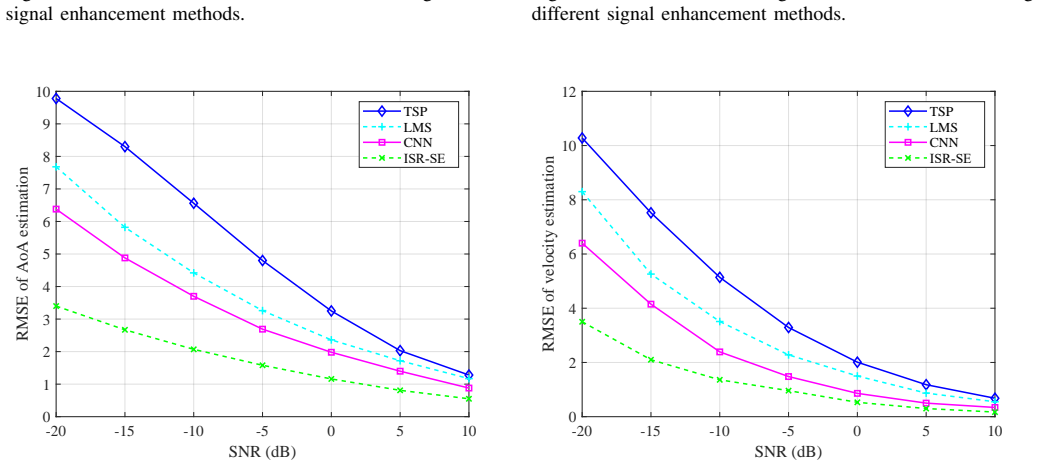
- At SNR levels down to -20 dB, the ISR-SE method keeps noise-estimation MSE below all three baselines and retains a lower RMSE for angle, range, and velocity estimates.
- Because the enhanced output is a time-domain signal, both communication demodulation and passive sensing benefit from the same processing chain, which is why the reported BER also improves by 1-2 orders of magnitude over CNN at low SNR.
- The power-allocation sweep shows a quantifiable tradeoff: increasing the sensing power factor $\beta_R$ improves range RMSE with diminishing returns while pushing BER toward $10^{-1}$, so systems must pick an operating point between communication and sensing quality.
- The framework replaces hand-designed filters and statistical noise assumptions with learned generative priors, so the same architecture can be retrained for different environments without changing the RGB construction or the sensing algorithms.
Reading between the lines
- Editorial inference: the paper does not describe how the observed noisy image enters the reverse diffusion process; as written, Algorithm 1 starts from pure Gaussian noise. A conditional diffusion formulation, where the observed RGB image steers each reverse step, is the natural way to make the pipeline consistent with standard denoising diffusion.
- Editorial inference: because the RGB encoding and ISTFT are invertible, the same denoiser could be retrained for other OFDM-based bistatic sensing setups or other weak-signal radar problems, provided the training data span the relevant SNR range.
- Editorial inference: the 63 percent figure is tied to the paper's custom training dataset; making that dataset or the SNR-dependent gain curves public would let others test how well image-space denoising generalizes beyond the simulated scenario.
Signed reviews
Editorial analysis
A structured set of objections, weighed in public.
Referee Report
Summary. The paper proposes an image super-resolution-based signal enhancement (ISR-SE) framework for bistatic ISAC systems. Received low-SNR signals are converted via STFT into RGB images whose channels encode magnitude, frequency index, and phase; an improved UNet-diffusion model is then applied to denoise or enhance these images, after which ISTFT reconstructs the time-domain signal for MUSIC and 2D-DFT based angle, range, and velocity estimation. The central claim is that the proposed method improves estimation accuracy by 63% compared to traditional signal processing.
Significance. If the claimed result held, the paper would illustrate a useful direction: applying generative image-space priors to low-SNR bistatic ISAC signal recovery. The manuscript provides a complete system model, a concrete pipeline, and comparisons against TSP, LMS, and CNN baselines. However, the key enhancement step is not reproducibly specified, the training and evaluation do not meet the standards needed to support the empirical claim, and no code or data are provided. The 63% improvement is thus a fitted simulation outcome rather than a demonstrated, reproducible result. The idea may have merit, but the current manuscript does not establish it.
major comments (4)
- [Algorithm 2 (Section III-C) and Algorithm 1 (Section III-B)] The reverse diffusion process in Algorithm 1 is defined only for x_T drawn from N(0,I), with no conditioning term on an observed image. Algorithm 2 instructs the reader to feed the observed RGB image x_T into the pretrained model and perform the operation according to Algorithm 1. If the observed image is used as x_T, it is not a sample from the Gaussian prior and its time index t is unknown, so the update in Eq. (12) has no denoising interpretation; if pure noise is used, the output is unrelated to the input. No guidance, replacement, inpainting, or other conditioning mechanism is described. As written, the enhancement step does not map a specific noisy image to a denoised version, making the reported results unreproducible.
- [Section III-B, Eq. (13) and training description] The composite loss in Eq. (13) includes SSIM(x_t, \hat{x}_t), but \hat{x}_t is never defined, and the paper does not specify how this loss is optimized relative to the standard diffusion noise-prediction objective. The training dataset is described only as 'collected through our own measurement and acquisition process', with no size, SNR distribution, or train/test split; Figs. 6 and 7 show only training loss curves, not validation or test performance. This prevents independent assessment of generalization and makes the claimed improvement unverifiable.
- [Section III-A, Eqs. (16)-(18) and Section III-C, Step 4] The RGB construction does not preserve the claimed information. The green channel in Eq. (17) is only the normalized frequency index and is deterministic for a fixed STFT configuration; it carries no signal-dependent information. More importantly, the paper gives no explicit inverse mapping from enhanced RGB values to a complex STFT for the ISTFT: it states that RGB channels are 'converted' back to amplitude, frequency, and phase, but no equations or procedures are provided. Without a defined inverse, the claim that the pipeline reconstructs a high-SNR time-domain signal is unsupported.
- [Abstract and Section V] The 63% improvement claim is not well-defined. The abstract says the method 'improves the estimation accuracy by 63%', while Section V says 'over 63% compared to the TSP-based method'; no SNR value, specific metric, or statistical significance is attached to this number. The evaluation is entirely based on the authors' own simulations and a custom dataset, with no independent test set or external benchmark. The baselines (e.g., LMS step size, CNN architecture) are also insufficiently specified, so the comparison cannot be reproduced.
minor comments (6)
- [Section III-B, Eq. (10)] The variance matrix in Eq. (10) is written with a summation symbol (\sum_t) and is not defined; use a consistent notation such as \Sigma_t.
- [Section III-B, Fig. 2] Figure 2 contains Chinese text ('改进的UNet去噪网络'); all figure labels should be in English.
- [Section V, baselines] Specify the LMS step size and filter length, the CNN architecture and training hyperparameters, and the exact evaluation protocol for all baselines.
- [Section IV, Eq. (19)] The variables f_e_l and tau_e_l in Eq. (19) are not defined; clarify their meaning or remove the superscript 'e'.
- [References] Reference [36] is mis-formatted: Denoising Diffusion Probabilistic Models is an arXiv paper (arXiv:2006.11239) and is not published in IEEE Wireless Communications Letters; please correct the citation.
- [Section III-A, Step 4] State the image dimensions used for the RGB representation and clarify whether the diffusion model operates on 8-bit quantized values or on continuous normalized values.
Circularity Check
As written, Algorithm 2 discards the observed RGB image: Algorithm 1 initializes x_T as pure Gaussian noise with no conditioning term, so the reported 63% gain is not derivable from the described method.
-
self definitional
[Algorithm 2 Steps 2–3 and Algorithm 1 lines 1–6 (Section III-B/C)]
"Algorithm 1: Reverse Diffusion Process 1: 𝒙𝑻∈N (0, I) ... Algorithm 2: ISR-based Signal Enhancement Framewrok Step 2: RGB image construction 6: Map the extracted spectral information into three separate color channels after normalization. Construct RGB image 𝒙𝑻. Step 3: Diffusion model-based image processing 8: Feed 𝒙𝑻 into pretrained diffusion model 𝐺, and perform the image super-resolution operation according to Algorithm 1. Recover super-resolution image 𝒙0."
The constructed RGB image is named x_T and handed to Algorithm 1, but Algorithm 1 defines x_T as a pure Gaussian draw and iterates Eq. (12) with no term that conditions on an observed image. No guidance, inpainting, replacement, or posterior-sampling mechanism is specified to connect the noisy RGB input to the reverse trajectory. Consequently, following the paper's own equations, the output x0 is a sample from the model's prior that is statistically independent of the observed signal; the claimed enhancement of that specific signal reduces by construction to unconstrained generation. The 63% RMSE improvement over TSP therefore cannot be derived from the described method without an unstated conditioning step.
full rationale
The core difficulty in this paper is not a self-citation chain or a fitted parameter relabeled as a prediction. References to the authors' prior work ([8], [27], [33]) are background and not load-bearing, and the diffusion network is trained with a conventional MSE-plus-SSIM objective on a self-collected dataset. The central claim is empirical rather than derived, so an independent benchmark could in principle support it. However, the enhancement step itself is internally inconsistent: Algorithm 2 labels the observed RGB image as x_T, while Algorithm 1 starts its reverse process by setting x_T from N(0,I) and contains no conditioning term. As written, the output x0 is not a function of the noisy input, so the reported 63% improvement is unsupported by the described method. This is a load-bearing definitional gap in the claimed input-output relation, and it is flagged here as a self-definitional reduction rather than a correctness quibble. If a proper conditioning mechanism were supplied, the method would be an empirical image-denoising pipeline whose comparison against LMS and CNN baselines could be evaluated externally; the present text does not provide that mechanism.
Assumptions & free parameters
free parameters (5)
- M_max =
not specified
- alpha (loss weight) =
not specified
- diffusion steps T =
500
- learning rate =
10^-4
- STFT window length and overlap =
128 and 120 samples
assumptions (4)
- ad hoc to paper The reverse diffusion process of Algorithm 1 can be initialized with the observed noisy RGB image x_T and still produce the denoised image x_0.
- ad hoc to paper The RGB mapping in Eqs (16)-(18) preserves all information needed to reconstruct the STFT and the subsequent time-domain signal via ISTFT.
- domain assumption The BS and detecting UAV are physically stationary (Section II-A).
- domain assumption The training data distribution matches the evaluation simulation distribution.
Cite this review
Pith. "Pith review of Image Super-Resolution-Based Signal Enhancement in Bistatic ISAC." pith.science (2026). https://pith.science/paper/SYD4Z45I
@misc{pith2026250709218,
  author       = {Pith},
  title        = {Pith review of: Image Super-Resolution-Based Signal Enhancement in Bistatic ISAC},
  year         = {2026},
  howpublished = {\url{https://pith.science/paper/SYD4Z45I}},
  note         = {Machine review of arXiv:2507.09218}
}
read the original abstract
Bistatic Integrated Sensing and Communication (ISAC) is poised to become a cornerstone technology in next-generation communication networks, such as Beyond 5G (B5G) and 6G, by enabling the concurrent execution of sensing and communication functions without requiring significant modifications to existing infrastructure. Despite its promising potential, a major challenge in bistatic cooperative sensing lies in the degradation of sensing accuracy, primarily caused by the inherently weak received signals resulting from high reflection losses in complex environments. Traditional methods have predominantly relied on adaptive filtering techniques to enhance the Signal-to-Noise Ratio (SNR) by dynamically adjusting the filter coefficients. However, these methods often struggle to adapt effectively to the increasingly complex and diverse network topologies. To address these challenges, we propose a novel Image Super-Resolution-based Signal Enhancement (ISR-SE) framework that significantly improves the recognition and recovery capabilities of ISAC signals. Specifically, we first perform a time-frequency analysis by applying the Short-Time Fourier Transform (STFT) to the received signals, generating spectrograms that capture the frequency, magnitude, and phase components. These components are then mapped into RGB images, where each channel represents one of the extracted features, enabling a more intuitive and informative visualization of the signal structure. To enhance these RGB images, we design an improved denoising network that combines the strengths of the UNet architecture and diffusion models. This hybrid architecture leverages UNet's multi-scale feature extraction and the generative capacity of diffusion models to perform effective image denoising, thereby improving the quality and clarity of signal representations under low-SNR conditions.
Figures


Figures from the paper (7 more)



Reference graph
Works this paper leans on
-
[1]
A Survey of Security in UA Vs and FANETs:Issues, Threats, Analysis of Attacks, and Solutions,
O. Ceviz, S. Sen and P. Sadioglu, “A Survey of Security in UA Vs and FANETs:Issues, Threats, Analysis of Attacks, and Solutions,” IEEE Commun. Surveys Tuts. , Dec. 2024, doi: 10.1109/COMST.2024.3515051
arXiv 2024
-
[2]
A Survey on Security of Unmanned Aerial Vehicle Systems: Attacks and Countermeasures,
X. Wei, J. Ma and C. Sun, “A Survey on Security of Unmanned Aerial Vehicle Systems: Attacks and Countermeasures,” IEEE Internet Things J., vol. 11, no. 21, pp. 34826–34847, Nov. 2024
work page 2024
-
[3]
Intrusion Detection for Unmanned Aerial Vehicles Security: A Tiny Machine Learning Model,
Y . Wu, L. Yang, L. Zhang, L. Nie and L. Zheng, “Intrusion Detection for Unmanned Aerial Vehicles Security: A Tiny Machine Learning Model,” IEEE Internet Things J. , vol. 11, no. 12, pp. 20970–20982, Jun. 2024
work page 2024
-
[4]
A Low-Slow-Small UA V Detection Method Based on Fusion of Range-Doppler Map and Satellite Map,
Q. Wang, H. Xu, S. Lin et al. , “A Low-Slow-Small UA V Detection Method Based on Fusion of Range-Doppler Map and Satellite Map,” IEEE Trans. Aerosp. Electron. Syst. , vol. 60, no. 4, pp. 4767–4783, Aug. 2024
work page 2024
-
[5]
Advanced Technology of High- Resolution Radar: Target Detection Tracking Imaging and Recognition,
T. Long, Z. Liang and Q. Liu, “Advanced Technology of High- Resolution Radar: Target Detection Tracking Imaging and Recognition,” Sci. China Inf. Sci. , vol. 62, pp. 1–26, Mar. 2019
work page 2019
-
[6]
Integrated Sensing and Communication Enabled Multiple Base Stations Cooperative Sensing Towards 6G,
Z. Wei, W. Jiang, Z. Feng et al., “Integrated Sensing and Communication Enabled Multiple Base Stations Cooperative Sensing Towards 6G,”IEEE Netw., vol. 38, no. 4, pp. 207–215, Jul. 2024
work page 2024
-
[7]
Inte- grated Sensing and Communications: Toward Dual-Functional Wireless Networks for 6G and Beyond,
F. Liu, Y . Cui, C. Masouros, J. Xu, T. Han, Y . Eldar and S. Buzzi, “Inte- grated Sensing and Communications: Toward Dual-Functional Wireless Networks for 6G and Beyond,” IEEE J. Sel. Areas Commun. , vol. 40, no. 6, pp. 1728–1767, Jun. 2022
work page 2022
-
[8]
ISAC Enabled Cooperative Detection for Cellular-Connected UA V Network,
Y . Wang, K. Zu, L. Xiang et al., “ISAC Enabled Cooperative Detection for Cellular-Connected UA V Network,”IEEE Trans. Wireless Commun., vol. 24, no. 2, pp. 1541–1554, Feb. 2025
work page 2025
Show all 40 references
-
[9]
Sensing in Bistatic ISAC Systems With Clock Asynchronism: A Signal Processing Perspective,
K. Wu, J. Pegoraro, F. Meneghello et al. , “Sensing in Bistatic ISAC Systems With Clock Asynchronism: A Signal Processing Perspective,” IEEE Signal Process. Mag. , vol. 41, no. 5, pp. 31–43, Sep. 2024
2024
-
[10]
Integrated Sensing and Communication (ISAC) for Vehicles: Bistatic Radar with 5G-NR Signals,
N. K. Nataraja, S. Sharma, K. Ali, F. Bai, R. Wang and A. F. Molisch, “Integrated Sensing and Communication (ISAC) for Vehicles: Bistatic Radar with 5G-NR Signals,” IEEE Trans. V eh. Technol., Dec. 2024, doi: 10.1109/TVT.2024.3514573
2024
-
[11]
Channel Modeling Framework for Both Communications and Bistatic Sensing Under 3GPP Standard,
C. Luo, A. Tang, F. Gao, J. Liu and X. Wang, “Channel Modeling Framework for Both Communications and Bistatic Sensing Under 3GPP Standard,” IEEE J. Sel. Topics Signal Process. , vol. 18, no. 5, pp. 842– 856, Jul. 2024
2024
-
[12]
Complex Neural Network Based Joint AoA and AoD Estimation for Bistatic ISAC,
S. Naoumi, A. Bazzi, R. Bomfin and M. Chafii, “Complex Neural Network Based Joint AoA and AoD Estimation for Bistatic ISAC,”IEEE J. Sel. Areas Sensors , vol. 1, pp. 166–176, Aug. 2024
2024
-
[13]
Joint Target Localization and Data Detection in Bistatic ISAC Networks,
N. Zhao, Q. Chang, X. Shen, Y . Wang and Y . Shen, “Joint Target Localization and Data Detection in Bistatic ISAC Networks,” IEEE Trans. on Commun. , Oct. 2024, doi: 10.1109/TCOMM.2024.3481046
2024
-
[14]
Radar Detection Performance Prediction Using Measured UA Vs RCS Data,
M. Rosamilia, A. Balleri, A. De Maio, A. Aubry and V . Carotenuto, “Radar Detection Performance Prediction Using Measured UA Vs RCS Data,” IEEE Trans. Aerosp. Electron. Syst. , vol. 59, no. 4, pp. 3550– 3565, Aug. 2023
2023
-
[15]
Trajectory Design and Power Control for Joint Radar and Communication Enabled Multi-UA V Cooperative Detection Systems,
T. Zhang, K. Zhu, S. Zheng, D. Niyato and N. C. Luong, “Trajectory Design and Power Control for Joint Radar and Communication Enabled Multi-UA V Cooperative Detection Systems,”IEEE Trans. Commun., vol. 71, no. 1, pp. 158–172, Jan. 2023
2023
-
[16]
Adaptive Filtering Noise Sup- pression Technique for EFA-Based Interferometric Fiber Optic Sensors,
W. Zhou, X. Wu, J. Zhang, J. Shi et al., “Adaptive Filtering Noise Sup- pression Technique for EFA-Based Interferometric Fiber Optic Sensors,” J. Lightw. Technol., vol. 42, no. 7, pp. 2544–2549, Apr. 2024
2024
-
[17]
Optimal Penalty Factor for the MOV-FxLMS Algorithm in Active Noise Control System,
D. Shi, W. -S. Gan, B. Lam and X. Shen, “Optimal Penalty Factor for the MOV-FxLMS Algorithm in Active Noise Control System,” IEEE Signal Process. Lett. , vol. 29, pp. 85–89, Nov. 2021
2021
-
[18]
Adaptive Noise Suppression of Pediatric Lung Auscultations With Real Applications to Noisy Clinical Settings in Developing Countries,
D. Emmanouilidou, E. D. McCollum, D. E. Park and M. Elhilali, “Adaptive Noise Suppression of Pediatric Lung Auscultations With Real Applications to Noisy Clinical Settings in Developing Countries,” IEEE Trans. Biomed. Eng. , vol. 62, no. 9, pp. 2279–2288, Sep. 2015
2015
-
[19]
Estimation of Measurement-Noise Variance for Variable-Step- Size NLMS Filters,
T. Strutz, “Estimation of Measurement-Noise Variance for Variable-Step- Size NLMS Filters,” Proc. European Signal Process. Conf. (EUSIPCO) , pp. 1–5, 2019
2019
-
[20]
Faster, Stabler, and Simpler-A Recursive- Least-Squares Algorithm Exploiting the Frisch-Waugh-Lovell Theo- rem,
P. Monsurro and A. Trifiletti, “Faster, Stabler, and Simpler-A Recursive- Least-Squares Algorithm Exploiting the Frisch-Waugh-Lovell Theo- rem,” IEEE Trans. Circuits Sys. II Exp. Briefs , vol. 64, no. 3, pp. 344– 348, Mar. 2017
2017
-
[21]
Reduced-Complexity Constrained Recursive Least-Squares Adaptive Filtering Algorithm,
R. Arablouei and K. Dogancay, “Reduced-Complexity Constrained Recursive Least-Squares Adaptive Filtering Algorithm,” IEEE Trans. Signal Process., vol. 60, no. 12, pp. 6687–6692, Dec. 2012
2012
-
[22]
Deep CNN-Based Super-Resolution Using External and Internal Examples,
J. Y . Cheong and I. K. Park, “Deep CNN-Based Super-Resolution Using External and Internal Examples,” IEEE Trans. Signal Process. Lett. , vol. 24, no. 8, pp. 1252–1256, Aug. 2017
2017
-
[23]
A Method for Denoising Seismic Signals With a CNN Based on an Attention Mechanism,
S. Yan, Y . Long, R. Fu, X. Huang, J. Lin and Z. Li, “A Method for Denoising Seismic Signals With a CNN Based on an Attention Mechanism,” IEEE Trans. Geosci. Remote Sens. , vol. 60, pp. 1–15, Oct. 2022
2022
-
[24]
DeepSense: A Unified Deep Learning Framework for Time-Series Mobile Sensing Data Processing,
S. Yao, S. Hu, Y . Zhao, A. Zhang and T. Abdelzaher, “DeepSense: A Unified Deep Learning Framework for Time-Series Mobile Sensing Data Processing,” arXiv:1611.01942, 2017
2017 arXiv
-
[25]
Sea Clutter Suppression for Radar PPI Images Based on SCS-GAN,
X. Mou, X. Chen, J. Guan, Y . Dong and N. Liu, “Sea Clutter Suppression for Radar PPI Images Based on SCS-GAN,” IEEE Geosci. Remote Sens. Lett., vol. 18, no. 11, pp. 1886–1890, Nov. 2021
2021
-
[26]
A Sea Clutter Suppression Method Based on Machine Learning Approach for Marine Surveillance Radar,
J. Pei, Y . Yang, Z. Wu, Y . Maet al., “A Sea Clutter Suppression Method Based on Machine Learning Approach for Marine Surveillance Radar,” IEEE J. Sel. Topics Appl. Earth Observ. Remote Sens. , vol. 15, pp. 3120– 3130, Apr. 2022
2022
-
[27]
WTE-CGAN Based Signal Enhancement for Weak Target Detection,
Y . Wang, C. Zang, B. Yu, W. Zhao et al. , “WTE-CGAN Based Signal Enhancement for Weak Target Detection,” IEEE Geosci. Remote Sens. Lett., vol. 21, pp. 1–5, Dec. 2023
2023
-
[28]
Joint Estimation of Satellite Attitude and Size Based on ISAR Image Interpretation and Parametric Optimization,
J. Wang, Y . Li, L. Du, M. Song and M. Xing, “Joint Estimation of Satellite Attitude and Size Based on ISAR Image Interpretation and Parametric Optimization,” IEEE Trans. Geosci. Remote Sens. , vol. 60, pp. 1–17, Aug. 2021
2021
-
[29]
Channel Estimation for Intelligent Reflecting Surface Aided Wireless Communications Using Conditional GAN,
M. Ye, H. Zhang and J. -B. Wang, “Channel Estimation for Intelligent Reflecting Surface Aided Wireless Communications Using Conditional GAN,” IEEE Commun. Lett. , vol. 26, no. 10, pp. 2340–2344, Oct. 2022
2022
-
[30]
Generative AI for Integrated Sensing and Communication: Insights From the Physical Layer Perspective,
J. Wang, H. Du, D. Niyato et al., “Generative AI for Integrated Sensing and Communication: Insights From the Physical Layer Perspective,” IEEE Wireless Commun. , vol. 31, no. 5, pp. 246–255, Oct. 2024
2024
-
[31]
Enabling Joint Communication and Radar Sensing in Mobile Networks-A Survey,
J. A. Zhang, M. L. Rahman, K. Wu, X. Huang, Y . J. Guo, S. Chen and J. Yuan, “Enabling Joint Communication and Radar Sensing in Mobile Networks-A Survey,” IEEE Commun. Surveys Tuts. , vol. 24, no. 1, pp. 306–345, Firstquarter 2022
2022
-
[32]
Multibeam for Joint Communication and Radar Sensing Using Steerable Analog Antenna Arrays,
J. A. Zhang, X. Huang, Y . J. Guo, J. Yuan and R. W. Heath, “Multibeam for Joint Communication and Radar Sensing Using Steerable Analog Antenna Arrays,” IEEE Trans. V eh. Technol. , vol. 68, no. 1, pp. 671– 685, Jan. 2019
2019
-
[33]
Interference Characterization and Mitigation for Multi-beam ISAC Systems in Vehicular Networks,
Y . Wang, Q. Zhang, J. Andrew Zhang, Z. Wei, Z. Feng and J. Peng, “Interference Characterization and Mitigation for Multi-beam ISAC Systems in Vehicular Networks,” IEEE Trans. Wireless Commun. , vol. 23, no. 10, pp. 14729–14742, Oct. 2024
2024
-
[34]
Conditional Denoising Diffusion Probabilistic Models for Data Reconstruction Enhancement in Wireless Communications,
M. Letafati, S. Ali and M. Latva-Aho, “Conditional Denoising Diffusion Probabilistic Models for Data Reconstruction Enhancement in Wireless Communications,” IEEE Trans. Mach. Learn. Commun. Netw. , vol. 3, pp. 133–146, Dec. 2024
2024
-
[35]
Diffusion Model-Aided Data Reconstruction in Cell-Free Massive MIMO Downlink: A Computation- Aware Approach,
M. Letafati, S. Ali and M. Latva-Aho, “Diffusion Model-Aided Data Reconstruction in Cell-Free Massive MIMO Downlink: A Computation- Aware Approach,” IEEE Wireless Commun. Lttt. , vol. 13, no. 11, pp. 3162–3166, Nov. 2024
2024
-
[36]
Denoising Diffusion Probabilistic Mod- els,
J. Ho, A. Jain and P. Abbeel, “Denoising Diffusion Probabilistic Mod- els,” IEEE Wireless Commun. Lttt. , vol. 13, no. 11, pp. 3162–3166, arXiv:2006.11239, Dec. 2020
2006 arXiv
-
[37]
Study on Channel Model for Frequencies From 0.5 to 100 GHz, V14.3.0,
3GPP, TR 38.901, “Study on Channel Model for Frequencies From 0.5 to 100 GHz, V14.3.0,” 2017
2017
-
[38]
Performance Enhancement of Codebook-Based Beamforming Using Least Squares Approach,
S. J. Lee, “Performance Enhancement of Codebook-Based Beamforming Using Least Squares Approach,” IEEE Wireless Commun. Lett. , vol. 13, no. 2, pp. 338–342, Feb. 2024
2024
-
[39]
The Provi- sional Regulations on the Flight Management of Unmanned Aircraft,
The State Council and the Central Military Commission, “The Provi- sional Regulations on the Flight Management of Unmanned Aircraft,” Jun. 2023
2023
-
[40]
Kalman Filter- Based Sensing in Communication Systems With Clock Asynchronism,
X. Chen, Z. Feng, J. A. Zhang, X. Yuan and P. Zhang, “Kalman Filter- Based Sensing in Communication Systems With Clock Asynchronism,” IEEE Trans. Commun. , vol. 72, no. 1, pp. 403–417, Jan. 2024
2024
Reviewed August 6, 2026 · model on record in the stance chip above.
Discussion (0). Continue with ORCID to comment.