REVIEW 4 major objections 5 minor 35 references
Computational Aerothermal Framework and Analysis of Stetson Mach 6 Blunt Cone
T0 review · 4 major / 5 minor · reviewed 2026-08-06 · deepseek-v4-flash
Pith's one-line read A one-way CFD-to-heat-conduction workflow predicts Mach 6 blunt-cone surface heating, with residual error blamed on missing chemical kinetics.
desk verdict Central validation claim unsupported; material-property error and contradictory flow descriptions make this a desk reject. read the letter →
The pith
A machine-rendered reading of the paper's core claim, the machinery that carries it, and where it could break.
The reading
What carries the argument
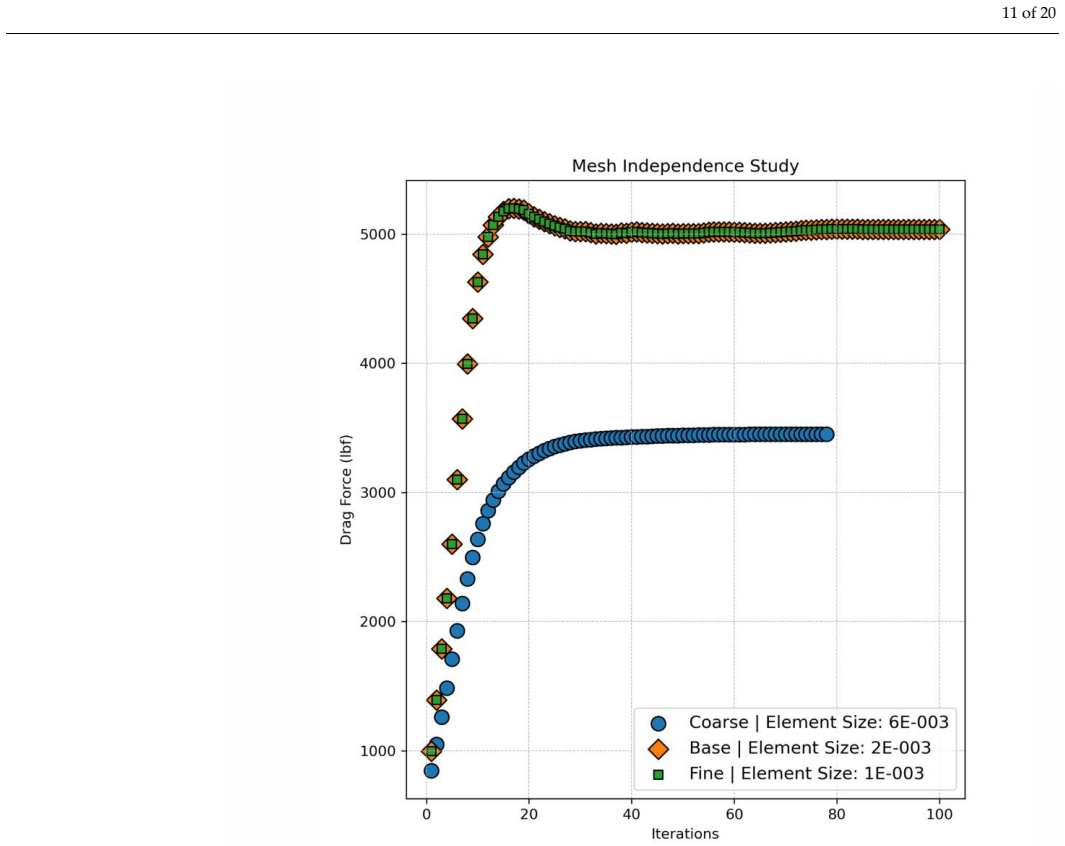
The mechanism that carries the argument is the one-way coupling loop. First, a steady, axisymmetric, compressible Navier-Stokes solver with AUSM flux, second-order upwind spatial discretization, and a no-slip wall computes the external Mach 6 flow; discrete roughness elements are inserted on the cone wall and modeled through the modified law-of-the-wall roughness function $\Delta U^+$ in the turbulent runs. Second, the surface temperature field is passed as a boundary condition to a finite-element heat-conduction solve of the 1-inch-thick wall with an inner adiabatic zero-flux condition. Third, the computed heat transfer coefficient is compared with the experimental curve, making $h$ the validating observable. Temperature-dependent conductivity and specific heat for the wall material enter through Eqs. (5) and (6), and mesh independence is asserted by stabilizing computed drag across coarse, base, and fine grids.
What would settle it
Digitize the experimental heat-transfer coefficient as a function of surface distance from the 1983 paper and overplot the computed curve for the same roughness configuration. If the computed values differ by more than the experimental uncertainty in the laminar, pre-transition region—where chemical kinetics should be negligible—then the validation claim fails and the discrepancy cannot be attributed entirely to missing chemistry.
Extended reading notes
Core claim
The central claim on the paper's own terms is that a one-way coupled CFD-thermal framework—laminar and k-omega RANS solutions of the external Mach 6 flow over an axisymmetric 8-degree half-angle blunt cone, followed by a finite-element heat-conduction solve of the 17-4 PH stainless steel wall using the CFD surface temperature as boundary condition—yields heat transfer coefficients that are physically reliable when compared with the 1983 experiment. The discrete roughness elements produce localized flow separation, horseshoe vortices, small shock signatures, and early transition, which appear as temperature spikes on the cone frustum; the stagnation point carries the peak heat load. The authors state that the results are validated against the experimental heat transfer coefficient and that the residual discrepancies are due to the absent chemical kinetics model, specifically the missing vibrational-dissociation non-equilibrium effects in the energy equation.
Load-bearing premise
The computational setup faithfully reproduces the 1983 experiment—nose radius, 8-degree half-angle, Mach 6 at 4000 feet, and the discrete roughness-element sizes on the cone wall all matching the physical test article; if any of these differs, the claimed validation against the experimental heat-transfer data has no meaning.
Editorial extensions
If this is right
- If the framework is as reliable as claimed, thermal protection system screening for blunt hypersonic bodies can be done with steady CFD plus a solid heat-conduction solve, avoiding the cost of fully coupled reacting-flow simulations.
- The computed temperature spikes at discrete roughness elements imply that roughness height and placement directly control where peak thermal loads occur and where transition begins.
- Because the paper attributes the mismatch to missing chemical kinetics, the non-reacting results establish a baseline that a finite-rate chemistry solver should improve upon; improvement of the heat transfer comparison would confirm that attribution.
- The one-way coupling is justified only when the wall temperature response does not appreciably alter the boundary layer; for thicker walls or higher enthalpy flows where surface temperature feeds back, a fully coupled solve would be required.
- The mesh-independence procedure based on stabilized drag suggests that global force convergence, not just local heating convergence, is used as the grid-quality criterion; adopting this check in similar studies would help reproducibility.
Reading between the lines
- A testable extension the paper leaves implicit: run the same geometry and conditions with a finite-rate chemistry or two-temperature model and compare the heat transfer coefficient curve to the non-reacting result; the difference would isolate the thermochemical contribution that the authors blame for the experimental gap.
- The paper's roughness treatment is a RANS-level law-of-the-wall modification; a natural next test is to resolve the trip elements directly in an LES or DNS and see whether the predicted temperature spikes and transition onset shift.
- The framework's claim of physical accuracy rests on a single geometry and Mach number; applying the same one-way workflow to a different blunt-body shape or higher enthalpy condition would show how much of the agreement is specific to this test case.
- Because the authors note that the current energy equation excludes vibrational-electronic energy exchange, an implicit consequence is that wall temperature and heat flux predictions are likely most trustworthy where non-equilibrium is weak and least trustworthy near the stagnation point at high enthalpy; future work should state that domain of validity explicitly.
Signed reviews
Editorial analysis
A structured set of objections, weighed in public.
Referee Report
Summary. This paper proposes a computational aerothermal framework that couples a steady-state axisymmetric compressible Navier-Stokes CFD solution with a finite-element heat conduction solution for a Mach 6 blunt cone geometry inspired by Stetson's 1983 experiments. The authors model discrete roughness elements through a modified law-of-the-wall and compute surface temperature and heat transfer coefficient fields, then claim validation against Stetson's experimental heat transfer coefficient. The manuscript reports mesh independence based on drag force, presents Mach number and temperature contours, and identifies the absence of chemical kinetics as a source of discrepancies with experiment. However, no quantitative comparison with Stetson's heat transfer data is provided anywhere in the paper, and the text explicitly admits discrepancies and states that experimental validation remains future work.
Significance. If the one-way coupled framework were validated against Stetson's experiment, it would be a useful contribution to hypersonic aerothermal modeling, particularly for assessing roughness-induced heating. The mesh independence study and the explicit recognition that chemical kinetics are needed for high-enthalpy flows are worthwhile elements. However, the central validation claim is unsupported: the manuscript contains no computed or measured heat transfer coefficients, no error metrics, and no comparison figures. In addition, the material-property equations used for the 17-4 PH steel wall appear to be for air, undermining the solid heat conduction calculation. These are load-bearing issues that prevent the paper from making a reliable contribution in its current form.
major comments (4)
- [Section 3, 'Method' and Section 4, 'Computational Set-Up and Results'] The central claim, stated in Section 3 as 'The employed approach is validated against the experimental heat transfer coefficient outlined by Stetson, thereby ensuring its physical accuracy and reliability,' is not supported by any quantitative data in the manuscript. No computed or experimental heat transfer coefficient values, comparison plots, error bounds, or uncertainty analyses are presented. The only substantive statement about comparison appears in Section 4, where the authors write that 'observed discrepancies in the heat transfer coefficient results between Rodriguez (2024) and Stetson (AIAA, 1983) can be attributed to the absence of a more sophisticated energy equation model and chemical kinetics.' This admission directly contradicts the validation claim and makes the central assertion unfalsifiable from the manuscript as written.
- [Section 4, Eqs. (5)-(6)] Equations (5) and (6) are introduced as the temperature-dependent thermal conductivity and specific heat capacity of the 17-4 PH stainless steel wall, but the paragraph immediately following states that they 'encapsulate the temperature-dependent characteristics of air's thermal conductivity and specific heat capacity.' These are load-bearing equations for the heat conduction simulation. The numerical values are also inconsistent with a metallic solid: Eq. (5) gives k on the order of 10^-4 BTU/(in·s·F), which is orders of magnitude below the thermal conductivity of 17-4 PH steel, and the units of Eq. (6) do not produce a physically meaningful specific heat in BTU/(lbm·F). This error propagates into the computed heat transfer coefficient and invalidates the solid-domain thermal response.
- [Section 4, 'Computational Set-Up and Results'] The computational geometry is asserted to 'pertain to the blunt cone utilized by Stetson in his physical experiments,' but no citation or detailed comparison to the original Stetson experiment is given. The dimensions listed (base radius 2.0 inches, nose tip base 0.6 inches, half-angle 8 degrees) are not verified against Stetson's paper, and the roughness element heights—central to the study's stated objective—are never specified. Without a documented correspondence between the simulated configuration and Stetson's experimental setup, the claimed validation against Stetson's heat transfer data is not meaningful.
- [Section 4 and Section 5, 'Limitations and Future Work'] The manuscript is internally inconsistent about the status of validation. Section 4 admits 'observed discrepancies' with Stetson's data, Section 5 states that 'experimental validation remains crucial for reinforcing computational findings,' and Section 7 says future work will include 'Experimental Validation' through wind and water tunnel tests. These statements contradict the earlier claim in Section 3 that the approach is validated and ensures physical accuracy. Additionally, Section 7 refers to 'our current two-temperature model,' but no two-temperature model is described or used in the paper; the governing equations shown in Eqs. (1)-(3) are for a single-temperature perfect gas.
minor comments (5)
- [General] Figure numbering is inconsistent: the text refers to 'Figure 5' as a temperature contour, then later refers to 'Figure 7' for the same type of plot, and some figures cited in the discussion are not present in the manuscript.
- [Section 3.4] The text mentions 'finite volume spectral method' alongside 'second-order upwind scheme' for spatial discretization; please clarify which discretization was actually used in ANSYS Fluent.
- [References] Reference [26] (Rodriguez) lacks a year and publication venue; please provide a complete citation, as this reference is central to the claimed comparison with Stetson.
- [Nomenclature] Unit symbols are inconsistent (e.g., 'Lbm' vs. 'lbm', spacing in compound units); please standardize the nomenclature list.
- [Abstract] The abstract says the study 'draws inspiration from Stetson's foundational experimental work,' which is more cautious than the validation claim in Section 3; the two statements should be reconciled.
Circularity Check
No circularity: the claimed validation targets an external experiment (Stetson 1983) and no quantity is fitted to or derived from that target.
full rationale
The paper's central comparison is between its own CFD/heat-conduction outputs and Stetson's external 1983 experimental heat transfer data. The heat transfer coefficient is computed from the simulation's surface temperature and heat flux, not from Stetson's data, so the comparison is not self-referential. The one-way coupling (CFD surface temperature as a boundary condition for the solid heat conduction solver) is a modeling choice and does not mathematically force agreement with Stetson. Self-citations (refs. 3, 26, 32, 33) are contextual: ref. 26 is mentioned in Section 4 when attributing observed discrepancies to the absence of chemical kinetics, but the present results are not derived from that prior work. The claimed validation is asserted without a quantitative comparison, and the manuscript itself concedes discrepancies and states that experimental validation remains crucial; this is an evidentiary/validity weakness, not circularity. No fitted parameter is renamed as a prediction, and no uniqueness theorem or ansatz is imported from the authors' own prior work to force the result.
Assumptions & free parameters
free parameters (3)
- k(T) polynomial coefficients (Eq. 5) =
2.08e-4 + 1.13e-7 * T
- Cp(T) polynomial coefficients (Eq. 6) =
0.104 + 3.38e-5 * T + 4.45e-8 * T^2
- Roughness element heights and modified law-of-the-wall parameters =
not reported
assumptions (5)
- domain assumption Perfect gas and ideal gas law for air at 4000 ft altitude.
- domain assumption Steady-state axisymmetric Navier-Stokes (or k-omega RANS) captures roughness-induced transition.
- domain assumption One-way coupling (CFD surface temperature to solid conduction, no feedback) is sufficient.
- domain assumption The computational setup replicates Stetson's 1983 experiment.
- domain assumption Wall material is 17-4 PH stainless steel with temperature-dependent properties.
Cite this review
Pith. "Pith review of Computational Aerothermal Framework and Analysis of Stetson Mach 6 Blunt Cone." pith.science (2026). https://pith.science/paper/EMTWXAA3
@misc{pith2026250709368,
  author       = {Pith},
  title        = {Pith review of: Computational Aerothermal Framework and Analysis of Stetson Mach 6 Blunt Cone},
  year         = {2026},
  howpublished = {\url{https://pith.science/paper/EMTWXAA3}},
  note         = {Machine review of arXiv:2507.09368}
}
read the original abstract
Accurately predicting aerothermal behavior is paramount for the effective design of hypersonic vehicles, as aerodynamic heating plays a pivotal role in influencing performance metrics and structural integrity. This study introduces a computational aerothermal framework and analyzes a blunt cone subjected to Mach 6 conditions, drawing inspiration from Stetson foundational experimental work published in 1983. While the findings offer significant insights into the phenomena at play, the study highlights an urgent necessity for integrating chemical kinetics to comprehensively capture non-equilibrium effects, thereby enhancing the predictive accuracy of computational fluid dynamics (CFD) simulations. This research implements a one-way coupling method between CFD simulations and heat conduction analysis, facilitating a thorough investigation of surface heat transfer characteristics. The numerical results elucidate discrete roughness elements' impact on surface heating and fluid dynamics within high-speed airflow. Furthermore, the investigation underscores the critical importance of accounting for non-equilibrium thermochemical effects in aerothermal modeling to bolster the accuracy of high-enthalpy flow simulations. By refining predictive computational tools and deepening understanding of hypersonic aerothermal mechanisms, this research lays a robust groundwork for future experimental and computational endeavors, significantly contributing to advancing high-speed flight applications.
Figures


Figures from the paper (4 more)


Reference graph
Works this paper leans on
-
[1]
Hypersonic Laminar -Turbulent Transition on Circular Cones and Scramjet Forebodies
Schneider, S.P. Hypersonic Laminar -Turbulent Transition on Circular Cones and Scramjet Forebodies. Progress in Aerospace Sciences 2004, 40, 1–50, doi:10.1016/j.paerosci.2003.11.001
-
[2]
Uncertainty Assessment of Hypersonic Aerothermodynamics Prediction Capability
Bose, D.; Brown, J.L.; Prabhu, D.K.; Gnoffo, P.; Johnston, C.O.; Hollis, B. Uncertainty Assessment of Hypersonic Aerothermodynamics Prediction Capability. 42nd AIAA Thermophysics Conference 2011, doi:10.2514/1.62176
-
[3]
Kumar, P.; Rodriguez, A.; Adansi, R.O.; Kumar, V.; Moreno, E.; Alonzo, E.M. Surface Roughness Effects on the Hypersonic Flow Over Double -Wedge Bodies With a Blunt Leading Edge at Different Aft -Wedge Angles. In Proceedings of the Fluids Engineering Division Summer Meeting; American Society of Mechanical Engineers, 2024; Vol. 88124, p. V001T03A020
work page 2024
-
[4]
Passiatore, D.; Sciacovelli, L.; Cinnella, P.; Pascazio, G. Finite-Rate Chemistry Effects in Turbulent Hypersonic Boundary Layers: A Direct Numerical Simulation Study. Phys Rev Fluids 2021, 6, doi:10.1103/PhysRevFluids.6.054604
-
[5]
Coupled Flow, Thermal, and Structural Analysis of Aerodynamically Heated Panels
Thornton, E.A.; Dechaumphai, P. Coupled Flow, Thermal, and Structural Analysis of Aerodynamically Heated Panels. J Aircr 1988, 25, 1052–1059, doi:10.2514/3.45702
-
[6]
Aerothermoelastic Analysis of a Hypersonic Vehicle Based on Thermal Modal Reconstruction
Chen, Z.; Zhao, Y. Aerothermoelastic Analysis of a Hypersonic Vehicle Based on Thermal Modal Reconstruction. International Journal of Aerospace Engineering 2019, 2019, doi:10.1155/2019/8384639
-
[7]
Roughness -Induced Transient Growth on a Hypersonic Blunt Cone
Sharp, N.S.; White, E.B. Roughness -Induced Transient Growth on a Hypersonic Blunt Cone. 52nd Aerospace Sciences Meeting 2014
work page 2014
-
[8]
Effects of Roughness on Hypersonic Boundary-Layer Transition
Schneider, S.P. Effects of Roughness on Hypersonic Boundary-Layer Transition. Collection of Technical Papers - 45th AIAA Aerospace Sciences Meeting 2007, 6, 3690–3718, doi:10.2514/6.2007-305
Show all 35 references
-
[9]
Nosetip Bluntness Effects on Cone Frustum Boundary Layer Transition in Hypersonic Flow
STETSON, K. Nosetip Bluntness Effects on Cone Frustum Boundary Layer Transition in Hypersonic Flow. 1983, doi:10.2514/6.1983-1763
1983 doi
-
[10]
Theory of Stagnation Point Heat Transfer in Dissociated Air
FAY, J.A.; RIDDELL, F.R. Theory of Stagnation Point Heat Transfer in Dissociated Air. Journal of the Aerospace Sciences 1958, 25, 73–85, doi:10.2514/8.7517
1958 doi
-
[11]
Improved Fay-Riddell Procedure to Compute the Stagnation Point Heat Flux
Zuppardi, G.; Verde, G. Improved Fay-Riddell Procedure to Compute the Stagnation Point Heat Flux. J Spacecr Rockets 1998, 35, 403–405, doi:10.2514/2.3342
1998 doi
-
[12]
Computational Investigation and Simulation of the Aerothermodynamics of Reentry Vehicles
Papadopoulos, P.; Subrahmanyam, P. Computational Investigation and Simulation of the Aerothermodynamics of Reentry Vehicles. A Collection of Technical Papers - 13th AIAA/CIRA International Space Planes and Hypersonic Systems and Technologies Conference 2005, 1, 61–73, doi:10.2...
2005 doi
-
[13]
Boundary -Layer Stability Analysis for Stetson’s Mach 6 Blunt -Cone Experiments
Jewell, J.S.; Kimmel, R.L. Boundary -Layer Stability Analysis for Stetson’s Mach 6 Blunt -Cone Experiments. J Spacecr Rockets 2017, 54, 258–265, doi:10.2514/1.A33619
2017 doi
-
[14]
Two -Temperature Extension of the HTR Solver for Hypersonic Turbulent Flows in Thermochemical Nonequilibrium
Williams, C.; Di Renzo, M.; Urzay, J. Two -Temperature Extension of the HTR Solver for Hypersonic Turbulent Flows in Thermochemical Nonequilibrium. Stanford.Edu 2021, 95–107
2021
-
[15]
V.; Subbareddy, P.K.; Brock, J.M
Candler, G. V.; Subbareddy, P.K.; Brock, J.M. Advances in Computational Fluid Dynamics Methods for Hypersonic Flows. J Spacecr Rockets 2015, 52, 17–28, doi:10.2514/1.A33023
2015 doi
-
[16]
Candler, G. V. Rate Effects in Hypersonic Flows; 2019; Vol. 51
2019
-
[17]
Nonequilibrium Gas Dynamics and Molecular Simulation; 2017; ISBN 9781139683494
Boyd, I.D.; Schwartzentruber, T.E. Nonequilibrium Gas Dynamics and Molecular Simulation; 2017; ISBN 9781139683494
2017
-
[18]
Conservation Equations and Physical Models for Hypersonic Air Flows in Thermal and Chemical Nonequilibrium
Gnoffo, P.A.; Gupta, R.N.; Shinn, J.L. Conservation Equations and Physical Models for Hypersonic Air Flows in Thermal and Chemical Nonequilibrium. NASA Technical Paper 1989
1989
-
[19]
Nonequilibrium Hypersonic Aerothermodynamics
Park, C. Nonequilibrium Hypersonic Aerothermodynamics. Phys Today 1990, 358
1990
-
[20]
Computational Aerothermodynamic Design Issues for Hypersonic Vehicles
Gnoffo, P.A.; Weilmuenster, K.J.; Hamilton, H.H.; Olynick, D.R.; Venkatapathy, E. Computational Aerothermodynamic Design Issues for Hypersonic Vehicles. 32nd Thermophysics Conference 1997, doi:10.2514/6.1997-2473
1997 doi
-
[21]
Effect of Leading Edge Bluntness on Aerothermal Characteristics of Osculating Cone Waveriders
Ghosh, A.; Rao, A.G.; Rao, S.M.V. Effect of Leading Edge Bluntness on Aerothermal Characteristics of Osculating Cone Waveriders. 25th AIAA International Space Planes and Hypersonic Systems and Technologies Conference, 2023 2023, doi:10.2514/6.2023-3051
2023 doi
-
[22]
Review of Testing Methods to Inform Materials Selection in High-Temperature Structural Applications
Rossi, A.; Hilmas, A.; Josken, A.; Dickerson, M.; Detwiler, K. Review of Testing Methods to Inform Materials Selection in High-Temperature Structural Applications. Int J Appl Ceram Technol 2024, doi:10.1111/ijac.14837
2024 doi
-
[23]
A CFD Validation Roadmap Hypersonic Flows
Marvin, J.G. A CFD Validation Roadmap Hypersonic Flows. NASA Tech Memo 1992
1992
-
[24]
Distributed Roughness Effects on Blunt -Body Transition and Turbulent Heating
Hollis, B.R. Distributed Roughness Effects on Blunt -Body Transition and Turbulent Heating. 52nd AIAA Aerospace Sciences Meeting - AIAA Science and Technology Forum and Exposition, SciTech 2014 2014, doi:10.2514/6.2014-0238. 20 of 20
2014 doi
-
[25]
On the Effects of Surface Roughness on Boundary Layer Transition
Choudhari, M.M.; Li, F.; Chang, C.-L.; Edwards, J. On the Effects of Surface Roughness on Boundary Layer Transition. In Proceedings of the IISc Centenary International Conference and Exhibition on Aerospace Engineering (ICEAE2009); 2009
2009
-
[26]
Computational Investigation of Roughness Effects on Boundary Layer Transition for Stetson’s Blunt Cone at Mach 6
Rodriguez, A. Computational Investigation of Roughness Effects on Boundary Layer Transition for Stetson’s Blunt Cone at Mach 6
-
[27]
Validation of CFD Simulations for Hypersonic Flow Over a Yawed Validation of CFD Simulations for Hypersonic Flow Over a Yawed Cone Cone
Cecil, J. Validation of CFD Simulations for Hypersonic Flow Over a Yawed Validation of CFD Simulations for Hypersonic Flow Over a Yawed Cone Cone. 2018
2018
-
[28]
The Finite Volume Method
Versteeg, H.K.; Malalasekera, W. The Finite Volume Method. An Introduction to Computational Fluid Dynamics 1995, 102– 206
1995
-
[29]
An Introduction to Computational Fluid Dynamics: The Finite Volume Method
Sørensen, L.S. An Introduction to Computational Fluid Dynamics: The Finite Volume Method. 1999, M, 267
1999
-
[30]
Viscous Fluid Flow; McGraw-Hill New York, 2006; Vol
White, F.M.; Majdalani, J. Viscous Fluid Flow; McGraw-Hill New York, 2006; Vol. 3
2006
-
[31]
Momentum Transfer in Boundary Layers
Cebeci, T.; Bradshaw, P. Momentum Transfer in Boundary Layers. 1977
1977
-
[32]
Causal Inference Analysis to Find Relationships Found in Boundarylayer Transition Part i: Theoretical
Rodriguez, A.; Terrazas, J.; Adansi, R.; Krushnarao Kotteda, V.M.; Munoz, J.A.; Kumar, V. Causal Inference Analysis to Find Relationships Found in Boundarylayer Transition Part i: Theoretical. American Society of Mechanical Engineers, Fluids Engineering Division (Publication) ...
2021 doi
-
[33]
Predicting Boundary-Layer Transition (BLT) Using Artificial Intelligence (AI) Causality Inference
Rodriguez, A.; Enriquez, A.; Terrazas, J.; Villanueva, D.; Paez, B.; Dudu, N.; Baez, R.; Harris, C.; Kumar, V. Predicting Boundary-Layer Transition (BLT) Using Artificial Intelligence (AI) Causality Inference. APS March Meeting Abstracts 2022, 2022, S49-005
2022
-
[34]
The Near-Wall Mechanics of Three -Dimensional Turbulent Boundary Layers ; Stanford University, 1992; ISBN 9798208712337
Sendstad, O. The Near-Wall Mechanics of Three -Dimensional Turbulent Boundary Layers ; Stanford University, 1992; ISBN 9798208712337
1992
-
[35]
High -Reynolds-Number Fractal Signature of Nascent Turbulence during Transition
Wu, Z.; Zaki, T.A.; Meneveau, C. High -Reynolds-Number Fractal Signature of Nascent Turbulence during Transition. Proc Natl Acad Sci U S A 2020, 117, 3461–3468, doi:10.1073/pnas.1916636117. Disclaimer/Publisher’s Note: The statements, opinions and data contained in all publica...
2020 doi
Reviewed August 6, 2026 · model on record in the stance chip above.
Discussion (0). Continue with ORCID to comment.