REVIEW 4 major objections 7 minor 35 references
Deep Image Prior Assisted ISAR Imaging for Missing Data Case
T0 review · 4 major / 7 minor · reviewed 2026-08-06 · deepseek-v4-flash
Pith's one-line read A deep image prior with randomly initialized weights and no training can complete complex ISAR radar echoes even when 70% of samples are missing, outperforming compressive sensing and matrix completion baselines in the paper's experiments.
desk verdict A legitimate new application of DIP to complex ISAR data with broad experiments, but the headline numbers look inflated and the early-stopping rule may leak test information. read the letter →
The pith
A machine-rendered reading of the paper's core claim, the machinery that carries it, and where it could break.
The reading
What carries the argument
The load-bearing mechanism is deep image prior (DIP): a randomly initialized encoder-decoder convolutional network with a fixed noise input, optimized by gradient descent so that its output matches the observed entries of the corrupted matrix under an MSE loss. The prior is implicit in the network architecture and initialization; no external training data is used. The paper uses the SkipNet variant, whose gating functions decide whether to skip blocks, with added convolutional layers on skip connections, a depth of six, channel sizes 256–128–64–64–128–256, 5x5 kernels, Swish activation, and Adam at a learning rate of 1e-3, with early stopping based on SNR convergence. The complex ISAR matrix is completed by running two independent such networks on the real and imaginary parts, normalizing inputs to [0,1] and denormalizing outputs before recombination, after which a 2D Fourier transform forms the image.
What would settle it
Take a synthetic complex ISAR matrix whose real and imaginary parts share a known phase structure, drop 70% of its entries, run the proposed real/imaginary DIP completion, and compare the phase of the reconstructed complex matrix against ground truth; if the independent networks introduce different biases, phase error will grow and the final image will show artifacts even when each component's RMSE is low. A simpler version is to report per-component RMSEs alongside the complex-matrix RMSE and check whether the latter is consistent with phase coherence.
Extended reading notes
Core claim
The paper's central claim is that an untrained convolutional network, optimized on only the observed samples, imposes a natural-image-like prior strong enough to reconstruct missing complex radar data. Because the data term penalizes only known entries, the network fills the missing positions by fitting the observed pattern; the authors show this survives up to 70% random loss of the raw echo matrix, a regime where NNM produces line artifacts and 2D-SL0 corrupts target structure. The method's specific move is to treat the real and imaginary channels as separate grayscale-like completion problems, adding normalization and denormalization to avoid scale loss, and to use a SkipNet architecture with gating-based skip connections and added convolutions on the skip paths. Their experiments report that DIP ranks first on RMSE and correlation in most tested scenarios, and that its performance is nearly flat across missing ratios on real data, while the comparison methods degrade sharply.
Load-bearing premise
The load-bearing premise is that filling the real and imaginary parts separately with two independent networks, then putting them back together, preserves the phase relationship between the components well enough for coherent Fourier imaging; the paper checks this only on its test scenarios, not by measuring phase error directly.
Editorial extensions
If this is right
- If the central claim is correct, DIP-based completion offers a training-free route to ISAR imaging under severe random data loss, removing the need for sparsity dictionaries or low-rank parameter tuning.
- The method handles pixel-wise, column-wise, and compressed missing patterns in a single pipeline, so one implementation could replace separate compressive sensing and matrix completion preprocessing chains.
- Because completion happens in the raw data domain, the completed echo matrix can be followed by any imaging algorithm, not only the range-Doppler method shown.
- The reported robustness to SNR values between -30 and 30 dB suggests the approach could also serve noisy as well as missing-data scenarios without retraining.
Reading between the lines
- An implicit consequence is that the same real/imaginary split-and-recombine trick might extend to other complex-valued sensor data such as SAR, GPR, or MRI k-space, with the same phase-coherence caveat.
- The paper does not analyze whether the two independent DIP networks preserve the phase relationship between the real and imaginary parts; a testable extension would be to measure the phase error of the reconstructed complex matrix directly and compare it against a complex-valued DIP variant that couples the channels.
- If the phase-coherence concern is real, artifacts could be expected specifically where the real and imaginary components share correlated fine structure, a regime the current three-target evaluation may not fully stress.
- The reported running time of roughly 7 seconds on a 221x79 matrix suggests acceleration or shallower variants would be needed before real-time ISAR use, since the paper states DIP is slower than IALM and 2D-SL0.
Editorial analysis
A structured set of objections, weighed in public.
Referee Report
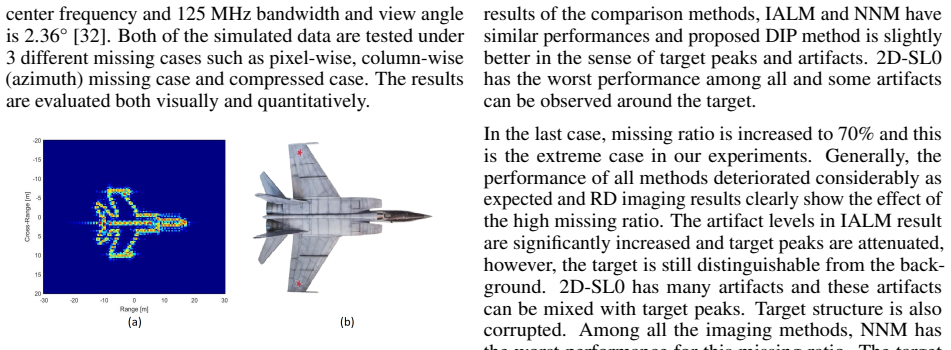
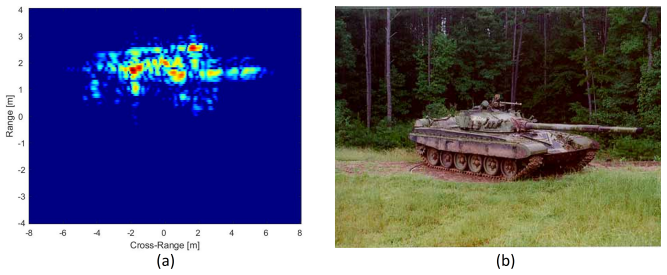
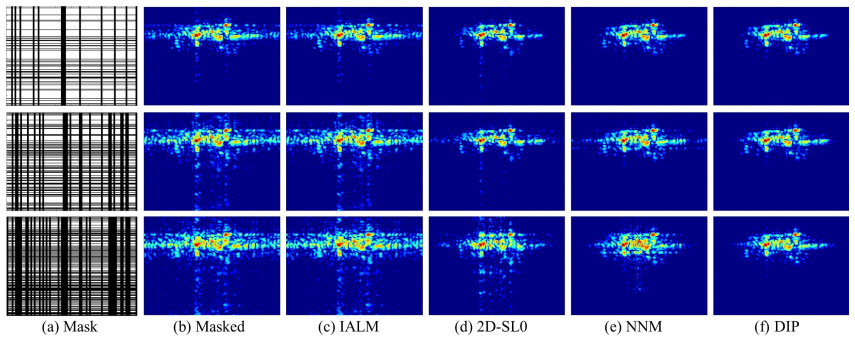
Summary. The paper addresses random missing data in inverse synthetic aperture radar (ISAR) echo matrices by proposing a deep image prior (DIP) based completion method. The complex echo matrix is split into real and imaginary parts, each completed by an independently initialized and normalized DIP network, then recombined and imaged with a conventional Fourier-based range-Doppler method. The method requires no training and uses only the observed entries in the loss. The authors compare DIP against IALM, 2D-SL0, and NNM for pixel-wise, column-wise, and compressed missing patterns at 30%, 50%, and 70% missing ratios, using simulated Mig-25 and USS Fletcher data and real T-72 turntable data. Quantitative comparisons use RMSE, correlation, and image contrast, plus a runtime comparison. The paper claims that DIP remains effective at high missing ratios and reports large percentage improvements in the abstract.
Significance. If the central claim is correct, the paper offers a training-free alternative to compressive sensing and matrix completion for ISAR with severe data loss, avoiding dictionary construction and low-rank assumptions. The experimental design is broad: three missing scenarios, three missing ratios, two simulated datasets, and one real dataset, with both visual and quantitative comparisons. The paper also includes a runtime comparison and a noise robustness experiment. However, the lack of a defined stopping rule, single-run results without seeds or error bars, and unsupported abstract percentages currently prevent the claim from being accepted at face value. The contribution is promising but requires a fairer experimental protocol and reproducibility details.
major comments (4)
- [5.4 and Fig. 19] The early-stopping criterion for DIP is not reproducible because SNR is never defined and no reference is stated. Since the authors generate masks from complete data, the natural reading of Fig. 19 is that SNR is computed against the original full-data image; if so, DIP is stopped using test labels, whereas IALM, 2D-SL0, and NNM are stopped by fixed tolerance (1e-5) and an iteration cap. This makes the comparison unfair and the claim in Section 5.1 that 'the proposed DIP is the only method that remains effective at a 70% missing ratio' potentially an artifact of oracle stopping. Please define SNR, state its reference, and either use a stopping rule based only on observed entries (e.g., validation loss on a held-out subset of the observed data) or give the baselines the same oracle stopping and show that the conclusions are unchanged.
- [Tables 1-10] All quantitative results are reported as single numbers for each configuration, yet DIP is stochastic: Section 4 states that the network parameters are initialized randomly, and the masks are also randomly generated. A single favorable initialization or mask can dominate the reported advantage at 70% missing ratio. Please report means and standard deviations over multiple random seeds and masks (at least 5-10 runs per setting), state the seeds, and make code and data available so the results can be reproduced.
- [Abstract and Section 5.1] The abstract's quantitative claims are not supported by the tables. For example, Table 1 at 70% missing ratio gives DIP RMSE 0.3139 versus IALM 0.5817, a relative reduction of about 46%, not the '100% increase' stated in the abstract; correlation at 70% in Table 1 goes from 0.8430 (IALM) to 0.9447 (DIP), about a 12% relative improvement, not 50%. Moreover, the phrase 'only method that remains effective at a 70% missing ratio' is scenario-specific: in the real-data pixel-wise 70% case (Table 8), IALM and NNM also achieve correlation above 0.98. Please re-state the headline claims using the actual table values and clearly scope them to the specific dataset and scenario.
- [4, Eq. (13), and Fig. 5] The proposed method completes the real and imaginary parts with independently initialized and independently normalized DIP networks and then recombines them. The paper does not analyze whether independent completion preserves the phase relationship between the two components; different biases in the two reconstructions can produce Fourier-domain artifacts even when each component has low RMSE. This is a load-bearing assumption for the imaging claim. Please add a complex-domain evaluation (e.g., phase error or complex RMSE of the completed echo matrix before imaging) and discuss or test the sensitivity of the final image to the independent-component design.
minor comments (7)
- [2, Eq. (4)] Equation (4) has a dimensional inconsistency: the exponentials contain c (speed of light) in the denominator, which cannot cancel to produce the dimensionless phase in a 2D DFT; please correct the derivation and align it with the resolution definitions Δy=c/(2NΔf) and Δx=c/(2MΔθ).
- [5.2 and Table 7] The data details are referred to as 'Table??' in Section 5.2, and the compressed-case real data discussion says 'it can be seen on Table 6' but should refer to Table 10; please fix these cross-references.
- [Tables 1-10] The number of decimal places is inconsistent across entries (e.g., Table 2 reports 0.18427 and 0.35286 while neighboring entries have four decimals); please unify formatting.
- [5.1 and figure captions] The acronym 'RD' is used for the imaging result (e.g., Fig. 6(a)) but is never expanded; please define 'range-Doppler' at first use.
- [5.3] The noise experiment does not define how SNR is computed, what quantity is plotted in Fig. 18, or whether noise is added to the full data before masking; please specify these details.
- [4] Equation (13) uses the same norm notation for the DIP reconstruction operator and for norms, which is confusing; please introduce a dedicated notation for the reconstruction mapping.
- [4] The hyperparameters (depth 6, channel sizes 256,128,64,64,128,256, 5x5 kernels, Swish, learning rate 1e-3) are stated as choices but no sensitivity analysis or a priori justification is given; a brief ablation or a statement that these were fixed in advance would strengthen the generalization claim.
Circularity Check
No significant circularity: the DIP-based ISAR completion is an empirical comparison against external baselines and does not reduce to its inputs by construction.
full rationale
The paper's derivation chain is self-contained in the relevant sense. The signal model in Section 2 is a standard far-field ISAR formulation, and the DIP formulation in Section 4 is the standard deep image prior inpainting setup: the loss in Eq. (9) is computed only over the observed entries, and the network is optimized to match those entries without ever being fit to the final image-quality metric or to the claimed advantage. The real/imaginary decomposition is a processing choice for handling complex data, not a definition that encodes the reported outcome. Quantitative claims are obtained by comparing reconstructed images with original images using external baselines (IALM, 2D-SL0, NNM) on simulated and real data, so the reported RMSE, Correlation, and IC improvements are not fitted parameters renamed as predictions. The self-citations [21] and [26] provide background and motivation from the same authors' earlier work on GPR and matrix completion, but they are not load-bearing evidence for the ISAR-specific results; the DIP method and its evaluation are presented directly in this paper. Concerns about undefined SNR-based early stopping or single-realization tables would be reproducibility or experimental-fairness issues, not circular reductions by construction, and the paper's own equations do not make any claimed prediction equivalent to its inputs.
Assumptions & free parameters
free parameters (6)
- DIP network depth =
6
- DIP channel sizes =
256,128,64,64,128,256
- Convolution kernel size =
5x5
- Activation function =
Swish
- Learning rate =
1e-3
- Early stopping criterion =
3 consecutive iterations with <=1% SNR improvement
assumptions (5)
- domain assumption The ISAR signal follows the far-field, small-angle, point-scatterer model of Eq. (1)-(4)
- domain assumption DIP's convolutional architecture provides a useful implicit prior for complex radar echo matrices
- ad hoc to paper Real and imaginary parts of the complex ISAR data can be completed independently and then recombined without significant phase distortion
- domain assumption The observed entries of the data matrix are accurate and the mask is known
- ad hoc to paper The hyperparameters chosen (depth, channels, activation) generalize across datasets
Cite this review
Pith. "Pith review of Deep Image Prior Assisted ISAR Imaging for Missing Data Case." pith.science (2026). https://pith.science/paper/6PGCC2IX
@misc{pith2026250709393,
  author       = {Pith},
  title        = {Pith review of: Deep Image Prior Assisted ISAR Imaging for Missing Data Case},
  year         = {2026},
  howpublished = {\url{https://pith.science/paper/6PGCC2IX}},
  note         = {Machine review of arXiv:2507.09393}
}
read the original abstract
In Inverse Synthetic Aperture Radar (ISAR), random missing entries of the received radar echo matrix deteriorate the imaging quality, compromising target distinction from the background. Compressive sensing techniques or matrix completion prior to conventional imaging have been used in recent years to solve this issue. However, while the former techniques fail to preserve target continuity due to the sparsity constraint, the latter fails for high missing ratios. This paper proposes to use deep image prior (DIP) to complete the complex radar data and then obtain the radar image by conventional Fourier imaging. Real and imaginary parts are separately completed by independent deep structures and then put together for the imaging part. The proposed DIP based imaging method has been compared with IALM, 2D-SL0 and NNM methods visually and quantitatively for both simulated and real data. The results demonstrate an increase of 100% for some extreme cases in terms of RMSE, 50% increase on Correlation and 30% increase on IC metrics quantitatively.
Figures


Figures from the paper (16 more)








Reference graph
Works this paper leans on
-
[1]
Compu- tationally efficient two-dimensional Capon spectrum analysis,
A. Jakobsson, S. L. Marple and P. Stoica, "Compu- tationally efficient two-dimensional Capon spectrum analysis," inIEEE Transactions on Signal Process- ing, vol. 48, no. 9, pp. 2651-2661, Sept. 2000
work page 2000
-
[2]
A new data extrapolation algorithm for high resolution ISAR imaging
Erer, I¸ sin. "A new data extrapolation algorithm for high resolution ISAR imaging."AEU-International Journal of Electronics and Communications60.4 (2006): 316-319
work page 2006
-
[3]
2-D data extrapolation for high resolution radar imaging using autoregressive lattice modelling
Erer, I¸ sın, Mesut Kartal, and A. H. Kayran. "2-D data extrapolation for high resolution radar imaging using autoregressive lattice modelling."IEE Proceedings- Radar , Sonar and Navigation148.5 (2001): 277-283
work page 2001
-
[4]
Superresolu- tion ISAR imaging using 2-D autoregressive lattice filters
Erer, I¸ sin, and Ahmet Hamdi Kayran. "Superresolu- tion ISAR imaging using 2-D autoregressive lattice filters."Microwave and Optical Technology Letters 32.1 (2002): 81-85
work page 2002
-
[5]
Two-dimensional superresolution radar imaging us- ing the MUSIC algorithm,
J. W. Odendaal, E. Barnard and C. W. I. Pistorius, "Two-dimensional superresolution radar imaging us- ing the MUSIC algorithm," in IEEE Transactions on Antennas and Propagation, vol. 42, no. 10, pp. 1386-1391, Oct. 1994
work page 1994
-
[6]
Filling missing values of multi station GNSS coordinate time series based on matrix completion,
Bao, Z., Chang, G., Zhang, L., Chen, G., & Zhang, S. “Filling missing values of multi station GNSS coordinate time series based on matrix completion,” Measurement, vol. 183, p. 109862, 2021
work page 2021
-
[7]
Li, Y ., Bao, T., Chen, Z., Gao, Z., Shu, X., & Zhang, K. “A missing sensor measurement data reconstruc- tion framework powered by multi-task Gaussian pro- cess regression for dam structural health monitoring systems,”Measurement, vol. 186, p. 110085, 2021
work page 2021
-
[8]
Kavianpour, M., Ramezani, A., & Beheshti, M. T. “A class alignment method based on graph convolution neural network for bearing fault diagnosis in presence of missing data and changing working conditions,” Measurement, vol. 199, p. 111536, 2022. 16
work page 2022
Show all 35 references
-
[9]
Donoho, D. L. (2006). Compressed sensing. IEEE Transactions on Information Theory, 52(4), 1289–1306
2006
-
[10]
Sparse decomposition of two di- mensional signals
Ghaffari, Aboozar, Massoud Babaie-Zadeh, and Christian Jutten. "Sparse decomposition of two di- mensional signals." 2009IEEE international con- ference on acoustics, speech and signal processing. IEEE, 2009
2009
-
[11]
A Fast Approach for Overcomplete Sparse Decompo- sition Based on Smoothed ℓ0 Norm,
H. Mohimani, M. Babaie-Zadeh, and C. Jutten, “A Fast Approach for Overcomplete Sparse Decompo- sition Based on Smoothed ℓ0 Norm,”IEEE Transac- tions on Signal Processing, vol. 57, no. 1, pp. 289– 301, Jan. 2009
2009
-
[12]
2D sparse signal re- covery via 2D orthogonal matching pursuit,
Fang, Y ., Wu, J., & Huang, B. “2D sparse signal re- covery via 2D orthogonal matching pursuit,”Science China Information Sciences, vol. 55, pp. 889–897, 2012
2012
-
[13]
A Novel Compressive Sens- ing Algorithm for SAR Imaging,
X. Dong and Y . Zhang, "A Novel Compressive Sens- ing Algorithm for SAR Imaging," inIEEE Journal of Selected Topics in Applied Earth Observations and Remote Sensing, vol. 7, no. 2, pp. 708-720, Feb. 2014
2014
-
[14]
High- resolution ISAR imaging based on two-dimensional group sparse recovery,
He, X., Tong, N., Hu, X., & Feng, W. “High- resolution ISAR imaging based on two-dimensional group sparse recovery,”IET Radar , Sonar & Naviga- tion, vol. 12, no. 1, pp. 82–86, 2018
2018
-
[15]
High-resolution ISAR imaging via MMV-based block-sparse signal recov- ery,
He, X., Tong, N., & Hu, X. “High-resolution ISAR imaging via MMV-based block-sparse signal recov- ery,”IET Radar , Sonar & Navigation, vol. 13, no. 2, pp. 208–212, 20
-
[16]
Compressive sensing-based inverse synthetic radar imaging from incomplete data,
Tomei, S., Bacci, A., Giusti, E., Martorella, M., & Berizzi, F. “Compressive sensing-based inverse synthetic radar imaging from incomplete data,”IET Radar , Sonar & Navigation, vol. 10, pp. 386–397, 2016
2016
-
[17]
Low-Rank Ma- trix Completion: A Contemporary Survey,
L. T. Nguyen, J. Kim and B. Shim, "Low-Rank Ma- trix Completion: A Contemporary Survey," inIEEE Access, vol. 7, pp. 94215-94237, 2019
2019
-
[18]
A survey on matrix comple- tion: Perspective of signal processing
Li, Xiao Peng, et al. "A survey on matrix comple- tion: Perspective of signal processing." arXiv preprint arXiv:1901.10885 (2019)
2019 arXiv
-
[19]
An Accelerated Proximal Gradi- ent Algorithm for Nuclear Norm Regularized Least Squares Problems
Toh, K.C.; Yun, S. An Accelerated Proximal Gradi- ent Algorithm for Nuclear Norm Regularized Least Squares Problems. Pac. J. Optim. 2010, 6, 15
2010
-
[20]
Solving a low-rank factor- ization model for matrix completion by a nonlinear successive over-relaxation algorithm
Wen, Z.; Yin,W.; Zhang, Y . Solving a low-rank factor- ization model for matrix completion by a nonlinear successive over-relaxation algorithm. Math. Program. Comput. 2012, 4, 333–361
2012
-
[21]
Ground penetrating radar clutter removal via randomized low rank and sparse decom- position for missing data case.Int
Kumlu, D.; Erer, I. Ground penetrating radar clutter removal via randomized low rank and sparse decom- position for missing data case.Int. J. Remote Sens. 2020, 41, 7680–7699
2020
-
[22]
Miss- ing Data Reconstruction in Remote Sensing Image With a Unified Spatial–Temporal–Spectral Deep Con- volutional Neural Network,
Q. Zhang, Q. Yuan, C. Zeng, X. Li and Y . Wei, "Miss- ing Data Reconstruction in Remote Sensing Image With a Unified Spatial–Temporal–Spectral Deep Con- volutional Neural Network," inIEEE Transactions on Geoscience and Remote Sensing, vol. 56, no. 8, pp. 4274-4288, Aug. 2018
2018
-
[23]
Pyramid-Context En- coder Network (PEN-Net) for Missing Data Recov- ery in Ground Penetrating Radar,
K. Tas, D. Kumlu and I. Erer, "Pyramid-Context En- coder Network (PEN-Net) for Missing Data Recov- ery in Ground Penetrating Radar," 2021 44thInterna- tional Conference on Telecommunications and Signal Processing (TSP), 2021, pp. 263-266
2021
-
[24]
ISAR imag- ing enhancement: exploiting deep convolutional neu- ral network for signal reconstruction,
Yang, T., Shi, H., Lang, M., & Guo, J. “ISAR imag- ing enhancement: exploiting deep convolutional neu- ral network for signal reconstruction,”International Journal of Remote Sensing, vol. 41, no. 24, pp. 9447– 9468, 2020
2020
-
[25]
Super-Resolution ISAR Imaging for Ma- neuvering Target Based on Deep-Learning-Assisted Time–Frequency Analysis,
J. Qian, S. Huang, L. Wang, G. Bi and X. Yang, "Super-Resolution ISAR Imaging for Ma- neuvering Target Based on Deep-Learning-Assisted Time–Frequency Analysis," inIEEE Transactions on Geoscience and Remote Sensing, vol. 60, pp. 1-14, 2022, Art no. 5201514
2022
-
[26]
Miss- ing Data Recovery via Deep Networks for Limited Ground Penetrating Radar Measurements
Kumlu, Deniz, Kubra Tas, and Isin Erer. "Miss- ing Data Recovery via Deep Networks for Limited Ground Penetrating Radar Measurements."Remote Sensing14.3 (2022): 754
2022
-
[27]
Exact Matrix Completion via Convex Optimization
Candes, E.J.; Recht, B. Exact Matrix Completion via Convex Optimization. Found Comput. Math. 2008, 9, 717
2008
-
[28]
GoDec: Randomized low-rank & sparse matrix decomposition in noisy case,
Zhou, T., & Tao, D. “GoDec: Randomized low-rank & sparse matrix decomposition in noisy case,” in Proceedings of the 28th International Conference on Machine Learning (ICML), Bellevue, W A, USA, June 28–July 2, 2011, pp. 33–40
2011
-
[29]
Matrix completion by deep matrix factorization
Fan, Jicong, and Jieyu Cheng. "Matrix completion by deep matrix factorization." Neural Networks 98 (2018): 34-41
2018
-
[30]
Skipnet: Learning dynamic rout- ing in convolutional networks
Wang, Xin, et al. "Skipnet: Learning dynamic rout- ing in convolutional networks." Proceedings of the European Conference on Computer Vision (ECCV). 2018
2018
-
[31]
Visualizing the loss landscape of neu- ral nets
Li, Hao, et al. "Visualizing the loss landscape of neu- ral nets." Advances in neural information processing systems 31 (2018)
2018
-
[32]
210, John Wiley & Sons, 2012
Ozdemir, C.Inverse Synthetic Aperture Radar Imag- ing with MATLAB Algorithms, vol. 210, John Wiley & Sons, 2012
2012
-
[33]
Jointly using low-rank and sparsity priors for sparse inverse synthetic aperture radar imaging
Qiu, Wei, Jianxiong Zhou, and Qiang Fu. "Jointly using low-rank and sparsity priors for sparse inverse synthetic aperture radar imaging."IEEE Transactions on Image Processing29 (2019): 100-115
2019
-
[34]
Interpretation and analysis of target scattering from fully-polarized ISAR images using Pauli decomposi- tion scheme for target recognition
Demirci, Sevket, Ozkan Kirik, and Caner Ozdemir. "Interpretation and analysis of target scattering from fully-polarized ISAR images using Pauli decomposi- tion scheme for target recognition."IEEE Access8 (2020): 155926-155938
2020
-
[35]
https://www.sdms.afrl.af.mil/index.php?collection=gtri 17
Reviewed August 6, 2026 · model on record in the stance chip above.
Discussion (0). Continue with ORCID to comment.