REVIEW 4 major objections 7 minor 45 references
EAT: QoS-Aware Edge-Collaborative AIGC Task Scheduling via Attention-Guided Diffusion Reinforcement Learning
T0 review · 4 major / 7 minor · reviewed 2026-08-06 · deepseek-v4-flash
Pith's one-line read EAT, an attention-guided diffusion reinforcement-learning scheduler, cuts edge AIGC inference latency by up to 74.3% while holding output quality, by gang-scheduling split tasks, reusing loaded models, and tuning inference steps.
desk verdict A plausible edge-AIGC scheduling system with a genuinely new joint formulation, but the headline latency gains rest on a time-prediction model the paper admits is weakest in exactly the reload-heavy regime where the gains are claimed. read the letter →
The pith
A machine-rendered reading of the paper's core claim, the machinery that carries it, and where it could break.
The reading
What carries the argument
The load-bearing object is the EAT policy network: an attention layer condenses the server/task state matrix into a feature vector $f_s$, and a diffusion model, conditioned on $f_s$, denoises random noise into a continuous action vector whose components encode whether to schedule, which task to pick (via softmax preference scores), and the number of inference steps (mapped linearly to $[S_{\min}, S_{\max}]$). A separate server selector then greedily picks idle servers, reusing the loaded model group when $|G_t^m| = c_k$ and otherwise unloading and loading models, while predicted execution time $t_e^k = f(s_k, c_k)$ keeps the simulation and reward aligned with the real system. The diffusion sampling gives the actor a flexible, high-dimensional action distribution; the attention layer is what lets the policy read heterogeneous server load and queue state without information overload.
What would settle it
Instrument the real edge cluster so every scheduled task logs actual versus predicted execution time, then separate the logs by whether the model was reused or reloaded. If the mean absolute prediction error for reloaded tasks is larger than EAT's smallest reported latency advantage over any baseline, then prediction error swamps the scheduling signal.
Extended reading notes
Core claim
EAT's central claim is that an attention-guided diffusion policy network can solve the gang-scheduling MDP for split AIGC tasks: it selects the task, its patch count, its inference steps, and the server set as one joint action, using a diffusion denoiser conditioned on a compressed state to generate the action vector, and a server selector that prefers groups of idle servers already holding the required model ($|G_t^m| = c_k$). The paper argues that this combination yields the lowest model reload rate among all tested schedulers and the best quality-per-second efficiency, and that the real-system measurements show latency reductions up to 74.3% over a Greedy scheduler at comparable output quality.
Load-bearing premise
The whole MDP, reward, and server selection depend on the assumption that a task's execution time is predictable from a linear function of inference steps and patch count, and that model initialization time is roughly constant; the paper itself reports that these time predictions are least accurate for tasks that need a model reload, which is exactly the regime where the reuse decision is made.
Editorial extensions
If this is right
- Patch-based gang scheduling with dynamic inference-step selection reduces per-task latency without perceptible quality loss: real-system runs show 1.63x and 2.07x speedups for 2- and 4-patch splits at nearly identical CLIP quality.
- Reusing already-loaded models cuts cold-start overhead; EAT consistently achieves the lowest model reload rate across 4/8/12-server settings.
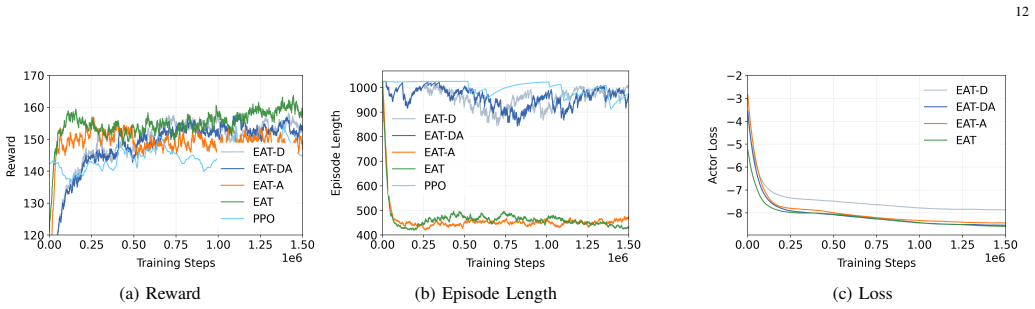
- The attention layer is not optional: removing it (EAT-A) raises reload rate and response time, and removing the diffusion policy (EAT-D) drops performance toward plain SAC, implying the two components carry the reported gains.
- EAT's advantage persists across task arrival rates from 0.01 to 0.19, so the policy generalizes beyond the training distribution to different load levels and cluster sizes.
Reading between the lines
- If model reload avoidance is the main driver of EAT's gains, then simpler load-aware heuristics with the same $|G_t^m| = c_k$ reuse rule could capture part of the benefit; the paper's ablations show the diffusion component contributes most when the attention features are already good, which suggests the two mechanisms are complementary rather than independent.
- The linear time-prediction model is the fragile part: under memory pressure or storage heterogeneity, initialization time may no longer be roughly constant, and the paper's own time-prediction analysis concedes reloading tasks are the least predictable. A stress test with heterogeneous disk speeds would show whether EAT's edge survives.
- The reward uses a CLIP threshold as a hard quality gate; in production, a learned or task-specific quality proxy could replace CLIP, but that would change the reward structure and likely require retraining the policy.
- The same action structure — choose task, step count, and server set — could be adapted to other iterative generative workloads (e.g., diffusion-based video or code generation), where step count and model caching are similarly controllable.
Editorial analysis
A structured set of objections, weighed in public.
Referee Report
Summary. The paper introduces EAT, a QoS-aware edge-collaborative scheduler for AIGC (text-to-image) tasks. EAT segments tasks into patches, schedules them as gang jobs across heterogeneous edge servers, dynamically selects the number of diffusion inference steps, and reuses already-loaded models to reduce cold-start overhead. The authors formulate the problem as an MDP and propose a soft actor-critic variant whose policy is an attention-conditioned diffusion model. They implement a real four-GPU DistriFusion-based testbed and also run larger simulations, reporting average latency reductions of roughly 25% in real environments and up to 56% (abstract) or 74.3% (conclusion) against baselines while keeping CLIP-based image quality comparable.
Significance. If the reported gains are robust, EAT is a useful contribution to edge AIGC serving: it addresses a realistic combination of gang scheduling, model heterogeneity, cold-start avoidance, and quality-latency trade-offs for diffusion-based inference. The paper's strengths include a working system implementation, open-source code, real-machine experiments, and a clear ablation structure (EAT, EAT-A, EAT-D, EAT-DA). The significance is, however, tempered by several load-bearing weaknesses: the reward used for training does not match the stated objective, the reported training configuration is internally inconsistent, and the headline latency numbers are not shown to be robust to the admitted inaccuracy of the execution-time predictor in the model-reload regime.
major comments (4)
- [Section V.A.4 and Eq. (4a)] The immediate reward is written as R_t = α_q·q_k∗ − λ_q·I_k∗ + 1/(β_t·t_r_k∗ + μ_t·t_avg_Q,t), with the text stating that this reciprocal form is used 'to align with the optimization goal.' The optimization objective in Eq. (4a) is max E[Σ(α_q q_k − β_t t_r_k − λ_q I_k)]; the reciprocal transformation is not equivalent to a linear time penalty, and the queue-average term μ_t·t_avg_Q,t does not appear in the objective at all. Because this reward is the sole training signal, the paper must either justify the reciprocal form by a monotonicity/optimality argument or provide an ablation showing that the scheduling ranking is insensitive to this choice. Without this, the learned policy's relationship to the stated QoS objective is undefined.
- [Section VI.A.2 and Table VIII] The training configuration is internally inconsistent. The text states 'The model undergo 1.5×10^6 training episodes,' while Table VIII lists 'ETotal training episodes 5×10^3.' These differ by three orders of magnitude and make the experimental setup unreproducible. The task arrival rates stated in Section VI.A.2 (0.05, 0.1, 0.15 for 4-, 8-, and 12-server configurations) also do not match the column headers in Tables IX–XI (which use 0.01–0.19 ranges). These values must be reconciled and tied to the specific tables.
- [Section VI.B.7 and Tables X–XI] The execution-time predictor t_e^k = f(s_k,c_k) and the constant initialization time in Table VI drive the MDP transitions, the reward, and the server-selection logic. However, Section VI.B.7 concedes that for tasks requiring model reloading, execution times are random and the predictor is 'less accurate.' Table XI shows that EAT's reload rate reaches 0.633 in the 4-node real system, so a substantial fraction of the measured latencies in Table X falls in exactly the regime where the predictor is least reliable. The paper reports no error bars, no reload/non-reload latency breakdown, and no sensitivity analysis to prediction error. Consequently, the headline latency reductions (28.7–74.3%) are not demonstrably robust. Please provide per-task-type latency statistics and a sensitivity analysis that perturbs predicted times within the observed error range.
- [Abstract, Section VI.B.4, and Section VIII] The central quantitative claim is inconsistent across the paper: the abstract reports latency reduction 'up to 56%,' Section VI.B.4 reports 'EAT outperforms ... Greedy by 114.5 (74.3%)', and the conclusion repeats 'up to 74.3%.' The 114.5/74.3% numbers correspond to the 4-node, arrival-rate-0.05 column of Table X, but the text does not identify this condition, nor does it explain where the 56% figure comes from. Since the paper's main contribution is a measured latency improvement, the headline numbers must be reconciled and each percentage tied to an explicit table cell and experimental condition (real versus simulated).
minor comments (7)
- [Section V.A.2, Eq. (6)] The state matrix is described as 3×(|E|+l) but the notation in the third row uses 'ta_k1 ··· ta_k|K|' and 'ck1 ··· ck|K|', which conflates the full task set with the top-l queue considered by the scheduler; please use l consistently.
- [Algorithm 1] Line 13 contains a typo: 'not excute' should be 'not execute.'
- [Section VI.B.8] The phrase 'time utilizaiton' should be 'time utilization.'
- [Section VI.B.3 and Table IX] The quality ranking 'Greedy>SAC-based methods>PPO>meta-heuristic methods>Random' is not fully supported by Table IX, because EAT-A has quality 0.265 at several arrival rates while EAT has 0.262; the ranking should be qualified to reflect the overlapping ranges.
- [Section VI.B.7] The statement that the less-accurate predictor 'still adequately reflects node load conditions' is an unsupported assertion; please give a quantitative measure of prediction error and its effect on scheduling outcomes.
- [Tables X and Section VI.B.4] Table X is captioned 'Response Latency,' while the text refers to 'inference latency' for the same metric; the terminology should be made consistent (the metric appears to be end-to-end response time including queueing and initialization).
- [Section VI.B.9 and Table XII] The label 'Inference Latency' for the algorithm's own computation time is confusing because the same term is used in the paper for task generation latency; consider renaming this to 'Scheduling Overhead.'
Circularity Check
No significant circularity: the time model is measured system identification, and the headline real-system latency gain is clock-measured rather than defined by the reward.
full rationale
EAT's derivation chain is not circular. The execution-time and initialization-time model t_e^k=f(s_k,c_k), t_d^k is built from direct measurements reported in Table VI (Init Time 33.5/31.9/35.0 s; 0.53/0.29/0.20 s per inference step), and using these measured constants in the MDP transition, reward, and the 8/12-node simulator is a standard system-identification step rather than a definitional equivalence. The paper describes the real 4-node system as receiving 'actual task execution time and actual model loading time' from the servers, so the headline latency reductions in Section VI.B.4 (up to 74.3% versus Greedy) are externally clock-measured results, not outputs of the fitted predictor. The 8/12-node simulation results do inherit the fitted time model and are therefore self-consistent rather than fully independent, but the paper explicitly acknowledges the predictor's limits for reloading tasks in Section VI.B.7 ('the time predictor is less accurate for these reloading tasks') and does not present the linear/constant model as a first-principles derivation. Self-citations ([4], [7], [8], [10]) are background system and survey references and are not load-bearing; no uniqueness theorem or prior result by the authors is invoked to forbid alternative scheduling choices. The ablations EAT-A, EAT-D, and EAT-DA are constructed from the same objective and are compared on measured quality and latency, so their ranking is not forced by construction. Overall, the central claim is empirically anchored; the score of 2 reflects only the mild caveat that the simulated portion shares the fitted time model with the training reward, which is a robustness concern rather than circularity.
Assumptions & free parameters
free parameters (5)
- Reward weight coefficients alpha_q, beta_t, lambda_q, mu_t =
not reported
- Task arrival rate and collaboration distribution D_g, D_c =
arrival rates 0.05, 0.1, 0.15 for 4/8/12 nodes; c_k in {1,2,4,8}
- Per-step execution time and initialization time constants =
0.53, 0.29, 0.20 s per step; 33.5, 31.9, 35.0 s init for 1/2/4 patches (Table VI)
- RL hyperparameters (temperature, discount, target update, batch, diffusion steps) =
alpha=0.05, gamma=0.95, tau=0.005, batch=512, T=10, etc.
- Minimum quality threshold q_min and penalty p_quality =
not specified
assumptions (7)
- domain assumption Stable Diffusion inference time is linear in the number of inference steps and inversely proportional to patch count, with per-step times given in Table VI.
- domain assumption Model initialization time is roughly constant (about 32-35 seconds) and depends only on patch count, not on task or server state.
- domain assumption CLIP score is a valid measure of AIGC generation quality for QoS decisions.
- domain assumption Network transfer latency is negligible because communication overlaps with computation in the implemented system.
- domain assumption The synthetic task arrival and collaboration distributions D_g and D_c represent realistic edge AIGC workloads.
- standard math Standard diffusion denoising and SAC update equations from prior work (Eqs. 10-22) are correct.
- ad hoc to paper The reciprocal-form time penalty in the reward is a valid proxy for the objective's linear time penalty.
Cite this review
Pith. "Pith review of EAT: QoS-Aware Edge-Collaborative AIGC Task Scheduling via Attention-Guided Diffusion Reinforcement Learning." pith.science (2026). https://pith.science/paper/KCWRE44A
@misc{pith2026250710026,
  author       = {Pith},
  title        = {Pith review of: EAT: QoS-Aware Edge-Collaborative AIGC Task Scheduling via Attention-Guided Diffusion Reinforcement Learning},
  year         = {2026},
  howpublished = {\url{https://pith.science/paper/KCWRE44A}},
  note         = {Machine review of arXiv:2507.10026}
}
read the original abstract
The growth of Artificial Intelligence (AI) and large language models has enabled the use of Generative AI (GenAI) in cloud data centers for diverse AI-Generated Content (AIGC) tasks. Models like Stable Diffusion introduce unavoidable delays and substantial resource overhead, which are unsuitable for users at the network edge with high QoS demands. Deploying AIGC services on edge servers reduces transmission times but often leads to underutilized resources and fails to optimally balance inference latency and quality. To address these issues, this paper introduces a QoS-aware \underline{E}dge-collaborative \underline{A}IGC \underline{T}ask scheduling (EAT) algorithm. Specifically: 1) We segment AIGC tasks and schedule patches to various edge servers, formulating it as a gang scheduling problem that balances inference latency and quality while considering server heterogeneity, such as differing model distributions and cold start issues. 2) We propose a reinforcement learning-based EAT algorithm that uses an attention layer to extract load and task queue information from edge servers and employs a diffusion-based policy network for scheduling, efficiently enabling model reuse. 3) We develop an AIGC task scheduling system that uses our EAT algorithm to divide tasks and distribute them across multiple edge servers for processing. Experimental results based on our system and large-scale simulations show that our EAT algorithm can reduce inference latency by up to 56\% compared to baselines. We release our open-source code at https://github.com/zzf1955/EAT.
Figures


Figures from the paper (5 more)



Reference graph
Works this paper leans on
-
[1]
High- resolution image synthesis with latent diffusion models,
R. Rombach, A. Blattmann, D. Lorenz, P. Esser, and B. Ommer, “High- resolution image synthesis with latent diffusion models,” inProceedings of the IEEE/CVF Conference on Computer Vision and Pattern Recogni- tion (CVPR), IEEE/CVF, 2022, pp. 10 684–10 695
work page 2022
-
[2]
Deepseek-r1: Incentivizing reasoning capability in llms via reinforcement learning,
D. Guo, D. Yang, H. Zhang, J. Song, R. Zhang, R. Xu, Q. Zhu, S. Ma, P. Wang, X. Biet al., “Deepseek-r1: Incentivizing reasoning capability in llms via reinforcement learning,”arXiv Preprint arXiv:2501.12948, 2025, doi:10.48550/arXiv.2501.12948
-
[3]
Edge computing: Vision and challenges,
W. Shi, J. Cao, Q. Zhang, Y . Li, and L. Xu, “Edge computing: Vision and challenges,”IEEE Internet of Things Journal, vol. 3, no. 5, pp. 637–646, 2016
2016
-
[4]
Empowering edge intelligence: A comprehensive survey on on-device ai models,
X. Wang, Z. Tang, J. Guo, T. Meng, C. Wang, T. Wang, and W. Jia, “Empowering edge intelligence: A comprehensive survey on on-device ai models,”ACM Computing Surveys, 2025, early Access
work page 2025
-
[5]
Diffusion-based reinforcement learning for edge-enabled ai-generated content services,
H. Du, Z. Li, D. Niyato, J. Kang, Z. Xiong, H. Huang, and S. Mao, “Diffusion-based reinforcement learning for edge-enabled ai-generated content services,”IEEE Transactions on Mobile Computing, vol. 23, no. 9, pp. 8902–8918, 2024
2024
-
[6]
Ai- generated incentive mechanism and full-duplex semantic communica- tions for information sharing,
H. Du, J. Wang, D. Niyato, J. Kang, Z. Xiong, and D. I. Kim, “Ai- generated incentive mechanism and full-duplex semantic communica- tions for information sharing,”IEEE Journal on Selected Areas in Communications, vol. 41, no. 9, pp. 2981–2997, 2023
work page 2023
-
[7]
Velo: A vector database- assisted cloud-edge collaborative llm qos optimization framework,
Z. Yao, Z. Tang, J. Lou, P. Shen, and W. Jia, “Velo: A vector database- assisted cloud-edge collaborative llm qos optimization framework,” in Proceedings of the 2024 IEEE International Conference on Web Services (ICWS). IEEE, 2024, pp. 865–876
work page 2024
-
[8]
Multi-user layer- aware online container migration in edge-assisted vehicular networks,
Z. Tang, F. Mou, J. Lou, W. Jia, Y . Wu, and W. Zhao, “Multi-user layer- aware online container migration in edge-assisted vehicular networks,” IEEE/ACM Transactions on Networking, vol. 32, no. 2, pp. 1807–1822, 2024
work page 2024
Show all 45 references
-
[9]
Provably efficient algorithms for placement of service function chains with ordering con- straints,
A. Tomassilli, F. Giroire, N. Huin, and S. P ´erennes, “Provably efficient algorithms for placement of service function chains with ordering con- straints,” inProceedings of IEEE International Conference on Computer Communications (INFOCOM), IEEE, 2018, pp. 774–782. 14
2018
-
[10]
Joint resource overbooking and container scheduling in edge computing,
Z. Tang, F. Mou, J. Lou, W. Jia, Y . Wu, and W. Zhao, “Joint resource overbooking and container scheduling in edge computing,”IEEE Trans- actions on Mobile Computing, vol. 23, no. 12, pp. 10 903 – 10 917, 2024
2024
-
[11]
Sustainable aigc workload scheduling of geo-distributed data centers: A multi-agent reinforcement learning approach,
S. Zhang, M. Xu, W. Y . B. Lim, and D. Niyato, “Sustainable aigc workload scheduling of geo-distributed data centers: A multi-agent reinforcement learning approach,” inProceedings of the IEEE Global Communications Conference (GLOBECOM), IEEE, 2023, pp. 3500– 3505
2023
-
[12]
Learning-to-cache: Accelerating diffusion transformer via layer caching,
X. Ma, G. Fang, M. Bi, and Y . Shi, “Learning-to-cache: Accelerating diffusion transformer via layer caching,” inAdvances in Neural Infor- mation Processing Systems, 2024, pp. 133 282–133 304
2024
-
[13]
Training-free adaptive diffusion with bounded difference approximation strategy,
H. Ye, J. Yuan, R. Xia, Y . Zhou, and X. Zhang, “Training-free adaptive diffusion with bounded difference approximation strategy,” inAdvances in Neural Information Processing Systems, 2024, pp. 306–332
2024
-
[14]
Distrifusion: Distributed parallel inference for high-resolution diffusion models,
M. Li, T. Cai, J. Cao, Q. Zhang, H. Cai, J. Bai, Y . Jia, K. Li, and S. Han, “Distrifusion: Distributed parallel inference for high-resolution diffusion models,” inProceedings of the IEEE/CVF Conference on Computer Vision and Pattern Recognition (CVPR), IEEE/CVF, 2024, pp. 7183– 7193
2024
-
[15]
Diffusion models: A comprehensive survey of methods and applications,
L. Yang, Z. Zhang, Y . Song, S. Hong, R. Xu, Y . Zhao, W. Zhang, B. Cui, and M.-H. Yang, “Diffusion models: A comprehensive survey of methods and applications,”ACM Computing Surveys, vol. 56, no. 4, pp. 1–39, 2023
2023
-
[16]
Efficient large language models: A survey,
Z. Wan, X. Wang, C. Liu, S. Alam, Y . Zhenget al., “Efficient large language models: A survey,”arXiv preprint arXiv:2312.03863, vol. 1, 2023
2023 arXiv
-
[17]
Reduce, reuse, recycle: Compositional generation with energy-based diffusion models and mcmc,
Y . Du, C. Durkan, R. Strudel, J. B. Tenenbaum, S. Dieleman, R. Fergus, J. Sohl-Dickstein, A. Doucet, and W. S. Grathwohl, “Reduce, reuse, recycle: Compositional generation with energy-based diffusion models and mcmc,” inInternational conference on machine learning, 2023, pp. ...
2023
-
[18]
Knowl- edge distillation with the reused teacher classifier,
D. Chen, J.-P. Mei, H. Zhang, C. Wang, Y . Feng, and C. Chen, “Knowl- edge distillation with the reused teacher classifier,” inthe IEEE/CVF conference on computer vision and pattern recognition, 2022, pp. 11 933–11 942
2022
-
[19]
Enhancing large vision language models with self-training on image comprehension,
Y . Deng, P. Lu, F. Yin, Z. Hu, S. Shen, Q. Gu, J. Y . Zou, K.-W. Chang, and W. Wang, “Enhancing large vision language models with self-training on image comprehension,”Advances in Neural Information Processing Systems, vol. 37, pp. 131 369–131 397, 2024
2024
-
[20]
Attention is all you need,
A. Vaswani, N. Shazeer, N. Parmar, J. Uszkoreit, L. Jones, A. N. Gomez, Ł. Kaiser, and I. Polosukhin, “Attention is all you need,” 2017
2017
-
[21]
Dynamic topology and resource allocation for distributed training in mobile edge computing,
W. Fan, D. Wang, F. Xiao, Y . Zuo, M. Lv, L. Han, and S.-Y . Hsieh, “Dynamic topology and resource allocation for distributed training in mobile edge computing,”IEEE Transactions on Mobile Computing, 2025
2025
-
[22]
Reflexpilot: Startup- aware dependent task scheduling based on deep reinforcement learning for edge-cloud collaborative computing,
W. Zou, Z. Zhang, N. Wang, Y . Tian, and L. Tian, “Reflexpilot: Startup- aware dependent task scheduling based on deep reinforcement learning for edge-cloud collaborative computing,”IEEE Transactions on Cloud Computing, 2025
2025
-
[23]
Resource-efficient collaborative edge transformer inference with hybrid model parallelism,
S. Ye, B. Ouyang, J. Du, L. Zeng, T. Qian, W. Ou, X. Chu, D. Guo, Y . Lu, and X. Chen, “Resource-efficient collaborative edge transformer inference with hybrid model parallelism,”IEEE Transactions on Mobile Computing, 2025
2025
-
[24]
Design and timing guarantee for non- preemptive gang scheduling,
S. Lee, N. Guan, and J. Lee, “Design and timing guarantee for non- preemptive gang scheduling,” in2022 IEEE Real-Time Systems Sympo- sium (RTSS). IEEE, 2022, pp. 132–144
2022
- [25]
-
[26]
Concise thoughts: Impact of output length on llm reasoning and cost,
S. Nayab, G. Rossolini, M. Simoni, A. Saracino, G. Buttazzo, N. Manes, and F. Giacomelli, “Concise thoughts: Impact of output length on llm reasoning and cost,”arXiv Preprint arXiv:2407.19825, 2024, doi:10.48550/arXiv.2407.19825
-
[27]
Characterizing and scheduling of diffusion process for text-to-image generation in edge networks,
S. Gao, P. Yang, Y . Kong, F. Lyu, and N. Zhang, “Characterizing and scheduling of diffusion process for text-to-image generation in edge networks,”IEEE Transactions on Mobile Computing, 2025
2025
-
[28]
Efficient and adaptive diffusion model inference through lookup table on mobile devices,
Q. Wang, S. Jiang, Y . Yang, R. Liu, Y . Li, T. Cao, and X. Liu, “Efficient and adaptive diffusion model inference through lookup table on mobile devices,”IEEE Transactions on Mobile Computing, 2025
2025
-
[29]
Language models are few-shot learners,
T. Brown, B. Mann, N. Ryder, M. Subbiah, J. D. Kaplan, P. Dhariwal, A. Neelakantan, P. Shyam, G. Sastry, A. Askellet al., “Language models are few-shot learners,”Neural Information Processing Systems, vol. 33, pp. 1877–1901, 2020
1901
- [30]
-
[31]
Towards efficient generative large language model serving: A survey from algorithms to systems,
X. Miao, G. Oliaro, Z. Zhang, X. Cheng, H. Jin, T. Chen, and Z. Jia, “Towards efficient generative large language model serving: A survey from algorithms to systems,”arXiv Preprint arXiv:2312.15234, 2023, doi:10.48550/arXiv.2312.15234
-
[32]
Exploding ai power use: An opportunity to rethink grid planning and management,
L. Lin, R. Wijayawardana, V . Rao, H. Nguyen, E. W. GNIBGA, and A. A. Chien, “Exploding ai power use: An opportunity to rethink grid planning and management,” inProceedings of the 15th ACM International Conference on Future and Sustainable Energy Systems (FSES), ACM, 2024, pp. 434–441
2024
-
[33]
Spatio–temporal edge service placement: A bandit learning approach,
L. Chen, J. Xu, S. Ren, and P. Zhou, “Spatio–temporal edge service placement: A bandit learning approach,”IEEE Transactions on Wireless Communications, vol. 17, no. 12, pp. 8388–8401, 2018
2018
-
[34]
Dependent task offloading for edge computing based on deep rein- forcement learning,
J. Wang, J. Hu, G. Min, W. Zhan, A. Y . Zomaya, and N. Georgalas, “Dependent task offloading for edge computing based on deep rein- forcement learning,”IEEE Transactions on Computers, vol. 71, no. 10, pp. 2449–2461, 2021
2021
- [35]
-
[36]
A reinforcement learning diffusion decision model for value-based decisions,
L. Fontanesi, S. Gluth, M. S. Spektor, and J. Rieskamp, “A reinforcement learning diffusion decision model for value-based decisions,”Psycho- nomic Bulletin & Review, vol. 26, no. 4, pp. 1099–1121, 2019
2019
-
[37]
Learning transferable visual models from natural language supervision,
A. Radford, J. W. Kim, C. Hallacy, A. Ramesh, G. Goh, S. Agarwal, G. Sastry, A. Askell, P. Mishkin, J. Clarket al., “Learning transferable visual models from natural language supervision,” inProceedings of the International Conference on Machine Learning (ICML), PMLR, 2021, pp...
2021
-
[38]
Denoising diffusion probabilistic models,
J. Ho, A. Jain, and P. Abbeel, “Denoising diffusion probabilistic models,” Neural Information Processing Systems, vol. 33, pp. 6840–6851, 2020
2020
-
[39]
Soft actor-critic: Off- policy maximum entropy deep reinforcement learning with a stochastic actor,
T. Haarnoja, A. Zhou, P. Abbeel, and S. Levine, “Soft actor-critic: Off- policy maximum entropy deep reinforcement learning with a stochastic actor,” inProceedings of the International Conference on Machine Learning (ICML), PMLR, 2018, pp. 1861–1870
2018
-
[40]
Adam: A method for stochastic optimization,
D. P. Kingma and J. Ba, “Adam: A method for stochastic optimization,” inProceedings of the International Conference on Learning Represen- tations (ICLR), 2015
2015
- [41]
-
[42]
A new heuristic optimization algorithm: harmony search,
Z. W. Geem, J. H. Kim, and G. V . Loganathan, “A new heuristic optimization algorithm: harmony search,”simulation, vol. 76, no. 2, pp. 60–68, 2001
2001
-
[43]
J. H. Holland,Adaptation in natural and artificial systems: an intro- ductory analysis with applications to biology, control, and artificial intelligence. MIT press, 1992
1992
-
[44]
Prox- imal policy optimization algorithms,
J. Schulman, F. Wolski, P. Dhariwal, A. Radford, and O. Klimov, “Prox- imal policy optimization algorithms,”arXiv preprint arXiv:1707.06347, 2017. Zhifei Xuis currently pursuing a bachelor’s degree in the Faculty of Arts and Sciences, Beijing Normal University at Zhuhai, China...
2017 arXiv
-
[2011]
His research interests include internet of things, edge computing, and mobile computing
Currently, he is a Professor in the Institute of AI and Future Networks, Beijing Normal University. His research interests include internet of things, edge computing, and mobile computing. He has 27 patents and has published more than 200 papers in high-level journals and conf...
2005
Reviewed August 6, 2026 · model on record in the stance chip above.
Discussion (0). Sign in to comment.