REVIEW 5 major objections 5 minor 1 cited by
A double dipole geometry for PSR~J0740+6620
T0 review · 5 major / 5 minor · reviewed 2026-08-06 · deepseek-v4-flash
Pith's one-line read This paper argues that the magnetic field of PSR J0740+6620 is best described by two nearly antipodal dipoles buried roughly ten percent of the stellar radius below the surface, because that configuration simultaneously reproduces the…
desk verdict The double dipole is asserted, never actually fitted: the central claim outruns the paper's own computations, though the hot-spot size tension is real and the new radio data are useful. read the letter →
The pith
A machine-rendered reading of the paper's core claim, the machinery that carries it, and where it could break.
The reading
What carries the argument
The mechanism is a double dipole geometry: two magnetic dipoles buried in the crust, close to antipodal, whose far fields merge into a single dipole-like field but whose near-surface fields are locally dominated by each buried dipole. This configuration shrinks the open-field-line polar cap to the observed hot-spot angular size, something a centred dipole cannot do. The argument is carried by four data and model components locked together by phase alignment of the radio, NICER X-ray, and Fermi gamma-ray profiles: the striped-wind gamma-ray model that links peak separation to $\alpha$ and $\zeta$; the rotating vector model for the polarisation position angle; the NICER hot-spot geometry; and the analytic relation between pulse width, emission height, and beam opening angle. Aberration, retardation, and magnetic sweep-back delay formulas are used to explain why the X-ray and radio pulses arrive nearly in phase.
What would settle it
A decisive test would be high-sensitivity, phase-resolved polarisation and hot-spot mapping: if the two radio pulses' polarisation sweeps require different $\alpha$ and $\zeta$ values once measured without the arbitrary 0.03-phase shift, or if NICER resolves the hot spots as non-circular or displaced from the dipole axes, the double-dipole solution fails. A quantitative calculation of the force-free magnetosphere of the proposed two-dipole field that predicts a gamma-ray peak separation or radio-X-ray phase lag differing from the observed values beyond the quoted few-degree uncertainty would also falsify it.
Extended reading notes
Core claim
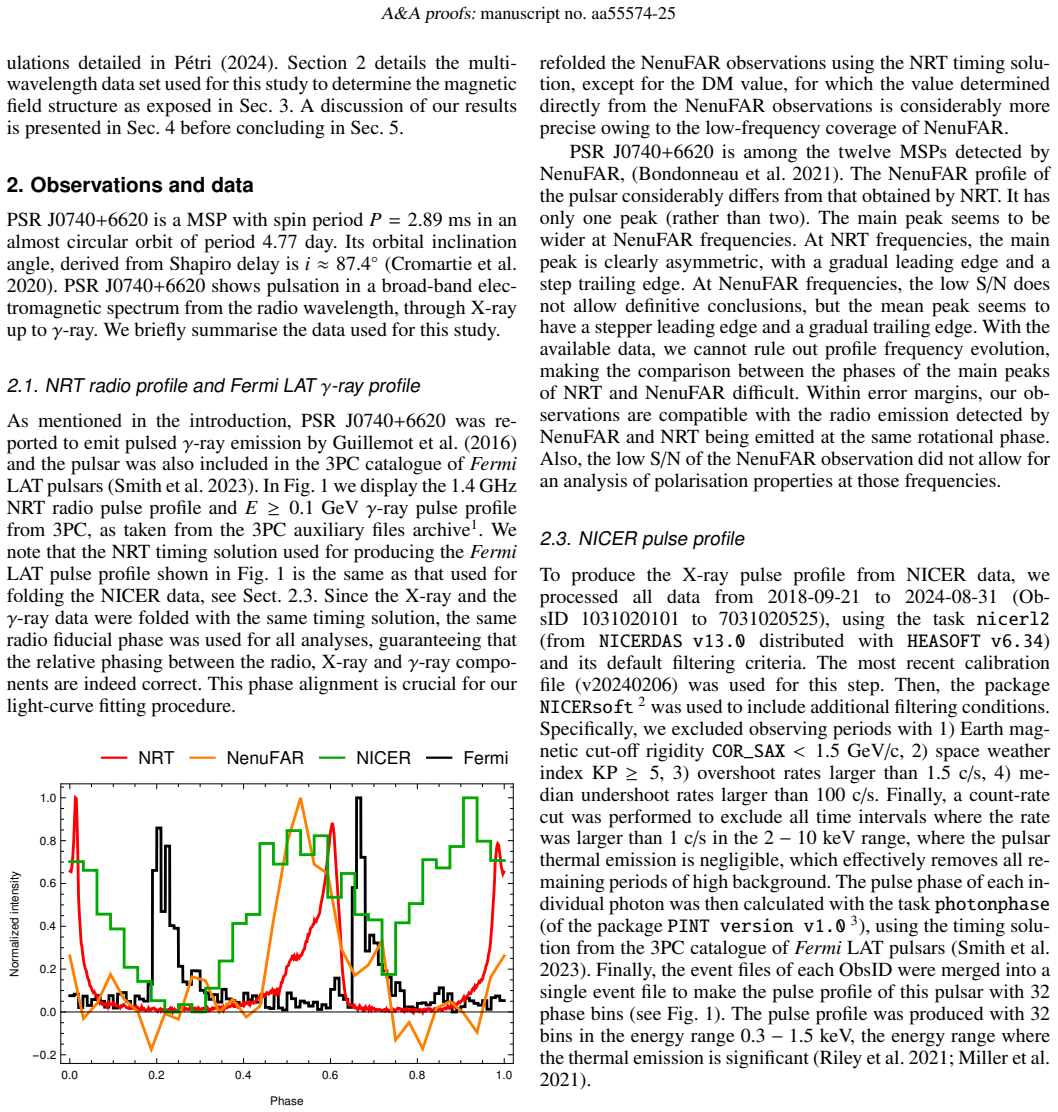
The central claim is that PSR J0740+6620's magnetic field is not a single dipole anchored at the stellar centre. Fitting the gamma-ray light curve and the radio pulse/interpulse with a striped-wind model gives $\alpha \approx 51^\circ$ and $\zeta \approx 82^\circ$, which also places the NICER hot spots correctly on the sky; but the same centred dipole, with the standard polar cap size $\theta_{\rm pc}\approx\sqrt{R/r_{\rm L}}\approx 0.306$ rad, predicts X-ray hot spots almost three times larger than the $\xi\approx 0.115$ rad spots measured by NICER and XMM. Off-centring a single dipole by $\epsilon\approx 0.2$ still leaves the multiwavelength phase ordering inconsistent. The solution the paper adopts is a double dipole: two dipoles of comparable strength located roughly 10% of the stellar radius below the surface in nearly antipodal positions, each producing one hot spot and one radio beam. With two independent magnetic axes, the model reproduces the NICER hot-spot locations and sizes, the gamma-ray peak separation and phase lag, the radio pulse and interpulse structure, and the phase-resolved polarisation position angle fitted with the rotating vector model ($\alpha\approx 74^\circ$ to $79^\circ$, $\zeta\approx 88^\circ$ to $89^\circ$).
Load-bearing premise
The fit assumes the X-ray hot spots are the heating footprints of the same large-scale magnetic field that produces the radio and gamma-ray emission, with the magnetic axis passing through the centre of each hot spot; if the hot spots are not connected to that field, the inferred obliquities and the proposed double-dipole geometry lose their X-ray anchor.
Editorial extensions
If this is right
- If the double dipole is right, single-dipole obliquities inferred from NICER hot spots ($\alpha\approx 72^\circ$ to $78^\circ$) are not the true large-scale geometry; the field is a superposition of two crustal dipoles.
- The measured X-ray hot-spot size becomes a direct probe of burial depth, since a small inward shift of a dipole ($z_0/R\approx 0.85$ to $0.89$) reduces the polar cap to the observed angular size.
- Phase-aligned multiwavelength pulse shapes become the standard cross-check for MSP geometry, because aberration plus retardation and force-free sweep-back nearly cancel, explaining the observed radio-versus-X-ray phase alignment.
- Other millisecond pulsars with complex radio profiles and NICER hot-spot maps, explicitly PSR J0437-4715 and PSR J1231-1411, are predicted to need similar double-dipole treatment.
- Gamma-ray peak separation alone is insufficient to fix the geometry of fast millisecond pulsars, because off-centring changes the separation by only about $0.02$ in phase while strongly changing the inferred obliquity.
Reading between the lines
- Editor's inference: if crustal double dipoles are common in recycled pulsars, the magnetic fields of millisecond pulsars may not record a fossil core field, so spin-down and field-decay models that assume a single global dipole need revision.
- Editor's inference: a testable extension is phase-resolved X-ray polarimetry of PSR J0740+6620, since a double dipole predicts a different polarisation-angle sweep across the hot spots than a centred dipole.
- Editor's inference: applying the same fitting pipeline to all NICER millisecond pulsars would reveal whether the roughly 10% burial depth and near-antipodal placement are universal, which would point to a common formation or accretion mechanism.
- Editor's inference: the model's claim of radio emission heights between 20% and 50% of the light-cylinder radius could be checked independently through scintillation-based size measurements or by radio-gamma phase-resolved timing.
Editorial analysis
A structured set of objections, weighed in public.
Referee Report
Summary. The paper combines phase-aligned NICER X-ray, NRT/NenuFAR radio, and Fermi-LAT gamma-ray observations of PSR J0740+6620 to infer the neutron star's magnetic field geometry. The authors first fit the gamma-ray pulse profile with a centered dipole striped-wind model, obtaining a magnetic obliquity alpha=51 deg and line-of-sight inclination zeta=82 deg, and fit the radio polarization position angle with the rotating vector model, obtaining alpha=74-79 deg and zeta=88-89 deg. Using the NICER hot spot centers from Salmi et al. (2024a) and Dittmann et al. (2024), they then derive an off-centered dipole with alpha roughly 72-90 deg and displacement epsilon about 0.2. Noting that a centered dipole would predict hot spots about three times larger than observed, the paper proposes a configuration of two subsurface, nearly antipodal dipoles. The abstract and conclusions state that this double dipole model reproduces all salient radio, gamma-ray, and polarization characteristics, but the body of the paper never computes a double-dipole light curve, PPA curve, or statistical fit.
Significance. If substantiated, a double-dipole crustal magnetic field for a millisecond pulsar would be a noteworthy result for models of MSP magnetospheres and crustal field structure. The paper has real strengths: it uses genuinely multi-wavelength, phase-aligned data, includes a new NenuFAR profile, presents a quantitative RVM fit to the PPA, and explicitly states several important caveats in Sec. 4. However, the central claim is not demonstrated. The quantitative fits in the paper are all single-dipole fits (centered dipole, RVM, off-centered dipole), and these fits disagree with each other at the roughly 20 deg level in alpha. The double-dipole geometry appears only as a qualitative sketch (Fig. 6) and as a verbal argument; no double-dipole model is fitted to any of the data. As it stands, the paper provides evidence that a centered dipole fails, and a suggestion that two buried dipoles might do better, but it does not establish the double-dipole solution.
major comments (5)
- [Sec. 5 and Abstract] The central claim that the double dipole model reproduces all salient radio and gamma-ray characteristics, including polarization, is not supported by any computation presented in the manuscript. Section 3.1 fits the gamma-ray profile with a centered dipole, Sec. 3.4 fits the PPA with a single-dipole RVM, and Table 2 derives an off-centered dipole from the hot spot locations. Figure 6 is a field-line sketch, and Fig. 8 shows gamma-ray light curves for off-centered dipoles, not for the double-dipole configuration. A quantitative double-dipole model with its parameters, predicted light curves, PPA, and a goodness-of-fit comparison to the observed profiles is absent. This missing calculation is the load-bearing element of the paper's abstract and conclusions.
- [Sec. 3.1, Sec. 3.4, and Table 2] The three independent fits reported in the paper give mutually inconsistent geometries: the gamma-ray fit gives alpha=51 deg and zeta=82 deg, the RVM PPA fit gives alpha=74-79 deg and zeta=88-89 deg, and the off-centered dipole derived from the NICER hot spots gives alpha approximately 72-90 deg. The statement in Sec. 4 that the radio emission and PPA fit agree with the gamma-ray light curve 'within a few degrees of uncertainties' is contradicted by these numbers, which differ by about 20 deg or more in alpha. The paper does not provide a quantitative mechanism by which the double-dipole configuration reconciles these discrepancies; it only notes the sensitivity of alpha to the gamma-ray peak separation, which is not a substitute for a simultaneous fit.
- [Sec. 3.2 and Sec. 4] The derivation of the off-centered dipole in Table 2 assumes that the magnetic axis passes through the center of each hot spot. The authors acknowledge this in Sec. 4 ('the magnetic axis was assumed to cross the centre of each hot spot') and further note that 'the hot spot radiating X-ray are not directly connected to the large scale dipole field.' If the hot spots are not tied to the large-scale field, then the hot spot locations cannot be used as direct constraints on the dipole axes, and the proposed double-dipole geometry loses its main X-ray anchor. This assumption is load-bearing for the central claim and is not resolved by the paper's discussion.
- [Sec. 4, Eq. (6)] The argument that a subsurface dipole can reduce the polar cap size is made using Eq. (6), which is derived for a single off-centered dipole in an aligned-rotator approximation, giving z0/R approximately 0.85-0.89. This is not the same as the proposed double-dipole configuration with dipoles located approximately 10% below the surface. The relation between the Eq. (6) result and the double-dipole geometry is not established, so the hot-spot-size argument does not validate the double-dipole claim. A dedicated calculation for the two-dipole configuration is needed.
- [Sec. 3.1 and Table 4] The gamma-ray constraint on alpha is highly sensitive to the peak separation Delta. For zeta=82 deg, increasing Delta from 0.46 to 0.48 changes alpha from 48 deg to 66 deg, and the authors themselves emphasize this sensitivity in Sec. 4. Since the fitted alpha=51 deg is used to argue against the larger obliquities implied by the NICER and RVM analyses, the uncertainty in Delta must be propagated into the fitted geometry. Without that propagation, the discrepancy between alpha=51 deg and the other fits is not a robust basis for invoking a double dipole.
minor comments (5)
- [Sec. 2.2] The text says 'a stepper leading edge'; this should be 'a steeper leading edge.'
- [Sec. 4] The phrase 'In all in all' should be 'All in all.'
- [Fig. 7] The PPA plot does not show error bars or a quantitative goodness-of-fit measure; including these would make it easier to judge the RVM fits with alpha=74-79 deg and zeta=88-89 deg.
- [Table 1] The w10 and w5 rows are difficult to parse; the columns for phase intervals and the resulting separations should be labeled more clearly.
- [Sec. 2.2] The reference to 'Zarka et al. in prep.' is incomplete and should be replaced with a published reference or a full preprint identifier.
Circularity Check
No demonstrable circularity: the double-dipole conclusion is computationally unsupported, but no analyzed quantity reduces to its own input by construction.
full rationale
The paper's derivation chain is not circular. The gamma-ray geometry in Sec. 3.1 is an explicit fit: Eq. (1) converts the observed peak separation Delta=0.462 into allowed alpha, zeta, and a full light-curve fit then returns (51 deg, 82 deg); the text labels this a fit, not a prediction. The PPA analysis in Sec. 3.4 is likewise a rotating-vector-model fit to the NRT data. The strongest independent content is the centered-dipole polar-cap area test: the expected cap radius sqrt(R/r_L) ~ 0.306 is compared with the NICER hot-spot radii xi ~ 0.115 and found to be a factor of about three too large, a genuine falsifiable mismatch. Eq. (6) then solves for the off-centre displacement z0 required to satisfy the observed spot size; this is parameter estimation, and the paper does not rename that fitted depth as an independent prediction of the spot size. The double-dipole configuration is introduced qualitatively (Fig. 6), and its full multi-wavelength light curves are not computed; Sec. 4 admits 'we do not dive into such refinements.' The concluding claim that the double dipole 'reproduces all salient radio and gamma-ray characteristics' is therefore an overreach and an omitted computation, but it is not a circular reduction: no equation in the paper is equivalent to its own input by construction, and the cited prior work (Petri 2011, 2017, 2024; Benli et al. 2021) supplies numerical machinery rather than an unverified uniqueness theorem. The concern here is completeness and correctness risk, not circularity.
Assumptions & free parameters
free parameters (6)
- gamma-ray fit magnetic obliquity alpha =
51 degrees
- gamma-ray fit line-of-sight inclination zeta =
82 degrees
- gamma-ray phase shift phi =
0.02 in text, -0.05 in Fig. 4 caption
- RVM PPA fit magnetic obliquity alpha =
74 or 79 degrees
- RVM PPA fit line-of-sight inclination zeta =
88 or 89 degrees
- off-centred dipole parameters (alpha, beta, delta, epsilon) =
alpha 72-90 degrees, beta 82-95 degrees, delta 69-92 degrees, epsilon 0.17-0.23 R
assumptions (7)
- domain assumption Striped wind gamma-ray emission model and the relation cos(pi Delta) = |cot alpha cot zeta| (Eq. 1).
- domain assumption Rotating vector model for radio polarization position angle.
- domain assumption Radio emission originates along open field lines in the polar cap region.
- domain assumption One-to-one correspondence between polar caps and NICER thermal hot spots.
- ad hoc to paper Magnetic axis crosses the center of each hot spot.
- domain assumption Spin-orbit alignment zeta = i for the NICER hot spot geometry.
- domain assumption Force-free magnetosphere solutions describe the large-scale field.
invented entities (1)
-
Double dipole configuration (two subsurface magnetic dipoles)
Cite this review
Pith. "Pith review of A double dipole geometry for PSR~J0740+6620." pith.science (2026). https://pith.science/paper/735ZBZZL
@misc{pith2026250710197,
  author       = {Pith},
  title        = {Pith review of: A double dipole geometry for PSR~J0740+6620},
  year         = {2026},
  howpublished = {\url{https://pith.science/paper/735ZBZZL}},
  note         = {Machine review of arXiv:2507.10197}
}
abstract
Millisecond pulsars are known to show complex radio pulse profiles and polarisation position angle evolution with rotational phase. Small scale surface magnetic fields and multipolar components are believed to be responsible for this complexity due to the radiation mechanisms occurring close to the stellar surface but within the relatively small light-cylinder compared to the stellar radius. In this work, we use the latest NICER phase aligned thermal X-ray pulse profile of PSR~J0740+6620 combined with radio and $\gamma$-ray pulse profiles and radio polarisation to deduce the best magnetic field configuration that can simultaneously reproduce the light-curves in these respective bands. We assume a polar cap model for the radio emission and use the rotating vector model for the associated polarisation, a striped wind model for the $\gamma$-ray light-curves and rely on the NICER collaboration results for the hot spot geometry. We demonstrate that an almost centred dipole can account for the hot spot location with a magnetic obliquity of $\alpha \approx 51 \deg$ and a line of sight inclination angle of $\zeta \approx 82 \deg$. However, with this geometry, the hot spot areas are three times too large. We found a better solution consisting of two dipoles located just below the surface in approximately antipodal positions. Our double dipole model is able to reproduce all the salient radio and $\gamma$-ray characteristics of PSR~J0740+6620 including radio polarisation data. A double dipole solution is more flexible than an off-centred dipole because of two independent magnetic axes and could hint at a magnetic field mostly concentrated within the crust and not in the core.
Figures


Figures from the paper (4 more)


Forward citations
Cited by 1 Pith paper
-
A NICER view of the millisecond pulsar PSR J2124$-$3358: evidence for a helium atmosphere
X-PSI modeling of NICER/Chandra data for PSR J2124−3358 substantially prefers a helium atmosphere, giving M = 1.8 ± 0.5 M⊙ and Req = 11.7^{+2.6}_{-3.0} km with two slightly non-antipodal hot spots.
Reference graph
Works this paper leans on
- [1]
-
[2]
Bondonneau, L., Grießmeier, J.-M., Theureau, G., et al. 2021, A&A, 652, A34
work page 2021
-
[3]
2024, ApJL, 971, L20
Choudhury, D., Salmi, T., Vinciguerra, S., et al. 2024, ApJL, 971, L20
2024
-
[4]
Cromartie, H. T., Fonseca, E., Ransom, S. M., et al. 2020, Nat Astron, 4, 72
work page 2020
-
[5]
J., Miller, M
Dittmann, A. J., Miller, M. C., Lamb, F. K., et al. 2024, ApJ, 974, 295
2024
-
[6]
Fonseca, E., Cromartie, H. T., Pennucci, T. T., et al. 2021, ApJL, 915, L12
work page 2021
-
[7]
Guillemot, L., Cognard, I., Straten, W. v., Theureau, G., & Gérard, E. 2023, A&A, 678, A79
work page 2023
-
[8]
Guillemot, L., Smith, D. A., Laffon, H., et al. 2016, A&A, 587, A109
work page 2016
Show all 24 references
-
[9]
1984, A&A, 132, 312
Gil, J., Gronkowski, P., & Rudnicki, W. 1984, A&A, 132, 312
1984
-
[10]
H., Cordes, J.M
Hankins, T. H., Cordes, J.M. 1981, ApJ, 249, 241
1981
-
[11]
W., van Straten, W., & Manchester, R
Hotan, A. W., van Straten, W., & Manchester, R. N. 2004, PASA, 21, 302
2004
-
[12]
2023, MNRAS, 520, 4801
Johnston, S., Kramer, M., Karastergiou, A., et al. 2023, MNRAS, 520, 4801
2023
-
[13]
C., Lamb, F
Miller, M. C., Lamb, F. K., Dittmann, A. J., et al. 2019, ApJL, 887, L24
2019
-
[14]
C., Lamb, F
Miller, M. C., Lamb, F. K., Dittmann, A. J., et al. 2021, ApJ, 918, L28
2021
-
[15]
Phillips, J. A. 1992, ApJ, 385, 282 Pétri, J. 2011, MNRAS, 412, 1870 Pétri, J. 2017, MNRAS, 466, L73 Pétri, J. 2019, MNRAS, 488, 4161 Pétri, J. 2021, MNRAS, 501, 4479 Pétri, J. 2024, A&A, 687, A169 Pétri, J., Guillot, S., Guillemot, L., et al. 2023, A&A, 680, A93 Pétri, J., Gu...
1992
-
[16]
& Cooke, D
Radhakrishnan, V . & Cooke, D. J. 1969, Ap. Lett., 3, 225
1969
-
[17]
E., Watts, A
Riley, T. E., Watts, A. L., Bogdanov, S., et al. 2019, ApJL, 887, L21
2019
-
[18]
E., Watts, A
Riley, T. E., Watts, A. L., Ray, P. S., et al. 2021, ApJ, 918, L27
2021
-
[19]
2022, ApJ, 941, 150
Salmi, T., Vinciguerra, S., Choudhury, D., et al. 2022, ApJ, 941, 150
2022
-
[20]
A., Abdollahi, S., Ajello, M., et al
Smith, D. A., Abdollahi, S., Ajello, M., et al. 2023, ApJ, 958, 191
2023
-
[21]
L., et al
Vinciguerra, S., Salmi, T., Watts, A. L., et al. 2024, ApJ, 961, 62
2024
-
[22]
M., McLaughlin, M
Wahl, H. M., McLaughlin, M. A., Gentile, P. A., et al. 2022, ApJ, 926, 168
2022
-
[23]
T., Guillot, S., Bogdanov, S., et al
Wolff, M. T., Guillot, S., Bogdanov, S., et al. 2021, ApJ, 918, L26
2021
-
[24]
2015, in 2015 International Conference on Antenna Theory and Techniques (ICATT), 1–6 Article number, page 8 of 8
Zarka, P., Tagger, M., Denis, L., et al. 2015, in 2015 International Conference on Antenna Theory and Techniques (ICATT), 1–6 Article number, page 8 of 8
2015
Reviewed August 6, 2026 · model on record in the stance chip above.
Discussion (0). Sign in to comment.