REVIEW 5 major objections 5 minor 56 references
Emission properties of 5 pulsars in the death-valley and implications on death line models
T0 review · 5 major / 5 minor · reviewed 2026-08-06 · deepseek-v4-flash
Pith's one-line read Most pulsars in the death valley have multi-component profiles, contradicting single-spark death models.
desk verdict Solid new observations of death-valley pulsars, but the claim that the majority falsifies single-spark death models rests on an unproven component-to-spark mapping. read the letter →
The pith
A machine-rendered reading of the paper's core claim, the machinery that carries it, and where it could break.
The reading
What carries the argument
The load-bearing device is the complexity parameter: in the vacuum gap model, $a_{\rm vg}=r_p/h$, the polar cap radius divided by the spark dimension, and in the partially screened gap model, $a_{\rm psg}=A_{pc}/A_{sp}$, the polar cap area divided by the spark area. Following the GS00 result, the paper treats $a_{\rm vg}$ as an upper bound on the number of profile components, and reasons that a multi-component profile requires $a_{\rm vg}\ge 3$ because the sparks must form a ring with at least one cone. Setting either parameter to 1 gives the single-spark death line; comparing each pulsar's parameters with the number of components in its folded profile is what produces the contradiction.
What would settle it
Take the nine single-component death-valley pulsars, in particular the 8.5-second pulsar J2144-3933 with $a_{\rm vg}=a_{\rm psg}=1$, and observe them with deep multi-frequency, single-pulse-capable observations. If any of them shows a second resolved profile component, subpulse drifting, or mode changing, the single-spark model is falsified for its own best candidates; if all remain strictly single-component, the model survives for those objects and the discrepancy is confined to the multi-component majority.
Extended reading notes
Core claim
Under both the vacuum voltage gap model and the partially screened gap model, a pulsar that can barely sustain pair production ends up with a single spark occupying the whole polar cap; single-spark models therefore predict a single-component folded profile and forbid subpulse drifting and mode changing. The paper reports five death-valley pulsars, observed at 550 to 750 MHz, whose profiles contain two or three components at some frequency, and whose general emission properties (duty cycle, radius-to-frequency mapping, rotating-vector-model polarization sweeps, microstructures) resemble the normal pulsar population. The strongest result is statistical: of 28 pulsars located in the single-spark death valley of the vacuum gap model, 19 show multi-component profiles. Two of those pulsars, J1232-4742 and J1320-3512, have both complexity parameters below one, meaning they should not emit in radio under either voltage gap framework, yet J1232-4742 shows a two-component profile.
Load-bearing premise
The argument assumes that the number of distinct components in a folded radio profile directly reflects the number of sparks on the polar cap, via the GS00 bound that components cannot exceed $a_{\rm vg}$ and that multi-component profiles require $a_{\rm vg}\ge 3$; if a single spark can generate multiple components through propagation, refraction, or emission at different heights, the central contradiction dissolves.
Editorial extensions
If this is right
- The death valley is not empty: pulsars with $a_{\rm vg}$ and $a_{\rm psg}$ below one can still produce radio emission, so the observed lower boundary on the $P$--$\dot P$ plane is not a simple death line.
- Death-line models need at least one extra ingredient, such as an additional pair-production mechanism, a different surface field configuration, or a revised relation between sparks and profile components, to accommodate the 68 percent multi-component majority.
- Emission features once used to mark a dying single-spark pulsar, no subpulse drifting, no mode changing, and a single component, are found in pulsars that are near death, so those features cannot be used as unambiguous death indicators.
- The 8.5-second pulsar J2144-3933 remains the cleanest potential example of a single-spark emitter; whether it is truly single-spark becomes a testable question rather than an assumption.
Reading between the lines
- The paper's counting argument leans on the GS00 assumption that one spark means one profile component; if future simulations or observations show that a single spark can illuminate several profile components through refraction, multiple emission heights, or propagation effects, the contradiction would weaken without changing the reported profiles.
- The discovery of a new emission mode in J1503+2111 and drifting in two death-valley pulsars suggests that the polar cap structure of old pulsars is as rich as that of the general population; a testable extension is to run long single-pulse campaigns on all 28 death-valley pulsars to search for drifting subpulses.
- If the death valley truly contains live pulsars, the lower boundary of the $P$--$\dot P$ diagram may be set by observational selection and by the narrowing of beams rather than by a physical death process, which would connect directly to population-synthesis studies that reproduce the pulsar population without any death term.
- Ultra-long-period sources that sit far beyond the death lines would be less anomalous if death lines are as permissive as these data suggest; checking whether such sources produce multi-component or drifting emission would offer an independent test.
Editorial analysis
A structured set of objections, weighed in public.
Referee Report
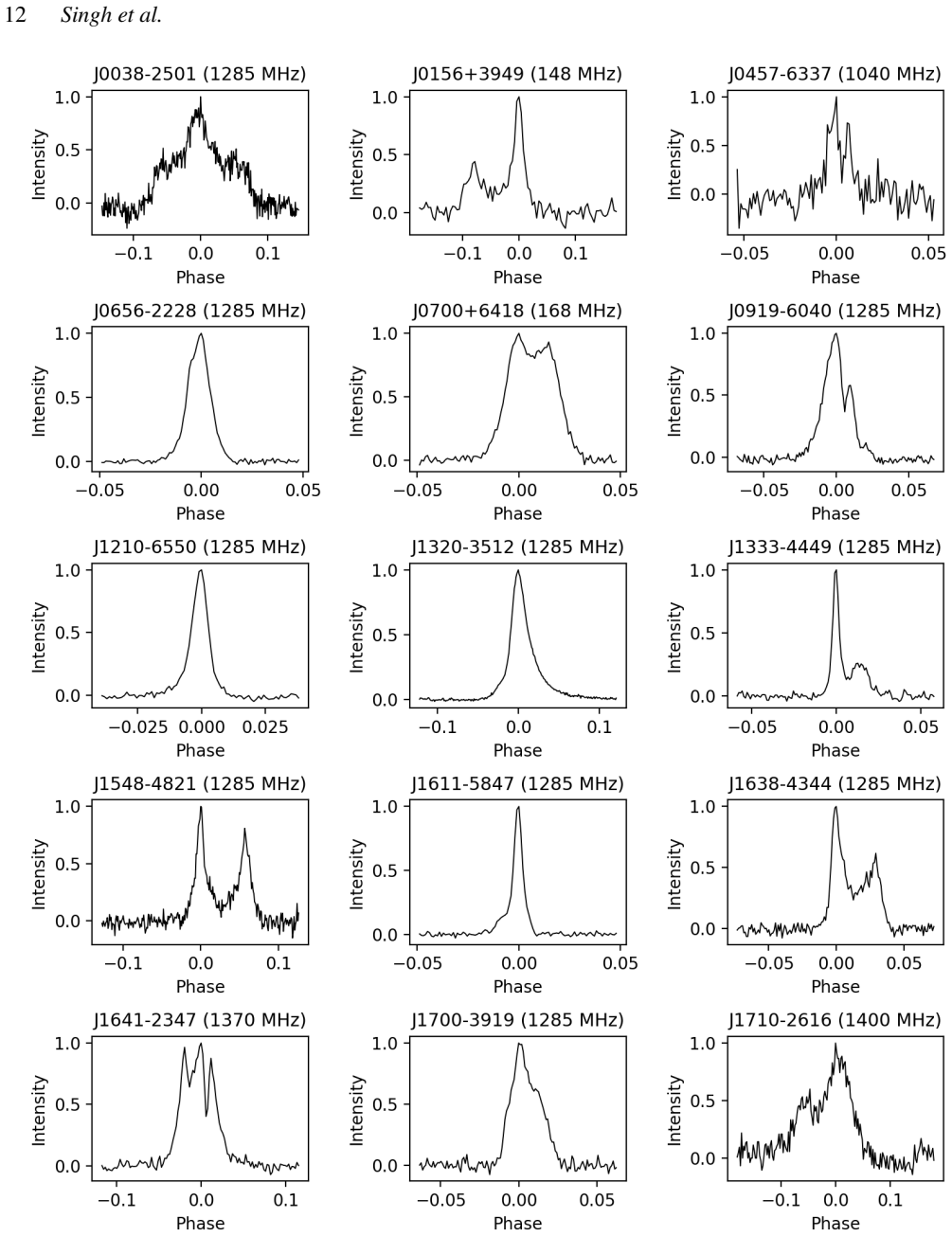
Summary. The manuscript revisits pulsar death under the vacuum-gap (RS75/GS00) and partially screened gap (PSG) voltage-gap models. It argues that in both frameworks a dying pulsar can sustain only a single spark on the polar cap, which should yield a single-component folded profile and no subpulse drifting or mode changing. The authors present uGMRT band-4 observations of five long-period pulsars near the empirical lower boundary of the P-Pdot plane, find that these pulsars' emission properties are similar to those of the general pulsar population, and report that all five show multi-component profiles at some frequency. They then compile folded profiles for 28 pulsars in the single-spark death valley and claim that 19 of 28 (68%) show multi-component profiles, contradicting the single-spark death model. Two pulsars, J1320-3512 and J1232-4742, have both a_vg and a_psg less than one yet are detectable in radio, which would be particularly strong falsifiers of the death-line calibration. The central empirical content is the new uGMRT observations and the compiled sample; the central theoretical inference is that the number of profile components maps directly to the number of sparks.
Significance. If the component-to-spark inference were secure, the paper would provide an important observational challenge to single-spark death-line models. The work has clear strengths: it delivers new uGMRT detections of five pulsars, a newly discovered emission mode change in J1503+2111, microstructure timescale measurements for two pulsars, and a compiled atlas of 28 death-valley profiles with derived a_vg and a_psg values that will be useful to the community. The two pulsars with a<1 that are nevertheless detected are potentially strong, parameter-dependent falsifiers of the absolute death-line calibration. However, the broader 68% claim rests on a component-counting assumption that is not derived or tested against plausible alternatives, so the significance as a model test is currently limited. The manuscript is within scope for an astrophysical journal and the observational material deserves consideration, but the theoretical conclusion needs substantial additional support.
major comments (5)
- [Section 5, first paragraph] The load-bearing step of the paper is the inference that the number of distinct profile components equals the number of sparks on the polar cap, but this is asserted rather than demonstrated. The text states that GS00 showed a_vg is an upper limit on component number and then asserts that 'a pulsar should have a_vg >= 3 to have at least one cone in the radio beam and therefore more than one profile component.' This latter step is not derived and is not self-evident: with sparks of dimension h separated by h, a line of sight crossing the polar cap could plausibly intersect roughly 2*a_vg spark columns, which would make a_vg on the order of 1 sufficient for a two-component profile. If that alternative bound is correct, then many pulsars in Table 3 with a_vg between 1.1 and 1.3 and two-component profiles are consistent with the spark model, and the 19/28 statistic no longer supports the single-spark contradiction. Please derive the component-count bound from the GS00 geometry or give a precise citation, and show how the conclusion changes if the threshold is 2*a_vg rather than a_vg >= 3.
- [Section 1 and Section 5] The paper itself cites Karastergiou & Johnston (2007), who attribute the more complex profiles of older pulsars to a wider range of emission heights rather than to a larger number of sparks. Death-valley pulsars are old, so this is a directly competing explanation for the observed multi-component profiles. The manuscript never rules out this alternative before concluding that multi-component profiles imply multiple sparks. The central claim therefore does not uniquely test the single-spark death model. Please address this alternative explicitly, for example with frequency-evolution measurements of component separation, polarization-position-angle behavior, or single-pulse diagnostics that could discriminate between multiple sparks and multiple emission heights.
- [Section 5 and Table 3] The selection rule stated in Section 5, 'If profiles at more than one frequency are available for a pulsar, we take the profile with the maximum number of distinct components,' combined with the absence of a quantitative criterion for counting components, biases the sample toward multi-component classifications. Because 15 of the 19 claimed multi-component pulsars are two-component, and several of those have a_vg between 1.1 and 1.2 (e.g., J0919-6040, J1333-4449, J1548-4821, J2136-1606), the 68% statistic is sensitive to both the component-counting threshold and the choice of frequency. A sensitivity analysis that counts only components independently confirmed at two or more frequencies, or that uses a defined component-finding algorithm, is needed to support the majority claim.
- [Tables 1 and 3] The parameters a_vg and a_psg are computed 'with a reference that pulsar J2144-3933 (8.5 s pulsar) should have only a single spark,' and no uncertainties are propagated from the measured P and Pdot or from the model parameters (C in Eq. 8; eta, T6, alpha_l, b in Eq. 12). Several tabulated a_vg values lie within a few tenths of unity (0.92, 0.95, 1.03, 1.1, 1.2, 1.3), so the claim that J1232-4742 and J1320-3512 have a_vg < 1 and a_psg < 1 and therefore 'should not be emitting' is not robust to plausible parameter variations in the calibration. Please provide confidence intervals or a sensitivity analysis over the free parameters, and state which parameter values were used to compute a_psg for each pulsar.
- [Section 2.4, Eq. (12)] Equation (12) for a_psg depends on eta, T6, alpha_l, and b, but the manuscript does not specify the values of these parameters used to populate Tables 1 and 3. The text states eta=0.15, T6=2, and alpha_l~45 degrees for the death-valley boundaries in Figure 1, and uses b=1 and b=100 for the upper and lower limits, but it is unclear which combination (and whether b varies per pulsar) was used in the tables. Reproducibility of the 'both a_vg and a_psg < 1' claim for the two constraining pulsars requires these choices to be stated explicitly for each tabulated entry.
minor comments (5)
- [Section 4.3] The phrase 'signature of RMV sweep' should read 'signature of RVM sweep'.
- [Figure 1 caption and Section 2.4] The caption refers to a 'yellow-shaded region' for the PSG death valley, while the text in Section 2.4 describes it as 'orange-shaded'; please make the colors consistent.
- [Section 4.4] The micropulse widths quoted as '2.0±0.3' and '3.8±0.3' are missing units; presumably they are in milliseconds, but this should be stated.
- [Section 5 and Figure 5] The text says 'The beam subtraction (PA-IA) performed on 04 Feb 2023 observation' while Figure 5 and its caption refer to '04 Feb 2022'; please correct the date inconsistency.
- [Section 5] The text says 'Pulsar J1232-4742, with a_vg = 0.97 and a_psg = 0.6,' but Table 1 lists a_vg = 0.95 for the same pulsar; the two values should be reconciled.
Circularity Check
The empirical multi-component test is not circular; only the J2144-3933 calibration anchor is a minor self-referential input.
-
self definitional
[Table 1 caption; Table 3 caption; Section 6 first paragraph (9/28 'potentially agreeing' count)]
"These parameters were computed using equation 8 and 12, with a reference that pulsar J2144-3933 (8.5 s pulsar) should have only a single spark."
The absolute scales of a_vg and a_psg are normalized so that J2144-3933 sits on the single-spark death boundary (a_vg ~ 1, a_psg ~ 1). Its observed single-component profile is therefore an input to the calibration, not an independent prediction. When the paper later counts J2144 among the 9 pulsars 'potentially agreeing' with the single-spark model, that count is forced for this pulsar by construction. The effect is minor: removing J2144 still leaves 19 of 27 pulsars with multi-component profiles, so the paper's central conclusion does not reduce to this calibration.
full rationale
The central empirical test is not circular. The multi-component profiles used in the 19/28 statistic were not used to set the death-line parameters; a_vg and a_psg are computed from P and Pdot via equations 8 and 12, while component counts come from independent uGMRT and literature profiles. The death-line models themselves are adopted from external work (RS75, GS00, Chen & Ruderman 1993, Mitra et al. 2020) and are not supported by a self-citation chain from the present authors. The only mild circularity is the explicit calibration to J2144-3933, whose single-spark status is assumed when computing the parameter normalizations and then reported as a consistent data point; this is non-load-bearing because the majority claim survives without J2144. The Section 5 assumption that the number of profile components maps directly to the number of sparks, and the a_vg >= 3 threshold for multi-component profiles, are model-interpretation premises rather than circular reductions: if they are wrong, the test is weakened physically, but the derivation of the statistic from the premises is not circular. No significant self-citation load-bearing circularity was found.
Assumptions & free parameters
free parameters (2)
- C, the vacuum gap complexity normalization =
~1, chosen so that J2144-3933 has a_vg = 1
- PSG parameters: eta, T6, alpha_l, b =
eta=0.15, T6=2, alpha_l=45 deg, b not explicitly stated (effectively tuned to make J2144-3933 have a_psg=1)
assumptions (4)
- domain assumption Coherent curvature radiation from spark cascades is the mechanism for pulsar radio emission.
- domain assumption The number of profile components cannot exceed the complexity parameter a_vg, and a_vg >= 3 is required for a multi-component profile.
- domain assumption Dipolar magnetic field geometry at radio emission heights for duty cycle and radius-to-frequency mapping comparisons.
- standard math Standard pair cascade condition (Eq. 5) and critical field B_q = 4.4e13 G.
Cite this review
Pith. "Pith review of Emission properties of 5 pulsars in the death-valley and implications on death line models." pith.science (2026). https://pith.science/paper/ED2H6ZTU
@misc{pith2026250710374,
  author       = {Pith},
  title        = {Pith review of: Emission properties of 5 pulsars in the death-valley and implications on death line models},
  year         = {2026},
  howpublished = {\url{https://pith.science/paper/ED2H6ZTU}},
  note         = {Machine review of arXiv:2507.10374}
}
abstract
In the framework of the coherent curvature radiation model of pulsar radio emission, charged particles responsible for the radio emission are generated on the polar cap in the localized pair cascade processes called sparks. When a pulsar can no longer sustain the sparking process on its polar cap, the coherent radio emission from the pulsar stops, and the pulsar is called dead. In this work, we revisit the pulsar death phenomena under two popular voltage gap models: vacuum voltage gap and partially screened voltage gap. We notice that a dying pulsar resorts to a single spark on the polar cap to sustain the pair production under both voltage gap frameworks. The presence of only one spark on the polar cap has important implications for the radio emission properties of the pulsar. We study the emission properties of five pulsars close to the lower boundary on the $P-\dot{P}$ plane of the current pulsar population, as these pulsars are expected to be dying. We find that the dying pulsars in our sample and the normal pulsar population have very similar emission properties. We show that the majority of pulsars in the pulsar death valley, including five pulsars in our sample, show evidence of multiple sparks as opposed to what is expected from single spark death line models.
Figures


Figures from the paper (5 more)


Reference graph
Works this paper leans on
-
[1]
write newline
" write newline "" before.all 'output.state := FUNCTION fin.entry write newline FUNCTION new.block output.state before.all = 'skip after.block 'output.state := if FUNCTION new.sentence output.state after.block = 'skip output.state before.all = 'skip after.sentence 'output.state := if if FUNCTION not #0 #1 if FUNCTION and 'skip pop #0 if FUNCTION or pop #1...
-
[2]
Ben \'a c ek J., Mu \ n oz P. A., B \"u chner J., Jessner A., 2023, @doi [ ] 10.1051/0004-6361/202345987 , https://ui.adsabs.harvard.edu/abs/2023A&A...675A..42B 675, A42
-
[3]
Ben \'a c ek J., Timokhin A., Mu \ n oz P. A., Jessner A., Rievajov \'a T., Pohl M., B \"u chner J., 2024, @doi [ ] 10.1051/0004-6361/202450949 , https://ui.adsabs.harvard.edu/abs/2024A&A...691A.137B 691, A137
-
[4]
Beskin V. S., Istomin A. Y., 2022, @doi [Monthly Notices of the Royal Astronomical Society] 10.1093/mnras/stac2423 , 516, 5084
-
[5]
Beskin V. S., Litvinov P. E., 2022, @doi [ ] 10.1093/mnras/stab3575 , https://ui.adsabs.harvard.edu/abs/2022MNRAS.510.2572B 510, 2572
-
[6]
Bilous A. V., et al., 2016, @doi [ ] 10.1051/0004-6361/201527702 , https://ui.adsabs.harvard.edu/abs/2016A&A...591A.134B 591, A134
-
[7]
Buch K. D., Kale R., Muley M., Kudale S., Ajithkumar B., 2023, @doi [Journal of Astrophysics and Astronomy] 10.1007/s12036-023-09919-x , https://ui.adsabs.harvard.edu/abs/2023JApA...44...37B 44, 37
-
[8]
Caleb M., et al., 2022, @doi [Nature Astronomy] 10.1038/s41550-022-01688-x , https://ui.adsabs.harvard.edu/abs/2022NatAs...6..828C 6, 828
Show all 56 references
-
[9]
Caleb M., et al., 2024, @doi [Nature Astronomy] 10.1038/s41550-024-02277-w , https://ui.adsabs.harvard.edu/abs/2024NatAs...8.1159C 8, 1159
2024 doi
-
[10]
J., 1995, @doi [ ] 10.1086/175737 , https://ui.adsabs.harvard.edu/abs/1995ApJ...445..756C 445, 756
Camilo F., Nice D. J., 1995, @doi [ ] 10.1086/175737 , https://ui.adsabs.harvard.edu/abs/1995ApJ...445..756C 445, 756
1995 doi
-
[11]
Chen K., Ruderman M., 1993, @doi [ ] 10.1086/172129 , https://ui.adsabs.harvard.edu/abs/1993ApJ...402..264C 402, 264
1993 doi
-
[12]
L., Wang H
Chen J. L., Wang H. G., 2014, @doi [ ] 10.1088/0067-0049/215/1/11 , https://ui.adsabs.harvard.edu/abs/2014ApJS..215...11C 215, 11
2014 doi
- [13]
-
[14]
Dirson L., P \'e tri J., Mitra D., 2022, @doi [ ] 10.1051/0004-6361/202243305 , https://ui.adsabs.harvard.edu/abs/2022A&A...667A..82D 667, A82
2022 doi
- [15]
-
[16]
A., Sendyk M., 2000, @doi [The Astrophysical Journal] 10.1086/309394 , 541, 351–366
Gil J. A., Sendyk M., 2000, @doi [The Astrophysical Journal] 10.1086/309394 , 541, 351–366
2000 doi
-
[17]
I., Geppert U., 2003, @doi [ ] 10.1051/0004-6361:20030854 , https://ui.adsabs.harvard.edu/abs/2003A&A...407..315G 407, 315
Gil J., Melikidze G. I., Geppert U., 2003, @doi [ ] 10.1051/0004-6361:20030854 , https://ui.adsabs.harvard.edu/abs/2003A&A...407..315G 407, 315
2003 doi
-
[18]
Gil J., Melikidze G., Zhang B., 2006, @doi [The Astrophysical Journal] 10.1086/506982 , 650, 1048
2006 doi
-
[19]
Hurley-Walker N., et al., 2024, @doi [ ] 10.3847/2041-8213/ad890e , https://ui.adsabs.harvard.edu/abs/2024ApJ...976L..21H 976, L21
2024 doi
-
[20]
Johnston S., Karastergiou A., 2017, @doi [ ] 10.1093/mnras/stx377 , https://ui.adsabs.harvard.edu/abs/2017MNRAS.467.3493J 467, 3493
2017 doi
-
[21]
Johnston S., Karastergiou A., 2019, @doi [ ] 10.1093/mnras/stz400 , https://ui.adsabs.harvard.edu/abs/2019MNRAS.485..640J 485, 640
2019 doi
-
[22]
Johnston S., Kerr M., 2018, @doi [ ] 10.1093/mnras/stx3095 , https://ui.adsabs.harvard.edu/abs/2018MNRAS.474.4629J 474, 4629
2018 doi
-
[23]
J., Oswald L
Johnston S., Kramer M., Karastergiou A., Keith M. J., Oswald L. S., Parthasarathy A., Weltevrede P., 2023, @doi [ ] 10.1093/mnras/stac3636 , https://ui.adsabs.harvard.edu/abs/2023MNRAS.520.4801J 520, 4801
2023 doi
-
[24]
J., Oswald L
Johnston S., Mitra D., Keith M. J., Oswald L. S., Karastergiou A., 2024, @doi [ ] 10.1093/mnras/stae1175 , https://ui.adsabs.harvard.edu/abs/2024MNRAS.530.4839J 530, 4839
2024 doi
-
[25]
Karastergiou A., Johnston S., 2007, @doi [ ] 10.1111/j.1365-2966.2007.12237.x , https://ui.adsabs.harvard.edu/abs/2007MNRAS.380.1678K 380, 1678
2007
-
[26]
Kramer M., Johnston S., Van Straten W., 2002, @doi [Monthly Notices of the Royal Astronomical Society] 10.1046/j.1365-8711.2002.05478.x , 334, 523–532
2002
-
[27]
W., 2024, @doi [Nature Astronomy] 10.1038/s41550-023-02125-3 , https://ui.adsabs.harvard.edu/abs/2024NatAs...8..230K 8, 230
Kramer M., Liu K., Desvignes G., Karuppusamy R., Stappers B. W., 2024, @doi [Nature Astronomy] 10.1038/s41550-023-02125-3 , https://ui.adsabs.harvard.edu/abs/2024NatAs...8..230K 8, 230
2024 doi
- [28]
-
[29]
arXiv:2411.15739
Li D., et al., 2024, @doi [arXiv e-prints] 10.48550/arXiv.2411.15739 , https://ui.adsabs.harvard.edu/abs/2024arXiv241115739L p. arXiv:2411.15739
2024 doi
-
[30]
G., Manchester R
Lyne A. G., Manchester R. N., Taylor J. H., 1985, @doi [ ] 10.1093/mnras/213.3.613 , https://ui.adsabs.harvard.edu/abs/1985MNRAS.213..613L 213, 613
1985 doi
-
[31]
Maciesiak K., Gil J., 2011, @doi [ ] 10.1111/j.1365-2966.2011.19359.x , https://ui.adsabs.harvard.edu/abs/2011MNRAS.417.1444M 417, 1444
2011
-
[32]
Maciesiak K., Gil J., Melikidze G., 2012, @doi [Monthly Notices of the Royal Astronomical Society] 10.1111/j.1365-2966.2012.21246.x , 424, 1762
2012
-
[33]
N., Taylor J
Manchester R. N., Taylor J. H., 1977, Pulsars
1977
-
[34]
Mitra D., 2017, @doi [Journal of Astrophysics and Astronomy] 10.1007/s12036-017-9457-6 , 38
2017 doi
-
[35]
I., Arjunwadkar M., 2020, @doi [ ] 10.1093/mnras/stz3620 , https://ui.adsabs.harvard.edu/abs/2020MNRAS.492.2468M 492, 2468
Mitra D., Basu R., Melikidze G. I., Arjunwadkar M., 2020, @doi [ ] 10.1093/mnras/stz3620 , https://ui.adsabs.harvard.edu/abs/2020MNRAS.492.2468M 492, 2468
2020 doi
-
[36]
Morello V., et al., 2020a, @doi [ ] 10.1093/mnras/staa321 , https://ui.adsabs.harvard.edu/abs/2020MNRAS.493.1165M 493, 1165
-
[37]
D., Stappers B
Morello V., Barr E. D., Stappers B. W., Keane E. F., Lyne A. G., 2020b, @doi [ ] 10.1093/mnras/staa2291 , https://ui.adsabs.harvard.edu/abs/2020MNRAS.497.4654M 497, 4654
-
[38]
Philippov A., Timokhin A., Spitkovsky A., 2020, @doi [ ] 10.1103/PhysRevLett.124.245101 , https://ui.adsabs.harvard.edu/abs/2020PhRvL.124x5101P 124, 245101
2020 doi
-
[39]
Posselt B., et al., 2021, @doi [ ] 10.1093/mnras/stab2775 , https://ui.adsabs.harvard.edu/abs/2021MNRAS.508.4249P 508, 4249
2021 doi
-
[40]
Posselt B., et al., 2023, @doi [ ] 10.1093/mnras/stac3383 , https://ui.adsabs.harvard.edu/abs/2023MNRAS.520.4582P 520, 4582
2023 doi
-
[41]
J., 1969, , https://ui.adsabs.harvard.edu/abs/1969ApL.....3..225R 3, 225
Radhakrishnan V., Cooke D. J., 1969, , https://ui.adsabs.harvard.edu/abs/1969ApL.....3..225R 3, 225
1969
-
[42]
H., et al., 2017, @doi [Journal of Astronomical Instrumentation] 10.1142/S2251171716410117 , https://ui.adsabs.harvard.edu/abs/2017JAI.....641011R 6, 1641011
Reddy S. H., et al., 2017, @doi [Journal of Astronomical Instrumentation] 10.1142/S2251171716410117 , https://ui.adsabs.harvard.edu/abs/2017JAI.....641011R 6, 1641011
2017 doi
-
[43]
N., Pen U.-L., 2018, @doi [ ] 10.3847/1538-4357/aad815 , https://ui.adsabs.harvard.edu/abs/2018ApJ...864..160R 864, 160
Roy J., Chengalur J. N., Pen U.-L., 2018, @doi [ ] 10.3847/1538-4357/aad815 , https://ui.adsabs.harvard.edu/abs/2018ApJ...864..160R 864, 160
2018 doi
-
[44]
A., Sutherland P
Ruderman M. A., Sutherland P. G., 1975, @doi [ ] 10.1086/153393 , https://ui.adsabs.harvard.edu/abs/1975ApJ...196...51R 196, 51
1975 doi
-
[45]
Sautron M., P \'e tri J., Mitra D., Dirson L., 2024, @doi [ ] 10.1051/0004-6361/202451097 , https://ui.adsabs.harvard.edu/abs/2024A&A...691A.349S 691, A349
2024 doi
-
[46]
W., Ray P
Singh S., Roy J., Panda U., Bhattacharyya B., Morello V., Stappers B. W., Ray P. S., McLaughlin M. A., 2022, @doi [ ] 10.3847/1538-4357/ac7b91 , https://ui.adsabs.harvard.edu/abs/2022ApJ...934..138S 934, 138
2022 doi
-
[47]
Singh S., Gupta Y., De K., 2024, @doi [ ] 10.1093/mnras/stad3334 , https://ui.adsabs.harvard.edu/abs/2024MNRAS.527.2612S 527, 2612
2024 doi
-
[48]
Song X., et al., 2023, @doi [ ] 10.1093/mnras/stad135 , https://ui.adsabs.harvard.edu/abs/2023MNRAS.520.4562S 520, 4562
2023 doi
-
[49]
Spiewak R., et al., 2020, @doi [ ] 10.1093/mnras/staa1869 , https://ui.adsabs.harvard.edu/abs/2020MNRAS.496.4836S 496, 4836
2020 doi
-
[50]
E., 1992, @doi [International Astronomical Union Colloquium] 10.1017/S0002731600154952 , 128, 143–146
Thorsett S. E., 1992, @doi [International Astronomical Union Colloquium] 10.1017/S0002731600154952 , 128, 143–146
1992 doi
-
[51]
N., 2010, @doi [Monthly Notices of the Royal Astronomical Society] 10.1111/j.1365-2966.2010.17286.x , 408, 2092
Timokhin A. N., 2010, @doi [Monthly Notices of the Royal Astronomical Society] 10.1111/j.1365-2966.2010.17286.x , 408, 2092
2010
-
[52]
Vivekanand M., Radhakrishnan V., 1980, @doi [Journal of Astrophysics and Astronomy] 10.1007/BF02714232 , https://ui.adsabs.harvard.edu/abs/1980JApA....1..119V 1, 119
1980 doi
-
[53]
Wahl H., Rankin J., Venkataraman A., Olszanski T., 2023, @doi [ ] 10.1093/mnras/stac3613 , https://ui.adsabs.harvard.edu/abs/2023MNRAS.520..314W 520, 314
2023 doi
-
[54]
Young M., Manchester R., Johnston S., 1999, @doi [Nature] 10.1038/23650 , 400, 848
1999 doi
-
[55]
Young M. D. T., Chan L. S., Burman R. R., Blair D. G., 2010, @doi [ ] 10.1111/j.1365-2966.2009.15972.x , https://ui.adsabs.harvard.edu/abs/2010MNRAS.402.1317Y 402, 1317
2010
-
[56]
J., 2017, @doi [ ] 10.1093/mnras/stw3068 , https://ui.adsabs.harvard.edu/abs/2017MNRAS.467.1661V 467, 1661
van Heerden E., Karastergiou A., Roberts S. J., 2017, @doi [ ] 10.1093/mnras/stw3068 , https://ui.adsabs.harvard.edu/abs/2017MNRAS.467.1661V 467, 1661
2017 doi
Reviewed August 6, 2026 · model on record in the stance chip above.
Discussion (0). Sign in to comment.