REVIEW 3 major objections 4 minor 43 references
Propensity score weighting across counterfactual worlds: longitudinal effects under positivity violations
T0 review · 3 major / 4 minor · reviewed 2026-08-06 · deepseek-v4-flash
Pith's one-line read A cross-world weighted estimand can identify longitudinal treatment-regime contrasts without positivity assumptions, but only under a partial common-support condition.
desk verdict The identification theorem is broken in a way that is both central and repairable; the paper's best ideas survive a redefinition of the target. read the letter →
The pith
A machine-rendered reading of the paper's core claim, the machinery that carries it, and where it could break.
The reading
What carries the argument
The central object is the cumulative cross-world weighted effect \psi(a_T, a'_T) = E[(Y(a_T) - Y(a'_T)) \prod_{t=1}^T w_t{p_t(X_t(a_{t-1}))} w'_t{p'_t(X_t(a'_{t-1}))}], where p_t and p'_t are natural propensity scores under the two intervention histories. The argument works by identifying those natural propensity scores as ordinary observed propensity scores \pi_t and \pi'_t conditional on regime-consistent histories, then re-expressing \psi as a difference of weighted g-formula integrals. The efficiency analysis is carried by the efficient influence function \varphi = \varphi_m + \varphi_w, where \varphi_m debiases the sequential regressions and \varphi_w accounts for estimating the propensity-score weights; the covariate density ratio \rho_t = dP(X_t | A_{t-1}=a_{t-1}, X_{t-1})/dP(X_t | A_{t-1}=a'_{t-1}, X_{t-1}) is handled by writing it as a ratio of four binary-regression probabilities.
What would settle it
Set T=2 with X2 = A1 so that the conditional law of X2 given A1=1 and given A1=0 have disjoint support, choose treatments A_t and outcome Y so that Y(1,1) - Y(0,0) is nonzero, and compute both sides of the identification display in Theorem 1 under Assumption 1; the weighted g-formula side collapses to zero while the estimand's defining expectation is nonzero, which would show the stated identification formula does not follow from the paper's stated assumptions.
Extended reading notes
Core claim
On the paper's own terms, the central discovery is that the cross-world weighted contrast \psi(a_T, a'_T) is identifiable from observed data without positivity, provided the weights are zero whenever either natural propensity score is zero and strong sequential randomization holds. The proof rewrites \psi as a difference of two weighted g-formula functionals, one per regime, with the same cross-world weight product applied to each. The same analysis reveals that the estimand's informativeness requires a partial common support assumption on time-varying covariate distributions; when the conditional laws of covariates under the two regimes have disjoint support, the identified functional vanishes identically, so the estimand is only meaningful as a mechanistic contrast when some overlap remains. The paper also derives an efficient influence function and a sample-split doubly robust estimator that converges to a normal distribution at root-n rate, recasting the challenging covariate density ratio as a ratio of four binary-regression probabilities.
Load-bearing premise
The proof's key identification step assumes, without stating it, that the counterfactual covariate history under the comparison regime can be treated as equivalent to the covariate history under the target regime inside the same expectation, a cross-world equivalence that strong sequential randomization alone does not imply and that generally fails when treatment affects intermediate covariates.
Editorial extensions
If this is right
- Researchers can estimate contrasts between two treatment regimes when some subjects have near-zero probability of following one or both regimes, without assuming full positivity.
- The doubly robust estimator achieves \sqrt{n}-consistent, asymptotically normal inference when nuisance models converge at n^{-1/4} rates, so standard machine learning can be used for the nuisance steps.
- The estimand's null-preservation property distinguishes it from flip interventions: if the two potential outcomes are almost surely equal, the weighted effect is exactly zero.
- In practice, estimates should be accompanied by checks of the covariate density ratio \rho_t, because absence of overlap makes the identified functional collapse to zero.
- The interpretability-implementability tradeoff is made explicit: mechanism-relevant effects need not correspond to interventions anyone could perform.
Reading between the lines
- If the unstated cross-world covariate equivalence fails, as it will whenever treatment changes intermediate covariates, the identification proof's replacement of one counterfactual covariate history by the other may not hold; a simple two-timepoint simulation with X2 = A1 could test this directly.
- Because the estimand depends on natural propensity scores under both regimes, the same weighting construction should extend to continuous treatments or multi-valued actions by replacing propensity scores with dose-response or generalized propensity functions, though the density-ratio conditions would need reworking.
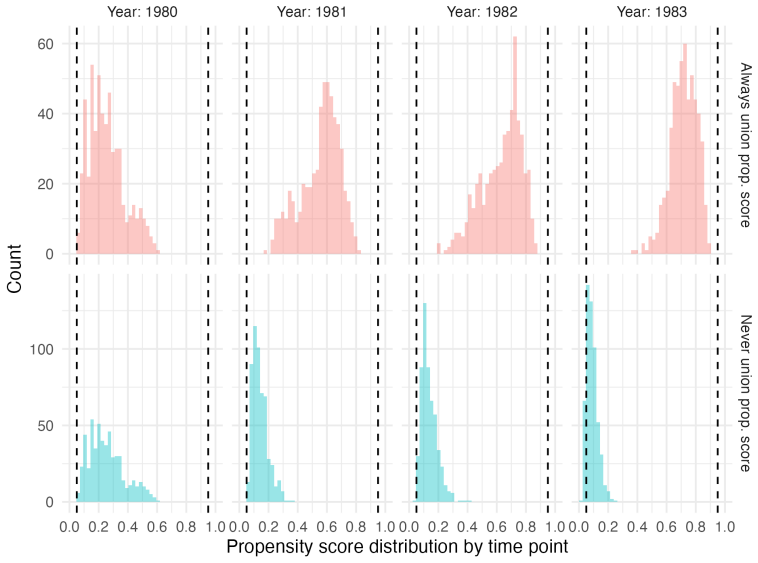
- The collapse-to-zero behavior suggests that any applied report of this effect should also report the empirical distribution of the covariate density ratios, as the paper's data analysis does; otherwise a null result could reflect support failure rather than absence of mechanism.
- A natural next comparison is against flip interventions on the same dataset: differences between the two estimates would quantify the bias flip effects incur from their additional effects on intermediate treatments and covariates.
Editorial analysis
A structured set of objections, weighed in public.
Referee Report
Summary. The paper introduces a new longitudinal causal estimand, the cumulative cross-world weighted effect, which weights the difference in potential outcomes under two treatment regimes by a product of natural propensity scores evaluated under both counterfactual covariate histories. The authors claim that this estimand isolates the mechanistic contrast between regimes while adapting to positivity violations, is identifiable without a positivity assumption under strong sequential randomization, and admits doubly robust-style estimators with n^{-1/4} nuisance convergence rates. They derive an efficient influence function, propose a sample-split estimator, and illustrate the method with a union-membership wage analysis. The central identification theorem (Theorem 1) is, however, invalid as stated because the proof substitutes counterfactual covariate histories across regimes without a justifying assumption, so the identified functional in equations (4)-(5) does not correspond to the estimand in equation (1).
Significance. If the identification claim were correct, the paper would contribute a novel class of estimands for longitudinal positivity violations, along with a concrete estimation strategy and a useful conceptual discussion of the tradeoff between mechanistic and policy relevance. The development of an efficient influence function and the reformulation of density-ratio estimation as binary regression are methodologically interesting, and the included code and data analysis are positive features. However, because Theorem 1 is the foundation for the estimator and the data analysis, the paper's main contribution is not currently supported. The manuscript is candid about the cross-world nature of the estimand, but that candor makes the missing cross-world assumption in the proof more consequential rather than less.
major comments (3)
- [Section 4, Theorem 1 and Appendix A.2] The proof of Theorem 1 identifies a different estimand than the one defined in equation (1). In equation (1), the time-t weight includes p'_t{X_t(a'_{t-1})}, the natural propensity under the a' regime evaluated at the covariate history generated by a'. The identified functional in equations (4)-(5) instead evaluates both weights w_t{pi_t(x_t)}w'_t{pi'_t(x_t)} at a single covariate history x_t that is generated under the a-regime in the first integral and under the a'-regime in the second integral. The 'Timepoint 2' step of the proof replaces X_t(a'_{t-1}) by X_t inside an expectation conditional on A_1=a_1, which is only justified if the counterfactual covariate histories under the two regimes coincide in law. Assumption 1 is a single-world conditional independence restriction and implies no such equality in distribution. Remark 1 explicitly concedes that X_t(a_{t-1}) and X_t(a'_{t-1}) are generally not equal in distribution when treatment affects intermediate covariates. Consequently, the functional in (4)-(5) is the g-formula for a single-world weighted estimand, not for psi(a_T,a'_T) in (1). This invalidates Theorem 1 as a statement about the proposed estimand.
- [Section 4, Lemma 1 and its use in Theorem 1] Lemma 1 identifies the natural propensity P{A_t(a'_{t-1})=a'_t | X_t(a'_{t-1})} under positivity of the a'-regime propensity scores and conditioning on A_{t-1}=a'_{t-1}. In the proof of Theorem 1, however, this lemma is invoked inside an expectation in which the conditioning event involves the a-regime history (e.g., after 'iterated expectations on X_2 | A_1 = a_1, X_1'). The lemma does not license replacing the counterfactual covariate history X_t(a'_{t-1}) with the observed history X_t under the target regime A_{t-1}=a_{t-1}. The manuscript's own Example in Section 4.1 shows that the support of X_t under the two regimes can be disjoint even without positivity violations, which makes the substitution particularly problematic. The proof therefore relies on an unstated cross-world equivalence that is neither implied by Assumption 1 nor otherwise justified.
- [Section 5, Lemma 2 and Theorem 2] The efficient influence function in Lemma 2 and the estimator in Algorithm 1 are derived for the functional in equations (4)-(5), not for the estimand in equation (1). Since Theorem 1 is invalid, the estimator's consistency claim for psi(a_T,a'_T) in Theorem 2 is unsupported. If the authors intend to estimate the single-world weighted functional that appears in (4)-(5), they should redefine the target estimand accordingly and re-derive the influence function under that target. The current presentation conflates the two functionals, and the data analysis in Section 6 therefore does not provide evidence about the estimand advertised in the abstract and introduction.
minor comments (4)
- [Appendix A.1] The proof of Lemma 1 contains typographical errors, such as 'A1 = a1X1' where a comma is missing, and notation is used inconsistently (for example, X_3(a_2) versus X_3). These should be corrected.
- [Abstract and Section 3] The abstract states that the proposed effect 'circumvents the limitations of existing longitudinal methods' and 'isolates mechanistic differences,' but Section 3.1 and Remark 1 appropriately emphasize that the effect is not policy-relevant because it is cross-world. The abstract could mislead readers about the applicability of the estimand, and it should be qualified accordingly.
- [Section 5.4] The identity for the density ratio is stated as holding 'when rho_t(X_t) < infinity almost surely,' but the convention that propensity scores are set to zero when the conditioning event has probability zero is not enough to ensure the ratio is well-defined for the intermediate expressions. The conditions under which the four probabilities in the ratio are obtained from observed data should be stated more carefully.
- [Table 1] The table lists 'Weighting towards a_T only' with w_t = p_t and w'_t = 1. This weight is unbounded when p_t is near zero and does not satisfy Condition 1 of Theorem 1, since the product w_t w'_t does not necessarily vanish when pi_t pi'_t = 0. The authors should clarify which weights in the table are actually covered by their main results.
Circularity Check
Theorem 1 identifies a single-world weighted g-formula, not the cross-world estimand in (1): the proof silently evaluates w'_t at the a-regime covariate history, so the identification is equivalent to assuming the two counterfactual histories coincide.
-
self definitional
[Section 4, Theorem 1 and proof, 'Timepoint 2' step (Appendix A.2); compare Eq. (1) with Eqs. (4)-(5)]
"Then, by strong sequential exchangeability and iterated expectations on X2 | A1 = a1, X1, we have ... = E( E( E[ Y(aT ) ... | X2, A1 = a1, X1] w2(π2)w′2(π′2) | X1) w1(π1)w′1(π′1) )."
In the estimand (1), w′2 is evaluated at the counterfactual covariate history X2(a′1) generated by regime a′1. In the proof, the expectation is taken conditional on X2 with A1 = a1, so w′2(π′2) is evaluated at X2(a1) instead. Lemma 1 identifies P{At(a′t−1)=a′t | X t(a′t−1)} = π′t(X t) along the history generated by a′t−1; it does not license replacing X t(a′t−1) by X t(at−1) inside the same expectation. That replacement is exactly the condition that the two counterfactual covariate processes coincide (or that the cross-world joint factorizes), which Remark 1 concedes fails when treatment affects intermediate covariates.
-
other
[Section 5.1, Eq. (6), and Algorithm 1 / Theorem 2]
"First, let ψ(aT ) denote the first half of the identified cumulative cross-world weighted effect; i.e., ψ(aT ) = ∫_{X^T} E(Y | aT , xT ) ∏_{t=1}^{T} wt{πt(xt)}w′t{π′t(xt)}dP(xt | At−1 = at−1, xt−1)."
The estimand developed in Section 5 is not the first component of the original cross-world estimand (1): it places both weights wt and w′t on the same observed covariate history xt under regime a, whereas (1) requires w′t to be evaluated at X t(a′t−1). Consequently the efficient influence function, the doubly robust estimator, and Theorem 2's asymptotic normality are guarantees for the single-world functional (6)/(4), not for the headline cross-world ψ(aT, a′T). The estimation theory therefore 'confirms' a quantity that has already been substituted into the target by construction.
full rationale
Score is 6 rather than 0 because the central identification theorem does not actually identify the estimand stated in (1). The paper's own Remark 1 concedes that the two counterfactual covariate histories are not equal in distribution when treatments affect intermediate covariates, and the proof of Theorem 1 nonetheless evaluates both weights on a single history inside each expectation. Lemma 1 is a standard g-computation identification of natural propensities and is not itself circular; the circularity enters in the step from the cross-world estimand to the g-formula, where the distinct histories are silently equated. Since the asymptotic theory in Section 5 is developed for the redefined functional in (6), the efficiency results do not provide independent support for the original cross-world estimand. I found no load-bearing self-citation chain: the references to McClean et al. (2025) are motivational, and the identification argument rests on Assumption 1, not on those citations. The paper is not circular in the fitting sense (no fitted parameter is renamed a prediction), which is why the score is below 8. But because the headline claim—identifiability of cumulative cross-world weighted effects—reduces to an unstated equivalence of counterfactual histories, the central derivation is partially circular.
Assumptions & free parameters
free parameters (1)
- Smoothing constant k in data analysis weights =
20
assumptions (6)
- domain assumption Nonparametric structural equation model (NPSEM) with deterministic functions f_X,t, f_A,t, f_Y and exogenous variables U_X,t, U_A,t, U_Y
- domain assumption Assumption 1: strong sequential randomization, U_A,t independent of (U_X,t+1, U_A,t+1, U_Y) given H_t for all t
- domain assumption Assumption 2: partial common support, P{rho_t(X_t) in (0, infinity)} > 0 for every t
- ad hoc to paper Condition 1 in Theorem 1: weights vanish whenever pi_t * pi'_t = 0
- standard math Technical regularity conditions in Lemma 2 and Theorem 2: boundedness of the sequential regressions, bounded inverse propensity weights, and a bounded 2+delta moment of the covariate density ratio
- ad hoc to paper Hidden cross-world equivalence: X_t(a_{t-1}) and X_t(a'_{t-1}) have the same conditional law given the observed history (unstated)
Cite this review
Pith. "Pith review of Propensity score weighting across counterfactual worlds: longitudinal effects under positivity violations." pith.science (2026). https://pith.science/paper/ZJH6FAMG
@misc{pith2026250710774,
  author       = {Pith},
  title        = {Pith review of: Propensity score weighting across counterfactual worlds: longitudinal effects under positivity violations},
  year         = {2026},
  howpublished = {\url{https://pith.science/paper/ZJH6FAMG}},
  note         = {Machine review of arXiv:2507.10774}
}
read the original abstract
When examining a contrast between two interventions, longitudinal causal inference studies frequently encounter positivity violations when one or both regimes are impossible to observe for some subjects. Existing weighting methods either assume positivity holds or produce effects that conflate interventions' impacts on ultimate outcomes with their effects on intermediate treatments and covariates. We propose a novel class of estimands -- cumulative cross-world weighted effects -- that weights potential outcome differences using propensity scores adapting to positivity violations cumulatively across timepoints and simultaneously across both counterfactual treatment histories. This new estimand isolates mechanistic differences between treatment regimes, is identifiable without positivity assumptions, and circumvents the limitations of existing longitudinal methods. Further, our analysis reveals two fundamental insights about longitudinal causal inference under positivity violations. First, while mechanistically meaningful, these effects correspond to non-implementable interventions, exposing a core interpretability-implementability tradeoff. Second, the identified effects faithfully capture mechanistic differences only under a partial common support assumption; violations cause the identified functional to collapse to zero, even when the causal effect is non-zero. We develop doubly robust-style estimators that achieve asymptotic normality and parametric convergence under nonparametric assumptions on the nuisance estimators. To this end, we reformulate challenging density ratio estimation as regression function estimation, which is achievable with standard machine learning methods. We illustrate our methods through analysis of union membership's effect on earnings.
Figures
Reference graph
Works this paper leans on
-
[1]
Insights into the cross-world independence assumption of causal mediation analysis
Ryan M Andrews and Vanessa Didelez. Insights into the cross-world independence assumption of causal mediation analysis. Epidemiology, 32 0 (2): 0 209--219, 2021
work page 2021
-
[2]
Doubly robust estimation in missing data and causal inference models
Heejung Bang and James M Robins. Doubly robust estimation in missing data and causal inference models. Biometrics, 61 0 (4): 0 962--973, 2005
2005
-
[3]
Efficient and adaptive estimation for semiparametric models, volume 4
Peter J Bickel, Chris AJ Klaassen, Y Ritov, and JA Wellner. Efficient and adaptive estimation for semiparametric models, volume 4. Springer, 1993
work page 1993
-
[4]
Density ratio estimation via infinitesimal classification
Kristy Choi, Chenlin Meng, Yang Song, and Stefano Ermon. Density ratio estimation via infinitesimal classification. In International Conference on Artificial Intelligence and Statistics, pages 2552--2573. PMLR, 2022
work page 2022
-
[5]
Dealing with limited overlap in estimation of average treatment effects
Richard K Crump, V Joseph Hotz, Guido W Imbens, and Oscar A Mitnik. Dealing with limited overlap in estimation of average treatment effects. Biometrika, 96 0 (1): 0 187--199, 2009
work page 2009
-
[6]
Population intervention causal effects based on stochastic interventions
Iv \'a n D \' az and Mark van der Laan. Population intervention causal effects based on stochastic interventions. Biometrics, 68 0 (2): 0 541--549, 2012
work page 2012
-
[7]
Nonparametric causal effects based on longitudinal modified treatment policies
Iv \'a n D \' az, Nicholas Williams, Katherine L Hoffman, and Edward J Schenck. Nonparametric causal effects based on longitudinal modified treatment policies. Journal of the American Statistical Association, 118 0 (542): 0 846--857, 2023
work page 2023
-
[8]
Orthogonal statistical learning
Dylan J Foster and Vasilis Syrgkanis. Orthogonal statistical learning. The Annals of Statistics, 51 0 (3): 0 879--908, 2023
work page 2023
Show all 43 references
-
[9]
Principal stratification in causal inference
Constantine E Frangakis and Donald B Rubin. Principal stratification in causal inference. Biometrics, 58 0 (1): 0 21--29, 2002
2002
-
[10]
A distribution-free theory of nonparametric regression, volume 1
L \'a szl \'o Gy \"o rfi, Michael Kohler, Adam Krzyzak, Harro Walk, et al. A distribution-free theory of nonparametric regression, volume 1. Springer, 2002
2002
-
[11]
Estimation of the effect of interventions that modify the received treatment
Sebastian Haneuse and Andrea Rotnitzky. Estimation of the effect of interventions that modify the received treatment. Statistics in medicine, 32 0 (30): 0 5260--5277, 2013
2013
-
[12]
Causal Inference: What if
Miguel Hern\' a n and James Robins. Causal Inference: What if. Boca Raton: Chapman & Hall/CRC, 2020
2020
-
[13]
Robust estimation of inverse probability weights for marginal structural models
Kosuke Imai and Marc Ratkovic. Robust estimation of inverse probability weights for marginal structural models. Journal of the American Statistical Association, 110 0 (511): 0 1013--1023, 2015
2015
-
[14]
Identification and responses to positivity violations in longitudinal studies: an illustration based on invasively mechanically ventilated icu patients
Aksel KG Jensen, Theis Lange, Olav L Schj rring, and Maya L Petersen. Identification and responses to positivity violations in longitudinal studies: an illustration based on invasively mechanically ventilated icu patients. Biostatistics & Epidemiology, 8 0 (1): 0 e2347709, 2024
2024
-
[15]
Semiparametric counterfactual density estimation
Edward Kennedy, Sivaraman Balakrishnan, and Larry Wasserman. Semiparametric counterfactual density estimation. Biometrika, 110 0 (4): 0 875--896, 2023
2023
-
[16]
Nonparametric causal effects based on incremental propensity score interventions
Edward H Kennedy. Nonparametric causal effects based on incremental propensity score interventions. Journal of the American Statistical Association, 114 0 (526): 0 645--656, 2019
2019
-
[17]
Semiparametric doubly robust targeted double machine learning: a review
Edward H Kennedy. Semiparametric doubly robust targeted double machine learning: a review. Handbook of Statistical Methods for Precision Medicine, pages 207--236, 2024
2024
-
[18]
Sharp instruments for classifying compliers and generalizing causal effects
Edward H Kennedy, Sivaraman Balakrishnan, and Max G’Sell. Sharp instruments for classifying compliers and generalizing causal effects. The Annals of Statistics, 48 0 (4): 0 2008--2030, 2020
2008
-
[19]
Doubly-robust and heteroscedasticity-aware sample trimming for causal inference
Samir Khan and Johan Ugander. Doubly-robust and heteroscedasticity-aware sample trimming for causal inference. arXiv preprint arXiv:2210.10171, 2022
2022 arXiv
-
[20]
Fair comparisons of causal parameters with many treatments and positivity violations
Alec McClean, Yiting Li, Sunjae Bae, Mara A McAdams-DeMarco, Iv \'a n D \' az, and Wenbo Wu. Fair comparisons of causal parameters with many treatments and positivity violations. arXiv preprint arXiv:2410.13522, 2024
2024
-
[21]
Longitudinal weighted and trimmed treatment effects with flip interventions
Alec McClean, Alexander W Levis, Nicholas Williams, and Ivan Diaz. Longitudinal weighted and trimmed treatment effects with flip interventions. arXiv preprint arXiv:2506.09188, 2025
2025 arXiv
-
[22]
Causality
Judea Pearl. Causality. Cambridge University Press, 2009
2009
-
[23]
Diagnosing and responding to violations in the positivity assumption
Maya L Petersen, Kristin E Porter, Susan Gruber, Yue Wang, and Mark J Van Der Laan. Diagnosing and responding to violations in the positivity assumption. Statistical methods in medical research, 21 0 (1): 0 31--54, 2012
2012
-
[24]
SuperLearner: Super Learner Prediction, 2024
Eric Polley, Erin LeDell, Chris Kennedy, and Mark van der Laan . SuperLearner: Super Learner Prediction, 2024. URL https://CRAN.R-project.org/package=SuperLearner. R package version 2.0-29
2024
-
[25]
R: A Language and Environment for Statistical Computing
R Core Team . R: A Language and Environment for Statistical Computing. R Foundation for Statistical Computing, Vienna, Austria, 2024. URL https://www.R-project.org/
2024
-
[26]
Single world intervention graphs (swigs): A unification of the counterfactual and graphical approaches to causality
Thomas S Richardson and James M Robins. Single world intervention graphs (swigs): A unification of the counterfactual and graphical approaches to causality. Center for the Statistics and the Social Sciences, University of Washington Series. Working Paper, 128 0 (30): 0 2013, 2013
2013
-
[27]
A new approach to causal inference in mortality studies with a sustained exposure period—application to control of the healthy worker survivor effect
James Robins. A new approach to causal inference in mortality studies with a sustained exposure period—application to control of the healthy worker survivor effect. Mathematical modelling, 7 0 (9-12): 0 1393--1512, 1986
1986
-
[28]
Effects of multiple interventions
James M Robins, Miguel A Hern \'a n, and Uwe Siebert. Effects of multiple interventions. Comparative quantification of health risks: global and regional burden of disease attributable to selected major risk factors, 1: 0 2191--2230, 2004
2004
-
[29]
Causal inference for continuous multiple time point interventions
Michael Schomaker, Helen McIlleron, Paolo Denti, and Iv \'a n D \' az. Causal inference for continuous multiple time point interventions. Statistics in Medicine, 43 0 (28): 0 5380--5400, 2024
2024
-
[30]
Introductory Econometrics: A Modern Approach, 7e
Justin M. Shea. wooldridge: 115 Data Sets from "Introductory Econometrics: A Modern Approach, 7e" by Jeffrey M. Wooldridge, 2024. URL https://CRAN.R-project.org/package=wooldridge. R package version 1.4-4
2024
-
[31]
Nonparametric policy analysis
James H Stock. Nonparametric policy analysis. Journal of the American Statistical Association, 84 0 (406): 0 567--575, 1989
1989
-
[32]
Density ratio estimation in machine learning
Masashi Sugiyama, Taiji Suzuki, and Takafumi Kanamori. Density ratio estimation in machine learning. Cambridge University Press, 2012
2012
-
[33]
On causal inference in the presence of interference
Eric J Tchetgen Tchetgen and Tyler J VanderWeele. On causal inference in the presence of interference. Statistical methods in medical research, 21 0 (1): 0 55--75, 2012
2012
-
[34]
rpart: Recursive Partitioning and Regression Trees, 2023
Terry Therneau and Beth Atkinson. rpart: Recursive Partitioning and Regression Trees, 2023. URL https://CRAN.R-project.org/package=rpart. R package version 4.1.23
2023
-
[35]
Semiparametric theory and missing data, volume 4
Anastasios A Tsiatis. Semiparametric theory and missing data, volume 4. Springer, 2006
2006
-
[36]
Causal effect models for realistic individualized treatment and intention to treat rules
Mark J van der Laan and Maya L Petersen. Causal effect models for realistic individualized treatment and intention to treat rules. The international journal of biostatistics, 3 0 (1), 2007
2007
-
[37]
Asymptotic statistics, volume 3
Aad W van der Vaart. Asymptotic statistics, volume 3. Cambridge University Press, 2000
2000
-
[38]
Whose wages do unions raise? a dynamic model of unionism and wage rate determination for young men
Francis Vella and Marno Verbeek. Whose wages do unions raise? a dynamic model of unionism and wage rate determination for young men. Journal of Applied Econometrics, 13 0 (2): 0 163--183, 1998
1998
-
[39]
Dynamic covariate balancing: estimating treatment effects over time
Davide Viviano and Jelena Bradic. Dynamic covariate balancing: estimating treatment effects over time. arXiv preprint arXiv:2103.01280, 2021
2021
-
[40]
On the asymptotic distribution of differentiable statistical functions
Richard von Mises. On the asymptotic distribution of differentiable statistical functions. The annals of mathematical statistics, 18 0 (3): 0 309--348, 1947
1947
-
[41]
Wright and Andreas Ziegler
Marvin N. Wright and Andreas Ziegler. ranger : A fast implementation of random forests for high dimensional data in C++ and R . Journal of Statistical Software, 77 0 (1): 0 1--17, 2017. doi:10.18637/jss.v077.i01
2017 doi
-
[42]
Identification, estimation and approximation of risk under interventions that depend on the natural value of treatment using observational data
Jessica G Young, Miguel A Hern \'a n, and James M Robins. Identification, estimation and approximation of risk under interventions that depend on the natural value of treatment using observational data. Epidemiologic methods, 3 0 (1): 0 1--19, 2014
2014
-
[43]
Propensity score weighting analysis of survival outcomes using pseudo-observations
Shuxi Zeng, Fan Li, and Liangyuan Hu. Propensity score weighting analysis of survival outcomes using pseudo-observations. Statistica Sinica, 33 0 (3): 0 2161--2184, 2023
2023
Reviewed August 6, 2026 · model on record in the stance chip above.
Discussion (0). Sign in to comment.