REVIEW 4 major objections 5 minor 63 references
Accelerating seismic inversion and uncertainty quantification with efficient high-rank Hessian approximations
T0 review · 4 major / 5 minor · reviewed 2026-08-06 · deepseek-v4-flash
Pith's one-line read High-rank Hessian approximations built from point-spread functions and pseudo-differential probing make seismic inversion and Bayesian uncertainty quantification practical, with MCMC variances that track the true posterior.
desk verdict A genuinely new PSF+ Hessian approximation with a convincing ideal-model test, but the Marmousi UQ validation leans on a low-rank benchmark that undercuts the paper's strongest claim. read the letter →
The pith
A machine-rendered reading of the paper's core claim, the machinery that carries it, and where it could break.
The reading
What carries the argument
The central object is the Hessian $H = H_d + \Gamma_{pr}^{-1}$ of the negative log-posterior, accessed only through matrix-vector products that each cost two wave-equation solves per source. The argument treats $H_d$ as a pseudo-differential operator with symbol $s(x,\xi)$, a phase-space scaling function; PSF and PDO are dual ways of sampling that symbol, respectively along spatial rows via delta-function responses and along frequency columns via sinusoidal probing vectors. The load-bearing identities are $H_d\phi_\xi(x)=\phi_\xi(x)s(x,\xi)$ and $s(x_k,\xi)=(2\pi)^2\widehat{p_k}(\xi)$, which let a few operator applications recover enough of the symbol to reconstruct a low-rank separated approximation $s(x,\xi)\approx\sum_{k=1}^r a_k(x)b_k(\xi)$ that is applied in $O(rN\log N)$ time. For UQ, the symbol is square-rooted pointwise to keep the operator symmetric positive definite, and a high-pass filter plus low-rank correction separates the well-localized mid-frequency symbol from the smooth low-frequency part.
What would settle it
Run PSF+ on a synthetic model with a sharp high-contrast interface, compare the approximate Hessian's action on many random vectors against exact Hessian-vector products, and check whether gpCN samples still reproduce the variance of a converged reference sampler; growing relative error with contrast strength, or sample variance falling below the reference, would show the locality assumption has failed.
Extended reading notes
Core claim
On the paper's own terms, the central claim is that the seismic misfit Hessian $H_d$, although too large to store and too high-rank for low-rank compression, can be approximated as a pseudo-differential operator with a symbol $s(x,\xi)$ that is low-rank in a separated sense. The PSF method samples rows of this symbol by applying $H_d$ to delta functions; the PDO method samples columns by applying it to sums of sinusoids; the new PSF+ method combines both sets of samples by extracting a row basis with a singular value decomposition (SVD) and refining column coefficients through a small Tikhonov-regularized least-squares problem. After a high-pass filter removes nonlocal low-frequency content and a low-rank correction restores that content, the approximation is symmetric positive definite, so its inverse square root can seed Gaussian proposals for the gpCN sampler. The numerical evidence is that these proposals mix far faster than pCN or low-rank gpCN and, more importantly, that the spread of the samples matches the true posterior variance, whereas the baselines underestimate it and give misleadingly high effective sample sizes.
Load-bearing premise
The load-bearing premise is that the misfit Hessian behaves like a pseudo-differential operator with a symbol smooth and separable in space and frequency, so sampled point-spread functions stay localized and probed symbol columns can be interpolated; Section 5 states this can be violated in models with sharp parameter variations, and if it fails the approximations and the uncertainty gains break down.
Editorial extensions
If this is right
- Full-waveform inversion can use the inverse Hessian approximation as an L-BFGS initial Hessian or Newton-Krylov preconditioner, cutting iteration counts and improving recovery in deeper, less-illuminated regions.
- Bayesian UQ with gpCN becomes practical for high-rank seismic posteriors, since the proposal covariance captures directional scalings that low-rank and uninformative proposals miss.
- Common MCMC diagnostics such as autocorrelation and effective sample size can report good mixing even when a chain is confined to a narrow region; the paper's histograms and variance maps expose that false confidence.
- The PSF+ method inherits both the spatial locality of PSF sampling and the frequency locality of PDO probing, and in the benchmark experiments it is more accurate than either method alone.
- The pseudo-differential row-column structure remains valid in three dimensions, so the approach is extensible to 3D seismic problems.
Reading between the lines
- An implication the paper leaves implicit is that the row-column symbol completion strategy should transfer to other inverse problems governed by partial differential equations whose Hessians are pseudo-differential operators, such as elastic or electromagnetic inversion, though no such experiment appears here.
- The paper's diagnostic lesson suggests a practical safeguard it does not itself implement: before trusting effective sample size for a Hessian-informed sampler, compare sample marginals against the Laplace approximation's marginals.
- A natural testable extension, if sharp parameter contrasts violate symbol locality, is adaptive symbol sampling that places point-spread functions or probing frequencies where the symbol changes fastest, or a multiscale split that treats the nonlocal part separately.
Signed reviews
Editorial analysis
A structured set of objections, weighed in public.
Referee Report
Summary. The paper adapts two established high-rank Hessian approximation methods (the point spread function method and the pseudo-differential operator probing method) and proposes a new PSF+ method that combines row and column symbol information to approximate the misfit Hessian of a seismic inverse problem. These approximations are used as preconditioners for L-BFGS in deterministic full-waveform inversion and as the proposal covariance in a generalized preconditioned Crank-Nicolson (gpCN) MCMC sampler for Bayesian uncertainty quantification. The methods are validated on an ideal quadratic model with analytically known posterior covariance and on the Marmousi model, where a low-rank Hessian-based gpCN run is used as the reference. The paper concludes that high-rank Hessian approximations are essential for accurate posterior variance estimation and can substantially improve MCMC efficiency.
Significance. If the central claim holds, the paper would make a meaningful contribution to large-scale Bayesian seismic UQ by showing that high-rank Hessian approximations can capture the directional scalings of the posterior in a regime where low-rank approximations are known to fail. The ideal quadratic model is a strong, falsifiable benchmark because the true posterior covariance is known analytically and the PSF+ method reproduces it, and the PSF/PDO duality derivation in Eqs. (39)-(42) is algebraically consistent. The paper also demonstrates concrete L-BFGS preconditioning benefits. However, the Marmousi validation currently lacks an independent reference, and the paper itself reports non-converged chains and acknowledges approximation limitations (Section 5, Appendix A3), so the strongest claims about posterior variance accuracy are not yet fully supported.
major comments (4)
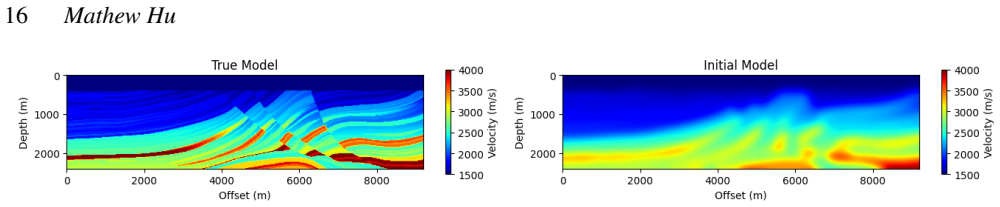
- [Section 4.2.2, Table 4] The Marmousi benchmark is constructed as a 'brute-force low-rank approximation of the Hessian at the MAP model' followed by MCMC-gpCN sampling, but Sections 3.1 and 3.7 argue that low-rank approximations with insufficient rank underestimate posterior variance, and Table 4's own note states that the compared chains 'have not yet converged.' Therefore the statement that gpCN-PSF+ 'closely matches the benchmark' could simply reflect a shared low-rank truncation or non-convergence bias. The authors should provide a higher-rank or independently verified reference (for example, a Hessian approximation with explicit rank-convergence checks, or an independent sampling method with convergence diagnostics) before the Marmousi experiment can support the central claim about posterior variance accuracy.
- [Section 4.2.2, Table 4] The ESS values for gpCN-PSF+ on the Marmousi model (7.05, 6.14, 6.57, 4.88, 16.00) are not systematically higher than those of pCN or gpCN-LR, yet the text dismisses ESS and autocorrelation as 'heuristic' while relying on histograms that are compared only with the low-rank benchmark. Since no quantitative distance between the PSF+ marginal histograms and the benchmark is reported, and since non-convergence can affect all chains including the benchmark, the evidence for improved posterior variance accuracy in Marmousi is currently visual and indirect. Quantitative comparisons (for example, variance ratios against a trusted covariance, coverage of a reference interval, or a suitable distance between marginals) with convergence diagnostics are needed.
- [Section 3.7 and Appendix A3] The construction of UQ proposal samples via pointwise square roots of symbol rows and columns requires discarding negative symbol values, but the effect of this truncation on the resulting covariance is not analyzed. In addition, Appendix A3 states that the PDO method 'tends to overestimate high-frequency components' and that this 'poses challenges for UQ' because the proposal random vector is not band-limited; nevertheless, PDO is used as a UQ method in Sections 4.1.3 and 4.2.2. The paper should quantify the resulting bias in posterior marginal variances, for example by comparing PDO-based posterior variance against the analytic reference in the ideal quadratic model, and explain why the acknowledged high-frequency overestimate does not invalidate the UQ conclusions.
- [Section 5 and Figures 12-13] The methods rely on the assumption that the misfit Hessian has strong locality in both spatial and frequency domains, and Section 5 acknowledges that this 'may be violated in models with sharp parameter variations.' The Marmousi model contains strong velocity contrasts including the 400 m water layer, but no quantitative approximation error (for example, the relative operator norm error ||Hd - H_approx||_F / ||Hd||_F) is reported for the PSF, PDO, or PSF+ approximations on this model. A numerical assessment of the approximation error and its spatial distribution would be needed to rule out that the locality assumption is silently violated in the very setting used for the UQ validation.
minor comments (5)
- [Section 3.5, Eq. (39) and Figure 1] There are several typographical errors: 'self-adjont' should be 'self-adjoint', 'Too see' should be 'To see', and the Figure 1 caption 'An illustration of the duality ... this shown' should be 'this is shown.' These should be corrected.
- [Section 3, introductory paragraph] The sentence 'we introduce low-rank approximation as both a baseline and an auxiliary technique...' contains a duplicated word ('are are') in the preceding paragraph: 'two established Hessian approximation methods that are are widely used.' Please fix.
- [Sections 4.1.3 and 4.2.2] The MCMC settings are not fully specified: the step-size parameter beta in Eq. (14), the burn-in length, the number of chains, and the total number of samples after burn-in are not reported. Providing these details in the appendix would make the experiments reproducible and help interpret the reported ESS values.
- [Section 3.3, Eq. (27)] The definition of the symbol class is imprecise. The standard definition of S^1 requires derivative bounds of the form |∂_ξ^α ∂_x^β s(x,ξ)| ≤ C_{αβ}(1+|ξ|)^{1-|α|}; the text's wording 'bounded by polynomials of ξ of corresponding orders' is too vague. Similarly, Eq. (35) is an asymptotic expansion, not an exact polynomial expansion, and should be described as such.
- [Data Availability] The wave simulation code is proprietary, and the paper states it can be substituted with any standard code that supports gradient and Hessian-vector products. It would be helpful to specify at least the grid spacing, time-stepping scheme, source frequencies, and number of wave equation solves per Hessian-vector product, so that the reported numerical results can be meaningfully reproduced with an open-source solver.
Circularity Check
No significant circularity; the central UQ claim is anchored in an exact analytical benchmark, and the Marmousi low-rank reference issue is a validation limitation, not a circular reduction.
full rationale
The derivation chain is self-contained. The PSF, PDO, and PSF+ Hessian approximations are built from Hessian-vector products applied to delta functions and sinusoids (Sections 3.2-3.6); no constant is fitted to the target posterior variance or to the MCMC output. The ideal quadratic model provides the load-bearing validation: the true posterior covariance is analytically known (Section 4.1), and the reported standard deviations are compared with the exact inverse Hessian (Fig. 10), not with the approximate Hessian used in the proposals. The low-rank correction is an additional approximation of the low-frequency subspace and is not used to define the evaluation metric. In the Marmousi experiment, the benchmark is a brute-force low-rank Hessian approximation (Section 4.2.2), which the paper itself argues underestimates variance (Sections 3.1, 4.1.3), and Table 4 explicitly concedes that the chains have not converged. This weakens the empirical support for the high-rank methods in the realistic setting, but it is a benchmarking and convergence weakness rather than a circular derivation: the paper does not define "posterior variance" as the benchmark variance, and no equation reduces the claimed result to its inputs. Section 5 and Appendix A3 honestly acknowledge the locality and high-frequency limitations. Self-citations to prior PSF/PDO work provide algorithms and theory; the present claims are tested against the exact quadratic solution, so the citations are not load-bearing in the circular sense.
Assumptions & free parameters
free parameters (6)
- Low-rank correction rank =
100
- PDO angular sampling count =
8
- Number of PSFs =
36 for ideal quadratic; not stated for Marmousi
- gpCN step-size beta =
not reported
- Tikhonov regularization coefficient alpha =
alpha = ||B[:, Ic]||_F^2 / ||B||_F^2
- Prior and noise parameters (delta, gamma, Gamma_noise) =
not reported
assumptions (6)
- domain assumption The misfit Hessian Hd is (up to smooth error) a pseudo-differential operator of order 1, with a symbol that is low-rank in the sense of eq. (28).
- domain assumption Hd has local point-spread functions: reflection effects are local, while transmission effects are shallow and low-frequency enough to be removed by a high-pass filter.
- domain assumption The symbol columns of Hd are well-separated in frequency space, so applying Hd to a sum of sinusoids and Fourier-transforming the result separates the individual symbol columns.
- domain assumption The low-frequency part of Hd is smooth and low-rank, and the high-pass filtered part faithfully represents the pseudo-differential component.
- standard math The symbol of the square root of a pseudo-differential operator is approximately the pointwise square root of the symbol.
- domain assumption The posterior is sufficiently close to Gaussian for the Laplace-approximation-based gpCN proposal to mix effectively when the Hessian is well approximated.
Cite this review
Pith. "Pith review of Accelerating seismic inversion and uncertainty quantification with efficient high-rank Hessian approximations." pith.science (2026). https://pith.science/paper/RIF27DWR
@misc{pith2026250710804,
  author       = {Pith},
  title        = {Pith review of: Accelerating seismic inversion and uncertainty quantification with efficient high-rank Hessian approximations},
  year         = {2026},
  howpublished = {\url{https://pith.science/paper/RIF27DWR}},
  note         = {Machine review of arXiv:2507.10804}
}
read the original abstract
Efficient high-rank approximations of the Hessian can accelerate seismic full waveform inversion (FWI) and uncertainty quantification (UQ). In FWI, approximations of the inverse of the Hessian may be used as preconditioners for Newton-type or quasi-Newton algorithms, reducing computational costs and improving recovery in deeper subsurface regions. In Bayesian UQ, Hessian approximations enable the construction of Markov chain Monte Carlo (MCMC) proposals that capture the directional scalings of the posterior, enhancing the efficiency of MCMC. Computing the exact Hessian is intractable for large-scale problems because the Hessian is accessible only through matrix-vector products, and performing each matrix-vector product requires costly solution of wave equations. Moreover, the Hessian is high-rank, which means that low-rank methods, often employed in large-scale inverse problems, are inefficient. We adapt two existing high-rank Hessian approximations -- the point spread function method and the pseudo-differential operator probing method. Building on an observed duality between these approaches, we develop a novel method that unifies their complementary strengths. We validate these methods on a synthetic quadratic model and on the Marmousi model. Numerical experiments show that these high-rank Hessian approximations substantially reduce the computational costs in FWI. In UQ, MCMC samples computed using no Hessian approximation or a low-rank approximation explore the posterior slowly, providing little meaningful statistical information after tens of thousands of iterations and underestimating the variance. At the same time, the effective sample size is overestimated, providing false confidence. In contrast, MCMC samples generated using the high-rank Hessian approximations provide meaningful statistical information about the posterior and more accurately assess the posterior variance.
Figures


Figures from the paper (15 more)




Reference graph
Works this paper leans on
-
[1]
, " * write output.state after.block = add.period write newline
ENTRY address author booktitle chapter edition editor howpublished institution journal key month note number organization pages publisher school series title type volume year label extra.label sort.label short.list INTEGERS output.state before.all mid.sentence after.sentence after.block FUNCTION init.state.consts #0 'before.all := #1 'mid.sentence := #2 '...
-
[2]
write newline
" write newline "" before.all 'output.state := FUNCTION n.dashify 't := "" t empty not t #1 #1 substring "-" = t #1 #2 substring "--" = not "--" * t #2 global.max substring 't := t #1 #1 substring "-" = "-" * t #2 global.max substring 't := while if t #1 #1 substring * t #2 global.max substring 't := if while FUNCTION word.in bbl.in " " * FUNCTION format....
-
[3]
NAT@ctr \@lbibitem[ NAT@ctr ] \@lbibitem[#1]#2 \@extra@b@citeb \@ifundefined br@#2\@extra@b@citeb \@namedef br@#2 \@nameuse br@#2\@extra@b@citeb \@ifundefined b@#2\@extra@b@citeb @num @parse #2 [ @natanchorstart #2\@extra@b@citeb \@biblabel @num @natanchorend] @ifcmd#1()()\@nil #2 @lbibitem\@undefined @lbibitem\@lbibitem \@lbibitem[#1]#2 @lbibitem[#1] #2 ...
arXiv 1997
-
[4]
Alfarhan, M., Ravasi, M., Chen, F., & Alkhalifah, T., 2024. Robust F ull W aveform I nversion with deep H essian deblurring, Geophysical Journal International\/ , p. ggae378
work page 2024
-
[5]
Alger, N., Villa, U., Bui-Thanh, T., & Ghattas, O., 2017. A data scalable augmented lagrangian KKT preconditioner for large-scale inverse problems, SIAM Journal on Scientific Computing\/ , 39 (5), A2365--A2393
work page 2017
-
[6]
Alger, N., Rao, V., Myers, A., Bui-Thanh, T., & Ghattas, O., 2019. Scalable matrix-free adaptive product-convolution approximation for locally translation-invariant operators, SIAM Journal on Scientific Computing\/ , 41 (4), A2296--A2328
work page 2019
-
[7]
Alger, N., Hartland, T., Petra, N., & Ghattas, O., 2024. Point spread function approximation of high-rank H essians with locally supported nonnegative integral kernels, SIAM Journal on Scientific Computing\/ , 46 (3), A1658--A1689
work page 2024
- [8]
Show all 63 references
-
[9]
Hierarchical matrix approximations of H essians arising in inverse problems governed by PDE s, SIAM Journal on Scientific Computing\/ , 42 (5), A3397--A3426
Ambartsumyan, I., Boukaram, W., Bui-Thanh, T., Ghattas, O., Keyes, D., Stadler, G., Turkiyyah, G., & Zampini, S., 2020. Hierarchical matrix approximations of H essians arising in inverse problems governed by PDE s, SIAM Journal on Scientific Computing\/ , 42 (5), A3397--A3426
2020
-
[10]
& Symes, W
Bao, G. & Symes, W. W., 1996. Computation of pseudo-differential operators, SIAM Journal on Scientific Computing\/ , 17 (2), 416--429
1996
-
[11]
B., Alfaro, J
Barclay, F., Bruun, A., Rasmussen, K. B., Alfaro, J. C., Cooke, A., Cooke, D., Salter, D., Godfrey, R., Lowden, D., McHugo, S., et al., 2008. Seismic inversion: R eading between the lines, Oilfield Review\/ , 20 (1), 42--63
2008
-
[12]
E., & Stuart, A
Beskos, A., Girolami, M., Lan, S., Farrell, P. E., & Stuart, A. M., 2017. Geometric MCMC for infinite-dimensional inverse problems, Journal of Computational Physics\/ , 335 , 327--351
2017
-
[13]
Beydoun, W. B. & Mendes, M., 1989. Elastic ray- B orn l_2 -migration/inversion, Geophysical Journal International\/ , 97 (1), 151--160
1989
-
[14]
Imaging of discontinuities in the inverse scattering problem by inversion of a causal generalized R adon transform, Journal of mathematical physics\/ , 26 (1), 99--108
Beylkin, G., 1985. Imaging of discontinuities in the inverse scattering problem by inversion of a causal generalized R adon transform, Journal of mathematical physics\/ , 26 (1), 99--108
1985
-
[15]
B., 2017
Bezanson, J., Edelman, A., Karpinski, S., & Shah, V. B., 2017. Julia: A fresh approach to numerical computing, SIAM review\/ , 59 (1), 65--98
2017
-
[16]
Marmousi, model and data, in EAEG workshop-practical aspects of seismic data inversion\/ , pp
Brougois, A., Bourget, M., Lailly, P., Poulet, M., Ricarte, P., & Versteeg, R., 1990. Marmousi, model and data, in EAEG workshop-practical aspects of seismic data inversion\/ , pp. cp--108, European Association of Geoscientists & Engineers
1990
-
[17]
Bui-Thanh, T., Ghattas, O., Martin, J., & Stadler, G., 2013. A computational framework for infinite-dimensional B ayesian inverse problems P art I : The linearized case, with application to global seismic inversion, SIAM Journal on Scientific Computing\/ , 35 (6), A2494--A2523
2013
-
[18]
Efficient geometric M arkov chain M onte C arlo for nonlinear B ayesian inversion enabled by derivative-informed neural operators, arXiv preprint arXiv:2403.08220\/
Cao, L., O'Leary-Roseberry, T., & Ghattas, O., 2024. Efficient geometric M arkov chain M onte C arlo for nonlinear B ayesian inversion enabled by derivative-informed neural operators, arXiv preprint arXiv:2403.08220\/
2024 arXiv
-
[19]
MCMC methods for functions: M odifying old algorithms to make them faster, Statistical Science\/ , 28 (3), 424--446
Cotter, S., Roberts, G., Stuart, A., & White, D., 2013. MCMC methods for functions: M odifying old algorithms to make them faster, Statistical Science\/ , 28 (3), 424--446
2013
-
[20]
J., & Marzouk, Y
Cui, T., Law, K. J., & Marzouk, Y. M., 2016. Dimension-independent likelihood-informed MCMC , Journal of Computational Physics\/ , 304 , 109--137
2016
-
[21]
& Stadler, G., 2018
Daon, Y. & Stadler, G., 2018. Mitigating the influence of the boundary on PDE -based covariance operators, Inverse Problems and Imaging\/ , 12 (5), 1083--1102
2018
-
[22]
& Ying, L., 2011
Demanet, L. & Ying, L., 2011. Discrete symbol calculus, SIAM review\/ , 53 (1), 71--104
2011
-
[23]
Matrix probing: a randomized preconditioner for the wave-equation H essian, Applied and Computational Harmonic Analysis\/ , 32 (2), 155--168
Demanet, L., L \'e tourneau, P.-D., Boumal, N., Calandra, H., Chiu, J., & Snelson, S., 2012. Matrix probing: a randomized preconditioner for the wave-equation H essian, Applied and Computational Harmonic Analysis\/ , 32 (2), 155--168
2012
-
[24]
Fast approximations of shift-variant blur, International Journal of Computer Vision\/ , 115 , 253--278
Denis, L., Thi \'e baut, E., Soulez, F., Becker, J.-M., & Mourya, R., 2015. Fast approximations of shift-variant blur, International Journal of Computer Vision\/ , 115 , 253--278
2015
-
[25]
A N ewton- CG method for large-scale three-dimensional elastic full-waveform seismic inversion, Inverse Problems\/ , 24 (3), 034015
Epanomeritakis, I., Ak c elik, V., Ghattas, O., & Bielak, J., 2008. A N ewton- CG method for large-scale three-dimensional elastic full-waveform seismic inversion, Inverse Problems\/ , 24 (3), 034015
2008
-
[26]
& Weiss, P., 2017
Escande, P. & Weiss, P., 2017. Approximation of integral operators using product-convolution expansions, Journal of Mathematical Imaging and Vision\/ , 58 , 333--348
2017
-
[27]
Interpolating point spread function anisotropy, Astronomy & Astrophysics\/ , 549 , A1
Gentile, M., Courbin, F., & Meylan, G., 2013. Interpolating point spread function anisotropy, Astronomy & Astrophysics\/ , 549 , A1
2013
-
[28]
& Willcox, K., 2021
Ghattas, O. & Willcox, K., 2021. Learning physics-based models from data: perspectives from inverse problems and model reduction, Acta Numerica\/ , 30 , 445--554
2021
-
[29]
A., 2011
Halko, N., Martinsson, P.-G., & Tropp, J. A., 2011. Finding structure with randomness: P robabilistic algorithms for constructing approximate matrix decompositions, SIAM review\/ , 53 (2), 217--288
2011
-
[30]
Hierarchical off-diagonal low-rank approximation of H essians in inverse problems, with application to ice sheet model initialization, Inverse Problems\/ , 39 (8), 085006
Hartland, T., Stadler, G., Perego, M., Liegeois, K., & Petra, N., 2023. Hierarchical off-diagonal low-rank approximation of H essians in inverse problems, with application to ice sheet model initialization, Inverse Problems\/ , 39 (8), 085006
2023
-
[31]
J., Moghaddam, P., & Stolk, C
Herrmann, F. J., Moghaddam, P., & Stolk, C. C., 2008. Sparsity-and continuity-promoting seismic image recovery with curvelet frames, Applied and Computational Harmonic Analysis\/ , 24 (2), 150--173
2008
-
[32]
J., Brown, C
Herrmann, F. J., Brown, C. R., Erlangga, Y. A., & Moghaddam, P. P., 2009. Curvelet-based migration preconditioning and scaling, Geophysics\/ , 74 (4), A41--A46
2009
-
[33]
The analysis of linear partial differential operators III : P seudo-differential operators\/ , Springer Science & Business Media
H \"o rmander, L., 2007. The analysis of linear partial differential operators III : P seudo-differential operators\/ , Springer Science & Business Media
2007
-
[34]
Isaac, T., Petra, N., Stadler, G., & Ghattas, O., 2015. Scalable and efficient algorithms for the propagation of uncertainty from data through inference to prediction for large-scale problems, with application to flow of the A ntarctic ice sheet, Journal of Computational Physi...
2015
-
[35]
Improving the resolution of migrated images by approximating the inverse H essian using deep learning, Geophysics\/ , 85 (4), WA173--WA183
Kaur, H., Pham, N., & Fomel, S., 2020. Improving the resolution of migrated images by approximating the inverse H essian using deep learning, Geophysics\/ , 85 (4), WA173--WA183
2020
-
[36]
Kim, K.-T., Villa, U., Parno, M., Marzouk, Y., Ghattas, O., & Petra, N., 2023. hIPPYlib-MUQ : A B ayesian inference software framework for integration of data with complex predictive models under uncertainty, ACM Transactions on Mathematical Software\/ , 49 (2), 1--31
2023
-
[37]
& Bednar, J., 1983
Lailly, P. & Bednar, J., 1983. The seismic inverse problem as a sequence of before stack migrations, in Conference on inverse scattering: theory and application\/ , vol. 1983, pp. 206--220, Philadelphia, Pa
1983
-
[38]
Lindgren, F., Rue, H., & Lindstr \"o m, J., 2011. An explicit link between G aussian fields and G aussian M arkov random fields: the stochastic partial differential equation approach, Journal of the Royal Statistical Society Series B: Statistical Methodology\/ , 73 (4), 423--498
2011
-
[39]
E., 2001
Lumley, D. E., 2001. Time-lapse seismic reservoir monitoring, Geophysics\/ , 66 (1), 50--53
2001
-
[40]
C., Burstedde, C., & Ghattas, O., 2012
Martin, J., Wilcox, L. C., Burstedde, C., & Ghattas, O., 2012. A stochastic N ewton MCMC method for large-scale statistical inverse problems with application to seismic inversion, SIAM Journal on Scientific Computing\/ , 34 (3), A1460--A1487
2012
-
[41]
R., 2015
Martin, J. R., 2015. A computational framework for the solution of infinite-dimensional Bayesian statistical inverse problems with application to global seismic inversion\/ , Ph.D. thesis, The University of Texas at Austin
2015
-
[42]
Approximate inverse scattering using pseudodifferential scaling\/ , Master's thesis, Rice University
Nammour, R., 2009. Approximate inverse scattering using pseudodifferential scaling\/ , Master's thesis, Rice University
2009
-
[43]
Approximate multi-parameter inverse scattering using pseudodifferential scaling\/ , Ph.D
Nammour, R., 2011. Approximate multi-parameter inverse scattering using pseudodifferential scaling\/ , Ph.D. thesis, Rice University
2011
-
[44]
& Symes, W
Nammour, R. & Symes, W. W., 2011. Multiparameter inversion: C ramer's rule for pseudodifferential operators, International Journal of Geophysics\/ , 2011 (1), 780291
2011
-
[45]
& Wright, S
Nocedal, J. & Wright, S. J., 1999. Numerical optimization\/ , Springer
1999
-
[46]
Petra, N., Martin, J., Stadler, G., & Ghattas, O., 2014. A computational framework for infinite-dimensional B ayesian inverse problems, P art II : S tochastic N ewton MCMC with application to ice sheet flow inverse problems, SIAM Journal on Scientific Computing\/ , 36 (4), A15...
2014
-
[47]
J., Simpson, G., Stuart, A
Pinski, F. J., Simpson, G., Stuart, A. M., & Weber, H., 2015. Algorithms for K ullback-- L eibler approximation of probability measures in infinite dimensions, SIAM Journal on Scientific Computing\/ , 37 (6), A2733--A2757
2015
-
[48]
& Sprungk, B., 2018
Rudolf, D. & Sprungk, B., 2018. On a generalization of the preconditioned C rank-- N icolson M etropolis algorithm, Foundations of Computational Mathematics\/ , 18 , 309--343
2018
-
[49]
Numerical methods for large eigenvalue problems: revised edition\/ , SIAM
Saad, Y., 2011. Numerical methods for large eigenvalue problems: revised edition\/ , SIAM
2011
-
[50]
K., Lee, J., & Kitanidis, P
Saibaba, A. K., Lee, J., & Kitanidis, P. K., 2016. Randomized algorithms for generalized hermitian eigenvalue problems with application to computing K arhunen-- L o \`e ve expansion, Numerical Linear Algebra with Applications\/ , 23 (2), 314--339
2016
-
[51]
Sheriff, R. E. & Geldart, L. P., 1995. Exploration seismology\/ , Cambridge university press
1995
-
[52]
C., 2000
Stolk, C. C., 2000. Microlocal analysis of a seismic linearized inverse problem, Wave Motion\/ , 32 (3), 267--290
2000
-
[53]
M., 2010
Stuart, A. M., 2010. Inverse problems: a B ayesian perspective, Acta numerica\/ , 19 , 451--559
2010
-
[54]
Target-oriented wave-equation least-squares migration/inversion with phase-encoded H essian, Geophysics\/ , 74 (6), WCA95--WCA107
Tang, Y., 2009. Target-oriented wave-equation least-squares migration/inversion with phase-encoded H essian, Geophysics\/ , 74 (6), WCA95--WCA107
2009
-
[55]
Inversion of seismic reflection data in the acoustic approximation, Geophysics\/ , 49 (8), 1259--1266
Tarantola, A., 1984. Inversion of seismic reflection data in the acoustic approximation, Geophysics\/ , 49 (8), 1259--1266
1984
-
[56]
Inverse problem theory and methods for model parameter estimation\/ , SIAM
Tarantola, A., 2005. Inverse problem theory and methods for model parameter estimation\/ , SIAM
2005
-
[57]
S., Alumbaugh, D., Lin, Y., & Feng, S., 2023
Um, E. S., Alumbaugh, D., Lin, Y., & Feng, S., 2023. Real-time deep-learning inversion of seismic full waveform data for CO2 saturation and uncertainty in geological carbon storage monitoring, Geophysical Prospecting\/ , 72 (Machine learning applications in geophysical explora...
2023
-
[58]
Villa, U., Petra, N., & Ghattas, O., 2021. hIPPYlib : An extensible software framework for large-scale inverse problems governed by PDE s: P art I : D eterministic inversion and linearized B ayesian inference, ACM Transactions on Mathematical Software (TOMS)\/ , 47 (2), 1--34
2021
-
[59]
& Operto, S., 2009
Virieux, J. & Operto, S., 2009. An overview of full-waveform inversion in exploration geophysics, Geophysics\/ , 74 (6), WCC1--WCC26
2009
-
[60]
Time-domain least-squares migration using the G aussian beam summation method, Geophysical Journal International\/ , 214 (1), 548--572
Yang, J., Zhu, H., McMechan, G., & Yue, Y., 2018. Time-domain least-squares migration using the G aussian beam summation method, Geophysical Journal International\/ , 214 (1), 548--572
2018
-
[61]
A., & Luo, X., 2021
Yang, J., Huang, J., Li, Z., Zhu, H., McMechan, G. A., & Luo, X., 2021. Approximating the G auss-- N ewton H essian using a space-wavenumber filter and its applications in least-squares seismic imaging, IEEE Transactions on Geoscience and Remote Sensing\/ , 60 , 1--13
2021
-
[62]
An efficient and stable high-resolution seismic imaging method: point-spread function deconvolution, Journal of Geophysical Research: Solid Earth\/ , 127 (7), e2021JB023281
Yang, J., Huang, J., Zhu, H., McMechan, G., & Li, Z., 2022. An efficient and stable high-resolution seismic imaging method: point-spread function deconvolution, Journal of Geophysical Research: Solid Earth\/ , 127 (7), e2021JB023281
2022
-
[63]
A B ayesian approach to estimate uncertainty for full-waveform inversion using a priori information from depth migration, Geophysics\/ , 81 (5), R307--R323
Zhu, H., Li, S., Fomel, S., Stadler, G., & Ghattas, O., 2016. A B ayesian approach to estimate uncertainty for full-waveform inversion using a priori information from depth migration, Geophysics\/ , 81 (5), R307--R323
2016
Reviewed August 6, 2026 · model on record in the stance chip above.
Discussion (0). Continue with ORCID to comment.