REVIEW 3 major objections 5 minor 49 references
Sublimation and deposition at a solid sphere in the presence of a non-condensable gas
T0 review · 3 major / 5 minor · reviewed 2026-08-06 · deepseek-v4-flash
Pith's one-line read This paper computes the three Onsager kinetic coefficients for sublimation and deposition at a solid argon sphere in a helium background gas, and shows that the cross-coupling term can change sign and deviate by more than 100% from its…
desk verdict Solid incremental study of sublimation at a sphere in a binary mixture; useful tables, but Eq. (47) has a sign error and the complete-condensation boundary condition deserves a caveat. read the letter →
The pith
A machine-rendered reading of the paper's core claim, the machinery that carries it, and where it could break.
The reading
What carries the argument
The load-bearing object is the symmetric Onsager matrix built from the fluxes $J_P=(1-C_0)u_2$ and $J_T=C_0q_1+(1-C_0)q_2$, evaluated with the linearized Boltzmann equation for the binary mixture, where $u_2$ is the mean bulk velocity of the sublimating species and $q_1$, $q_2$ are the heat fluxes of the two species. The collision integral is replaced by the McCormack model, which respects conservation laws and the H-theorem and gives correct mixture transport coefficients, while the interatomic forces enter through the $\Omega$-integrals for either hard spheres or ab initio potentials. To handle the discontinuity of the distribution function at the surface of a convex body, the solution is split into an analytically known free-streaming part and a numerical part solved with the discrete velocity method, and the reciprocity relation $\Lambda_{PT}=\Lambda_{TP}$ is used as a check of the numerical error. The free-molecular regime is solved analytically and serves as the reference for all deviations.
What would settle it
Measure the steady mass flow from a small argon sphere suspended in a helium-argon mixture at $T_0=50$ K with $C_0=0.5$ while sweeping the pressure so that the rarefaction parameter runs from about 0.1 to 10, and applying a small temperature difference of about 0.1 K. The predicted sign change of $\Lambda_{PT}$ would appear as a reversal of the net argon flow direction relative to the temperature gradient, and the particular value of $\delta$ at which the reversal occurs would distinguish the hard-sphere from the ab initio potential prediction.
Extended reading notes
Core claim
For sublimation and deposition at a solid argon sphere surrounded by a helium-argon mixture, the interface mass and energy flow rates are linear functions of two thermodynamic forces, the vapor pressure difference and the temperature difference, with the proportionality encoded in a symmetric matrix of three kinetic coefficients: $\Lambda_{PP}$, $\Lambda_{PT}(=\Lambda_{TP})$ and $\Lambda_{TT}$. The paper establishes how these coefficients behave: $\Lambda_{PP}$ and $\Lambda_{TT}$ stay positive, while $\Lambda_{PT}$ can be positive or negative and its sign depends on the rarefaction parameter $\delta$, the helium molar fraction $C_0$, the temperature, the interatomic potential, and the mass ratio of the two gases. Unlike the planar case, where $\Lambda_{PP}$ decreases monotonically with rarefaction, for the sphere $\Lambda_{PP}$ can increase, peak, or decrease depending on the molar fraction. The cross coefficient is so sensitive that in some conditions the hard-sphere model predicts a sign opposite to the ab initio potential at the same state point, and the inverted temperature gradient appears near the sphere, with its presence controlled by the helium fraction.
Load-bearing premise
The surface is assumed to be a perfect phase-change interface: every incident argon or krypton atom is absorbed and the surface re-emits vapor atoms with a Maxwellian distribution at the surface temperature and saturation pressure, while helium is fully accommodated; if the real condensation or sticking coefficient is less than one, the tabulated coefficients change.
Editorial extensions
If this is right
- Any small driving force (pressure or temperature difference) at an argon sphere in helium now yields the mass and energy flow rates directly from the relations $\dot M=4\pi R_0^2 n_0 v_0 m_2 J_P$ and $\dot E=4\pi R_0^2 v_0 p_0\left(J_T+\tfrac52 J_P\right)$ using the tabulated coefficients.
- In the transitional and continuum regimes the hard-sphere model is not reliable for the cross effect: at $C_0=0.5$ and $\delta=10$ the ab initio and hard-sphere potentials give $\Lambda_{PT}$ values that differ by more than 100% and even have opposite signs.
- Adding helium as a background gas suppresses the mass flow coefficient $\Lambda_{PP}$ strongly, by about 60% when the helium fraction grows from 0.1 to 0.5 at $\delta=1$, so even a modest amount of non-condensable gas slows sublimation.
- The inverted temperature gradient near the sphere is confirmed and shown to depend on the helium molar fraction and the rarefaction parameter, not on the interatomic interaction potential.
- The helium-krypton comparison shows that the mass ratio of the sublimating species strongly shifts the heat-flow coefficient $\Lambda_{TT}$, with deviations up to about 43%, so results cannot be freely transferred from one sublimating species to another.
Reading between the lines
- A sign change in $\Lambda_{PT}$ implies a regime where a temperature difference alone drives argon mass flow in the direction opposite to the saturated-pressure gradient; this could be searched for by levitating an argon particle and imposing a small thermal asymmetry while sweeping the background pressure.
- If the real surface condensation or sticking coefficient is not exactly unity, the published tables would shift quantitatively, but the qualitative structure (sign change of $\Lambda_{PT}$ and non-monotonic $\Lambda_{PP}$) likely persists, so the free-molecular reference values could be rescaled by an effective sticking fraction as a first-order correction.
- The same Onsager-matrix methodology extends naturally to dust grains, aerosol droplets, and sublimating particles in vacuum systems and planetary atmospheres, where the sphere is the natural geometry; the strong potential sensitivity warns that realistic collision cross-sections are needed in those applications too.
Signed reviews
Editorial analysis
A structured set of objections, weighed in public.
Referee Report
Summary. The paper studies sublimation/deposition at a solid argon sphere in a helium-argon mixture, using the linearized Boltzmann equation with the McCormack collision model. The authors compute the Onsager kinetic coefficients ΛPP, ΛPT, ΛTT that determine mass and energy flow rates at the interface, over a range of rarefaction parameter δ, molar fractions C0, and two temperatures (50 K and 70 K), using both hard-sphere and ab-initio potentials. They also give analytic free-molecular results, solve the transitional regime numerically by a discrete velocity method, report flow fields and temperature/pressure jump behavior, and include examples of mass and energy flow rates. The main claims are that the cross coefficient ΛPT is highly sensitive to rarefaction, can deviate by more than 100% from its free-molecular value, and can change sign with δ.
Significance. If the results hold, the paper provides a useful tabulation of spherical-geometry kinetic coefficients for sublimation/deposition in a binary mixture, based on ab-initio interaction data rather than fitted transport parameters. The free-molecular formulas are explicit and check against the tables, and the numerical reciprocity check ΛPT=ΛTP is a valuable internal consistency test. The comparison of hard-sphere and ab-initio potentials, and of argon and krypton, gives a concrete picture of where the interaction model matters. However, the central quantitative claims are conditional on the assumed complete phase transition boundary condition, and no sensitivity analysis for that assumption is provided; this is the main scientific weakness.
major comments (3)
- [Sec. 6, Eq. (47)] Equation (47) for ν(P)_2 has the wrong sign. With h(P)_2=1 on the cone 0≤θ≤θ0 and zero outside (Eq. (43)), the angular average is (1−cos θ0)/2 = (1−sqrt(1−(r0/r)^2))/2, which is positive and tends to 0 as r→∞. The printed expression −1/2 − sqrt(1−(r0/r)^2)/2 is negative everywhere and tends to −1 at infinity; it also contradicts the positive ν(P)_2 profiles in Figure 1. Please correct Eq. (47) and check the companion moments (48)–(51) for consistency.
- [Sec. 4, Eqs. (26)–(27); Tables 2–4] The complete phase transition boundary condition (26)–(27) is an assumption that enters every entry of Tables 2–4. The headline conclusions—that ΛPT can deviate by more than 100% from its free-molecular value and can change sign with δ—are statements about the solution of this particular boundary-value problem. A partial sticking coefficient or non-Maxwellian emission could shift or remove the zero of ΛPT. The paper offers no sensitivity analysis and no experimental benchmark for the sticking coefficient. Please add a parametric study with a partial-condensation boundary condition (e.g., a Maxwell-type condition) or, at minimum, a quantitative discussion of how the tabulated coefficients would change; otherwise the conclusions should be presented as conditional on the complete-transition assumption.
- [Sec. 7; Tables 2–4] The claimed numerical error of 0.1% for the kinetic coefficients is stated but not demonstrated. The sign change of ΛPT occurs at values as small as 0.0040 (Table 2, HS, C0=0.5, δ=5), and the reported deviations from free-molecular values exceed 100%. The accuracy statement needs to be supported by a convergence study in Nr, Nθ, Nc and rmax, or by a supplementary table reporting the grid-variation results. Please include this information so that the sign changes in the tables can be assessed as genuine physical effects rather than numerical artifacts.
minor comments (5)
- [Sec. 4] There is a typo: “emmited” should be “emitted”.
- [Sec. 7] The sentence about rmax (“while the distance rmax was set as δ varied so that the increment in the radial distance ∆r ∼ 10−3”) is unclear and should be rewritten; please state the actual rmax values used for each δ.
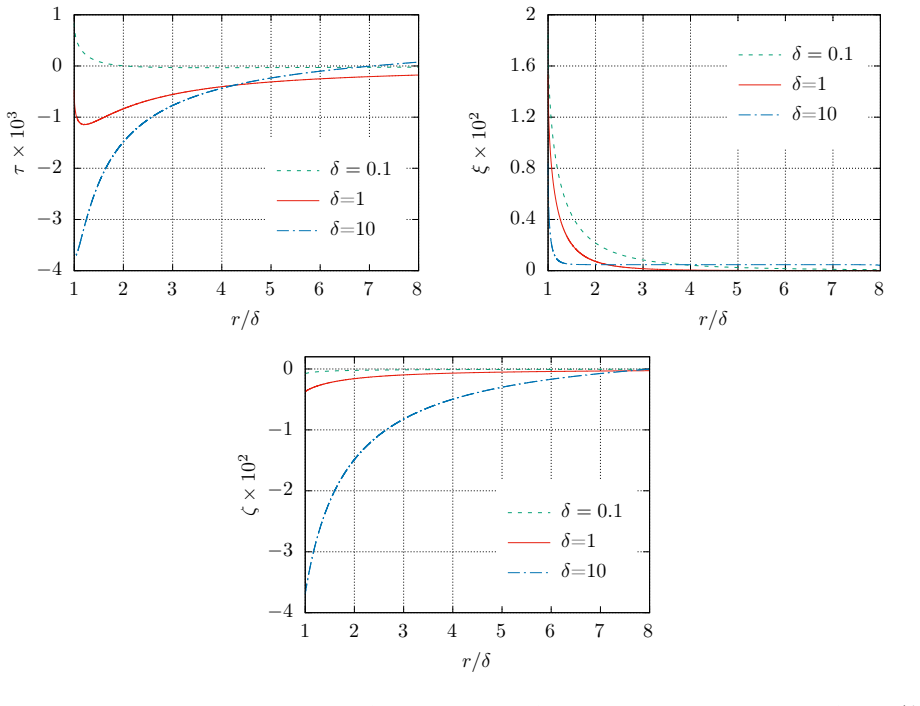
- [Sec. 8.7] The text after Eq. (85) swaps the symbols for pressure and mole fraction deviations: ξ is defined as the pressure deviation in Eq. (84) and ζ as the mole fraction deviation in Eq. (85), but the paragraph says “The local mole fraction deviation, ξ, is always negative” and “the pressure deviation, ζ, is always positive.” This should be corrected in the text and checked against the panels in Figures 7–9.
- [Tables 2–4] Please state in the captions that the rows with δ=0 are obtained from the analytic free-molecular formulas, not from the discrete velocity method.
- [Appendix A, Eq. (A.9)] The choice γα=p0α/µ0α is introduced by analogy with the single-gas Shakhov model; a brief justification or a citation to a previous mixture validation of this specific choice would help the reader assess its effect on the transitional-regime results.
Circularity Check
No circularity: the kinetic coefficients are direct numerical outputs of a stated linearized kinetic boundary-value problem, with no parameter fitted to the reported results.
full rationale
The derivation chain is self-contained. The kinetic coefficients are moments of perturbation functions obtained by solving the linearized Boltzmann equation with the McCormack collision model (Eqs. 10-14) subject to explicitly stated boundary conditions (Eqs. 23-27), and the free-molecular limits (Eqs. 62-64) follow analytically from Eq. (41). No parameter is fitted to the reported values of the coefficients. The model inputs are independent: the ab initio omega-integrals come from Refs. [43,48], the hard-sphere diameter ratio is obtained from a standard viscosity relation (Eq. A.13), and the saturation pressures used in the illustrative examples come from Ref. [28]. The collision-frequency parameters gamma_alpha are chosen by analogy (Eq. A.9), not calibrated to the target flow rates. The thermodynamic-flux definitions (Eqs. 30-32) invoke the general reciprocal-relation framework of Refs. [37,38], which is an independent theoretical result; moreover, the paper verifies Lambda_PT = Lambda_TP numerically rather than imposing it on the solution. The complete-phase-transition boundary condition is a physical modeling assumption that can affect the numerical values, but it is not defined in terms of, or fitted to, the output coefficients, so it is a correctness risk rather than a circular step. The occasional self-citations are to benchmark calculations and prior independent results, not to a claimed uniqueness theorem or to the present target results. Therefore no significant circularity is present.
Assumptions & free parameters
free parameters (1)
- Hard-sphere atomic diameter ratio d2/d1 =
2.109 (He-Ar at 50 K), 2.031 (He-Ar at 70 K)
assumptions (6)
- domain assumption The McCormack collision model (Eq. A.1) accurately represents the linearized Boltzmann collision operator for the binary mixture.
- domain assumption Complete phase transition at the sphere surface for argon/krypton: all incident vapor atoms are absorbed and re-emitted as a Maxwellian at Ts and saturation pressure p2s (Eqs. 26-27).
- domain assumption Helium is diffusely scattered with full accommodation at the sphere surface (Eqs. 23-25).
- ad hoc to paper The collision frequency in the McCormack model is chosen as γα = p0α/µ0α (Eq. A.9) by analogy with the single-gas Shakhov model.
- domain assumption The driving forces XP and XT are small (Eq. 5), justifying linearization around a single equilibrium.
- domain assumption Far from the sphere the perturbation vanishes (Eq. 28), modeling an unbounded equilibrium reservoir.
Cite this review
Pith. "Pith review of Sublimation and deposition at a solid sphere in the presence of a non-condensable gas." pith.science (2026). https://pith.science/paper/PQQ6MM6R
@misc{pith2026250710858,
  author       = {Pith},
  title        = {Pith review of: Sublimation and deposition at a solid sphere in the presence of a non-condensable gas},
  year         = {2026},
  howpublished = {\url{https://pith.science/paper/PQQ6MM6R}},
  note         = {Machine review of arXiv:2507.10858}
}
read the original abstract
The sublimation/deposition process at a solid sphere of argon into its vapor in the presence of helium as a background gas is modeled applying the linearized Boltzmann equation, in which the McCormack model is employed for the collisional term. The Onsager coefficients determining the mass and energy flow rates at the interface are calculated over a wide range of rarefaction parameter and for some values of molar fraction of the background gas in the mixture. Moreover, two values for the temperature of the mixture are considered on the basis of the sublimation curves of argon and krypton. To assess the influence of the interatomic interaction potential on the numerical results, the calculations are carried out for both the hard-spheres and \textit{ab-initio} potentials. The kinetic coefficients are presented as well as the flow fields around the sphere. The effect of a small temperature difference between the spherical surface and the gas mixture is analyzed.
Figures


Figures from the paper (6 more)




Reference graph
Works this paper leans on
-
[1]
A review of water sublimatio n cooling and water evaporation cooling in complex space environments
K Chang, Y-Y Wang, and Y-Z Li. A review of water sublimatio n cooling and water evaporation cooling in complex space environments. Progress in Aerospace Sciences, 140:100930, 2023
work page 2023
-
[2]
Rarefied gas dynamic s aspects of pharma- ceutical freeze-drying
A Ganguly, S L Nail, and A A Alexeenko. Rarefied gas dynamic s aspects of pharma- ceutical freeze-drying. Vacuum, 86(11):1739–1747, 2012
work page 2012
-
[3]
A. Faghri and Y. Zhang. Fundamentals of Multiphase Heat Transfer and Flow, chapter Sublimation and Vapor Deposition, pages 323–353. Springer , 2020
work page 2020
-
[4]
Deposition technologies and app lications: Introduction and overview
W Kern and K K Schuegraf. Deposition technologies and app lications: Introduction and overview. In Krisna Seshan, editor, Handbook of Thin Film Deposition Processes and Techniques (Second Edition), pages 11–43. William Andrew Publishing, Norwich , NY, second edition edition, 2001
work page 2001
-
[5]
C-H Su. Vapor Crystal Growth and Characterization, chapter Fundamentals of Physical Vapor Transport Process, pages 9–38. Springer, 2020
work page 2020
-
[6]
Mathematical Theory of Transport Processes in Gases
J H Ferziger and H G Kaper. Mathematical Theory of Transport Processes in Gases. North-Holland Publishing Company, Amsterdam, 1972
work page 1972
-
[7]
C Cercignani. Rarefied Gas Dynamics. From Basic Concepts to Actual Calculations. Cambridge University Press, Cambridge, 2000
work page 2000
-
[8]
Y Sone. Molecular Gas Dynamics. Theory, Techniques and Applications. Birkhäuser, Boston, 2007
work page 2007
Show all 49 references
-
[9]
Rarefied Gas Dynamics
F Sharipov. Rarefied Gas Dynamics. Fundamentals for Research and Practice. Wiley- VCH, Berlin, 2016. doi: 10.1002/9783527685523. 19
2016 doi
-
[10]
Sublimation and d eposition in gaseous mixtures
A Polikarpov, I Graur, and F Sharipov. Sublimation and d eposition in gaseous mixtures. Int. J. Heat Mass Transfer, 160:120213, 2020. doi: 10.1016/j.ijheatmasstransfer.2020.120213
2020
-
[11]
Application of kinetic theory to the problem of evaporation and condensation
Y-P Pao. Application of kinetic theory to the problem of evaporation and condensation. Phys. Fluids, 14(2):306–312, 1971
1971
-
[12]
Kinetic theory of evaporation and co ndensation
Y Sone and Y Onishi. Kinetic theory of evaporation and co ndensation. J. Phys. Soc. Jpn., 35:1773–1776, 1973
1973
-
[13]
Y Sone and Y. Onishi. Kinetic theory of evaporation and c ondensation - hydrodynamic equation and slip boundary condition. J. Phys. Soc. Japan, 44:1981–1994, 1978
1981
-
[14]
Vapor flows caused by evapo ration and condensation on two parallel plane surfaces: Effect of the presence of nonc ondensable gas
K Aoki, S Takata, and S Kosuge. Vapor flows caused by evapo ration and condensation on two parallel plane surfaces: Effect of the presence of nonc ondensable gas. Phys. Fluids, 10(6):1519–1533, 1998
1998
-
[15]
Vapor flows with evaporat ion and condensation in the continuum limit: effect of trace of noncondensable gas
K Aoki, S Takata, and S Taguchi. Vapor flows with evaporat ion and condensation in the continuum limit: effect of trace of noncondensable gas. Eur. J. Mech. B / Fluids, 22:51–71, 2003
2003
-
[16]
Evaporation and condensation o n two parallel plates at finit Reynolds numbers
K Aoki and C Cercignani. Evaporation and condensation o n two parallel plates at finit Reynolds numbers. Phys. Fluids, 26:1163–1164, 1983
1983
-
[17]
Evaporation and condensati on on a plane con- densed phase: numerical analysis of the linearized Boltzma nn equation for hard-sphere molecules
Y Sone, T Ohwada, and K Aoki. Evaporation and condensati on on a plane con- densed phase: numerical analysis of the linearized Boltzma nn equation for hard-sphere molecules. Phys. Fluids A, 1:1398–1405, 1989
1989
-
[18]
Heat transfer and evaporation/condensati on problems based on the lin- earized Boltzmann equation
C E Siewert. Heat transfer and evaporation/condensati on problems based on the lin- earized Boltzmann equation. Eur. J. Mech. B/Fluids, 22:391–408, 2003
2003
-
[19]
Rarefied gas flow be tween two cylinders caused by the evaporation and condensation on their surface s
L M G Cumin, F M Sharipov, and G M Kremer. Rarefied gas flow be tween two cylinders caused by the evaporation and condensation on their surface s. Phys. Fluids, 10(12): 3203–3208, 1998
1998
-
[20]
Transport phenome na in rotating rarefied gases
F Sharipov, L M G Cumin, and G M Kremer. Transport phenome na in rotating rarefied gases. Phys. Fluids, 13(1):335–346, 2001
2001
-
[21]
Numerical analysis of steady flows of a gas evaporating from its cylindrical condensed phase on the basis of kinetic theory
H Sugimoto and Y Sone. Numerical analysis of steady flows of a gas evaporating from its cylindrical condensed phase on the basis of kinetic theory. Phys. Fluids A, 4(2):419–440, 1992
1992
-
[22]
Evaporation of a rarefied gas from a cylindrical condenced phase into vacuum
Y Sone and H Sugimoto. Evaporation of a rarefied gas from a cylindrical condenced phase into vacuum. Phys. Fluids, 7(8):2072–2085, 1995
1995
-
[23]
Margilevskii and V.G
A.E. Margilevskii and V.G. Chernyak. Evaporation and c ondensation growth of a droplet in a vapor-gas medium for arbitrary Knudsen numbers. Fluid Dynamics, 20:607–613, 1985. 20
1985
-
[24]
Slow evaporation and cond ensation on a spheri- cal droplet in the presence of a noncondensable gas
S Kosuge, K Aoki, and M Hatano. Slow evaporation and cond ensation on a spheri- cal droplet in the presence of a noncondensable gas. Phys. Fluids, 22(6), 2010. doi: 10.1063/1.3432130
2010 doi
-
[25]
The spherical-droplet problem of evaporatio n and condensation in a vapour- gas mixture
Y Onishi. The spherical-droplet problem of evaporatio n and condensation in a vapour- gas mixture. J. Fluid Mech., 163:171–194, 1986
1986
-
[26]
Kinetic model for binary gas mixture
B B Hamel. Kinetic model for binary gas mixture. Phys. Fluids, 8(3):418–425, 1965
1965
-
[27]
Construction of linearized kinetic mode ls for gaseous mixture and molecular gases
F J McCormack. Construction of linearized kinetic mode ls for gaseous mixture and molecular gases. Phys. Fluids, 16:2095–2105, 1973
1973
-
[28]
The sublimation of argon, kryp ton, and xenon
A G M Ferreira and L Q Lobo. The sublimation of argon, kryp ton, and xenon. J. Chem. Thermodynamics, 40:1621–1626, 2008. doi: 10.1016/j.jct. 2008.07.023
2008 doi
-
[29]
Comparative st udy of the Boltzmann and McCormack equations for Couette and Fourier flows of bina ry gaseous mixtures
M T Ho, L Wu, I Graur, Y Zhang, and J M Reese. Comparative st udy of the Boltzmann and McCormack equations for Couette and Fourier flows of bina ry gaseous mixtures. Int. J. Heat Mass Transfer, 96:29–41, 2016
2016
-
[30]
Benchmark problems for mi xtures of rarefied gases
F Sharipov and J L Strapasson. Benchmark problems for mi xtures of rarefied gases. I. Couette flow. Phys. Fluids, 25:027101, 2013
2013
-
[31]
Ab initio simulation of heat transfer through a mixture of rarefied gases
J L Strapasson and F Sharipov. Ab initio simulation of heat transfer through a mixture of rarefied gases. Int. J. Heat Mass Transfer, 71:91–97, 2014
2014
-
[32]
Comparative study between computational and experimental results for binary gas flows through long mi- crochannels
L Szalmas, J Pitakarnnop, S Geoffroy, S Colin, and D Valou georgis. Comparative study between computational and experimental results for binary gas flows through long mi- crochannels. Microfluid Nanofluid, 9:1103–1114, 2010
2010
-
[33]
Velocity slip and temperature jump coefficients for gaseous mixtures
F Sharipov and D Kalempa. Velocity slip and temperature jump coefficients for gaseous mixtures. II. Thermal slip coefficient. Phys. Fluids, 16(3):759–764, 2004
2004
-
[34]
Velocity slip and temperature jump coefficients for gaseous mixtures
F Sharipov and D Kalempa. Velocity slip and temperature jump coefficients for gaseous mixtures. IV. Temperature jump coefficient. Int. J. Heat Mass Transfer, 48(6):1076– 1083, 2005
2005
-
[35]
Non-Equilibrium Thermodynamics
S R De Groot and P Mazur. Non-Equilibrium Thermodynamics. Dover Publications, Inc., New York, 1984
1984
-
[36]
The Mathematical Theory of Non-Uniform Gases
S Chapman and T G Cowling. The Mathematical Theory of Non-Uniform Gases. Uni- versity Press, Cambridge, 3 edition, 1970
1970
-
[37]
Onsager-Casimir reciprocal r elations based on the Boltz- mann equation and gas-surface interaction
F Sharipov and D Kalempa. Onsager-Casimir reciprocal r elations based on the Boltz- mann equation and gas-surface interaction. Gaseous mixtur es. J. Stat. Phys., 125(3): 661–675, 2006
2006
-
[38]
The reciprocal relations between cross phe nomena in boundless gaseous systems
F Sharipov. The reciprocal relations between cross phe nomena in boundless gaseous systems. Physica A, 389:3743–3760, 2010. 21
2010
-
[39]
Discontinuity of the velocity dist ribution function in a rarefied gas around a convex body and the s layer at the bottom of the Knu dsen layer
Y Sone and Sh Takata. Discontinuity of the velocity dist ribution function in a rarefied gas around a convex body and the s layer at the bottom of the Knu dsen layer. Trans. Theory Stat. Phys., 21(4-6):501–530, 1992
1992
-
[40]
The driven cavity flow over th e whole range of the Knudsen number
S Naris and D Valougeorgis. The driven cavity flow over th e whole range of the Knudsen number. Phys. Fluids, 17(9):097106, 2005
2005
-
[41]
Approximate Calculation of Integrals
V I Krylov. Approximate Calculation of Integrals. Dover Publication Inc., Mineola, 2005
2005
-
[42]
The kinetic theory of heat and mass transfer from a spherical particle in a rarefied gas
V G Chernyak and A Ye Margilevskiy. The kinetic theory of heat and mass transfer from a spherical particle in a rarefied gas. J. Heat Mass Transfer, 32(11):2127–2134, 1986
1986
-
[43]
Transport coefficients of argo n and its mixtures with helium and neon at low density based ab initio potentials
F Sharipov and V J Benites. Transport coefficients of argo n and its mixtures with helium and neon at low density based ab initio potentials. Fluid Phase Equilibria, 498:23–32,
-
[44]
Evidence of an in verted temperature gradient during evaporation/condensation of a Lennard-Jones fluid
A Frezzotti, P Grosfils, and S Toxvaerd. Evidence of an in verted temperature gradient during evaporation/condensation of a Lennard-Jones fluid. Physics of Fluids, 15(10): 2837–2842, 10 2003
2003
-
[45]
Molecular dynamics simulation of the inverte d temperature gradient phe- nomenon
R Meland. Molecular dynamics simulation of the inverte d temperature gradient phe- nomenon. Physics of Fluids, 15(10):3244–3247, 10 2003
2003
-
[46]
Evaporation into half-space: Experiment s with water at the molecular mean free path scale
E Y Gatapova. Evaporation into half-space: Experiment s with water at the molecular mean free path scale. Physics of Fluids, 36(9):091707, 09 2024
2024
-
[47]
Generalization of the Krook kinetic relaxa tion equation
E M Shakhov. Generalization of the Krook kinetic relaxa tion equation. Fluid Dynamics, 3(5):95–96, 1968
1968
-
[48]
Transport coefficients of heli um-argon mixture based on ab initio potential
F Sharipov and V J Benites. Transport coefficients of heli um-argon mixture based on ab initio potential. J. Chem. Phys., 143:154104, 2015. 22 Table 1: Values of Ω-integrals for ab-initio potential. He-Ar He-Kr Ω(mn) αβ × 1016 [m3/s] T0=50 K T0=70 K T0=70 K Ω(11) 12 0.452601 0.4...
2015
-
[2019]
doi: 10.1016/j.fluid.2019.06.010
2019 doi
Reviewed August 6, 2026 · model on record in the stance chip above.
Discussion (0). Continue with ORCID to comment.