REVIEW 4 major objections 5 minor 42 references
Start from the End: A Framework for Computational Policy Exploration to Inform Effective and Geospatially Consistent Interventions applied to COVID-19 in St. Louis
T0 review · 4 major / 5 minor · reviewed 2026-08-06 · deepseek-v4-flash
Pith's one-line read This paper claims that a statistical emulator trained on 30,000 runs of a St.
desk verdict Useful emulation framework for policy search in expensive ABMs, but the headline feasibility counts are unvalidated in the regime that matters most; still worth refereeing. read the letter →
The pith
A machine-rendered reading of the paper's core claim, the machinery that carries it, and where it could break.
The reading
What carries the argument
The load-bearing object is the emulator: a statistical surrogate that predicts each simulator outcome at untried inputs. For cumulative infections it combines a Gradient-Boosting Machine for the mean response with a heteroskedastic Gaussian process (Matérn $\nu=5/2$ kernel) for the residual, yielding point predictions with uncertainty; for SVI variance it uses a zero-mean Gaussian process. The emulator converts 30,000 simulator runs into a dense response surface over ten policy dimensions, which is then searched with Latin-hypercube samples — 500,000 candidates when all ten policies are active. To rank candidate policies by 'smallness,' the paper uses the sum of squared normalized policy intensities, $\sum_{i=1}^{10} p_i^2$, which favors balanced mixtures over pushing any single policy to its maximum.
What would settle it
Select a random sample of, say, 100 policy combinations from the 500,000 that the emulator predicts will keep cumulative infections at or below 500,000, run each through TRACE-STL, and count how many actually meet the target; if the observed pass rate falls well below the emulated proportion, the central claim fails. A second check targets the equity claim: re-run Policy 3 across many random seeds and verify that the SVI-stratified variance drops from $1.27\times10^{-3}$ to roughly $5.69\times10^{-4}$; failure to reproduce that reduction would undercut the geospatial-consistency result.
Extended reading notes
Core claim
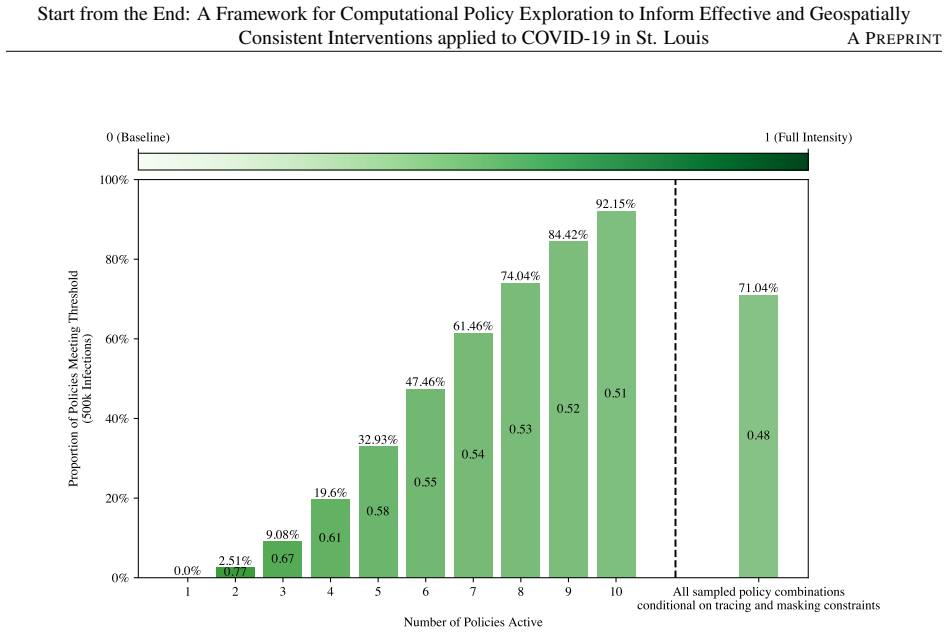
The paper's central discovery is that a Gaussian-process emulator, with a gradient-boosted mean function for cumulative infections, trained on 1,500 Latin-hypercube design points each replicated 20 times, maps the ten-policy response surface of TRACE-STL accurately enough to invert the policy question. Instead of asking what a chosen intervention does, the authors fix a target — no more than 500,000 cumulative infections — and search for all policy vectors that meet it. In a 500,000-sample sweep over all ten policies, 92.15% of sampled combinations were estimated to meet the target; when contact tracing and mask adherence are capped at the midpoint of their ranges, 71.04% still meet it. The ten smallest such policies were simulated with the agent-based model and generally confirmed the emulator's predictions, and one policy reduced SVI-stratified variance in attack rate from $1.27\times10^{-3}$ to $5.69\times10^{-4}$ while keeping infections below the target.
Load-bearing premise
The framework assumes the emulator remains accurate in ten-dimensional regions where the simulator was never run, and that accuracy is backed by only a small set of validation runs.
Editorial extensions
If this is right
- Policymakers can invert the modeling workflow: specify an outcome objective first, then search the policy space for all combinations that achieve it, rather than testing a few pre-specified scenarios.
- Combinations of moderate interventions can substitute for one very intense intervention: even with contact tracing and mask adherence capped at half their ranges, 71.04% of emulated policy mixtures keep infections at or below 500,000.
- Emulator screening can find policies that improve equity as a side effect: the identified Policy 3 cuts SVI-stratified variance from $1.27\times10^{-3}$ to $5.69\times10^{-4}$ while holding infections below target.
- Trade-offs and substitutions among interventions can be mapped cheaply, for example the finding that mask-duration after contact tracing prevents roughly 24,000 infections at baseline tracing capacity but 170,000 at high tracing capacity, and that vaccines can substitute for boosters over part of the policy range.
- The same framework can be ported to other expensive complex simulation models used for policy, wherever a small training set of runs can support a statistical surrogate.
Reading between the lines
- Beyond the paper, the 500,000-policy sweep would benefit from a sequential or active-learning check: run the simulator on a random sample of the emulator's predicted successes, then retrain the emulator on those outcomes. The paper validates only the ten smallest policies, so its own evidence does not yet cover the central mass of claimed feasible policies.
- Beyond the paper, the emulator's success at finding balanced low-intensity mixtures suggests a resource-allocation interpretation the authors only touch on: the 'smallest' portfolios cluster around moderate contact tracing (~22,000–32,000 contacts per day) plus small boosts to masking and testing, hinting that a test-trace-mask portfolio is the cheapest route to the target.
- Beyond the paper, because the underlying model makes quarantine weaker in high-SVI tracts by construction, the variance reduction claim is partly built into the mechanism; a stronger extension would put equity constraints directly into the search objective rather than checking SVI variance after selecting on infection counts.
- Beyond the paper, applying this framework prospectively would require re-calibrating the emulator to an unfolding wave and accepting that the 500,000-infection target is itself uncertain; the current demonstration is retrospective and benefits from knowing the target ex post.
Editorial analysis
A structured set of objections, weighed in public.
Referee Report
Summary. The paper proposes a computational policy-exploration framework in which a Gaussian-process emulator (with a GBM mean for the primary outcome) is trained on a Latin-hypercube sample of TRACE-STL simulations of the COVID-19 Omicron wave in St. Louis, then used to search a 10-dimensional policy space for intervention mixtures that achieve a target of at most 500,000 cumulative infections and to examine SVI-stratified outcome variance. The authors calibrate the ABM to observed cases and test positivity, report one-dimensional policy sweeps and interaction analyses, and identify many low-intensity policy combinations—including 71.04% of a constrained k=10 sample—that are emulator-predicted to meet the target. They also simulate ten 'smallest' such policies and report that the emulator tracks simulator outcomes, with a selected policy reducing SVI-stratified variance from 1.27e-3 to 5.69e-4.
Significance. If validated, this is a useful and timely contribution: it directly addresses a real bottleneck in using expensive agent-based models for policy, provides a transparent emulator design (GBM plus heteroskedastic GP), makes falsifiable predictions about simulator outputs, and reports calibration against observed trends. The paper's main value is in demonstrating that a modest number of simulations can support a broad policy search with quantified uncertainty. The central technical risk is that the headline feasibility counts are emulator extrapolations, and the current validation does not exercise the same candidate distributions used to compute them; this is fixable with additional simulator runs and reporting. The paper is also honest about the retrospective nature of the exercise and about some limitations of the emulator/simulation agreement.
major comments (4)
- [Section 3.4, Figure 4] The headline feasibility fractions, including the 71.04% for the constrained k=10 sample, are obtained by applying a hard threshold to emulator point predictions over 500,000 sampled policies, but no simulator validation is reported for randomly drawn policies from this candidate distribution. The only direct checks are the one-dimensional sweeps in Figure 2 and the ten boundary-selected policies in Section 3.5, neither of which is a random sample from the k=10 or k<10 distributions used to compute the percentages. Because the manuscript itself notes in Section 3.5 that emulated predictions can be lower than simulated outcomes, a small systematic emulator bias could substantially change the fraction of policies classified as feasible. I request either random simulator runs from the same search distributions with reported prediction errors and interval coverage, or a revised presentation that explicitly labels these percentages as emulator-only exploratory estimates.
- [Section 3.5, Figure 5] The ten validation policies are selected by the emulator as the 'smallest' policies satisfying the target, so they form a highly selected boundary sample rather than representative draws from the feasible set. The paper does not report how many of the ten simulated policies actually remained below 500,000 infections, the signed prediction errors, or the empirical coverage of the reported 90% predictive intervals. Without these diagnostics, the statement 'Policy emulation comports with simulation outcomes' is not supported beyond the specific ten cases and cannot be used to calibrate the threshold-count claims in Figure 4.
- [Section 3.4] For k<10, inactive policies are fixed exactly at baseline, placing candidate policies on lower-dimensional faces of the 10-dimensional policy hypercube. The training Latin-hypercube design has essentially no direct support on these faces, apart from the single augmented baseline point, so the emulator predictions underlying the k=1..9 results in Figure 4 are extrapolations in a design regime distinct from the training data. This should be acknowledged explicitly and, ideally, tested with a small number of simulator runs drawn from these lower-dimensional faces.
- [Section 2.4] The SVI-dependent quarantine adherence mechanism is introduced as a modeling assumption and is not calibrated to data. Since this mechanism is the primary driver of the SVI-stratified variance outcome, the geospatial-consistency claims in Section 3.5, including the variance reduction from 1.27e-3 to 5.69e-4, are conditional on this unvalidated construct. The paper should state this limitation more prominently and, if feasible, provide a sensitivity analysis over the form or strength of the SVI dependence.
minor comments (5)
- [Section 3.4] The paragraph immediately after Figure 4 refers to panels (a)-(e) and 'Policy Number 3' that actually appear in Figure 5, creating a confusing cross-reference that should be corrected.
- [Discussion] There is a duplicated word in the Discussion: 'high potential utility utility for policymakers' should read 'high potential utility for policymakers.'
- [Section 3.1] The calibration assessment in Figure 1 is visual only; adding quantitative fit metrics such as root mean squared error or interval coverage for the county-level case and test-positivity curves would strengthen the calibration claim.
- [Figure 2 caption] The caption's description of validation points is ambiguous: it says they are 'simulations of policies not explicitly included in the training set with the exception of the points representing the highest policy strength along the righthand edge,' but it is unclear which points are actually in the training set and why the right-hand edge points are exceptions.
- [Table S1 and Section 3.5] The reporting of the ten validation simulations does not state the number of replicates or the random-seed handling used for those simulator runs, whereas Section 3.2 reports 20 replicates per design point for the training data; this information should be provided for the validation runs as well.
Circularity Check
No significant circularity: the emulator is trained on simulator outputs and its policy-feasibility predictions are checked against held-out simulator runs, so the central derivation is not equivalent to its inputs.
full rationale
The paper's central claim is that a Gaussian-process-plus-GBM emulator can predict cumulative infections and SVI-stratified variance at unseen policy inputs, allowing a search for policy combinations meeting a 500,000-infection target. The target is an externally chosen policy goal, not a function fitted from the emulator, and the emulator itself is trained on independent TRACE-STL simulator outputs. Validation then compares emulator predictions against actual simulator runs: Figure 2 shows validation runs for single-policy sweeps, and Section 3.5/Figure 5 simulates ten selected policies and compares emulated and simulated infection totals. This is a genuine out-of-sample check, even though the ten selected policies are boundary cases chosen for being 'smallest.' The authors explicitly acknowledge that these are among the most challenging policies to meet the threshold, and they do not claim the 500,000-sample search was directly simulator-validated. The only self-citations that appear (e.g., the prior TRACE-STL model and the hetGPy software package) are supporting tools rather than load-bearing justifications that forbid alternatives; no uniqueness theorem or prior result by the authors is invoked to make the emulation choice forced. The acknowledged hindsight in choosing the 500,000 threshold is a framing and external-validity concern, not a circularity in the statistical derivation. Therefore the derivation chain is self-contained: the prediction target is not defined in terms of the fit, no fitted parameter is renamed as a prediction, and no step reduces to its own input by construction.
Assumptions & free parameters
free parameters (4)
- Base transmission rate =
0.10
- Initial case multiplier =
5.0
- GBM hyperparameters =
Not reported
- Gaussian process hyperparameters =
Not reported
assumptions (3)
- domain assumption The synthetic population and contact networks from RTI 2010 are representative of the St. Louis population.
- domain assumption The quarantine adherence mechanism at instantiation, with Pr(quarantine) = 0.5 times adherence plus 0.5 times (1 - SVI), produces realistic SVI-stratified infection differences.
- domain assumption The emulator model class (GBM plus heteroskedastic GP with Matérn 5/2 kernel) is flexible enough to capture the simulator response.
invented entities (1)
-
Heterogeneous quarantine-adherence probability based on tract-level SVI
Cite this review
Pith. "Pith review of Start from the End: A Framework for Computational Policy Exploration to Inform Effective and Geospatially Consistent Interventions applied to COVID-19 in St. Louis." pith.science (2026). https://pith.science/paper/3AP63WOG
@misc{pith2026250710870,
  author       = {Pith},
  title        = {Pith review of: Start from the End: A Framework for Computational Policy Exploration to Inform Effective and Geospatially Consistent Interventions applied to COVID-19 in St. Louis},
  year         = {2026},
  howpublished = {\url{https://pith.science/paper/3AP63WOG}},
  note         = {Machine review of arXiv:2507.10870}
}
read the original abstract
Mathematical models are a powerful tool to study infectious disease dynamics and intervention strategies against them in social systems. However, due to their detailed implementation and steep computational requirements, practitioners and stakeholders are typically only able to explore a small subset of all possible intervention scenarios, a severe limitation when preparing for disease outbreaks. In this work, we propose a parameter exploration framework utilizing emulator models to make uncertainty-aware predictions of high-dimensional parameter spaces and identify large numbers of feasible response strategies. We apply our framework to a case study of a large-scale agent-based disease model of the COVID-19 ``Omicron wave'' in St. Louis, Missouri that took place from December 2021 to February 2022. We identify large numbers of response strategies that would have been estimated to have reduced disease spread by a substantial amount. We also identify policy interventions that would have been able to reduce the geospatial variation in disease spread, which has additional implications for designing thoughtful response strategies.
Figures


Figures from the paper (3 more)


Reference graph
Works this paper leans on
-
[1]
Faruque Ahmed, Sara Kim, Mary Patricia Nowalk, Jennifer P King, Jeffrey J VanWormer, Manjusha Gaglani, Richard K Zimmerman, Todd Bear, Michael L Jackson, Lisa A Jackson, Emily Martin, Caro- line Cheng, Brendan Flannery, Jessie R Chung, and Amra Uzicanin. Paid Leave and Access to Telework as Work Attendance Determinants during Acute Respiratory Illness, Un...
arXiv 2017
-
[2]
covidcast: Client for Delphi’s COVIDcast Epidata API, 2023
Taylor Arnold, Jacob Bien, Logan Brooks, Sarah Colquhoun, David Farrow, Jed Grabman, Pedrito Maynard- Zhang, Alex Reinhart, and Ryan Tibshirani. covidcast: Client for Delphi’s COVIDcast Epidata API, 2023. URL https://cmu-delphi.github.io/covidcast/covidcastR/. R package version 0.5.2
work page 2023
-
[3]
Toon Braeye, Lucy Catteau, Ruben Brondeel, Joris AF van Loenhout, Kristiaan Proesmans, Laura Cornelissen, Herman Van Oyen, Veerle Stouten, Pierre Hubin, Matthieu Billuart, et al. Vaccine effectiveness against trans- mission of alpha, delta and omicron sars-cov-2-infection, belgian contact tracing, 2021–2022. Vaccine, 41(20): 3292–3300, 2023
work page 2021
-
[4]
Science brief: Commu- nity use of masks to control the spread of SARS-CoV-2 | CDC
Centers for Disease Control and Prevention. Science brief: Commu- nity use of masks to control the spread of SARS-CoV-2 | CDC. URL https://web.archive.org/web/20220331191743/https://www.cdc.gov/coronavirus/2019-ncov/science/science-briefs/masking-science-sars-cov2.html?CDCAAref V al = https : //www.cdc.gov/coronavirus/ 2019− ncov/more/masking− science− sa...
-
[5]
Centers for Disease Control and Prevention. Guidance for Antigen Testing for SARS- CoV-2 for Healthcare Providers Testing Individuals in the Community, 2020. URL https://www.cdc.gov/coronavirus/2019-ncov/lab/resources/antigen-tests-guidelines.html
work page 2020
-
[6]
COVID-19 Quarantine and Isolation | CDC, 2021
Centers for Disease Control and Prevention. COVID-19 Quarantine and Isolation | CDC, 2021. URL https://web.archive.org/web/20220105003448/https:/www.cdc.gov/coronavirus/2019-ncov/your-health/quarantine-isolation.html
arXiv 2021
-
[7]
Estimated COVID-19 Burden, 2021
Centers for Disease Control and Prevention. Estimated COVID-19 Burden, 2021. URL https://web.archive.org/web/20211005014945/https:/www.cdc.gov/coronavirus/2019-ncov/cases-updates/burden.html
-
[8]
Derek K Chu, Elie A Akl, Stephanie Duda, Karla Solo, Sally Yaacoub, Holger J Sch ¨unemann, Amena El- Harakeh, Antonio Bognanni, Tamara Lotfi, Mark Loeb, et al. Physical distancing, face masks, and eye protection to prevent person-to-person transmission of sars-cov-2 and covid-19: a systematic review and meta-analysis.The lancet, 395(10242):1973–1987, 2020
work page 1973
Show all 42 references
-
[9]
Serial Interval of COVID-19 among Publicly Reported Confirmed Cases
Zhanwei Du, Xiaoke Xu, Ye Wu, Lin Wang, Benjamin J Cowling, and Lauren Ancel Meyers. Serial Interval of COVID-19 among Publicly Reported Confirmed Cases. Emerging Infect. Dis., 26(6):1341–1343, June 2020. ISSN 1080-6059. doi: 10.3201/eid2606.200357. URL https://pubmed.ncbi.nlm...
2020 arXiv
-
[10]
Influenza in workplaces: transmission, workers’ adherence to sick leave advice and European sick leave recommendations
Christina Hansen Edwards, Gianpaolo Scalia Tomba, and Birgitte Freiesleben de Blasio. Influenza in workplaces: transmission, workers’ adherence to sick leave advice and European sick leave recommendations. European Journal of Public Health , 26(3):478–485, June 2016. ISSN 1101...
2016 doi
-
[11]
Ferguson, D
N. Ferguson, D. Laydon, G. Nedjati Gilani, N. Imai, K. Ainslie, M. Baguelin, S. Bhatia, A. Boonyasiri, Z. Cu- cunuba Perez, G. Cuomo-Dannenburg, A. Dighe, I. Dorigatti, H. Fu, K. Gaythorpe, W. Green, A. Hamlet, W. Hinsley, L. Okell, S. Van Elsland, H. Thompson, R. Verity, E. V...
2020
-
[12]
COVID-19 vaccinations in the united states,county
Centers for Disease Control and Prevention. COVID-19 vaccinations in the united states,county. https://data.cdc.gov/Vaccinations/COVID-19-Vaccinations-in-the-United-States-County/8xkx- amqh/aboutdata, 2023
2023
-
[13]
Sars-cov-2 incubation period across variants of concern, individual factors, and circumstances of infection in france: a case series analysis from the comcor study
Simon Galmiche, Thomas Cortier, Tiffany Charmet, Laura Schaeffer, Olivia Ch ´eny, Cassandre von Platen, Anne L´evy, Sophie Martin, Fa¨ıza Omar, Christophe David, et al. Sars-cov-2 incubation period across variants of concern, individual factors, and circumstances of infection ...
2023
-
[14]
Yang Ge, Leonardo Martinez, Shengzhi Sun, Zhiping Chen, Feng Zhang, Fangyu Li, Wanwan Sun, Enfu Chen, Jin- ren Pan, Changwei Li, Jimin Sun, Andreas Handel, Feng Ling, and Ye Shen. COVID-19 Transmission Dynamics Among Close Contacts of Index Patients With COVID-19: A Population...
2021
-
[15]
COVID-19 Community Mobility Reports, 2020
Google. COVID-19 Community Mobility Reports, 2020. URL https://www.google.com/covid19/mobility/
2020
-
[16]
Ornstein, Rob Purcell, Matthew D
Ross Hammond, Joseph T. Ornstein, Rob Purcell, Matthew D. Haslam, and Matt Kasman. Modeling Robustness of COVID-19 Containment Policies, May 2021. URL https://osf.io/h5ua7/
2021
-
[17]
Robert Hinch, William J. M. Probert, Anel Nurtay, Michelle Kendall, Chris Wymant, Matthew Hall, Katrina Lythgoe, Ana Bulas Cruz, Lele Zhao, Andrea Stewart, Luca Ferretti, Daniel Montero, James Warren, Nicole Mather, Matthew Abueg, Neo Wu, Olivier Legat, Katie Bentley, Thomas M...
2021
-
[18]
COVID-19 statistics
Illinois Department of Public Health. COVID-19 statistics. URLhttps://web.archive.org/web/20220323025332/https://dph.illinois.gov/covid19/data.html
-
[19]
IHME COVID-19 Projections, 2020
Institute for Health Metrics and Evaluation. IHME COVID-19 Projections, 2020. URL https://covid19.healthdata.org/
2020
-
[20]
Iwen, Joseph Fauver, Bryan Buss, and Matthew Donahue
Lauren Jansen, Bryan Tegomoh, Kate Lange, Kimberly Showalter, Jon Figliomeni, Baha Abdalhamid, Peter C. Iwen, Joseph Fauver, Bryan Buss, and Matthew Donahue. Investigation of a SARS-CoV-2 B.1.1.529 (Omicron) Variant Cluster — Nebraska, November–December 2021. MMWR. Morbidity a...
2021 doi
-
[21]
COVID-19
Johns Hopkins University. COVID-19. URL https://github.com/govex/COVID-19. original-date: 2020-03- 25T16:11:27Z
2020
-
[22]
Use of rapid antigen tests during the omicron wave
P J ¨uni, S Baert, A Corbeil, J Johnstone, SN Patel, P Bobos, et al. Use of rapid antigen tests during the omicron wave. Science Briefs of the Ontario COVID-19 Science Advisory Table, 3(10.47326), 2022
2022
-
[23]
Kerr, Robyn M
Cliff C. Kerr, Robyn M. Stuart, Dina Mistry, Romesh G. Abeysuriya, Katherine Rosenfeld, Gregory R. Hart, Rafael C. N ´u˜nez, Jamie A. Cohen, Prashanth Selvaraj, Brittany Hagedorn, Lauren George, Michał Jastrze ¸bski, Amanda S. Izzo, Greer Fowler, Anna Palmer, Dominic Delport, ...
2021
-
[24]
Outward and in- ward protection efficiencies of different mask designs for different respiratory activities
Xue Qi Koh, Anqi Sng, Jing Yee Chee, Anton Sadovoy, Ping Luo, and Dan Daniel. Outward and in- ward protection efficiencies of different mask designs for different respiratory activities. Journal of Aerosol Science, 160:105905, February 2022. ISSN 00218502. doi: 10.1016/j.jaero...
2022
-
[25]
Laitman, Joshua A
Andrew M. Laitman, Joshua A. Lieberman, Noah G. Hoffman, Pavitra Roychoudhury, Patrick C. Mathias, and Alexander L. Greninger. The SARS-CoV-2 Omicron Variant Does Not Have Higher Nasal Viral Loads Compared to the Delta Variant in Symptomatic and Asymptomatic Individuals. Journ...
2022 doi
-
[26]
Evaluation of waning of sars-cov-2 vaccine–induced immunity: a systematic review and meta-analysis
Francesco Menegale, Mattia Manica, Agnese Zardini, Giorgio Guzzetta, Valentina Marziano, Valeria d’Andrea, Fil- ippo Trentini, Marco Ajelli, Piero Poletti, and Stefano Merler. Evaluation of waning of sars-cov-2 vaccine–induced immunity: a systematic review and meta-analysis. J...
2023
-
[27]
Data downloads | COVID-19 outbreak
Missouri Department of Health & Senior Services. Data downloads | COVID-19 outbreak. URL https://web.archive.org/web/20220224113832/https://health.mo.gov/living/healthcondiseases/communicable/novel-coronavirus/data/data-download.php
-
[28]
Quantifying inequities in covid-19 vaccine distribution over time by social vulnerability, race and ethnicity, and location: A population-level analysis in st
Aaloke Mody, Cory Bradley, Salil Redkar, Branson Fox, Ingrid Eshun-Wilson, Matifadza G Hlatshwayo, Anne Tro- lard, Khai Hoan Tram, Lindsey M Filiatreau, Franda Thomas, et al. Quantifying inequities in covid-19 vaccine distribution over time by social vulnerability, race and et...
2022
-
[29]
Clinical performance of rapid antigen tests in comparison to rt-pcr for sars-cov-2 diagnosis in omicron variant: A systematic review and meta-analysis
Zahra Eslami Mohammadie, Saeed Akhlaghi, Saeed Samaeinasab, Shakiba Shaterzadeh-Bojd, Tannaz Jamialahmadi, and Amirhossein Sahebkar. Clinical performance of rapid antigen tests in comparison to rt-pcr for sars-cov-2 diagnosis in omicron variant: A systematic review and meta-an...
2023
-
[30]
2022 School Pulse Panel, 2022
National Center for Education Statistics. 2022 School Pulse Panel, 2022. URL https://ies.ed.gov/schoolsurvey/2022NAEPEnrollmentP olicies/. 8 TRACE-STL Model Description VERSION 2.0
2022
-
[31]
Active epidemiological investigation on SARS-CoV-2 infection caused by Omicron variant (Pango lineage B.1.1.529) in Japan: preliminary report on infectious period, 2022
National Institute of Infectious Diseases. Active epidemiological investigation on SARS-CoV-2 infection caused by Omicron variant (Pango lineage B.1.1.529) in Japan: preliminary report on infectious period, 2022. URL https://www.niid.go.jp/niid/en/2019-ncov-e/10884-covid19-66-en.html
2022
-
[32]
Rosenblatt, Laurent H ´ebert-Dufresne, Rob Purcell, Matt Kasman, and Ross A
David O’Gara, Samuel F. Rosenblatt, Laurent H ´ebert-Dufresne, Rob Purcell, Matt Kasman, and Ross A. Hammond. TRACE-omicron: Policy counterfactuals to inform mitigation of COVID-19 spread in the united states. page 2300147. ISSN 2513-0390, 2513-0390. doi: 10.1002/adts.20230014...
-
[33]
Mod- elling the potential impact of mask use in schools and society on covid-19 control in the uk
J Panovska-Griffiths, CC Kerr, W Waites, RM Stuart, D Mistry, D Foster, DJ Klein, RM Viner, and C Bonell. Mod- elling the potential impact of mask use in schools and society on covid-19 control in the uk. Scientific reports, 11(1): 8747, 2021
2021
-
[34]
Unreported sars-cov-2 home testing and test positivity
Soo Park, Gregory M Marcus, Jeffrey E Olgin, Thomas Carton, Rita Hamad, Mark J Pletcher, Rasha Khatib, Carmen R Isasi, Paul Meissner, Heather Kitzman, et al. Unreported sars-cov-2 home testing and test positivity. JAMA Network Open, 6(1):e2252684–e2252684, 2023
2023
-
[35]
Cabrera, Andrew Chin, Eu Jing Chua, Brian Clark, Sarah Colquhoun, Nat DeFries, David C
Alex Reinhart, Logan Brooks, Maria Jahja, Aaron Rumack, Jingjing Tang, Sumit Agrawal, Wael Al Saeed, Taylor Arnold, Amartya Basu, Jacob Bien, ´Angel A. Cabrera, Andrew Chin, Eu Jing Chua, Brian Clark, Sarah Colquhoun, Nat DeFries, David C. Farrow, Jodi Forlizzi, Jed Grabman, S...
2021
-
[36]
Presenting characteristics, comorbidities, and outcomes among 5700 patients hospitalized with covid-19 in the new york city area
Safiya Richardson, Jamie S Hirsch, Mangala Narasimhan, James M Crawford, Thomas McGinn, Karina W Davidson, Douglas P Barnaby, Lance B Becker, John D Chelico, Stuart L Cohen, et al. Presenting characteristics, comorbidities, and outcomes among 5700 patients hospitalized with co...
2020
-
[37]
Serial Intervals and Household Transmission of SARS-CoV-2 Omicron Variant, South Korea, 2021
Jin Su Song, Jihee Lee, Miyoung Kim, Hyeong Seop Jeong, Moon Su Kim, Seong Gon Kim, Han Na Yoo, Ji Joo Lee, Hye Young Lee, Sang-Eun Lee, Eun Jin Kim, Jee Eun Rhee, Il Hwan Kim, and Young-Joon Park. Serial Intervals and Household Transmission of SARS-CoV-2 Omicron Variant, Sout...
2021
-
[38]
False-positive COVID- 19 results: hidden problems and costs
Elena Surkova, Vladyslav Nikolayevskyy, and Francis Drobniewski. False-positive COVID- 19 results: hidden problems and costs. The Lancet Respiratory Medicine , 8(12):1167– 1168, December 2020. ISSN 22132600. doi: 10.1016/S2213-2600(20)30453-7. URL https://linkinghub.elsevier.c...
2020 doi
-
[39]
The durability of immunity against reinfection by SARS-CoV-2: a comparative evolutionary study
Jeffrey P Townsend, Hayley B Hassler, Zheng Wang, Sayaka Miura, Jaiveer Singh, Sudhir Kumar, Nancy H Ruddle, Alison P Galvani, and Alex Dornburg. The durability of immunity against reinfection by SARS-CoV-2: a comparative evolutionary study. The Lancet Microbe, 2(12):e666–e675...
2021 doi
-
[40]
Pa- tients’ Compliance With Quarantine Requirements for Exposure or Potential Symptoms of COVID-19
Chien-Wen Tseng, Yoonhwan Roh, Colette DeJong, Leimomi N Kanagusuku, and Komal S Soin. Pa- tients’ Compliance With Quarantine Requirements for Exposure or Potential Symptoms of COVID-19. Hawai’i journal of health & social welfare , 80(11):276–282, November 2021. ISSN 2641-5224...
2021
-
[41]
Effectiveness of Face Masks in Preventing Airborne Transmission of SARS-CoV-
Hiroshi Ueki, Yuri Furusawa, Kiyoko Iwatsuki-Horimoto, Masaki Imai, Hiroki Kabata, Hidekazu Nishimura, and Yoshihiro Kawaoka. Effectiveness of Face Masks in Preventing Airborne Transmission of SARS-CoV-
-
[42]
ISSN 2379-5042
mSphere, 5(5):e00637–20, October 2020. ISSN 2379-5042. doi: 10.1128/mSphere.00637-20. URL https://journals.asm.org/doi/10.1128/mSphere.00637-20. 9
2020 doi
Reviewed August 6, 2026 · model on record in the stance chip above.
Discussion (0). Sign in to comment.