Special flow systems with the minimal self-joining property
Pith reviewed 2026-05-19 05:16 UTC · model grok-4.3
The pith
Typical Arnol'd flows have the minimal self-joining property
A machine-rendered reading of the paper's core claim, the machinery that carries it, and where it could break.
Core claim
We prove that typical Arnol'd flows have the minimal self-joining property. Consequently, we can classify centralizers and factors of typical Arnol'd flows.
What carries the argument
The minimal self-joining property, which forces every joining of the flow with itself to be either the product measure or supported on the graph of a power of the flow
If this is right
- Centralizers of typical Arnol'd flows admit a complete classification.
- Factors of typical Arnol'd flows admit a complete classification.
- The rigidity imposed by minimal self-joinings applies uniformly across a dense class of these surface flows.
Where Pith is reading between the lines
- The same approach may apply to special flows with other types of singularities beyond the logarithmic case.
- Results could inform the study of joining properties for flows on surfaces of higher genus.
- One could test the boundary of typicality by examining sequences of roof functions approaching the exceptional set.
Load-bearing premise
The precise meaning of 'typical' Arnol'd flows, meaning the property holds for a comeager or full-measure set in the space of roof functions.
What would settle it
An explicit construction of an Arnol'd flow (with a concrete roof function) that lies outside the typical set yet still lacks the minimal self-joining property, or a demonstration that the exceptional set is dense.
Figures
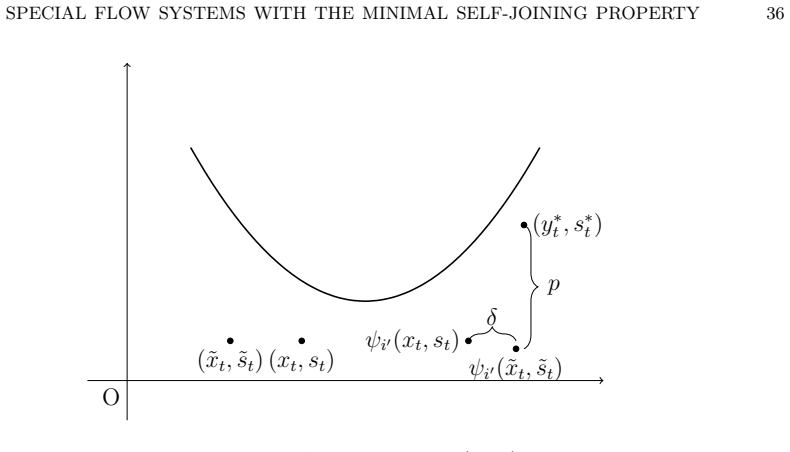
read the original abstract
Arnol'd flows are a class of area-preserving flows on surfaces. In this paper, we prove that typical Arnol'd flows have the minimal self-joining property. Consequently, we can classify centralizers and factors of typical Arnol'd flows.
Editorial analysis
A structured set of objections, weighed in public.
Referee Report
Summary. The manuscript asserts a proof that typical Arnol'd flows have the minimal self-joining property, which in turn allows the classification of centralizers and factors for these flows.
Significance. Should the proof be complete and the notion of typicality rigorously defined, this would represent a notable advance in the ergodic theory of surface flows by establishing a strong rigidity property for a generic class of Arnol'd flows.
major comments (1)
- [Abstract] The abstract claims a proof for 'typical' Arnol'd flows but does not specify the parameter space of roof functions or the sense in which the set is typical (e.g., comeager in Baire category or full measure). This definition is load-bearing for the genericity statement.
minor comments (1)
- Ensure that all definitions, including those for special flows and logarithmic singularities, are clearly stated early in the paper.
Simulated Author's Rebuttal
We thank the referee for their careful reading of the manuscript and for highlighting the need for greater precision regarding the notion of typicality. We address the major comment below and will incorporate the necessary clarifications in a revised version.
read point-by-point responses
-
Referee: [Abstract] The abstract claims a proof for 'typical' Arnol'd flows but does not specify the parameter space of roof functions or the sense in which the set is typical (e.g., comeager in Baire category or full measure). This definition is load-bearing for the genericity statement.
Authors: We agree that the abstract should explicitly define the parameter space and the precise sense of typicality to support the genericity claim. In the body of the manuscript, typicality is understood in the Baire category sense: a comeager set of roof functions in the space of C^∞ functions on the circle, equipped with the Whitney topology, for which the corresponding special flow satisfies the minimal self-joining property. We will revise the abstract to state this definition clearly, including the relevant function space and topology, so that the statement is self-contained. revision: yes
Circularity Check
No circularity: direct proof of MSJ for typical Arnol'd flows
full rationale
The paper states a theorem that typical Arnol'd flows (special flows over irrational rotations with logarithmic singularities) possess the minimal self-joining property and derives consequences for centralizers and factors. No quoted step reduces the claimed result to a fitted parameter, self-defined quantity, or load-bearing self-citation chain; the genericity argument is presented as an independent proof controlling return times and singularities within the stated parameter space. The derivation therefore stands as self-contained mathematical reasoning rather than a renaming or tautological reduction of its inputs.
Axiom & Free-Parameter Ledger
axioms (1)
- standard math Standard results from ergodic theory on self-joinings and special flows
Lean theorems connected to this paper
-
IndisputableMonolith/Foundation/AbsoluteFloorClosure.leanreality_from_one_distinction unclear?
unclearRelation between the paper passage and the cited Recognition theorem.
Theorem 1.4: For an explicit full Lebesgue measure set of α ∈ (0,1), Arnol'd flows have the minimal self-joining property.
What do these tags mean?
- matches
- The paper's claim is directly supported by a theorem in the formal canon.
- supports
- The theorem supports part of the paper's argument, but the paper may add assumptions or extra steps.
- extends
- The paper goes beyond the formal theorem; the theorem is a base layer rather than the whole result.
- uses
- The paper appears to rely on the theorem as machinery.
- contradicts
- The paper's claim conflicts with a theorem or certificate in the canon.
- unclear
- Pith found a possible connection, but the passage is too broad, indirect, or ambiguous to say the theorem truly supports the claim.
Reference graph
Works this paper leans on
-
[1]
O. N. Ageev. A typical dynamical system is not simple or semisimple. Ergodic Theory and Dynamical Systems , 23(6):1625–1636, 2003
work page 2003
-
[2]
V.I. Arnol'd. Topological and ergodic properties of closed 1-forms with incommensurable periods. Funct Anal Its Appl , 25:81–90, 1991
work page 1991
-
[3]
F. Blanchard, E. Glasner, and J. Kwiatkowski. Minimal self-joinings and positive topological entropy. Monatshefte für Mathematik , 120(3-4):205--222, 1995
work page 1995
-
[4]
F. Blanchard and J. Kwiatkowski. Minimal self-joinings and positive topological entropy ii. Studia Mathematica , 128(2):121--133, 1998
work page 1998
-
[5]
J. Chaika and A. Eskin. Self-joinings for 3-iets. Journal of the European Mathematical Society , 23, 05 2021
work page 2021
-
[6]
J. Chaika and B. Kra. A prime system with many self-joinings. Journal of Modern Dynamics , 17(0):213--265, 2021
work page 2021
-
[7]
J. Chaika and D. Robertson. A rank one mild mixing system without minimal self joinings, 2024
work page 2024
- [8]
- [9]
-
[10]
Thierry de La Rue. Joinings in ergodic theory. In Encyclopedia of Complexity and Systems Science . Springer, 2020
work page 2020
-
[11]
S. Ferenczi, C. Holton, and L. Zamboni. Joinings of three-interval exchange transformations. Ergodic Theory and Dynamical Systems , 25(2):483–502, 2005
work page 2005
-
[12]
B. Fayad and A. Kanigowski. Multiple mixing for a class of conservative surface flows. Inventiones Mathematicae , 203:555--614, 2016
work page 2016
-
[13]
K. Fr a czek and M. Lemańczyk. On mild mixing of special flows over irrational rotations under piecewise smooth functions. Ergodic Theory and Dynamical Systems , 26(3):719–738, 2006
work page 2006
-
[14]
K. Fr a czek and M. Lemańczyk. Smooth singular flows in dimension 2 with the minimal self-joining property. Monatshefte für Mathematik , 156:11–45, 07 2009
work page 2009
-
[15]
Disjointness in ergodic theory, minimal sets, and a problem in diophantine approximation
Harry Furstenberg. Disjointness in ergodic theory, minimal sets, and a problem in diophantine approximation. Mathematical Systems Theory , 1(1):1--49, Mar 1967
work page 1967
-
[16]
A. Del Junco, M. Rahe, and L. Swanson. Chacon's automorphism has minimal self-joinings. Journal d'Analyse Mathématique , 37(1):276--284, Dec 1980
work page 1980
-
[17]
Khinchin. Continued Fractions . Phoenix books. University of Chicago Press, 1964
work page 1964
-
[18]
Jonathan L. F. King. Joining-rank and the structure of finite rank mixing transformations. Journal d’Analyse Math \'e matique , 51:182--227, 1988
work page 1988
-
[19]
A. Kanigowski, J. Ku aga-Przymus, and C. Ulcigrai. Multiple mixing and parabolic divergence in smooth area-preserving flows on higher genus surfaces. Journal of the European Mathematical Society , 21(12):3797--3855, 2019
work page 2019
-
[20]
A. Kanigowski, M. Lemańczyk, and C. Ulcigrai. On disjointness properties of some parabolic flows. Inventiones mathematicae , 221, 07 2020
work page 2020
-
[21]
A. V. Kochergin. The absence of mixing in special flows over a rotation of the circle and in flows on a two-dimensional torus. Dokl. Akad. Nauk SSSR , 205:515--518, 1972
work page 1972
-
[22]
I. V. Klimov and V. V. Ryzhikov. Minimal self-joinings of infinite mixing actions of rank 1. Mat. Zametki , 102(6):851--856, 2017
work page 2017
-
[23]
F. Parreau and E. Roy. Prime poisson suspensions. Ergodic Theory and Dynamical Systems , 35(7):2216--2230, 2015
work page 2015
-
[24]
Horocycle flows, joinings and rigidity of products
Marina Ratner. Horocycle flows, joinings and rigidity of products. Annals of Mathematics , 118(2):277--313, 1983
work page 1983
-
[25]
V.A. Rokhlin. On the Fundamental Ideas of Measure Theory . American Mathematical Society translations. American Mathematical Society, 1952
work page 1952
-
[26]
Daniel J. Rudolph. An example of a measure preserving map with minimal self-joinings, and applications. Journal d’Analyse Mathématique , 35(1):97--122, Dec 1979
work page 1979
-
[27]
V. V. Ryzhikov. Around simple dynamical systems: Induced joinings and multiple mixing. Journal of Dynamical and Control Systems , 3:111--127, 1997
work page 1997
-
[28]
Y.G. Sinai and K.M. Khanin. Mixing for some classes of special flows over rotations of the circle. Funct Anal Its Appl , 26:155–169, 1992
work page 1992
-
[29]
Substitutions, tiling dynamical systems and minimal self-joinings
Younghwan Son. Substitutions, tiling dynamical systems and minimal self-joinings. Discrete Contin. Dyn. Syst. , 34(11):4855--4874, 2014
work page 2014
-
[30]
The self-joinings of rank two mixing transformations
Daniel Ullman. The self-joinings of rank two mixing transformations. Proc. Amer. Math. Soc. , 114(1):53--60, 1992
work page 1992
-
[31]
William A. Veech. A criterion for a process to be prime. Monatshefte für Mathematik , 94:335--342, 1982
work page 1982
-
[32]
Zur operatorenmethode in der klassischen mechanik
John von Neumann. Zur operatorenmethode in der klassischen mechanik. Annals of Mathematics , 33:587, 1932
work page 1932
discussion (0)
Sign in with ORCID, Apple, or X to comment. Anyone can read and Pith papers without signing in.