Dimension of Bi-degree (d,d) Spline Spaces with the Highest Order of Smoothness over Hierarchical T-Meshes
Pith reviewed 2026-05-19 05:08 UTC · model grok-4.3
The pith
Bi-degree (d,d) splines with highest smoothness over hierarchical T-meshes have a recursive dimension formula under tensor-product subdivision.
A machine-rendered reading of the paper's core claim, the machinery that carries it, and where it could break.
Core claim
Using the smoothing cofactor-conformality method, the dimension of the conformality vector space over a tensor product T-connected component is given by a specific formula, and for hierarchical T-meshes under tensor product subdivision, this dimension can be computed recursively over T-connected components, yielding an overall dimensional formula for the bi-degree (d,d) spline space with highest smoothness, assuming the mesh satisfies the mild condition that permits the recursion.
What carries the argument
The conformality vector space, whose dimension is calculated recursively from tensor-product T-connected components to determine the spline space dimension.
If this is right
- The dimension formula allows direct computation without building bases.
- A modification strategy exists to make the dimension stable for any starting hierarchical T-mesh.
- The dimension equals that of a lower-degree spline space over the CVR graph of the mesh.
- This equality suggests a path to constructing basis functions by reducing to simpler spaces.
Where Pith is reading between the lines
- Knowing the dimension in closed form could simplify error estimates in isogeometric analysis on adaptive meshes.
- If the recursion holds, similar methods might apply to tri-degree splines in 3D.
- The CVR graph reduction might link to graph theory problems in mesh processing.
Load-bearing premise
The hierarchical T-mesh must admit tensor product subdivision and satisfy an unspecified mild assumption that allows the recursive calculation of conformality vector space dimensions.
What would settle it
A specific hierarchical T-mesh that admits tensor product subdivision but where the computed spline dimension differs from the recursive formula when the highest smoothness is imposed.
Figures


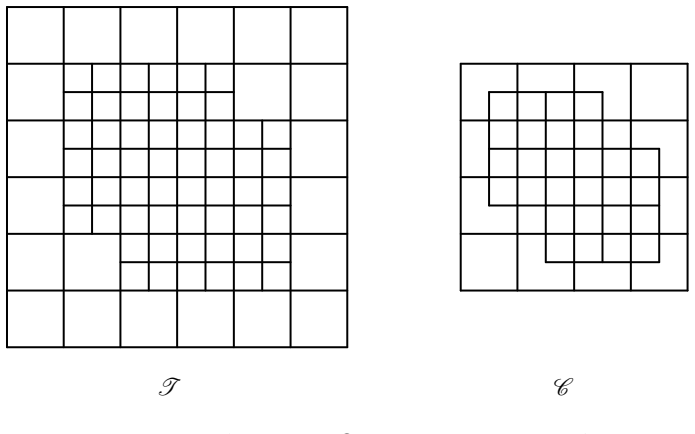
read the original abstract
In this article, we study the dimension of the spline space of di-degree $(d,d)$ with the highest order of smoothness over a hierarchical T-mesh $\mathscr T$ using the smoothing cofactor-conformality method. Firstly, we obtain a dimensional formula for the conformality vector space over a tensor product T-connected component. Then, we prove that the dimension of the conformality vector space over a T-connected component of a hierarchical T-mesh under the tensor product subdivision can be calculated in a recursive manner. Combining these two aspects, we obtain a dimensional formula for the bi-degree $(d,d)$ spline space with the highest order of smoothness over a hierarchical T-mesh $\mathscr T$ with mild assumption. Additionally, we provide a strategy to modify an arbitrary hierarchical T-mesh such that the dimension of the bi-degree $(d,d)$ spline space is stable over the modified hierarchical T-mesh. Finally, we prove that the dimension of the spline space over such a hierarchical T-mesh is the same as that of a lower-degree spline space over its CVR graph. Thus, the proposed solution can pave the way for the subsequent construction of basis functions for spline space over such a hierarchical T-mesh.
Editorial analysis
A structured set of objections, weighed in public.
Referee Report
Summary. The manuscript develops a dimensional formula for the space of bi-degree (d, d) splines with maximal smoothness over hierarchical T-meshes. Using the smoothing cofactor-conformality method, the authors first derive an explicit dimension formula for the conformality vector space on a tensor-product T-connected component. They then establish a recursive procedure for computing this dimension over T-connected components in a hierarchical T-mesh that admits tensor-product subdivision, provided a mild assumption holds. Combining these, they obtain the spline space dimension under the mild assumption. The paper also proposes a modification strategy for arbitrary hierarchical T-meshes to stabilize the dimension and proves equivalence to the dimension of a lower-degree spline space over the CVR graph.
Significance. If the recursive formula and the mild assumption can be made fully rigorous and explicit, the results would offer a practical tool for dimension calculation in hierarchical spline spaces, which are central to adaptive isogeometric analysis. The connection to the CVR graph and the modification strategy are notable strengths that could facilitate basis function construction. The extension of the cofactor-conformality method with recursive and equivalence results grounded in mesh structure is a positive contribution.
major comments (2)
- [Abstract and statement of main result] The dimensional formula is stated to hold 'with mild assumption,' but this assumption is not characterized (e.g., no condition on T-junction nesting, level counts, or crossing configurations is provided). Since the recursion over T-connected components relies on this assumption, its unspecified nature makes it impossible to verify applicability to general hierarchical T-meshes satisfying only tensor-product subdivision. This is load-bearing for the central claim.
- [Section on recursive calculation of conformality dimension] The abstract and reader's summary indicate that full proof details for the recursive dimension calculation and the equivalence results are not fully expanded. Without these details, it is difficult to confirm that the recursion holds without gaps once the mild assumption is satisfied.
minor comments (1)
- [Introduction and notation] Ensure that all mesh-related terms like 'T-connected component' and 'CVR graph' are defined clearly at first use.
Simulated Author's Rebuttal
We thank the referee for the careful reading of our manuscript and the constructive feedback. We address the major comments point by point below and will incorporate revisions to strengthen the presentation and rigor of the results.
read point-by-point responses
-
Referee: [Abstract and statement of main result] The dimensional formula is stated to hold 'with mild assumption,' but this assumption is not characterized (e.g., no condition on T-junction nesting, level counts, or crossing configurations is provided). Since the recursion over T-connected components relies on this assumption, its unspecified nature makes it impossible to verify applicability to general hierarchical T-meshes satisfying only tensor-product subdivision. This is load-bearing for the central claim.
Authors: We agree that the mild assumption requires explicit characterization to ensure the main result is verifiable and applicable. In the revised version, we will add a precise definition of this assumption in both the abstract and the statement of the main theorem. The characterization will specify conditions on the hierarchical T-mesh, including restrictions on T-junction nesting depths, level counts, and the absence of crossing configurations that would disrupt the tensor-product subdivision property. This will clarify the scope for general hierarchical T-meshes and support the recursion over T-connected components. revision: yes
-
Referee: [Section on recursive calculation of conformality dimension] The abstract and reader's summary indicate that full proof details for the recursive dimension calculation and the equivalence results are not fully expanded. Without these details, it is difficult to confirm that the recursion holds without gaps once the mild assumption is satisfied.
Authors: We acknowledge that the proofs of the recursive dimension calculation and the equivalence to the lower-degree space on the CVR graph would benefit from expanded details. In the revision, we will enhance the relevant section by including a full inductive argument for the recursion, explicit verification steps for base cases, and additional intermediate results to demonstrate that the recursion proceeds without gaps under the (now explicitly characterized) mild assumption. We will also expand the equivalence proof with more intermediate lemmas linking the conformality vector spaces. revision: yes
Circularity Check
Derivation builds recursive dimension formulas from mesh structure without self-referential reductions
full rationale
The paper obtains an explicit dimensional formula for the conformality vector space on tensor-product T-connected components, then proves a recursive reduction for T-connected components of hierarchical T-meshes that admit tensor-product subdivision. These steps are grounded in the smoothing cofactor-conformality method and the combinatorial structure of the mesh; the mild assumption is introduced as an explicit precondition for the recursion rather than a hidden self-definition. No quoted equation or claim reduces a prediction to a fitted input by construction, nor does any load-bearing step collapse to a self-citation whose content is unverified. The additional results on mesh modification for stability and equivalence to the CVR-graph spline space supply independent content, confirming the derivation chain is self-contained.
Axiom & Free-Parameter Ledger
axioms (2)
- domain assumption The smoothing cofactor-conformality method can be applied to determine dimensions of bi-degree (d,d) spline spaces.
- domain assumption Hierarchical T-meshes admit tensor product subdivision allowing recursive dimension calculation.
Reference graph
Works this paper leans on
-
[1]
Hierarchical B-spline refinement,
D. R. Forsey and R. H. Bartels, “Hierarchical B-spline refinement,” in Proceedings of the 15th annual conference on Computer graphics and interactive techniques, 1988, pp. 205–212
work page 1988
-
[3]
On the completeness of hierarchical tensor- product b-splines,
D. Mokriˇ s, B. J¨ uttler, and C. Giannelli, “On the completeness of hierarchical tensor- product b-splines,” Journal of Computational and Applied Mathematics, vol. 271, pp. 53–70, 2014
work page 2014
-
[4]
Bases and dimensions of bivariate hierarchical tensor- product splines,
C. Giannelli and B. J¨ uttler, “Bases and dimensions of bivariate hierarchical tensor- product splines,” Journal of Computational and Applied Mathematics, vol. 239, pp. 162–178, 2013
work page 2013
-
[5]
T. W. Sederberg, J. Zheng, A. Bakenov, and A. Nasri, “T-splines and t-nurccs,” ACM transactions on graphics (TOG), vol. 22, no. 3, pp. 477–484, 2003
work page 2003
-
[6]
T-spline simplification and local refinement,
T. W. Sederberg, D. L. Cardon, G. T. Finnigan, N. S. North, J. Zheng, and T. Lyche, “T-spline simplification and local refinement,” ACM transactions on graphics (TOG), vol. 23, no. 3, pp. 276–283, 2004. 26
work page 2004
-
[7]
On linear inde- pendence of T-spline blending functions,
X. Li, J. Zheng, T. W. Sederberg, T. J. Hughes, and M. A. Scott, “On linear inde- pendence of T-spline blending functions,” Computer Aided Geometric Design, vol. 29, no. 1, pp. 63–76, 2012
work page 2012
-
[8]
Polynomial splines over hierarchical T-meshes,
J. Deng, F. Chen, X. Li, C. Hu, W. Tong, Z. Yang, and Y. Feng, “Polynomial splines over hierarchical T-meshes,” Graphical Models, vol. 70, no. 4, pp. 76–86, 2008
work page 2008
-
[9]
Polynomial splines over locally refined box-partitions,
T. Dokken, T. Lyche, and K. F. Pettersen, “Polynomial splines over locally refined box-partitions,” Computer Aided Geometric Design, vol. 30, no. 3, pp. 331–356, 2013
work page 2013
-
[10]
A survey on the local refinable splines,
X. Li, F. Chen, H. Kang, and J. Deng, “A survey on the local refinable splines,” Science China Mathematics, vol. 59, pp. 617–644, 2016
work page 2016
-
[11]
Dimensions of spline spaces over T-meshes,
J. Deng, F. Chen, and Y. Feng, “Dimensions of spline spaces over T-meshes,” Journal of Computational and Applied Mathematics, vol. 194, no. 2, pp. 267–283, 2006
work page 2006
-
[12]
Improvement on the dimensions of spline spaces on T-mesh,
C. Li, R. Wang, and F. Zhang, “Improvement on the dimensions of spline spaces on T-mesh,” Journal of Information & Computational Science, vol. 3, no. 2, pp. 235–244, 2006
work page 2006
-
[13]
M. J. Lai and L. L. Schumaker, Spline functions on triangulations. Cambridge Uni- versity Press, 2007, vol. 110
work page 2007
-
[14]
Approximation power of polynomial splines on T- meshes,
L. L. Schumaker and L. Wang, “Approximation power of polynomial splines on T- meshes,” Computer Aided Geometric Design, vol. 29, no. 8, pp. 599–612, 2012
work page 2012
-
[15]
On the dimension of spline spaces on planar T-meshes,
B. Mourrain, “On the dimension of spline spaces on planar T-meshes,” Mathematics of Computation, vol. 83, no. 286, pp. 847–871, 2014
work page 2014
-
[16]
Dimensions of spline spaces over 3D hierarchical T- meshes,
X. Li, J. Deng, and F. Chen, “Dimensions of spline spaces over 3D hierarchical T- meshes,” Journal of Information and Computational Science, vol. 3, no. 3, pp. 487–501, 2006
work page 2006
-
[17]
On the dimension of trivariate spline spaces with the highest order smoothness on 3D T-meshes,
C. Zeng and J. Deng, “On the dimension of trivariate spline spaces with the highest order smoothness on 3D T-meshes,” Advances in Computational Mathematics, vol. 44, no. 2, pp. 423–451, 2018
work page 2018
-
[18]
On the instability in the dimension of splines spaces over T-meshes,
X. Li and F. Chen, “On the instability in the dimension of splines spaces over T-meshes,” Computer Aided Geometric Design, vol. 28, no. 7, pp. 420–426, 2011
work page 2011
-
[19]
On the problem of instability in the dimension of a spline space over a T-mesh,
D. Berdinsky, M. Oh, T. Kim, and B. Mourrain, “On the problem of instability in the dimension of a spline space over a T-mesh,” Computers & Graphics, vol. 36, no. 5, pp. 507–513, 2012
work page 2012
-
[20]
On the problem of instability in the dimensions of spline spaces over T-meshes with T-cycles,
Q. Guo, R. Wang, and C. Li, “On the problem of instability in the dimensions of spline spaces over T-meshes with T-cycles,” Journal of Computational Mathematics, pp. 248–262, 2015
work page 2015
-
[21]
The instability in the dimensions of spline spaces over T-meshes with nested T-cycles,
C. Li and P. Wang, “The instability in the dimensions of spline spaces over T-meshes with nested T-cycles,” Numer. Math., Theory Methods Appl, vol. 12, no. 1, pp. 187–211, 2019. 27
work page 2019
-
[22]
On the stability of the dimensions of spline spaces with highest order of smoothness over t-meshes,
B. Huang and F. Chen, “On the stability of the dimensions of spline spaces with highest order of smoothness over t-meshes,” Journal of Computational and Applied Mathematics, p. 115681, 2023
work page 2023
-
[23]
On the dimension of spline spaces over T-meshes with smoothing cofactor-conformality method,
X. Li and J. Deng, “On the dimension of spline spaces over T-meshes with smoothing cofactor-conformality method,” Computer Aided Geometric Design, vol. 41, pp. 76–86, 2016
work page 2016
-
[24]
Dimensions of biquadratic spline spaces over T-meshes,
J. Deng, F. Chen, and L. Jin, “Dimensions of biquadratic spline spaces over T-meshes,” Journal of Computational and Applied Mathematics, vol. 238, pp. 68–94, 2013
work page 2013
-
[25]
Hierarchical bases of spline spaces with highest order smoothness over hierarchical T-subdivisions,
M. Wu, J. Xu, R. Wang, and Z. Yang, “Hierarchical bases of spline spaces with highest order smoothness over hierarchical T-subdivisions,”Computer Aided Geometric Design, vol. 29, no. 7, pp. 499–509, 2012
work page 2012
-
[26]
Dimensions of biquadratic and bicubic spline spaces over hierarchical T-meshes,
C. Zeng, F. Deng, X. Li, and J. Deng, “Dimensions of biquadratic and bicubic spline spaces over hierarchical T-meshes,” Journal of Computational and Applied Mathematics, vol. 287, pp. 162–178, 2015
work page 2015
-
[27]
Surface modeling with polynomial splines over hierarchical T-meshes,
X. Li, J. Deng, and F. Chen, “Surface modeling with polynomial splines over hierarchical T-meshes,” The Visual Computer, vol. 23, pp. 1027–1033, 2007
work page 2007
-
[28]
Polynomial splines over general T-meshes,
Li, Xin, Deng, Jiansong, and Chen, Falai, “Polynomial splines over general T-meshes,” The Visual Computer, vol. 26, pp. 277–286, 2010
work page 2010
-
[29]
Parallel and adaptive surface recon- struction based on implicit PHT-splines,
J. Wang, Z. Yang, L. Jin, J. Deng, and F. Chen, “Parallel and adaptive surface recon- struction based on implicit PHT-splines,” Computer Aided Geometric Design, vol. 28, no. 8, pp. 463–474, 2011
work page 2011
-
[30]
Adaptive finite element methods for elliptic equations over hierarchical T-meshes,
L. Tian, F. Chen, and Q. Du, “Adaptive finite element methods for elliptic equations over hierarchical T-meshes,” Journal of Computational and Applied Mathematics, vol. 236, no. 5, pp. 878–891, 2011
work page 2011
-
[31]
N. Nguyen-Thanh, H. Nguyen-Xuan, S. P. A. Bordas, and T. Rabczuk, “Isogeometric analysis using polynomial splines over hierarchical T-meshes for two-dimensional elastic solids,” Computer Methods in Applied Mechanics and Engineering, vol. 200, no. 21-22, pp. 1892–1908, 2011
work page 1908
-
[32]
A hierarchical approach to adap- tive local refinement in isogeometric analysis,
A.-V. Vuong, C. Giannelli, B. J¨ uttler, and B. Simeon, “A hierarchical approach to adap- tive local refinement in isogeometric analysis,”Computer Methods in Applied Mechanics and Engineering, vol. 200, no. 49-52, pp. 3554–3567, 2011
work page 2011
-
[33]
Adaptive isogeometric analysis using rational PHT-splines,
P. Wang, J. Xu, J. Deng, and F. Chen, “Adaptive isogeometric analysis using rational PHT-splines,” Computer Aided Design, vol. 43, no. 11, pp. 1438–1448, 2011
work page 2011
-
[34]
J. Xu, F. Chen, and J. Deng, “Two-dimensional domain decomposition based on skele- ton computation for parameterization and isogeometric analysis,” Computer Methods in Applied Mechanics and Engineering, vol. 284, pp. 541–555, 2015
work page 2015
-
[35]
On the dimension of spaces of piecewise polynomials in two variables,
L. L. Schumaker, “On the dimension of spaces of piecewise polynomials in two variables,” Multivariate Approximation Theory, pp. 396–412, 1979
work page 1979
-
[36]
Wang, Multivariate spline functions and their applications
R. Wang, Multivariate spline functions and their applications. Springer Science & Business Media, 2013, vol. 529. 28
work page 2013
discussion (0)
Sign in with ORCID, Apple, or X to comment. Anyone can read and Pith papers without signing in.