REVIEW 4 major objections 5 minor 128 references
The Accretion-Ejection Connection in the Black Hole X-ray Binary MAXI J1820$+$070
T0 review · 4 major / 5 minor · reviewed 2026-08-06 · deepseek-v4-flash
Pith's one-line read Three re-brightenings of the black hole binary MAXI J1820+070 all follow the same light-curve shape, matching disk-instability models that include irradiation from the inner disk.
desk verdict Solid observational benchmark with a nice 3D activity plane, but the abstract overclaims the disk-instability comparison and the correlation slopes rest on post-hoc data cuts. read the letter →
The pith
A machine-rendered reading of the paper's core claim, the machinery that carries it, and where it could break.
The reading
What carries the argument
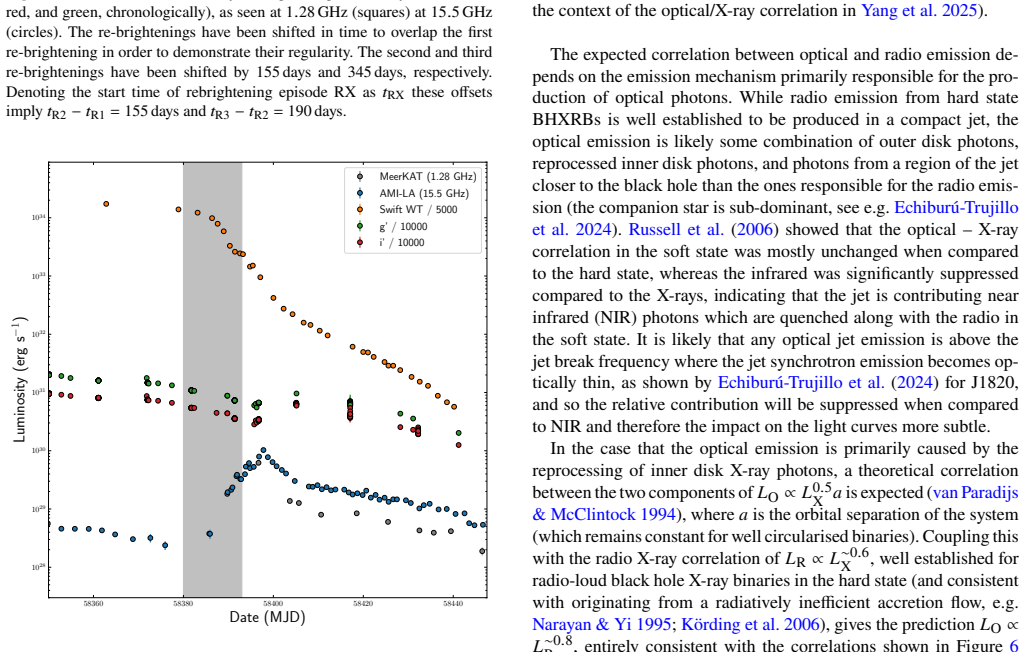
The central machinery is the three-dimensional radio–X-ray–optical activity plane: a parametric line fit in log-luminosity space (Equation 1) to quasi-simultaneous hard-state measurements that have been binned in time. It unifies the well-known radio–X-ray correlation with optical data, exposing state-transition hysteresis and the independent optical fade. The second load-bearing element is the irradiated disk-instability model of Dubus et al. (2001), which predicts the observed two-phase decay: an initial exponential decline while irradiation keeps the disk hot and ionised, followed by a steeper decline as a cooling front propagates inward once irradiation fades.
What would settle it
A concrete test is to re-fit the hard-state correlations including all points currently excluded: hard-state points within 5 days of the state transitions and optical points before MJD 58233.5. If the correlation slopes or the 3D activity-line parameters shift by more than the quoted uncertainties, the claim that the hard state follows one line fails. A second decisive test is to catch a future re-brightening (of J1820 or a similar source like Swift J1910.2−0546) at daily cadence in radio, X-ray, and optical: if the decay is a single power law rather than the two-phase exponential-then-steeper profile, the irradiated disk-instability interpretation is falsified.
Extended reading notes
Core claim
On its own terms, the paper establishes that the entire four-year radio, X-ray, and optical evolution of MAXI J1820+070 is organised by a single set of correlations. In the hard state, radio, X-ray, and optical luminosities are strongly correlated and lie along one line in three-dimensional log-luminosity space, with centroid [LX,0, LR,0, LO,0] = [35.984, 29.510, 35.105] and unit direction vector [0.846, 0.383, 0.371] (Equation 1). Excursions from this line occur mainly during the rising hard state, where the optical fades independently of the correlated radio and X-ray emission, and during the hard-to-soft and soft-to-hard transitions, which trace out a hysteresis loop. The paper also establishes that the three hard-state-only re-brightenings (R1, R2, R3) have remarkably similar light-curve morphologies: a fast rise, a shallow decay lasting roughly 30 days, then a steeper decay lasting roughly 20 days, visible in all three bands. This two-phase decay profile is argued to be broadly consistent with modified disk-instability models in which irradiation from the inner accretion disk (or corona) keeps the disk fully ionised until the irradiation weakens enough for a cooling front to move inwards.
Load-bearing premise
The reported hard-state correlation slopes rest on excluding hard-state points within five days of state transitions (because of a clear drop in radio emission) and optical points before MJD 58233.5 (because they clearly do not follow the X-ray emission); if those exclusions are not physically justified, the slopes describe a selected subset of the hard state rather than the full one.
Editorial extensions
If this is right
- If the 3D activity plane is confirmed for other well-sampled black hole X-ray binaries, it would provide a standard diagnostic for linking accretion state, jet launching, and optical emission in a single framework.
- The regularity and shared morphology of the re-brightenings imply that a common process regulates them, tying J1820's behaviour to a broader class of low-mass X-ray binary re-brightening phenomena.
- The radio–X-ray correlation slope of about 0.48 for J1820 is shallower than the canonical 0.6 for radio-loud sources, yet the source stays on the radio-loud track throughout; this constrains models that tie the slope to accretion efficiency.
- The inferred jet contribution to the optical emission during the soft-to-hard transition, suggested by the ordering of the radio and optical peaks, can be tested with broadband spectral energy distribution fitting and optical polarimetry.
- The striking similarity of the re-brightening events to the fading hard state (R0) indicates that the same physical mechanism can operate both during the tail of the canonical outburst and in subsequent hard-state-only flares.
Reading between the lines
- The near-constant peak luminosity of the re-brightenings (about 0.2 per cent of Eddington for an 8.5 solar-mass black hole) may point to a threshold in disk-stability models that could be tested across other sources, although the paper does not make this generalisation explicitly.
- Extending the 3D activity-plane analysis to other bright outbursts, such as Swift J1727.8−1613 as the authors themselves suggest, would reveal whether a single line in log-luminosity space is a universal feature of hard states or an idiosyncrasy of J1820.
- A re-analysis that includes the hard-state points currently excluded (within 5 days of state transitions, and optical points before MJD 58233.5) would test how much of the reported tight correlation relies on the selection; if the slopes shift significantly, the 'single line' claim would be weakened.
- The disk-instability interpretation predicts that the spacing between re-brightenings (roughly 155–190 days) and the two-phase decay timescales should be tied to the disk mass-transfer rate and the irradiation strength, which could be checked with time-dependent disk models tailored to J1820's parameters.
Editorial analysis
A structured set of objections, weighed in public.
Referee Report
Summary. This paper presents radio (AMI-LA 15.5 GHz and MeerKAT 1.28 GHz), Swift X-ray, and LCO optical g'/i' monitoring of MAXI J1820+070 from 2018 to 2022, covering the initial hard state, a soft-state excursion, and three hard-state-only re-brightenings. The authors construct two-dimensional radio-X-ray, optical-X-ray, and radio-optical correlations, plus a three-dimensional radio-X-ray-optical activity plane, and report slopes, a hysteresis pattern, and morphological similarities between the re-brightenings. They interpret the re-brightening light curves as broadly consistent with irradiation-modified disk instability models and discuss jet formation and optical jet contributions during state transitions.
Significance. The dataset is unusually comprehensive and publicly available in machine-readable form, with detailed reduction descriptions; if the correlations are robust, the 3D activity plane provides a valuable diagnostic of accretion-ejection coupling for one of the best-sampled BHXRBs. The paper also correctly notes degeneracies between irradiated-disk and jet origins for optical emission. However, the central model-consistency claim is only qualitative, and the correlation slopes rely on data-dependent exclusions; these issues need to be addressed before the broad conclusions are established.
major comments (4)
- [4.1 and Conclusions] The abstract's claim that the re-brightenings are 'broadly consistent' with irradiation-modified disk instability models is not quantitatively supported. Section 4.1 describes the two-stage decay morphology and qualitatively matches it to the Dubus et al. (2001) description, but the paper computes no model light curves for J1820's parameters, fits none of the observed light curves, and reports no timescale comparison or goodness-of-fit statistic. As it stands, any template with a fast rise and two decay rates would be equally consistent, so the wording 'We establish' overstates the evidence; either soften the claim or add a quantitative model comparison.
- [3.2.1-3.2.3] The fitted correlation indices are directly affected by data-dependent selection. Section 3.2.1 excludes hard-state points within 5 days of state transitions because of a 'clear drop in radio emission', and Sections 3.2.2-3.2.3 exclude optical points before MJD 58233.5 because they 'clearly do not follow the X-ray emission'. Since these cuts are motivated by inspection of the same data being fit, the reported slopes (and the claimed flattening during re-brightenings in Section 3.2.1) may reflect the selection rather than the full hard state. Please report the fits with and without these cuts, or define an independent a priori criterion.
- [Table 6 / Section 3.2.4] The reduced chi-squared values in Table 6 range from 3.9 to 12.4, which, given the quoted errors, formally reject the power-law models at high significance, yet Section 3.2.4 describes the hard-state data as 'strongly correlated' and lying 'along a line'. The paper should quantify the intrinsic scatter (e.g., with a scatter parameter or an explicit statement of the rms dispersion about the line) so that 'high degree of correlation' has a well-defined meaning; otherwise the activity-plane claim is stronger than the statistics warrant.
- [3.2.4] It is not stated whether the 3D line fit applies the same data exclusions used in the 2D fits (the 5-day transition window and the pre-MJD 58233.5 optical cut). If those points are included, the line is fit through the rising-hard-state optical fade that the 2D analysis explicitly rejects; if they are excluded, the 'hard state' line is defined on a subset. Please state which points enter the 3D fit and show the sensitivity of the centroid and direction vector to this choice.
minor comments (5)
- [2.1.2] The phrase 'in quadrate' should be 'in quadrature'.
- [3.2.1] The reference to 'panel B of Figure 1' should be 'panel B of Figure 2'; the spectral index is shown in Figure 2, not the calibrator light curve in Figure 1.
- [Figure 7 / Section 4.5] The interactive URL 'https://joesbright.github.io/MAXIJ180' appears truncated; it should include the full source name 'MAXIJ1820+070'.
- [3.2.1] The sentence describing Figure 4 says 'which includes the hard-state-only re-brightenings only' and is redundant; consider rewording.
- [3.2] The bin sizes (1.5 and 1.8 days) are stated without justification; a brief sentence explaining the choice and its sensitivity would help.
Circularity Check
No significant circularity: the paper's correlations are measured fits to independent observational data, and the disk-instability comparison is a qualitative post hoc interpretation rather than a derivation from the model.
full rationale
The paper's empirical claims are derived directly from independent radio, X-ray, and optical observations, not from fitted model inputs. The two- and three-dimensional correlation slopes (Eqs. 2-3, Section 3.2) are fits to measured luminosities and are presented as measured correlations, not as predictions generated from a theoretical model. The central interpretive claim that the re-brightening events are 'broadly consistent with modified disk instability models' (Section 4.1, Conclusions) is a qualitative post hoc comparison with no quantitative model fit or similarity statistic; being unsupported is a robustness concern, not a circularity concern. The reuse of early MeerKAT flux densities and the earlier 0.50 +/- 0.09 radio-X-ray slope from Bright et al. (2020) is a citation of independently published measurements by overlapping authors, and the paper reproduces consistent slopes from its own expanded dataset, so the self-citation is not load-bearing. The Section 4.3 discussion of an expected optical-radio slope combines the van Paradijs & McClintock (1994) reprocessing exponent with the paper's measured radio-X-ray slope; this is an algebraic consistency check among measured correlations, and the paper explicitly states that 'based on correlation arguments no conclusions can be drawn' about the optical photon origin. No definitional equivalence, fitted-parameter-renamed-as-prediction, or uniqueness-imported-by-self-citation is present.
Assumptions & free parameters
free parameters (14)
- 2D correlation bin size =
1.5 days
- 3D correlation bin size =
1.8 days
- Hard-state AMI-LA radio-X-ray index a_A =
0.481 ± 0.009
- Hard-state MeerKAT radio-X-ray index a_M =
0.41 ± 0.03
- Re-brightening AMI-LA radio-X-ray index (post MJD 58500) =
0.37 ± 0.02
- Re-brightening MeerKAT radio-X-ray index =
0.41 ± 0.04
- g'-band vs X-ray index =
0.45 ± 0.02
- i'-band vs X-ray index =
0.41 ± 0.01
- g'-band vs 15.5 GHz index =
0.95 ± 0.05
- i'-band vs 15.5 GHz index =
0.93 ± 0.04
- g'-band vs 1.28 GHz index =
1.1 ± 0.1
- i'-band vs 1.28 GHz index =
0.86 ± 0.06
- 3D line centroid [log LX, log LR, log LO] =
[35.984, 29.510, 35.105]
- 3D line direction vector [a, b, c] =
[0.846, 0.383, 0.371]
assumptions (8)
- domain assumption The source distance is 2.96 kpc from Atri et al. (2020) and is used to convert fluxes to luminosities.
- domain assumption Optical extinction correction uses A_V = 0.558 with Cardelli et al. (1989) coefficients.
- domain assumption X-ray spectra are modeled as absorbed power laws, with nH = 0.091 and Gamma = 1.7 fixed for low-count spectra.
- domain assumption Accretion state classifications (hard, intermediate, soft) are taken from Shidatsu et al. (2019).
- standard math The power-law correlation model L1 = A L2^a is adequate, with ODR assuming Gaussian errors in log-luminosity space.
- domain assumption Upper limits are ignored in all correlations.
- domain assumption Radio luminosities can be scaled to 5 GHz using the nearest spectral index within 3 days, or the median spectral index if no measurement is close enough.
- domain assumption A flat radio spectrum is assumed when converting flux densities to luminosities for the light curves.
Cite this review
Pith. "Pith review of The Accretion-Ejection Connection in the Black Hole X-ray Binary MAXI J1820$+$070." pith.science (2026). https://pith.science/paper/YHU7TIPG
@misc{pith2026250711303,
  author       = {Pith},
  title        = {Pith review of: The Accretion-Ejection Connection in the Black Hole X-ray Binary MAXI J1820$+$070},
  year         = {2026},
  howpublished = {\url{https://pith.science/paper/YHU7TIPG}},
  note         = {Machine review of arXiv:2507.11303}
}
abstract
The black hole X-ray binary MAXI J1820$+$070 began its first recorded outburst in March 2018, and remained an active radio, X-ray, and optical source for over four years. Due to the low distance to the source and its intrinsically high luminosity MAXI J1820$+$070 was observed extensively over this time period, resulting in high-cadence and quasi-simultaneous observations across the electromagnetic spectrum. These data sets provide the opportunity to probe the connection between accretion and the launch of jets in greater detail than for the majority of black hole X-ray binaries. In this work we present radio (Arcminute Microkelvin Imager Large Array, MeerKAT), X-ray (Swift), and optical (Las Cumbres Observatory) observations of MAXI J1820$+$070 throughout its entire outburst, including its initial hard state, subsequent soft state, and further hard-state-only re-brightenings (covering March 2018 to August 2022). Due to the regularity and temporal density of our observational data we are able to create a Radio - X-ray - Optical activity plane where we find a high degree of correlation between the three wave bands during the hard states, and observe hysteresis as MAXI J1820$+$070 enters and exits the soft state. Based on the morphology of the optical light curves we see evidence for optical jet contributions during the soft-to-hard state transition, as well as fading optical emission well before the hard to soft transition. We establish that the remarkably similar profiles of the re-brightening events are broadly consistent with modified disk instability models where irradiation from the inner accretion disk is included.
Figures


Figures from the paper (6 more)


Reference graph
Works this paper leans on
-
[1]
Alabarta K., et al., 2021, @doi [ ] 10.1093/mnras/stab2241 , https://ui.adsabs.harvard.edu/abs/2021MNRAS.507.5507A 507, 5507
-
[2]
A., 1996, in Jacoby G
Arnaud K. A., 1996, in Jacoby G. H., Barnes J., eds, Astronomical Society of the Pacific Conference Series Vol. 101, Astronomical Data Analysis Software and Systems V. p. 17
1996
-
[3]
Atri P., et al., 2020, @doi [ ] 10.1093/mnrasl/slaa010 , https://ui.adsabs.harvard.edu/abs/2020MNRAS.493L..81A 493, L81
-
[4]
C., Russell D
Baglio M. C., Russell D. M., Lewis F., 2018, The Astronomer's Telegram, https://ui.adsabs.harvard.edu/abs/2018ATel11418....1B 11418
2018
-
[5]
C., Russell D
Baglio M. C., Russell D. M., Saikia P., Bramich D. M., Lewis F., 2021, The Astronomer's Telegram, https://ui.adsabs.harvard.edu/abs/2021ATel14492....1B 14492
2021
-
[6]
C., Russell D
Baglio M. C., Russell D. M., Alabarta K., Saikia P., Bramich D. M., Homan J., Lewis F., 2023, The Astronomer's Telegram, https://ui.adsabs.harvard.edu/abs/2023ATel16192....1B 16192
2023
-
[7]
Bahramian A., et al., 2023, @doi [ ] 10.3847/2041-8213/accde1 , https://ui.adsabs.harvard.edu/abs/2023ApJ...948L...7B 948, L7
-
[8]
M., 2010, in Belloni T., ed., , Vol
Belloni T. M., 2010, in Belloni T., ed., , Vol. 794, Lecture Notes in Physics, Berlin Springer Verlag. p. 53
2010
Show all 128 references
-
[9]
D., K \"o nigl A., 1979, @doi [ ] 10.1086/157262 , https://ui.adsabs.harvard.edu/abs/1979ApJ...232...34B 232, 34
Blandford R. D., K \"o nigl A., 1979, @doi [ ] 10.1086/157262 , https://ui.adsabs.harvard.edu/abs/1979ApJ...232...34B 232, 34
1979 doi
-
[11]
S., 1995, PhD thesis, New Mexico Institute of Mining and Technology
Briggs D. S., 1995, PhD thesis, New Mexico Institute of Mining and Technology
1995
-
[12]
S., et al., 2020, @doi [Nature Astronomy] 10.1038/s41550-020-1023-5 , https://ui.adsabs.harvard.edu/abs/2020NatAs...4..697B 4, 697
Bright J. S., et al., 2020, @doi [Nature Astronomy] 10.1038/s41550-020-1023-5 , https://ui.adsabs.harvard.edu/abs/2020NatAs...4..697B 4, 697
2020 doi
-
[13]
N., et al., 2005, @doi [ ] 10.1007/s11214-005-5097-2 , https://ui.adsabs.harvard.edu/abs/2005SSRv..120..165B 120, 165
Burrows D. N., et al., 2005, @doi [ ] 10.1007/s11214-005-5097-2 , https://ui.adsabs.harvard.edu/abs/2005SSRv..120..165B 120, 165
2005 doi
-
[14]
CASA Team et al., 2022, @doi [ ] 10.1088/1538-3873/ac9642 , https://ui.adsabs.harvard.edu/abs/2022PASP..134k4501C 134, 114501
2022 doi
-
[15]
A., Clayton G
Cardelli J. A., Clayton G. C., Mathis J. S., 1989, @doi [ ] 10.1086/167900 , https://ui.adsabs.harvard.edu/abs/1989ApJ...345..245C 345, 245
1989 doi
-
[16]
Carotenuto F., et al., 2021a, @doi [ ] 10.1093/mnras/stab864 , https://ui.adsabs.harvard.edu/abs/2021MNRAS.504..444C 504, 444
-
[17]
Carotenuto F., et al., 2021b, @doi [ ] 10.1093/mnrasl/slab049 , https://ui.adsabs.harvard.edu/abs/2021MNRAS.505L..58C 505, L58
-
[18]
Carotenuto F., Corbel S., Tzioumis A., 2022, @doi [ ] 10.1093/mnrasl/slac087 , https://ui.adsabs.harvard.edu/abs/2022MNRAS.517L..21C 517, L21
2022 doi
-
[20]
R., Livio M., 1997, @doi [ ] 10.1086/304921 , https://ui.adsabs.harvard.edu/abs/1997ApJ...491..312C 491, 312
Chen W., Shrader C. R., Livio M., 1997, @doi [ ] 10.1086/304921 , https://ui.adsabs.harvard.edu/abs/1997ApJ...491..312C 491, 312
1997 doi
-
[21]
P., 2002, @doi [ ] 10.1086/341870 , https://ui.adsabs.harvard.edu/abs/2002ApJ...573L..35C 573, L35
Corbel S., Fender R. P., 2002, @doi [ ] 10.1086/341870 , https://ui.adsabs.harvard.edu/abs/2002ApJ...573L..35C 573, L35
2002 doi
-
[22]
P., Tzioumis A
Corbel S., Fender R. P., Tzioumis A. K., Nowak M., McIntyre V., Durouchoux P., Sood R., 2000, , https://ui.adsabs.harvard.edu/abs/2000A&A...359..251C 359, 251
2000
-
[23]
Corbel S., et al., 2001, @doi [ ] 10.1086/321364 , https://ui.adsabs.harvard.edu/abs/2001ApJ...554...43C 554, 43
2001 doi
-
[24]
P., Tzioumis A
Corbel S., Fender R. P., Tzioumis A. K., Tomsick J. A., Orosz J. A., Miller J. M., Wijnands R., Kaaret P., 2002, @doi [Science] 10.1126/science.1075857 , https://ui.adsabs.harvard.edu/abs/2002Sci...298..196C 298, 196
2002 doi
-
[25]
A., Fender R
Corbel S., Nowak M. A., Fender R. P., Tzioumis A. K., Markoff S., 2003, @doi [ ] 10.1051/0004-6361:20030090 , https://ui.adsabs.harvard.edu/abs/2003A&A...400.1007C 400, 1007
2003 doi
-
[26]
Corbel S., et al., 2013, @doi [ ] 10.1093/mnrasl/slt018 , https://ui.adsabs.harvard.edu/abs/2013MNRAS.431L.107C 431, L107
2013 doi
-
[29]
A., et al., 2020, @doi [ ] 10.1093/mnras/staa1606 , https://ui.adsabs.harvard.edu/abs/2020MNRAS.496.1001C 496, 1001
C \'u neo V. A., et al., 2020, @doi [ ] 10.1093/mnras/staa1606 , https://ui.adsabs.harvard.edu/abs/2020MNRAS.496.1001C 496, 1001
2020 doi
-
[30]
Cunningham C., 1976, @doi [ ] 10.1086/154636 , https://ui.adsabs.harvard.edu/abs/1976ApJ...208..534C 208, 534
1976 doi
-
[32]
Denisenko D., 2018, The Astronomer's Telegram, https://ui.adsabs.harvard.edu/abs/2018ATel11400....1D 11400
2018
-
[33]
F., Rodr \' guez L
Dhawan V., Mirabel I. F., Rodr \' guez L. F., 2000, @doi [ ] 10.1086/317088 , https://ui.adsabs.harvard.edu/abs/2000ApJ...543..373D 543, 373
2000 doi
-
[34]
M., Lasota J
Dubus G., Hameury J. M., Lasota J. P., 2001, @doi [ ] 10.1051/0004-6361:20010632 , https://ui.adsabs.harvard.edu/abs/2001A&A...373..251D 373, 251
2001 doi
-
[35]
Echibur \'u -Trujillo C., et al., 2024, @doi [ ] 10.3847/1538-4357/ad1a10 , https://ui.adsabs.harvard.edu/abs/2024ApJ...962..116E 962, 116
2024 doi
-
[36]
Espinasse M., et al., 2020, @doi [ ] 10.3847/2041-8213/ab88b6 , https://ui.adsabs.harvard.edu/abs/2020ApJ...895L..31E 895, L31
2020 doi
-
[37]
A., et al., 2009, @doi [ ] 10.1111/j.1365-2966.2009.14913.x , https://ui.adsabs.harvard.edu/abs/2009MNRAS.397.1177E 397, 1177
Evans P. A., et al., 2009, @doi [ ] 10.1111/j.1365-2966.2009.14913.x , https://ui.adsabs.harvard.edu/abs/2009MNRAS.397.1177E 397, 1177
2009
- [38]
-
[39]
Falcke H., K \"o rding E., Markoff S., 2004, @doi [ ] 10.1051/0004-6361:20031683 , https://ui.adsabs.harvard.edu/abs/2004A&A...414..895F 414, 895
2004 doi
-
[40]
P., Garrington S
Fender R. P., Garrington S. T., McKay D. J., Muxlow T. W. B., Pooley G. G., Spencer R. E., Stirling A. M., Waltman E. B., 1999a, @doi [ ] 10.1046/j.1365-8711.1999.02364.x , https://ui.adsabs.harvard.edu/abs/1999MNRAS.304..865F 304, 865
1999
-
[41]
Fender R., et al., 1999b, @doi [ ] 10.1086/312128 , https://ui.adsabs.harvard.edu/abs/1999ApJ...519L.165F 519, L165
-
[43]
Fender R., et al., 2016, in MeerKAT Science: On the Pathway to the SKA. p. 13 ( @eprint arXiv 1711.04132 ), @doi 10.22323/1.277.0013
2016 arXiv
-
[44]
P., Hynes R
Gallo E., Fender R. P., Hynes R. I., 2005, @doi [ ] 10.1111/j.1365-2966.2004.08503.x , https://ui.adsabs.harvard.edu/abs/2005MNRAS.356.1017G 356, 1017
2005
-
[45]
P., Fender R., 2012, @doi [ ] 10.1111/j.1365-2966.2012.20899.x , https://ui.adsabs.harvard.edu/abs/2012MNRAS.423..590G 423, 590
Gallo E., Miller B. P., Fender R., 2012, @doi [ ] 10.1111/j.1365-2966.2012.20899.x , https://ui.adsabs.harvard.edu/abs/2012MNRAS.423..590G 423, 590
2012
-
[46]
Gallo E., Degenaar N., van den Eijnden J., 2018, @doi [ ] 10.1093/mnrasl/sly083 , https://ui.adsabs.harvard.edu/abs/2018MNRAS.478L.132G 478, L132
2018 doi
-
[47]
Gasealahwe K. V. S., et al., 2023, @doi [ ] 10.1093/mnras/stad649 , https://ui.adsabs.harvard.edu/abs/2023MNRAS.521.2806G 521, 2806
2023 doi
-
[48]
Gehrels N., et al., 2004, @doi [ ] 10.1086/422091 , https://ui.adsabs.harvard.edu/abs/2004ApJ...611.1005G 611, 1005
2004 doi
-
[49]
J., et al., 2020, @doi [ ] 10.1093/mnras/staa2588 , https://ui.adsabs.harvard.edu/abs/2020MNRAS.498.3429G 498, 3429
Goodwin A. J., et al., 2020, @doi [ ] 10.1093/mnras/staa2588 , https://ui.adsabs.harvard.edu/abs/2020MNRAS.498.3429G 498, 3429
2020 doi
-
[50]
V., et al., 2020, @doi [ ] 10.1093/mnras/stz3420 , https://ui.adsabs.harvard.edu/abs/2020MNRAS.492.2858G 492, 2858
Gusinskaia N. V., et al., 2020, @doi [ ] 10.1093/mnras/stz3420 , https://ui.adsabs.harvard.edu/abs/2020MNRAS.492.2858G 492, 2858
2020 doi
-
[51]
Heywood I., 2020, oxkat: Semi-automated imaging of MeerKAT observations , Astrophysics Source Code Library, record ascl:2009.003 ( @eprint ascl 2009.003 )
2020
-
[52]
Hickish J., et al., 2018, @doi [ ] 10.1093/mnras/sty074 , https://ui.adsabs.harvard.edu/abs/2018MNRAS.475.5677H 475, 5677
2018 doi
-
[53]
Homan J., Belloni T., 2005, @doi [ ] 10.1007/s10509-005-1197-4 , https://ui.adsabs.harvard.edu/abs/2005Ap&SS.300..107H 300, 107
2005 doi
-
[54]
D., Nespoli E., Belloni T., 2005, @doi [ ] 10.1086/428722 , https://ui.adsabs.harvard.edu/abs/2005ApJ...624..295H 624, 295
Homan J., Buxton M., Markoff S., Bailyn C. D., Nespoli E., Belloni T., 2005, @doi [ ] 10.1086/428722 , https://ui.adsabs.harvard.edu/abs/2005ApJ...624..295H 624, 295
2005 doi
-
[55]
Homan J., et al., 2020, @doi [ ] 10.3847/2041-8213/ab7932 , https://ui.adsabs.harvard.edu/abs/2020ApJ...891L..29H 891, L29
2020 doi
- [56]
-
[57]
V., Perkins S., Merry B., Mauch T., Smirnov O
Hugo B. V., Perkins S., Merry B., Mauch T., Smirnov O. M., 2022, in Ruiz J. E., Pierfedereci F., Teuben P., eds, Astronomical Society of the Pacific Conference Series Vol. 532, Astronomical Society of the Pacific Conference Series. p. 541 ( @eprint arXiv 2206.09179 )
2022 arXiv
-
[58]
A., Buxton M
Kalemci E., Din c er T., Tomsick J. A., Buxton M. M., Bailyn C. D., Chun Y. Y., 2013, @doi [ ] 10.1088/0004-637X/779/2/95 , https://ui.adsabs.harvard.edu/abs/2013ApJ...779...95K 779, 95
2013 doi
-
[59]
Kara E., et al., 2019, @doi [ ] 10.1038/s41586-018-0803-x , https://ui.adsabs.harvard.edu/abs/2019Natur.565..198K 565, 198
2019 doi
-
[60]
Kawamuro T., et al., 2018, The Astronomer's Telegram, https://ui.adsabs.harvard.edu/abs/2018ATel11399....1K 11399
2018
-
[61]
A., Marshall F
Kennea J. A., Marshall F. E., Page K. L., Palmer D. M., Siegel M. H., Neil Gehrels Swift Observatory Team 2018, The Astronomer's Telegram, https://ui.adsabs.harvard.edu/abs/2018ATel11403....1K 11403
2018
-
[62]
S., Smirnov O
Kenyon J. S., Smirnov O. M., Grobler T. L., Perkins S. J., 2018, @doi [ ] 10.1093/mnras/sty1221 , https://ui.adsabs.harvard.edu/abs/2018MNRAS.478.2399K 478, 2399
2018 doi
-
[63]
S., et al., 2017, @doi [ ] 10.1088/1538-3873/aa80d9 , https://ui.adsabs.harvard.edu/abs/2017PASP..129j4502K 129, 104502
Kochanek C. S., et al., 2017, @doi [ ] 10.1088/1538-3873/aa80d9 , https://ui.adsabs.harvard.edu/abs/2017PASP..129j4502K 129, 104502
2017 doi
-
[64]
Koljonen K. I. I., Long K. S., Matthews J. H., Knigge C., 2023, @doi [ ] 10.1093/mnras/stad809 , https://ui.adsabs.harvard.edu/abs/2023MNRAS.521.4190K 521, 4190
2023 doi
-
[66]
Lewis F., 2018, Robotic Telescope, Student Research and Education Proceedings, https://ui.adsabs.harvard.edu/abs/2018RTSRE...1..237L 1, 237
2018
-
[67]
M., Fender R
Lewis F., Russell D. M., Fender R. P., Roche P., Clark J. S., 2008, arXiv e-prints, https://ui.adsabs.harvard.edu/abs/2008arXiv0811.2336L p. arXiv:0811.2336
2008 arXiv
-
[68]
Ma X., et al., 2021, @doi [Nature Astronomy] 10.1038/s41550-020-1192-2 , https://ui.adsabs.harvard.edu/abs/2021NatAs...5...94M 5, 94
2021 doi
-
[69]
Ma R., M \'e ndez M., Garc \' a F., Sai N., Zhang L., Zhang Y., 2023, @doi [ ] 10.1093/mnras/stad2284 , https://ui.adsabs.harvard.edu/abs/2023MNRAS.525..854M 525, 854
2023 doi
-
[70]
J., Osler A., Miller-Jones J
Maccarone T. J., Osler A., Miller-Jones J. C. A., Atri P., Russell D. M., Meier D. L., McHardy I. M., Longa-Pe \ n a P. A., 2020, @doi [ ] 10.1093/mnrasl/slaa120 , https://ui.adsabs.harvard.edu/abs/2020MNRAS.498L..40M 498, L40
2020 doi
-
[71]
Makhathini S., 2018, PhD thesis, Rhodes University, South Africa
2018
-
[72]
Matsuoka M., et al., 2009, @doi [ ] 10.1093/pasj/61.5.999 , https://ui.adsabs.harvard.edu/abs/2009PASJ...61..999M 61, 999
2009 doi
-
[73]
H., Harbeck D.-R., Lister T
McCully C., Volgenau N. H., Harbeck D.-R., Lister T. A., Saunders E. S., Turner M. L., Siiverd R. J., Bowman M., 2018, in Guzman J. C., Ibsen J., eds, Society of Photo-Optical Instrumentation Engineers (SPIE) Conference Series Vol. 10707, Software and Cyberinfrastructure for A...
2018
-
[74]
P., Waters B., Schiebel D., Young W., Golap K., 2007, in Shaw R
McMullin J. P., Waters B., Schiebel D., Young W., Golap K., 2007, in Shaw R. A., Hill F., Bell D. J., eds, Astronomical Society of the Pacific Conference Series Vol. 376, Astronomical Data Analysis Software and Systems XVI. p. 127
2007
-
[75]
Merloni A., Heinz S., di Matteo T., 2003, @doi [ ] 10.1046/j.1365-2966.2003.07017.x , https://ui.adsabs.harvard.edu/abs/2003MNRAS.345.1057M 345, 1057
2003
-
[76]
A., Kaaret P., Fender R
Migliori G., Corbel S., Tomsick J. A., Kaaret P., Fender R. P., Tzioumis A. K., Coriat M., Orosz J. A., 2017, @doi [ ] 10.1093/mnras/stx1864 , https://ui.adsabs.harvard.edu/abs/2017MNRAS.472..141M 472, 141
2017 doi
-
[77]
Mihara T., et al., 2011, @doi [ ] 10.1093/pasj/63.sp3.S623 , https://ui.adsabs.harvard.edu/abs/2011PASJ...63S.623M 63, S623
2011 doi
-
[78]
Miller-Jones J. C. A., et al., 2012, @doi [ ] 10.1111/j.1365-2966.2011.20326.x , https://ui.adsabs.harvard.edu/abs/2012MNRAS.421..468M 421, 468
2012
-
[79]
F., Rodr \' guez L
Mirabel I. F., Rodr \' guez L. F., 1994, @doi [ ] 10.1038/371046a0 , https://ui.adsabs.harvard.edu/abs/1994Natur.371...46M 371, 46
1994 doi
-
[80]
E., Casella P., Fender R
Motta S. E., Casella P., Fender R. P., 2018, @doi [ ] 10.1093/mnras/sty1440 , https://ui.adsabs.harvard.edu/abs/2018MNRAS.478.5159M 478, 5159
2018 doi
-
[81]
Mu \ n oz-Darias T., et al., 2019, @doi [ ] 10.3847/2041-8213/ab2768 , https://ui.adsabs.harvard.edu/abs/2019ApJ...879L...4M 879, L4
2019 doi
-
[82]
Narayan R., Yi I., 1995, @doi [ ] 10.1086/176343 , https://ui.adsabs.harvard.edu/abs/1995ApJ...452..710N 452, 710
1995 doi
-
[83]
R., et al., 2014, @doi [ ] 10.1093/mnras/stu1368 , https://ui.adsabs.harvard.edu/abs/2014MNRAS.444..606O 444, 606
Offringa A. R., et al., 2014, @doi [ ] 10.1093/mnras/stu1368 , https://ui.adsabs.harvard.edu/abs/2014MNRAS.444..606O 444, 606
2014 doi
-
[84]
D., Altamirano D., Ak T., 2022, @doi [ ] 10.1093/mnras/stac1574 , https://ui.adsabs.harvard.edu/abs/2022MNRAS.514.3894O 514, 3894
\"O zbey Arabac M., Kalemci E., Din c er T., Bailyn C. D., Altamirano D., Ak T., 2022, @doi [ ] 10.1093/mnras/stac1574 , https://ui.adsabs.harvard.edu/abs/2022MNRAS.514.3894O 514, 3894
2022 doi
-
[85]
A., et al., 2019, @doi [ ] 10.1093/mnrasl/slz148 , https://ui.adsabs.harvard.edu/abs/2019MNRAS.490L..62P 490, L62
Paice J. A., et al., 2019, @doi [ ] 10.1093/mnrasl/slz148 , https://ui.adsabs.harvard.edu/abs/2019MNRAS.490L..62P 490, L62
2019 doi
-
[86]
S., Russell T
Parikh A. S., Russell T. D., Wijnands R., Miller-Jones J. C. A., Sivakoff G. R., Tetarenko A. J., 2019, @doi [ ] 10.3847/2041-8213/ab2636 , https://ui.adsabs.harvard.edu/abs/2019ApJ...878L..28P 878, L28
2019 doi
-
[87]
C., et al., 2013, @doi [ ] 10.1093/mnras/sts589 , https://ui.adsabs.harvard.edu/abs/2013MNRAS.429.3330P 429, 3330
Perrott Y. C., et al., 2013, @doi [ ] 10.1093/mnras/sts589 , https://ui.adsabs.harvard.edu/abs/2013MNRAS.429.3330P 429, 3330
2013 doi
-
[88]
F., Baglio M
Pirbhoy S. F., Baglio M. C., Russell D. M., Bramich D. M., Saikia P., Yazeedi A. A., Lewis F., 2020, The Astronomer's Telegram, https://ui.adsabs.harvard.edu/abs/2020ATel13451....1P 13451
2020
-
[89]
M., Gallo E., Jonker P
Plotkin R. M., Gallo E., Jonker P. G., 2013, @doi [ ] 10.1088/0004-637X/773/1/59 , https://ui.adsabs.harvard.edu/abs/2013ApJ...773...59P 773, 59
2013 doi
-
[90]
M., Bahramian A., Miller-Jones J
Plotkin R. M., Bahramian A., Miller-Jones J. C. A., Reynolds M. T., Atri P., Maccarone T. J., Shaw A. W., Gandhi P., 2021, @doi [ ] 10.1093/mnras/stab644 , https://ui.adsabs.harvard.edu/abs/2021MNRAS.503.3784P 503, 3784
2021 doi
-
[91]
A., McClintock J
Remillard R. A., McClintock J. E., 2006, @doi [ ] 10.1146/annurev.astro.44.051905.092532 , https://ui.adsabs.harvard.edu/abs/2006ARA&A..44...49R 44, 49
2006 arXiv
-
[92]
Rodriguez J., et al., 2020, @doi [ ] 10.3847/1538-4357/ab5db5 , https://ui.adsabs.harvard.edu/abs/2020ApJ...889...58R 889, 58
2020 doi
-
[93]
M., Fender R
Russell D. M., Fender R. P., Hynes R. I., Brocksopp C., Homan J., Jonker P. G., Buxton M. M., 2006, @doi [ ] 10.1111/j.1365-2966.2006.10756.x , https://ui.adsabs.harvard.edu/abs/2006MNRAS.371.1334R 371, 1334
2006
-
[94]
M., et al., 2013a, @doi [ ] 10.1093/mnras/sts377 , https://ui.adsabs.harvard.edu/abs/2013MNRAS.429..815R 429, 815
Russell D. M., et al., 2013a, @doi [ ] 10.1093/mnras/sts377 , https://ui.adsabs.harvard.edu/abs/2013MNRAS.429..815R 429, 815
-
[95]
M., et al., 2013b, @doi [ ] 10.1088/2041-8205/768/2/L35 , https://ui.adsabs.harvard.edu/abs/2013ApJ...768L..35R 768, L35
Russell D. M., et al., 2013b, @doi [ ] 10.1088/2041-8205/768/2/L35 , https://ui.adsabs.harvard.edu/abs/2013ApJ...768L..35R 768, L35
-
[96]
D., Soria R., Miller-Jones J
Russell T. D., Soria R., Miller-Jones J. C. A., Curran P. A., Markoff S., Russell D. M., Sivakoff G. R., 2014, @doi [ ] 10.1093/mnras/stt2498 , https://ui.adsabs.harvard.edu/abs/2014MNRAS.439.1390R 439, 1390
2014 doi
-
[97]
M., et al., 2019a, @doi [Astronomische Nachrichten] 10.1002/asna.201913610 , https://ui.adsabs.harvard.edu/abs/2019AN....340..278R 340, 278
Russell D. M., et al., 2019a, @doi [Astronomische Nachrichten] 10.1002/asna.201913610 , https://ui.adsabs.harvard.edu/abs/2019AN....340..278R 340, 278
-
[98]
D., et al., 2019b, @doi [ ] 10.3847/1538-4357/ab3d36 , https://ui.adsabs.harvard.edu/abs/2019ApJ...883..198R 883, 198
Russell T. D., et al., 2019b, @doi [ ] 10.3847/1538-4357/ab3d36 , https://ui.adsabs.harvard.edu/abs/2019ApJ...883..198R 883, 198
-
[99]
M., Baglio M
Russell D. M., Baglio M. C., Lewis F., 2019c, The Astronomer's Telegram, https://ui.adsabs.harvard.edu/abs/2019ATel12534....1R 12534
-
[100]
D., et al., 2020, @doi [ ] 10.1093/mnras/staa2650 , https://ui.adsabs.harvard.edu/abs/2020MNRAS.498.5772R 498, 5772
Russell T. D., et al., 2020, @doi [ ] 10.1093/mnras/staa2650 , https://ui.adsabs.harvard.edu/abs/2020MNRAS.498.5772R 498, 5772
2020 doi
-
[101]
Saikia P., et al., 2022, @doi [ ] 10.3847/1538-4357/ac6ce1 , https://ui.adsabs.harvard.edu/abs/2022ApJ...932...38S 932, 38
2022 doi
-
[102]
M., Pirbhoy S
Saikia P., Russell D. M., Pirbhoy S. F., Baglio M. C., Bramich D. M., Alabarta K., Lewis F., Charles P., 2023a, @doi [ ] 10.1093/mnras/stad2044 , https://ui.adsabs.harvard.edu/abs/2023MNRAS.524.4543S 524, 4543
-
[103]
M., Pirbhoy S
Saikia P., Russell D. M., Pirbhoy S. F., Baglio M. C., Bramich D. M., Alabarta K., Lewis F., Charles P., 2023b, @doi [ ] 10.3847/1538-4357/acc8cc , https://ui.adsabs.harvard.edu/abs/2023ApJ...949..104S 949, 104
-
[104]
I., Sunyaev R
Shakura N. I., Sunyaev R. A., 1973, , https://ui.adsabs.harvard.edu/abs/1973A&A....24..337S 24, 337
1973
-
[105]
J., et al., 2014, @doi [ ] 10.1088/0004-637X/788/1/48 , https://ui.adsabs.harvard.edu/abs/2014ApJ...788...48S 788, 48
Shappee B. J., et al., 2014, @doi [ ] 10.1088/0004-637X/788/1/48 , https://ui.adsabs.harvard.edu/abs/2014ApJ...788...48S 788, 48
2014 doi
-
[106]
W., et al., 2021, @doi [ ] 10.3847/1538-4357/abd1de , https://ui.adsabs.harvard.edu/abs/2021ApJ...907...34S 907, 34
Shaw A. W., et al., 2021, @doi [ ] 10.3847/1538-4357/abd1de , https://ui.adsabs.harvard.edu/abs/2021ApJ...907...34S 907, 34
2021 doi
-
[107]
L., Adachi R., Kawai N., Ueda Y., Negoro H., 2019, @doi [ ] 10.3847/1538-4357/ab09ff , https://ui.adsabs.harvard.edu/abs/2019ApJ...874..183S 874, 183
Shidatsu M., Nakahira S., Murata K. L., Adachi R., Kawai N., Ueda Y., Negoro H., 2019, @doi [ ] 10.3847/1538-4357/ab09ff , https://ui.adsabs.harvard.edu/abs/2019ApJ...874..183S 874, 183
2019 doi
-
[108]
D., et al., 2013, @doi [ ] 10.1093/mnras/sts259 , https://ui.adsabs.harvard.edu/abs/2013MNRAS.428.3114S 428, 3114
Staley T. D., et al., 2013, @doi [ ] 10.1093/mnras/sts259 , https://ui.adsabs.harvard.edu/abs/2013MNRAS.428.3114S 428, 3114
2013 doi
-
[109]
B., 1990, @doi [ ] 10.1086/132719 , https://ui.adsabs.harvard.edu/abs/1990PASP..102..932S 102, 932
Stetson P. B., 1990, @doi [ ] 10.1086/132719 , https://ui.adsabs.harvard.edu/abs/1990PASP..102..932S 102, 932
1990 doi
-
[110]
M., Spencer R
Stirling A. M., Spencer R. E., de la Force C. J., Garrett M. A., Fender R. P., Ogley R. N., 2001, @doi [ ] 10.1046/j.1365-8711.2001.04821.x , https://ui.adsabs.harvard.edu/abs/2001MNRAS.327.1273S 327, 1273
2001
-
[111]
Sugizaki M., et al., 2011, @doi [ ] 10.1093/pasj/63.sp3.S635 , https://ui.adsabs.harvard.edu/abs/2011PASJ...63S.635S 63, S635
2011 doi
-
[112]
E., Sivakoff G
Tetarenko B. E., Sivakoff G. R., Heinke C. O., Gladstone J. C., 2016, @doi [ ] 10.3847/0067-0049/222/2/15 , https://ui.adsabs.harvard.edu/abs/2016ApJS..222...15T 222, 15
2016 doi
-
[113]
E., Dubus G., Lasota J
Tetarenko B. E., Dubus G., Lasota J. P., Heinke C. O., Sivakoff G. R., 2018a, @doi [ ] 10.1093/mnras/sty1798 , https://ui.adsabs.harvard.edu/abs/2018MNRAS.480....2T 480, 2
-
[114]
E., Lasota J
Tetarenko B. E., Lasota J. P., Heinke C. O., Dubus G., Sivakoff G. R., 2018b, @doi [ ] 10.1038/nature25159 , https://ui.adsabs.harvard.edu/abs/2018Natur.554...69T 554, 69
-
[115]
J., Casella P., Miller-Jones J
Tetarenko A. J., Casella P., Miller-Jones J. C. A., Sivakoff G. R., Tetarenko B. E., Maccarone T. J., Gandhi P., Eikenberry S., 2019, @doi [ ] 10.1093/mnras/stz165 , https://ui.adsabs.harvard.edu/abs/2019MNRAS.484.2987T 484, 2987
2019 doi
-
[116]
J., et al., 2021, @doi [ ] 10.1093/mnras/stab820 , https://ui.adsabs.harvard.edu/abs/2021MNRAS.504.3862T 504, 3862
Tetarenko A. J., et al., 2021, @doi [ ] 10.1093/mnras/stab820 , https://ui.adsabs.harvard.edu/abs/2021MNRAS.504.3862T 504, 3862
2021 doi
-
[117]
L., et al., 2018, @doi [ ] 10.3847/1538-4357/aae386 , https://ui.adsabs.harvard.edu/abs/2018ApJ...867..105T 867, 105
Tonry J. L., et al., 2018, @doi [ ] 10.3847/1538-4357/aae386 , https://ui.adsabs.harvard.edu/abs/2018ApJ...867..105T 867, 105
2018 doi
-
[118]
Torres M. A. P., Casares J., Jim \'e nez-Ibarra F., Mu \ n oz-Darias T., Armas Padilla M., Jonker P. G., Heida M., 2019, @doi [ ] 10.3847/2041-8213/ab39df , https://ui.adsabs.harvard.edu/abs/2019ApJ...882L..21T 882, L21
2019 doi
-
[119]
Torres M. A. P., Casares J., Jim \'e nez-Ibarra F., \'A lvarez-Hern \'a ndez A., Mu \ n oz-Darias T., Armas Padilla M., Jonker P. G., Heida M., 2020, @doi [ ] 10.3847/2041-8213/ab863a , https://ui.adsabs.harvard.edu/abs/2020ApJ...893L..37T 893, L37
2020 doi
-
[120]
Tremou E., et al., 2020, @doi [ ] 10.1093/mnrasl/slaa019 , https://ui.adsabs.harvard.edu/abs/2020MNRAS.493L.132T 493, L132
2020 doi
-
[121]
A., et al., 2018, @doi [ ] 10.3847/2041-8213/aae88a , https://ui.adsabs.harvard.edu/abs/2018ApJ...867L...9T 867, L9
Tucker M. A., et al., 2018, @doi [ ] 10.3847/2041-8213/aae88a , https://ui.adsabs.harvard.edu/abs/2018ApJ...867L...9T 867, L9
2018 doi
-
[122]
Veledina A., Poutanen J., Vurm I., 2013, @doi [ ] 10.1093/mnras/stt124 , https://ui.adsabs.harvard.edu/abs/2013MNRAS.430.3196V 430, 3196
2013 doi
-
[123]
Veledina A., et al., 2019, @doi [ ] 10.1051/0004-6361/201834140 , https://ui.adsabs.harvard.edu/abs/2019A&A...623A..75V 623, A75
2019 doi
-
[124]
M., et al., 2021, @doi [ ] 10.1093/mnras/stab475 , https://ui.adsabs.harvard.edu/abs/2021MNRAS.503..614V 503, 614
Vincentelli F. M., et al., 2021, @doi [ ] 10.1093/mnras/stab475 , https://ui.adsabs.harvard.edu/abs/2021MNRAS.503..614V 503, 614
2021 doi
-
[125]
D., Raymond J
Vrtilek S. D., Raymond J. C., Garcia M. R., Verbunt F., Hasinger G., Kurster M., 1990, , https://ui.adsabs.harvard.edu/abs/1990A&A...235..162V 235, 162
1990
-
[126]
Wang J., et al., 2021, @doi [ ] 10.3847/2041-8213/abec79 , https://ui.adsabs.harvard.edu/abs/2021ApJ...910L...3W 910, L3
2021 doi
-
[127]
Williams D. R. A., et al., 2020, @doi [ ] 10.1093/mnrasl/slz152 , https://ui.adsabs.harvard.edu/abs/2020MNRAS.491L..29W 491, L29
2020 doi
-
[128]
M., et al., 2021, @doi [ ] 10.1093/mnras/stab1479 , https://ui.adsabs.harvard.edu/abs/2021MNRAS.505.3393W 505, 3393
Wood C. M., et al., 2021, @doi [ ] 10.1093/mnras/stab1479 , https://ui.adsabs.harvard.edu/abs/2021MNRAS.505.3393W 505, 3393
2021 doi
-
[129]
M., et al., 2024, @doi [ ] 10.3847/2041-8213/ad6572 , https://ui.adsabs.harvard.edu/abs/2024ApJ...971L...9W 971, L9
Wood C. M., et al., 2024, @doi [ ] 10.3847/2041-8213/ad6572 , https://ui.adsabs.harvard.edu/abs/2024ApJ...971L...9W 971, L9
2024 doi
-
[130]
Yan Z., Yu W., 2012, @doi [ ] 10.1111/j.1745-3933.2012.01333.x , https://ui.adsabs.harvard.edu/abs/2012MNRAS.427L..11Y 427, L11
2012
- [131]
-
[132]
You B., et al., 2021, @doi [Nature Communications] 10.1038/s41467-021-21169-5 , https://ui.adsabs.harvard.edu/abs/2021NatCo..12.1025Y 12, 1025
2021 doi
-
[133]
Zwart J. T. L., et al., 2008, @doi [ ] 10.1111/j.1365-2966.2008.13953.x , https://ui.adsabs.harvard.edu/abs/2008MNRAS.391.1545Z 391, 1545
2008
-
[134]
de Haas S. E. M., et al., 2021, @doi [ ] 10.1093/mnras/staa3853 , https://ui.adsabs.harvard.edu/abs/2021MNRAS.502..521D 502, 521
2021 doi
-
[135]
E., 1994, , https://ui.adsabs.harvard.edu/abs/1994A&A...290..133V 290, 133
van Paradijs J., McClintock J. E., 1994, , https://ui.adsabs.harvard.edu/abs/1994A&A...290..133V 290, 133
1994
Reviewed August 6, 2026 · model on record in the stance chip above.
Discussion (0). Sign in to comment.