REVIEW 2 major objections 5 minor 48 references
Solving Distance-Based Optimization Problems Using Optical Hardware
T0 review · 2 major / 5 minor · reviewed 2026-08-06 · deepseek-v4-flash
Pith's one-line read A coupled-oscillator network solves distance-based optimization by encoding coordinates as complex optical fields, achieving near-100% median success on noisy sensor localization problems.
desk verdict A clean mapping of distance-based optimization onto CT/GBB dynamics with two useful heuristics, but the evaluation relies on an uncertified ground state. read the letter →
The pith
A machine-rendered reading of the paper's core claim, the machinery that carries it, and where it could break.
The reading
What carries the argument
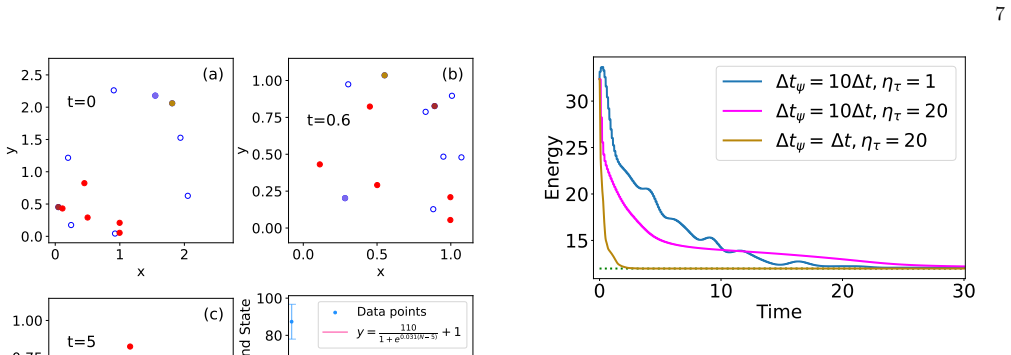
The central object is the canonical transformation, which introduces auxiliary real-valued oscillators $\tau_{ij}$ that encode the slack variables of the distance constraints, together with a complementary function $\Phi(\psi, \tau)$ whose stationary points coincide with those of the original energy. The dynamics are gradient descent and ascent on $\Phi$: $\dot{\tau}_{ij} = \sqrt{w_{ij}}(|\psi_i - \psi_j|^2 - d_{ij}^2) - \tfrac{1}{2}\tau_{ij}$ and $\dot{\psi}_i = \Gamma_i \psi_i + \sum_j \sqrt{w_{ij}} \tau_{ij} \psi_j$. The GBB method instead uses the gradient dynamics of the original energy with a feedback gain and an annealed distance matrix. The two enhancement techniques are asynchronous update (updating $\tau_{ij}$ more frequently than $\psi_i$) and steepened gradient (multiplying the $\tau$ right-hand side by $\eta_\tau > 1$), which rebalance the two time scales and eliminate chaotic fluctuations. The complex-number encoding of coordinates is what allows the problem to be realized on optical hardware.
What would settle it
Run the CT steepened-gradient method on distance matrices with known planted ground-truth coordinates plus controlled noise, and count a trial successful only if it reaches within $10^{-3}$ of the planted configuration's true energy; if success rates drop well below the reported near-100% median on these certified instances, the central claim would be refuted.
Extended reading notes
Core claim
The central discovery is that the nonconvex distance-based energy function $E = \sum_{ij} w_{ij}(\|x_i - x_j\|^2 - d_{ij}^2)^2$ can be mapped onto the phase and amplitude of coupled optical oscillators by writing each coordinate $x_i$ as $(R_i \cos\theta_i, R_i \sin\theta_i)$. The gradient dynamics of this energy are equivalent to a gain-dissipative oscillator network, and the paper shows by construction that both the canonical transformation dynamics and the gain-based bifurcation dynamics share the same fixed points as the original energy. In numerical tests on two-dimensional non-Euclidean distance matrices with anchors and binary weights, the CT method with steepened gradient and annealing reaches the ground state energy within tolerance $10^{-3}E_g$ in the vast majority of random trials, achieving a median success rate of 100% and fewer zero-success instances than GBB. The key new insight is that a two-time-scale mismatch between the auxiliary variables $\tau_{ij}$ and the primary variables $\psi_i$ is the cause of chaotic non-convergence, and that either slowing down $\psi$ updates or steepening the $\tau$ gradient can suppress it.
Load-bearing premise
The reported success rates assume that the lowest energy found by a standard local optimizer over 200 random initializations is the true global minimum of each test instance.
Editorial extensions
If this is right
- Distance-based problems such as wireless sensor network localization, social network visualization, market segmentation, protein structure determination, and molecular conformation can be mapped onto the same optical hardware already used for Ising and XY machines.
- The CT method with steepened gradient reaches the ground state energy within a small tolerance in a large fraction of random trials, with a median success rate near 100% for N=35 problems with anchors and binary weights.
- Asynchronous update and steepened gradient both resolve the two-time-scale instability that prevents convergence on noisy, non-Euclidean distance matrices, and either technique alone is sufficient.
- The GBB method with global or element-wise annealing also reaches high median success rates, though a substantial fraction of problem instances have zero success probability.
- Both methods extend naturally to three-dimensional distance-based problems by using two complex numbers per point, enabling the same optical implementation for 3D localization and structure determination.
Reading between the lines
- If the success-rate results transfer from simulation to physical hardware, a broad class of continuous-variable optimization problems beyond spin Hamiltonians would become practical on photonic platforms.
- The two-time-scale interpretation suggests a general principle: matching the update rates of auxiliary variables and primary variables could improve the convergence of other alternating or gradient-based solvers applied to nonconvex objectives.
- The observed decrease in average trials to ground state for large N on normalized distance matrices warns that normalizing distance matrices can compress the energy landscape and make local minima nearly indistinguishable, so evaluations on normalized problems should be treated cautiously.
- A testable extension is to apply the same CT and GBB dynamics to real protein NMR distance data and compare against alternating descent, which is the natural benchmark for 3D distance-based problems.
Editorial analysis
A structured set of objections, weighed in public.
Referee Report
Summary. The paper proposes a mapping from distance-based optimization problems, written as an s-stress energy over pairwise squared distances, onto coupled complex-valued oscillator fields, with the aim of solving them on optical hardware. Two dynamical schemes are developed: the gain-based bifurcation (GBB) method, which follows the gradient of the energy in a gain-dissipative form (Eq. 5), and the canonical transformation (CT) method, which introduces auxiliary real variables τij (Eq. 8) via a complementary function. Two enhancements to the CT method are introduced: asynchronous updates of τij and ψi, and a steepened-gradient factor ητ on the τij dynamics. Numerical experiments on two-dimensional wireless sensor network localization (SNL) instances, including non-Euclidean distance matrices, are reported; success-rate distributions are compared among CT, GBB, and gradient descent (Fig. 8), and runtime scaling is analyzed (Fig. 9).
Significance. If the numerical claims are upheld, the paper extends the reach of optical Ising/XY-style machines from standard spin Hamiltonians to a practically important class of continuous distance-based optimization problems, including sensor network localization and related applications. The derivation of the update equations from the energy function is coherent, the steepened-gradient modification preserves the fixed points, and the proposed asynchronous update is a sensible numerical remedy for the observed two-timescale behavior. The paper also gives a concrete, parameterized numerical protocol, which makes the simulations reproducible in principle. The main unresolved issue is the rigor of the benchmark: the reported near-100% success rates are measured against a ground-state proxy obtained by a local optimizer, not against certified global optima, and the method's dependence on hand-tuned annealing and steepening parameters is not quantified.
major comments (2)
- [Sec. IV D (Fig. 8 caption); Sec. IV B] The headline success-rate claim is benchmarked against an uncertified ground-state proxy. Fig. 8 defines success as reaching energy below 10^-3 Eg, where Eg is 'the minimum result obtained from SciPy's local optimizer over 100 random initializations,' and Sec. IV B states that 'we consider the energy obtained via the brute-force method as the ground state energy for general problem instances.' Since Eq. (2) is nonconvex and SNL is NP-hard for sparse graphs, a local optimizer with 100 or 200 restarts cannot certify the global minimum. If Eg overestimates the true global minimum, runs that reach the overestimated value are counted as successes, inflating the violin statistics in Fig. 8. This is load-bearing for the conclusion that CT and GBB 'effectively solve' the general problem; the authors should either benchmark on instances with certified optima (e.g., small cases solvable by exhaustive search, planted solutions with known lower bounds, or SDP-based bounds) or explicitly re-label the results as agreement with a local-search reference rather than global optimality.
- [Sec. IV B and Sec. IV D (Figs. 5, 6, 8, 9)] The near-100% success rates are achieved with hand-tuned parameters, and no rule is given for setting them on new instances. The steepened-gradient factor varies across experiments (ητ=50 in Fig. 6, ητ=100 in Fig. 5, ητ=10^3 in Fig. 8, and ητ=5.5×10^3 or 1.3×10^3 in Fig. 9), and the annealing constants c1, c2, c3, and ω in Fig. 5 are fixed without a selection protocol. Fig. 6(d) further shows that performance on the normalized problem behaves unexpectedly as N grows, with the average number of trials dropping rather than growing; the authors attribute this to the normalized energy landscape, but the accompanying logistic fit has essentially unconstrained parameters (a=110±120, c=5±65). Without a parameter-setting rule or a sensitivity analysis, the claim in Sec. V that 'both the CT and GBB methods can efficiently solve the general problem' is established only for the particular tuned configurations, not for the general problem class.
minor comments (5)
- [Fig. 2 caption; Sec. IV A vs Sec. IV B] The terminology for the reference energy is inconsistent: Fig. 2 refers to 'SciPy's global optimization solver,' while Sec. IV B and Fig. 4 refer to a local optimizer over 200 random initializations under the name 'brute-force method'; this distinction should be clarified and unified.
- [Sec. III, Eq. (7)] The statement that the energy (2) and the complementary function (7) have the same stationary points is a key structural claim; it should be justified by a short derivation or an explicit theorem statement from the canonical duality theory, rather than asserted in passing.
- [Sec. IV B, Fig. 6(d)] The logistic fit reported in Fig. 6(d) has very large uncertainties on all parameters (especially a=110±120 and c=5±65), making the fitted curve nearly uninformative; the authors should either provide confidence bands or remove the fit and discuss the data points directly.
- [Sec. IV D, Fig. 9] The runtime fits in Fig. 9 report different scaling exponents for single runs (b≈2.95) and batch runs (b≈1.84) of the same method; the discrepancy is not explained and should be discussed, since it bears on the claimed scalability.
- [Sec. III] The introduction of N×N additional OPO variables τij is an O(N^2) hardware overhead, which is a practical scalability concern for large N; the paper should explicitly discuss this overhead and its implications for the optical implementation.
Circularity Check
No circularity: the CT and GBB update equations are derived from the s-stress objective, and the unverified Eg baseline is a validation caveat rather than a circular reduction.
full rationale
The paper's derivation chain is self-contained rather than circular. For the GBB method, Eq. (5) is obtained by algebraically rearranging the negative gradient of the s-stress objective (2): substituting ξ_i = Σ_j w_ij d_ij^2, S_ij = w_ij |ψ_i − ψ_j|^2, and Q_ij = w_ij(|ψ_i − ψ_j|^2 − d_ij^2) makes the right-hand side exactly −∂E_2D/∂ψ_i^*, so no fitted quantity is renamed as a prediction. For the CT method, the τ_ij variables are introduced with the equilibrium condition (6), and the complementary function (7) is chosen so that at that equilibrium it coincides with E_2D; Eqs. (8a)-(8b) are the resulting ascent/descent dynamics. The statement that the energy and complementary function share stationary points is a mathematical duality property, not an input assumption equivalent to the target result. The asynchronous update and steepened gradient (Eq. (9)) preserve the same fixed points and only alter integration time scales, so they do not smuggle in the desired optimum. The hand-tuned annealing constants and η_τ are solver schedules, not separately predicted outputs. The main weakness, noted by the skeptics, is that the success-rate baseline Eg in Fig. 8 is taken as the minimum found by a SciPy local optimizer over 100 random initializations, which is not certified to be the global minimum. That is a benchmark-correctness concern, not a circular reduction: the method's equations do not depend on Eg for their derivation or update rules, and the reported success metric could in principle be beaten by finding lower energies. Self-citations such as Refs. [5], [12], [25], [27], and [28] appear in background and motivational statements and are not load-bearing for the distance-based derivation, so they do not raise the circularity score.
Assumptions & free parameters
free parameters (4)
- steepened gradient factor eta_tau =
10, 50, 100, 1000, 5.5e3, 1.3e3 depending on N
- annealing constants for CT =
c1=1.2, c2=pi/2, c3=0.75, omega=2
- GBB annealing parameters =
r in (0.1,2.0) or r fixed, omega_ij=2pi, P(t) linear
- success tolerance =
0.5% or 10^-3 Eg
assumptions (4)
- domain assumption Canonical duality theory provides a complementary function with the same stationary points as the original energy (Ref [46]).
- domain assumption Gain-based dynamics with annealing converge to global minima of the energy function (Refs [5,44,45]).
- domain assumption The random instances (D uniform in (0,1) or (0,10), W random binary) are representative of general SNL problems.
- ad hoc to paper SciPy's local optimizer over 200 random initializations yields a good estimate of the ground state energy Eg.
invented entities (1)
-
Degenerate optical parametric oscillator array for tau_ij
Cite this review
Pith. "Pith review of Solving Distance-Based Optimization Problems Using Optical Hardware." pith.science (2026). https://pith.science/paper/EKF27J7L
@misc{pith2026250711378,
  author       = {Pith},
  title        = {Pith review of: Solving Distance-Based Optimization Problems Using Optical Hardware},
  year         = {2026},
  howpublished = {\url{https://pith.science/paper/EKF27J7L}},
  note         = {Machine review of arXiv:2507.11378}
}
read the original abstract
We present a practical approach to solving distance-based optimization problems using optical computing hardware. The objective is to minimize an energy function defined as the weighted sum of squared differences between measured distances and the squared Euclidean distances of point coordinates. By representing coordinates as complex numbers, we map the optimization problem onto optical fields, enabling its solution through either the canonical transformation (CT) method or the gain-based bifurcation (GBB) method. To further enhance the performance of the CT method, we introduce two techniques: asynchronous update and steepened gradient. Both the CT and GBB methods can effectively solve the distance-based problem and are adaptable to various optical hardware platforms. Our optical implementation is inspired by recent progress in analog optical computing for combinatorial optimization, highlighting its promise for efficient and scalable problem-solving in high-dimensional settings.
Figures


Figures from the paper (5 more)



Reference graph
Works this paper leans on
-
[1]
C. Li, X. Zhang, J. Li, T. Fang, and X. Dong, The chal- lenges of modern computing and new opportunities for optics, PhotoniX 2, 20 (2021)
work page 2021
-
[2]
Stroev and N
N. Stroev and N. G. Berloff, Analog photonics computing for information processing, inference, and optimization, Advanced Quantum Technologies 6, 2300055 (2023)
2023
-
[3]
Mohseni, P
N. Mohseni, P. L. McMahon, and T. Byrnes, Ising ma- chines as hardware solvers of combinatorial optimization problems, Nature Reviews Physics 4, 363 (2022)
2022
-
[4]
S. H. Strogatz, Nonlinear Dynamics and Chaos: With Applications to Physics, Biology, Chemistry, and Engi- neering, 2nd ed. (CRC Press, Boca Raton, FL, 2015)
work page 2015
-
[5]
M. Syed and N. G. Berloff, Physics-enhanced bifurcation optimisers: All you need is a canonical complex network, IEEE Journal of Selected Topics in Quantum Electronics 29, 7400406 (2023)
work page 2023
-
[6]
J. M. R. Parrondo, J. M. Horowitz, and T. Sagawa, Thermodynamics of information, Nature Physics 11, 131 (2015)
2015
-
[7]
S. K. Vadlamani, T. P. Xiao, and E. Yablonovitch, 10 Physics successfully implements lagrange multiplier op- timization, Proceedings of the National Academy of Sci- ences of the United States of America 117, 26639 (2020)
work page 2020
-
[8]
R. P. Feynman, R. B. Leighton, and M. Sands,The Feyn- man Lectures on Physics, Volume II (Addison-Wesley, 1964)
work page 1964
Show all 48 references
-
[9]
H. Deng, H. Haug, and Y. Yamamoto, Exciton-polariton Bose-Einstein condensation, Rev. Mod. Phys. 82, 1489 (2010)
2010
-
[10]
Byrnes, N
T. Byrnes, N. Y. Kim, and Y. Yamamoto, Exci- ton–polariton condensates, Nature Physics 10, 803 (2014)
2014
-
[11]
Opala and M
A. Opala and M. Matuszewski, Harnessing exciton- polaritons for digital computing, neuromorphic comput- ing, and optimization (2023), arXiv:2306.06604
2023 arXiv
-
[12]
J. S. Cummins, H. Salman, and N. G. Berloff, Ising hamil- tonian minimization: Gain-based computing with mani- fold reduction of soft spins vs quantum annealing, Phys. Rev. Res. 7, 013150 (2025)
2025
-
[13]
Opala, S
A. Opala, S. Ghosh, T. C. Liew, and M. Matuszewski, Neuromorphic computing in Ginzburg-Landau polariton- lattice systems, Phys. Rev. Appl. 11, 064029 (2019)
2019
-
[14]
Sedov and A
E. Sedov and A. Kavokin, Polariton lattices as binarized neuromorphic networks, Light: Science & Applications 14, 52 (2025)
2025
-
[15]
P. L. McMahon, A. Marandi, Y. Haribara, R. Hamerly, C. Langrock, S. Tamate, T. Inagaki, H. Takesue, S. Utsunomiya, K. Aihara, R. L. Byer, M. M. Fejer, H. Mabuchi, and Y. Yamamoto, A fully programmable 100-spin coherent Ising machine with all-to-all connec- tions, Science 354, ...
2016
-
[16]
Yamamoto, T
Y. Yamamoto, T. Leleu, S. Ganguli, and H. Mabuchi, Co- herent Ising machines—quantum optics and neural net- work perspectives, Applied Physics Letters 117, 160501 (2020)
2020
-
[17]
Y. Gao, G. Chen, L. Qi, W. Fu, Z. Yuan, and A. J. Danner, Photonic Ising machines for combinatorial opti- mization problems, Applied Physics Reviews 11, 041307 (2024)
2024
-
[18]
B. J. Shastri, A. N. Tait, T. F. de Lima, W. H. P. Pernice, H. Bhaskaran, C. D. Wright, and P. R. Prucnal, Photon- ics for artificial intelligence and neuromorphic comput- ing, Nature Photonics 15, 102 (2021)
2021
-
[19]
J. Wu, X. Lin, Y. Guo, J. Liu, L. Fang, S. Jiao, and Q. Dai, Analog optical computing for artificial intelli- gence, Engineering 10, 133 (2022)
2022
-
[20]
Prabhu, C
M. Prabhu, C. Roques-Carmes, Y. Shen, N. Har- ris, L. Jing, J. Carolan, R. Hamerly, T. Baehr-Jones, M. Hochberg, V. ˇCeperi´ c, J. D. Joannopoulos, D. R. Englund, and M. Soljaˇ ci´ c, Accelerating recurrent Ising machines in photonic integrated circuits, Optica 7, 551 (2020)
2020
-
[21]
N. G. Berloff, M. Silva, K. Kalinin, A. Askitopoulos, J. D. T¨ opfer, P. Cilibrizzi, W. Langbein, and P. G. Lagoudakis, Realizing the classical XY Hamiltonian in polariton sim- ulators, Nature Materials 16, 1120 (2017)
2017
-
[22]
K. Peng, W. Li, N. G. Berloff, X. Zhang, and W. Bao, Room temperature polaritonic soft-spin XY Hamiltonian in organic–inorganic halide perovskites, Nanophotonics 13, 2651 (2024)
2024
-
[23]
Zhang, Perturbative study of the one-dimensional quantum clock model, Phys
B. Zhang, Perturbative study of the one-dimensional quantum clock model, Phys. Rev. E 102, 042110 (2020)
2020
-
[24]
Bairey, I
E. Bairey, I. Arad, and N. H. Lindner, Learning a local Hamiltonian from local measurements, Phys. Rev. Lett. 122, 020504 (2019)
2019
-
[25]
K. P. Kalinin, G. Mourgias-Alexandris, H. Ballani, N. G. Berloff, J. H. Clegg, D. Cletheroe, C. Gkant- sidis, I. Haller, V. Lyutsarev, F. Parmigiani, L. Pickup, and A. Rowstron, Analog iterative machine (AIM): Us- ing light to solve quadratic optimization problems with mixed v...
2023 arXiv
-
[26]
Khosravi, U
F. Khosravi, U. Yildiz, A. Scherer, and P. Ronagh, Non- convex quadratic programming using coherent optical networks (2023), arXiv:2209.04415
2023 arXiv
-
[27]
Kamaletdinov and N
A. Kamaletdinov and N. G. Berloff, Coupling light with matter for identifying dominant subnetworks (2024), arXiv:2405.17296
2024
-
[28]
R. Z. Wang, J. S. Cummins, M. Syed, N. Stroev, G. Pas- tras, J. Sakellariou, S. Tsintzos, A. Askitopoulos, D. Ve- raldi, M. Calvanese Strinati, S. Gentilini, D. Pierangeli, C. Conti, and N. G. Berloff, Efficient computation using spatial-photonic Ising machines with low-rank a...
2025
-
[29]
Dokmani´ c, R
I. Dokmani´ c, R. Parhizkar, J. Ranieri, and M. Vet- terli, Euclidean distance matrices: Essential theory, algo- rithms, and applications, IEEE Signal Processing Maga- zine 32, 12 (2015)
2015
-
[30]
Liberti, C
L. Liberti, C. Lavor, N. Maculan, and A. Mucherino, Eu- clidean distance geometry and applications, SIAM Re- view 56, 3 (2014)
2014
-
[31]
Aspnes, T
J. Aspnes, T. Eren, D. Goldenberg, A. Morse, W. White- ley, Y. Yang, B. Anderson, and P. Belhumeur, A theory of network localization, IEEE Transactions on Mobile Com- puting 5, 1663 (2006)
2006
-
[32]
Aspnes, D
J. Aspnes, D. Goldenberg, and Y. R. Yang, On the com- putational complexity of sensor network localization, in Algorithmic Aspects of Wireless Sensor Networks , edited by S. E. Nikoletseas and J. D. P. Rolim (Springer Berlin Heidelberg, Berlin, Heidelberg, 2004) pp. 32–44
2004
-
[33]
Tabassum, F
S. Tabassum, F. S. F. Pereira, S. Fernandes, and J. Gama, Social network analysis: An overview, WIREs Data Mining and Knowledge Discovery 8, e1256 (2018)
2018
-
[34]
E. K. Foedermayr and A. D. and, Market segmentation in practice: Review of empirical studies, methodological assessment, and agenda for future research, Journal of Strategic Marketing 16, 223 (2008)
2008
-
[35]
Huang, L
B. Huang, L. Kong, C. Wang, F. Ju, Q. Zhang, J. Zhu, T. Gong, H. Zhang, C. Yu, W.-M. Zheng, and D. Bu, Protein structure prediction: Challenges, advances, and the shift of research paradigms, Genomics, Proteomics and Bioinformatics 21, 913 (2023)
2023
-
[36]
D. C. Elton, Z. Boukouvalas, M. D. Fuge, and P. W. Chung, Deep learning for molecular design—a review of the state of the art, Molecular Systems Design and En- gineering 4, 828 (2019)
2019
-
[37]
Wuestefeld, S
A. Wuestefeld, S. M. Greve, S. P. N¨ asholm, and V. Oye, Benchmarking earthquake location algorithms: A syn- thetic comparison, GEOPHYSICS 83, KS35 (2018)
2018
-
[38]
Strang, Linear Algebra and Learning from Data(Cam- bridge University Press, 2019)
G. Strang, Linear Algebra and Learning from Data(Cam- bridge University Press, 2019)
2019
-
[39]
Parhizkar, Euclidean Distance Matrices: Properties, Algorithms and Applications , Ph.D
R. Parhizkar, Euclidean Distance Matrices: Properties, Algorithms and Applications , Ph.D. thesis, EPFL, Lau- sanne (2013)
2013
-
[40]
Biswas, T.-C
P. Biswas, T.-C. Liang, K.-C. Toh, Y. Ye, and T.-C. Wang, Semidefinite programming approaches for sensor network localization with noisy distance measurements, IEEE Transactions on Automation Science and Engineer- 11 ing 3, 360 (2006)
2006
-
[41]
Yadav and S
P. Yadav and S. C. Sharma, A systematic review of lo- calization in wsn: Machine learning and optimization- based approaches, International Journal of Communica- tion Systems 36, e5397 (2023)
2023
-
[42]
Pierangeli, M
D. Pierangeli, M. Rafayelyan, C. Conti, and S. Gigan, Scalable spin-glass optical simulator, Phys. Rev. Appl. 15, 034087 (2021)
2021
-
[43]
P. G. Lagoudakis and N. G. Berloff, A polariton graph simulator, New Journal of Physics 19, 125008 (2017)
2017
-
[44]
K. P. Kalinin and N. G. Berloff, Networks of non- equilibrium condensates for global optimization, New Journal of Physics 20, 113023 (2018)
2018
-
[45]
K. P. Kalinin and N. G. Berloff, Global optimization of spin Hamiltonians with gain-dissipative systems, Scien- tific Reports 8, 17791 (2018)
2018
-
[46]
D. Y. Gao, V. Latorre, and N. Ruan, Canonical Duality Theory: Unified Methodology for Multidisciplinary Study (Springer Cham, 2017)
2017
-
[47]
G. Xu, G. Chen, Y. Hong, B. Fidan, T. Parisini, and K. H. Johansson, Global solution to sensor network lo- calization: A non-convex potential game approach and its distributed implementation (2024), arXiv:2401.02471
2024 arXiv
-
[48]
T. H. Cormen, C. E. Leiserson, R. L. Rivest, and C. Stein, Introduction to Algorithms , 3rd ed. (The MIT Press, Cambridge, MA, 2009)
2009
Reviewed August 6, 2026 · model on record in the stance chip above.
Discussion (0). Sign in to comment.