REVIEW 2 major objections 6 minor 62 references
REVA: Supporting LLM-Generated Programming Feedback Validation at Scale Through User Attention-based Adaptation
T0 review · 2 major / 6 minor · reviewed 2026-08-06 · deepseek-v4-flash
Pith's one-line read REVA helps instructors review AI-generated programming feedback with better misconception coverage and less context switching.
desk verdict A real systems contribution with a well-designed study, but the headline quality numbers rest on an annotation process that needs more transparency before the claim is taken at face value. read the letter →
The pith
A machine-rendered reading of the paper's core claim, the machinery that carries it, and where it could break.
The reading
What carries the argument
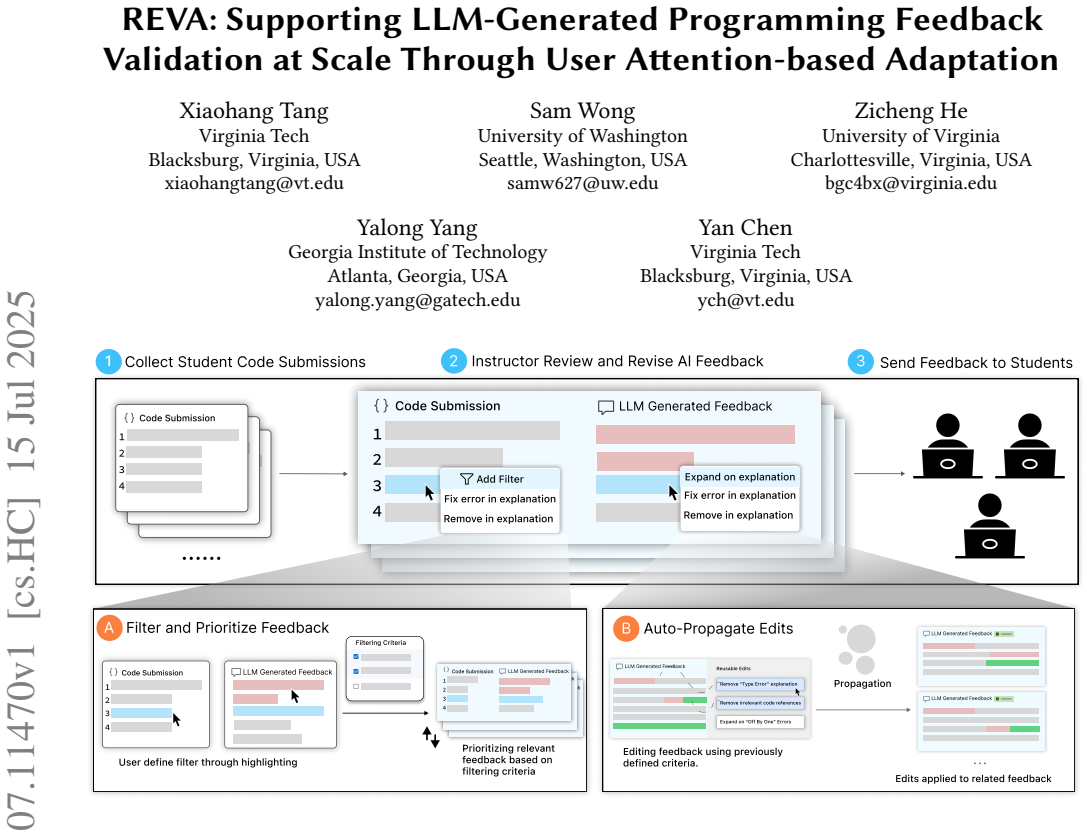
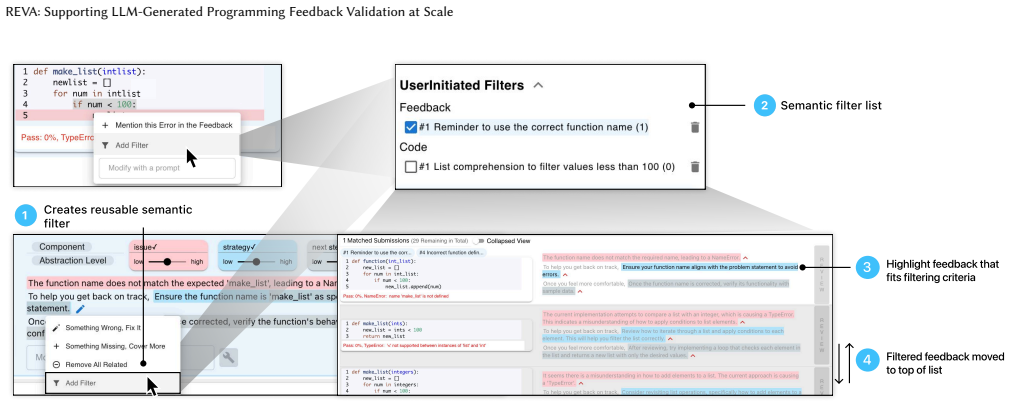
The carrying mechanism is attention-based adaptation, defined as dynamically reshaping the review workflow from implicit signals of instructor focus. Concretely, REVA's two load-bearing components are user-initiated semantic filters, which convert highlighted code or feedback into an LLM-generated filter that reorders and highlights upcoming submissions, and revision propagation, which extracts a revision goal from an accepted edit, matches semantically similar code-feedback pairs, and proposes adapted revisions for human verification. The system's assumption is that semantic repetition in student submissions is high enough that these matches are useful; an off-the-shelf large language model does the interpretation and matching.
What would settle it
Have independent annotators who are blind to the study condition and to the design team code all 475 code-feedback pairs for misconception ground truth and feedback coverage, require a reported inter-rater agreement such as Cohen's kappa above 0.8, and recompute the recall, precision, and quality comparisons; the central claim collapses if the REVA-vs-baseline differences no longer reach significance.
Extended reading notes
Core claim
On the paper's own terms, the discovery is that user attention, expressed through ordinary highlighting and editing actions, is a reliable signal for adapting a validation workflow. REVA captures this signal in two features: semantic filters, which an instructor creates by highlighting a problematic code segment or feedback phrase and which reorder the remaining submissions so similar issues are reviewed together; and revision propagation, which takes an accepted edit, extracts its goal, matches code and feedback patterns in upcoming submissions, and proposes adapted versions that the instructor can accept or reject. In the study, these features produced significantly higher misconception-coverage precision and recall, better overall feedback quality scores, more revisions per session, and lower reaction time when starting to validate a new code-feedback pair (18.69 vs 29.77 seconds), with no significant increase in validation time per pair.
Load-bearing premise
The quality gains rest on the assumption that the two researchers' hand-coded misconception ground truth and quality scores are valid, but no inter-rater reliability statistic is reported, the coders are on the design team, and only 89 of 475 feedback pairs (about 18%) were scored.
Editorial extensions
If this is right
- Instructors can validate roughly the same number of feedback items per session while cutting the time spent before first action on each item, making it feasible to review feedback for larger course sections.
- Accepted edits propagate to similar submissions, shifting instructor effort from repeating the same fix to spotting misconceptions the system hasn't caught.
- The higher recall and precision of misconception coverage mean students are less likely to receive feedback that misses their actual error or includes irrelevant points.
- Lower perceived mental demand and sustained revision engagement across a session suggest the approach reduces the fatigue that makes long validation sessions impractical.
- Quality gains do not come at the cost of speed, since per-item validation time did not significantly increase.
Reading between the lines
- If the mechanism generalizes, the filter-plus-propagation pattern could be tested in other high-volume human review of LLM output, such as essay grading, legal document review, or clinical note auditing, where a reviewer validates many similar drafts; this is an extrapolation, not a study result.
- Because the study measured instructor-side quality rather than student learning, a field deployment comparing student outcomes with and without REVA-validated feedback would be the natural next test.
- The 20-minute lab sessions may understate the benefit in real grading marathons, where fatigue and context-switch costs accumulate; a longer field study is needed to see whether the engagement effect persists.
- Using highlighting as an implicit priority signal could be adopted more broadly as a low-cost way to adapt AI workflows without explicit user configuration.
Editorial analysis
A structured set of objections, weighed in public.
Referee Report
Summary. The paper presents REVA, a human-AI system that supports instructors in reviewing and revising large volumes of LLM-generated programming feedback. REVA contributes two core mechanisms: attention-based semantic filtering and queue reordering, and automatic propagation of instructor revisions to semantically similar code-feedback pairs. The authors report a formative study (N=20) that motivates three design goals, and a within-subjects lab study (N=12) comparing REVA against a baseline without semantic filtering and propagation. The main quantitative claims are that REVA significantly increases the number of revisions, reduces reaction time to first action, and improves misconception-coverage precision (0.90 vs. 0.71), recall (0.86 vs. 0.55), and overall feedback quality (0.34 vs. 0.04), as summarized in Table 2. The paper concludes that REVA significantly improves both the efficiency and quality of feedback review and revision compared with the baseline.
Significance. If the main results are trustworthy, REVA addresses a real and timely bottleneck: enabling instructors to validate AI-generated programming feedback at scale without sacrificing quality. The study has notable strengths: it uses real student code submissions, a counterbalanced within-subjects design, a baseline that isolates the two novel features, and descriptive statistics for all NASA-TLX items. The reported effect sizes for precision and recall are large, and the system contribution is well motivated by the formative findings on context switching and revision reuse. The principal weakness is not the system design but the measurement of feedback quality: the ground-truth annotation is produced by two members of the research team with no reported inter-rater reliability or blinding, which places the central quality claim at risk. The paper does not contain mathematical derivations or fitted parameters, so the usual circularity concerns are absent; the concern is instead about the validity and independence of the outcome measure.
major comments (2)
- [§7, Table 2] The central quality claim rests on the precision/recall/overall-quality comparisons in Table 2, but the ground-truth annotation is not yet shown to be reliable or unbiased. The manuscript reports that two researchers annotated misconception types and coded feedback coverage, but it does not report an inter-rater reliability statistic (e.g., Cohen's kappa for misconception annotation, coverage coding, or the -1/0/1 quality scale), despite citing reliability norms [37]. It also does not state whether the coders were blind to condition or whether the misconception taxonomy was independently validated. This is load-bearing because REVA's propagation mechanism inserts instructor-revised misconception text into subsequent feedback; if coders were not blind, they could count system-inserted content as coverage and thereby inflate the recall and precision gaps. The limitations section (8.4) does not acknowledge this measurement threat. Please report IRR, describe coder training and independence, state whether coders were blind, and provide an external validation or third-coder check of the misconception ground truth.
- [§7, reaction-time analysis] The efficiency claim relies in part on the reaction-time result, but the metric as defined is confounded by the propagation feature. Reaction time is defined as the time before performing the first concrete action when validating a new feedback pair. In REVA, propagated revision suggestions are already displayed when the participant opens a propagated pair (Section 5.2.5), so the first concrete action can be accepting a system-generated suggestion rather than an instructor-initiated sensemaking action. The lower reaction time may therefore reflect system initiative rather than reduced context-switching cost. Please report the distribution of first-action types (e.g., accept propagation vs. edit vs. filter creation), or use a metric such as time to first independent edit, to separate these accounts.
minor comments (6)
- [§1, §5.2.1, §5.2.3, §8.2] Typos and wording: 'An novel system' should be 'A novel system'; 'maximum feedback's impact' should be 'maximize feedback's impact'; 'Based on the our observed' should be 'Based on our observed'; 'participatns' should be 'participants'.
- [Table 1] The TLX table reports medians and means but no inferential statistics; if no hypothesis tests were run for these items, say so explicitly, and avoid framing the qualitative observation that participants 'perceived low levels' as a comparative result.
- [§7] The overall quality score is a three-level ordinal scale (-1/0/1) but is analyzed with a t-test on means; consider a mixed-effects model or nonparametric test that accounts for repeated measures and the bounded, ordinal nature of the outcome, and report effect sizes or confidence intervals.
- [§7] The paper runs many outcome tests (TLX dimensions, revision counts, precision, recall, quality, reaction time) without any multiple-comparison correction; report adjusted p-values or justify the planned family of tests.
- [§7] The sentence 'we sampled 89 out of 475 (Around 18% coverage)' should be edited for grammar and capitalization, and the paper should clarify whether the 89 pairs are unique code-feedback pairs or pair-participant observations.
- [§3.3.1] The formative study also reports that 'two researchers independently annotated' feedback quality without an inter-rater reliability statistic; since this classification informs the design goals, please report agreement there as well.
Circularity Check
No circularity: REVA's claims rest on an empirical within-subjects study with externally annotated ground truth, not on a self-referential derivation.
full rationale
REVA does not present a formal derivation or fitted model; its central claims are empirical comparisons of instructor behavior and output quality in a within-subjects study. The precision/recall/quality metrics in Table 2 are computed against a misconception ground truth that was annotated independently of the system's outputs (Section 7: "we annotated misconception types for each code, and used it as the ground truth for issue coverage"), with the sampled pairs randomly shuffled before feedback annotation. Although the two researchers who coded the data are part of the research team and no inter-rater reliability statistic is reported, that is a measurement-validation threat rather than circular reasoning: the ground truth labels are not defined in terms of REVA's outputs, the study was not used to fit any parameter, and there is no equation or definitional chain that makes the outcome equal to the input. The authors' self-citations in the related-work sections are contextual and not load-bearing for the evaluation. REVA's propagation mechanism can inflate revision counts or content coverage by reusing instructor edits, but that is the intervention being tested, and its value is judged by instructor acceptance and by the independently defined misconception taxonomy. The central claims therefore have independent empirical content; concerns about annotation reliability, blinding, and the 18% sample belong under correctness risk, not circularity.
Assumptions & free parameters
assumptions (4)
- domain assumption Task-switching costs generalize to programming feedback review.
- domain assumption LLM-generated feedback is unreliable enough to require instructor validation.
- domain assumption Semantic repetition in code-feedback pairs can be detected reliably by off-the-shelf LLMs and embeddings.
- domain assumption The two researchers' misconception annotations are an accurate ground truth.
Cite this review
Pith. "Pith review of REVA: Supporting LLM-Generated Programming Feedback Validation at Scale Through User Attention-based Adaptation." pith.science (2026). https://pith.science/paper/CMIKR6YV
@misc{pith2026250711470,
  author       = {Pith},
  title        = {Pith review of: REVA: Supporting LLM-Generated Programming Feedback Validation at Scale Through User Attention-based Adaptation},
  year         = {2026},
  howpublished = {\url{https://pith.science/paper/CMIKR6YV}},
  note         = {Machine review of arXiv:2507.11470}
}
read the original abstract
This paper introduces REVA, a human-AI system that expedites instructor review of voluminous AI-generated programming feedback by sequencing submissions to minimize cognitive context shifts and propagating instructor-driven revisions across semantically similar instances. REVA introduces a novel approach to human-AI collaboration in educational feedback by adaptively learning from instructors' attention in the review and revision process to continuously improve the feedback validation process. REVA's usefulness and effectiveness in improving feedback quality and the overall feedback review process were evaluated through a within-subjects lab study with 12 participants.
Figures


Figures from the paper (6 more)




Reference graph
Works this paper leans on
-
[37]
Nora McDonald, Sarita Schoenebeck, and Andrea Forte. 2019. Reliability and Inter-rater Reliability in Qualitative Research: Norms and Guidelines for CSCW and HCI Practice. Proc. ACM Hum.-Comput. Interact. 3, CSCW, Article 72 (nov 2019), 23 pages. doi:10.1145/3359174
doi:10.1145/3359174 2019
-
[1]
Ian Arawjo, Chelse Swoopes, Priyan Vaithilingam, Martin Wattenberg, and Elena L Glassman. 2024. Chainforge: A visual toolkit for prompt engineering and llm hypothesis testing. In Proceedings of the 2024 CHI Conference on Human Factors in Computing Systems . 1–18
work page 2024
-
[2]
Ebrahim Babaei, Tilman Dingler, Benjamin Tag, and Eduardo Velloso. 2025. Should we use the NASA-TLX in HCI? A review of theoretical and methodological issues around Mental Workload Measurement. International Journal of Human- Computer Studies (2025), 103515
work page 2025
-
[3]
Brian P Bailey and Shamsi T Iqbal. 2008. Understanding changes in mental work- load during execution of goal-directed tasks and its application for interruption management. ACM Transactions on Computer-Human Interaction (TOCHI) 14, 4 (2008), 1–28
work page 2008
-
[4]
Bender, Timnit Gebru, Angelina McMillan-Major, and Shmargaret Shmitchell
Emily M. Bender, Timnit Gebru, Angelina McMillan-Major, and Shmargaret Shmitchell. 2021. On the Dangers of Stochastic Parrots: Can Language Models Be Too Big? Proceedings of the 2021 ACM Conference on Fairness, Accountability, and Transparency (2021). https://api.semanticscholar.org/CorpusID:262580630
work page 2021
-
[5]
Bernstein, Greg Little, Robert C
Michael S. Bernstein, Greg Little, Robert C. Miller, Björn Hartmann, Mark S. Ackerman, David R. Karger, David Crowell, and Katrina Panovich. 2010. Soylent: a word processor with a crowd inside. In Proceedings of the 23nd Annual ACM Symposium on User Interface Software and Technology (New York, New York, USA) (UIST ’10). Association for Computing Machinery...
arXiv 2010
-
[6]
Jelmer P Borst, Niels A Taatgen, and Hedderik van Rijn. 2015. What makes interruptions disruptive? A process-model account of the effects of the problem state bottleneck on task interruption and resumption. In Proceedings of the 33rd annual ACM conference on human factors in computing systems . 2971–2980
work page 2015
-
[7]
Tom Brown, Benjamin Mann, Nick Ryder, Melanie Subbiah, Jared D Kaplan, Prafulla Dhariwal, Arvind Neelakantan, Pranav Shyam, Girish Sastry, Amanda Askell, Sandhini Agarwal, Ariel Herbert-Voss, Gretchen Krueger, Tom Henighan, Rewon Child, Aditya Ramesh, Daniel Ziegler, Jeffrey Wu, Clemens Winter, Chris Hesse, Mark Chen, Eric Sigler, Mateusz Litwin, Scott Gr...
2020
Show all 62 references
-
[8]
Deborah L Butler and Philip H Winne. 1995. Feedback and self-regulated learning: A theoretical synthesis. Review of educational research 65, 3 (1995), 245–281
1995
-
[9]
Çiğdem Suzan Çardak and Kıymet Selvi. 2016. Increasing teacher candidates’ ways of interaction and levels of learning through action research in a blended course. Computers in Human Behavior 61 (2016), 488–506
2016
-
[10]
Yan Chen, Jaylin Herskovitz, Gabriel Matute, April Wang, Sang Won Lee, Walter S Lasecki, and Steve Oney. 2020. EdCode: Towards Personalized Support at Scale for Remote Assistance in CS Education. In2020 IEEE Symposium on Visual Languages and Human-Centric Computing (VL/HCC) . ...
2020
-
[11]
Anna Comas-Quinn. 2011. Learning to teach online or learning to become an online teacher: An exploration of teachers’ experiences in a blended learning course. ReCALL 23, 3 (2011), 218–232
2011
-
[12]
Allen Cypher and Daniel Conrad Halbert. 1993. Watch what I do: programming by demonstration. MIT press
1993
-
[13]
Iria Estévez-Ayres, Patricia Callejo, Miguel Ángel Hombrados-Herrera, Carlos Alario-Hoyos, and Carlos Delgado Kloos. 2024. Evaluation of LLM Tools for Feedback Generation in a Course on Concurrent Programming. International Journal of Artificial Intelligence in Education (2024), 1–17
2024
-
[14]
Hagit Gabbay and Anat Cohen. 2024. Combining LLM-Generated and Test- Based Feedback in a MOOC for Programming. In Proceedings of the Eleventh ACM Conference on Learning@ Scale . 177–187
2024
-
[16]
Kummerfeld, and Elena L
Katy Ilonka Gero, Chelse Swoopes, Ziwei Gu, Jonathan K. Kummerfeld, and Elena L. Glassman. 2024. Supporting Sensemaking of Large Language Model Outputs at Scale. In Proceedings of the CHI Conference on Human Factors in Computing Systems (Honolulu, HI, USA) (CHI ’24). Associati...
2024 doi
-
[17]
Elena L Glassman, Jeremy Scott, Rishabh Singh, Philip J Guo, and Robert C Miller
-
[18]
Elena L Glassman, Tianyi Zhang, Björn Hartmann, and Miryung Kim. 2018. Visualizing API usage examples at scale. InProceedings of the 2018 CHI Conference on Human Factors in Computing Systems . 1–12
2018
-
[19]
Kummerfeld, and Elena L
Ziwei Gu, Ian Arawjo, Kenneth Li, Jonathan K. Kummerfeld, and Elena L. Glass- man. 2024. An AI-Resilient Text Rendering Technique for Reading and Skimming Documents. In Proceedings of the 2024 CHI Conference on Human Factors in Com- puting Systems (Honolulu, HI, USA) (CHI ’24)...
2024
-
[20]
Sumit Gulwani. 2011. Automating string processing in spreadsheets using input- output examples. ACM Sigplan Notices 46, 1 (2011), 317–330
2011
-
[21]
John Hattie. 2012. Visible learning for teachers: Maximizing impact on learning . Routledge
2012
-
[22]
John Hattie and Helen Timperley. 2007. The power of feedback. Review of educational research 77, 1 (2007), 81–112
2007
-
[23]
Andrew Head, Elena Glassman, Gustavo Soares, Ryo Suzuki, Lucas Figueredo, Loris D’Antoni, and Björn Hartmann. 2017. Writing reusable code feedback at scale with mixed-initiative program synthesis. In Proceedings of the Fourth (2017) ACM Conference on Learning@ Scale (Cambridge...
2017
-
[24]
Lei Huang, Weijiang Yu, Weitao Ma, Weihong Zhong, Zhangyin Feng, Haotian Wang, Qianglong Chen, Weihua Peng, Xiaocheng Feng, Bing Qin, and Ting Liu. 2023. A Survey on Hallucination in Large Language Models: Principles, Taxonomy, Challenges, and Open Questions. arXiv:2311.05232 ...
2023 arXiv
-
[25]
Lucas Jasper Jacobsen, Jonathan Rohlmann, and Kira Elena Weber. 2025. AI Feedback in Education: The Impact of Prompt Design and Human Expertise on LLM Performance. (2025)
2025
-
[26]
Peiling Jiang, Jude Rayan, Steven P Dow, and Haijun Xia. 2023. Graphologue: Exploring large language model responses with interactive diagrams. In Proceed- ings of the 36th annual ACM symposium on user interface software and technology . 1–20
2023
-
[27]
Hita Kambhamettu, Jamie Flores, and Andrew Head. 2024. Traceable Text: Deepening Reading of AI-Generated Summaries with Phrase-Level Provenance REV A: Supporting LLM-Generated Programming Feedback Validation at Scale Links. arXiv preprint arXiv:2409.13099 (2024)
2024 arXiv
-
[28]
Sean Kandel, Andreas Paepcke, Joseph Hellerstein, and Jeffrey Heer. 2011. Wran- gler: interactive visual specification of data transformation scripts. InProceedings of the SIGCHI Conference on Human Factors in Computing Systems (Vancouver, BC, Canada) (CHI ’11). Association fo...
2011
-
[29]
Onur Karademir, Atezaz Ahmad, Jan Schneider, Daniele Di Mitri, Ioana Jivet, and Hendrik Drachsler. 2021. Designing the Learning Analytics Cockpit - A Dashboard that Enables Interventions. In Methodologies and Intelligent Systems for Technology Enhanced Learning, 11th Internati...
2021
-
[30]
Nguyen, Alfie Abdul-Rahman, Benjamin Bach, Min Chen, Euan Freeman, and Cagatay Turkay
Saiful Khan, Phong H. Nguyen, Alfie Abdul-Rahman, Benjamin Bach, Min Chen, Euan Freeman, and Cagatay Turkay. 2022. Propagating Visual Designs to Nu- merous Plots and Dashboards. IEEE Transactions on Visualization and Computer Graphics 28, 1 (2022), 86–95. doi:10.1109/TVCG.2021.3114828
2022
-
[31]
Tae Soo Kim, Yoonjoo Lee, Jamin Shin, Young-Ho Kim, and Juho Kim. 2024. Evallm: Interactive evaluation of large language model prompts on user-defined criteria. In Proceedings of the 2024 CHI Conference on Human Factors in Computing Systems. 1–21
2024
-
[32]
Thomas Kosch, Jakob Karolus, Johannes Zagermann, Harald Reiterer, Albrecht Schmidt, and Paweł W. Woźniak. 2023. A Survey on Measuring Cognitive Workload in Human-Computer Interaction. ACM Comput. Surv. 55, 13s, Article 283 (July 2023), 39 pages. doi:10.1145/3582272
2023 doi
-
[33]
Philippe Laban, Jesse Vig, Marti Hearst, Caiming Xiong, and Chien-Sheng Wu
-
[34]
Henry Lieberman. 2001. Your wish is my command: Programming by example . Elsevier
2001
-
[35]
Alan Lundgard and Arvind Satyanarayan. 2022. Accessible Visualization via Natural Language Descriptions: A Four-Level Model of Semantic Content. IEEE Transactions on Visualization and Computer Graphics 28, 1 (2022), 1073–1083. doi:10.1109/TVCG.2021.3114770
2022
-
[36]
Stephen MacNeil, Andrew Tran, Dan Mogil, Seth Bernstein, Erin Ross, and Ziheng Huang. 2022. Generating diverse code explanations using the gpt-3 large language model. In Proceedings of the 2022 ACM conference on international computing education research-volume 2 . 37–39
2022
-
[38]
Bryan Min and Haijun Xia. 2025. Feedforward in Generative AI: Opportunities for a Design Space. arXiv preprint arXiv:2502.14229 (2025)
2025 arXiv
-
[39]
Stephen Monsell. 2003. Task switching. Trends in cognitive sciences 7, 3 (2003), 134–140
2003
-
[40]
Daye Nam, Andrew Macvean, Vincent Hellendoorn, Bogdan Vasilescu, and Brad Myers. 2024. Using an llm to help with code understanding. In Proceedings of the IEEE/ACM 46th International Conference on Software Engineering . 1–13
2024
-
[41]
Sydney Nguyen, Hannah McLean Babe, Yangtian Zi, Arjun Guha, Carolyn Jane Anderson, and Molly Q Feldman. 2024. How Beginning Programmers and Code LLMs (Mis) read Each Other. In Proceedings of the CHI Conference on Human Factors in Computing Systems . 1–26
2024
-
[42]
Bernstein
Joon Sung Park, Joseph O’Brien, Carrie Jun Cai, Meredith Ringel Morris, Percy Liang, and Michael S. Bernstein. 2023. Generative Agents: Interactive Simulacra of Human Behavior. In Proceedings of the 36th Annual ACM Symposium on User Interface Software and Technology (San Franc...
2023
-
[43]
Tung Phung, Victor-Alexandru Pădurean, Anjali Singh, Christopher Brooks, José Cambronero, Sumit Gulwani, Adish Singla, and Gustavo Soares. 2024. Au- tomating Human Tutor-Style Programming Feedback: Leveraging GPT-4 Tutor Model for Hint Generation and GPT-3.5 Student Model for ...
2024
-
[44]
Peter Pirolli and Stuart Card. 1999. Information foraging. Psychological review 106, 4 (1999), 643
1999
-
[45]
Shashank Sonkar, Kangqi Ni, Sapana Chaudhary, and Richard G Baraniuk. 2024. Pedagogical alignment of large language models. arXiv preprint arXiv:2402.05000 (2024)
2024 arXiv
-
[46]
Pragnya Sridhar, Aidan Doyle, Arav Agarwal, Chris Bogart, Jaromir Savelka, and Majd F. Sakr. 2023. Harnessing LLMs in Curricular Design: Using GPT- 4 to Support Authoring of Learning Objectives. In LLM@AIED. https://api. semanticscholar.org/CorpusID:259308858
2023
-
[47]
Sangho Suh, Bryan Min, Srishti Palani, and Haijun Xia. 2023. Sensecape: En- abling multilevel exploration and sensemaking with large language models. In Proceedings of the 36th annual ACM symposium on user interface software and technology. 1–18
2023
-
[48]
Wannapon Suraworachet, Jennifer Seon, and Mutlu Cukurova. 2024. Pre- dicting challenge moments from students’ discourse: A comparison of GPT- 4 to two traditional natural language processing approaches. In Proceedings of the 14th Learning Analytics and Knowledge Conference (Ky...
2024
-
[49]
Xiaohang Tang, Sam Wong, Kevin Pu, Xi Chen, Yalong Yang, and Yan Chen. 2024. VizGroup: An AI-assisted Event-driven System for Collaborative Programming Learning Analytics. In Proceedings of the 37th Annual ACM Symposium on User Interface Software and Technology (Pittsburgh, PA...
2024
-
[50]
Janneke Van de Pol, Monique Volman, and Jos Beishuizen. 2010. Scaffolding in teacher–student interaction: A decade of research. Educational psychology review 22 (2010), 271–296
2010
-
[51]
April Yi Wang, Yan Chen, John Joon Young Chung, Christopher Brooks, and Steve Oney. 2021. PuzzleMe: Leveraging Peer Assessment for In-Class Programming Exercises. Proceedings of the ACM on Human-Computer Interaction 5, CSCW2 (2021), 1–24
2021
-
[52]
Theodora Worledge, Tatsunori Hashimoto, and Carlos Guestrin. 2024. The Extractive-Abstractive Spectrum: Uncovering Verifiability Trade-offs in LLM Generations. arXiv preprint arXiv:2411.17375 (2024)
2024 arXiv
-
[53]
Shaffer, and Yan Chen
Tong Wu, Xiaohang Tang, Sam Wong, Xi Chen, Clifford A. Shaffer, and Yan Chen
-
[54]
Tongshuang Wu, Michael Terry, and Carrie Jun Cai. 2022. AI Chains: Transpar- ent and Controllable Human-AI Interaction by Chaining Large Language Model Prompts. In Proceedings of the 2022 CHI Conference on Human Factors in Comput- ing Systems (New Orleans, LA, USA) (CHI ’22). ...
2022
-
[55]
switch costs
Glenn Wylie and Alan Allport. 2000. Task switching and the measurement of “switch costs”. Psychological research 63 (2000), 212–233
2000
-
[56]
Zexing Xu, Zhuang Luo, Yichuan Li, Kyumin Lee, and S Rasoul Etesami. 2024. From Critique to Clarity: A Pathway to Faithful and Personalized Code Explana- tions with Large Language Models. arXiv preprint arXiv:2501.14731 (2024)
2024 arXiv
-
[57]
Gautam Yadav, Ying-Jui Tseng, and Xiaolin Ni. 2023. Contextualizing problems to student interests at scale in intelligent tutoring system using large language models. arXiv preprint arXiv:2306.00190 (2023)
2023 arXiv
-
[58]
Kexin Bella Yang, Vanessa Echeverria, Zijing Lu, Hongyu Mao, Kenneth Hol- stein, Nikol Rummel, and Vincent Aleven. 2023. Pair-up: prototyping human-AI co-orchestration of dynamic transitions between individual and collaborative learning in the classroom. In Proceedings of the ...
2023
-
[59]
Ashley Ge Zhang, Yan Chen, and Steve Oney. 2023. VizProg: Identifying Mis- understandings By Visualizing Students’ Coding Progress. In Proceedings of the 2023 CHI Conference on Human Factors in Computing Systems . 1–16
2023
-
[60]
Ashley Ge Zhang, Xiaohang Tang, Steve Oney, and Yan Chen. 2024. CFlow: Supporting Semantic Flow Analysis of Students’ Code in Programming Problems at Scale. In Proceedings of the Eleventh ACM Conference on Learning @ Scale (Atlanta, GA, USA) (L@S ’24). Association for Computin...
2024
-
[2015]
ACM Transactions on Computer-Human Interaction (TOCHI) 22, 2, Article 7 (March 2015), 35 pages
OverCode: Visualizing variation in student solutions to programming problems at scale. ACM Transactions on Computer-Human Interaction (TOCHI) 22, 2, Article 7 (March 2015), 35 pages. doi:10.1145/2699751
2015 doi
-
[2024]
In Proceedings of the 37th Annual ACM Symposium on User Interface Software and Technology (Pittsburgh, PA, USA) (UIST ’24)
Beyond the Chat: Executable and Verifiable Text-Editing with LLMs. In Proceedings of the 37th Annual ACM Symposium on User Interface Software and Technology (Pittsburgh, PA, USA) (UIST ’24). Association for Computing Machin- ery, New York, NY, USA, Article 20, 23 pages. doi:10...
-
[2025]
(2025), 1260–1266
The Impact of Group Discussion and Formation on Student Performance: An Experience Report in a Large CS1 Course. (2025), 1260–1266. doi:10.1145/ 3641554.3701973
2025
Reviewed August 6, 2026 · model on record in the stance chip above.
Discussion (0). Sign in to comment.