REVIEW 4 major objections 4 minor 1 cited by
COS-EDGES: Co-rotation and Kinematic Stratification of the Multi-Phase CGM Around Edge-On Galaxies
T0 review · 4 major / 4 minor · reviewed 2026-08-06 · deepseek-v4-flash
Pith's one-line read The circumgalactic gas around edge-on galaxies co-rotates with the disk inside 0.2 Rvir, then decouples by ionization state.
desk verdict A solid observational survey with a clean major-axis sample and a credible radial stratification trend, but the sign-based co-rotation metric makes the headline percentages looser than they look. read the letter →
The pith
A machine-rendered reading of the paper's core claim, the machinery that carries it, and where it could break.
The reading
What carries the argument
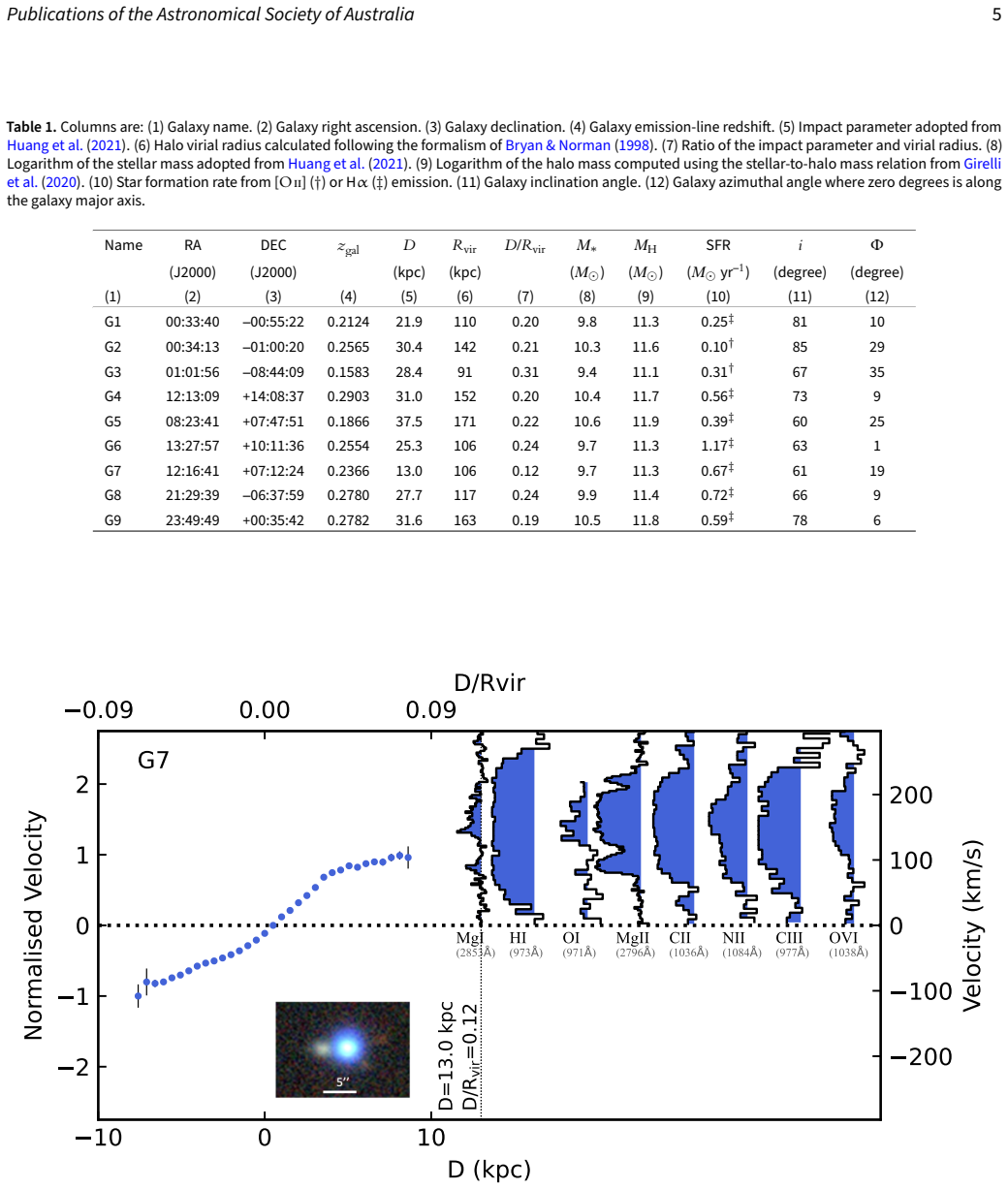
The load-bearing setup is the restrictive absorber geometry: nine near-edge-on galaxies (inclination 60–85 degrees) with quasar sightlines within 38 kpc along the major axis (azimuthal angle within 35 degrees), so that absorption velocities can be compared directly with rotation-curve velocities along the same line of sight. The key statistic is the equivalent-width co-rotation fraction, $f_{\rm EW}^{\rm corot}$, the fraction of total absorption optical depth lying on the side of the galaxy systemic velocity that matches the disk rotation direction, with $v > v_{\rm sys}$ counted as co-rotating; it is supplemented by the optical-depth-weighted median velocity, $v_{\rm abs}$, and by the velocity widths $\Delta v_{50}$ and $\Delta v_{90}$ that enclose 50% and 90% of the total optical depth. These measures turn a single absorption profile per ion per sightline into quantities that can be stacked across galaxies and compared in two radial bins ($D/R_{\rm vir}=0.12$–$0.20$ and $0.21$–$0.31$). Bootstrap resampling over 1000 stacked spectra provides the uncertainties that let the two radial bins be distinguished.
What would settle it
A concrete falsifier is a stacking test that subtracts a simple infall model: if, after assigning a radially infalling component to each line profile and removing it, the remaining absorption does not retain more than 80% sign agreement with rotation at $D/R_{\rm vir}\le0.2$, the co-rotation claim fails. The same test could be run on a control sample of face-on or minor-axis systems, where co-rotation along the sightline should be absent; if the major-axis trend is reproduced there, the statistic is not measuring rotation.
Extended reading notes
Core claim
The central discovery is a radial kinematic stratification of the multi-phase CGM around disk galaxies. In stacked spectra split at $D/R_{\rm vir}=0.2$, the survey finds that at small radius every ion — Mg I, H I, Mg II, C II, C III, and O VI — has an equivalent-width co-rotation fraction above 0.80 and an optical-depth-weighted median velocity ($v_{\rm abs}$) of about 110 km/s, statistically consistent with the peak rotation speed. At larger radius, Mg I, Mg II, C II, and H I keep co-rotation fractions above 0.80 but their $v_{\rm abs}$ drops to roughly 60% of the rotation speed, whereas O VI drops to a co-rotation fraction of about 0.63 and $v_{\rm abs}$ of $0.20\pm0.15$ of the rotation speed. The velocity width containing half the optical depth ($\Delta v_{50}$) of low-ionisation gas is up to 1.8 times larger in the inner halo than at large radius, while $\Delta v_{50}$ (and $\Delta v_{90}$) for C III and O VI does not change with distance. The authors conclude that low-ionisation gas traces extended co-rotating inflow or recycled accretion, while O VI and H I beyond about $0.2\,R_{\rm vir}$ trace a mixture of co-rotating, lagging, and discrete collisionally ionised structures — the kinematic stratification the paper set out to establish.
Load-bearing premise
The result assumes that absorption on the same side of the galaxy's systemic velocity as the disk rotation is actually co-rotating gas; without modelling radial motion, a single sightline gives only one velocity component, so an infalling or foreground cloud with a small positive $v$ would be counted as co-rotating.
Editorial extensions
If this is right
- Within about $0.2\,R_{\rm vir}$, all probed gas phases share the disk's rotation speed, so the inner CGM is dynamically part of the galaxy's angular-momentum budget rather than a static or infalling envelope.
- Beyond about $0.2\,R_{\rm vir}$, low-ionisation gas remains directionally co-rotating but slower (about 60% of peak speed), consistent with gas on its way into the disk, whether from cold inflow or recycled fountains.
- OVI decouples most strongly at large radius (co-rotation fraction about 0.63, velocity about 20% of rotation speed), so warm/hot gas in the outer halo cannot be used as a tracer of disk rotation and may include material that is not gravitationally bound.
- The larger inner-halo $\Delta v_{50}$ of low-ionisation gas, together with distance-invariant C III and O VI widths, implies that the cool phase becomes dynamically broad and multi-component near the galaxy while the warm-hot phase stays kinematically broad at every radius sampled.
Reading between the lines
- If the sign-based classification is accepted, the $0.2\,R_{\rm vir}$ transition is plausibly a universal scale in halos of roughly $10^{11.6}\,M_\odot$; an extension would be to measure where co-rotation drops in lower- and higher-mass galaxies and check whether that radius tracks the predicted cooling and virial-shock radius.
- A natural extension the paper does not attempt is to fit each absorption profile with separate rotation, radial-inflow, and outflow components; without that decomposition, a foreground cloud moving slowly toward the observer is indistinguishable from a genuinely rotating one.
- Measuring metallicities of the co-rotating low-ion absorption could separate pristine filamentary inflow from enriched recycled fountain gas, a distinction the paper explicitly leaves to future work.
- If the stratification is real, spatially resolved CGM emission maps (for example in Ly-alpha or OVI) around edge-on galaxies should show an inner component rotating with the disk and an outer component lagging or scattering about systemic velocity, offering a test that does not rely on one quasar sightline per galaxy.
Editorial analysis
A structured set of objections, weighed in public.
Referee Report
Summary. The paper introduces COS-EDGES, a survey of nine isolated, near-edge-on galaxies at z~0.2, each probed along its major axis by a background quasar at D/Rvir = 0.12-0.31. Using VLT/UVES and HST/COS spectra, the authors measure Mg I, H I, Mg II, C II, C III, and O VI absorption and compare its kinematics with galaxy rotation curves from Keck/LRIS and Magellan/MagE. The sample is split at D/Rvir = 0.2 into inner (4 galaxies) and outer (5 galaxies) bins. The central claims are that (i) at low D/Rvir, over 80% of absorption in all ions lies on the rotation side of systemic velocity and the optical-depth-weighted velocity v_abs matches the peak rotation speed; (ii) at high D/Rvir, low-ionisation gas retains >80% 'co-rotation' but v_abs drops to ~60% of v_rot, while O VI drops to ~60% co-rotation and ~20% v_rot; and (iii) the Δv50 widths of low ions are larger in the inner halo while C III and O VI widths do not change with radius. These results are interpreted as evidence for a kinematically stratified CGM: co-rotating, inflowing/recycled cool gas in the inner halo and a decoupled, collisionally ionised warm component at larger radii.
Significance. If the conclusions hold, the paper provides a valuable observational constraint on the angular momentum and radial structure of the multiphase CGM, using a carefully selected homogeneous sample of edge-on major-axis quasar-galaxy pairs at small impact parameters. The study is a natural extension of prior work by Nateghi et al. (2024a,b) and Ho et al. (2025), and it has the merit of directly measuring v_abs, velocity widths, and co-rotation fractions from stacked spectra with bootstrap uncertainties rather than relying on parametric fits. The comparison of low- and high-ionisation behaviour across a narrow radial range is a useful step toward connecting CGM kinematics to accretion and feedback physics. However, the physical interpretation is substantially dependent on a sign-based definition of co-rotation, which is a load-bearing weakness that needs to be addressed before the central claims can be accepted at face value.
major comments (4)
- [Section 3.4.3, Eq. (1)] The equivalent-width co-rotation fraction is defined by integrating the numerator only over v > v_sys, so every absorption component on the positive-velocity side of systemic is counted as co-rotating regardless of whether its velocity matches the expected rotation velocity at the probed radius. Because each sightline yields only one line-of-sight velocity at one projected radius, a radially infalling or outflowing cloud with a small positive velocity is classified as co-rotating. The headline percentages (80%, 60%, 20%) are exactly these sign-based fractions. The definition is acknowledged as 'by construction' in the text, but the paper does not test whether a rotation-model-based metric would preserve the radial and ionisation trends. I recommend either renaming this quantity a 'same-side fraction' and tempering the physical interpretation accordingly, or adding an alternative metric that requires consistency with the rotation curve amplitude (e.g., the fraction of equivalent width within a tolerance of v_rot(D) at the sightline radius) and showing that the stratification remains.
- [Section 3.4.2, Figure 7] The key quantitative claim that O VI 'drops to 20% of the rotation speed' rests on v_abs/v_rot = 0.20 ± 0.15 in the high D/Rvir bin. With only five galaxies in that bin, this value is marginally consistent with a wide range, including values well above 0.3, and the difference between low and high bins is not quantified with a significance test. The text also reports the low-ionisation drop to ~0.6 without quoting uncertainties. Please report the full bootstrap distributions for each ion and bin, and give a significance level for the low-vs-high radial differences and for the O VI vs Mg II difference. This is necessary to support the abstract's precise-sounding percentages.
- [Section 3.4.1] The split at D/Rvir = 0.2 is a free choice that places four galaxies in the low bin and five in the high bin, with G1 and G4 sitting almost exactly on the boundary (D/Rvir = 0.20). The paper's central dichotomy ('within 0.2 Rvir' versus 'beyond 0.2 Rvir') depends on this binning, but no sensitivity test is presented. Please test whether the trends persist when the boundary is moved to, for example, 0.18 or 0.22, or when G1 and G4 are moved to the other bin. The discussion already motivates 0.2 Rvir from theory, but the observational claim should not be tied to an untested bin choice.
- [Section 2.3 and Appendix Figures 11, 14] The rotation curves for G2 and G5 are described as shallow and based on few spatial apertures because of faint emission lines. Since the paper normalises v_abs by the 'maximum rotation speed' of each galaxy, an uncertain maximum can directly bias the normalised velocities in the high D/Rvir bin, where G2 and G5 reside. Please quantify the uncertainty in the adopted peak rotation speeds (including how many apertures define the flat part) and consider cross-checks using alternative normalisations, such as the rotation velocity extrapolated to the impact parameter D or the circular velocity from the halo mass.
minor comments (4)
- [Section 3.4.2] The paragraph beginning 'hows the optical depth weighted velocity' appears truncated and then immediately repeated; the duplicated text should be removed and replaced with a clear description of Figure 7.
- [Section 3.4.2 and Figure 8 caption] There are several typographical errors, including 'the the optical depth weighted normalized velocity' and 'and and more steep' in the Figure 8 caption; these should be corrected.
- [Section 3.4.3, Figure 9] The text reports co-rotation fractions such as 0.84 and 0.63 without quoting uncertainties, even though the figure appears to show error bars. Please state the bootstrap 1σ values in the text or table.
- [Section 3.3 and Conclusions] The escape-velocity statement says low-ionisation gas in 8/9 galaxies is below the escape velocity at Rvir, but the text notes that G7 has a large fraction above it. Please clarify in the abstract and conclusions that the 8/9 refers to all of the low-ionisation absorption being bound, not simply the majority of galaxies having some bound absorption.
Circularity Check
No significant circularity: the kinematic stratification claims are direct measurements from stacked spectra, not predictions derived from fitted inputs or self-citations.
full rationale
The paper's central results—v_abs, Δv50, Δv90, and the equivalent-width co-rotation fraction—are measured directly from bootstrapped stacked absorption profiles after splitting the nine galaxies into low and high D/Rvir bins (Sections 3.4.1–3.4.3). No parameter is fitted to one subset of the data and then used to predict a closely related quantity; the co-rotation fraction (Section 3.4.3) is an explicitly defined, sign-based integral over the observed line profile. Its radial and ionization trends are therefore empirical outputs, not consequences of the definition: the fraction could have been ~0.5 or flat, but is observed to be >0.8 at low D/Rvir and to fall to ~0.63 for OVI at high D/Rvir. The only 'by construction' statement is the trivial bound 0 ≤ f_EW_corot ≤ 1. Self-citations (Nateghi et al. 2024a,b; Kacprzak et al. 2019) are used for method provenance and comparison, not as load-bearing evidence that forces the conclusions. The concern that sign agreement with vsys does not prove physical co-rotation is a limitation on the interpretation of the metric, not a circularity in its derivation.
Assumptions & free parameters
free parameters (2)
- co-rotation integration limits (vmin, vmax) =
per stacked spectrum; not tabulated
- D/Rvir bin boundary =
0.2
assumptions (4)
- domain assumption Gas detected in absorption is physically associated with the target galaxy and located at projected distance D from it.
- domain assumption The line-of-sight velocity sign relative to systemic is sufficient to identify co-rotation; any v > vsys counts as co-rotating.
- domain assumption Halo masses and virial radii from the stellar-to-halo mass relation (Girelli et al. 2020) and Bryan & Norman (1998) are accurate for these galaxies.
- domain assumption Rotation curves traced by H-alpha or [OII] emission represent the circular velocity of the disk at the quasar position.
Cite this review
Pith. "Pith review of COS-EDGES: Co-rotation and Kinematic Stratification of the Multi-Phase CGM Around Edge-On Galaxies." pith.science (2026). https://pith.science/paper/3HE62XDS
@misc{pith2026250711613,
  author       = {Pith},
  title        = {Pith review of: COS-EDGES: Co-rotation and Kinematic Stratification of the Multi-Phase CGM Around Edge-On Galaxies},
  year         = {2026},
  howpublished = {\url{https://pith.science/paper/3HE62XDS}},
  note         = {Machine review of arXiv:2507.11613}
}
abstract
We present the first results from the COS-EDGES survey, targeting the kinematic connection between the ISM and multi-phase circumgalactic medium (CGM) in nine isolated, edge-on galaxies at z~0.2, each probed along its major axis by a background quasar at impact parameters of 13-38kpc. Using VLT/UVES and HST/COS quasar spectra, we analyse MgI, MgII, HI, CII, CIII, and OVI absorption relative to galaxy rotation curves from Keck/LRIS and Magellan/MagE spectra. We find that at lower $D/R_{vir}$ ($D/R_{vir}\leq 0.2$), over 80% of absorption in all ions lies on the side of systemic velocity matching disk rotation, and the optical-depth-weighted median velocity ($v_{abs}$) is consistent with the peak rotation speed. At higher $D/R_{vir}$ ($D/R_{vir} > 0.2$), the kinematics diverge by ionisation state: For low ionisation gas, the amount of co-rotating absorption remains >80%, yet $v_{abs}$ drops to 60% of the galaxy rotation speed. For high ionisation gas (OVI), only 60% of the absorption is consistent with co-rotation and $v_{abs}$ drops to 20% of the rotation speed. Furthermore, the velocity widths, corresponding to 50% of the total optical depth ($\Delta v_{50}$) for low ionisation gas is 1.8 times larger in the inner halo than at larger radii, while for CIII and OVI $\Delta v_{50}$ remains unchanged with distance. These results suggest a radially dependent CGM kinematic structure: the inner halo hosts cool, dynamically broad gas tightly coupled to disk rotation, whereas beyond 0.2$R_{vir}$, particularly traced by OVI and HI, the CGM shows weaker rotational alignment and lower velocity dispersion. Therefore, low-ionisation gas likely traces extended co-rotating gas, inflows and/or recycled accretion, while high-ionisation gas reflects a mixture of co-rotating, lagging, discrete collisionally ionised structures, indicating a kinematic stratification of the multi-phase CGM. [Abridged]
Figures


Figures from the paper (13 more)


Forward citations
Cited by 1 Pith paper
-
Baryonic Ecosystem IN Galaxies (BEINGMgII) -- III. Cool gas reservoirs at $0.3 \le z \le 1.6$ in the Dark Energy Survey
New sample of 377 galaxies shows MgII absorber strength rising with redshift, positive correlations with stellar mass and SFR, clumpy CGM structure, and mostly bound gas consistent with galactic fountain recycling.
Reference graph
Works this paper leans on
-
[1]
2017, MNRAS, 470, 4698
Anglés-Alcázar, D., Faucher-Giguère, C.-A., Kereš, D., et al. 2017, MNRAS, 470, 4698
2017
-
[2]
2016, MNRAS, 462, 4157
Armillotta, L., Fraternali, F., & Marinacci, F. 2016, MNRAS, 462, 4157
2016
-
[3]
M., & Webb, J
Barcons, X., Lanzettat, K. M., & Webb, J. K. 1995, Nature, 376, 321
1995
-
[4]
L., Fumagalli, M., et al
Beckett, A., Morris, S. L., Fumagalli, M., et al. 2021, MNRAS, 506, 2574
2021
-
[5]
1986, A&A, 155, L8
Bergeron, J. 1986, A&A, 155, L8
1986
-
[6]
2003, MNRAS, 345, 349
Birnboim, Y., & Dekel, A. 2003, MNRAS, 345, 349
2003
-
[7]
Boksenberg, A., & Sargent, W. L. W. 1978, ApJ, 220, 42
1978
-
[8]
J., Knobel, C., et al
Bordoloi, R., Lilly, S. J., Knobel, C., et al. 2011, ApJ, 743, 10
2011
Show all 88 references
-
[9]
J., Hardmeier, E., et al
Bordoloi, R., Lilly, S. J., Hardmeier, E., et al. 2014, ApJ, 794, 130 Bouché, N., Hohensee, W., Vargas, R., et al. 2012, MNRAS, 426, 801 Bouché, N., Murphy, M. T., Kacprzak, G. G., et al. 2013, Science, 341, 50 Bouché, N., Finley, H., Schroetter, I., et al. 2016, ApJ, 820, 121
2014
-
[10]
2022, arXiv e-prints, arXiv:2203.15055
Bradley, L., Davé, R., Cui, W., Smith, B., & Sorini, D. 2022, arXiv e-prints, arXiv:2203.15055
2022 arXiv
-
[11]
C., Gnat, O., & Brinboim, Y
Bromberg, I., Sarkar, K. C., Gnat, O., & Brinboim, Y. 2024, arXiv e-prints, arXiv:2407.18071
2024 arXiv
-
[12]
L., & Norman, M
Bryan, G. L., & Norman, M. L. 1998, ApJ, 495, 80
1998
-
[13]
C., & Churchill, C
Charlton, J. C., & Churchill, C. W. 1998, ApJ, 499, 181
1998
-
[14]
E., Gauthier, J.-R., et al
Chen, H.-W., Helsby, J. E., Gauthier, J.-R., et al. 2010, ApJ, 714, 1521
2010
-
[15]
W., Evans, J
Churchill, C. W., Evans, J. L., Stemock, B., et al. 2020, ApJ, 904, 28
2020
-
[16]
W., Trujillo-Gomez, S., Nielsen, N
Churchill, C. W., Trujillo-Gomez, S., Nielsen, N. M., & Kacprzak, G. G. 2013, ApJ, 779, 87, (MAGIICA T III)
2013
-
[17]
W., & V ogt, S
Churchill, C. W., & V ogt, S. S. 2001, AJ, 122, 679
2001
-
[18]
F., Genel, S., et al
DeFelippis, D., Bouché, N. F., Genel, S., et al. 2021, ApJ, 923, 56
2021
-
[19]
2006, MNRAS, 368, 2
Dekel, A., & Birnboim, Y. 2006, MNRAS, 368, 2
2006
-
[20]
2000, in SPIE Conference Series, V ol
Dekker, H., D’Odorico, S., Kaufer, A., Delabre, B., & Kotzlowski, H. 2000, in SPIE Conference Series, V ol. 4008, Optical and IR Telescope Instru- mentation and Detectors, ed. M. Iye & A. F. Moorwood, 534–545
2000
-
[21]
J., Lang, D., et al
Dey, A., Schlegel, D. J., Lang, D., et al. 2019, AJ, 157, 168
2019
-
[22]
M., Coil, A
Diamond-Stanic, A. M., Coil, A. L., Moustakas, J., et al. 2016, ApJ, 824, 24
2016
-
[23]
2025, ApJ, 985, 44
Dutta, S., Muzahid, S., Schaye, J., et al. 2025, ApJ, 985, 44
2025
-
[24]
2025, ApJ, 978, 63
Favaro, J., Courteau, S., Comerón, S., & Stone, C. 2025, ApJ, 978, 63
2025
-
[25]
2017, in Astrophysics and Space Science Library, V ol
Fraternali, F. 2017, in Astrophysics and Space Science Library, V ol. 430, Gas Accretion onto Galaxies, ed. A. Fox & R. Davé, 323
2017
-
[26]
M., & Wakker, B
French, D. M., & Wakker, B. P. 2020, ApJ, 897, 151
2020
-
[27]
2020, A&A, 634, A135
Girelli, G., Pozzetti, L., Bolzonella, M., et al. 2020, A&A, 634, A135
2020
-
[28]
Grand, R. J. J., van de V oort, F., Zjupa, J., et al. 2019, MNRAS, 490, 4786
2019
-
[29]
C., Froning, C
Green, J. C., Froning, C. S., Osterman, S., et al. 2012, ApJ, 744, 60
2012
-
[30]
Guthrie, B. N. G. 1992, A&AS, 93, 255
1992
-
[31]
2019, MNRAS, 488, 1248
Hafen, Z., Faucher-Giguère, C.-A., Anglés-Alcázar, D., et al. 2019, MNRAS, 488, 1248
2019
-
[32]
2022, MNRAS, 514, 5056
Hafen, Z., Stern, J., Bullock, J., et al. 2022, MNRAS, 514, 5056
2022
-
[33]
D., & Burke, B
Haschick, A. D., & Burke, B. F. 1975, ApJ, 200, L137
1975
-
[34]
H., Martin, C
Ho, S. H., Martin, C. L., Kacprzak, G. G., & Churchill, C. W. 2017, ApJ, 835, 267
2017
-
[35]
H., Martin, C
Ho, S. H., Martin, C. L., Nateghi, H., Kacprzak, G. G., & Stern, J. 2025, arXiv e-prints, arXiv:2507.11664
2025
-
[36]
H., Martin, C
Ho, S. H., Martin, C. L., & Schaye, J. 2021, ApJ, 923, 137
2021
-
[37]
H., Martin, C
Ho, S. H., Martin, C. L., & Turner, M. L. 2019, ApJ, 875, 54
2019
-
[38]
A., et al
Huang, Y.-H., Chen, H.-W., Shectman, S. A., et al. 2021, MNRAS, 502, 4743
2021
-
[39]
G., Churchill, C
Kacprzak, G. G., Churchill, C. W., Barton, E. J., & Cooke, J. 2011, ApJ, 733, 105
2011
-
[40]
G., Churchill, C
Kacprzak, G. G., Churchill, C. W., Ceverino, D., et al. 2010, ApJ, 711, 533
2010
-
[41]
G., Churchill, C
Kacprzak, G. G., Churchill, C. W., & Nielsen, N. M. 2012, ApJ, 760, L7
2012
-
[42]
G., Churchill, C
Kacprzak, G. G., Churchill, C. W., Steidel, C. C., Murphy, M. T., & Evans, J. L. 2007, ApJ, 662, 909
2007
-
[43]
G., Muzahid, S., Churchill, C
Kacprzak, G. G., Muzahid, S., Churchill, C. W., Nielsen, N. M., & Charlton, J. C. 2015, ApJ, 815, 22
2015
-
[44]
G., Vander Vliet, J
Kacprzak, G. G., Vander Vliet, J. R., Nielsen, N. M., et al. 2019, ApJ, 870, 137 Kereš, D., Katz, N., Weinberg, D. H., & Davé, R. 2005, MNRAS, 363, 2
2019
-
[45]
J., Geller, M
Kewley, L. J., Geller, M. J., & Jansen, R. A. 2004, AJ, 127, 2002
2004
-
[46]
V., Kulkarni, V., Wake, D
Klimenko, V. V., Kulkarni, V., Wake, D. A., et al. 2023, ApJ, 954, 115
2023
-
[47]
2014, ApJ, 795, 31
Lan, T.-W., Ménard, B., & Zhu, G. 2014, ApJ, 795, 31
2014
-
[48]
2018, ApJ, 866, 36
Lan, T.-W., & Mo, H. 2018, ApJ, 866, 36
2018
-
[49]
M., & Bowen, D
Lanzetta, K. M., & Bowen, D. V. 1992, ApJ, 391, 48
1992
-
[50]
C., Howk, J
Lehner, N., Berek, S. C., Howk, J. C., et al. 2020, ApJ, 900, 9 16 Glenn G. Kacprzak et al
2020
-
[51]
C., Collins, L., et al
Lehner, N., Howk, J. C., Collins, L., et al. 2025, arXiv e-prints, arXiv:2506.16573
2025 arXiv
-
[52]
F., et al
Lopez, S., Tejos, N., Barrientos, L. F., et al. 2020, MNRAS, 491, 4442
2020
-
[53]
F., Creech, S., Brammer, G., et al
Lundgren, B. F., Creech, S., Brammer, G., et al. 2021, ApJ, 913, 50
2021
-
[54]
Marasco, A., Fraternali, F., & Binney, J. J. 2012, MNRAS, 419, 1107
2012
-
[55]
2010, MNRAS, 404, 1464
Marinacci, F., Binney, J., Fraternali, F., et al. 2010, MNRAS, 404, 1464
2010
-
[56]
V., V ogelsberger, M., Torrey, P., & Springel, V
Marinacci, F., Sales, L. V., V ogelsberger, M., Torrey, P., & Springel, V. 2019, MNRAS, 489, 4233
2019
-
[57]
L., Burles, S., Thompson, I
Marshall, J. L., Burles, S., Thompson, I. B., et al. 2008, in Society of Photo- Optical Instrumentation Engineers (SPIE) Conference Series, V ol. 7014, Ground-based and Airborne Instrumentation for Astronomy II, ed. I. S. McLean & M. M. Casali, 701454
2008
-
[58]
L., Ho, S
Martin, C. L., Ho, S. H., Kacprzak, G. G., & Churchill, C. W. 2019, ApJ, 878, 84
2019
-
[59]
K., Cohen, J
McCarthy, J. K., Cohen, J. G., Butcher, B., et al. 1998, in Society of Photo- Optical Instrumentation Engineers (SPIE) Conference Series, V ol. 3355, Optical Astronomical Instrumentation, ed. S. D’Odorico, 81–92
1998
-
[60]
L., Kereš, D., Faucher-Giguère, C.-A., et al
Muratov, A. L., Kereš, D., Faucher-Giguère, C.-A., et al. 2017, MNRAS, 468, 4170
2017
-
[61]
2016, UVES_popler: POst-PipeLine Echelle Reduction software, doi:10.5281/zenodo.56158, doi:10.5281/zenodo.56158
Murphy, M. 2016, UVES_popler: POst-PipeLine Echelle Reduction software, doi:10.5281/zenodo.56158, doi:10.5281/zenodo.56158
2016 doi
-
[62]
T., Kacprzak, G
Murphy, M. T., Kacprzak, G. G., Savorgnan, G. A. D., & Carswell, R. F. 2019, MNRAS, 482, 3458
2019
-
[63]
2018, MNRAS, 477, 450
Nelson, D., Kauffmann, G., Pillepich, A., et al. 2018, MNRAS, 477, 450
2018
-
[64]
2020, MNRAS, 498, 2391
Nelson, D., Sharma, P., Pillepich, A., et al. 2020, MNRAS, 498, 2391
2020
-
[65]
M., Kacprzak, G
Ng, M., Nielsen, N. M., Kacprzak, G. G., et al. 2019, ApJ, 886, 66
2019
-
[66]
M., Kacprzak, G
Nielsen, N. M., Kacprzak, G. G., Muzahid, S., et al. 2017, ApJ, 834, 148
2017
-
[67]
B., Cohen, J
Oke, J. B., Cohen, J. G., Carr, M., et al. 1995, PASP, 107, 375
1995
-
[68]
Oppenheimer, B. D. 2018, MNRAS, 480, 2963
2018
-
[69]
D., Crain, R
Oppenheimer, B. D., Crain, R. A., Schaye, J., et al. 2016, MNRAS, 460, 2157
2016
-
[70]
Y., Ho, L
Peng, C. Y., Ho, L. C., Impey, C. D., & Rix, H.-W. 2010, AJ, 139, 2097 Péroux, C., Nelson, D., van de V oort, F., et al. 2020, MNRAS, 499, 2462
2010
-
[71]
2021, MNRAS, 508, 4667
Pillepich, A., Nelson, D., Truong, N., et al. 2021, MNRAS, 508, 4667
2021
-
[72]
2020, The Journal of Open Source Software, 5, 2308
Prochaska, J., Hennawi, J., Westfall, K., et al. 2020, The Journal of Open Source Software, 5, 2308
2020
-
[73]
X., & W olfe, A
Prochaska, J. X., & W olfe, A. M. 1997, ApJ, 487, 73
1997
-
[74]
2018, MNRAS, 474, 254
Rahmani, H., Péroux, C., Augustin, R., et al. 2018, MNRAS, 474, 254
2018
-
[75]
C., Wakker, B
Sameer, Charlton, J. C., Wakker, B. P., et al. 2024, MNRAS, 530, 3827
2024
-
[76]
C., Kollmeier, J
Steidel, C. C., Kollmeier, J. A., Shapley, A. E., et al. 2002, ApJ, 570, 526
2002
-
[77]
2024, MNRAS, 530, 1711
Stern, J., Fielding, D., Hafen, Z., et al. 2024, MNRAS, 530, 1711
2024
-
[78]
2021, ApJ, 911, 88
Stern, J., Faucher-Giguère, C.-A., Fielding, D., et al. 2021, ApJ, 911, 88
2021
-
[79]
R., Brooks, A
Stewart, K. R., Brooks, A. M., Bullock, J. S., et al. 2013, ApJ, 769, 74
2013
-
[80]
R., Kaufmann, T., Bullock, J
Stewart, K. R., Kaufmann, T., Bullock, J. S., et al. 2011, ApJ, 738, 39
2011
-
[81]
R., Maller, A
Stewart, K. R., Maller, A. H., Oñorbe, J., et al. 2017, ApJ, 843, 47
2017
-
[82]
W., Kereš, D., Chan, T
Trapp, C. W., Kereš, D., Chan, T. K., et al. 2022, MNRAS, 509, 4149
2022
-
[83]
K., et al
Tumlinson, J., Thom, C., Werk, J. K., et al. 2011, Science, 334, 948 van de V oort, F., Schaye, J., Booth, C. M., Haas, M. R., & Dalla Vecchia, C. 2011, MNRAS, 414, 2458 V ogt, N. P., Forbes, D. A., Phillips, A. C., et al. 1996, ApJ, 465, L15
2011
-
[84]
Weisheit, J. C. 1978, ApJ, 219, 829
1978
-
[85]
2024, MNRAS, 527, 3494
Weng, S., Péroux, C., Ramesh, R., et al. 2024, MNRAS, 527, 3494
2024
-
[86]
K., Prochaska, J
Werk, J. K., Prochaska, J. X., Cantalupo, S., et al. 2016, ApJ, 833, 54
2016
-
[87]
2024, MNRAS, 527, 1612
Yang, T., Davé, R., Cui, W., et al. 2024, MNRAS, 527, 1612
2024
-
[88]
F., Schroetter, I., et al
Zabl, J., Bouché, N. F., Schroetter, I., et al. 2019, MNRAS, 485, 1961 Appendix 1. Individual Galaxy Gas–CGM Kinematic Com- parisons In this section, we show the remaining galaxies not shown in the manuscript (G1, G2, G3, G4, G5, G6 and G9). For each figure, the DECaLS grz col...
2019
Reviewed August 6, 2026 · model on record in the stance chip above.
Discussion (0). Sign in to comment.