Reduced Order Modeling of Nonlinear Dynamical Systems Using Slow Manifolds
Pith reviewed 2026-05-19 03:56 UTC · model grok-4.3
The pith
Slow manifolds formed by intersecting unstable and stable manifolds enable reduced-order modeling of nonlinear systems when transverse decay rates are large.
A machine-rendered reading of the paper's core claim, the machinery that carries it, and where it could break.
Core claim
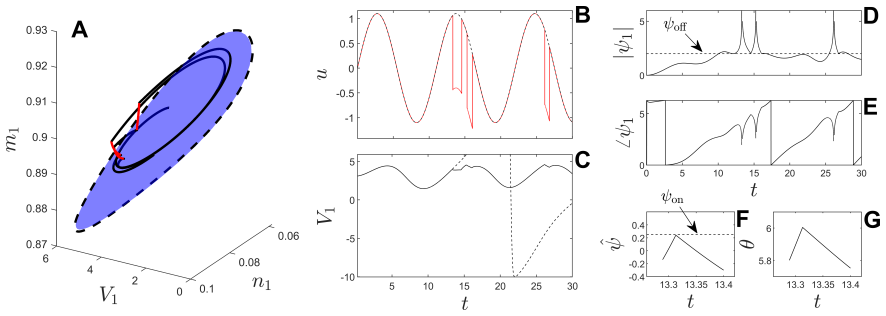
The paper claims that when the decay rates of perturbations transverse to the unstable manifold are sufficiently large, the slow manifold defined by the intersection of an unstable manifold of an unstable fixed point or periodic orbit and the stable manifold of a stable attractor can be used for reduced modeling purposes by leveraging the isostable coordinate framework. Detailed examples are provided for two different highly nonlinear dynamical systems, the first being a coupled system of Hodgkin-Huxley neurons and the second being a biophysically detailed model of circadian oscillations. The resulting reduced order models are illustrated in two different biologically motivated control tasks
What carries the argument
The slow manifold obtained from the intersection of an unstable manifold and a stable manifold, together with isostable coordinates that track the decay of transverse perturbations.
If this is right
- The reduced models accurately capture long-term behavior for control purposes in the example systems.
- The same construction applies whether the unstable object is a fixed point or a periodic orbit.
- Biological control objectives become feasible in lower-dimensional descriptions of neuron networks and circadian clocks.
- Highly nonlinear models with clear timescale separation become more tractable without losing essential features.
Where Pith is reading between the lines
- The approach might still work under moderate parameter changes that keep transverse decays fast but would require checking the boundary where the assumption fails.
- It could be combined with other reduction techniques to handle even larger networks of oscillators.
- Numerical tests on systems with multiple coexisting attractors would clarify how many such slow manifolds can be extracted simultaneously.
Load-bearing premise
The intersection of the unstable manifold and the stable manifold forms a slow manifold on which transverse decay rates are large enough to support reduced-order modeling.
What would settle it
A side-by-side simulation of the full high-dimensional system and the reduced model on the slow manifold that shows large divergence precisely when the transverse decay rates are moderate rather than large.
Figures




read the original abstract
Model order reduction in high-dimensional, nonlinear dynamical systems if often enabled through fast-slow timescale separation. One such approach involves identifying a low-dimensional slow manifold to which the state rapidly converges and subsequently studying the behavior on the slow manifold. This work investigates slow manifolds defined by the intersection of an unstable manifold of an unstable fixed point or periodic orbit and the stable manifold of a stable attractor. When the decay rates of perturbations transverse to the unstable manifold are sufficiently large, the resulting slow manifold can be used for reduced modeling purposes by leveraging the isostable coordinate framework. Detailed examples are provided for two different highly nonlinear dynamical systems, the first being a coupled system of Hodgkin-Huxley neurons and the second being a biophysically detailed model of circadian oscillations. The resulting reduced order models are illustrated in two different biologically motivated control objectives.
Editorial analysis
A structured set of objections, weighed in public.
Referee Report
Summary. The manuscript proposes defining slow manifolds in nonlinear dynamical systems as the intersection of the unstable manifold of an unstable fixed point or periodic orbit with the stable manifold of a stable attractor. It claims that when transverse decay rates to the unstable manifold are sufficiently large, the isostable coordinate framework can be applied to obtain reduced-order models, with demonstrations on a coupled Hodgkin-Huxley neuron system and a biophysically detailed circadian oscillator model for two biologically motivated control objectives.
Significance. If the transverse decay condition is verified, the approach extends isostable-based reduction techniques to systems featuring saddle structures, offering a systematic route to low-dimensional models in high-dimensional biological dynamics. The use of concrete, biophysically detailed examples strengthens potential applicability, though the absence of quantitative checks on the key decay-rate assumption limits immediate impact.
major comments (2)
- [§4 (Hodgkin-Huxley example)] The central claim that the intersection yields a usable slow manifold for isostable reduction rests on the unverified assumption that transverse decay rates are sufficiently large relative to motion along the manifold. No explicit computation of transverse Lyapunov exponents, decay times, or rate ratios is reported in the Hodgkin-Huxley example to confirm the condition holds.
- [§5 (circadian oscillations and control)] In the circadian model, the reduced-order controllers are presented without accompanying error metrics (e.g., L2 trajectory errors or phase-response curve comparisons) between the full-order system and the reduced model on the proposed slow manifold, leaving the practical accuracy of the reduction unquantified.
minor comments (2)
- [Introduction] Notation for isostable coordinates and manifold intersections should be introduced with a brief reminder of the cited framework to improve readability for readers unfamiliar with the prior literature.
- [Figures in §§4–5] Figure captions for the reduced-model trajectories should include the specific parameter values used in the control objectives to allow direct reproduction.
Simulated Author's Rebuttal
We thank the referee for the constructive comments, which help clarify the presentation of our results. We respond to each major comment below and indicate the revisions we will make to the manuscript.
read point-by-point responses
-
Referee: [§4 (Hodgkin-Huxley example)] The central claim that the intersection yields a usable slow manifold for isostable reduction rests on the unverified assumption that transverse decay rates are sufficiently large relative to motion along the manifold. No explicit computation of transverse Lyapunov exponents, decay times, or rate ratios is reported in the Hodgkin-Huxley example to confirm the condition holds.
Authors: We agree that the manuscript would benefit from explicit verification of the transverse decay condition in the Hodgkin-Huxley example. While the theoretical development in the paper states the requirement that transverse decay rates be large relative to motion along the manifold, we did not include numerical checks of transverse Lyapunov exponents or rate ratios for this specific system. In the revised manuscript we will add these computations in §4, reporting the relevant exponents and confirming that the separation of timescales holds for the chosen parameters. revision: yes
-
Referee: [§5 (circadian oscillations and control)] In the circadian model, the reduced-order controllers are presented without accompanying error metrics (e.g., L2 trajectory errors or phase-response curve comparisons) between the full-order system and the reduced model on the proposed slow manifold, leaving the practical accuracy of the reduction unquantified.
Authors: We concur that quantitative error metrics would strengthen the demonstration of the reduced-order model's accuracy. The current manuscript illustrates the controllers on the circadian oscillator but does not report explicit L2 trajectory errors or phase-response curve comparisons. In the revision we will add these metrics in §5 for both control tasks, comparing the full-order trajectories and phase responses against those obtained from the reduced model on the slow manifold. revision: yes
Circularity Check
No significant circularity detected; derivation is self-contained
full rationale
The paper defines the slow manifold explicitly as the intersection of the unstable manifold of an unstable fixed point or periodic orbit with the stable manifold of a stable attractor. It then states that when transverse decay rates to the unstable manifold are sufficiently large, this intersection can be leveraged for reduced-order modeling via the isostable coordinate framework, which is presented as a pre-existing method rather than derived or fitted from the current results. The Hodgkin-Huxley and circadian examples illustrate application but do not involve redefining fitted quantities as predictions or reducing the central claim to a self-citation chain. No self-definitional loops, ansatzes smuggled via citation, or uniqueness theorems imported from the same authors appear in the provided abstract and description; the load-bearing steps rest on external mathematical definitions and stated assumptions that remain independently verifiable.
Axiom & Free-Parameter Ledger
Lean theorems connected to this paper
-
IndisputableMonolith/Foundation/RealityFromDistinction.leanreality_from_one_distinction unclear?
unclearRelation between the paper passage and the cited Recognition theorem.
slow manifold defined by the intersection of an unstable manifold of an unstable fixed point or periodic orbit and the stable manifold of a stable attractor... leveraging the isostable coordinate framework
-
IndisputableMonolith/Cost/FunctionalEquation.leanwashburn_uniqueness_aczel unclear?
unclearRelation between the paper passage and the cited Recognition theorem.
isostable coordinates... principal Koopman eigenmodes... ψ_j evolve according to dψ_j/dt = λ_j ψ_j
What do these tags mean?
- matches
- The paper's claim is directly supported by a theorem in the formal canon.
- supports
- The theorem supports part of the paper's argument, but the paper may add assumptions or extra steps.
- extends
- The paper goes beyond the formal theorem; the theorem is a base layer rather than the whole result.
- uses
- The paper appears to rely on the theorem as machinery.
- contradicts
- The paper's claim conflicts with a theorem or certificate in the canon.
- unclear
- Pith found a possible connection, but the passage is too broad, indirect, or ambiguous to say the theorem truly supports the claim.
Reference graph
Works this paper leans on
- [1]
-
[2]
S. L. Brunton, B. W. Brunton, J. L. Proctor, and J. N. Kutz. Koopman invariant subspaces and finite linear representations of nonlinear dynamical systems for control. PloS One, 11(2), 2016
work page 2016
-
[3]
M. Cenedese, J. Ax˚ as, B. B¨ auerlein, K. Avila, and G. Haller. Data-driven modeling and prediction of non-linearizable dynamics via spectral submanifolds. Nature Communications, 13(1):872, 2022
work page 2022
-
[4]
S. Farjami, V. Kirk, and H. M. Osinga. Computing the stable manifold of a saddle slow manifold. SIAM Journal on Applied Dynamical Systems , 17(1):350–379, 2018
work page 2018
- [5]
- [6]
- [7]
-
[8]
J. Guckenheimer. Isochrons and phaseless sets. Journal of Mathematical Biology, 1(3):259–273, 1975
work page 1975
-
[9]
J. Guckenheimer and C. Kuehn. Computing slow manifolds of saddle type. SIAM Journal on Applied Dynamical Systems, 8(3):854–879, 2009
work page 2009
-
[10]
G. Haller and S. Ponsioen. Nonlinear normal modes and spectral submanifolds: existence, uniqueness and use in model reduction. Nonlinear Dynamics, 86:1493–1534, 2016
work page 2016
-
[11]
A. L. Hodgkin and A. F. Huxley. A quantitative description of membrane current and its application to conduction and excitation in nerve. J. Physiol., 117:500–44, 1952
work page 1952
-
[12]
D. Johnston and S. M.-S. Wu. Foundations of Cellular Neurophysiology . MIT Press, Cam- bridge, MA, 1995
work page 1995
-
[13]
D. Jordan and P. Smith. Nonlinear Ordinary Differential Equations: An Introduction for Scientists and Engineers , volume 10. Oxford University Press, Oxford, 2007
work page 2007
- [14]
-
[15]
T. J. Kaper. Systems theory for singular perturbation problems. In Analyzing multiscale phenomena using singular perturbation methods , pages 85–131. AMS, 1999
work page 1999
-
[16]
J. N. Kutz, S. L. Brunton, B. W. Brunton, and J. L. Proctor. Dynamic mode decomposition: data-driven modeling of complex systems . Society for Industrial and Applied Mathematics, Philadelphia, PA, 2016
work page 2016
-
[17]
M. D. Kvalheim and S. Revzen. Existence and uniqueness of global Koopman eigenfunctions for stable fixed points and periodic orbits. Physica D: Nonlinear Phenomena , page 132959, 2021
work page 2021
-
[18]
J. C. Leloup and A. Goldbeter. Toward a detailed computational model for the mammalian circadian clock. Proceedings of the National Academy of Sciences , 100(12):7051–7056, 2003
work page 2003
- [19]
-
[20]
A. Mauroy and I. Mezi´ c. Global stability analysis using the eigenfunctions of the Koopman operator. IEEE Transactions on Automatic Control , 61(11):3356–3369, 2016
work page 2016
- [21]
-
[22]
I. Mezi´ c. Analysis of fluid flows via spectral properties of the Koopman operator. Annual Review of Fluid Mechanics , 45:357–378, 2013
work page 2013
-
[23]
I. Mezi´ c. Spectrum of the Koopman operator, spectral expansions in functional spaces, and state-space geometry. Journal of Nonlinear Science , pages 1–55, 2019
work page 2019
-
[24]
I. Mezi´ c. Spectrum of the Koopman operator, spectral expansions in functional spaces, and state-space geometry. Journal of Nonlinear Science , 30(5):2091–2145, 2020
work page 2091
-
[25]
B. Monga and J. Moehlis. Optimal phase control of biological oscillators using augmented phase reduction. Biological Cybernetics, 113(1-2):161–178, 2019
work page 2019
-
[26]
H. M. Osinga and J. Moehlis. Continuation-based computation of global isochrons. SIAM Journal on Applied Dynamical Systems , 9(4):1201–1228, 2010
work page 2010
-
[27]
Y. Park and D. Wilson. -body oscillator interactions of higher-order coupling functions. SIAM Journal on Applied Dynamical Systems , 23(2):1471–1503, 2024
work page 2024
-
[28]
S. Ponsioen, S. Jain, and G. Haller. Model reduction to spectral submanifolds and forced- response calculation in high-dimensional mechanical systems. Journal of Sound and Vibration , 488:115640, 2020
work page 2020
-
[29]
P. J. Schmid. Dynamic mode decomposition of numerical and experimental data. Journal of Fluid Mechanics, 656:5–28, 2010
work page 2010
-
[30]
A. Sootla and A. Mauroy. Geometric properties of isostables and basins of attraction of monotone systems. IEEE Transactions on Automatic Control , 62(12):6183–6194, 2017. 26
work page 2017
- [31]
-
[32]
S. Wiggins. Introduction to applied nonlinear dynamical systems and chaos, volume 2. Springer, 2003
work page 2003
-
[33]
M. O. Williams, I. G. Kevrekidis, and C. W. Rowley. A data–driven approximation of the koopman operator: Extending dynamic mode decomposition. Journal of Nonlinear Science , 25(6):1307–1346, 2015
work page 2015
-
[34]
D. Wilson. A data-driven phase and isostable reduced modeling framework for oscillatory dynamical systems. Chaos: An Interdisciplinary Journal of Nonlinear Science , 30(1):013121, 2020
work page 2020
-
[35]
D. Wilson. Phase-amplitude reduction far beyond the weakly perturbed paradigm. Physical Review E, 101(2):022220, 2020
work page 2020
-
[36]
D. Wilson. Identification and computation of slow manifolds using the isostable coordinate system. arXiv preprint:PENDING, 202025
-
[37]
D. Wilson. Analysis of input-induced oscillations using the isostable coordinate framework. Chaos: An Interdisciplinary Journal of Nonlinear Science , 31(2):023131, 2021
work page 2021
-
[38]
D. Wilson. Data-driven inference of high-accuracy isostable-based dynamical models in response to external inputs. Chaos: An Interdisciplinary Journal of Nonlinear Science , 31(6):063137, 2021
work page 2021
-
[39]
D. Wilson. An adaptive phase-amplitude reduction framework without O(ϵ) constraints on inputs. SIAM Journal on Applied Dynamical Systems , 21(1):204–230, 2022
work page 2022
-
[40]
D. Wilson and B. Ermentrout. Greater accuracy and broadened applicability of phase reduction using isostable coordinates. Journal of Mathematical Biology , 76(1-2):37–66, 2018
work page 2018
-
[41]
D. Wilson and J. Moehlis. Isostable reduction of periodic orbits. Physical Review E , 94(5):052213, 2016
work page 2016
-
[42]
A. Winfree. The Geometry of Biological Time . Springer Verlag, New York, second edition, 2001. 27
work page 2001
discussion (0)
Sign in with ORCID, Apple, or X to comment. Anyone can read and Pith papers without signing in.