REVIEW 3 major objections 5 minor 53 references
The Galactic Bulge exploration VI.: Gaia Enceladus/Sausage RR Lyrae stars in the inner-central stellar halo of the Milky Way
T0 review · 3 major / 5 minor · reviewed 2026-08-06 · deepseek-v4-flash
Pith's one-line read The paper claims that the Gaia-Enceladus/Sausage merger contributed just 6-9% ± 2% of the inner-central halo's RR Lyrae stars, and essentially none of its debris follows bulge-like orbits.
desk verdict First inner-central halo GES fraction estimate from RR Lyrae stars, but the headline 6–9% number leans on Auriga transfer fractions that need a systematic error bar. read the letter →
The pith
A machine-rendered reading of the paper's core claim, the machinery that carries it, and where it could break.
The reading
What carries the argument
The load-bearing comparison is between observed orbits and a simulated Milky Way analog with a GES-like merger. The paper works in the space of integrals of motion, using the canonical GES selection box in $L_z$–$E$ (retrograde-to-low angular momentum, relatively high energy) and the eccentricity distribution, where $e = (r_{\mathrm{apo}} - r_{\mathrm{peri}})/(r_{\mathrm{apo}} + r_{\mathrm{peri}})$. The simulated analog provides the fraction of accreted stars (40%), the share of GES among accreted stars inside the $L_z$–$E$ box (25%), and the share outside it (10%); these factors convert the raw 39% selection rate into the corrected 6% estimate. Supporting machinery includes orbit integration in a fixed Galactic potential, period-luminosity-metallicity distances, radial velocities from template fitting, and photometric metallicity from light-curve shapes, with the $z_{\mathrm{max}}>3$ kpc cut doing the work of separating halo from bulge/disk.
What would settle it
Take the 281 RR Lyrae stars, or the roughly 20,000-star sample expected from the next astrometric data release, and measure individual abundances such as $[\mathrm{Mg/Fe}]$ and $[\mathrm{Al/Fe}]$. If the excess of high-eccentricity, metal-poor stars in the inner-central halo does not show the low $[\mathrm{Mg/Fe}]$ signature characteristic of GES, the 6-9% fraction would collapse; alternatively, repeating the same analysis with a different Milky Way-like simulation whose GES analog has different mass or merger time, and finding a predicted GES fraction outside $6\pm2\%$, would show the quoted uncertainty is too small.
Extended reading notes
Core claim
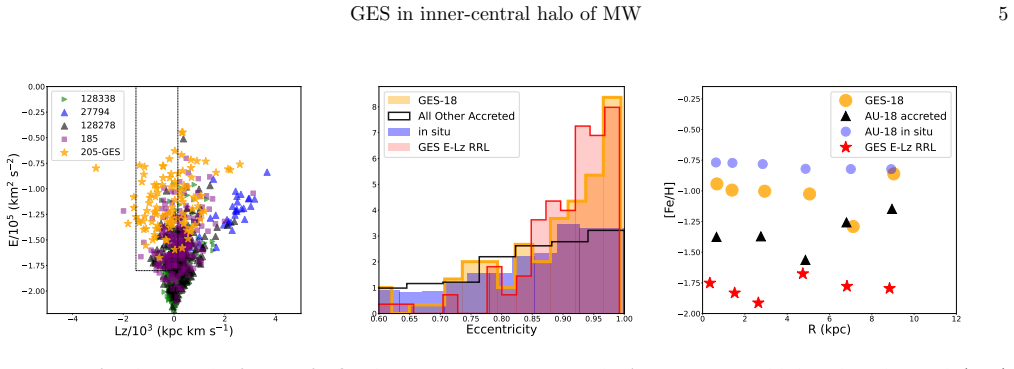
The central claim is that the inner-central halo of the Milky Way contains a real but minority GES remnant. From a six-dimensional inner-Galaxy RR Lyrae catalog, 281 RR Lyrae stars with $3 < z_{\mathrm{max}} < 20$ kpc and $|x| < 10$ kpc are identified as halo rather than bulge/disk stars; these are more metal-poor than bulge RR Lyrae stars and show a bimodal (Oosterhoff) period distribution characteristic of an accreted population. In the energy–angular-momentum plane, 110 of the 281 (39%) fall inside the canonical GES selection region ($-1500 < L_z < 150$ kpc km/s, $E > -1.8\times10^5\ \mathrm{km^2\,s^{-2}}$), but the simulation's contamination analysis implies only $6\pm2\%$ of the full sample is truly GES; an independent estimate from the excess of high-eccentricity stars ($e>0.85$) gives $9\pm2\%$. Almost none of the simulated GES debris reaches $z_{\mathrm{max}} < 1.1$ kpc, so the paper concludes that no (or very few) bulge-orbit RR Lyrae stars originated from GES.
Load-bearing premise
The load-bearing premise is that the Au-18 simulation's merger history, its GES analog, and the resulting fractions (40% accreted, 25% GES among accreted stars inside the $L_z$–$E$ box, 10% outside) faithfully describe the real Milky Way's inner-central halo; the paper does not quantify the systematic uncertainty in this transfer.
Editorial extensions
If this is right
- The GES merger contributed only a minority (roughly 6-9%) of the inner-central halo RR Lyrae population, so older accretion events and in-situ stars dominate the old metal-poor stars near the Galactic center.
- RR Lyrae stars on bulge-like orbits ($z_{\mathrm{max}}<1.1$ kpc) are essentially all non-GES, meaning the bar/bulge assembly did not directly incorporate GES stars.
- The inner-halo GES fraction is much lower than the roughly 25-30% seen near the Sun, so GES debris becomes relatively rarer toward the Galactic center, opposite to the general accreted-star trend.
- The lack of a radial metallicity gradient among GES RR Lyrae stars inside 9 kpc indicates the GES population is chemically well mixed in this region.
- A raw energy-angular momentum selection without simulation correction would overstate the GES fraction by roughly a factor of four in this sample.
Reading between the lines
- A direct chemical follow-up of the 281 stars could test the paper's identification: if the $e>0.85$ excess is GES, it should carry low $[\mathrm{Mg/Fe}]$ and $[\mathrm{Al/Fe}]$ at fixed metallicity; the paper itself notes spectroscopic abundances would separate overlapping accretion events.
- The same simulation-calibration recipe could be applied to other halo tracers such as blue horizontal branch stars or metal-poor red giants to check whether the 6-9% fraction is tracer-dependent; RR Lyrae stars sample the metal-weak tail, so the fraction for all inner-halo stars could differ.
- With the larger RR Lyrae sample expected from the next astrometric data release, the eccentricity-excess method could map how the GES fraction changes with height above the plane and with metallicity, testing whether the merger debris is radially stratified.
- The implied dominance of other early accreted populations in the inner halo suggests that kinematic selection alone will keep mislabeling those stars as GES, so future inner-halo surveys should rely on chemistry before assigning membership.
Editorial analysis
A structured set of objections, weighed in public.
Referee Report
Summary. The paper selects 281 RR Lyrae stars from the combined BRAVA-RR/APOGEE catalog whose orbits (3 < zmax < 20 kpc, |x| < 10 kpc) place them in the inner-central stellar halo, and compares their energies, angular momenta, eccentricities, and metallicities with the Auriga Au-18 cosmological zoom-in simulation and its GES-like merger, GES-18. Two estimators are used: an eccentricity-excess method yielding a GES fraction of ~9 ± 2%, and an E-Lz selection with Au-18 contamination corrections yielding ~6 ± 2%. The paper also reports that essentially no GES debris should populate bulge-like orbits with zmax < 1.1 kpc. The central claim is that GES contributed only a minority fraction of the inner-central halo RR Lyrae population and did not significantly populate the bar/bulge region.
Significance. If the result holds, it is an important measurement of the GES contribution in a poorly explored region of the Milky Way, and it provides an observational test of Auriga's prediction that GES-like debris is less dominant at small Galactocentric radii than in the solar neighborhood. The paper benefits from a clean, well-defined RR Lyrae sample with homogeneous distances, velocities, and metallicities from the authors' prior work, and from using an external cosmological simulation rather than fitting the data. The two independent estimators agreeing within their formal errors is a strength. The main limitation is that the quoted uncertainties are Poisson-only, so the headline fractions do not yet reflect the dominant systematic uncertainty in transferring Auriga calibration numbers to the Milky Way.
major comments (3)
- [Section 3.3, Figure 4] The 6 ± 2% estimate is obtained by combining the observed fraction of RRLs in the Helmi et al. (2018) E-Lz box (39%) with the Au-18 fractions of GES-18 among accreted stars (25% in the box, 10% outside) and an assumed accreted fraction of 40%. No systematic uncertainty is propagated from these three model-transfer inputs, which depend on Au-18's merger history, the GES-18 infall time and mass, and the orbital structure of the simulated inner galaxy. The quoted ±2% is derived only from Poisson statistics of the observed counts and therefore understates the error budget. The authors should add a sensitivity analysis that varies the accreted fraction over a plausible range, varies the E-Lz box boundaries, and/or compares Au-18 with other Auriga halos, and report a systematic-dominated uncertainty or soften the precision of the headline claim accordingly.
- [Section 3.1, Figure 3] The eccentricity-based fraction of ~9 ± 2% compares the observed fraction of RRLs with e > 0.85 (51%) with Au-18 fractions of 42% for in situ and 44% for other accreted particles. The text does not state the mixture calculation used to form the predicted baseline, but the expected fraction depends on the adopted accreted fraction, so the mixture must be written explicitly. In addition, the e > 0.85 threshold appears to be chosen after inspecting the distributions, and no test of sensitivity to the threshold is presented. The Poisson error attached to the observed count ignores errors in the simulated comparison fractions. Please present the calculation in a transparent equation and propagate at least the variation across plausible thresholds and accreted fractions.
- [Section 5 vs. Section 3.3] The Conclusions state that Au-18 suggests ~50% of the RRL population in the inner-central halo is consistent with originating from accretion, citing Figure 4, whereas Section 3.3 adopts 40% as the accreted fraction for the same RRL metallicity range. Since the inferred 6% GES fraction scales linearly with the adopted accreted fraction, this is not merely a wording issue. The authors should specify which value applies to the RRL-selected sample, define the metallicity window used, and reconcile the two statements.
minor comments (5)
- [Section 2.1] The sentence 'The RRLs with zmax > 3 have lower metallicities and than those RRLs with zmax < 3' contains a grammatical error that should be corrected.
- [Section 2.2] The phrase 'RRLs compromise a more metal-weak tail' should be 'comprise a more metal-weak tail'.
- [Section 3.1 and Discussion] The typo 'originated form GES' appears in Section 4 and should read 'originated from GES'.
- [Section 3.3] The phrase 'This is a slighter lower estimated fraction' is ungrammatical; it should read 'This is a slightly lower estimated fraction'.
- [Abstract and Section 2.1] The text describes the sample as probing R <~ 10 kpc, but the actual selection is on the Galactocentric x-coordinate with |x| < 10 kpc and 3 < zmax < 20 kpc; please clarify the difference between the in-plane radius and the full 3D distance in the selection description.
Circularity Check
No circularity found: observed RRL kinematics are compared to an external Auriga simulation and literature-defined GES selection criteria, with no fitted parameter renamed as a prediction.
full rationale
The paper's derivation chain compares observed RR Lyrae kinematics and metallicities to two independent external inputs: the Auriga Au-18 cosmological zoom-in simulation and the Helmi et al. (2018) E-Lz selection criteria for Gaia-Enceladus/Sausage stars. The central estimates (9 +/- 2% from the eccentricity excess and 6 +/- 2% from the E-Lz contamination calculation) are obtained by directly applying Au-18 particle fractions to the observed RRL sample, not by fitting those fractions to the data. No equation in the paper defines the predicted GES fraction in terms of the observed RRL properties by construction, and no fitted parameter is later relabeled as a prediction. The self-citations to prior papers in the Galactic Bulge Exploration series (Prudil et al. 2024a,b, 2025a; Kunder et al. 2024) provide the distance, velocity, and metallicity catalog used for orbit integration, but these are data-calibration references rather than the load-bearing argument for the GES fraction. The main limitation is unquantified systematic uncertainty in transferring Au-18's merger history and contamination fractions to the Milky Way, which is a model-dependence concern, not a circularity. Therefore the paper is self-contained against external benchmarks for the purpose of circularity analysis.
Assumptions & free parameters
free parameters (4)
- zmax selection threshold =
3 kpc < zmax < 20 kpc
- eccentricity threshold for GES excess =
e > 0.85
- Auriga particle selection cuts =
age > 10 Gyr, [Fe/H] < -0.5
- assumed accreted fraction of inner-central halo RRLs =
40%
assumptions (6)
- domain assumption Auriga Au-18 is a quantitatively accurate analog of the Milky Way's GES merger and inner halo population
- domain assumption Adopted Milky Way potential (McMillan 2017) is accurate enough for orbit integration
- domain assumption RR Lyrae distances and photometric metallicities from prior calibrations are accurate
- domain assumption The Helmi et al. (2018) energy and angular momentum box selects GES-like stars in the inner Galaxy
- domain assumption The zmax > 3 kpc cut separates halo from bulge/disk RR Lyrae stars
- domain assumption Auriga particle selection reproduces the observed RR Lyrae selection function
Cite this review
Pith. "Pith review of The Galactic Bulge exploration VI.: Gaia Enceladus/Sausage RR Lyrae stars in the inner-central stellar halo of the Milky Way." pith.science (2026). https://pith.science/paper/LXCZNK55
@misc{pith2026250711741,
  author       = {Pith},
  title        = {Pith review of: The Galactic Bulge exploration VI.: Gaia Enceladus/Sausage RR Lyrae stars in the inner-central stellar halo of the Milky Way},
  year         = {2026},
  howpublished = {\url{https://pith.science/paper/LXCZNK55}},
  note         = {Machine review of arXiv:2507.11741}
}
read the original abstract
We present a view of the stellar halo in the inner-central regions of the Milky Way (R <~ 10 kpc) mapped by RR Lyrae stars. The combined BRAVA-RR/APOGEE RR Lyrae catalog is used to obtain a sample of 281 RR Lyrae stars located in the bulge region of the Galaxy, but with orbits indicating they belong to the inner-central halo. The RR Lyrae stars in the halo are more metal-poor than the bulge RR Lyrae stars and have pulsation properties more consistent with an accreted population. We use the Milky Way-like zoom-in cosmological simulation Auriga to compare the properties of the RR Lyrae stars to those expected from the "Gaia-Enceladus-Sausage" (GES) merger. The integrals of motions and eccentricities of the RR Lyrae stars are consistent with a small fraction of 6-9 +- 2 % of the inner-central halo RR Lyrae population having originated from GES. This fraction, lower than what is seen in the solar neighborhood, is consistent with trends seen in the Auriga simulation, where a GES-like merger would have a decreasing fraction of GES stars at small Galactocentric radii compared to other accreted populations. Very few of the Auriga inner Galaxy GES-18 particles have properties consistent with belonging to a bulge population with (z_max < 1.1 kpc), indicating that no (or very few) RR Lyrae stars with bulge orbits should have originated from GES.
Figures


Figures from the paper (2 more)


Reference graph
Works this paper leans on
- [1]
-
[2]
Ardern-Arentsen, A., Monari, G., Queiroz, A.B.A. 2024, MNRAS, 530, 3391
work page 2024
- [3]
-
[4]
Belokurov, V., Erkal, D., Evans, N.W., Koposov, S.E., Deason, A.J. 2018, MNRAS, 478, 611
work page 2018
-
[5]
Bonifacio, P., Monaco, L, Salvadori, S. et al. 2021, A&A, 651, 79
work page 2021
-
[6]
Bullock, J. S., & Johnston, K. V. 2005, ApJ, 635, 931 Cabrera Garcia, J., Beers, T.C., Huang, Y. et al. 2024, MNRAS, 527, 8973
work page 2005
-
[7]
Carrillo, A., Deason, A.J., Fattahi, A., Callingham, T. M., Grand, R. J. J. 2024, MNRAS, 527, 2165
work page 2024
-
[8]
Catelan, M., & Smith, H. A. 2015, Pulsating Stars (New York: Wiley) Ciuc˘ a, I., Kawata, D., Ting Y.-S. et al. 2023, MNRAS, 528, 122
work page 2015
Show all 53 references
-
[9]
Conroy, C., Bonaca, A., Cargile, P. et al. 2019, ApJ, 883, 107
2019
-
[10]
P., Cole, S., Frenk, C
Cooper, A. P., Cole, S., Frenk, C. S., et al. 2010, MNRAS, 406, 744
2010
-
[11]
Crestani, J., Fabrizio, M., Braga, V.F. et al. 2021, ApJ, 908, 20
2021
-
[12]
2020, MNRAS, 493, 519
Das, P., Hawkins, K., Jofr´ e, P. 2020, MNRAS, 493, 519
2020
-
[13]
2019, MNRAS, 490, 3426 D´ ek´ any, I., Grebel, E.K., Pojma’nski, G
Deason, A.J., Belokurov, V., Sanders, J.L. 2019, MNRAS, 490, 3426 D´ ek´ any, I., Grebel, E.K., Pojma’nski, G. 2021, ApJ, 920, 33 Di Matteo, P., Haywood, M., Lehnert, M.D., Katz, D.,
2019
-
[14]
2019, A&A 632, 4
Khoperskov, S., Snaith, O.N., G´ omez, A., Robichon, N. 2019, A&A 632, 4
2019
-
[15]
2020, MNRAS 494, 3880
Belokurov, V., Sanders, J.L., Fattahi, A., Smith, M.C., Deason, A.J., Evans, N.W., Grand , R.J.J. 2020, MNRAS 494, 3880
2020
-
[16]
El-Badry, K., Bland-Hawthorn, J., Wetzel, A. et al. (2018), MNRAS, 480, 652
2018
-
[17]
Feng, Y., Guhathakurta, P., Peng, E., Cunningham, E., Gwyn, S., Ferrarese, L. et al. 2024, ApJ, accepted: arXiv:2402.05418
2024 arXiv
-
[18]
& Feuillet, D.K
Feltzing, S. & Feuillet, D.K. 2023, ApJ, 2023, ApJ, 953, 143 Feuillet D. K., Feltzing S., Sahlholdt C. L., Casagrande L., 2020, MNRAS, 497, 109
2023
-
[19]
L., Feltzing, S., Casagrande, L
Feuillet, D.K., Sahlholdt, C. L., Feltzing, S., Casagrande, L. 2021, MNRAS, 508, 1489 Fragkoudi F., Grand, R. J. J., Pakmor, R., et al. 2020, MNRAS, 494, 5936
2021
-
[20]
2020, A&A, 634, 135 G´ omez, F
Baldi, M. 2020, A&A, 634, 135 G´ omez, F. A., Helmi, A., Cooper, A. P., et al. 2013, MNRAS, 436, 3602 Grand R. J. et al., 2017, MNRAS, 467, 179 Grand R. J., Fragkoudi, F., G´ omez, F. A., Jenkins, A., Marinacci, F., Pakmor, R., Springel, V. 2024, MNRAS, 532, 1814
2020
-
[21]
Hayes, C.R., Majewski, S.R., Hasselquist, S. et al. 2020, ApJ, 889, 63
2020
-
[22]
Veljanoski, J., Brown, A. G. A. 2018, Natur, 563, 85
2018
-
[23]
& de Zeeuw, P
Helmi, A. & de Zeeuw, P. T. 2000, MNRAS, 319, 657
2000
-
[24]
1994, Natur, 370, 6486
Ibata, R.A., Gilmore, G., Irwin, M.J. 1994, Natur, 370, 6486
1994
-
[25]
2021, MNRAS, 502, 5686
Iorio, G., Belokurov, V. 2021, MNRAS, 502, 5686
2021
-
[26]
V., Hernquist, L., & Bolte, M
Johnston, K. V., Hernquist, L., & Bolte, M. 1996, ApJ, 465, 278
1996
-
[27]
2020, A&A, 563, 85
Koppelman, H.H., Bos, R.O.Y., Helmi, A. 2020, A&A, 563, 85
2020
-
[28]
Kruijssen, J. M. D., Pfeffer, J. L., Chevance, M. et al. 2020, MNRAS, 498, 2472
2020
-
[29]
Kunder, A., P´ erez-Villegas, A., Rich, R.M. et al. 2020, AJ, 159, 270
2020
-
[30]
2024, AJ, 168, 139
Hughes, J., Covey, K.R., Devine, K. 2024, AJ, 168, 139
2024
-
[31]
Liu, G.C., Huang, Y., Zhang, H.W. et al. 2020, ApJS, 247, 68
2020
-
[32]
2022, MNRAS, 517, 2787
Liu, G., Huang, Y., Bird, S.A., Zhang, H., Wang, F., Tian, H. 2022, MNRAS, 517, 2787
2022
-
[33]
Lucey, M., Hawkins, K., Ness, M. et al. 2021, MNRAS, 501, 5981
2021
-
[34]
Lucey, M., Hawkins, K., Ness, M., 2022, MNRAS, 509, 122
2022
-
[35]
2024, A&A, 690, 17
Clementini, G., Longo, G. 2024, A&A, 690, 17
2024
-
[36]
McMillan, P.J., 2017, MNRAS, 466, 174
2017
-
[37]
L., Vivas, A
Medina, G.E., Mu˜ noz, R., Carlin, J. L., Vivas, A. K., Grebel, E.K., Mart ´ ınez-V´ azquez, C.E., Hansen, C.J. 2024, MNRAS, 531, 4762
2024
-
[38]
Medina, G.E., Ting, S.L., Koposov, S. et al. 2025, astroph:2504.02924
2025 arXiv
-
[39]
Merrow, A., Grand, R. J. J., Fragkoudi, F., Martig, M. 2024, MNRAS, 531, 1520
2024
-
[40]
Minelli, A., Bellazzini, M., Mucciarelli, A. et al. 2023, A&A, 669, 54 Myeong G. C., Vasiliev E., Iorio G., Evans N. W., Belokurov V., 2019, MNRAS, 488, 1235 Myeong G. C., Belokurov V., Aguado D. S., Evans N. W., Caldwell N., Bradley J., 2022, ApJ, 938, 21
2023
-
[41]
Monachesi, A., G´ omez, F., Grand, R.J.J. et al. 2019, MNRAS, 485, 2589
2019
-
[42]
P., Conroy, C., Bonaca, A., 2019, ApJ, 901, 48
Naidu, R. P., Conroy, C., Bonaca, A., 2019, ApJ, 901, 48
2019
-
[43]
& Gerhard, O., 2015, MNRAS, 450, 66
Portail, M., Wegg, C. & Gerhard, O., 2015, MNRAS, 450, 66
2015
-
[44]
K., Kunder, A
Prudil, Z., D´ ek´ any, I., Grebel, E. K., Kunder, A. 2020, MNRAS, 492, 3408
2020
-
[45]
2025, A&A, accepted, arXiv:2506.19074
Prudil, Z., et al. 2025, A&A, accepted, arXiv:2506.19074
2025 arXiv
-
[46]
2025, A&A, 695, 211
Prudil, Z., Kunder, A., Beraldo e Silva, L., et al. 2025, A&A, 695, 211
2025
-
[47]
D., Kraft, R
Suntzeff, N.B., Kinman, T. D., Kraft, R. P. 1991, ApJ, 367, 528
1991
-
[48]
B., Scannapieco, C., Beers, T.C., Carollo, D
Tissera, P. B., Scannapieco, C., Beers, T.C., Carollo, D. 2013, MNRAS, 432, 3391
2013
-
[49]
Sk´ ulad´ ottir, A., Battaglia, G
Tolstoy, E. Sk´ ulad´ ottir, A., Battaglia, G. et al. 2023, A&A, 675, 49
2023
-
[50]
2019, MNRAS, 482, 1525 Vincenzo F., Spitoni E., Calura F., Matteucci F., Silva Aguirre V., Miglio A., Cescutti G., 2019, MNRAS, 487, 47
Vasiliev, E. 2019, MNRAS, 482, 1525 Vincenzo F., Spitoni E., Calura F., Matteucci F., Silva Aguirre V., Miglio A., Cescutti G., 2019, MNRAS, 487, 47
2019
-
[51]
C., Casetti-Dinescu, D
Zinn, R., Chen, X., Layden, A. C., Casetti-Dinescu, D. I. 2020, MNRAS, 492, 2161
2020
-
[52]
Zoccali, M., Vasquez, S., Gonzalez, O. A. et al. 2017, A&A, 599, 12
2017
-
[53]
Zolotov, A., Willman, B., Brooks, A. et. al. 2009, ApJ, 702, 1058
2009
Reviewed August 6, 2026 · model on record in the stance chip above.
Discussion (0). Sign in to comment.