REVIEW 3 major objections 4 minor 18 references
Fiducial Matching: Differentially Private Inference for Categorical Data
T0 review · 3 major / 4 minor · reviewed 2026-08-06 · deepseek-v4-flash
Pith's one-line read Fiducial matching converts differentially private categorical estimates into confidence intervals with asymptotically exact coverage.
desk verdict FIMA for a single proportion is a genuinely nice idea, but the multinomial extension is false as stated because component-wise resampling ignores the covariance among the estimated proportions. read the letter →
The pith
A machine-rendered reading of the paper's core claim, the machinery that carries it, and where it could break.
The reading
What carries the argument
The load-bearing object is a matching equation rewritten as an inverse-CDF problem. Starting from $\hat\pi = \bar\theta^*(\theta) + Y^*$, the paper uses the fact that the simulated proportion is an empirical distribution function evaluated at $\theta$, so the equation becomes $F_{U^*}(\theta) = \hat\pi - Y^*$, and the solution is $\hat\theta = F_{U^*}^{-1}(\tilde\theta^*)$ with $\tilde\theta^* = \hat\pi - Y^*$. This converts an optimization over $\theta$ into a ranking operation on simulated uniforms, and it is what makes the method computationally light and gives it a distribution. The proof that the resulting intervals have nominal coverage then rests on extremum-estimator regularity conditions and the validity of the percentile bootstrap for the simulated estimator.
What would settle it
Replicate the one-sample binomial experiment of Section 5.1 with $\theta_0 = 0.5$, sample sizes $n = 30, 100, 1000$, privacy budget $\epsilon = 1$, and $B = 10^4$ replications, computing empirical coverage of nominal 95% FIMA intervals; Theorem 1 predicts coverage approaches 0.95 as $n$ grows, so a persistent shortfall such as coverage below 0.93 at $n = 1000$ would falsify the claim.
Extended reading notes
Core claim
The central claim is that Fiducial Matching produces valid frequentist inference for categorical parameters under additive privacy mechanisms. Given the observed privatized proportion $\hat\pi = \bar\theta + Y$, FIMA draws independent copies of the privacy noise and uniforms, forms $\tilde\theta^* = \hat\pi - Y^*$, and sets $\hat\theta = F_{U^*}^{-1}(\tilde\theta^*)$; when the noise pushes $\tilde\theta^*$ outside the unit interval, the solution is truncated at a small $\delta$. Because the empirical CDF is discrete, the matching solution is an interval, and choosing the fiducial mixing variable $D \sim \mathrm{Beta}(1/2, 1/2)$ gives the closed form $\hat\theta \sim \mathrm{Beta}(n\tilde\theta^* + 1/2, n - n\tilde\theta^* + 1/2)$. Under the assumption that the true parameter is interior to $[0,1]$, Theorem 1 states $P(\theta_0 \leq \hat\theta_\alpha) = \alpha + o_p(1)$, and Proposition 1 extends the same coverage guarantee to any continuously differentiable statistic $\varphi(\hat\theta)$ of a multinomial FIMA vector.
Load-bearing premise
The whole coverage guarantee rests on the assumption that the percentile bootstrap works for the simulated matching estimator, a uniformity condition the paper invokes from a cited preprint rather than proving directly in the differential privacy setting.
Editorial extensions
If this is right
- FIMA confidence intervals for a binomial proportion have asymptotically exact coverage under any additive privacy mechanism of the form in Assumption 1, including Laplace and Gaussian mechanisms.
- The same coverage guarantee holds for continuously differentiable statistics of a multinomial parameter vector, covering chi-square statistics and logit coefficients in saturated logistic models with categorical predictors.
- The closed-form Beta sampling step makes FIMA's running time essentially flat in sample size $n$, so it scales better than simulation-heavy alternatives.
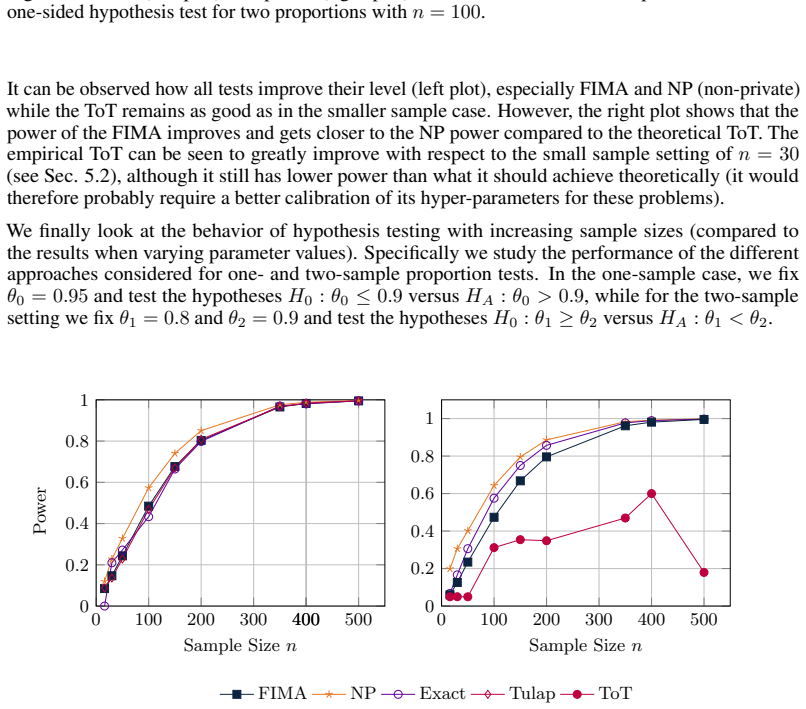
- In the one-sample binomial setting, FIMA achieves coverage and power comparable to the Tulap-based uniformly most powerful private test, and in two-sample and chi-square settings it provides stable level and competitive power relative to existing differentially private tests.
Reading between the lines
- If the percentile-bootstrap validity assumption holds, FIMA's inverse-CDF trick could extend to other exponential-family sufficient statistics whose matching equation can be inverted, such as Poisson counts or negative-binomial totals.
- The paper's boundary handling suggests that coverage near the edges of the parameter space is the first place the guarantee might break, since differentiability and interior-point assumptions fail there.
- A natural practical extension is to apply FIMA to multiway contingency tables by privatizing each marginal count and inverting component-wise, a direction the chi-square adaptation gestures toward but does not fully develop.
- The coverage theorem inherits the conditions of the cited percentile-bootstrap result, so any failure of that result in differentially private settings would undermine the guarantee regardless of FIMA's empirical performance.
Editorial analysis
A structured set of objections, weighed in public.
Referee Report
Summary. The paper proposes Fiducial Matching (FIMA), a simulation-based method for differentially private inference on categorical data. The method matches a privatized estimator to simulated privatized estimators, solves the matching problem through a fiducial argument, and uses the resulting distribution to construct confidence intervals and tests. For the binomial case, Algorithm 1 produces a Beta-distributed fiducial draw. The paper claims asymptotic coverage validity in Theorem 1 and extends the claim to multinomial data for any continuously differentiable statistic in Proposition 1, with experiments on one- and two-sample proportions, chi-square tests, logistic models, and real data.
Significance. If the main theorem were fully established, a general simulation-based inference method for privatized categorical data would be valuable, especially one that handles arbitrary additive privacy mechanisms without constructing exact sampling distributions. The binomial FIMA is computationally efficient, and the experiments show competitive performance against the Tulap-based UMP test. However, the central multinomial claim is false as stated, and the proof of Theorem 1 is incomplete. The method's practical utility for multinomial contrasts, chi-square statistics, and logistic models is therefore unsupported.
major comments (3)
- [§4.2, Proposition 1] Proposition 1 is false as stated. In the multinomial extension, Algorithm 1 is applied independently to each component of the privatized vector π̂, so the FIMA draws θ̂_k are conditionally independent given π̂=p, with variance approximately p_k(1−p_k)/n and zero covariance. The actual privatized estimator has covariance approximately (diag(θ0)−θ0θ0^T)/n, with off-diagonal entries −θ0iθ0j/n of the same order as the diagonal. The FIMA resampling distribution therefore does not reproduce the dependence structure of the estimator. For φ(θ)=θ1−θ2, the true asymptotic variance is [θ1(1−θ1)+θ2(1−θ2)+2θ1θ2]/n, whereas the FIMA conditional variance is [θ1(1−θ1)+θ2(1−θ2)]/n; for θ1=θ2=0.25 the standard deviations differ by a factor of about 1.155, producing roughly 91% coverage for a nominal 95% interval. This contradicts the coverage claim and affects every statistic depending on more than one component, including contrasts, chi-square-type statistics, and multi-category logit contrasts.
- [§4.1, Proof of Theorem 1] The proof of Theorem 1 does not establish the claimed coverage. It asserts that the conditions from Newey and McFadden (1994) and the percentile bootstrap are satisfied, but it never verifies that the simulated matching estimator in (3) satisfies uniform convergence or that the percentile bootstrap of the fiducial distribution is consistent. The third condition is checked only at the true value θ0, not uniformly in θ as the proof states, and the argument relies on Orso et al. (2024), an unreviewed preprint, without supplying the required conditions. This is a gap in the central derivations, separate from the multinomial issue.
- [§5.2 and Appendix 7.1] The two-sample proportion experiments use the statistic λ_h = θ̂_{1,h} − θ̂_{2,h} and invoke Proposition 1 for validity. Because the two FIMA draws are independent and the actual estimators are negatively correlated, the level and power results in Figure 3 and Figure 7 are not supported by the paper's theory and may reflect the same covariance mismatch documented above.
minor comments (4)
- [Abstract and Introduction] There are numerous typographical errors, for example "Y ounes" in the author line, "multinomial" misspelled as "mulitnomial" in Algorithm 2, "i =, 1" in Algorithm 1, and incomplete sentences around equations. A careful proofreading pass is needed.
- [Remark 3] The remark states that Proposition 1 requires continuous privacy noise, but no theoretical explanation is given for why the proof fails for discrete noise. This should be clarified or the scope of the claim should be stated explicitly.
- [Figure labels] The running-time figure (Figure 5) appears to have overlapping or unclear line labels; please ensure all method names are legible and distinguishable in the final version.
- [References] The references to Orso et al. (2024) and other unpublished preprints are central to the proof; the paper should state explicitly which results are quoted from these preprints and which are original.
Circularity Check
No circularity found: FIMA's coverage claim is an application of external bootstrap theory, not a relabeled fit or self-citation chain.
full rationale
A complete walk of the derivation chain shows no step where a claimed prediction is equivalent by construction to its input. Algorithm 1 constructs a fiducial distribution by matching the observed DP estimate to simulated ones; the choice D ~ Beta(1/2, 1/2) is a modeling choice for the fiducial interval, not a parameter fitted to achieve nominal coverage. Theorem 1's proof invokes standard conditions (compact convex parameter space, interior point, injective differentiable binding function, CLT for the DP estimator) and imports percentile-bootstrap validity from Orso et al. (2024), an external preprint whose authors do not overlap with the present paper; that is a borrowed regularity theorem, not a self-citation chain. The multinomial Proposition 1 extends the argument component-wise and may be invalid because the resampling distribution has zero inter-component covariance, but that is a mathematical correctness concern, not circularity: the coverage statement is not imposed or fitted into the construction. No fitted input is relabeled as a prediction, no known result is merely renamed, and the limitations (Remark 3, discrete noise) are acknowledged rather than hidden. Therefore the paper receives no circularity penalty.
Assumptions & free parameters
free parameters (2)
- Fiducial distribution D =
Beta(1/2, 1/2)
- Truncation constant delta =
small positive, described as close to zero
assumptions (5)
- domain assumption The DP mechanism is additive noise of the form pihat = thetabar + Y with Y independent of the data and with known distribution
- domain assumption The true parameter theta0 is in the interior of [0,1] (or the simplex)
- domain assumption The statistic phi(theta) is continuously differentiable
- ad hoc to paper The extremum estimator theory of Newey-McFadden and the percentile bootstrap validity results of Orso et al. (2024) apply to the simulated matching estimator in (3)
- domain assumption The sample size n is public and not privacy constrained
Cite this review
Pith. "Pith review of Fiducial Matching: Differentially Private Inference for Categorical Data." pith.science (2026). https://pith.science/paper/FF6SKVQ5
@misc{pith2026250711762,
  author       = {Pith},
  title        = {Pith review of: Fiducial Matching: Differentially Private Inference for Categorical Data},
  year         = {2026},
  howpublished = {\url{https://pith.science/paper/FF6SKVQ5}},
  note         = {Machine review of arXiv:2507.11762}
}
read the original abstract
The task of statistical inference, which includes the building of confidence intervals and tests for parameters and effects of interest to a researcher, is still an open area of investigation in a differentially private (DP) setting. Indeed, in addition to the randomness due to data sampling, DP delivers another source of randomness consisting of the noise added to protect an individual's data from being disclosed to a potential attacker. As a result of this convolution of noises, in many cases it is too complicated to determine the stochastic behavior of the statistics and parameters resulting from a DP procedure. In this work, we contribute to this line of investigation by employing a simulation-based matching approach, solved through tools from the fiducial framework, which aims to replicate the data generation pipeline (including the DP step) and retrieve an approximate distribution of the estimates resulting from this pipeline. For this purpose, we focus on the analysis of categorical (nominal) data that is common in national surveys, for which sensitivity is naturally defined, and on additive privacy mechanisms. We prove the validity of the proposed approach in terms of coverage and highlight its good computational and statistical performance for different inferential tasks in simulated and applied data settings.
Figures


Figures from the paper (5 more)


Reference graph
Works this paper leans on
-
[2]
20 n β 0 β1 β2 Coverage Length Coverage Length Coverage Length 15 0.9867 9.52 0.9858 13.94 0.9885 13.36 30 0.9504 4.68 0.9654 10.05 0.9766 9.94 100 0.9491 1.51 0.9747 4.93 0.9629 4.50 200 0.9495 1.24 0.9592 3.42 0.9481 2.22 500 0.9525 0.77 0.9472 1.70 0.9540 1.31 1000 0.9513 0.53 0.9452 1.19 0.9601 0.86 2000 0.9512 0.37 0.9413 0.77 0.9583 0.62 Table 2: CI...
-
[4]
This yielded a p-value of 0.0002, compared to 0.0004 from the non-private test. A 95% differentially private confidence interval for the HIV infection rate among those reporting male-to-male sexual contact in Alabama is (0.5652, 0.6637), closely aligning with the non-private interval of (0.5711, 0.6695). Our results therefore indicate substantial progress...
work page 2022
-
[5]
A General Approach for Simulation-based Bias Correction in High Dimensional Settings
Stéphane Guerrier, Mucyo Karemera, Samuel Orso, Maria-Pia Victoria-Feser, and Yuming Zhang. A general approach for simulation-based bias correction in high dimensional settings. arXiv preprint arXiv:2010.13687,
work page Pith review arXiv 2010
-
[11]
Revisiting differentially private hypothesis tests for categorical data
Yue Wang, Jaewoo Lee, and Daniel Kifer. Revisiting differentially private hypothesis tests for categorical data. arXiv preprint arXiv:1511.03376,
-
[13]
Just identified indirect inference estimator: Accurate inference through bias correction
Yuming Zhang, Yanyuan Ma, Samuel Orso, Mucyo Karemera, Maria-Pia Victoria-Feser, and Stéphane Guerrier. Just identified indirect inference estimator: Accurate inference through bias correction. arXiv preprint arXiv:2204.07907,
-
[16]
Results from the non-private asymptotic test (p-value = 9.5 × 10⁻⁷) and Fisher’s exact binomial test ( p-value = 9.9 × 10⁻⁷) aligned with our findings. To evaluate consistency, we repeated the private test 104 times with different random seeds, observing a minimum p-value of 0 and a maximum of 0.0062. We further analyzed the effect of ϵ on test outcomes. ...
work page 2025
-
[104]
Table 1 shows the CI coverage and length for the parameters β0 and β1. n β 0 β1 Coverage Length Coverage Length 15 0.9518 5.6602 0.9761 9.4099 30 0.9493 3.9519 0.9724 6.9174 100 0.9503 1.1586 0.9693 3.8286 200 0.9495 0.8799 0.9464 2.0628 500 0.9499 0.5377 0.9483 1.1215 1000 0.9547 0.3696 0.9496 0.7670 2000 0.9491 0.2607 0.9453 0.5299 Table 1: CI coverage ...
work page 2000
-
[2000]
Differential privacy for clinical trial data: Preliminary evaluations
Duy Vu and Aleksandra Slavkovic. Differential privacy for clinical trial data: Preliminary evaluations. In 2009 IEEE International Conference on Data Mining Workshops, pages 138–143. IEEE, 2009a. 16 Duy Vu and Aleksandra Slavkovic. Differential privacy for clinical trial data: Preliminary evaluations. In 2009 IEEE International Conference on Data Mining W...
work page 2009
Show all 18 references
-
[2006]
Bayesian inference and the parametric bootstrap
Bradley Efron. Bayesian inference and the parametric bootstrap. The annals of applied statistics, 6 (4):1971,
1971
-
[2007]
An accurate percentile method for parametric inference based on asymptotically biased estimators
Samuel Orso, Mucyo Karemera, Maria-Pia Victoria-Feser, and Stéphane Guerrier. An accurate percentile method for parametric inference based on asymptotically biased estimators. arXiv preprint arXiv:2405.05403,
-
[2010]
Repro samples method for finite-and large-sample inferences
Min-ge Xie and Peng Wang. Repro samples method for finite-and large-sample inferences. arXiv preprint arXiv:2206.06421,
-
[2014]
Private posterior distributions from variational approximations
Vishesh Karwa, Dan Kifer, and Aleksandra B Slavkovi ´c. Private posterior distributions from variational approximations. arXiv preprint arXiv:1511.07896,
-
[2015]
Exact inference with approximate computation for differentially private data via perturbations
Ruobin Gong. Exact inference with approximate computation for differentially private data via perturbations. arXiv preprint arXiv:1909.12237,
1909 arXiv
-
[2018]
Simulation-based, finite-sample inference for privatized data
Jordan Awan and Zhanyu Wang. Simulation-based, finite-sample inference for privatized data. arXiv preprint arXiv:2303.05328,
-
[2019]
Protec- tion against reconstruction and its applications in private federated learning
Abhishek Bhowmick, John Duchi, Julien Freudiger, Gaurav Kapoor, and Ryan Rogers. Protec- tion against reconstruction and its applications in private federated learning. arXiv preprint arXiv:1812.00984,
-
[2022]
Approximate bayesian computation: a survey on recent results
Christian P Robert. Approximate bayesian computation: a survey on recent results. In Monte Carlo and Quasi-Monte Carlo Methods: MCQMC, Leuven, Belgium, April 2014, pages 185–205. Springer,
2014
-
[2024]
Differentially private hypothesis testing with the subsampled and aggregated randomized response mechanism
Víctor Peña and Andrés F Barrientos. Differentially private hypothesis testing with the subsampled and aggregated randomized response mechanism. arXiv preprint arXiv:2208.06803,
-
[2030]
In Alabama, the Office of HIV Prevention and Care reported 374 new HIV cases in the third quarter of 2024, with 232 involving male-to-male sexual contact4
Effective interventions are required at multiple levels, especially for highly affected groups, such as those reporting male-to-male sexual contact. In Alabama, the Office of HIV Prevention and Care reported 374 new HIV cases in the third quarter of 2024, with 232 involving ma...
2024
Reviewed August 6, 2026 · model on record in the stance chip above.
Discussion (0). Continue with ORCID to comment.