REVIEW 4 major objections 7 minor 40 references
Scene Graph-Aided Probabilistic Semantic Communication for Image Transmission
T0 review · 4 major / 7 minor · reviewed 2026-08-06 · deepseek-v4-flash
Pith's one-line read The central claim is that image transmission can be reduced to sending the unpredictable residue of a scene graph, with a shared probability graph letting the receiver restore the rest, yielding more than 200 times the throughput of JPEG…
desk verdict A clean, incremental extension of the authors' probability-graph compression to scene graphs, but the key missing evidence is scene-graph recovery accuracy and a comparison with semantic communication baselines. read the letter →
The pith
A machine-rendered reading of the paper's core claim, the machinery that carries it, and where it could break.
The reading
What carries the argument
The load-bearing object is the probability graph (PG), a shared table of two conditional distributions learned from scene-graph annotations: $p(r|h,t)$, the probability that relation $r$ connects head entity $h$ to tail entity $t$, and $p(t|h)$, the probability that tail $t$ co-occurs with head $h$. At transmission, a relation is dropped when its conditional probability exceeds 0.5, and a tail entity is dropped when it is the most probable co-occurrence of its head; at reception, the same tables fill in the most probable values. The recovered scene graph then conditions a latent diffusion model to regenerate the image.
What would settle it
Run Algorithms 1 and 2 on a held-out set of images and compare every recovered triplet $(h,r,t)$ with the extracted scene graph; a high triplet-mismatch rate on images where the true relation is not the modal relation would show that the throughput gain is purchased by silently changing image content.
Extended reading notes
Core claim
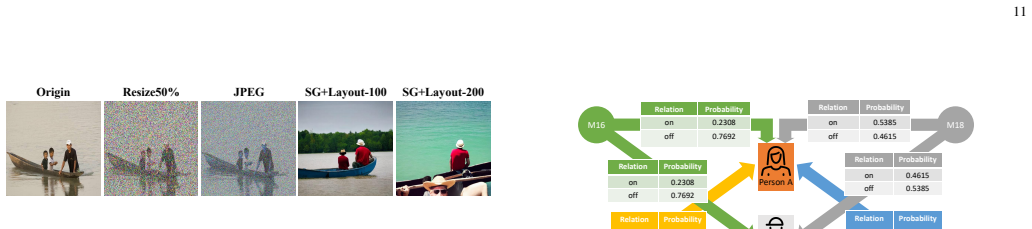
The paper's central claim is that the statistical regularities of scene descriptions can serve as a shared prior between a sender and a receiver, so that most of a scene graph never needs to be sent. A sender extracts a scene graph from an image, then deletes every relation whose conditional probability $p(r|h,t)$ exceeds 0.5 and every tail entity that is the most probable co-occurrence of its head; the receiver uses the same probability tables to insert the most probable relation and entity back. Because the remaining representation is small text, transmission of hundreds of images per second is feasible on a 5 MHz channel where JPEG manages a handful, and a latent diffusion model conditioned on the recovered scene graph plus bounding-box layouts redraws an image whose CLIP similarity to the original stays above 0.8. The paper also proposes a distributed scheme in which users upload local probability graphs to be aggregated into a shared one, and shows the shared graph compresses better than local ones.
Load-bearing premise
The whole compression gain rests on the learned probability tables matching the images actually sent: whenever the true relation or co-occurrence is not the most probable one, the receiver silently reconstructs a different triplet, and the paper does not measure how often that happens.
Editorial extensions
If this is right
- A 5 MHz link with QPSK and LDPC coding can carry hundreds of filtered scene-graph-plus-layout images per second even at 0 dB SNR, where pixel-based transmission is nearly useless.
- Filtering relations before transmission multiplies throughput by roughly 1.64 relative to sending full scene graphs, at a measurable cost in CLIP similarity and perceptual fidelity.
- Semantic alignment of regenerated images improves with diffusion-model inference steps and stabilizes near 50 steps, with both full and filtered scene graphs exceeding 0.8 CLIP similarity.
- Aggregating local probability graphs into a shared graph improves compression over any single user's local graph, with the largest gains when local datasets are small.
- Pixel-level fidelity is not preserved: LPIPS values are around 0.6, so the scheme is a semantic-content channel rather than a lossless image channel.
Reading between the lines
- An implication the paper leaves implicit: with scene-graph extraction accuracy as the new bottleneck, end-to-end performance should be measured against scene-graph recall and precision, not just image metrics; an unrecognized object is silently absent and no probability graph can restore it.
- A testable extension would be to make the sender transmit a small flag or hash for each triplet whose relation is not the modal one, turning silent misrecovery into detectable errors; the paper's design has no error-detection mechanism for non-modal relations.
- Because the compression rule deletes only the single most probable relation and the single most probable tail, generalizing the probability graph to condition on scene type or neighboring triplets is a natural next step that would compress further without changing the overall framework.
Editorial analysis
A structured set of objections, weighed in public.
Referee Report
Summary. The manuscript proposes a wireless image transmission framework in which high-level image semantics are represented as scene graphs and compressed against a shared probability graph (PG) learned from Visual Genome. At the transmitter, a two-stage algorithm prunes relations and tail entities using conditional probabilities estimated from the PG; at the receiver, the same PG is used to restore omitted relations and entities by argmax, after which a latent diffusion model reconstructs the image. The authors also introduce a distributed PG aggregation scheme, a multi-round semantic compression extension, and a piecewise-linear computation-load model. Experiments report compression ratios, throughput relative to JPEG/JPEG2000, and CLIP/LPIPS scores of reconstructed images, leading to the conclusion that scene-graph transmission achieves orders-of-magnitude throughput improvements over traditional image compression while preserving semantic consistency.
Significance. The core idea of using a shared probabilistic knowledge base to make semantic compression self-inverse is attractive: if the learned conditional distributions match the source, the receiver can in principle restore pruned relations and entities with negligible overhead. The manuscript contributes explicit compression and recovery algorithms, a distributed knowledge-base construction mechanism, and a clear separation of semantic extraction, compression, recovery, and generation. These are useful building blocks for low-bandwidth image delivery. However, the central empirical claims are not yet supported: scene-graph recovery accuracy is never measured, the pruning specification is internally inconsistent, and the throughput comparison is payload-only with no semantic-communication baselines. If the recovery accuracy issue is resolved and the comparison is made end-to-end, the framework could be a meaningful step toward practical probabilistic semantic communication.
major comments (4)
- [Sec. II-E1 / Algorithm 1] The text of Stage 1 and Algorithm 1 specify inconsistent pruning rules. The text states that if the conditional probability of the most frequent relation between a head h and tail t exceeds theta_r, then "that specific relation r" is omitted; read literally, this omits the modal relation regardless of the relation actually present in the extracted triplet, so a non-modal triplet is silently corrupted at the receiver. Algorithm 1, line 3, instead checks PMG(r|h,t) for the actual relation r, which would only omit relations that are already modal and hence correctly recovered. The two readings lead to different recovered graphs whenever a test triplet's relation is not the modal one. Please specify which rule was actually implemented and report triplet-level recovery accuracy; this is load-bearing because the CLIP and throughput claims presuppose that the recovered scene graph matches the transmitted one or that mismatches are negligible.
- [Sec. III-B / Algorithms 2] Scene-graph recovery is never evaluated. Algorithms 1 and 2 are designed to be lossy, and the mismatch rate is easy to quantify: precision and recall of recovered triplets, relation accuracy per (h,t) pair, and tail-entity accuracy. The paper reports compression ratios and end-image metrics but never reports how often the receiver's argmax reconstruction differs from the transmitter's extracted scene graph. In particular, Fig. 9 shows compression ratio versus local training size for the distributed PG, but not the corresponding recovery error; a lower compression ratio is not evidence of a reliable system if it is achieved by systematically replacing non-modal relations with modal ones. Recovery accuracy should be reported for the Visual Genome test set and for the distributed-PG scenario before the central claim of high semantic consistency is accepted.
- [Sec. III-B3 / Fig. 10] The throughput comparison is not end-to-end and omits relevant baselines. The throughput metric counts payload bytes of scene graphs versus JPEG/JPEG2000 files and does not account for the computational cost of scene-graph extraction, PG lookup, LDM inference, or the receiver-side generation process. The paper also does not compare with DeepJSCC or SemanticStyleGAN, despite reviewing JSCC methods in Sec. I-B. The conclusion of "over 200 times the throughput of JPEG" is therefore a payload-level comparison, not a system-level one. Please either restrict the throughput claim to transmitted payload size or include an end-to-end bitrate and complexity comparison.
- [Sec. II-E / Fig. 9] The robustness of the compression-recovery scheme to distribution shift is unaddressed. Because p(r|h,t) and p(t|h) are estimated once from Visual Genome training annotations, any test image whose relation is non-modal for its (h,t) pair will be reconstructed by the receiver as the modal relation, regardless of the true relation. The test set appears to be drawn from the same distribution as the PG training data, and Fig. 13 reports a single-image experiment; neither setup stresses the assumption. Please report recovery accuracy on a deliberately shifted test split, or at minimum show that the test triplets are predominantly modal relative to the training PG. This is essential before claiming reliable semantic recovery across user contexts, especially given the distributed-PG scenario proposed in Sec. II-D.
minor comments (7)
- [Abstract] "Satiable semantic alignment" appears to be a typo; it should likely be "satisfiable" or "satisfactory semantic alignment."
- [Fig. 1 caption] The caption contains untranslated Chinese characters "总体框架"; please translate or remove them.
- [Sec. III-B3] JPEG2000 is described as "lossless concerning compression." JPEG2000 supports both lossy and lossless modes, and the subsequent claim about higher resolution and larger data size needs clarification.
- [Fig. 14 caption] "Throughout" should be "throughput" in the caption text.
- [Eq. (4)] The slope condition "0 > A1 > A2 > ... > AS" is ambiguous; if the slopes are negative, please state explicitly that |A_s| increases with s, or clarify the intended ordering.
- [Algorithm 3] In line 25, the tensor indexing "T(t),...,...,r(t)m" contains a typographical error that makes the condition hard to parse.
- [Figures 9, 10, 12, 13] The plots show no error bars or confidence intervals; given the stochasticity of LDM inference and the small sample sizes in several experiments, adding them would strengthen the empirical claims.
Circularity Check
The PG-based recovery of omitted relations is the exact inverse of the omission rule (same argmax), and the multi-round 'theoretical analysis' is a self-citation; the main throughput and CLIP evaluations are external and independent, so circularity is partial.
-
self definitional
[Sec. II-E, Algorithm 1 (lines 2-7) and Algorithm 2 (lines 12-14)]
"Algorithm 1: for (h, r, t) ∈ G do if PMG(r|h, t) < 0.5 then Gfilter1 ← Gfilter1 ∪ {(h, r, t)} else Gfilter1 ← Gfilter1 ∪ {(h, t)} ... Algorithm 2: for (h, t) ∈ ˆGfilter1 do r ← arg maxr PMG(r|h, t); ˆG ← ˆG ∪ {(h, r, t)}"
An omitted relation is one with PMG(r|h,t) ≥ 0.5, which for a normalized relation distribution makes it the argmax relation; recovery sets r = arg max PMG(r|h,t). Thus the compression and recovery stages are functional inverses: anything the compressor removes is reinstated by the very same statistic that authorized its removal. The paper's later claim that 'the PG-based recovery mechanism effectively reconstructs semantic information' is therefore true by construction for the omitted components, and no scene-graph recovery error is reported that could distinguish PG-based prediction from simple inversion. This is a partial self-definitional validation, although the throughput and CLIP comparisons against JPEG/JPEG2000 are external and not circular.
-
self citation load bearing
[Sec. II-F.2, Eq. (4)]
"According to [36], the computation load of multi-round semantic compression can be modeled as c(ρ) = { A1ρ + B1, D1 ≤ ρ ≤ 1, A2ρ + B2, D2 ≤ ρ < D1, ... } (4)"
Reference [36] is 'A joint communication and computation design for probabilistic semantic communications' (Entropy, 2024) by Zhao, Yang, Chen, Zhang, and Poor, which shares authors with the present paper. The paper calls this imported piecewise-linear model its theoretical performance analysis and later states that the sensor-data simulation is 'closed to our theoretical assumption.' Since the model is neither derived in this paper nor checked against an independent derivation, the multi-round power-consumption 'theory' rests on an unverified self-citation; however, this is a side contribution rather than the core throughput/CLIP claim.
full rationale
The central claims about throughput (Fig. 10) and semantic consistency (Fig. 12) are not circular in their main comparison: JPEG/JPEG2000 baselines, LDM reconstruction, and CLIP/LPIPS metrics are external evaluation procedures, and the scene-graph data volume is measured rather than fit to the conclusion. The circularity is confined to two places. First, the compression/recovery pair in Algorithms 1 and 2 is self-definitional for the omitted components: a relation is omitted exactly when PMG(r|h,t) ≥ 0.5 and is recovered by arg max PMG(r|h,t), so a perfect recovery of omitted relations is guaranteed by construction and cannot validate the shared PG's predictive value; the paper reports no scene-graph recovery error. Second, the multi-round semantic compression 'theoretical analysis' (Eq. 4) is imported by self-citation from the authors' own [36] and only compared with a simulation described as 'closed to our theoretical assumption,' so that portion is load-bearing self-citation. The internal contradiction between the prose in Sec. II-E.1 (omitting the most frequent relation) and Algorithm 1 (omitting only the actual relation when it is probable) is an implementation/specification defect rather than a circularity, but it compounds the lack of a recovery-error measurement. Overall circularity is partial, not total.
Assumptions & free parameters
free parameters (3)
- Relation pruning threshold theta_r =
0.5
- Tail entity filtering threshold theta_t =
0.5
- Piecewise-linear load parameters A_s, B_s, D_s =
none given
assumptions (4)
- domain assumption Training distribution representativeness: p(r|h,t) and p(t|h) from Visual Genome training split apply to transmitted images.
- domain assumption Semantic extractor accuracy: ResNet-50 plus dual-branch transformer produces correct and complete scene graphs.
- domain assumption LDM conditioning fidelity: latent diffusion model conditioned on scene graph and layout generates images that preserve semantic content.
- ad hoc to paper Computational load model piecewise linearity with monotone slopes.
Cite this review
Pith. "Pith review of Scene Graph-Aided Probabilistic Semantic Communication for Image Transmission." pith.science (2026). https://pith.science/paper/CZZNFOQJ
@misc{pith2026250711913,
  author       = {Pith},
  title        = {Pith review of: Scene Graph-Aided Probabilistic Semantic Communication for Image Transmission},
  year         = {2026},
  howpublished = {\url{https://pith.science/paper/CZZNFOQJ}},
  note         = {Machine review of arXiv:2507.11913}
}
read the original abstract
Semantic communication emphasizes the transmission of meaning rather than raw symbols. It offers a promising solution to alleviate network congestion and improve transmission efficiency. In this paper, we propose a wireless image communication framework that employs probability graphs as shared semantic knowledge base among distributed users. High-level image semantics are represented via scene graphs, and a two-stage compression algorithm is devised to remove predictable components based on learned conditional and co-occurrence probabilities. At the transmitter, the algorithm filters redundant relations and entity pairs, while at the receiver, semantic recovery leverages the same probability graphs to reconstruct omitted information. For further research, we also put forward a multi-round semantic compression algorithm with its theoretical performance analysis. Simulation results demonstrate that our semantic-aware scheme achieves superior transmission throughput and satiable semantic alignment, validating the efficacy of leveraging high-level semantics for image communication.
Figures


Figures from the paper (12 more)



Reference graph
Works this paper leans on
-
[1]
A vision of 6G wireless systems: Applications, trends, technologies, and open research problems,
W. Saad, M. Bennis, and M. Chen, “A vision of 6G wireless systems: Applications, trends, technologies, and open research problems,” IEEE Network, vol. 34, no. 3, pp. 134–142, May 2020
work page 2020
-
[2]
Ultrareliable and low-latency wireless communication: Tail, risk, and scale,
M. Bennis, M. Debbah, and H. V . Poor, “Ultrareliable and low-latency wireless communication: Tail, risk, and scale,” Proceedings of the IEEE, vol. 106, no. 10, pp. 1834–1853, 2018
work page 2018
-
[3]
Z. Zhao, Z. Yang, C. Huang, L. Wei, Q. Yang, C. Zhong, W. Xu, and Z. Zhang, “A joint communication and computation design for distributed RISs assisted probabilistic semantic communication in IIoT,” IEEE Internet Things J. , vol. 11, no. 16, pp. 26 568–26 579, Aug. 2024
work page 2024
-
[4]
A mathematical theory of communication,
C. E. Shannon, “A mathematical theory of communication,” The Bell System Technical Journal, vol. 27, no. 3, pp. 379–423, 1948
1948
-
[5]
Distributed com- pressive sensing: Performance analysis with diverse signal ensembles,
S.-H. Hsieh, W.-J. Liang, C.-S. Lu, and S.-C. Pei, “Distributed com- pressive sensing: Performance analysis with diverse signal ensembles,” IEEE Transactions on Signal Processing, vol. 68, pp. 3500–3514, 2020
work page 2020
-
[6]
Near shannon limit error- correcting coding and decoding: Turbo-codes. 1,
C. Berrou, A. Glavieux, and P. Thitimajshima, “Near shannon limit error- correcting coding and decoding: Turbo-codes. 1,” in Proceedings of ICC ’93 - IEEE International Conference on Communications , vol. 2, 1993, pp. 1064–1070 vol.2
work page 1993
-
[7]
Low-density parity-check codes,
R. Gallager, “Low-density parity-check codes,” IRE Transactions on Information Theory, vol. 8, no. 1, pp. 21–28, 1962
work page 1962
-
[8]
New frequency-time scheduling algorithms for 3gpp/lte-like ofdma air interface in the downlink,
M. Assaad and A. Mourad, “New frequency-time scheduling algorithms for 3gpp/lte-like ofdma air interface in the downlink,” in VTC Spring 2008 - IEEE Vehicular Technology Conference , 2008, pp. 1964–1969
work page 2008
Show all 40 references
-
[9]
Joint power and bandwidth allocation algorithm with qos support in heterogeneous wireless networks,
J. Miao, Z. Hu, K. Yang, C. Wang, and H. Tian, “Joint power and bandwidth allocation algorithm with qos support in heterogeneous wireless networks,” IEEE Communications Letters , vol. 16, no. 4, pp. 479–481, 2012
2012
-
[10]
From semantic communication to semantic-aware networking: Model, architecture, and open problems,
G. Shi, Y . Xiao, Y . Li, and X. Xie, “From semantic communication to semantic-aware networking: Model, architecture, and open problems,” IEEE Communications Magazine , vol. 59, no. 8, pp. 44–50, 2021
2021
-
[11]
Energy-efficient probabilistic semantic communication over space-air- ground integrated networks,
Z. Zhao, Z. Yang, M. Chen, C. Zhu, W. Xu, Z. Zhang, and K. Huang, “Energy-efficient probabilistic semantic communication over space-air- ground integrated networks,” IEEE Trans. Wireless Commun. , pp. 1–1, 2025
2025
-
[12]
Beyond transmitting bits: Context, seman- tics, and task-oriented communications,
D. G ¨und¨uz, Z. Qin, I. E. Aguerri, H. S. Dhillon, Z. Yang, A. Yener, K. K. Wong, and C.-B. Chae, “Beyond transmitting bits: Context, seman- tics, and task-oriented communications,” IEEE J. Sel. Areas Commun. , vol. 41, no. 1, pp. 5–41, Nov. 2022
2022
-
[13]
Compression ratio allocation for probabilistic semantic communication with RSMA,
Z. Zhao, Z. Yang, Y . Hu, C. Zhu, M. Shikh-Bahaei, W. Xu, Z. Zhang, and K. Huang, “Compression ratio allocation for probabilistic semantic communication with RSMA,” IEEE Trans. Commun. , pp. 1–1, 2025
2025
-
[14]
Blockchain-aided secure semantic communication for ai-generated con- tent in metaverse,
Y . Lin, H. Du, D. Niyato, J. Nie, J. Zhang, Y . Cheng, and Z. Yang, “Blockchain-aided secure semantic communication for ai-generated con- tent in metaverse,” IEEE Open Journal of the Computer Society , vol. 4, pp. 72–83, 2023
2023
-
[15]
Research on some key technologies of deep learning in the field of computer vision,
Y . Mao and R. Mao, “Research on some key technologies of deep learning in the field of computer vision,” in 2024 3rd International Conference for Innovation in Technology (INOCON) , 2024, pp. 1–5
2024
-
[16]
Afsse: An interpretable classi- fier with axiomatic fuzzy set and semantic entropy,
X. Liu, W. Jia, W. Liu, and W. Pedrycz, “Afsse: An interpretable classi- fier with axiomatic fuzzy set and semantic entropy,” IEEE Transactions on Fuzzy Systems , vol. 28, no. 11, pp. 2825–2840, 2020
2020
-
[17]
Storytelling from an image stream using scene graphs,
R. Wang, Z. Wei, P. Li, Q. Zhang, and X. Huang, “Storytelling from an image stream using scene graphs,” in The Thirty-Fourth AAAI Conference on Artificial Intelligence, AAAI 2020, The Thirty-Second Innovative Applications of Artificial Intelligence Conference, IAAI 2020, The T...
2020
-
[18]
Deep joint source- channel coding for multi-task network,
M. Wang, Z. Zhang, J. Li, M. Ma, and X. Fan, “Deep joint source- channel coding for multi-task network,” IEEE Signal Processing Letters, vol. 28, pp. 1973–1977, 2021
1973
-
[19]
Deep joint source- channel coding for wireless image transmission,
E. Bourtsoulatze, D. Burth Kurka, and D. G ¨und¨uz, “Deep joint source- channel coding for wireless image transmission,” IEEE Transactions on Cognitive Communications and Networking , vol. 5, no. 3, pp. 567–579, 2019
2019
-
[20]
An overview of the jpeg 2000 still image compression standard,
M. Rabbani and R. Joshi, “An overview of the jpeg 2000 still image compression standard,” Signal Processing: Image Communication , vol. 17, no. 1, pp. 3–48, 2002, jPEG 2000. [Online]. Available: https://www.sciencedirect.com/science/article/pii/S0923596501000248
2000
-
[21]
Wireless image transmission using deep source channel coding with attention modules,
J. Xu, B. Ai, W. Chen, A. Yang, P. Sun, and M. Rodrigues, “Wireless image transmission using deep source channel coding with attention modules,” IEEE Transactions on Circuits and Systems for Video Tech- nology, vol. 32, no. 4, pp. 2315–2328, 2022
2022
-
[22]
Deep joint source-channel coding for wireless image transmission with adaptive rate control,
M. Yang and H.-S. Kim, “Deep joint source-channel coding for wireless image transmission with adaptive rate control,” in ICASSP 2022 - 2022 IEEE International Conference on Acoustics, Speech and Signal Processing (ICASSP), 2022, pp. 5193–5197
2022
-
[23]
Predictive and adaptive deep coding for wireless image transmission in semantic communication,
W. Zhang, H. Zhang, H. Ma, H. Shao, N. Wang, and V . C. M. Leung, “Predictive and adaptive deep coding for wireless image transmission in semantic communication,” IEEE Transactions on Wireless Communica- tions, vol. 22, no. 8, pp. 5486–5501, 2023
2023
-
[24]
Visual relationship detection: A survey,
J. Cheng, L. Wang, J. Wu, X. Hu, G. Jeon, D. Tao, and M. Zhou, “Visual relationship detection: A survey,” IEEE Transactions on Cybernetics , vol. 52, no. 8, pp. 8453–8466, 2022
2022
-
[25]
Fully convolutional networks for semantic segmentation,
J. Long, E. Shelhamer, and T. Darrell, “Fully convolutional networks for semantic segmentation,” in 2015 IEEE Conference on Computer Vision and Pattern Recognition (CVPR) , 2015, pp. 3431–3440
2015
-
[26]
Deep residual learning for image recognition,
K. He, X. Zhang, S. Ren, and J. Sun, “Deep residual learning for image recognition,” in 2016 IEEE Conference on Computer Vision and Pattern Recognition (CVPR), 2016, pp. 770–778
2016
-
[27]
Transferring cnn ensemble for hyperspectral image classification,
X. He and Y . Chen, “Transferring cnn ensemble for hyperspectral image classification,” IEEE Geoscience and Remote Sensing Letters , vol. 18, no. 5, pp. 876–880, 2021
2021
-
[28]
Deep knowledge training and heterogeneous cnn for handwritten chinese text recognition,
S. Wang, L. Chen, L. Xu, W. Fan, J. Sun, and S. Naoi, “Deep knowledge training and heterogeneous cnn for handwritten chinese text recognition,” in 2016 15th International Conference on Frontiers in Handwriting Recognition (ICFHR) , 2016, pp. 84–89
2016
-
[29]
Semanticstylegan: Learning compositional generative priors for controllable image synthesis and editing,
Y . Shi, X. Yang, Y . Wan, and X. Shen, “Semanticstylegan: Learning compositional generative priors for controllable image synthesis and editing,” in 2022 IEEE/CVF Conference on Computer Vision and Pattern Recognition (CVPR), 2022, pp. 11 244–11 254
2022
-
[30]
Knowledge-aided semantic communication leveraging probabilistic graphical modeling,
H. Wan, Q. Yang, J. Tang, and Z. Shi, “Knowledge-aided semantic communication leveraging probabilistic graphical modeling,” in 2024 IEEE 100th Vehicular Technology Conference (VTC2024-Fall) , 2024, pp. 1–5
2024
-
[31]
Transmit what you need: Task-adaptive semantic communications for visual information,
J. Park and S. W. Yoon, “Transmit what you need: Task-adaptive semantic communications for visual information,” 2024. [Online]. Available: https://arxiv.org/abs/2412.13646
2024
-
[32]
Image attributes: an investigation,
C. J ¨orgensen, “Image attributes: an investigation,” 1995. [Online]. Available: https://api.semanticscholar.org/CorpusID:58316018
1995
-
[33]
Visual genome: Connecting language and vision using crowdsourced dense image annotations,
R. Krishna, Y . Zhu, O. Groth, J. Johnson, K. Hata, J. Kravitz, S. Chen, Y . Kalantidis, L.-J. Li, D. A. Shamma, M. S. Bernstein, and L. Fei-Fei, “Visual genome: Connecting language and vision using crowdsourced dense image annotations,” Int. J. Comput. Vision, vol. 123, no. 1...
2017 doi
-
[34]
Reltr: Relation transformer for scene graph generation,
Y . Cong, M. Y . Yang, and B. Rosenhahn, “Reltr: Relation transformer for scene graph generation,” IEEE Transactions on Pattern Analysis and Machine Intelligence, vol. 45, no. 9, pp. 11 169–11 183, 2023
2023
-
[35]
A joint communication and computation design for semantic wireless communication with probability graph,
Z. Zhao, Z. Yang, X. Gan, Q.-V . Pham, C. Huang, W. Xu, and Z. Zhang, “A joint communication and computation design for semantic wireless communication with probability graph,” J. Franklin Inst. , vol. 361, no. 13, p. 107055, Sep. 2024
2024
-
[36]
A joint communication and computation design for probabilistic semantic com- munications,
Z. Zhao, Z. Yang, M. Chen, Z. Zhang, and H. V . Poor, “A joint communication and computation design for probabilistic semantic com- munications,” Entropy, vol. 26, no. 5, Apr. 2024
2024
-
[37]
High-resolution image synthesis with latent diffusion models,
R. Rombach, A. Blattmann, D. Lorenz, P. Esser, and B. Ommer, “High-resolution image synthesis with latent diffusion models,” in 2022 IEEE/CVF Conference on Computer Vision and Pattern Recognition (CVPR), 2022, pp. 10 674–10 685
2022
-
[38]
Learning transferable visual models from natural language supervi- sion,
A. Radford, J. Kim, C. Hallacy, A. Ramesh, G. Goh, S. Agarwal, G. Sastry, A. Askell, P. Mishkin, J. Clark, G. Krueger, and I. Sutskever, “Learning transferable visual models from natural language supervi- sion,” 02 2021
2021
-
[39]
The unreasonable effectiveness of deep features as a perceptual metric,
R. Zhang, P. Isola, A. Efros, E. Shechtman, and O. Wang, “The unreasonable effectiveness of deep features as a perceptual metric,” 01 2018
2018
-
[40]
Annotat- ing smart environment sensor data for activity learning,
S. Szewcyzk, K. Dwan, B. Minor, B. Swedlove, and D. Cook, “Annotat- ing smart environment sensor data for activity learning,” Technology and health care : official journal of the European Society for Engineering and Medicine, vol. 17, pp. 161–9, 02 2009
2009
Reviewed August 6, 2026 · model on record in the stance chip above.
Discussion (0). Sign in to comment.