REVIEW 5 major objections 4 minor 257 references
A Review of Generative AI in Aquaculture: Foundations, Applications, and Future Directions for Smart and Sustainable Farming
T0 review · 5 major / 4 minor · reviewed 2026-08-06 · deepseek-v4-flash
Pith's one-line read This review claims to be the first comprehensive synthesis of generative AI in aquaculture, and proposes a taxonomy that maps generative model families to every layer of smart aquaculture, from underwater sensing and robot mission…
desk verdict A useful but uneven review: the marine-robotics case study is solid, but the taxonomy's citation base overstates what's actually been demonstrated, and the 'first comprehensive' claim collides with a prior review the authors themselves cite. read the letter →
The pith
A machine-rendered reading of the paper's core claim, the machinery that carries it, and where it could break.
The reading
What carries the argument
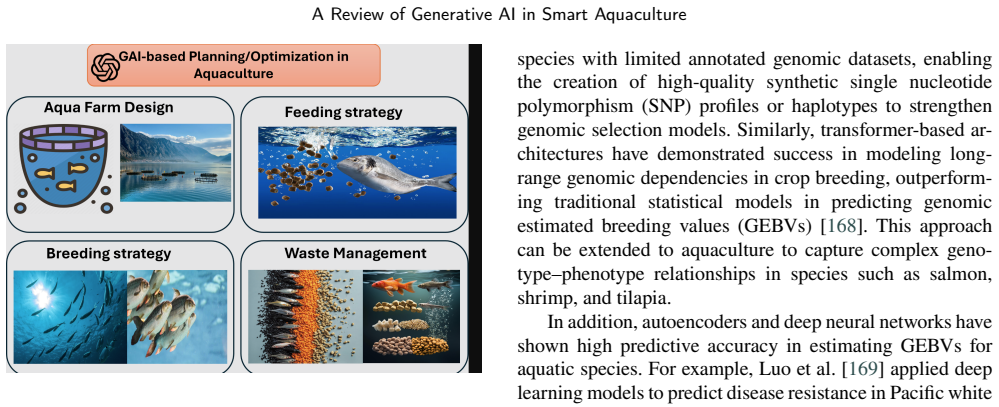
The carrying structure is the application taxonomy of Table 2, which maps generative model families (GANs, VAEs, diffusion models, LLMs, retrieval-augmented generation, and vision-language models) to aquaculture use cases with datasets and evaluation methods, alongside Table 3's catalog of GAI/LLM marine-robotics systems. The taxonomy does the argumentative work: it converts scattered case studies into a grid that shows which model types are already paired with which tasks and which tasks remain unserved. The marine-robotics case studies and the proposed roadmap for responsible adoption carry the forward-looking claims.
What would settle it
Locate in the cited sources a diffusion-model study that trains an inspection robot on simulated biofouling of fish cages; if references [70,71] are the only support given, the taxonomy entry rests on a sonar-imagery review and a GAN-based underwater-image-enhancement paper rather than on a diffusion–robot experiment, and that row of the map would not stand as written.
Extended reading notes
Core claim
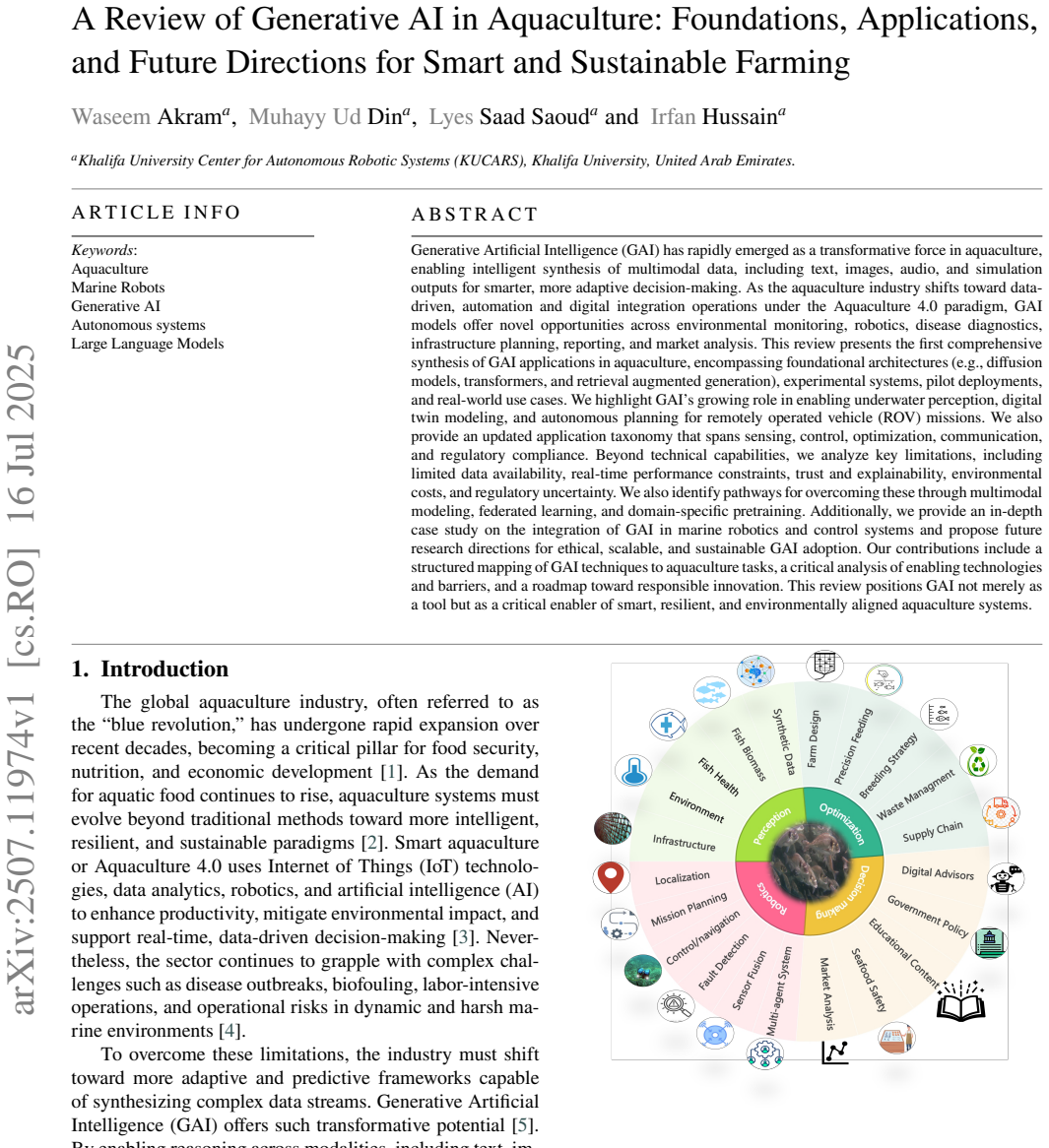
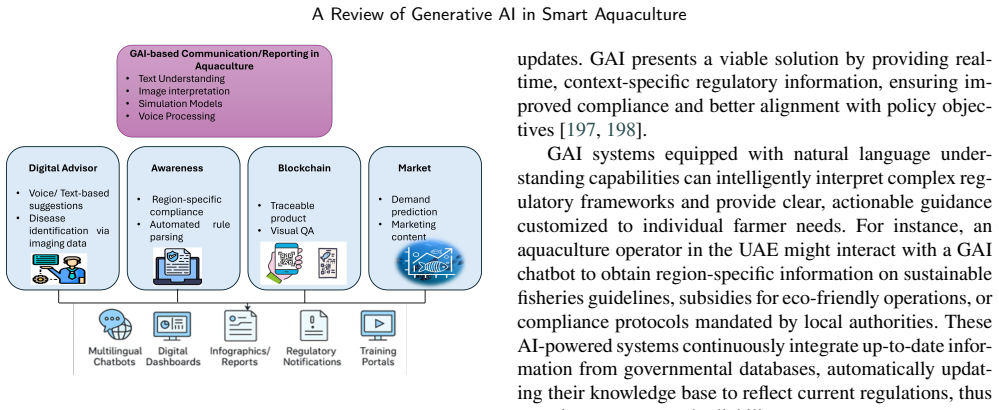
On the paper's own terms, the central discovery is that generative AI already touches every layer of the aquaculture value chain, and that a single application taxonomy can organize the field. The paper claims to be the first review to connect GAI to all key layers of smart aquaculture—from perception and automation to policy-level decision support—and to document real prototypes such as LLM-guided ROV mission planners, digital advisor chatbots, and GAI-blockchain traceability systems. It positions these not as isolated demos but as evidence that GAI is shifting from a theoretical possibility to an emerging design principle for marine robotics and farm management. The paper concludes that realizing this potential requires addressing data scarcity, real-time deployment constraints, interpretability, and regulatory safeguards.
Load-bearing premise
The review's taxonomy is only as accurate as its citations: it assumes each cited study actually deployed a generative model in aquaculture, rather than a non-generative deep-learning method or a system tested in a neighboring domain.
Editorial extensions
If this is right
- A reader can use the taxonomy to see where generative models have already been tested in aquaculture—perception, mission planning, advisory systems, reporting—and where the evidence is only adjacent or prototypical, setting priorities for new experiments.
- If the synthesis holds, language-driven planning systems for ROVs and USVs become a practical baseline for aquaculture robotics, turning natural-language commands into mission plans that can be validated in simulation.
- Digital twin and synthetic-data pipelines become a standard route to overcome data scarcity in underwater perception, with GAN and diffusion augmentation as the enabling layer for training inspection models.
- The roadmap's proposed directions—multimodal fusion, federated learning, domain-specific pretraining, and standardized benchmarks—would, if followed, make GAI aquaculture systems more reliable, comparable, and easier to deploy at the edge.
Reading between the lines
- A skeptical reader should treat each taxonomy row as a claim to verify against the primary source; several rows appear to cite non-generative deep learning or adjacent-domain systems, so the truly proven core of the map may be smaller than the table suggests.
- The paper's emphasis on data scarcity implies a testable extension: measure how much synthetic underwater imagery from diffusion models improves downstream net-inspection segmentation relative to real data, which would quantify the load-bearing benefit of synthetic generation.
- If the proposed federated and domain-pretraining directions are followed, the field would need an aquaculture-specific benchmark suite to compare generalist foundation models against domain-specialized ones; the paper calls for such benchmarks but does not build them.
- Because the review treats regulatory compliance as an application layer, a natural extension is a regulatory-grade evaluation of LLM-generated compliance documents against official legal frameworks, a test the paper identifies as open.
Editorial analysis
A structured set of objections, weighed in public.
Referee Report
Summary. The manuscript is a review of generative AI (GAI) applications in aquaculture. It introduces core GAI architectures, proposes an application taxonomy spanning sensing, robotics, planning, optimization, communication, and compliance, surveys case studies in marine robotics (Table 3), and discusses limitations and future directions. The central claim is that it provides the first comprehensive synthesis of GAI in aquaculture and a reliable map of demonstrated generative-model use across the sector.
Significance. If the synthesis were accurate, it would be a useful entry point for researchers and practitioners, organizing a rapidly growing literature and identifying gaps. The paper's Table 3 catalog of LLM-based marine robotics systems (e.g., OceanChat, OceanPlan, Word2Wave) is concrete and largely well-chosen, and the discussion of deployment barriers (Section 5) is balanced and thoughtful. However, the value of a review stands or falls on the accuracy of its citation base; the specific mis-citations and overclaims identified below are load-bearing for the paper's central promise of a reliable map of proven GAI capabilities.
major comments (5)
- [3.1.1] The sentence beginning 'For example, generative diffusion models have been used successfully to simulate diverse biofouling conditions on fish cages...' (p.7) is not supported by the cited references. Reference [70] is a review of deep learning for sonar imagery analysis, and [71] is a GAN-based underwater image enhancement paper; neither reports diffusion-based simulation of biofouling or robots trained on such synthetic data. This is a concrete instance of the review presenting adjacent or non-generative work as demonstrated GAI application, which directly undermines the stated goal of mapping what has actually been tested.
- [3.1.2] The claim that 'deep learning has been effectively utilized to synthesize realistic visual data representing diseases such as sea lice infestations, fungal infections, or bacterial diseases [76]' is supported only by a 2005 disease-management review (Bondad-Reantaso et al.) that contains no generative modeling. The passage should be rewritten to distinguish between disease detection using discriminative deep learning and actual generative synthesis of disease imagery, or it should cite primary studies that perform such synthesis.
- [3.4.3] The statement that 'practical deployments of combined GAI-blockchain systems have already been explored in sustainable shrimp farming initiatives in Southeast Asia [209], such as IBM Food Trust pilots in Vietnam and Thailand [210,211,212]' is not supported by the cited references. [209] describes an IBM Food Trust blockchain pilot without a generative component, and [211] is a general manufacturing quality-control paper. These citations do not demonstrate GAI-blockchain deployment in aquaculture, so the claim should be corrected to reflect that such integration is at most a proposal or adjacent development.
- [Table 2] Table 2 is central to the paper's contribution as a 'structured mapping of GAI techniques to aquaculture tasks,' but many rows list models that are not generative at all (e.g., CNNs/LSTMs, YOLOv8, AIoT frameworks, and drone-based visual models). This conflation of general deep learning with GAI is not limited to one row; it recurs across the table and in the surrounding text of Section 3. Without a clear distinction between generative and non-generative methods, the table does not yet deliver the promised GAI-specific synthesis.
- [Introduction] The abstract and Introduction claim 'the first comprehensive synthesis of GAI applications in aquaculture,' but the authors themselves cite Fini et al. [13]/[38], a prior review titled 'Application of generative artificial intelligence in the aquacultural sector' (Aquacultural Engineering, 2025). The manuscript needs to either identify a precise scope difference (e.g., the robotics/planning/compliance emphasis) or soften the novelty claim; in its current form the claim is contradicted by the authors' own bibliography.
minor comments (4)
- [References] References [13] and [38] are identical (Fini et al.), and references [8] and [40] appear to be the same work (Aung et al., 2025); these duplicates should be consolidated.
- [Figure 3] Figure 3 reports a Scopus count, but the search query, date, and inclusion criteria are not stated; a brief methodological note would improve reproducibility.
- [p.20] The section title 'Decleration' should be 'Declaration'.
- [Section 4.1] The phrase 'GPT and SLM-based models' uses 'SLM' without defining it; if it refers to small language models, it should be spelled out on first use.
Circularity Check
No significant circularity: the review's synthesis and taxonomy are not derived from its own inputs or self-citations.
full rationale
This paper is a literature review, not a derivation with equations or fitted parameters, so the main circularity patterns (self-definitional claims, fitted inputs called predictions, uniqueness imported from authors, ansatz smuggled via citation) do not apply. The central contribution is a taxonomy and synthesis of cited work. The authors' self-citations ([74], [95], [97], [98], [103]) are used for illustrative figures, background on underwater vision, and general support; none of these is the sole load-bearing evidence for the review's conclusions. Several passages do cite references that do not clearly demonstrate generative AI in aquaculture (e.g., Section 3.1.1 cites [70] and [71] for diffusion-based biofouling simulation, but those are a sonar-imagery review and a GAN-based enhancement paper), and the claim of being the 'first comprehensive synthesis' is in tension with the paper's own citation [13], which is a prior review of GAI in aquaculture. These are accuracy, support, and novelty concerns, not circularity: the review's claims are not true by construction, and no cited result is equivalent to the paper's own output. Accordingly, the circularity score is 0.
Assumptions & free parameters
assumptions (3)
- domain assumption Generative AI includes LLMs, diffusion models, GANs, VAEs, and RAG, and these are applicable to the aquaculture tasks listed.
- domain assumption The cited literature accurately describes GAI systems and their performance in aquaculture.
- domain assumption The Scopus publication trend in Figure 3 is representative of the field.
Cite this review
Pith. "Pith review of A Review of Generative AI in Aquaculture: Foundations, Applications, and Future Directions for Smart and Sustainable Farming." pith.science (2026). https://pith.science/paper/ZJGRR7JS
@misc{pith2026250711974,
  author       = {Pith},
  title        = {Pith review of: A Review of Generative AI in Aquaculture: Foundations, Applications, and Future Directions for Smart and Sustainable Farming},
  year         = {2026},
  howpublished = {\url{https://pith.science/paper/ZJGRR7JS}},
  note         = {Machine review of arXiv:2507.11974}
}
read the original abstract
Generative Artificial Intelligence (GAI) has rapidly emerged as a transformative force in aquaculture, enabling intelligent synthesis of multimodal data, including text, images, audio, and simulation outputs for smarter, more adaptive decision-making. As the aquaculture industry shifts toward data-driven, automation and digital integration operations under the Aquaculture 4.0 paradigm, GAI models offer novel opportunities across environmental monitoring, robotics, disease diagnostics, infrastructure planning, reporting, and market analysis. This review presents the first comprehensive synthesis of GAI applications in aquaculture, encompassing foundational architectures (e.g., diffusion models, transformers, and retrieval augmented generation), experimental systems, pilot deployments, and real-world use cases. We highlight GAI's growing role in enabling underwater perception, digital twin modeling, and autonomous planning for remotely operated vehicle (ROV) missions. We also provide an updated application taxonomy that spans sensing, control, optimization, communication, and regulatory compliance. Beyond technical capabilities, we analyze key limitations, including limited data availability, real-time performance constraints, trust and explainability, environmental costs, and regulatory uncertainty. This review positions GAI not merely as a tool but as a critical enabler of smart, resilient, and environmentally aligned aquaculture systems.
Figures


Figures from the paper (9 more)


Reference graph
Works this paper leans on
-
[13]
C. Fini, S. G. Amato, D. Scutaru, S. Biancardi, F. Antonucci, S. Violino, L. Ortenzi, E. N. Nemmi, A. Mei, F. Pallottino, et al., Application of generative artificial intelligence in the aquacultural sector, Aquacultural Engineering (2025) 102568
2025
-
[70]
Y.Chai,H.Yu,L.Xu,D.Li,Y.Chen, Deeplearningalgorithmsfor sonar imagery analysis and its application in aquaculture: A review, IEEE Sensors Journal 23 (2023) 28549–28563
2023
-
[71]
Panetta, L
K. Panetta, L. Kezebou, V. Oludare, S. Agaian, Comprehensive underwaterobjecttrackingbenchmarkdatasetandunderwaterimage enhancement with gan, IEEE Journal of Oceanic Engineering 47 (2021) 59–75
2021
-
[76]
M. G. Bondad-Reantaso, R. P. Subasinghe, J. R. Arthur, K. Ogawa, S. Chinabut, R. Adlard, Z. Tan, M. Shariff, Disease and health management in asian aquaculture, Veterinary parasitology 132 (2005) 249–272
2005
-
[209]
Chase, Nfi, sirf partner on seafood blockchain pilot with ibm, SeafoodSource, 2019
C. Chase, Nfi, sirf partner on seafood blockchain pilot with ibm, SeafoodSource, 2019. URL: https: //www.seafoodsource.com/news/environment-sustainability/ nfi-sirf-partner-on-seafood-blockchain-pilot-with-ibm , national FisheriesInstituteandSeafoodIndustryResearchFundpartnerwith IBM Food Trust for seafood supply chain traceability
work page 2019
-
[211]
M.R.Islam,M.Z.H.Zamil,M.E.Rayed,M.M.Kabir,M.Mridha, S.Nishimura,J.Shin,Deeplearningandcomputervisiontechniques for enhanced quality control in manufacturing processes, IEEE Access (2024)
work page 2024
-
[38]
C. Fini, S. Amato, D. Scutaru, C. Costa, Application of generative artificial intelligence in the aquacultural sector, Aquacultural Engi- neering (2025)
2025
-
[1]
Subasinghe, D
R. Subasinghe, D. Soto, J. Jia, Global aquaculture and its role in sustainable development, Reviews in aquaculture 1 (2009) 2–9
2009
Show all 257 references
-
[2]
URL: https://openknowledge.fao.org/server/api/core/bitstreams/ a2090042-8cda-4f35-9881-16f6302ce757/content , accessed: 2025- 05-21
FAO, The State of World Fisheries and Aquaculture 2022: Towards Blue Transformation, FAO, Rome, 2022. URL: https://openknowledge.fao.org/server/api/core/bitstreams/ a2090042-8cda-4f35-9881-16f6302ce757/content , accessed: 2025- 05-21
2022
-
[3]
Biazi, C
V. Biazi, C. Marques, Industry 4.0-based smart systems in aquacul- ture:Acomprehensivereview,AquaculturalEngineering103(2023) 102360
2023
-
[4]
Mandal, A
A. Mandal, A. R. Ghosh, Role of artificial intelligence (ai) in fish growth and health status monitoring: a review on sustainable aquaculture, Aquaculture International 32 (2024) 2791–2820
2024
-
[5]
R.Bommasani,D.A.Hudson,E.Adeli,R.Altman,S.Arora,S.von Arx, M. S. Bernstein, J. Bohg, A. Bosselut, E. Brunskill, et al., On the opportunities and risks of foundation models, arXiv preprint arXiv:2108.07258 (2021)
2021 arXiv
-
[6]
Akkem, S
Y. Akkem, S. K. Biswas, A. Varanasi, A comprehensive review of synthetic data generation in smart farming by using variational autoencoder and generative adversarial network, Engineering Ap- plications of Artificial Intelligence 131 (2024) 107881
2024
-
[7]
S. H. Vemprala, R. Bonatti, A. Bucker, A. Kapoor, Chatgpt for robotics:Designprinciplesandmodelabilities, IeeeAccess(2024)
2024
-
[8]
T. Aung, R. Abdul Razak, A. Rahiman Bin Md Nor, Artificial intelligence methods used in various aquaculture applications: A systematic literature review, Journal of the World Aquaculture Society 56 (2025) e13107
2025
-
[9]
L. Yang, Z. Zhang, Y. Song, S. Hong, R. Xu, Y. Zhao, W. Zhang, B. Cui, M.-H. Yang, Diffusion models: A comprehensive survey of methods and applications, ACM Computing Surveys 56 (2023) 1–39
2023
-
[10]
C. Wang, Z. Li, T. Wang, X. Xu, X. Zhang, D. Li, Intelligent fish farm—the future of aquaculture, Aquaculture International (2021) 1–31
2021
-
[11]
Y. Ma, Z. Song, Y. Zhuang, J. Hao, I. King, A survey on vision-language-action models for embodied ai, arXiv preprint arXiv:2405.14093 (2024)
2024 arXiv
-
[12]
J. Wen, Y. Zhu, J. Li, M. Zhu, Z. Tang, K. Wu, Z. Xu, N. Liu, R. Cheng, C. Shen, et al., Tinyvla: Towards fast, data-efficient vision-language-action models for robotic manipulation, IEEE Robotics and Automation Letters (2025)
2025
-
[14]
Trigka, E
M. Trigka, E. Dritsas, The evolution of generative ai: Trends and applications, IEEE Access (2025)
2025
-
[15]
Balasubramaniam, V
S. Balasubramaniam, V. Chirchi, S. Kadry, T. Sivakumar, The road ahead: Emerging trends, unresolved issues, and concluding remarks in generative ai—a comprehensive review, International Journal of Intelligent Systems (2024)
2024
-
[16]
J. Li, C. Zhang, W. Zhu, Y. Ren, A comprehensive survey of image generation models based on deep learning, Annals of Data Science (2025)
2025
-
[17]
Aymen, A
F. Aymen, A. Pester, F. Andres, Synthetic water crystal image generation using vae-gans and diffusion models, in: Lecture Notes in Networks and Systems, 2024
2024
-
[18]
Accessed: 2025-06-17
OpenAI,Chatgpt:Optimizinglanguagemodelsfordialogue, https: //openai.com/blog/chatgpt, 2023. Accessed: 2025-06-17
2023
-
[19]
K. Kim, K. Cho, R. Jang, N. Kim, Updated primer on generative artificialintelligenceandlargelanguagemodelsinmedicalimaging for medical professionals, Korean Journal of Radiology (2024)
2024
-
[20]
P.Rouzrokh,B.Khosravi,S.Faghani,B.Erickson, Acurrentreview ofgenerativeaiinmedicine:Coreconcepts,applications,andcurrent limitations, Current Reviews in Musculoskeletal Medicine (2025)
2025
-
[21]
Akram et al.:Preprint submitted to Elsevier Page 20 of 26 A Review of Generative AI in Smart Aquaculture Machine Intelligence 45 (2023) 10850–10869
F.-A.Croitoru,V.Hondru,R.T.Ionescu,M.Shah, Diffusionmodels in vision: A survey, IEEE Transactions on Pattern Analysis and W. Akram et al.:Preprint submitted to Elsevier Page 20 of 26 A Review of Generative AI in Smart Aquaculture Machine Intelligence 45 (2023) 10850–10869
2023
-
[22]
Pinheiro Cinelli, M
L. Pinheiro Cinelli, M. Araújo Marins, E. A. Barros da Silva, S. Lima Netto, Variational autoencoder, in: Variational methods for machine learning with applications to deep networks, Springer, 2021, pp. 111–149
2021
-
[23]
C. Li, T. Zhang, X. Du, H. Xie, Generative ai models for different steps in architectural design: A literature review, Frontiers of Architectural Research (2025)
2025
-
[24]
Mitra, I
R. Mitra, I. Zualkernan, Music generation using deep learning and generative ai: A systematic review, IEEE Access (2025)
2025
-
[25]
Waisberg, J
E. Waisberg, J. Ong, S. Kamran, A. Tavakkoli, Generative artificial intelligence in ophthalmology, Survey of Ophthalmology (2025)
2025
-
[26]
Huang, T
L. Huang, T. Oki, Enhancing people’s walking preferences in street design through generative artificial intelligence and crowdsourcing surveys: The case of tokyo, Environment and Planning B: Urban Analytics and City Science (2025)
2025
-
[27]
K.Kaswan,J.Dhatterwal,K.Malik,A.Baliyan, Generativeai:Are- viewonmodelsandapplications, in:2023InternationalConference on Communication, Security and Artificial Intelligence (ICCSAI), 2023
2023
-
[28]
Saxena, J
D. Saxena, J. Cao, Generative adversarial networks (gans) chal- lenges, solutions, and future directions, ACM Computing Surveys (CSUR) 54 (2021) 1–42
2021
-
[29]
Rombach, A
R. Rombach, A. Blattmann, D. Lorenz, P. Esser, B. Ommer, High- resolution image synthesis with latent diffusion models, arXiv preprint arXiv:2112.10752, 2022. URL: https://arxiv.org/abs/ 2112.10752
2022 arXiv
-
[30]
AI, Deepseek-vl: Vision-language large model,https://github
D. AI, Deepseek-vl: Vision-language large model,https://github. com/deepseek-ai/DeepSeek-VL, 2024. Accessed: 2025-06-17
2024
-
[31]
Ramesh, M
A. Ramesh, M. Pavlov, G. Goh, S. Gray, C. Voss, A. Radford, M. Chen, I. Sutskever, Zero-shot text-to-image generation, arXiv preprint arXiv:2102.12092, 2021. URL: https://arxiv.org/abs/ 2102.12092
2021 arXiv
-
[32]
J. Li, M. Xu, L. Xiang, D. Chen, W. Zhuang, X. Yin, Z. Li, Foundation models in smart agriculture: Basics, opportunities, and challenges, Computers and Electronics in Agriculture 222 (2024) 109032
2024
-
[33]
Ubina, S
N. Ubina, S. Cheng, H. Chen, H. Lan, A visual aquaculture system using a cloud-based autonomous drones, Drones (2021)
2021
-
[34]
S. Roy, M. Beg, S. Bhagat, T. Kim, Application of artificial intelligence in aquaculture – recent developments and prospects, Aquacultural Engineering (2025)
2025
-
[35]
H.Yang,Q.Feng,S.Xia,Y.Zhang,Ai-drivenaquaculture:Areview oftechnologicalinnovationsandtheirsustainableimpacts, Artificial Intelligence in Agriculture (2025)
2025
-
[36]
J. Kong, S. Tang, J. Feng, X. Jin, Aasnet: A novel image instance segmentation framework for fine-grained fish recognition, Applied Sciences (2025)
2025
-
[37]
Sundaravadivel, P
P. Sundaravadivel, P. Roselyn, V. Narayanaswamy, A. Khanal, Inte- grating image-based llms on edge-devices for underwater robotics, in: SPIE Proceedings, 2024
2024
-
[39]
Fortino, S
A. Fortino, S. Gaur, Generative artificial intelligence as the killer app: Revolutionizing human–robot interaction, in: Synergy of AI and Fintech in the Digital Gig Economy, Springer, 2025
2025
-
[40]
T. Aung, R. Abdul Razak, A. Rahiman Bin Md Nor, Artificial intelligence methods used in various aquaculture applications: A systematic literature review, Journal of the World Aquaculture Society (2025)
2025
-
[41]
Ragab, S
S. Ragab, S. Hoseinifar, H. Van Doan, E. El-Haroun, Overview of aquaculture artificial intelligence (aai) applications: Enhance sustainability and productivity, reduce labor costs, and increase the quality of aquatic products, Annals of Animal Science (2025)
2025
-
[42]
Jasmin, P
A. Jasmin, P. Ramesh, M. Tanveer, Development of artificial intelligence-based chatbot for smart aquafarm practices, Expert Systems (2024)
2024
-
[43]
Bhusan, S
S. Bhusan, S. Iburahim, J. Akash, U. Arisekar, Emerging trends in information technology with reference to fisheries and aquaculture, Information Technology in Fisheries and Aquaculture (2025)
2025
-
[44]
Y.Zhang,Y.Liu,Z.Jiong,E.Chen, Developmentandassessmentof blockchain-iot-based traceability system for frozen aquatic product, Journal of Food Process Engineering (2021)
2021
-
[45]
Narang, A
G. Narang, A. Galdelli, A. Tassetti, A. Mancini, Precision aqua- culture framework for remote mussel growth monitoring with iot blockchain and cloud integration, in: IEEE International Workshop on Metrology for the Sea (MetroSea), 2024
2024
-
[46]
D. Roy, M. Padhiary, P. Roy, J. Barbhuiya, Artificial intelligence- driven smart aquaculture: Revolutionizing sustainability through automation and machine learning, LatIA (2024)
2024
-
[47]
Krivoguz, A
D. Krivoguz, A. Ioshpa, S. Chernyi, K. Gritsenko, Real-time epizootic monitoring with inception dnn for maritime applications, Transactions on Maritime Science (2025)
2025
-
[48]
N.Shang,C.Zhang,W.Zhang,Y.Zhang, Assessmentoffishhealth status for waterless transportation via deep learning, Aquaculture (2025)
2025
-
[49]
H.Zhang,Z.Tian,L.Liu,L.Zeng, Real-timedetectionofdeadfish forunmannedaquaculturebyyolov8-baseduav,Aquaculture(2025)
2025
-
[50]
Zhang, J
Z. Zhang, J. Li, C. Su, C. Liu, A method for counting fish based on improved yolov8, Aquacultural Engineering (2024)
2024
-
[51]
Steele, R
S. Steele, R. Ranjan, K. Sharrer, C. Good, Computer-simulated virtual image datasets to train ml models for non-invasive fish detection, Sensors (2024)
2024
-
[52]
P.Arepalli,J.Naik,J.Rout, Aquaculturewaterqualityclassification with sparse attention transformers, in: ACM ICPS, 2024
2024
-
[53]
S.Kanwal,M.Abdullah,S.Kumar,D.Kumar,Anoptimaliot-driven decision-making system for real-time fishpond monitoring, Sensors (2024)
2024
-
[54]
Bendel, N
O. Bendel, N. Zbinden, The animal whisperer project, in: ACM International Conference Proceeding Series, 2024
2024
-
[55]
Huang, S
Y.-P. Huang, S. Khabusi, Artificial intelligence of things (aiot) advances in aquaculture: A review, Processes (2025)
2025
-
[56]
Fortino, S
A. Fortino, S. Gaur, Generative artificial intelligence as the killer app: Revolutionizing human–robot interaction, in: Synergy of AI and Fintech in the Digital Gig Economy, Springer, 2024
2024
-
[57]
Srikanth, V
M. Srikanth, V. Varma, S. Aziz, V. Bharath, Ai-optimised model for resource management in aquaculture-agriculture systems, in: Proceedings of the 4th International Conference on Ubiquitous Computing and Intelligent Information Systems (ICUIS), 2024
2024
-
[58]
Rafiq, S
K. Rafiq, S. Beery, M. Palmer, B. Abrahms, Generative ai as a tool to accelerate the field of ecology, Nature Ecology and Evolution (2025)
2025
-
[59]
Pallottino, S
F. Pallottino, S. Violino, S. Figorilli, L. Ortenzi, Applications and perspectives of generative artificial intelligence in agriculture, Computers and Electronics in Agriculture (2025)
2025
-
[60]
E.Gogou,I.Semenoglou,A.Grasmann,P.Taoukis,Implementation of blockchain in food supply chains: Field test monitoring of fresh aquaculture fish cold chain, in: Refrigeration Science and Technol- ogy, 2020
2020
-
[61]
Sevin, S
S. Sevin, S. Dikel, Building a collaborative aquaculture research ecosystem with apis and ai, Aquatic Sciences and Engineering (2025)
2025
-
[62]
Weichelt, M
B. Weichelt, M. Pilz, R. Burke, K. Namkoong, The potential of ai andchatgptinimprovingagriculturalinjuryandillnesssurveillance programming and dissemination, Journal of Agromedicine (2024)
2024
-
[63]
S.Qiao,H.Yu,J.Song,W.Huang, Tda-glm:textdataaugmentation for aquaculture disease prevention and control via a small model- guided chatglm, Aquaculture International (2025)
2025
-
[64]
Nugraha, I
F. Nugraha, I. Saputra, H. Triana, Sumanto, From traditional to innovation: Large language models in fisheries data extraction, in: ICITRI 2024, 2024
2024
-
[65]
Z. Li, S. Zhang, P. Cao, Z. An, Research on fine-tuning strategies for text classification in the aquaculture domain by combining deep learning and large language models, Aquaculture International (2025). W. Akram et al.:Preprint submitted to Elsevier Page 21 of 26 A Review of...
2025
-
[66]
Jiang, R
L. Jiang, R. Zhao, C. Dong, S. Fang, Construction and verification of the visual knowledge map of aquatic diseases based on deep learning, Nongye Gongcheng Xuebao (2023)
2023
-
[67]
Leite, J
M. Leite, J. Abe, M. Souza, I. de Alencar Nääs, Enhancing envi- ronmental control in broiler production: Retrieval-augmented gen- eration for improved decision-making with large language models, AgriEngineering (2025)
2025
-
[68]
K. Pugh, M. Musavi, T. Johnson, B. Pugh, Neural nets for sus- tainability conversations: modeling discussion disciplines and their impacts, Neural Computing and Applications (2023)
2023
-
[69]
Rahman, M
A. Rahman, M. Xi, J. J. Dabrowski, J. McCulloch, S. Arnold, M. Rana, A. George, M. Adcock, An integrated framework of sensing, machine learning, and augmented reality for aquaculture prawn farm management, Aquacultural Engineering 95 (2021) 102192
2021
-
[72]
M. Á. González-Santamarta, F. J. Rodríguez-Lera, Á. M. Guerrero- Higueras,V.Matellán-Olivera, Integrationoflargelanguagemodels withincognitivearchitecturesforautonomousrobots, arXivpreprint arXiv:2309.14945 (2023)
2023 arXiv
-
[73]
Elmezain, L
M. Elmezain, L. S. Saoud, A. Sultan, M. Heshmat, L. Seneviratne, I.Hussain, Advancingunderwatervision:Asurveyofdeeplearning modelsforunderwaterobjectrecognitionandtracking, IEEEAccess (2025)
2025
-
[74]
Akram, T
W. Akram, T. Hassan, H. Toubar, M. Ahmed, N. Miškovic, L. Seneviratne, I. Hussain, Aquaculture defects recognition via multi-scale semantic segmentation, Expert systems with applica- tions 237 (2024) 121197
2024
-
[75]
Assefa, F
A. Assefa, F. Abunna, Maintenance of fish health in aquaculture: review of epidemiological approaches for prevention and control of infectious disease of fish, Veterinary medicine international 2018 (2018) 5432497
2018
-
[77]
K. Kim, H. Myung, Autoencoder-combined generative adversarial networks for synthetic image data generation and detection of jelly- fish swarm, IEEE Access 6 (2018) 54207–54214
2018
-
[78]
Gupta, E
A. Gupta, E. Bringsdal, K. M. Knausgård, M. Goodwin, Accurate wound and lice detection in atlantic salmon fish using a convolu- tional neural network, Fishes 7 (2022) 345
2022
-
[79]
D. Li, X. Li, Q. Wang, Y. Hao, Advanced techniques for the intelligent diagnosis of fish diseases: A review, Animals 12 (2022) 2938
2022
-
[80]
Zhang, Y
T. Zhang, Y. Yang, Y. Liu, C. Liu, R. Zhao, D. Li, C. Shi, Fully automatic system for fish biomass estimation based on deep neural network, Ecological Informatics 79 (2024) 102399
2024
-
[81]
Abinaya, D
N. Abinaya, D. Susan, R. K. Sidharthan, Deep learning-based segmental analysis of fish for biomass estimation in an occulted environment, Computers and Electronics in Agriculture 197 (2022) 106985
2022
-
[82]
Zahir, Y
M. Zahir, Y. Su, M. I. Shahzad, G. Ayub, S. U. Rehman, J. Ijaz, A review on monitoring, forecasting, and early warning of harmful algal bloom, Aquaculture (2024) 741351
2024
-
[83]
Accessed: 2025-05-27
IEEE Spectrum, Aquaculture, https://spectrum.ieee.org/ aquaculture, 2024. Accessed: 2025-05-27
2024
-
[84]
innovasea.com/aquaculture-intelligence/biomass-estimation/,
Innovasea, Biomass estimation for aquaculture, https://www. innovasea.com/aquaculture-intelligence/biomass-estimation/,
-
[85]
A. N. America, Google sister company helps usher in precision aquaculture, https://www.aquaculturenorthamerica.com/ google-sister-company-helps-usher-in-precision-aquaculture/ ,
-
[86]
English, M
G. English, M. J. Lawrence, C. W. McKindsey, A. Lacoursière- Roussel, H. Bergeron, S. Gauthier, B. F. Wringe, M. Trudel, A reviewofdatacollectionmethodsusedtomonitortheassociationsof wild species with marine aquaculture sites, Reviews in Aquaculture 16 (2024) 1160–1185
2024
-
[87]
Q. Ren, X. Wang, W. Li, Y. Wei, D. An, Research of dissolved oxygen prediction in recirculating aquaculture systems based on deep belief network, Aquacultural Engineering 90 (2020) 102085
2020
-
[88]
E. Eze, T. Ajmal, Dissolved oxygen forecasting in aquaculture: A hybrid model approach, Applied Sciences 10 (2020) 7079
2020
-
[89]
Pachaiyappan, G
P. Pachaiyappan, G. Chidambaram, A. Jahid, M. H. Alsharif, En- hancing underwater object detection and classification using ad- vancedimagingtechniques:anovelapproachwithdiffusionmodels, Sustainability 16 (2024) 7488
2024
-
[90]
yosemitech.com/MULTI/Y4003-Deep-Water-Multi-parameter-Sensor
Yosemitech, Y4003 deep water multi-parameter sensor,https://e. yosemitech.com/MULTI/Y4003-Deep-Water-Multi-parameter-Sensor. html, 2024. Accessed: 2025-05-27
2024
-
[91]
T. I. Ltd, Water temperature logger sensor,https://www.tempcon. co.uk/data-loggers/underwater/water-temperature-logger-sensor ,
-
[92]
Magazine, Autonomous sensor solutions for ocean ph and oxygen observations, https://ecomagazine.com/in-depth/ autonomous-sensor-solutions-for-ocean-ph-and-oxygen-observations/ ,
E. Magazine, Autonomous sensor solutions for ocean ph and oxygen observations, https://ecomagazine.com/in-depth/ autonomous-sensor-solutions-for-ocean-ph-and-oxygen-observations/ ,
-
[93]
O. S. Technology, Underwater pressure sensors, https://www.oceansciencetechnology.com/suppliers/ underwater-pressure-sensors/, 2024. Accessed: 2025-05-27
2024
-
[94]
J. Li, X. Zhang, Q. Hu, F. Zhang, O. Gaida, L. Chen, Data augmentation technique based on improved time-series generative adversarial networks for power load forecasting in recirculating aquaculture systems, Sustainability 16 (2024) 10721
2024
-
[95]
L.SaadSaoud,Z.Niu,A.Sultan,L.Seneviratne,I.Hussain, Adod: Adaptive domain-aware object detection with residual attention for underwater environments, in: 2023 21st International Conference on Advanced Robotics (ICAR), 2023, pp. 633–638. doi:10.1109/ ICAR58858.2023.10436502
2023
-
[96]
Accessed: 2025-05-27
2025
-
[97]
Hussain, Seeing through the haze: A comprehensive review of underwaterimageenhancementtechniques, IEEEAccess12(2024) 145206–145233
L.SaadSaoud,M.Elmezain,A.Sultan,M.Heshmat,L.Seneviratne, I. Hussain, Seeing through the haze: A comprehensive review of underwaterimageenhancementtechniques, IEEEAccess12(2024) 145206–145233
2024
-
[98]
Saad Saoud, Z
L. Saad Saoud, Z. Niu, L. Seneviratne, I. Hussain, Real-time and resource-efficient multi-scale adaptive robotics vision for underwa- ter object detection and domain generalization, in: 2024 IEEE International Conference on Image Processing (ICIP), 2024, pp. 3917–3923. doi:10....
2024
-
[99]
D. Guihen, The challenges and opportunities for the use of robotic autonomous robotic systems in support of the blue economy, in: International Conference on Offshore Mechanics and Arctic Engi- neering,volume86922,AmericanSocietyofMechanicalEngineers, 2023, p. V010T13A008
2023
-
[100]
Natarajan, K
P. Natarajan, K. Basha, A. Nambiar, Synth-sonar: Sonar image synthesis with enhanced diversity and realism via dual diffusion modelsandgptprompting,arXivpreprintarXiv:2410.08612(2024)
2024 arXiv
-
[101]
Bayat, N
B. Bayat, N. Crasta, A. Crespi, A. M. Pascoal, A. Ijspeert, Environ- mental monitoring using autonomous vehicles: a survey of recent searching techniques, Current opinion in biotechnology 45 (2017) 76–84
2017
-
[102]
S. Yang, O. Nachum, Y. Du, J. Wei, P. Abbeel, D. Schuurmans, Foundation models for decision making: Problems, methods, and opportunities, arXiv preprint arXiv:2303.04129 (2023)
2023 arXiv
-
[103]
Heshmat, L
M. Heshmat, L. Saad Saoud, M. Abujabal, A. Sultan, M. Elmezain, L. Seneviratne, I. Hussain, Underwater slam meets deep learning: Challenges, multi-sensor integration, and future directions, Sensors 25 (2025) 3258. W. Akram et al.:Preprint submitted to Elsevier Page 22 of 26 A ...
2025
-
[104]
Accessed: 2025-06-25
H2O Robotics, H2omni-x: Autonomous surface vehicle,https:// h2o-robotics.com/h2omni-x/, 2021. Accessed: 2025-06-25
2021
-
[105]
F. F. R. Merveille, B. Jia, Z. Xu, B. Fred, Advancements in sensor fusion for underwater slam: A review on enhanced navigation and environmental perception, Sensors (Basel, Switzerland) 24 (2024) 7490
2024
-
[106]
Chakravarty, P
P. Chakravarty, P. Narayanan, T. Roussel, Gen-slam: Generative modelingformonocularsimultaneouslocalizationandmapping, in: 2019 International conference on robotics and automation (ICRA), IEEE, 2019, pp. 147–153
2019
-
[107]
Safron, O
A. Safron, O. Çatal, T. Verbelen, Generalized simultaneous local- ization and mapping (g-slam) as unification framework for natural and artificial intelligences: towards reverse engineering the hip- pocampal/entorhinal system and principles of high-level cognition, Frontiers i...
2022
-
[108]
G. Böer, J. P. Gröger, S. Badri-Höher, B. Cisewski, H. Renkewitz, F.Mittermayer,T.Strickmann,H.Schramm, Adeep-learningbased pipeline for estimating the abundance and size of aquatic organisms in an unconstrained underwater environment from continuously captured stereo video, S...
2023
-
[109]
Rahimi, A
F. Rahimi, A. Sadeghi-Niaraki, S.-M. Choi, Generative ai meets virtualreality:Acomprehensivesurveyonapplications,challenges, and future direction, IEEE Access (2025)
2025
-
[110]
Andreoni, W
M. Andreoni, W. T. Lunardi, G. Lawton, S. Thakkar, Enhancing autonomous system security and resilience with generative ai: A comprehensive survey, IEEE Access (2024)
2024
-
[111]
Swinton, J.-H
S. Swinton, J.-H. Ewers, E. McGookin, D. Anderson, D. Thomson, Autonomous mission planning for planetary surface exploration usingateamofmicrorovers, FrontiersinRoboticsandAI12(2025) 1565173
2025
-
[112]
B. Liu, G. Cai, Z. Ling, J. Qian, Q. Zhang, Precise positioning and prediction system for autonomous driving based on generative artificial intelligence, Applied and Computational Engineering 64 (2024) 42–49
2024
-
[113]
Siderska, S
J. Siderska, S. N. B. M. Aini, D. Kedziora, Complementing robotic process automation with generative artificial intelligence (chatgpt), case of robocorp, in: Future of Information and Communication Conference, Springer, 2024, pp. 37–53
2024
-
[114]
R. Yang, M. Hou, J. Wang, F. Zhang, Oceanchat: Piloting au- tonomous underwater vehicles in natural language, arXiv preprint arXiv:2309.16052 (2023)
2023 arXiv
-
[115]
Isreal, L
A. Isreal, L. Ismail, S. Oladele, F. Lambao, The rise of autonomous robots: Ai-driven navigation and control (2025)
2025
-
[116]
V.Berman,A.Bazhenov,S.Satsevich,D.Tsetserukou, Missiongpt: Mission planner for mobile robot based on robotics transformer model, in: 2024 2nd International Conference on Foundation and Large Language Models (FLLM), IEEE, 2024, pp. 201–206
2024
-
[117]
Serpiva, A
V. Serpiva, A. Lykov, A. Myshlyaev, M. H. Khan, A. A. Ab- dulkarim, O. Sautenkov, D. Tsetserukou, Racevla: Vla-based rac- ing drone navigation with human-like behaviour, arXiv preprint arXiv:2503.02572 (2025)
2025 arXiv
-
[118]
S. K. Nagothu, P. Bindu Sri, G. Anitha, S. Vincent, O. P. Kumar, Advancingaquaculture:Fuzzylogic-basedwaterqualitymonitoring and maintenance system for precision aquaculture, Aquaculture International 33 (2025) 32
2025
-
[119]
Mikołajewska, D
E. Mikołajewska, D. Mikołajewski, T. Mikołajczyk, T. Paczkowski, Generative ai in ai-based digital twins for fault diagnosis for predic- tive maintenance in industry 4.0/5.0, Applied Sciences 15 (2025) 3166
2025
-
[120]
Firoozi, J
R. Firoozi, J. Tucker, S. Tian, A. Majumdar, J. Sun, W. Liu, Y. Zhu, S. Song, A. Kapoor, K. Hausman, et al., Foundation models in robotics:Applications,challenges,andthefuture, TheInternational Journal of Robotics Research 44 (2025) 701–739
2025
-
[121]
V. Mugala, Leveraging generative ai for enhanced predictive main- tenance and anomaly detection in manufacturing, in: Generative Artificial Intelligence (AI) Approaches for Industrial Applications, Springer, 2025, pp. 261–279
2025
-
[122]
Mahale, S
Y. Mahale, S. Kolhar, A. S. More, A comprehensive review on artificial intelligence driven predictive maintenance in vehicles: technologies, challenges and future research directions, Discover Applied Sciences 7 (2025) 243
2025
-
[123]
Huang, S
Y.-P. Huang, S. P. Khabusi, Artificial intelligence of things (aiot) advances in aquaculture: A review, Processes 13 (2025) 73
2025
-
[124]
Y.Hu,A.N.NA,D.D.Yellamati,Y.Goktas, Leveraginggenerative ai tools for proactive risk mitigation in design, in: 2025 Annual Reliability and Maintainability Symposium (RAMS), IEEE, 2025, pp. 1–6
2025
-
[125]
thesis, University of Maryland, College Park, 2024
X.Lin,TowardsEfficientOceanicRobotLearningWithSimulation, Ph.D. thesis, University of Maryland, College Park, 2024
2024
-
[126]
Menges, A
D. Menges, A. Rasheed, Digital twin for autonomous surface vessels: Enabler for safe maritime navigation, arXiv preprint arXiv:2411.03465 (2024)
2024 arXiv
-
[127]
Z. A. Ali, M. Zain, R. Hasan, M. S. Pathan, H. AlSalman, F. A. Almisned, Digital twins: cornerstone to circular economy and sustainability goals, Environment, Development and Sustainability (2025) 1–42
2025
-
[128]
S. M. Kargar, B. Yordanov, C. Harvey, A. Asadipour, Emerging trends in realistic robotic simulations: A comprehensive systematic literature review, IEEE Access (2024)
2024
-
[129]
S.Ali,P.Arcaini,A.Arrieta,Foundationmodelsforthedigitaltwins creationofcyber-physicalsystems, in:InternationalSymposiumon LeveragingApplicationsofFormalMethods,Springer,2024,pp.9– 26
2024
-
[130]
M. Raza, H. Prokopova, S. Huseynzade, S. Azimi, S. Lafond, To- wards integrated digital-twins: An application framework for au- tonomous maritime surface vessel development, Journal of Marine Science and Engineering 10 (2022) 1469
2022
-
[131]
Hasan, T
A. Hasan, T. Asfihani, O. Osen, R. T. Bye, Leveraging digital twins for fault diagnosis in autonomous ships, Ocean Engineering 292 (2024) 116546
2024
-
[132]
Y. Shen, H. Ding, L. Seenivasan, T. Shu, M. Unberath, Position: Foundationmodelsneeddigitaltwinrepresentations, arXivpreprint arXiv:2505.03798 (2025)
2025 arXiv
-
[133]
Ciuccoli, L
N. Ciuccoli, L. Screpanti, D. Scaradozzi, Underwater simulators analysis for digital twinning, IEEE Access (2024)
2024
-
[134]
Aubard, A
M. Aubard, A. Madureira, L. Teixeira, J. Pinto, Sonar-based deep learning in underwater robotics: Overview, robustness, and chal- lenges, IEEE Journal of Oceanic Engineering (2025)
2025
-
[135]
Q. Tang, J. Liang, F. Zhu, A comparative review on multi-modal sensorsfusionbasedondeeplearning, SignalProcessing213(2023) 109165
2023
-
[136]
N. S. Madusanka, Y. Fan, S. Yang, X. Xiang, Digital twin in the maritimedomain:Areviewandemergingtrends, JournalofMarine Science and Engineering 11 (2023) 1021
2023
-
[137]
L. Fan, Y. Wang, H. Zhang, C. Zeng, Y. Li, C. Gou, H. Yu, Multimodal perception and decision-making systems for complex roads based on foundation models, IEEE Transactions on Systems, Man, and Cybernetics: Systems (2024)
2024
-
[138]
M. A. Lee, B. Yi, R. Martín-Martín, S. Savarese, J. Bohg, Multi- modal sensor fusion with differentiable filters, in: 2020 IEEE/RSJ InternationalConferenceonIntelligentRobotsandSystems(IROS), IEEE, 2020, pp. 10444–10451
2020
-
[139]
Huang, H
Z. Huang, H. Yan, Q. Zhan, S. Yang, M. Zhang, C. Zhang, Y. Lei, Z. Liu, Q. Liu, Y. Wang, A survey on remote sensing foun- dation models: From vision to multimodality, arXiv preprint arXiv:2503.22081 (2025)
2025 arXiv
-
[140]
A. R. Gepperth, T. Hecht, M. Gogate, A generative learning approach to sensor fusion and change detection, Cognitive Com- putation 8 (2016) 806–817
2016
-
[141]
X.He,Y.Chen,L.Huang,D.Hong,Q.Du,Foundationmodel-based multimodal remote sensing data classification, IEEE Transactions on Geoscience and Remote Sensing 62 (2023) 1–17
2023
-
[142]
X. Han, S. Chen, Z. Fu, Z. Feng, L. Fan, D. An, C. Wang, L. Guo, W. Meng, X. Zhang, et al., Multimodal fusion and vision-language models:Asurveyforrobotvision, arXivpreprintarXiv:2504.02477 W. Akram et al.:Preprint submitted to Elsevier Page 23 of 26 A Review of Generative AI ...
2025
-
[143]
C. H. Song, J. Wu, C. Washington, B. M. Sadler, W.-L. Chao, Y. Su, Llm-planner: Few-shot grounded planning for embodied agentswithlargelanguagemodels,in:ProceedingsoftheIEEE/CVF international conference on computer vision, 2023, pp. 2998–3009
2023
-
[144]
H. Wang, K. Köser, P. Ren, Large foundation model empowered discriminative underwater image enhancement, IEEE Transactions on Geoscience and Remote Sensing (2025)
2025
-
[145]
L. Xu, S. Almahri, S. Mak, A. Brintrup, Multi-agent systems and foundationmodelsenableautonomoussupplychains:Opportunities and challenges, IFAC-PapersOnLine 58 (2024) 795–800
2024
-
[146]
Z. Xiao, X. Fu, L. Zhang, W. Zhang, M. Agarwal, R. S. M. Goh, Marinemas: A multi-agent framework to aid design, modelling, and evaluationofautonomousshippingsystems, JournalofInternational MaritimeSafety,EnvironmentalAffairs,andShipping2(2019)43– 57
2019
-
[147]
S. Wang, N. Niu, Z. Wang, Y. Lv, J. Zhang, Heterogeneous multi- agent task planning method in complex marine environment, IEEE Access (2025)
2025
-
[148]
D.Wu,X.Wei,G.Chen,H.Shen,X.Wang,W.Li,B.Jin,Generative multi-agent collaboration in embodied ai: A systematic review, arXiv preprint arXiv:2502.11518 (2025)
2025 arXiv
-
[149]
R.Domínguez-May,J.M.Hernández,I.Velázquez-Abunader, Are- viewofdynamicoptimizationinaquacultureproductioneconomics, Reviews in Aquaculture 16 (2024) 1696–1717
2024
-
[150]
J. Colt, J. E. Huguenin, Design and operating guide for aquaculture seawater systems, volume 33, Elsevier, 2002
2002
-
[151]
B.F.Terjesen,S.T.Summerfelt,S.Nerland,Y.Ulgenes,S.O.Fjæra, B.K.M.Reiten,R.Selset,J.Kolarevic,P.Brunsvik,G.Bæverfjord, et al., Design, dimensioning, and performance of a research facility for studies on the requirements of fish in ras environments, Aqua- cultural engineering 54...
2013
-
[152]
J. You, Z. Jia, C. Dong, Q. Wu, Z. Han, Generative ai-enhanced cooperative mec of uavs and ground stations for unmanned surface vehicles, arXiv preprint arXiv:2502.08119 (2025)
2025 arXiv
-
[153]
Katsidoniotaki, B
E. Katsidoniotaki, B. Su, E. Kelasidi, T. P. Sapsis, Multifidelity digital twin for real-time monitoring of structural dynamics in aquaculture net cages, arXiv preprint arXiv:2406.04519 (2024). Submitted June 6, 2024; Revised June 10, 2024
2024 arXiv
-
[154]
Z.Li,H.Ning, Autonomousgis:thenext-generationai-poweredgis, International Journal of Digital Earth 16 (2023) 4668–4686
2023
-
[155]
T.T.E.Vo,H.Ko,J.-H.Huh,Y.Kim,Overviewofsmartaquaculture system:Focusingonapplicationsofmachinelearningandcomputer vision, Electronics 10 (2021) 2882
2021
-
[156]
A.G.LaRosa,P.Simpson,R.Zammit, Exploringtheopportunities of generative artificial intelligence in concept ship design, in: International Marine Design Conference, 2024
2024
-
[157]
D. A. Davis, Feed and feeding practices in aquaculture, Woodhead Publishing, 2022
2022
-
[158]
A. Saad, A. Baikas, M. Remen, F. O. Bjørnson, Optimizing feeding strategies in aquaculture using machine learning: Ensuring sustainableandeconomicallyviablefishfarmingpractices, Procedia Computer Science 246 (2024) 4712–4721
2024
-
[159]
Y.Wu,H.Xu,X.Wu,H.Wang,Z.Zhai, Identificationoffishhunger degree with deformable attention transformer, Journal of Marine Science and Engineering 12 (2024) 726
2024
-
[160]
M. Luna, I. Llorente, A. Cobo, Determination of feeding strategies in aquaculture farms using a multiple-criteria approach and genetic algorithms, Annals of Operations Research 314 (2022) 551–576
2022
-
[161]
Tynchenko, O
V. Tynchenko, O. Kukartseva, Y. Tynchenko, V. Kukartsev, T. Pan- filova, K. Kravtsov, X. Wu, I. Malashin, Predicting tilapia pro- ductivity in geothermal ponds: A genetic algorithm approach for sustainable aquaculture practices, Sustainability 16 (2024) 9276
2024
-
[162]
M. A. Rather, I. Ahmad, A. Shah, Y. A. Hajam, A. Amin, S. Khur- sheed, I. Ahmad, S. Rasool, Exploring opportunities of artificial intelligence in aquaculture to meet increasing food demand, Food Chemistry: X (2024) 101309
2024
-
[163]
I.-H.Chen,Digitizingfishfeedingbehaviour:Asteptowardsfeeding automation in aquaculture (2025)
2025
-
[164]
Metin, A
A. Metin, A. Kasif, C. Catal, Temporal fusion transformer-based predictioninaquaponics, TheJournalofSupercomputing79(2023) 19934–19958
2023
-
[165]
Spillias, E
S. Spillias, E. A. Fulton, F. Boschetti, C. Bulman, J. Strzelecki, R. Trebilco, Automated diet matrix construction for marine ecosys- tem models using generative ai, bioRxiv (2025) 2025–05
2025
-
[166]
N.Killoran,L.J.Lee,A.Delong,D.Duvenaud,B.J.Frey, Generat- ing and designing dna with deep generative models, arXiv preprint arXiv:1712.06148 (2017)
2017 arXiv
-
[167]
C.Wu,Y.Zhang,Z.Ying,L.Li,J.Wang,H.Yu,M.Zhang,X.Feng, X. Wei, X. Xu, A transformer-based genomic prediction method fused with knowledge-guided module, Briefings in Bioinformatics 25 (2024) bbad438
2024
-
[168]
M. Cui, X. Liu, H. Liu, Z. Du, T. Chen, G. Lian, D. Li, W. Wang, Multimodal fish feeding intensity assessment in aquaculture, IEEE Transactions on Automation Science and Engineering (2024)
2024
-
[169]
Z.Luo,Y.Yu,Z.Bao,F.Li, Evaluationofmachinelearningmethod in genomic selection for growth traits of pacific white shrimp, Aquaculture 581 (2024) 740376
2024
-
[170]
R. L. Vallejo, T. D. Leeds, G. Gao, J. E. Parsons, K. E. Martin, J. P. Evenhuis, B. O. Fragomeni, G. D. Wiens, Y. Palti, Genomic selection models double the accuracy of predicted breeding values for bacterial cold water disease resistance compared to a traditional pedigree-bas...
2017
-
[171]
Jubair, J
S. Jubair, J. R. Tucker, N. Henderson, C. W. Hiebert, A. Badea, M. Domaratzki, W. D. Fernando, Gptransformer: a transformer- based deep learning method for predicting fusarium related traits in barley, Frontiers in plant science 12 (2021) 761402
2021
-
[172]
R. Chen, W. Han, H. Zhang, H. Su, Z. Wang, X. Liu, H. Jiang, W. Ouyang, N. Dong, An embarrassingly simple approach to enhance transformer performance in genomic selection for crop breeding, arXiv preprint arXiv:2405.09585 (2024)
2024 arXiv
-
[173]
P. K. Pandey, A. Pande, Aquatic Environment Management, CRC Press, 2023
2023
-
[174]
Y. Wang, J. Li, X. Zhang, Y. Yao, Y. Peng, Recent development in intelligentcompactionforasphaltpavementconstruction:leveraging smart sensors and machine learning, Sensors 24 (2024) 2777
2024
-
[175]
Sastry, A
A.Radford,J.W.Kim,C.Hallacy,A.Ramesh,G.Goh,S.Agarwal, G. Sastry, A. Askell, P. Mishkin, J. Clark, G. Krueger, I. Sutskever, Learning transferable visual models from natural language supervi- sion, Proceedings of the 38th International Conference on Machine Learning 139 (2021) ...
2021
-
[176]
Suravajhala, L
P. Suravajhala, L. J. Kogelman, H. N. Kadarmideen, Multi-omic data integration and analysis using systems genomics approaches: methods and applications in animal production, health and welfare, Genetics Selection Evolution 48 (2016) 1–14
2016
-
[177]
Ozair, A
I.Goodfellow,J.Pouget-Abadie,M.Mirza,B.Xu,D.Warde-Farley, S. Ozair, A. Courville, Y. Bengio, Generative adversarial nets, in: Advancesinneuralinformationprocessingsystems,2014,pp.2672– 2680
2014
-
[178]
J. Ho, A. Jain, P. Abbeel, Denoising diffusion probabilistic models, arXiv preprint arXiv:2006.11239 (2020)
2020 arXiv
-
[179]
J. Li, D. Li, C. Xiong, S. C. Hoi, Blip-2: Bootstrapping language- image pre-training with frozen image encoders and large language models, arXiv preprint arXiv:2301.12597 (2023)
2023 arXiv
-
[180]
B. J. Mary, Leveraging generative models for aquatic ecosystems. (????)
-
[181]
Khiari, Enzymes from fishery and aquaculture waste: Research trends in the era of artificial intelligence and circular bio-economy, Marine Drugs 22 (2024) 411
Z. Khiari, Enzymes from fishery and aquaculture waste: Research trends in the era of artificial intelligence and circular bio-economy, Marine Drugs 22 (2024) 411
2024
-
[182]
A.N.Schamne,A.Nagalli,A.A.V.Soeiro,J.P.d.S.P.Martins,Bim inconstructionwastemanagement:Aconceptualmodelbasedonthe industry foundation classes standard, Automation in Construction 159 (2024) 105283
2024
-
[183]
A. J. Morrissey, J. Browne, Waste management models and their application to sustainable waste management, Waste management W. Akram et al.:Preprint submitted to Elsevier Page 24 of 26 A Review of Generative AI in Smart Aquaculture 24 (2004) 297–308
2004
-
[184]
Available at:https:// openai.com/research/gpt-4v-system-card
OpenAI, Gpt-4 with vision (gpt-4v), 2024. Available at:https:// openai.com/research/gpt-4v-system-card
2024
-
[185]
P. Ma, S. Tsai, Y. He, X. Jia, D. Zhen, N. Yu, Q. Wang, J. K. Ahuja, C.-I. Wei, Large language models in food science: Innovations, applications, and future, Trends in Food Science & Technology (2024) 104488
2024
-
[186]
B.Lim,S.Ö.Arık,N.Loeff,T.Pfister,Temporalfusiontransformers forinterpretablemulti-horizontimeseriesforecasting, International Journal of Forecasting 37 (2021) 1748–1764
2021
-
[187]
H. Lin, J. Lin, F. Wang, An innovative machine learning model for supply chain management, Journal of Innovation & Knowledge 7 (2022) 100276
2022
-
[188]
V.Suresh,Goodaquaculturepracticesandsmartaquaculture(2023)
2023
-
[189]
Shehzad, U
K. Shehzad, U. Ali, A. Munir, Computer vision for food quality assessment: Advances and challenges, Available at SSRN 5196776 (2025)
2025
-
[190]
Romero-Tapiador, R
S. Romero-Tapiador, R. Tolosana, B. Lacruz-Pleguezuelos, L. J. Marcos-Zambrano, G. X. Bazán, I. Espinosa-Salinas, J. Fierrez, J. Ortega-Garcia, E. C. de Santa Pau, A. Morales, Are vision- language models ready for dietary assessment? exploring the next frontier in ai-powered f...
2025
-
[191]
Silverthorn, S
M. Silverthorn, S. O. Yakubu, L. Falconer, Checklist and report- ing framework to support documentation and communication of gis-based multi-criteria evaluation (mce) models for aquaculture site selection, PLOS Sustainability and Transformation 4 (2025) e0000155
2025
-
[192]
B. Li, K. Mellou, B. Zhang, J. Pathuri, I. Menache, Large language models for supply chain optimization, arXiv preprint arXiv:2307.03875 (2023)
2023 arXiv
-
[193]
S.Ramanan,M.Sujan,S.Kumari,O.G.Swathika, Ai-basedvirtual advisorforsmartclimatefarming, ResilientCommunityMicrogrids (2025) 1–30
2025
-
[194]
A.T.Landge,A.Mano,Akansha,K.Nikhil,S.AbuthagirIburahim, Iot and ai applications in fishing: Smart fishing for sustainable practices, in:InformationTechnologyinFisheriesandAquaculture, Springer, 2025, pp. 59–70
2025
-
[195]
URL: https: //docs.auroryai.com/aurory-ai/aurory-ai-agents/ag-aquagpt , accessed: 2025-04-23
Aurory AI, AG / AquaGPT - Aurory AI, 2024. URL: https: //docs.auroryai.com/aurory-ai/aurory-ai-agents/ag-aquagpt , accessed: 2025-04-23
2024
-
[196]
T.M.Garlock,F.Asche,J.L.Anderson,H.Eggert,T.M.Anderson, B. Che, C. A. Chávez, J. Chu, N. Chukwuone, M. M. Dey, et al., Environmental, economic, and social sustainability in aquaculture: theaquacultureperformanceindicators, NatureCommunications15 (2024) 5274
2024
-
[197]
C. S. Alexander, M. Yarborough, A. Smith, Who is responsible for ‘responsible ai’?: Navigating challenges to build trust in ai agriculture and food system technology, Precision Agriculture 25 (2024) 146–185
2024
-
[198]
F. Ma, Z. Fan, A. Nikolaeva, H. Bao, Redefining aquaculture safety with artificial intelligence: Design innovations, trends, and future perspectives, Fishes 10 (2025) 88
2025
-
[199]
U. M. of Climate Change, Environment, Uae national framework forsustainablefisheries,2023.URL: https://www.moccae.gov.ae/en/ home.aspx, accessed: 2023-04-23
2023
-
[200]
J. C. Kush, Integrating sensor technologies with conversational ai: Enhancing context-sensitive interaction through real-time data fusion, Sensors 25 (2025) 249
2025
-
[201]
A.Iles, Makingtheseafoodindustrymoresustainable:creatingpro- duction chain transparency and accountability, Journal of Cleaner Production 15 (2007) 577–589
2007
-
[202]
M. E. Lam, The ethics and sustainability of capture fisheries and aquaculture, Journal of Agricultural and Environmental Ethics 29 (2016) 35–65
2016
-
[203]
N. Rane, S. Choudhary, J. Rane, Blockchain and artificial intelli- gence (ai) integration for revolutionizing security and transparency in finance, Available at SSRN 4644253 (2023)
2023
-
[204]
Commission, Common fisheries policy (cfp), 2023
E. Commission, Common fisheries policy (cfp), 2023. URL: https://oceans-and-fisheries.ec.europa.eu/policy/ common-fisheries-policy-cfp_en, accessed: 2023-04-23
2023
-
[205]
O.S.Rørvik,BlockchainTechnologyappliedinAquacultureSupply Chains, Master’s thesis, NTNU, 2022
2022
-
[206]
Tolentino-Zondervan, P
F. Tolentino-Zondervan, P. T. A. Ngoc, J. L. Roskam, Use cases andfutureprospectsofblockchainapplicationsinglobalfisheryand aquaculture value chains, Aquaculture 565 (2023) 739158
2023
-
[207]
J. M. Rožanec, P. Zajec, E. Trajkova, B. Šircelj, B. Brecelj, I. No- valija, P. Dam, B. Fortuna, D. Mladenić, Towards a comprehensive visual quality inspection for industry 4.0, IFAC-PapersOnLine 55 (2022) 690–695
2022
-
[208]
I. M. Leghemo, C. Azubuike, O. D. Segun-Falade, C. S. Odionu, Data governance for emerging technologies: A conceptual frame- work for managing blockchain, iot, and ai, Journal of Engineering Research and Reports 27 (2025) 247–267
2025
-
[210]
A.Shamsuzzoha,J.Marttila,P.Helo, Blockchain-enabledtraceabil- itysystemforthesustainableseafoodindustry, TechnologyAnalysis & Strategic Management 36 (2024) 3891–3905
2024
-
[212]
T. A. Vijay, M. Raju, Blockchain applications in fisheries, in: E3S Web of Conferences, volume 399, EDP Sciences, 2023, p. 07008
2023
-
[213]
S. B. Dhal, D. Kar, Leveraging artificial intelligence and advanced food processing techniques for enhanced food safety, quality, and security: a comprehensive review, Discover Applied Sciences 7 (2025) 1–46
2025
-
[214]
Gleadall, A
I. Gleadall, A. Barkai, Z. Lajbner, P. McIntyre, H. Moustahfid, P.Olsen,R.Oyanedel,Y.Pang,G.J.Pierce,L.Quesada,etal., Sus- tainable seafood: advances in traceability, assessment, monitoring and resource management, African Journal of Marine Science 46 (2024) 239–245
2024
-
[215]
K.O.Obiero,H.Waidbacher,S.Drexler,G.Winkler,J.O.Manyala, J. M. Njiru, B. Kaunda-Arara, Knowledge management and invest- ing in human capacity development for aquacultural education and training in africa, Bull. Anim. Hlth. Prod. Afr (2016) 167–183
2016
-
[216]
Insights, National fisheries institute joins ibm’s food trust for blockchain traceability, Ledger Insights, 2019
L. Insights, National fisheries institute joins ibm’s food trust for blockchain traceability, Ledger Insights, 2019. URL:https://www. ledgerinsights.com/, first multi-company seafood blockchain pilot funded by SIRF and led by NFI
2019
-
[217]
S. I. Fernandes Borges Pena Seixas, J. Bostock, M. Eleftheriou, Promoting sustainable aquaculture: Building the capacity of local institutions and online teaching (elearning), Management of Envi- ronmental Quality: An International Journal 23 (2012) 434–450
2012
-
[218]
C. E. Boyd, L. R. D’Abramo, B. D. Glencross, D. C. Huyben, L. M. Juarez,G.S.Lockwood,A.A.McNevin,A.G.Tacon,F.Teletchea, J.R.TomassoJr,etal.,Achievingsustainableaquaculture:Historical andcurrentperspectivesandfutureneedsandchallenges, Journalof the world aquaculture society 51 ...
2020
-
[219]
J. Rane, Ö. Kaya, S. K. Mallick, N. L. Rane, Generative Artificial Intelligence in Agriculture, Education, and Business, Deep Science Publishing, 2024
2024
-
[220]
Brugere, T
C. Brugere, T. Bansal, F. Kruijssen, M. Williams, Humanizing aquaculture development: Putting social and human concerns at the center of future aquaculture development, Journal of the World Aquaculture Society 54 (2023) 482–526
2023
-
[221]
Haese, Q
A. Haese, Q. Rouhani, N. Mabasa, B. Trollope, C. van Zyl, P. Chisenga, Addressing accessibility of online platforms for low- literacy users in small-scale aquaculture (2024)
2024
-
[222]
K.Zander,A.Risius,Y.Feucht,M.Janssen,U.Hamm, Sustainable aquaculture products: implications of consumer awareness and of consumer preferences for promising market communication in ger- many, Journal of aquatic food product technology 27 (2018) 5–20
2018
-
[223]
C. A. Olawunmi, A. P. Clarke, Analysing the marketing strategies that fish farming businesses in the uk can use to gain a competitive advantage, JournalofEnterprisingCommunities:PeopleandPlaces in the Global Economy 17 (2023) 1410–1438
2023
-
[224]
Khademi-Vidra, B
A. Khademi-Vidra, B. Urbányi, I. M. Bakos, Educational and training innovation opportunities in the aquaculture and fisheries sector of hungarian secondary agricultural education, Aquaculture International 32 (2024) 5437–5459. W. Akram et al.:Preprint submitted to Elsevier Pag...
2024
-
[225]
Lucas, L.-G
S. Lucas, L.-G. Soler, C. Revoredo-Giha, Trend analysis of sustain- abilityclaims:Theeuropeanfisheriesandaquaculturemarketscase, Food Policy 104 (2021) 102141
2021
-
[226]
Fernandes, A
S. Fernandes, A. DMello, Artificial intelligence in the aquaculture industry: Current state, challenges and future directions, Aquacul- ture (2024) 742048
2024
-
[227]
J.Gladju,B.S.Kamalam,A.Kanagaraj,Applicationsofdatamining and machine learning framework in aquaculture and fisheries: A review, Smart Agricultural Technology 2 (2022) 100061
2022
-
[228]
Çelik, B
P. Çelik, B. Akmermer, Target market selection for the major aquaculture products of turkey-an evaluation on export markets by hybrid multi-criteria decision-making approach, Aquaculture Studies 22 (2021)
2021
-
[229]
Mitra, Fishsurv: An ai-driven api for predicting fish mortality in aquaculture using neural network survival analysis, Available at SSRN 4768075 (2024)
J. Mitra, Fishsurv: An ai-driven api for predicting fish mortality in aquaculture using neural network survival analysis, Available at SSRN 4768075 (2024)
2024
-
[230]
R. Yang, F. Zhang, M. Hou, Oceanplan: Hierarchical planning and replanning for natural language auv piloting in large-scale unexplored ocean environments, arXiv preprint arXiv:2403.15369 (2024)
2024 arXiv
-
[231]
D. J. Samuel, Y. Sermet, D. Cwiertny, I. Demir, Integrating vision- based ai and large language models for real-time water pollution surveillance, Water Environment Research 96 (2024) e11092
2024
-
[232]
P. Li, H. Han, S. Zhang, H. Fang, W. Fan, F. Zhao, C. Xu, Reviews on the development of digital intelligent fisheries technology in aquaculture, Aquaculture International 33 (2025) 191
2025
-
[233]
J. Wen, Z. Li, M. Xi, J. He, A llm-assisted auv 3d path planning schemeunderoceancurrentinterferenceviareinforcementlearning, IEEE Internet of Things Journal (2025)
2025
-
[234]
Z. Peng, E. Liu, C. Pan, L. Liu, Model-based deep reinforce- ment learning for data-driven motion control of an under-actuated unmanned surface vehicle: Path following and trajectory tracking, Journal of the Franklin Institute (2023)
2023
-
[235]
Lin, O.-W
M.-Y. Lin, O.-W. Lee, C.-Y. Lu, Embodied ai with large language models: A survey and new hri framework, in: 2024 9th IEEE International Conference on Advanced Robotics and Mechatronics (ICARM), 2024
2024
-
[236]
Sundaravadivel, P
P. Sundaravadivel, P. Roselyn, V. Narayanaswamy, A. Khanal, Inte- grating image-based llms on edge-devices for underwater robotics, in: Proceedings of SPIE, 2024
2024
-
[237]
Karim, D
H. Karim, D. Gupta, S. Sitharaman, Securing llm workloads with nist ai rmf in the internet of robotic things, IEEE Access (2025)
2025
-
[238]
Z.Bi,N.Zhang,Y.Xue,Y.Ou,D.Ji,G.Zheng,H.Chen, Oceangpt: A large language model for ocean science tasks, arXiv preprint arXiv:2310.02031 (2023)
2023 arXiv
-
[239]
S. Lian, H. Li, Evaluation of segment anything model 2: The role of sam2 in the underwater environment, arXiv preprint arXiv:2408.02924 (2024)
2024 arXiv
-
[240]
W.Zhang,X.Kong,C.Dewitt,J.Hong, Astudyonpromptinjection attackagainstllm-integratedmobileroboticsystems, in:2024IEEE 35th International Symposium on Software Reliability Engineering Workshops (ISSREW), 2024
2024
-
[241]
N.Khanal,C.M.Yu,J.-C.Chiu,A.Chaudhary,Z.Zhang,K.Katija, A. G. Forbes, Fathomgpt: A natural language interface for in- teractively exploring ocean science data, in: Proceedings of the 37th Annual ACM Symposium on User Interface Software and Technology, 2024, pp. 1–15
2024
-
[242]
Koskinopoulou, Y
M.Grimaldi,P.Cieslak,E.Ochoa,V.Bharti,H.Rajani,I.Carlucho, M. Koskinopoulou, Y. R. Petillot, N. Gracias, Stonefish: Support- ing machine learning research in marine robotics, arXiv preprint arXiv:2502.11887 (2025)
2025 arXiv
-
[243]
Nikushchenko, A
D. Nikushchenko, A. Maevskiy, I. Kozhemyakin, E. Nikitina, De- velopment of a cascade intelligent system for path planning of the group of marine robotic complexes, Journal of Marine Science and Engineering 11 (2023)
2023
-
[244]
R.Chen,D.Blow,A.Abdullah,M.J.Islam, Word2wave:Language driven mission programming for efficient subsea deployments of marine robots, arXiv preprint arXiv:2409.18405 (2024)
2024 arXiv
-
[245]
X. Xi, H. Yang, S. Zhang, Y. Liu, S. Sun, X. Fu, Lightweight multimodal artificial intelligence framework for maritime multi- scene recognition, arXiv preprint arXiv:2503.06978 (2025)
2025 arXiv
-
[246]
J.Coffelt,P.Kampmann,M.Beetz, Implementationandapplication ofaknowledgeserviceforauvmissionexplainability, in:2025IEEE Underwater Technology (UT), 2025
2025
-
[247]
Marina, T
T. Marina, T. Mampilly, S. Deepa, J. Jayapriya, Comprehensive largelanguagemodelforbathymetrydata, in:Proceedingsofthe4th International Conference on Ubiquitous Computing and Intelligent Information Systems (ICUIS), 2024
2024
-
[248]
Agyei, P
K. Agyei, P. Sarhadi, W. Naeem, Large language model-based decision-making for colregs and the control of autonomous surface vehicles, arXiv preprint arXiv:2411.16587 (2024)
2024 arXiv
-
[249]
H.-S. Liu, S. Kuroki, T. Kozuno, C.-Y. Lee, Language-guided patternformationforswarmroboticswithmulti-agentreinforcement learning, in: IEEE IROS 2024, 2024
2024
-
[250]
Anand, M
A. Anand, M. Bharath, P. Sundaravadivel, R. Annie Uthra, On- device intelligence for ai-enabled bio-inspired autonomous under- water vehicles (auvs), IEEE Access (2024)
2024
-
[251]
H.Luo,S.Jia,S.Chen,L.Ma, Embodiedintelligenceinunmanned surface vehicles: Current applications and future perspectives, in: Proceedings of SPIE - The International Society for Optical Engi- neering, 2024
2024
-
[252]
S. Wang, F. Ma, X. Yan, Y. Liu, Adaptive and extendable control of unmanned surface vehicle formations using distributed deep reinforcement learning, Applied Ocean Research (2021)
2021
-
[253]
Benjdira, A
B. Benjdira, A. Koubaa, A. Ali, Prompting robotic modalities (prm):Astructuredarchitectureforcentralizinglanguagemodelsin complex systems, Future Generation Computer Systems (2025)
2025
-
[254]
Gentili, M
A. Gentili, M. Bresciani, F. Ruscio, R. Costanzi, Detection and classification of man-made objects for the autonomy of underwater robots, in: IFAC-PapersOnLine, 2023
2023
-
[255]
Ortiz-Toro, C
C. Ortiz-Toro, C. Cerrada-Collado, D. Moreno-Salinas, A. Gutiér- rez, Exploring uuv development with nausim: An open-source simulation platform, in: GCWOT 2024, 2024
2024
-
[256]
Z. Qi, X. Jing, Advances in large language models for robotics, in: 2024 7th International Conference on Mechatronics, Robotics and Automation (ICMRA), 2024
2024
-
[260]
Marxer, V
R. Marxer, V. Hugel, K. Prud’Homme, I. Schjolberg, Marine and maritime intelligent robotics (mir), in: Oceans Conference Record (IEEE), 2021. W. Akram et al.:Preprint submitted to Elsevier Page 26 of 26
2021
Reviewed August 6, 2026 · model on record in the stance chip above.
Discussion (0). Sign in to comment.