Convergent close-coupling approach to ion collisions with multi-electron targets: Application to bar{p} + {rm C} collisions
Pith reviewed 2026-05-19 04:55 UTC · model grok-4.3
The pith
A multi-core description of the carbon atom is essential for accurate modeling of antiproton collisions using the extended convergent close-coupling approach.
A machine-rendered reading of the paper's core claim, the machinery that carries it, and where it could break.
Core claim
The single-centre convergent close-coupling approach has been extended to arbitrary multi-electron atoms and partially stripped ions by generating target pseudostates using the configuration interaction method with hybrid Hartree-Fock and Coulomb-Sturmian spin-orbitals. When applied to antiproton-carbon collisions, the multi-core target structure model proves essential for accurately modeling the collisions, producing distinct results for elastic-scattering, total excitation, and ionisation cross sections compared to frozen-core models.
What carries the argument
The multi-core target pseudostates generated via configuration interaction expansion in the convergent close-coupling equations for collision dynamics.
If this is right
- Validation of the target model through computed excitation energies, oscillator strengths, and dipole polarisability for carbon.
- Calculation of state-resolved excitation cross sections for the dominant transitions in the collision process.
- Provision of cross section data for elastic scattering, total excitation, and ionization in the specified energy range.
- Demonstration that multi-core descriptions outperform frozen-core approximations in modeling these interactions.
Where Pith is reading between the lines
- This method could be extended to other multi-electron atomic targets to study similar ion collisions.
- Improved cross section data may aid in modeling antiproton effects in condensed matter or atmospheric science.
- Further refinements to the hybrid orbital basis could enhance accuracy for low-energy regimes.
Load-bearing premise
The configuration interaction expansion using hybrid Hartree-Fock and Coulomb-Sturmian spin-orbitals produces pseudostates that are sufficiently complete and accurate to serve as the target basis in the close-coupling equations for the collision dynamics.
What would settle it
Experimental data on ionization cross sections for antiprotons colliding with carbon at 100 keV that agrees better with frozen-core predictions than with multi-core results would falsify the claim that the multi-core description is essential.
Figures


read the original abstract
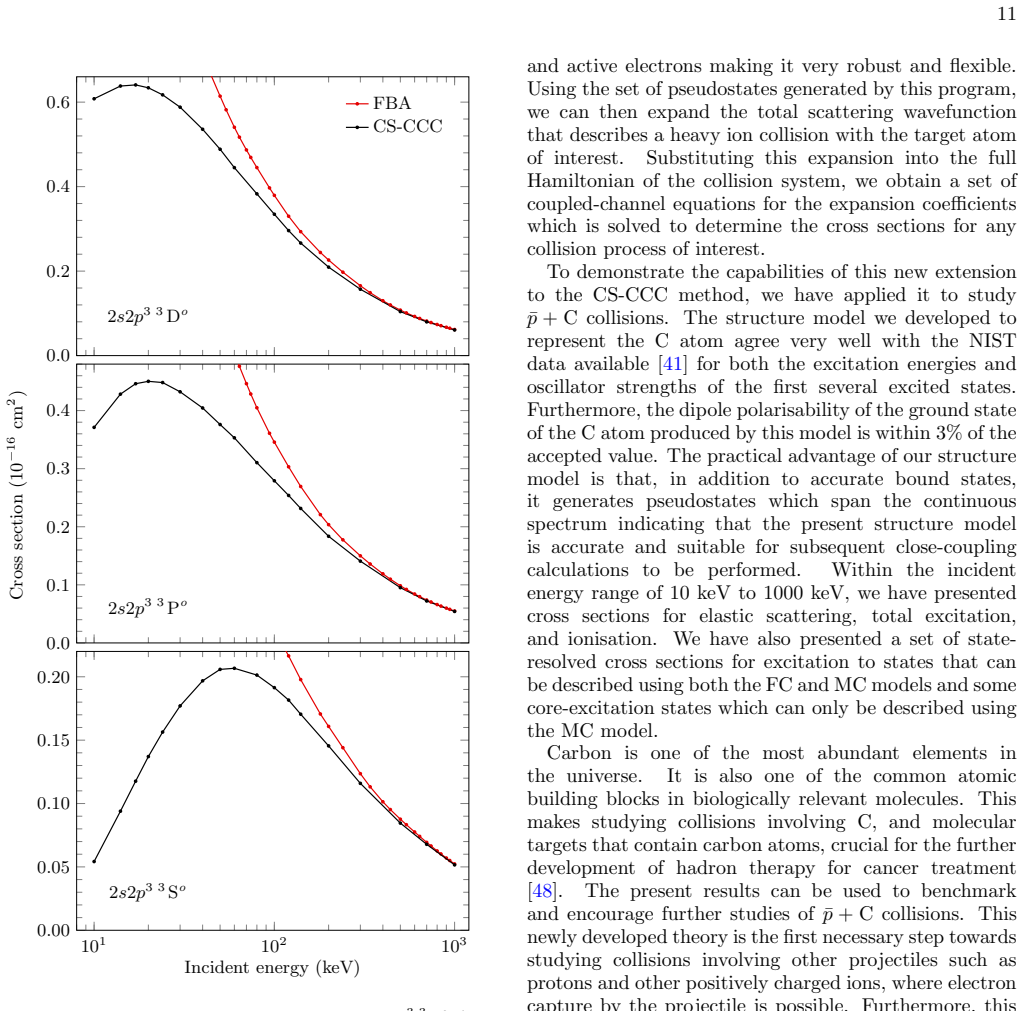
The single-centre convergent close-coupling approach to ion-atom collisions has been extended to model collisions involving arbitrary multi-electron atoms and partially stripped ions. This is accomplished by generating a set of target pseudostates using the configuration interaction method. The resulting pseudostates are expanded in terms of configuration state functions, constructed using a hybrid of Hartree-Fock and Coulomb-Sturmian spin-orbitals. This new approach is applied to study antiproton collisions with atomic carbon. We present excitation energies, oscillator strengths, and the dipole polarisability obtained using the target structure model to validate its accuracy. Furthermore, we present results for elastic-scattering, total excitation, and ionisation cross sections in the incident energy range between 10 to 1000 keV. State-resolved excitation cross sections for the first few dominant transitions are also presented. Throughout the manuscript, we compare results obtained using the multi-core target structure model with those from a frozen-core one. In all cases, we find that a multi-core description of the carbon atom target is essential for accurately modelling these collisions.
Editorial analysis
A structured set of objections, weighed in public.
Referee Report
Summary. The paper extends the single-centre convergent close-coupling method to arbitrary multi-electron targets by generating pseudostates via configuration interaction using a hybrid Hartree-Fock and Coulomb-Sturmian orbital basis. Applied to antiproton-carbon collisions, it validates the target model through excitation energies, oscillator strengths and dipole polarisability, then reports elastic, total excitation and ionisation cross sections (plus selected state-resolved excitations) for 10–1000 keV, with explicit multi-core versus frozen-core comparisons, concluding that a multi-core target description is essential.
Significance. If the central claim holds, the work supplies a practical route to treating core-electron effects in ion-atom collisions that were previously inaccessible within the CCC framework, with direct relevance to plasma, astrophysical and antimatter physics. The explicit multi-core/frozen-core comparison is a clear strength.
major comments (1)
- [Results section (cross-section calculations and comparisons)] The claim that a multi-core description is essential rests on the assumption that the CI-generated pseudostates are sufficiently complete for the collision dynamics. The manuscript validates static target properties (excitation energies, oscillator strengths, polarisability) but provides no explicit tests of how elastic, excitation or ionisation cross sections respond to enlarging the configuration-state-function space or the number of Coulomb-Sturmian orbitals. Ionisation, a dominant channel, is especially sensitive to the discretised continuum representation; an under-converged basis would render the reported necessity of the multi-core treatment inconclusive.
Simulated Author's Rebuttal
We thank the referee for their careful reading of the manuscript and for the constructive comment. We address the point raised below.
read point-by-point responses
-
Referee: The claim that a multi-core description is essential rests on the assumption that the CI-generated pseudostates are sufficiently complete for the collision dynamics. The manuscript validates static target properties (excitation energies, oscillator strengths, polarisability) but provides no explicit tests of how elastic, excitation or ionisation cross sections respond to enlarging the configuration-state-function space or the number of Coulomb-Sturmian orbitals. Ionisation, a dominant channel, is especially sensitive to the discretised continuum representation; an under-converged basis would render the reported necessity of the multi-core treatment inconclusive.
Authors: We agree that explicit convergence tests of the cross sections with respect to the CSF space and the number of Coulomb-Sturmian orbitals would strengthen the manuscript. The static-property validation follows standard practice for CCC target models, and the multi-core versus frozen-core comparisons were performed with identical basis sizes, isolating the effect of core-electron inclusion. Nevertheless, to directly address the concern, we will add a new subsection in the revised manuscript presenting cross-section results obtained with an enlarged basis (additional CS orbitals and expanded CSF space). These supplementary calculations confirm that the reported elastic, excitation and ionisation cross sections change by less than 5 % upon basis enlargement and that the multi-core/frozen-core differences remain large, supporting the conclusion that a multi-core description is essential. revision: yes
Circularity Check
No significant circularity detected
full rationale
The paper extends the established single-centre convergent close-coupling method to multi-electron targets by constructing pseudostates via configuration interaction with a hybrid Hartree-Fock plus Coulomb-Sturmian orbital basis. Static target properties (excitation energies, oscillator strengths, dipole polarisability) are computed and compared to external benchmarks for validation. Collision cross sections (elastic, excitation, ionisation) are then obtained from the close-coupling equations for both the multi-core and frozen-core target models, with the central claim that the multi-core description is essential following directly from the explicit numerical differences between these two independent calculations. No equation or result reduces by construction to a fitted parameter, self-definition, or load-bearing self-citation chain; the derivation remains self-contained against the stated external benchmarks and intra-paper model comparisons.
Axiom & Free-Parameter Ledger
free parameters (1)
- number and selection of configuration state functions / pseudostates
axioms (1)
- domain assumption The hybrid Hartree-Fock plus Coulomb-Sturmian basis adequately spans the relevant target states for the collision energy range considered.
Lean theorems connected to this paper
-
IndisputableMonolith/Foundation/AbsoluteFloorClosure.leanabsolute_floor_iff_bare_distinguishability unclear?
unclearRelation between the paper passage and the cited Recognition theorem.
The resulting pseudostates are expanded in terms of configuration state functions, constructed using a hybrid of Hartree-Fock and Coulomb-Sturmian spin-orbitals... We present excitation energies, oscillator strengths, and the dipole polarisability... Throughout the manuscript, we compare results obtained using the multi-core target structure model with those from a frozen-core one.
-
IndisputableMonolith/Cost/FunctionalEquation.leanwashburn_uniqueness_aczel unclear?
unclearRelation between the paper passage and the cited Recognition theorem.
we perform the following series of convergence tests... nmax = 18... εmax = 2.0 a.u.... 2590 pseudostates
What do these tags mean?
- matches
- The paper's claim is directly supported by a theorem in the formal canon.
- supports
- The theorem supports part of the paper's argument, but the paper may add assumptions or extra steps.
- extends
- The paper goes beyond the formal theorem; the theorem is a base layer rather than the whole result.
- uses
- The paper appears to rely on the theorem as machinery.
- contradicts
- The paper's claim conflicts with a theorem or certificate in the canon.
- unclear
- Pith found a possible connection, but the passage is too broad, indirect, or ambiguous to say the theorem truly supports the claim.
Reference graph
Works this paper leans on
-
[1]
From here on, we define the maximum value of n′ used in the model as nmax. In addition, to account for the correlations between the valence and core electrons, we included the following set of electron configurations: 1s22p2nℓn′ℓ′, 1 s22s2pnℓn′ℓ′ and 1 s22s(nℓ)3. Just as for the valence-valence electron configurations, in all cases n′ went up to nmax and ...
-
[2]
It is important to emphasise that we are not only concerned with obtaining an accurate description of the bound state spectrum of the C atom, but also of the continuum. The obtained result for the dipole polarisability is an indication that our new structure model adequately represents the continuum in addition to the bound state spectrum. With all of the...
-
[3]
are also shown. 9 We note that the CS-CCC results (both the FC and MC ones) merge with the corresponding FBA ones at the highest incident energies. However, it is clear that the CS-CCC and FBA results for the elastic-scattering cross section do not completely merge until beyond 1000 keV. We see that the CS-CCC excitation and ionisation cross sections merg...
-
[4]
below 300 keV. The largest difference between the MC CS-CCC results and the BGM ones with the no- response model occurs at 10 keV, where the former is about 50% smaller than the latter. There is a smaller, albeit still significant, difference between the MC CS- CCC and BGM results with the response model, which is at most about 40%. As the incident energy...
-
[5]
C. Hill, Dipti, K. Heinola, A. Dubois, N. Sisourat, A. Taoutioui, H. Agueny, K. T˝ ok´ esi, I. Ziaeian, C. Illescas, A. Jorge, L. M´ endez, A. Kadyrov, N. Antonio, A. Kotian, T. Kirchner, A. Leung, J. Ko, J. Lee, O. Marchuk, M. O’Mullane, E. Litherland-Smith, G. Pokol, O. Asztalos, P. Balazs, Y. Wu, C. Jia, L. Liu, and J. Wang, Nucl. Fusion 63, 125001 (2023)
work page 2023
-
[6]
Charge exchange in x-ray astrophysics,
L. Gu and C. Shah, “Charge exchange in x-ray astrophysics,” (Springer Nature Singapore, 2023) pp. 255–289
work page 2023
- [7]
-
[8]
A. C. Kraan, Front. Oncol. 5 (2015), 10.3389/fonc.2015.00150
- [9]
-
[10]
H. V. Knudsen, M. H. Holzscheiter, N. Bassler, J. Alsner, G. Beyer, J. J. DeMarco, M. Doser, D. Hajdukovic, O. Hartley, K. S. Iwamoto, O. J¨ akel, S. Kovacevic, S. P. Møller, J. Overgaard, J. B. Petersen, O. Ratib, T. D. Solberg, S. Vranjes, and B. G. Wouters, Nucl. Instrum. Method Phys. Res. Sect. B: Beam Interact. Mater. At. 266, 530 (2008)
work page 2008
- [11]
- [12]
-
[13]
H. J. L¨ udde, M. Horbatsch, and T. Kirchner, Phys. Rev. A 106, 022813 (2022)
work page 2022
-
[14]
R. E. Olson, A. Salop, R. A. Phaneuf, and F. W. Meyer, Phys. Rev. A 16, 1867 (1977)
work page 1977
-
[15]
I. M. Cheshire, Proc. Phys. Soc. 84, 89 (1964)
work page 1964
-
[16]
The low-energy, heavy- particle collisions–a close-coupling treatment,
M. Kimura and N. F. Lane, “The low-energy, heavy- particle collisions–a close-coupling treatment,” (Elsevier,
-
[17]
T. G. Winter, Phys. Rev. A 33, 3842 (1986)
work page 1986
-
[18]
D. R. Schultz, M. R. Strayer, and J. C. Wells, Phys. Rev. Lett. 82, 3976 (1999)
work page 1999
-
[19]
D. Belki´ c, I. Bray, and A. Kadyrov, State-of-the- Art Reviews on Energetic Ion-Atom and Ion-Molecule Collisions (WORLD SCIENTIFIC, 2019)
work page 2019
-
[20]
Schultz, Ion-Atom Collisions (De Gruyter, 2019)
M. Schultz, Ion-Atom Collisions (De Gruyter, 2019)
work page 2019
-
[21]
Tribedi, Advances in Atomic Molecular Collisions (Springer Nature Singapore, 2024)
L. Tribedi, Advances in Atomic Molecular Collisions (Springer Nature Singapore, 2024)
work page 2024
-
[22]
Portable gpu implementation of the wp-ccc ion-atom collisions code,
I. B. Abdurakhmanov, N. W. Antonio, M. Cytowski, and A. S. Kadyrov, “Portable gpu implementation of the wp-ccc ion-atom collisions code,” (Springer Nature Switzerland, 2025) pp. 102–114
work page 2025
-
[23]
H. J. L¨ udde, M. Horbatsch, and T. Kirchner, Phys. Rev. A 104, 032813 (2021)
work page 2021
-
[24]
T. Kirchner, M. Horbatsch, H. J. L¨ udde, and R. M. Dreizler, Phys. Rev. A 62, 042704 (2000)
work page 2000
-
[25]
C. C. Jia, J. W. Gao, Y. Wu, J. G. Wang, and N. Sisourat, Phys. Rev. A 110, 012803 (2024)
work page 2024
-
[26]
I. B. Abdurakhmanov, A. S. Kadyrov, I. Bray, and A. T. Stelbovics, J. Phys. B: At. Mol. Opt. Phys. 44, 075204 (2011)
work page 2011
-
[27]
S. K. Avazbaev, A. S. Kadyrov, I. B. Abdurakhmanov, D. V. Fursa, and I. Bray, Phys. Rev. A 93, 022710 (2016)
work page 2016
-
[28]
I. B. Abdurakhmanov, A. S. Kadyrov, S. K. Avazbaev, and I. Bray, J. Phys. B: At. Mol. Opt. Phys. 49, 115203 (2016)
work page 2016
-
[29]
I. B. Abdurakhmanov, J. J. Bailey, A. S. Kadyrov, and I. Bray, Phys. Rev. A 97, 032707 (2018)
work page 2018
-
[30]
N. W. Antonio, I. Bray, and A. S. Kadyrov, Phys. Rev. A 110, 032810 (2024)
work page 2024
-
[31]
S. U. Alladustov, I. B. Abdurakhmanov, A. S. Kadyrov, I. Bray, and K. Bartschat, Phys. Rev. A 99, 052706 (2019)
work page 2019
-
[32]
K. H. Spicer, C. T. Plowman, N. W. Antonio, M. S. Sch¨ offler, M. Schulz, and A. S. Kadyrov, Phys. Rev. A 109, 062805 (2024)
work page 2024
-
[33]
I. B. Abdurakhmanov, A. S. Kadyrov, D. V. Fursa, S. K. Avazbaev, J. J. Bailey, and I. Bray, Phys. Rev. A 91, 022712 (2015)
work page 2015
-
[34]
I. B. Abdurakhmanov, C. Plowman, A. S. Kadyrov, I. Bray, and A. M. Mukhamedzhanov, J. Phys. B: At. Mol. Opt. Phys. 53, 145201 (2020)
work page 2020
-
[35]
I. B. Abdurakhmanov, C. T. Plowman, K. H. Spicer, I. Bray, and A. S. Kadyrov, Phys. Rev. A 104, 042820 (2021)
work page 2021
-
[36]
I. B. Abdurakhmanov, A. S. Kadyrov, D. V. Fursa, and I. Bray, Phys. Rev. Lett. 111, 173201 (2013)
work page 2013
-
[37]
I. B. Abdurakhmanov, A. S. Kadyrov, D. V. Fursa, S. K. Avazbaev, and I. Bray, Phys. Rev. A 89, 042706 (2014)
work page 2014
-
[38]
C. T. Plowman, I. B. Abdurakhmanov, I. Bray, and A. S. Kadyrov, Eur. Phys. J. D 76 (2022), 10.1140/epjd/s10053-022-00359-w
-
[39]
C. F. Fischer, T. Brage, and P. J¨ onsson, Computational Atomic Structure (Routledge, 2019)
work page 2019
-
[40]
Theory and application of sturmian functions,
M. Rotenberg, “Theory and application of sturmian functions,” (Elsevier, 1970) pp. 233–268
work page 1970
-
[41]
I. B. Abdurakhmanov, A. S. Kadyrov, and I. Bray, Phys. Rev. A 94, 022703 (2016)
work page 2016
-
[42]
N. W. Antonio and A. S. Kadyrov, Phys. Rev. A 111, 052806 (2025)
work page 2025
- [43]
-
[44]
J. Avery and J. Avery, Generalized Sturmians and Atomic Spectra (World Scientific Publishing Co. Pte. Ltd., 2006)
work page 2006
-
[45]
A. Kramida, Yu. Ralchenko, J. Reader, and and NIST ASD Team, NIST Atomic Spectra Database (ver. 5.12), [Online]. Available: https://physics.nist.gov/asd [2025, June 30]. National Institute of Standards and Technology, Gaithersburg, MD. (2024)
work page 2025
-
[46]
S. Nasiri, S. Bubin, and L. Adamowicz, Mol. Phys. 122 (2024), 10.1080/00268976.2024.2325049
-
[47]
Y. Wang, O. Zatsarinny, and K. Bartschat, Phys. Rev. A 87, 012704 (2013). 13
work page 2013
- [48]
- [49]
- [50]
-
[51]
B. H. Bransden and M. R. C. McDowell, Charge Exchange and the Theory of Ion-Atom Collisions (Oxford University PressOxford, 1992)
work page 1992
-
[52]
E. Erdmann, M.-C. Bacchus-Montabonel, and M. Labuda, Phys. Chem. Chem. Phys. 19, 19722 (2017)
work page 2017
- [53]
-
[54]
W. R. Thompson, M. B. Shah, and H. B. Gilbody, J. Phys. B: At. Mol. Opt. Phys. 29, 725 (1996)
work page 1996
- [55]
discussion (0)
Sign in with ORCID, Apple, or X to comment. Anyone can read and Pith papers without signing in.