REVIEW 3 major objections 7 minor 82 references
Coexistence of anomalous spin dynamics and weak magnetic order in a chiral trillium lattice K2FeSn(PO4)3
T0 review · 3 major / 7 minor · reviewed 2026-08-06 · deepseek-v4-flash
Pith's one-line read A S=5/2 trillium magnet shows weak magnetic order coexisting with persistent, field-resistant spin dynamics.
desk verdict Credible first magnetic characterization of a heavily diluted S=5/2 trillium compound showing weak order plus persistent spin dynamics, but the interpretation leans on an unverified percolation assumption and a garbled disorder discussion. read the letter →
The pith
A machine-rendered reading of the paper's core claim, the machinery that carries it, and where it could break.
The reading
What carries the argument
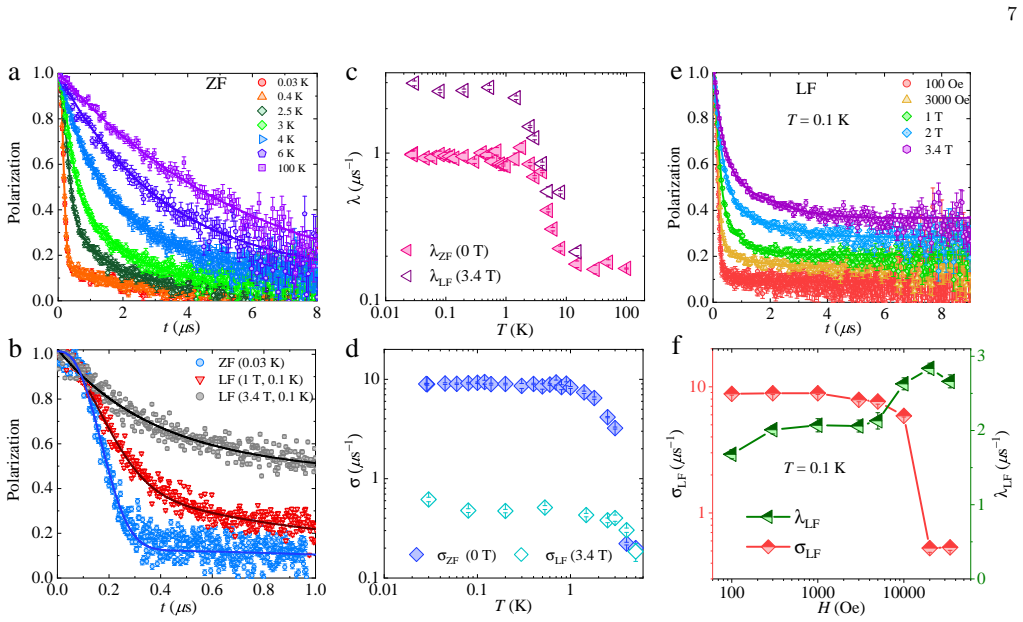
The central object is the hypertrillium lattice: two interpenetrating Fe3+ trillium sublattices linked by Fe1-Fe2 bonds of 4.96 Å to form a three-dimensional chiral network of corner-sharing tetrahedra in space group P213. This geometry is argued to survive Fe/Sn site dilution and to provide the degenerate spin manifold that sustains persistent dynamics. The argument is carried by muon spin relaxation with a two-component polarization function separating dynamic exponential relaxation from Gaussian quasistatic relaxation, by longitudinal-field decoupling that tests whether the quasistatic component is truly static, and by the low-temperature power-law specific heat Cmag≈αTn whose exponent n≈2.1-2.2 indicates gapless excitations. These probes together locate the system in an intermediate regime between static order and fast spin fluctuations.
What would settle it
A single-crystal neutron diffraction experiment below 2 K could settle the central claim: if it shows fully static, long-range canted magnetic order with an ordered moment close to 5 μB and no broad diffuse or continuum scattering, then the coexistence picture would be contradicted. Conversely, mapping the Fe/Sn spatial distribution by resonant scattering or atomic-scale imaging would test the percolation assumption directly, since disconnected Fe clusters would invalidate the attribution of the dynamics to the hypertrillium topology.
Extended reading notes
Core claim
The paper's central claim is that K2FeSn(PO4)3, despite roughly 50% magnetic site dilution by nonmagnetic Sn, retains a percolating hypertrillium Fe network and exhibits a ground state in which weak magnetic order coexists with dominant persistent spin dynamics. The authors report a two-stage evolution of magnetic correlations across T*=11 K, inferred from ESR linewidth power laws and specific-heat features at TH≈25 K and TL≈6.3 K. Below TN≈2 K, susceptibility shows a weak kink and a ZFC-FC bifurcation with no frequency dependence in ac susceptibility, consistent with a weak canted ferromagnetic component likely arising from Dzyaloshinskii-Moriya interactions in the non-centrosymmetric chiral space group. Muon spin relaxation shows neither coherent oscillations nor a conventional 1/3 spin-freezing tail, and requires both an exponential dynamic component and a Gaussian quasistatic component, with the quasistatic fraction remaining undecouplable even in a 3.4 T longitudinal field. The authors interpret this as evidence that dynamically fluctuating spins coexist with weak quasistatic local fields, and they contrast the behavior with random-singlet and conventional spin-glass scenarios.
Load-bearing premise
The whole interpretation rests on the Fe3+ ions remaining connected into a three-dimensional hypertrillium network despite roughly half of the magnetic sites being replaced by nonmagnetic Sn4+; the paper states that no direct percolation-threshold calculation for the trillium lattice exists, so the topology argument depends on the unproven assumption that the Fe occupancy lies above that threshold.
Editorial extensions
If this is right
- If KFSPO behaves as reported, it becomes a benchmark S=5/2 case where spin-liquid-like fluctuations survive a weak ordering transition, showing that classical spin-liquid physics can be realized in three dimensions without strong quantum fluctuations.
- Fields above about 2 T suppress the weak canted order while leaving persistent muon relaxation, implying that the weak order and the spin dynamics can be field-separated.
- The absence of a 1/3 magnetization plateau up to 55 T distinguishes the hypertrillium lattice from the single-trillium classical spin-liquid candidate Na[Mn(HCOO)3] and implies additional exchange interactions beyond the nearest-neighbor Heisenberg model.
- The near-quadratic low-temperature specific heat, interpreted as evidence of local spin singlets, connects the high-spin 3D trillium behavior to kagome-like spin-liquid phenomenology.
- Comparison with the sister compound KSrFe2(PO4)3 suggests that magnetic site dilution mainly affects weak ferromagnetic interactions while leaving the spin dynamics of the trillium topology largely intact.
Reading between the lines
- Editorial inference: If Fe/Sn occupancy is truly above the percolation threshold, a dilution series varying the Fe:Sn ratio should interpolate between percolating hypertrillium behavior and cluster-dominated behavior; observing that crossover would provide a direct test of the topology-based explanation.
- Editorial inference: The paper's own admission that no trillium-lattice percolation threshold has been calculated leaves a concrete missing check: a site-percolation simulation of the hypertrillium lattice at about 50% Fe occupancy would settle whether the observed ground state can be attributed to the clean trillium topology.
- Editorial inference: Because the muon sample contained both enantiomers of the chiral crystal, any handedness-specific signatures are averaged; growing or selecting single-enantiomer crystals could reveal whether the persistent dynamics or weak order differ between mirror twins.
- Editorial inference: The undecouplable Gaussian muSR component suggests that the 'quasistatic' fraction is not frozen on the muon timescale but may fluctuate on longer timescales; extending measurements to longer time windows or adding NMR would clarify whether the weak order is truly static.
Editorial analysis
A structured set of objections, weighed in public.
Referee Report
Summary. This manuscript reports a combined thermodynamic, ESR, and muon-spin-rotation study of the S = 5/2 double trillium compound K2FeSn(PO4)3, in which the two magnetic Fe sites are heavily and randomly substituted by Sn (Fe1 44(3)% Fe, Fe2 55(3)% Fe). From susceptibility, specific heat, and ESR the authors identify a two-stage development of correlations across a crossover at T* approximately 11 K, and from dc and ac susceptibility a weak ordering transition at TN approximately 2 K that is suppressed by fields of about 2 T and accompanied by ZFC/FC splitting and a small hysteresis. Specific heat below 3 K follows Cmag = alpha T^n with n approximately 2.1 to 2.2, and no anomaly appears at TN. In muSR, zero-field spectra show no coherent oscillations and no 1/3 tail; down to 30 mK the relaxation is described by a two-component model combining a slowly relaxing exponential component and a fast Gaussian component, with relaxation rates that flatten below about 1 K and persist under a 3.4 T longitudinal field without full polarization recovery. The authors interpret the results as evidence of weak (possibly Dzyaloshinskii-Moriya-driven canted) magnetic order coexisting with persistent, field-resilient spin dynamics, and argue that the behavior reflects the hypertrillium lattice topology despite the heavy site dilution, while acknowledging that no percolation threshold for this lattice is known.
Significance. If the interpretation holds, KFSPO would be the highest-spin (S = 5/2) double trillium system in which weak magnetic order demonstrably coexists with persistent spin dynamics, extending the phenomenology established for K2Ni2(SO4)3 and KSrFe2(PO4)3 and supporting the robustness of the classical-spin-liquid scenario in three-dimensional chiral lattices. The experimental dataset is broad and internally consistent, the muSR data are openly archived, and the paper is commendably explicit about its own limitations, including the absence of a trillium-lattice percolation calculation and the need for neutron diffraction to pin down the ordered structure. The coexistence claim itself is defensible from the data: the ordering is supported by the susceptibility kink, ZFC/FC splitting, and hysteresis, and the persistent dynamics by the temperature- and field-independent muSR relaxation. The main vulnerability is interpretive: the topology-based narrative requires percolation of the diluted Fe network, which the paper asserts but does not establish, and the LF-decoupling logic contains a genuine internal slip that needs correction.
major comments (3)
- [§IV (muSR decoupling argument)] The central interpretation, that the persistent spin dynamics originate from the hypertrillium spin topology, requires the approximately 50% diluted Fe sublattice to form a percolating three-dimensional network. With Fe occupancies of 44(3)% (Fe1) and 55(3)% (Fe2), the probability that an Fe1-Fe2 exchange bond is magnetically active is p1 x p2 approximately 0.24, which falls in the range of typical three-dimensional bond-percolation thresholds; moreover, on the bipartite Fe1-Fe2 hypertrillium graph both sublattices must percolate. The statement in §IV that 'there is no direct calculation for the percolation threshold of a trillium lattice' and that percolation is 'highly likely' is therefore not a sufficient basis for the paper's headline claim, and it is reinforced by the contradicted assertion in §III.B that the dilution operates 'without introducing exchange randomness or quenched disorder' despite the acknowledged approximately 50% Fe/Sn randomness. I request a Monte Carlo site-percolation study of the hypertrillium lattice at the refined occupancies (probability of a percolating cluster, cluster-size statistics, and, if feasible, effective sublattice thresholds), or, failing that, a reframing of the abstract and conclusions in which the topological interpretation is presented as one of several disorder-compatible scenarios. The raw experimental claims do not depend on this calculation, but the title and abstract claims do.
- [§IV (muSR decoupling argument)] The decoupling argument as written states: 'if the Gaussian relaxation originates entirely from disorder-induced quasistatic moments, this should be reflected in our decoupling experiments as a saturation of the full polarization at fields 3.4 T > Delta/gamma_mu. Therefore, the absence of full recovery of muon spin polarization in LF-muSR experiments provides concrete evidence for disorder-induced smearing of the LRO state.' The second sentence draws the opposite conclusion from the premise of the first: the absence of full polarization recovery is evidence against a purely static, disorder-induced field distribution, and for the presence of dynamic fluctuations. As written, the passage cannot be parsed consistently, and it matters because the paper's claim that the muSR data exclude a trivial disorder origin rests on this step. Please rewrite the argument so that the direction of inference is explicit, and state separately (i) what the LF data rule out, namely a completely static local field distribution of width Delta/gamma_mu approximately 3 kG, and (ii) what they leave open, namely dynamically fluctuating disorder-dominated clusters as well as topology-driven spin-liquid fluctuations.
- [§III.E; §IV] The two-component muSR model involves several adjustable parameters (fZF, lambdaZF, sigmaZF and their LF analogues), and the physical assignment of the components is underdetermined: the approximately 18% exponential fraction is attributed to 'weakly ordered moments that remain dynamic' and the approximately 80% Gaussian fraction to 'strongly correlated magnets hosting spin singlet' excitations, with the undecouplable Gaussian further attributed to 'spin excitations (e.g., spinons)'. The LF data convincingly rule out a purely static local field distribution, but a distribution of fast-fluctuating clusters, a disorder-dominated state, would also evade static decoupling, so the observed absence of full polarization recovery does not by itself single out spinon-like excitations. The dismissal of the random-singlet scenario in §IV excludes only the specific power-law phenomenology (chi proportional to T^-alpha, Cmag/T proportional to T^-alpha, Delta H proportional to T^-alpha, lambda proportional to T^-alpha with 0 < alpha < 1); it does not exclude a fluctuating cluster state with different functional forms. I recommend either quantitative modeling that distinguishes these scenarios, for example an explicit comparison of the ZF and LF spectra against a distribution of relaxation rates, or a softened wording that presents the spinon interpretation as one of several possibilities consistent with persistent dynamics.
minor comments (7)
- [§III.E] The sentence 'a distinct increase of fZF accompanied by a corresponding decrease of fZF' should read 'decrease of (1 - fZF)'.
- [§IV] The random-singlet dismissal is stated twice in nearly identical consecutive sentences ('The absence of a similar power-law dependence in KFSPO indicates...' and 'The absence of a characteristic power-law dependence and its scaling in KFSPO suggests...'); one of the two should be deleted.
- [§III.C] The temperature window over which Cmag = alpha T^n is fitted is never stated; please specify the fitting range in kelvin used to extract n and alpha for each field.
- [§III.B] The low-temperature Curie-Weiss regime below 66 K is quoted only through theta_CW = -30 K; the accompanying C and chi0 values and the fit range should be given so that the comparison with the high-temperature fit is complete.
- [§III.E] The estimate Delta/gamma_mu approximately 3 kG propagates the mean-field relation J = 3 k_B theta_CW / (2 z S (S+1)) with an assumed z = 6; since 3.4 T exceeds the estimate by an order of magnitude the decoupling conclusion is robust, but the text should label the underlying exchange estimate as order-of-magnitude.
- [§III.E; §IV] Although the absence of a muSR signature of TN is discussed, the estimated upper bound on the ordered moment consistent with the muSR spectra is not given; quoting such a bound, or stating that it cannot be reliably extracted, would strengthen the claim that the order is 'subtle'.
- [Throughout] Minor text corrections: 'stong magnetic interactions' in the Introduction, 'performend' in §II, 'titled compound' in §IV, 'expected 2.002(3)' for the free-electron g value in §III.D, and 'lambda LF (right x-axis)' in the Fig. 4 caption, which should read 'right y-axis'.
Circularity Check
No significant circularity: weak ordering at TN ≈ 2 K and persistent µSR spin dynamics are read from the paper's own susceptibility, specific-heat, ESR, and µSR data; self-citations are analogical, and the acknowledged absence of a trillium percolation calculation is an unverified assumption rather than a circular reduction.
full rationale
This paper is a measurements-driven study whose central claims are extracted from its own data rather than from prior results by the same group. The weak magnetic ordering at TN ≈ 2 K rests on the kink in dc/ac susceptibility, the ZFC–FC bifurcation, and the low-field hysteresis (Figs. 1d–1f), while the persistent spin dynamics rests on the µSR λZF plateau and the field-undecouplable early-time Gaussian relaxation (Figs. 4c–4f); the two-component µSR model is forced by the data below TL and is interpreted through the external, non-overlapping references Uemura et al. [70] and Živković et al. [38]. The mean-field estimate of the internal field width, Δ/γµ ≈ 3 kG, is computed from the fitted θCW and the measured λZF, but it is the input to a falsifiable decoupling test whose outcome (no full polarization recovery at 3.4 T ≫ 3 kG) is non-trivial and does not coincide with the static-field expectation, so no quantity is re-inserted as its own prediction. The paper's acknowledged weak assumption is not a circularity: Section IV states 'There is no direct calculation for the percolation threshold of a trillium lattice' and asserts that Fe occupancy 'highly likely' exceeds the threshold; this unverified geometric assumption is a correctness risk for the trillium-topology interpretation, but it does not make the derivation equivalent to its inputs. The self-citations — K2CrTi(PO4)3 [43] and FeP3SiO11 [61] — serve only analogical and methodological roles (similar two-stage broadening, similar hidden order, lattice-subtraction procedure) and are not load-bearing for KFSPO's own measured results; no uniqueness theorem and no ansatz is imported from the authors' prior work. Accordingly, no step reduces a prediction to its input by construction.
Assumptions & free parameters
free parameters (7)
- theta_CW =
-43(2) K (HT), -30 K (LT)
- chi0 =
-2.56e-3 cm3/mol
- C =
5.66(3) cm3 K/mol
- ESR crossover T* =
11 K
- specific heat exponent n =
2.13(1) to 2.24(1) with field
- muSR static/dynamic fractions =
fZF ~ 0.8 static, ~0.18 dynamic below 1 K
- muSR relaxation rates lambdaZF, sigmaZF =
lambdaZF 0.165 to 1 us^-1; sigmaZF rises to ~10^3 us^-1
assumptions (5)
- domain assumption Fe3+ carries S = 5/2 with only moderate orbital contribution
- ad hoc to paper The Fe1-Fe2 network retains 3D hypertrillium connectivity despite ~50% Fe/Sn dilution
- domain assumption Muons stop at interstitial sites ~1 A from O and sense local fields representative of the bulk
- ad hoc to paper Lack of full polarization recovery in LF-muSR implies dynamic spin excitations rather than static disorder fields
- domain assumption Dzyaloshinskii-Moriya interactions are active due to non-centrosymmetric P2_1^3 and induce weak ferromagnetism
Cite this review
Pith. "Pith review of Coexistence of anomalous spin dynamics and weak magnetic order in a chiral trillium lattice K2FeSn(PO4)3." pith.science (2026). https://pith.science/paper/EPJNNQDJ
@misc{pith2026250712076,
  author       = {Pith},
  title        = {Pith review of: Coexistence of anomalous spin dynamics and weak magnetic order in a chiral trillium lattice K2FeSn(PO4)3},
  year         = {2026},
  howpublished = {\url{https://pith.science/paper/EPJNNQDJ}},
  note         = {Machine review of arXiv:2507.12076}
}
abstract
Trillium lattices, where magnetic ions form a three-dimensional chiral network of corner-sharing equilateral triangular motifs, offer a prominent platform to explore exotic quantum states. In this work, we report ground-state properties of the $S$ = 5/2 trillium lattice compound K$_{2}$FeSn(PO$_{4}$)$_{3}$ through thermodynamic, electron spin resonance (ESR), and muon spin relaxation (${\mu}$SR) experiments. Thermodynamic and ESR measurements reveal the two-step evolution of magnetic correlations across $T^{*}$ = 11 K, which results from an interplay between dominant antiferromagnetic Heisenberg interactions and subleading interactions. Below $T^{*}$, \textit{dc} and \textit{ac} magnetic susceptibilities indicate weak \textcolor{black}{magnetic ordering} at $T_{\rm N} \approx 2$ K under low fields, which is suppressed for $\mu_{0}H \geq 2$ T, consistent with a power-law dependence of magnetic specific heat at low temperatures. $\mu$SR experiments confirm the dominance of persistent spin dynamics and the absence of conventional spin freezing, supporting the subtle nature of weak magnetic ordering coexisting with spin-liquid-like fluctuations. These findings underscore the potential for realizing a classical spin-liquid ground state with exotic excitations in high-spin trillium lattice systems.
Figures


Figures from the paper (1 more)
Reference graph
Works this paper leans on
-
[1]
Balents, Spin liquids in frustrated magnets, Nature 464, 199 (2010)
L. Balents, Spin liquids in frustrated magnets, Nature 464, 199 (2010)
2010
-
[2]
Savary and L
L. Savary and L. Balents, Quantum spin liquids: a re- view, Rep. Prog. Phys. 80, 016502 (2016)
2016
-
[3]
C. L. Henley, The “coulomb phase” in frustrated systems, Annu. Rev. Condens. Matter Phys. 1, 179 (2010)
work page 2010
-
[4]
G. C. Lau, R. S. Freitas, B. G. Ueland, B. D. Muegge, E. L. Duncan, P. Schiffer, and R. J. Cava, Zero-point entropy in stuffed spin-ice, Nat. Phys. 2, 249 (2006)
work page 2006
-
[5]
Z. Bacciconi, H. Xavier, I. Carusotto, T. Chanda, and M. Dalmonte, Theory of fractional quantum Hall liq- uids coupled to quantum light and emergent graviton- polaritons (2024), arXiv:2405.12292 [cond-mat.mes-hall]
-
[6]
Khatua, B
J. Khatua, B. Sana, A. Zorko, M. Gomilˇ sek, K. Sethu- pathi, M. R. Rao, M. Baenitz, B. Schmidt, and P. Khuntia, Experimental signatures of quantum and topological states in frustrated magnetism, Phys. Rep. 1041, 1 (2023)
2023
-
[7]
Takagi, T
H. Takagi, T. Takayama, G. Jackeli, G. Khaliullin, and S. E. Nagler, Concept and realization of Kitaev quantum spin liquids, Nat. Rev. Phys. 1, 264 (2019)
2019
-
[8]
Broholm, R
C. Broholm, R. J. Cava, S. A. Kivelson, D. G. Nocera, M. R. Norman, and T. Senthil, Quantum spin liquids, Science 367, eaay0668 (2020)
2020
Show all 82 references
-
[9]
Nasu, Majorana quasiparticles emergent in Kitaev spin liquid, Prog
J. Nasu, Majorana quasiparticles emergent in Kitaev spin liquid, Prog. Theor. Exp. Phys. , ptad115 (2023). 10
2023
-
[10]
J. A. Sears, L. E. Chern, S. Kim, P. J. Bereciartua, S. Francoual, Y. B. Kim, and Y.-J. Kim, Ferromag- netic Kitaev interaction and the origin of large magnetic anisotropy in α-RuCl3, Nat. Phys. 16, 837 (2020)
2020
-
[11]
D. A. Tennant, R. A. Cowley, S. E. Nagler, and A. M. Tsvelik, Measurement of the spin-excitation continuum in one-dimensional KCuF 3 using neutron scattering, Phys. Rev. B 52, 13368 (1995)
1995
-
[12]
B. Lake, D. A. Tennant, J.-S. Caux, T. Barthel, U. Schollw¨ ock, S. E. Nagler, and C. D. Frost, Multispinon continua at zero and finite temperature in a near-ideal Heisenberg chain, Phys. Rev. Lett. 111, 137205 (2013)
2013
-
[13]
P. W. Anderson, Resonating valence bonds: A new kind of insulator?, Mater. Res. Bull. 8, 153 (1973)
1973
-
[14]
Kitaev, Anyons in an exactly solved model and be- yond, Ann
A. Kitaev, Anyons in an exactly solved model and be- yond, Ann. Phys. 321, 2–111 (2006)
2006
-
[15]
S. Jeon, D. Wulferding, Y. Choi, S. Lee, K. Nam, K. H. Kim, M. Lee, T.-H. Jang, J.-H. Park, S. Lee, S. Choi, C. Lee, H. Nojiri, and K.-Y. Choi, One-ninth magnetiza- tion plateau stabilized by spin entanglement in a kagome antiferromagnet, Nat. Phys. 20, 435 (2024)
2024
-
[16]
Khuntia, M
P. Khuntia, M. Velazquez, Q. Barth´ elemy, F. Bert, E. Kermarrec, A. Legros, B. Bernu, L. Messio, A. Zorko, and P. Mendels, Gapless ground state in the archetypal quantum kagome antiferromagnet ZnCu3(OH)6Cl2, Nat. Phys. 16, 469 (2020)
2020
-
[17]
R. Bag, S. Xu, N. E. Sherman, L. Yadav, A. I. Kolesnikov, A. A. Podlesnyak, E. S. Choi, I. da Silva, J. E. Moore, and S. Haravifard, Evidence of dirac quantum spin liquid in YbZn2GaO5, Phys. Rev. Lett. 133, 266703 (2024)
2024
-
[18]
Li, YbMgGaO 4: A triangular-lattice quantum spin liquid candidate, Adv
Y. Li, YbMgGaO 4: A triangular-lattice quantum spin liquid candidate, Adv. Quantum Technol. 2, 1900089 (2019)
2019
-
[19]
T. Arh, B. Sana, M. Pregelj, P. Khuntia, Z. Jagliˇ ci´ c, M. D. Le, P. K. Biswas, P. Manuel, L. Mangin-Thro, A. Ozarowski, and A. Zorko, The Ising triangular-lattice antiferromagnet neodymium heptatantalate as a quan- tum spin liquid candidate, Nat. Mater. 21, 416 (2022)
2022
-
[20]
M. M. Bordelon, E. Kenney, C. Liu, T. Hogan, L. Posthuma, M. Kavand, Y. Lyu, M. Sherwin, N. P. Butch, C. Brown, M. J. Graf, L. Balents, and S. D. Wilson, Field-tunable quantum disordered ground state in the triangular-lattice antiferromagnet NaYbO 2, Nat. Phys. 15, 1058 (2019)
2019
-
[21]
Chillal, Y
S. Chillal, Y. Iqbal, H. O. Jeschke, J. A. Rodriguez- Rivera, R. Bewley, P. Manuel, D. Khalyavin, P. Steffens, R. Thomale, A. T. M. N. Islam, J. Reuther, and B. Lake, Evidence for a three-dimensional quantum spin liquid in PbCuTe2O6, Nat. Commun. 11, 2348 (2020)
2020
-
[22]
Khuntia, F
P. Khuntia, F. Bert, P. Mendels, B. Koteswararao, A. V. Mahajan, M. Baenitz, F. C. Chou, C. Baines, A. Amato, and Y. Furukawa, Spin liquid state in the 3D frustrated antiferromagnet PbCuTe2O6: NMR and Muon spin re- laxation studies, Phys. Rev. Lett. 116, 107203 (2016)
2016
-
[23]
K. W. Plumb, H. J. Changlani, A. Scheie, S. Zhang, J. W. Krizan, J. A. Rodriguez-Rivera, Y. Qiu, B. Winn, R. J. Cava, and C. L. Broholm, Continuum of quantum fluc- tuations in a three-dimensional s = 1 Heisenberg magnet, Nat. Phys. 15, 54 (2019)
2019
-
[24]
B. Gao, T. Chen, D. W. Tam, C.-L. Huang, K. Sas- mal, D. T. Adroja, F. Ye, H. Cao, G. Sala, M. B. Stone, C. Baines, J. A. T. Verezhak, H. Hu, J.-H. Chung, X. Xu, S.-W. Cheong, M. Nallaiyan, S. Spagna, M. B. Maple, A. H. Nevidomskyy, E. Morosan, G. Chen, and P. Dai, Experimenta...
2019
-
[25]
Wen, Quantum orders and symmetric spin liquids, Phys
X.-G. Wen, Quantum orders and symmetric spin liquids, Phys. Rev. B 65, 165113 (2002)
2002
-
[26]
Kalmeyer and R
V. Kalmeyer and R. B. Laughlin, Equivalence of the resonating-valence-bond and fractional quantum Hall states, Phys. Rev. Lett. 59, 2095 (1987)
1987
-
[27]
Kadow, L
W. Kadow, L. Vanderstraeten, and M. Knap, Hole spec- tral function of a chiral spin liquid in the triangular lat- tice hubbard model, Phys. Rev. B 106, 094417 (2022)
2022
-
[28]
Zhang, Y
X.-T. Zhang, Y. Huang, H.-Q. Wu, D. N. Sheng, and S.- S. Gong, Chiral spin liquid and quantum phase diagram of spin- 1 2J1−J2−Jχ model on the square lattice, Phys. Rev. B 109, 125146 (2024)
2024
-
[29]
Zhu, Chiral spin liquid versus mott antiferromag- netism in the triangular-lattice hubbard model, Phys
Z. Zhu, Chiral spin liquid versus mott antiferromag- netism in the triangular-lattice hubbard model, Phys. Rev. B 110, L041113 (2024)
2024
-
[30]
Bauer, L
B. Bauer, L. Cincio, B. P. Keller, M. Dolfi, G. Vidal, S. Trebst, and A. W. W. Ludwig, Chiral spin liquid and emergent anyons in a kagome lattice mott insulator, Nat. Commun. 5, 5137 (2014)
2014
-
[31]
Huang, X.-Y
Y. Huang, X.-Y. Dong, D. N. Sheng, and C. S. Ting, Quantum phase diagram and chiral spin liquid in the extended spin- 1 2 honeycomb xy model, Phys. Rev. B103, L041108 (2021)
2021
-
[32]
Lozano-G´ omez, Y
D. Lozano-G´ omez, Y. Iqbal, and M. Vojta, A classi- cal chiral spin liquid from chiral interactions on the py- rochlore lattice, Nat. Commun. 15, 10162 (2024)
2024
-
[33]
Fancelli, R
A. Fancelli, R. Flores-Calder´ on, O. Benton, B. Lake, R. Moessner, and J. Reuther, Fragile spin liquid in three dimensions, Phys. Rev. B 111, 134413 (2025)
2025
-
[34]
H. Yan, O. Benton, R. Moessner, and A. H. Nevidom- skyy, Classification of classical spin liquids: Typology and resulting landscape, Phys. Rev. B 110, L020402 (2024)
2024
-
[35]
Niggemann, M
N. Niggemann, M. Hering, and J. Reuther, Classical spi- ral spin liquids as a possible route to quantum spin liq- uids, J. Condens. Matter Phys. 32, 024001 (2019)
2019
-
[36]
S. V. Isakov, K. Gregor, R. Moessner, and S. L. Sondhi, Dipolar spin correlations in classical pyrochlore magnets, Phys. Rev. Lett. 93, 167204 (2004)
2004
-
[37]
Castelnovo, R
C. Castelnovo, R. Moessner, and S. Sondhi, Spin ice, fractionalization, and topological order, Annu. Rev. Con- dens. Matter Phys. 3, 35 (2012)
2012
-
[38]
ˇZivkovi´ c, V
I. ˇZivkovi´ c, V. Favre, C. Salazar Mejia, H. O. Jeschke, A. Magrez, B. Dabholkar, V. Noculak, R. S. Freitas, M. Jeong, N. G. Hegde, L. Testa, P. Babkevich, Y. Su, P. Manuel, H. Luetkens, C. Baines, P. J. Baker, J. Wos- nitza, O. Zaharko, Y. Iqbal, J. Reuther, and H. M. Rønno...
2021
-
[39]
J. M. Hopkinson and H.-Y. Kee, Geometric frustration inherent to the trillium lattice, a sublattice of the B20 structure, Phys. Rev. B 74, 224441 (2006)
2006
-
[40]
K. Boya, K. Nam, K. Kargeti, A. Jain, R. Kumar, S. K. Panda, S. M. Yusuf, P. L. Paulose, U. K. Voma, E. Ker- marrec, K. H. Kim, and B. Koteswararao, Signatures of spin-liquid state in a 3D frustrated lattice compound KSrFe2(PO4)3 with S = 5/2, APL Materials 10, 101103 (2022). 11
2022
-
[41]
M.-H. Li, S. Biswas, and S. A. Parameswaran, Classifi- cation of spin-1/2 fermionic quantum spin liquids on the trillium lattice (2024), arXiv:2409.02898 [cond-mat.str- el]
2024 arXiv
-
[42]
M. G. Gonzalez, V. Noculak, A. Sharma, V. Favre, J.-R. Soh, A. Magrez, R. Bewley, H. O. Jeschke, J. Reuther, H. M. Rønnow, Y. Iqbal, and I. ˇZivkovi´ c, Dynamics of K2Ni2(SO4)3 governed by proximity to a 3D spin liquid model, Nat. Commun. 15, 7191 (2024)
2024
-
[43]
Khatua, S
J. Khatua, S. Lee, G. Ban, M. Uhlarz, G. S. Muru- gan, R. Sankar, B. Hitti, G. Morris, K.-Y. Choi, and P. Khuntia, Magnetism and spin dynamics of the s= 3 2 frustrated trillium lattice compound K 2CrTi(PO4)3, Phys. Rev. B 109, 184432 (2024)
2024
-
[44]
W. Yao, Q. Huang, T. Xie, A. Podlesnyak, A. Brassing- ton, C. Xing, R. S. D. Mudiyanselage, H. Wang, W. Xie, S. Zhang, M. Lee, V. S. Zapf, X. Bai, D. A. Tennant, J. Liu, and H. Zhou, Continuous spin excitations in the three-dimensional frustrated magnet K2Ni2(SO4)3, Phys. Rev....
2023
-
[45]
Kub´ ıˇ ckov´ a, A
L. Kub´ ıˇ ckov´ a, A. K. Weber, M. Panth¨ ofer, S. Calder, and A. M¨ oller, Cs2Fe2(MoO4)3 a strongly frustrated magnet with orbital degrees of freedom and magnetocaloric prop- erties, Chem. Mat. 36, 7016 (2024)
2024
-
[46]
Kolay, Q.-P
R. Kolay, Q.-P. Ding, Y. Furukawa, A. A. Tsirlin, and R. Nath, Magnetic properties of the double trillium lat- tice antiferromagnet KBaCr 2(PO4)3, Phys. Rev. B 110, 224405 (2024)
2024
-
[47]
M¨ uhlbauer, B
S. M¨ uhlbauer, B. Binz, F. Jonietz, C. Pfleiderer, A. Rosch, A. Neubauer, R. Georgii, and P. B¨ oni, Skyrmion lattice in a chiral magnet, Science 323, 915 (2009)
2009
-
[48]
Kakihana, K
M. Kakihana, K. Nishimura, Y. Ashitomi, T. Yara, D. Aoki, A. Nakamura, F. Honda, M. Nakashima, Y. Amako, Y. Uwatoko, T. Sakakibara, S. Nakamura, T. Takeuchi, Y. Haga, E. Yamamoto, H. Harima, M. Hedo, T. Nakama, and Y. ¯Onuki, Unique electronic states in non-centrosymmetric cub...
2017
-
[49]
Mahraj and A
I. Mahraj and A. Ptok, Chiral phononic and electronic edge modes of EuPtSi, Phys. Rev. B 111, 165132 (2025)
2025
-
[50]
T. E. Redpath and J. M. Hopkinson, Spin ice on the trillium lattice studied by monte carlo calculations, Phys. Rev. B 82, 014410 (2010)
2010
-
[51]
S. V. Isakov, J. M. Hopkinson, and H.-Y. Kee, Fate of partial order on trillium and distorted windmill lattices, Phys. Rev. B 78, 014404 (2008)
2008
-
[52]
J. M. Bulled, J. A. M. Paddison, A. Wildes, E. Lhotel, S. J. Cassidy, B. Pato-Dold´ an, L. C. G´ omez-Aguirre, P. J. Saines, and A. L. Goodwin, Geometric frustration on the trillium lattice in a magnetic metal-organic framework, Phys. Rev. Lett. 128, 177201 (2022)
2022
-
[53]
I. V. Zatovsky, M. M. Yatskin, V. N. Baumer, N. S. Slobodyanik, and O. V. Shishkin, Langbeinite-related K2FeSn(PO4)3 from single-crystal data, Acta crystallogr. Section E 63, i199 (2007)
2007
-
[54]
See supplementary material for further details on sample synthesis, crystal structure, specific heat, and muon spin relaxation data analysis
-
[55]
Suter and B
A. Suter and B. Wojek, Musrfit: A free platform- independent framework forµSR data analysis, Phys. Pro- cedia 30, 69 (2012)
2012
-
[56]
B. H. Toby, EXPGUI, a graphical user interface for GSAS, J. Appl. Crystallogr. 34, 210 (2001)
2001
-
[57]
A. Sen, K. Damle, and R. Moessner, Vacancy-induced spin textures and their interactions in a classical spin liquid, Phys. Rev. B 86, 205134 (2012)
2012
-
[58]
Sibille, E
R. Sibille, E. Lhotel, M. Ciomaga Hatnean, G. J. Nilsen, G. Ehlers, A. Cervellino, E. Ressouche, M. Frontzek, O. Zaharko, V. Pomjakushin, U. Stuhr, H. C. Walker, D. T. Adroja, H. Luetkens, C. Baines, A. Amato, G. Bal- akrishnan, T. Fennell, and M. Kenzelmann, Coulomb spin liqu...
2017
-
[59]
Moriya, Anisotropic superexchange interaction and weak ferromagnetism, Phys
T. Moriya, Anisotropic superexchange interaction and weak ferromagnetism, Phys. Rev. 120, 91 (1960)
1960
-
[60]
Svoboda, P
P. Svoboda, P. Javorsk´ y, M. Diviˇ s, V. Sechovsk´ y, F. Honda, G. Oomi, and A. A. Menovsky, Importance of anharmonic terms in the analysis of the specific heat of UNi2Si2, Phys. Rev. B 63, 212408 (2001)
2001
-
[61]
Khatua, M
J. Khatua, M. Gomilˇ sek, K.-Y. Choi, and P. Khuntia, Magnetism and field-induced effects in the s = 5/2 hon- eycomb lattice antiferromagnet FeP3SiO11, Phys. Rev. B 110, 184402 (2024)
2024
-
[62]
A. P. Ramirez, B. Hessen, and M. Winklemann, Entropy balance and evidence for local spin singlets in a kagom´ e- like magnet, Phys. Rev. Lett. 84, 2957 (2000)
2000
-
[63]
Khatua, M
J. Khatua, M. Gomilˇ sek, J. C. Orain, A. M. Stry- dom, Z. Jagliˇ ci´ c, C. V. Colin, S. Petit, A. Ozarowski, L. Mangin-Thro, K. Sethupathi, M. S. R. Rao, A. Zorko, and P. Khuntia, Signature of a randomness-driven spin- liquid state in a frustrated magnet, Communications Physi...
2022
-
[64]
Lee, S.-H
S. Lee, S.-H. Do, W.-J. Lee, Y. S. Choi, M. Lee, E. S. Choi, A. P. Reyes, P. L. Kuhns, A. Ozarowski, and K.-Y. Choi, Multistage symmetry breaking in the breathing py- rochlore lattice Li(Ga,In)Cr4O8, Phys. Rev. B93, 174402 (2016)
2016
-
[65]
S. Lee, T. Zhu, Y. Oshima, T. Shiroka, C. Wang, H. Luetkens, H. Yang, M. L¨ u, and K.-Y. Choi, Timescale distributions of spin fluctuations in the s = 2 kagome antiferromagnet CsMn 3F6(SeO3)2, Phys. Rev. B 105, 094439 (2022)
2022
-
[66]
Glamazda, Y
A. Glamazda, Y. S. Choi, S.-H. Do, S. Lee, P. Lemmens, A. N. Ponomaryov, S. A. Zvyagin, J. Wosnitza, D. P. Sari, I. Watanabe, and K.-Y. Choi, Quantum criticality in the coupled two-leg spin ladder Ba 2CuTeO6, Phys. Rev. B 95, 184430 (2017)
2017
-
[67]
Le Yaouanc and P
A. Le Yaouanc and P. D. De Reotier, Muon spin ro- tation, relaxation, and resonance: applications to con- densed matter, 147 (OUP Oxford, 2011)
2011
-
[68]
Y. J. Uemura, T. Yamazaki, D. R. Harshman, M. Senba, and E. J. Ansaldo, Muon-spin relaxation in AuFe and CuMn spin glasses, Phys. Rev. B 31, 546 (1985)
1985
-
[69]
Y. Cai, M. N. Wilson, A. M. Hallas, L. Liu, B. A. Frand- sen, S. R. Dunsiger, J. W. Krizan, R. J. Cava, O. Rubel, Y. J. Uemura, and G. M. Luke, µSR study of spin freez- ing and persistent spin dynamics in NaCaNi2F7, J. Phys. Condens. Matter. 30, 385802 (2018)
2018
-
[70]
Y. J. Uemura, A. Keren, K. Kojima, L. P. Le, G. M. Luke, W. D. Wu, Y. Ajiro, T. Asano, Y. Kuriyama, M. Mekata, H. Kikuchi, and K. Kakurai, Spin fluctuations in frus- trated kagom´ e lattice system SrCr8Ga4O19 studied by muon spin relaxation, Phys. Rev. Lett. 73, 3306 (1994)
1994
-
[71]
Kanazawa, Y
N. Kanazawa, Y. Onose, T. Arima, D. Okuyama, K. Ohoyama, S. Wakimoto, K. Kakurai, S. Ishiwata, and Y. Tokura, Large topological hall effect in a short-period helimagnet mnge, Phys. Rev. Lett. 106, 156603 (2011). 12
2011
-
[72]
P. D. Battle, A. K. Cheetham, W. T. Harrison, and G. J. Long, The crystal structure and magnetic properties of the synthetic langbeinite KBaFe 2(PO4)3, J. Solid State Chem. 62, 16 (1986)
1986
-
[73]
Do, W.-J
S.-H. Do, W.-J. Lee, S. Lee, Y. S. Choi, K.-J. Lee, D. I. Gorbunov, J. Wosnitza, B. J. Suh, and K.-Y. Choi, Short- range quasistatic order and critical spin correlations in α-Ru1−xIrxCl3, Phys. Rev. B 98, 014407 (2018)
2018
-
[74]
Peng and L
C. Peng and L. Zhang, Scaling and data collapse of two- dimensional random singlet states in a magnetic field, Phys. Rev. B 111, 014409 (2025)
2025
-
[75]
W. Hong, L. Liu, C. Liu, X. Ma, A. Koda, X. Li, J. Song, W. Yang, J. Yang, P. Cheng, H. Zhang, W. Bao, X. Ma, D. Chen, K. Sun, W. Guo, H. Luo, A. W. Sandvik, and S. Li, Extreme suppression of antiferromagnetic order and critical scaling in a two-dimensional random quan- tum ma...
2021
-
[76]
Shimokawa, S
T. Shimokawa, S. Sabharwal, and N. Shannon, Can experimentally-accessible measures of entanglement dis- tinguish quantum spin liquids from disorder-driven ”ran- dom singlet” phases ? (2025), arXiv:2505.11874 [cond- mat.str-el]
2025 arXiv
-
[77]
C. Lee, S. Lee, H.-S. Kim, S. Kittaka, Y. Kohama, T. Sakakibara, K. H. Lee, J. van Tol, D. I. Gorbunov, S.-H. Do, S. Yoon, A. Berlie, and K.-Y. Choi, Random singlets in the s = 5/2 coupled frustrated cubic lattice Lu3Sb3Mn2O14, Phys. Rev. B 107, 214404 (2023)
2023
-
[78]
Silverman and J
A. Silverman and J. Adler, Site-percolation threshold for a diamond lattice with diatomic substitution, Phys. Rev. B 42, 1369 (1990)
1990
-
[79]
Moessner and J
R. Moessner and J. T. Chalker, Low-temperature prop- erties of classical geometrically frustrated antiferromag- nets, Phys. Rev. B 58, 12049 (1998)
1998
-
[80]
Kermarrec, R
E. Kermarrec, R. Kumar, G. Bernard, R. H´ enaff, P. Mendels, F. Bert, P. L. Paulose, B. K. Hazra, and B. Koteswararao, Classical spin liquid state in the s = 5 2 Heisenberg kagome antiferromagnet Li9Fe3(P2O7)3(PO4)2, Phys. Rev. Lett. 127, 157202 (2021)
2021
-
[81]
K.-Y. C. J. Khatua and J. A. Krieger, PSI µSR ex- periment database, http://musruser.psi.ch/cgi-bin/ SearchDB.cgi, accessed: [28/06/2025]
2025
-
[111]
after 7 T
crystal orientation. A continuous 4He-flow cryostat enabled controlling temperatures from 3.8 K to 280 K for the experiments. Muon spin relaxation (µSR) experiments were conducted on the FLAME spectrometers at Paul Scherrer Institut (PSI) in Villigen, Switzerland under zero-fi...
2023
Reviewed August 6, 2026 · model on record in the stance chip above.
Discussion (0). Continue with ORCID to comment.