REVIEW 3 major objections 5 minor 1 cited by
Shape Adaptation for 3D Hairstyle Retargeting
T0 review · 3 major / 5 minor · reviewed 2026-08-06 · deepseek-v4-flash
Pith's one-line read A constrained optimization retargets 3D hairstyles to new characters while preserving strand shapes and avoiding body penetration.
desk verdict A well-engineered hairstyle retargeting pipeline whose real novelty is the constrained-optimization formulation, but the quantitative fidelity evidence is nearly vacuous and the speedup claim is overstated. read the letter →
The pith
A machine-rendered reading of the paper's core claim, the machinery that carries it, and where it could break.
The reading
What carries the argument
The shape-adaptation objective of Equation 1: three energy terms (per-segment direction preservation, distance-weighted inter-strand Laplacian features, and hair-body local-position regularization) plus two hard constraints (fixed root positions and outward half-space penetration avoidance), solved iteratively as a quadratic program. The multi-scale solver is the enabling mechanism for scale: guide hairs selected by clustering carry the global inter-strand coupling at the coarse level, and normal hairs are optimized independently against the fixed guide hairs at the fine level, making the large system parallel. For hairline editing, the embedded membrane model minimizes a neo-Hookean hyperelastic energy over a scalp mesh that is constrained to move only on the head surface, with the user-drawn hairline as a Dirichlet boundary condition.
What would settle it
Take a tightly braided or interlocked hairstyle, retarget it between two characters with the same topology but different head sizes, and compare the multi-scale output with the global-solve output by computing the per-particle inter-strand Laplacian error $\sum_i \|L_i - \bar{L}_i\|^2$ and counting violations of the penetration half-space constraint; if the multi-scale error is substantially larger than the global error, or penetration violations appear that the global solve avoids, the paper's speedup claim would be shown to trade unacceptable fidelity for that case.
Extended reading notes
Core claim
The central claim is that high-fidelity 3D hairstyle retargeting can be posed as a constrained nonlinear optimization over strand-particle positions, and that this optimization can be solved fast enough for practical use. The objective combines $E_{strand-shape}$ (penalizes changes in segment directions while allowing length changes), $E_{inter-strand}$ (a distance-weighted Laplacian over $k$-nearest particles in other strands, encoding local bundles), and $E_{hair-body}$ (a regularization pulling toward an initial transfer that preserves local positioning relative to the skeleton). Two hard constraints fix the root positions on the target scalp and require every non-root particle to remain in the outward half-space of the body surface, preventing penetration. The optimization is solved iteratively as a quadratic program with ADMM after freezing nonlinear coefficients. A two-level hierarchy first solves a small set of guide hairs globally, then adapts each normal hair using only guide-hair neighbors, decoupling the large system and achieving a two-orders-of-magnitude speedup. Hairline edits are supported by relocating hair roots through a neo-Hookean embedded membrane that deforms the scalp region within the head surface with minimal distortion. The paper demonstrates the claim with more than ten hairstyles, ablation studies of each term, and regression tests showing near-identity behavior.
Load-bearing premise
The load-bearing premise is that the source and target characters share the same mesh topology and nearly the same pose, because the hair-body relationship energy relies on a skeleton correspondence from fitting a body model to both; if pose or topology differs significantly, the initial transfer degrades and the optimization cannot recover.
Editorial extensions
If this is right
- Artists can reuse an existing hair asset across characters with different body shapes without manual re-authoring, preserving the original style's look.
- High-resolution hairstyles (up to 8M particles in the paper) can be retargeted in minutes rather than hours, making the method usable in interactive and VR content pipelines.
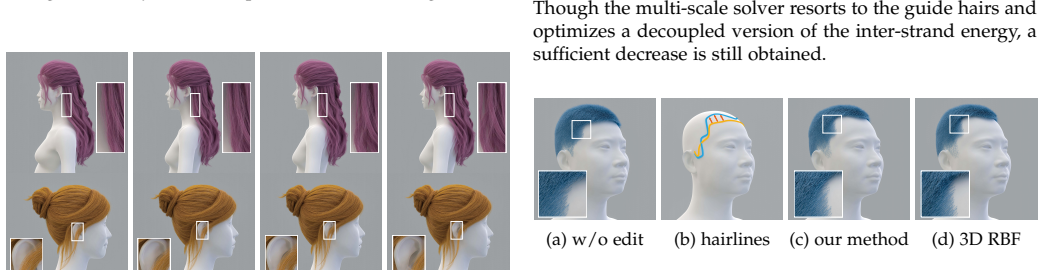
- The hairline-edit tool lets users create variants such as widow's peaks, M-shapes, and receding hairlines while keeping hair-root density changes small.
- Because the method requires no 3D hair dataset, it can be used to augment existing hair datasets with new character and pose variants, which the authors note could improve data-driven hair modeling.
- The reflexive and cycle regression tests indicate the retargeting is internally consistent; applying the same hairstyle back and forth between two characters returns nearly to the original.
Reading between the lines
- This suggests that the same constrained-optimization formulation could transfer other strand-like assets, such as fur, eyelashes, or grass, between bodies or terrains, since the inter-strand Laplacian energy is not hair-specific.
- An extension not developed in the paper is to relax the same-topology and similar-pose assumptions through a dense correspondence step or physics-based hair simulation; the paper itself identifies these as limitations.
- The multi-scale decoupling assumption, that normal hairs are locally coherent with guide hairs, could be stress-tested on braided or interlocked hairstyles where global coupling is strongest; if error grows, the guide-hair count becomes a quality knob.
- Making the pipeline differentiable, which the authors mention as future work, would let the retargeting error act as a semantic loss for self-supervised learning of hair models.
Editorial analysis
A structured set of objections, weighed in public.
Referee Report
Summary. The paper proposes an automatic method for retargeting strand-based 3D hairstyles between human characters that share mesh topology and approximately similar poses. Hair particles are first repositioned using SMPL-based skeleton anchors and local coordinates; the result is smoothed via a Poisson equation. A constrained optimization then minimizes a weighted sum of strand-direction preservation (Eq. 7), inter-strand Laplacian preservation (Eq. 10), and hair-body relationship attachment to the initial transfer (Eq. 11), subject to fixed root positions and a linearized penetration-avoidance half-space constraint (Eq. 13). The optimization is linearized iteratively and solved as a QP with ADMM. To make the problem tractable for millions of particles, a coarse set of guide hairs is optimized globally and normal hairs are adapted locally with respect to the guide hairs. A separate hairline-editing stage relocates hair roots by deforming a scalp membrane embedded in the head surface via a hyperelastic energy (Eq. 15). The paper reports qualitative results on 11 hairstyles and 3 targets, and quantitative regression (reflexive and cycle) tests, density-change comparisons for hairline edits, and runtime statistics.
Significance. If the results hold, the paper addresses a practical asset-reuse problem in games and VR with a well-structured optimization. Its strengths are the explicit decomposition of shape fidelity into strand, inter-strand, and hair-body energies; the multi-scale hierarchy with guide hairs; and the embedded-membrane hairline relocation, which is validated quantitatively against RBF and harmonic alternatives in Table 3. The method also appears fast enough for practical use on high-resolution models. However, the quantitative support for the main retargeting claim is currently too weak to confirm that the optimized output is more faithful than the initial transfer, and the reported speedups are partly overstated.
major comments (3)
- [Section 7.2, Table 2] The reflex and cycle regression tests are consistency checks, not fidelity tests for the actual retargeting operation. A method that returns the source hairstyle unchanged for every target would achieve zero error on both the reflexive (A→A) and cycle (A→B→A) tests, because the round trip A→A is exact. Table 2 therefore cannot distinguish a method that adapts the hair to the target character from one that ignores the target. To support the claim in Section 1 that 'the quantitative results demonstrate the fidelity', the paper should report source-vs-retarget metrics on the actual A→B outputs, for example per-strand direction or curvature error (Eq. 7), inter-strand Laplacian deviation (Eq. 10), and penetration depth or count (Eq. 13), and should compare these against a baseline that stops after the initial transfer of Section 4.1.
- [Table 4; Sections 1 and 7.4] The statement that multi-scale solving achieves a 'two-orders-of-magnitude speedup' is not supported by the data. In Table 4, only two of the eleven listed models (Ponytail, 111×, and Med-Len, 165×) exceed 100×; the other nine range from 31× to 93×. In addition, the Curly row is internally inconsistent: 9,643.62 / 130.31 ≈ 74.0, not the reported 57×. Please correct the table and revise the text to report the observed range or median speedup rather than claiming two orders of magnitude as a general property.
- [Sections 4.6 and 5] The paper should provide more evidence about the reliability and reproducibility of the iterative optimization. The outer loop linearizes the denominator in Eq. (7) and the projection/normal in Eq. (13) at the current iterate, but there is no stated stopping criterion, no tolerance, and no typical iteration count. Since the method's central claim depends on this loop converging to a good solution, please add convergence curves for at least one representative hairstyle and state the iteration/tolerance settings. In addition, the hyperparameters in Table 1, especially α and β in Eq. (1) and ϵ_c in Eq. (13), are set by hand without any sensitivity analysis; please include a small study showing the range over which the qualitative results are stable.
minor comments (5)
- [Abstract and Section 8] The abstract and introduction should state the scope conditions (same mesh topology and similar poses) that are acknowledged in Section 8; as written, the claims of 'distinct body shapes' and 'diverse targets' overstate the method's generality.
- [Eqs. (2) and (20)] The symbol σ is overloaded: in Eq. (2) it is set to 100 for bone selection, while in Eq. (20) it is set to 0.2 for hairline relocation weighting. Using distinct symbols or subscripts would avoid ambiguity.
- [Section 4.1, Eq. (2)] Equation (2) uses the indicator 1_{q_b ∈ Λ_b} without defining the notation in the text; please provide a formal definition or a reference.
- [Table 4 and Figure 7] Some cross-references between figures and tables are ambiguous, for example the 'Fig. 7, col 4' labels in Table 4; numbering the columns in Figure 7 would make the mapping clear.
- [Throughout] A brief language pass is recommended; there are minor grammatical issues throughout, for example 'the users could balance' in Section 5.
Circularity Check
No load-bearing circular derivation; the only self-referential element is the use of reflexive/cycle regression errors as quantitative fidelity evidence, which a target-ignoring baseline would also pass.
-
self definitional
[Section 7.2 (Table 2); Section 4 (Eqs. 1, 7, 10, 11, 12)]
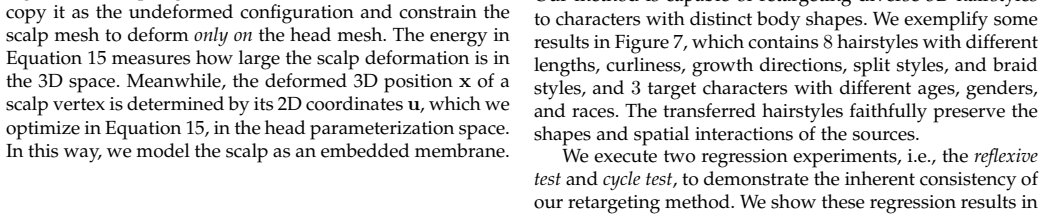
"We execute two regression experiments, i.e., the reflexive test and cycle test, to demonstrate the inherent consistency of our retargeting method. We show these regression results in Figure 6. Visually, they are almost indistinguishable from the original hairstyle. In Table 2, we report their corresponding per-particle distances and per-segment angle differences."
For the reflexive test, the source and target are the same character, so the original configuration is the zero of every energy in Eq. 1: segment directions match (Eq. 7), inter-strand Laplacians match (Eq. 10), the hair-body anchor coincides with the source (Eq. 11), and roots are fixed (Eq. 12). For the cycle test, the round trip is designed to invert the same SMPL-based correspondence, so again the original source configuration is the near-zero-energy point. A degenerate retargeter that ignores the target and always outputs the source would also score near zero on both tests. Table 2 therefore measures solver self-consistency, not whether the actual A-to-B retarget adapted to B, so citing these numbers as quantitative evidence of fidelity is largely definitional.
full rationale
The core optimization is self-contained: strand shape (Eq. 7), inter-strand Laplacian (Eq. 10), hair-body anchoring (Eq. 11), and penetration/root constraints (Eqs. 12-13) form a genuine constrained problem, and the multi-scale solving and hairline membrane deformation are implemented and compared against external baselines (RBF, harmonic maps, LSCM, ARAP, and prior local-positioning strategies). No fitted parameter is renamed as a prediction, and no load-bearing claim relies on a self-citation chain. The one self-referential element is the quantitative regression evidence: reflexive and cycle tests verify round-trip consistency, which is close to guaranteed by the objective design and does not independently establish retargeting fidelity to a new body. This is a validation weakness rather than a derivation that reduces to its inputs, so the overall circularity score is 2.
Assumptions & free parameters
free parameters (7)
- alpha (inter-strand weight) =
3e3
- beta (hair-body weight) =
1e3
- k (knn neighbors) =
5
- epsilon_c (clearance) =
5e-4
- epsilon_s (smoothing threshold) =
0.3
- sigma (bone selection exponent) =
100
- sigma (root-relocation falloff) =
0.2
assumptions (6)
- domain assumption Source and target characters have the same mesh topology and similar poses.
- domain assumption SMPL can be accurately fitted to both character meshes.
- domain assumption KNN neighborhoods computed on the source hairstyle remain approximately valid on the target after deformation.
- domain assumption Guide hairs selected by clustering are representative enough to capture global inter-strand relationships.
- domain assumption The neo-Hookean membrane model on the scalp produces visually acceptable hair-root redistribution.
- standard math The iterative QP with linearized constraints converges to a good local optimum.
Cite this review
Pith. "Pith review of Shape Adaptation for 3D Hairstyle Retargeting." pith.science (2026). https://pith.science/paper/XRGSC2RU
@misc{pith2026250712168,
  author       = {Pith},
  title        = {Pith review of: Shape Adaptation for 3D Hairstyle Retargeting},
  year         = {2026},
  howpublished = {\url{https://pith.science/paper/XRGSC2RU}},
  note         = {Machine review of arXiv:2507.12168}
}
read the original abstract
It is demanding to author an existing hairstyle for novel characters in games and VR applications. However, it is a non-trivial task for artists due to the complicated hair geometries and spatial interactions to preserve. In this paper, we present an automatic shape adaptation method to retarget 3D hairstyles. We formulate the adaptation process as a constrained optimization problem, where all the shape properties and spatial relationships are converted into individual objectives and constraints. To make such an optimization on high-resolution hairstyles tractable, we adopt a multi-scale strategy to compute the target positions of the hair strands in a coarse-to-fine manner. The global solving for the inter-strands coupling is restricted to the coarse level, and the solving for fine details is made local and parallel. In addition, we present a novel hairline edit tool to allow for user customization during retargeting. We achieve it by solving physics-based deformations of an embedded membrane to redistribute the hair roots with minimal distortion. We demonstrate the efficacy of our method through quantitative and qualitative experiments on various hairstyles and characters.
Figures


Figures from the paper (13 more)






Forward citations
Cited by 1 Pith paper
-
Detangled: A Framework for Creating, Editing, and Inferencing Feature Rich Hair Strands
A 5D texture parameterization plus centerline-based canonical space and supervised diffusion enables generation and texture transfer of feature-rich hair strands independent of style.
Reference graph
Works this paper leans on
-
[1]
Hair photobooth: geometric and photometric acquisition of real hairstyles
S. Paris, W. Chang, O. I. Kozhushnyan, W. Jarosz, W. Matusik, M. Zwicker, and F. Durand, “Hair photobooth: geometric and photometric acquisition of real hairstyles.” ACM Trans. Graph., vol. 27, no. 3, p. 30, 2008
work page 2008
-
[2]
L. Luo, H. Li, and S. Rusinkiewicz, “Structure-aware hair capture,” ACM Transactions on Graphics (TOG), vol. 32, no. 4, pp. 1–12, 2013
work page 2013
-
[3]
Ct2hair: High-fidelity 3d hair modeling using computed tomography,
Y. Shen, S. Saito, Z. Wang, O. Maury, C. Wu, J. Hodgins, Y. Zheng, and G. Nam, “Ct2hair: High-fidelity 3d hair modeling using computed tomography,” ACM Transactions on Graphics (TOG), vol. 42, no. 4, pp. 1–13, 2023
work page 2023
-
[4]
Michigan: multi-input-conditioned hair image generation for portrait editing,
Z. Tan, M. Chai, D. Chen, J. Liao, Q. Chu, L. Yuan, S. Tulyakov, and N. Yu, “Michigan: multi-input-conditioned hair image generation for portrait editing,” arXiv preprint arXiv:2010.16417, 2020
arXiv 2010
-
[5]
Barbershop: Gan- based image compositing using segmentation masks,
P . Zhu, R. Abdal, J. Femiani, and P . Wonka, “Barbershop: Gan- based image compositing using segmentation masks,” arXiv preprint arXiv:2106.01505, 2021
arXiv 2021
-
[6]
T. Kim, C. Chung, Y. Kim, S. Park, K. Kim, and J. Choo, “Style your hair: Latent optimization for pose-invariant hairstyle transfer via local-style-aware hair alignment,” in European Conference on Computer Vision. Springer, 2022, pp. 188–203
work page 2022
-
[7]
A style-based generator ar- chitecture for generative adversarial networks,
T. Karras, S. Laine, and T. Aila, “A style-based generator ar- chitecture for generative adversarial networks,” in Proceedings of the IEEE/CVF conference on computer vision and pattern recognition, 2019, pp. 4401–4410
work page 2019
-
[8]
Analyzing and improving the image quality of stylegan,
T. Karras, S. Laine, M. Aittala, J. Hellsten, J. Lehtinen, and T. Aila, “Analyzing and improving the image quality of stylegan,” in Proceedings of the IEEE/CVF conference on computer vision and pattern recognition, 2020, pp. 8110–8119
work page 2020
Show all 51 references
-
[9]
A survey on hair modeling: Styling, simulation, and rendering,
K. Ward, F. Bertails, T.-Y. Kim, S. R. Marschner, M.-P . Cani, and M. C. Lin, “A survey on hair modeling: Styling, simulation, and rendering,” IEEE transactions on visualization and computer graphics, vol. 13, no. 2, pp. 213–234, 2007
2007
-
[10]
A survey of image-based techniques for hair modeling,
Y. Bao and Y. Qi, “A survey of image-based techniques for hair modeling,” IEEE Access, vol. 6, pp. 18 670–18 684, 2018
2018
-
[11]
Single-view hair modeling using a hairstyle database,
L. Hu, C. Ma, L. Luo, and H. Li, “Single-view hair modeling using a hairstyle database,” ACM Transactions on Graphics (ToG), vol. 34, no. 4, pp. 1–9, 2015
2015
-
[12]
Autohair: Fully automatic hair modeling from a single image,
M. Chai, T. Shao, H. Wu, Y. Weng, and K. Zhou, “Autohair: Fully automatic hair modeling from a single image,” ACM Transactions on Graphics, vol. 35, no. 4, 2016
2016
-
[13]
3d hair synthesis using volumetric variational autoencoders,
S. Saito, L. Hu, C. Ma, H. Ibayashi, L. Luo, and H. Li, “3d hair synthesis using volumetric variational autoencoders,” ACM Transactions on Graphics (TOG), vol. 37, no. 6, pp. 1–12, 2018
2018
-
[14]
Neu- ralhdhair: Automatic high-fidelity hair modeling from a sin- gle image using implicit neural representations,
K. Wu, Y. Ye, L. Yang, H. Fu, K. Zhou, and Y. Zheng, “Neu- ralhdhair: Automatic high-fidelity hair modeling from a sin- gle image using implicit neural representations,” in Proceedings of the IEEE/CVF Conference on Computer Vision and Pattern Recognition, 2022, pp. 1526–1535
2022
-
[15]
A data-driven approach to four-view image-based hair modeling
M. Zhang, M. Chai, H. Wu, H. Yang, and K. Zhou, “A data-driven approach to four-view image-based hair modeling.” ACM Trans. Graph., vol. 36, no. 4, pp. 156–1, 2017
2017
-
[16]
Deepmvshair: Deep hair modeling from sparse views,
Z. Kuang, Y. Chen, H. Fu, K. Zhou, and Y. Zheng, “Deepmvshair: Deep hair modeling from sparse views,” in SIGGRAPH Asia 2022 Conference Papers, 2022, pp. 1–8
2022
-
[17]
Capturing braided hairstyles,
L. Hu, C. Ma, L. Luo, L.-Y. Wei, and H. Li, “Capturing braided hairstyles,” ACM Transactions on Graphics (TOG), vol. 33, no. 6, pp. 1–9, 2014
2014
-
[18]
Modeling hair from an rgb-d camera,
M. Zhang, P . Wu, H. Wu, Y. Weng, Y. Zheng, and K. Zhou, “Modeling hair from an rgb-d camera,” ACM Transactions on Graphics (TOG), vol. 37, no. 6, pp. 1–10, 2018
2018
-
[19]
Groomgen: A high-quality generative hair model using hierarchical latent representations,
Y. Zhou, M. Chai, A. Pepe, M. Gross, and T. Beeler, “Groomgen: A high-quality generative hair model using hierarchical latent representations,” ACM Transactions on Graphics (TOG), vol. 42, no. 6, pp. 1–16, 2023
2023
-
[20]
Text-conditioned generative model of 3d strand-based human hairstyles,
V . Sklyarova, E. Zakharov, O. Hilliges, M. J. Black, and J. Thies, “Text-conditioned generative model of 3d strand-based human hairstyles,” in Proceedings of the IEEE/CVF Conference on Computer Vision and Pattern Recognition, 2024, pp. 4703–4712
2024
-
[21]
Loho: Latent optimization of hairstyles via orthogonalization,
R. Saha, B. Duke, F. Shkurti, G. W. Taylor, and P . Aarabi, “Loho: Latent optimization of hairstyles via orthogonalization,” in Proceedings of the IEEE/CVF Conference on Computer Vision and Pattern Recognition, 2021, pp. 1984–1993
2021
-
[22]
Made-to- measure technologies for an online clothing store,
F. Cordier, H. Seo, and N. Magnenat-Thalmann, “Made-to- measure technologies for an online clothing store,” IEEE 12 Computer graphics and applications, vol. 23, no. 1, pp. 38–48, 2003
2003
-
[23]
Design automation for customized apparel products,
C. C. Wang, Y. Wang, and M. M. Yuen, “Design automation for customized apparel products,” Computer-aided design, vol. 37, no. 7, pp. 675–691, 2005
2005
-
[24]
Volume parameterization for design automation of customized free-form products,
C. C. Wang, K.-C. Hui, and K.-M. Tong, “Volume parameterization for design automation of customized free-form products,” IEEE transactions on automation science and engineering, vol. 4, no. 1, pp. 11–21, 2007
2007
-
[25]
Flexible shape control for automatic resizing of apparel products,
Y. Meng, C. C. Wang, and X. Jin, “Flexible shape control for automatic resizing of apparel products,” Computer-aided design, vol. 44, no. 1, pp. 68–76, 2012
2012
-
[26]
Design pre- serving garment transfer,
R. Brouet, A. Sheffer, L. Boissieux, and M.-P . Cani, “Design pre- serving garment transfer,” ACM Transactions on Graphics, vol. 31, no. 4, pp. Article–No, 2012
2012
-
[27]
Learning a shared shape space for multimodal garment design,
T. Y. Wang, D. Ceylan, J. Popovic, and N. J. Mitra, “Learning a shared shape space for multimodal garment design,” arXiv preprint arXiv:1806.11335, 2018
2018 arXiv
-
[28]
Drape: Dressing any person,
P . Guan, L. Reiss, D. A. Hirshberg, A. Weiss, and M. J. Black, “Drape: Dressing any person,” ACM Transactions on Graphics (ToG), vol. 31, no. 4, pp. 1–10, 2012
2012
-
[29]
Learning-based animation of clothing for virtual try-on,
I. Santesteban, M. A. Otaduy, and D. Casas, “Learning-based animation of clothing for virtual try-on,” in Computer Graphics Forum, vol. 38, no. 2. Wiley Online Library, 2019, pp. 355–366
2019
-
[30]
Clothcap: Seamless 4d clothing capture and retargeting,
G. Pons-Moll, S. Pujades, S. Hu, and M. J. Black, “Clothcap: Seamless 4d clothing capture and retargeting,” ACM Transactions on Graphics (ToG), vol. 36, no. 4, pp. 1–15, 2017
2017
-
[31]
Deepwrinkles: Accurate and realistic clothing modeling,
Z. Lahner, D. Cremers, and T. Tung, “Deepwrinkles: Accurate and realistic clothing modeling,” in Proceedings of the European conference on computer vision (ECCV), 2018, pp. 667–684
2018
-
[32]
Smpl: a skinned multi-person linear model,
M. Loper, N. Mahmood, J. Romero, G. Pons-Moll, and M. J. Black, “Smpl: a skinned multi-person linear model,” ACM Transactions on Graphics (TOG), vol. 34, no. 6, pp. 1–16, 2015
2015
-
[33]
Dis- tributed optimization and statistical learning via the alternating direction method of multipliers,
S. Boyd, N. Parikh, E. Chu, B. Peleato, J. Eckstein et al., “Dis- tributed optimization and statistical learning via the alternating direction method of multipliers,” Foundations and Trends® in Machine learning, vol. 3, no. 1, pp. 1–122, 2011
2011
-
[34]
A reduced model for interactive hairs,
M. Chai, C. Zheng, and K. Zhou, “A reduced model for interactive hairs,” ACM Transactions on Graphics (TOG), vol. 33, no. 4, pp. 1–11, 2014
2014
-
[35]
Real-time hair simulation with neural interpolation,
Q. Lyu, M. Chai, X. Chen, and K. Zhou, “Real-time hair simulation with neural interpolation,” IEEE Transactions on Visualization and Computer Graphics, vol. 28, no. 4, pp. 1894–1905, 2020
1905
-
[36]
Real- time physically guided hair interpolation,
J. Hsu, T. Wang, Z. Pan, X. Gao, C. Yuksel, and K. Wu, “Real- time physically guided hair interpolation,” ACM Transactions on Graphics (TOG), vol. 43, no. 4, pp. 1–11, 2024
2024
-
[37]
Example-based hair geometry synthesis,
L. Wang, Y. Yu, K. Zhou, and B. Guo, “Example-based hair geometry synthesis,” in ACM SIGGRAPH 2009 papers, 2009, pp. 1–9
2009
-
[38]
Multiresolution analysis of arbitrary meshes,
M. Eck, T. DeRose, T. Duchamp, H. Hoppe, M. Lounsbery, and W. Stuetzle, “Multiresolution analysis of arbitrary meshes,” in Proceedings of the 22nd annual conference on Computer graphics and interactive techniques, 1995, pp. 173–182
1995
-
[39]
Robust quasistatic finite elements and flesh simulation,
J. Teran, E. Sifakis, G. Irving, and R. Fedkiw, “Robust quasistatic finite elements and flesh simulation,” in Proceedings of the 2005 ACM SIGGRAPH/Eurographics symposium on Computer animation, 2005, pp. 181–190
2005
-
[40]
Com- putational design of skintight clothing,
J. Montes, B. Thomaszewski, S. Mudur, and T. Popa, “Com- putational design of skintight clothing,” ACM Transactions on Graphics (TOG), vol. 39, no. 4, pp. 105–1, 2020
2020
-
[41]
Chumpy autodifferentation library,
M. Loper, “Chumpy autodifferentation library,” 2014. [Online]. Available: https://github.com/mattloper/chumpy
2014
-
[42]
OSQP: an operator splitting solver for quadratic programs,
B. Stellato, G. Banjac, P . Goulart, A. Bemporad, and S. Boyd, “OSQP: an operator splitting solver for quadratic programs,” Mathematical Programming Computation, vol. 12, no. 4, pp. 637–672, 2020. [Online]. Available: https://doi.org/10.1007/ s12532-020-00179-2
2020
-
[43]
Ann: A library for approximate nearest neighbor searching,
D. M. Mount, “Ann: A library for approximate nearest neighbor searching,” http://www. cs. umd. edu/˜ mount/ANN/, 2010
2010
-
[44]
libigl: A simple c++ geometry processing library,
A. Jacobson, D. Panozzo, C. Sch ¨uller, O. Diamanti, Q. Zhou, N. Pietroni et al., “libigl: A simple c++ geometry processing library,” Google Scholar, 2013
2013
-
[45]
Relationship de- scriptors for interactive motion adaptation,
R. A. Al-Asqhar, T. Komura, and M. G. Choi, “Relationship de- scriptors for interactive motion adaptation,” in Proceedings of the 12th ACM SIGGRAPH/Eurographics Symposium on Computer Animation, 2013, pp. 45–53
2013
-
[46]
Least squares con- formal maps for automatic texture atlas generation,
B. L ´evy, S. Petitjean, N. Ray, and J. Maillot, “Least squares con- formal maps for automatic texture atlas generation,” in Seminal Graphics Papers: Pushing the Boundaries, Volume 2, 2023, pp. 193–202
2023
-
[47]
A local/global approach to mesh parameterization,
L. Liu, L. Zhang, Y. Xu, C. Gotsman, and S. J. Gortler, “A local/global approach to mesh parameterization,” in Computer graphics forum, vol. 27, no. 5. Wiley Online Library, 2008, pp. 1495–1504
2008
-
[48]
Faust: Dataset and evaluation for 3d mesh registration,
F. Bogo, J. Romero, M. Loper, and M. J. Black, “Faust: Dataset and evaluation for 3d mesh registration,” in Proceedings of the IEEE conference on computer vision and pattern recognition, 2014, pp. 3794–3801
2014
-
[49]
Functional maps: a flexible representation of maps between shapes,
M. Ovsjanikov, M. Ben-Chen, J. Solomon, A. Butscher, and L. Guibas, “Functional maps: a flexible representation of maps between shapes,” ACM Transactions on Graphics (ToG), vol. 31, no. 4, pp. 1–11, 2012
2012
-
[50]
A hybrid iterative solver for robustly capturing coulomb friction in hair dy- namics,
G. Daviet, F. Bertails-Descoubes, and L. Boissieux, “A hybrid iterative solver for robustly capturing coulomb friction in hair dy- namics,” in Proceedings of the 2011 SIGGRAPH Asia Conference, 2011, pp. 1–12
2011
-
[51]
Adaptive nonlinearity for collisions in complex rod assem- blies,
D. M. Kaufman, R. Tamstorf, B. Smith, J.-M. Aubry, and E. Grin- spun, “Adaptive nonlinearity for collisions in complex rod assem- blies,” ACM Transactions on Graphics (TOG), vol. 33, no. 4, pp. 1–12, 2014. Lu Y ureceived his bachelor’s degree in Applied Mathematics from Zhejia...
2014
Reviewed August 6, 2026 · model on record in the stance chip above.
Discussion (0). Sign in to comment.