REVIEW 4 major objections 5 minor 24 references
Cell Sensing: Traffic detection
T0 review · 4 major / 5 minor · reviewed 2026-08-06 · deepseek-v4-flash
Pith's one-line read A passive dual-receiver LTE setup can detect moving pedestrians and vehicles and estimate their speeds from differential Doppler shifts in ambient cellular signals, with over 90% detection accuracy above 6000 mm/min in controlled tests.
desk verdict A transparent LTE dual-receiver CSI feasibility study with a solid indoor demo, but the outdoor speed estimates hinge on a factor-2π slip and an unverified cross-term dominance assumption. read the letter →
The pith
A machine-rendered reading of the paper's core claim, the machinery that carries it, and where it could break.
The reading
What carries the argument
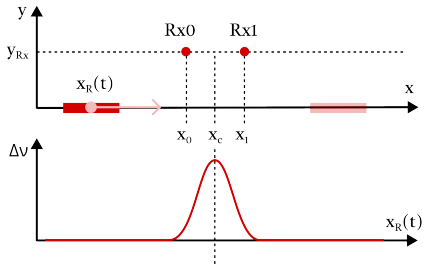
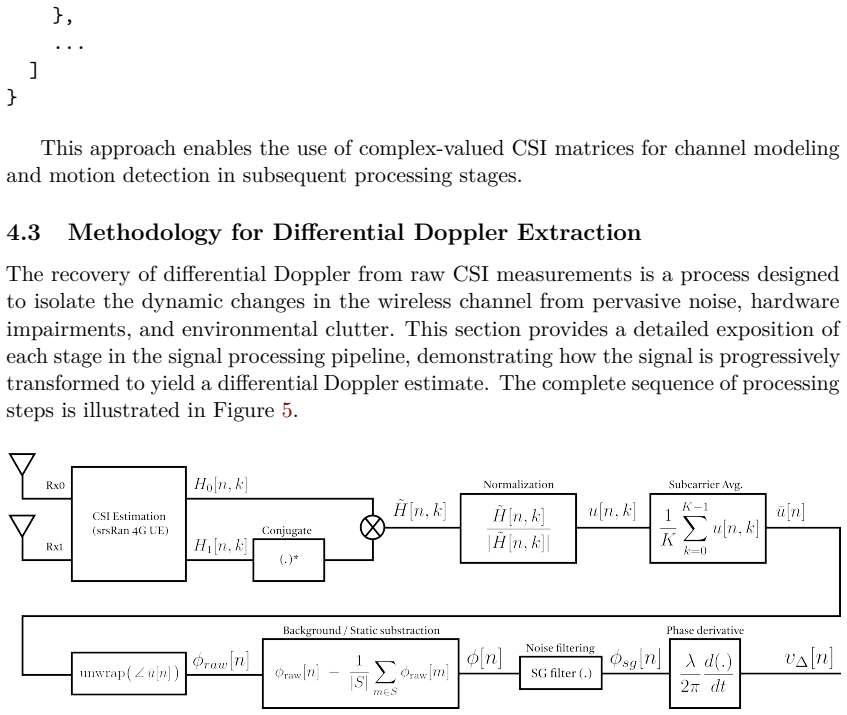
The load-bearing object is the composite channel $\tilde{H}(t,f)=\hat{H}_1(t,f)\,\hat{H}_0^*(t,f)$, the product of the two receivers' estimated channels with one conjugated. Under the assumption $C_0 \approx C_1 \approx C$, this multiplication turns common hardware impairments into the real factor $|C(t,f)|^2$ and exposes a differential dynamic cross-term whose phase, after normalization, subcarrier averaging, unwrapping, background subtraction, and smoothing, differentiates into the instantaneous differential Doppler $\Delta\nu(t)=\nu_1(t)-\nu_0(t)$. At the moment a reflector crosses the midpoint of the antenna baseline, this differential Doppler reaches a peak whose value feeds the speed estimate $v_x \approx -\Delta\nu(x_c)\,\lambda R_m / (2(x_c-x_0))$.
What would settle it
Feed the same RF signal into both receiver inputs through a power splitter so no true differential Doppler exists; any phase trajectory remaining after the pipeline is pure hardware mismatch. If that residual is comparable to the phase signature of a 6000 mm/min crossing, the cancellation assumption fails. Alternatively, repeat the indoor low-speed test at 2000 mm/min across sessions and check whether the reported 62.2% detection rate is stable, since the paper identifies low speeds as the regime where the dynamic echo drowns in static clutter.
Extended reading notes
Core claim
The central discovery is that the differential Doppler shift between two closely spaced receivers, extracted by conjugate-multiplying their CSI, is a usable proxy for a target crossing the antenna baseline, and its time-derivative yields speed. In the model, the hardware impairment term $C(t,f)$, which corrupts single-receiver phase, becomes $|C(t,f)|^2$ after multiplication, a real scaling factor; the surviving signal carries the term $a_1 a_0^* e^{j2\pi(\nu_1-\nu_0)t} e^{-j2\pi f(\tau_1-\tau_0)}$. The differential Doppler peaks when the reflector crosses the midpoint of the two antennas, and the peak value gives $v_x \approx -\Delta\nu(x_c)\,\lambda R_m / (2(x_c-x_0))$. The paper reports that this peak is detectable in practice and that the estimated speeds fall in physically reasonable ranges for pedestrians and vehicles.
Load-bearing premise
The load-bearing premise is that the two receivers' hardware impairments are effectively identical, $C_0(t,f) \approx C_1(t,f) \approx C(t,f)$, so that conjugate multiplication cancels phase errors and leaves only $|C(t,f)|^2$ as a real scaling factor.
Editorial extensions
If this is right
- At 6000 mm/min the controlled indoor detection rate is 96.8%, and at 10000 mm/min it is 91.9%, while at 2000 mm/min it drops to 62.2%.
- The same pipeline yields speed estimates without knowing the target's identity: outdoor estimates for pedestrians were about 6.8-11.1 km/h and for vehicles about 32.5-43.7 km/h.
- Direction of motion is encoded in the sign of the differential Doppler, but the paper's outdoor data show that the sign is not always consistent, so direction cannot yet be trusted in real conditions.
- Because the sensing is passive and uses the existing LTE downlink, each additional monitoring point needs only a receiver; the practical limits are synchronization, multipath, and per-site calibration rather than transmitter cost.
Reading between the lines
- A testable extension would be to sweep the antenna separation and measure residual phase noise after conjugate multiplication, which would map how far the common-impairment assumption holds.
- The speed formula assumes a known reflector distance $R_m$ from the baseline midpoint, so in multilane roads the same differential Doppler could correspond to very different true speeds; fusing angle-of-arrival or range information is a natural next step the paper leaves implicit.
- If the method is correct, low-cost roadside receivers could act as traffic-counting nodes for smart-city applications, but the 62.2% detection rate at 2000 mm/min suggests that pedestrian and bicycle speeds will need denser antenna arrays or learning-based separation of static and dynamic components.
Signed reviews
Editorial analysis
A structured set of objections, weighed in public.
Referee Report
Summary. The paper presents a passive traffic-sensing system that uses a dual-receiver software-defined radio to acquire LTE downlink CSI, multiplies the CSI of the two receivers to cancel common hardware impairments, and extracts a differential Doppler signal that is related to target velocity. The theoretical framework is based on Bello's time-variant channel model, and the processing pipeline includes normalization, subcarrier averaging, phase unwrapping, background subtraction, Savitzky-Golay filtering, and differentiation. The system is evaluated in a controlled indoor room with a moving reflector (239 trajectories for detection, 751 for speed classification) and in two outdoor scenarios (a parking area with pedestrians and a roadside with vehicles). The paper reports detection rates above 90% for speeds above 6000 mm/min in the controlled indoor tests and provides a few qualitative outdoor speed estimates.
Significance. If the central claims hold, the paper demonstrates a low-cost, passive approach to vehicle and pedestrian detection using ambient LTE signals, with clear relevance to ISAC and smart-infrastructure applications. The strengths of the manuscript include a concrete dual-receiver channel model, a transparent step-by-step signal-processing pipeline, and a quantitative indoor evaluation with detection rate and false-positive rate reported for 239 trajectories. The use of open-source srsRAN software and commodity SDR hardware supports reproducibility. However, the outdoor evidence is limited to six qualitative speed estimates without ground truth, the speed-estimation formula contains a factor-of-2π inconsistency, and the assumed dominance of the differential dynamic cross-term over static-dynamic cross-terms is not demonstrated. The indoor results are the only statistically solid part of the paper.
major comments (4)
- [6.2, Eq. (5)] Equation (5) is inconsistent with the speed formula derived in Section 3.2 and with the definition of vΔ in Section 4.3. Section 3.2 gives vx ≈ -Δν λ Rm / (2(xc-x0)), and Section 4.3 defines vΔ(t) = λ/(2π) Δν(t). Substituting these definitions into Eq. (5) shows that a factor of 2π is missing. For example, the reported pedestrian speed of 3.095 m/s would become about 19.45 m/s if the factor 2π were included, which is implausible; conversely, if vΔ is meant to be a phase derivative in units of mm/s, the notation and derivation are not explained. Please correct the formula and re-derive all outdoor speed estimates, or explicitly state the units and the physical meaning of vΔ.
- [3.2, expansion of H~] The claim that the differential dynamic cross-term a1 a0* e^{j2π(ν1-ν0)t} dominates after background subtraction is asserted but not demonstrated. The static-dynamic cross-terms Hs,1 a0* e^{-j2πν0 t} and Hs,0* a1 e^{j2πν1 t} carry time-varying phases at ν0 and ν1, respectively, and they are not removed by the background-subtraction step described in Section 4.3, which subtracts a constant or slowly varying phase offset. The paper states that suppression is 'achieved via background subtraction techniques' and lists the condition 'the vehicle echo is strong enough to be discerned,' but no measurement, ablation, or synthetic check quantifies |Hs|/|a| or demonstrates that the Δν component survives subcarrier averaging and normalization. In the outdoor scenarios the static or direct path is typically much stronger than the target echo, so the phase derivative computed in Section 4.3 step 6 may track ν0 or ν1 rather than Δν, which would invalidate Eq. (5). Please provide a quantitative analysis of the relative magnitudes of the four terms in at least one indoor and one outdoor measurement, for example via spectrograms or by comparing the phase derivative against the expected differential Doppler.
- [Abstract and Section 6.1, Fig. 12] The abstract's statement that 'the system demonstrated over 90% detection accuracy' is not supported by the reported metrics. Section 5.2 defines Detection Rate as sensitivity (TP/(TP+FN)), not accuracy, and Figure 12 reports DR of 96.8% at 6000 mm/min and 91.9% at 10000 mm/min, with corresponding FPR of 3.2% and 8.1%. The overall DR across all speeds is 82.0%. Reporting sensitivity as 'accuracy' overstates performance, especially because FPR is non-negligible and the paper itself notes that some false positives may be correct detections that are slightly offset from the ground-truth timestamps. Please report accuracy, precision, F1, and ROC curves, or explicitly state that the metric is sensitivity and give the accompanying FPR in the abstract.
- [3.2, assumption C0≈C1] The dual-receiver calibration relies on the assumption C0(t,f) ≈ C1(t,f) ≈ C(t,f), but the paper provides no validation of this assumption for the two RF chains of the LimeSDR. If the two chains have different phase noise, carrier frequency offset, sampling frequency offset, or I/Q imbalance, the conjugate multiplication does not reduce C to |C|² but leaves a residual complex exponential that corrupts the extracted differential phase. This is load-bearing because the speed estimate depends directly on a clean differential Doppler. Please include a calibration measurement under static conditions that quantifies the residual phase error after conjugate multiplication, or justify the assumption with hardware specifications and a sensitivity analysis.
minor comments (5)
- [Figure 13] The caption and the text disagree on which panel is intra-measurement and which is inter-measurement: the caption labels (a) intra and (b) inter, while the text refers to Figure 13b as intra and Figure 13a as inter. Please clarify.
- [5.2] There is a typo in 'where environmental and processing conditions conditions remain constant'; remove the duplicated word.
- [Section 9] 'extense' should be 'extensive' in the opening sentence of the conclusion.
- [6.2] The units of vΔ are unclear: the text gives values such as vΔ = 201 mm/s, but Section 4.3 defines vΔ with units of velocity (m/s if Δν is in Hz and λ in meters), and the subsequent computation mixes mm/s and meters. Please state the units explicitly and define how vΔ is obtained from the unwrapped phase in each experiment.
- [Figure 3] Figure 3 appears to be identical to Figure 1 (both are described as 'Passive vehicle detection scenario illustration'); please renumber or remove the duplicate.
Circularity Check
No significant circularity: the dual-RX differential-Doppler chain is derived, not assumed; the key dominance caveat is disclosed as a condition; the sole same-group citation is peripheral. Outdoor validation lacks ground truth but does not reduce to its inputs by construction.
full rationale
The central derivation chain is self-contained. Section 3.1 builds the single-RX CSI model from Bello's delay-Doppler formalism (Eq. 4), and Section 3.2 constructs the composite signal H~ = H1H0* under the explicitly stated assumption C0 ≈ C1 ≈ C, expands the product into four terms, and isolates the dynamic-dynamic term whose time-derivative is the differential Doppler. The speed formula vx ≈ −ΔνλRm/(2(xc−x0)) is obtained by differentiating the range geometry; it is not fitted to the measured data. The paper's weakest assumption, that static-static and static-dynamic cross-terms are suppressed, is openly disclosed rather than hidden: 'This model proves effective when: Static background subtraction is feasible, The vehicle echo is strong enough to be discerned, and The scenario involves a dominant dynamic path' (Section 3.2), and Section 7.1 restates that those cross-products 'can overlap with the desired differential dynamic cross-term.' An unverified physical assumption is a correctness and robustness gap, not a circular reduction. Indoor detection rates are scored against independent positioner ground truth, and speed evaluation is honestly framed as relative: 'the evaluation of speed for indoor measurements primarily relies on relative comparisons' (Section 6.1); inter-measurement degradation is attributed to per-session calibration and thresholds, which are disclosed as calibrations rather than presented as predictions. Outdoor speed estimates (Section 6.2) are model-based outputs checked only against expected ranges; Section 5.2 admits 'the evaluation relies on a combination of visual assessment and direct application of the speed estimation formula,' and Section 8.1 calls for future 'ground-truth validation mechanisms.' This weakens evidential support but does not make the estimates equal to their inputs by construction, since the inputs (antenna separation, Rm, wavelength) are measured, not derived from the output speeds. The only citation with same-group overlap is [20] (S. Li et al., ComplexBeat), cited in Section 2.3 for the general need for phase sanitization; it is peripheral and not load-bearing for any detection, estimation, or derivation claim. No fitted parameter is renamed as a prediction, no uniqueness theorem is imported from the authors' prior work, and no ansatz is smuggled in via self-citation.
Assumptions & free parameters
free parameters (4)
- Savitzky-Golay filter window size and polynomial order
- Background subtraction window
- Per-session classification thresholds
- Peak detection offset tolerance
assumptions (6)
- standard math Bello's delay-Doppler channel model applies to the LTE channel as modeled
- domain assumption The hardware impairment term C(t,f) is common to both receivers
- domain assumption A single dominant dynamic path represents the target
- domain assumption The transmitter is far enough that its range derivative cancels in the differential Doppler
- domain assumption Background subtraction fully removes static and static-dynamic cross-terms
- domain assumption The channel is approximately flat across averaged subcarriers
Cite this review
Pith. "Pith review of Cell Sensing: Traffic detection." pith.science (2026). https://pith.science/paper/BWIKTMCV
@misc{pith2026250712211,
  author       = {Pith},
  title        = {Pith review of: Cell Sensing: Traffic detection},
  year         = {2026},
  howpublished = {\url{https://pith.science/paper/BWIKTMCV}},
  note         = {Machine review of arXiv:2507.12211}
}
read the original abstract
This work presents a passive sensing system for traffic monitoring using ambient Long Term Evolution (LTE) signals as a non-intrusive and scalable alternative to traditional surveillance methods. The approach employs a dual-receiver architecture analyzing Channel State Information (CSI) to isolate differential Doppler shifts induced by moving targets, effectively mitigating hardware-induced phase impairments. Implemented with a Software Defined Radio (SDR) platform and srsRAN software, the system demonstrated over 90% detection accuracy for speeds above 6000 mm/min in controlled indoor tests, and provided reliable speed estimations for pedestrians and vehicles in outdoor evaluations. Despite challenges at low speeds, directional ambiguity, and multipath fading in urban settings, the results validate LTE-based passive sensing as a feasible traffic monitoring method, identifying critical areas for future research such as angle-of-arrival (AoA) integration, machine learning, and real-time embedded system development.
Figures


Figures from the paper (13 more)



Reference graph
Works this paper leans on
-
[1]
Wireless sensing for human activity: A survey,
J. Liu, H. Liu, Y. Chen, Y. Wang, and C. Wang, “Wireless sensing for human activity: A survey,” IEEE Communications Surveys & Tutorials, vol. 22, no. 3, pp. 1629–1645, 2020. d o i: 10.1109/COMST.2019.2934489
arXiv 2020
-
[2]
An efficient ofdm-based monostaticradardesignformultitargetdetection,
M. Delamou, G. Noubir, S. Dang, and E. M. Amhoud, “An efficient ofdm-based monostaticradardesignformultitargetdetection,” IEEE Access, vol.11, pp.135090– 135105, 2023. d o i: 10.1109/ACCESS.2023.3337079
arXiv 2023
-
[3]
Beamsense: Rethinking wireless sensing with mu-mimo wi-fi beamforming feedback,
K. F. Haque, M. Zhang, F. Meneghello, and F. Restuccia, “Beamsense: Rethinking wireless sensing with mu-mimo wi-fi beamforming feedback,”Computer Networks, vol. 258, p. 111020, Feb. 2025,i s s n: 1389-1286. d o i: 10.1016/j.comnet.2024. 111020. [Online]. Available: http://dx.doi.org/10.1016/j.comnet.2024. 111020
-
[4]
Tool release: Gathering 802.11n traces with channel state information,
D. Halperin, W. Hu, A. Sheth, and D. Wetherall, “Tool release: Gathering 802.11n traces with channel state information,” SIGCOMM Comput. Commun. Rev. , vol.41, no.1, p.53, Jan. 2011, i s s n: 0146-4833. d o i: 10.1145/1925861.1925870. [Online]. Available: https://doi.org/10.1145/1925861.1925870
-
[5]
Inferring motion direction with wi-fi,
Z. Yang, K. Qian, C. Wu, and Y. Zhang, “Inferring motion direction with wi-fi,” in Jan. 2021, pp. 157–182,i s b n: 978-981-16-5657-6. d o i: 10.1007/978-981-16- 5658-3_8
-
[6]
Passive radar sensing for human activity recognition: A survey,
F. Savvidou, S. A. Tegos, P. D. Diamantoulakis, and G. K. Karagiannidis, “Passive radar sensing for human activity recognition: A survey,”IEEE Open Journal of Engineering in Medicine and Biology, vol. 5, pp. 700–706, 2024.d o i: 10.1109/ OJEMB.2024.3420747
-
[7]
Jiao et al.,Information-theoretic limits of bistatic integrated sensing and com- munication, 2025
T. Jiao et al.,Information-theoretic limits of bistatic integrated sensing and com- munication, 2025. arXiv: 2306 . 06648 [cs.IT]. [Online]. Available: https : //arxiv.org/abs/2306.06648
arXiv 2025
-
[8]
Rf impairments in wireless transceivers: Phase noise, cfo, and iq imbalance – a survey,
A. Mohammadian and C. Tellambura, “Rf impairments in wireless transceivers: Phase noise, cfo, and iq imbalance – a survey,”IEEE Access, vol. 9, pp. 111718– 111791, 2021. d o i: 10.1109/ACCESS.2021.3101845
Show all 24 references
-
[9]
A survey on wifi-based indoor positioning technologies,
F. Liu et al., “A survey on wifi-based indoor positioning technologies,”IET Com- munications, vol. 14, Jun. 2020.d o i: 10.1049/iet-com.2019.1059
2020
-
[10]
Solving the wifi sensing dilemma in reality leveraging conformal prediction,
K. Wang, C. Shi, J. Cheng, Y. Wang, M. Xie, and Y. Chen, “Solving the wifi sensing dilemma in reality leveraging conformal prediction,” inProceedings of the 20th ACM Conference on Embedded Networked Sensor Systems, ser. SenSys ’22, Boston, Massachusetts: Association for Comput...
2023
-
[11]
Csi- based localization with cnns exploiting phase information,
A. Foliadis, M. H. C. Garcia, R. A. Stirling-Gallacher, and R. S. Thomä, “Csi- based localization with cnns exploiting phase information,” in2021 IEEE Wireless Communications and Networking Conference (WCNC), 2021, pp. 1–6. d o i: 10. 1109/WCNC49053.2021.9417561
2021
-
[12]
Csi-ratio-based doppler frequency estimation in integrated sensing and communications,
X. Li, J. A. Zhang, K. Wu, Y. Cui, and X. Jing, “Csi-ratio-based doppler frequency estimation in integrated sensing and communications,”IEEE Sensors Journal, vol. 22, no. 21, pp. 20886–20895, 2022.d o i: 10.1109/JSEN.2022.3208272
2022
-
[13]
Understandingandmodeling of wifi signal based human activity recognition,
W.Wang, A.X.Liu, M.Shahzad, K.Ling, andS.Lu, “Understandingandmodeling of wifi signal based human activity recognition,” inProceedings of the 21st Annual International Conference on Mobile Computing and Networking, ser. MobiCom ’15, Paris, France: Association for Computing Mac...
2015
-
[14]
On csi and passive wi-fi radar for opportunistic physical activity recognition,
W. Li, M. J. Bocus, C. Tang, R. J. Piechocki, K. Woodbridge, and K. Chetty, “On csi and passive wi-fi radar for opportunistic physical activity recognition,”IEEE Transactions on Wireless Communications, vol. 21, no. 1, pp. 607–620, 2022.d o i: 10.1109/TWC.2021.3098526
2022
-
[15]
Vehicle detection and classification using lte-commsense,
S. Sardar, A. K. Mishra, and M. Z. A. Khan, “Vehicle detection and classification using lte-commsense,”IET Radar, Sonar & Navigation, vol. 13, no. 5, 850–857, May 2019, i s s n: 1751-8792. d o i: 10 . 1049 / iet - rsn . 2018 . 5231. [Online]. Available: http://dx.doi.org/1...
2019
-
[16]
Wireless lan-based csi monitoring system for object detection,
T. Murakami, M. Miyazaki, S. Ishida, and A. Fukuda, “Wireless lan-based csi monitoring system for object detection,”Electronics, vol. 7, p. 290, Nov. 2018. d o i: 10.3390/electronics7110290
2018 doi
-
[17]
J. Guo, W. Zhuang, Y. Mao, and I. W.-H. Ho, Rssi-assisted csi-based passen- ger counting with multiple wi-fi receivers, 2024. arXiv: 2410.11400 [eess.SP] . [Online]. Available: https://arxiv.org/abs/2410.11400
2024 arXiv
-
[18]
Device-free crowd counting using multi-link wi-fi csi descriptors in doppler spec- trum,
R. F. Brena, E. Escudero, C. Vargas-Rosales, C. E. Galvan-Tejada, and D. Munoz, “Device-free crowd counting using multi-link wi-fi csi descriptors in doppler spec- trum,” Electronics, vol. 10, no. 3, 2021, i s s n: 2079-9292. d o i: 10 . 3390 / electronics10030315. [Online]. A...
2021
-
[19]
Integrating csi sensing in wireless networks: Challenges to privacy and countermeasures,
R. L. Cigno, F. Gringoli, M. Cominelli, and L. Ghiro, “Integrating csi sensing in wireless networks: Challenges to privacy and countermeasures,”IEEE Network, vol. 36, no. 4, pp. 174–180, 2022.d o i: 10.1109/MNET.010.2100740
2022 doi
-
[20]
Complexbeat: Breathing rate estimation from complex csi,
S. Li, A. T. Kristensen, A. Burg, and A. Balatsoukas-Stimming, “Complexbeat: Breathing rate estimation from complex csi,” in2021 IEEE Workshop on Signal Processing Systems (SiPS), 2021, pp. 217–222.d o i: 10.1109/SiPS52927.2021. 00046. 38
2021
-
[21]
Characterization of randomly time-variant linear channels,
P. Bello, “Characterization of randomly time-variant linear channels,”IEEE Trans- actions on Communications Systems, vol. 11, no. 4, pp. 360–393, 1963. d o i: 10.1109/TCOM.1963.1088793
1963
-
[22]
Fullbreathe: Full human res- piration detection exploiting complementarity of csi phase and amplitude of wifi signals,
Y. Zeng, D. Wu, R. Gao, T. Gu, and D. Zhang, “Fullbreathe: Full human res- piration detection exploiting complementarity of csi phase and amplitude of wifi signals,” Proceedings of the ACM on Interactive, Mobile, Wearable and Ubiquitous Technologies, vol. 2, pp. 1–19, Sep. 201...
2018 doi
-
[23]
attify - store
Attify Store, Limesdr (aluminum case), https : / / www . attify - store . com / products/limesdr-aluminum-case, Accessed: 2025-07-01, 2025
2025
-
[24]
Rg316 flexible coax cable fep jacket datasheet,
Fairview Microwave, “Rg316 flexible coax cable fep jacket datasheet,” Fairview Mi- crowave, Technical Data Sheet FMC02691, 2020, Accessed: 2025-07-01. [Online]. Available: https : / / www . fairviewmicrowave . com / content / dam / infinite - electronics/product-assets/fairvie...
2020
Reviewed August 6, 2026 · model on record in the stance chip above.
Discussion (0). Continue with ORCID to comment.