REVIEW 4 major objections 5 minor 4 cited by
NLI4VolVis: Natural Language Interaction for Volume Visualization via LLM Multi-Agents and Editable 3D Gaussian Splatting
T0 review · 4 major / 5 minor · reviewed 2026-08-06 · deepseek-v4-flash
Pith's one-line read A system combining editable 3D Gaussian splatting with LLM multi-agents lets users explore, query, and edit volume scenes using natural language.
desk verdict A first integration of editable 3DGS, CLIP querying, and multi-agent LLMs for volume visualization that ships real demos and honest limitations, but its headline open-vocabulary querying is never validated as a retrieval task. read the letter →
The pith
A machine-rendered reading of the paper's core claim, the machinery that carries it, and where it could break.
The reading
What carries the argument
The load-bearing mechanism is the per-component CLIP embedding matched with an editable Gaussian scene. Each segmented volume region is summarized by the mean CLIP embedding of its most informative rendered views, where informativeness is measured by the entropy of the alpha channel, so any free-text query can be matched to the closest object by cosine similarity. Each region is also trained as an independent iVR-GS model—an extension of 3D Gaussian splatting with per-Gaussian attributes for color offset, ambient, diffuse, specular, and shininess—so that color, opacity, and lighting can be edited in real time and scenes can be recomposed by concatenating Gaussian parameters. A hierarchy of LLM agents with function-calling tools then interprets user requests and issues declarative commands, following a visualization-perception-action loop to iteratively refine the result until the user's goal is met.
What would settle it
Run a retrieval test on a labeled volume with ground-truth object labels, such as the medical organ dataset used in the paper: issue a set of natural-language queries whose correct target object is known, plus at least one query naming something absent from the scene, and check whether the highest cosine-similarity object is the ground truth and whether the absent query is rejected. If top-1 accuracy is near chance for any dataset, or if an absent-object query yields a confident highlight, the central claim fails.
Extended reading notes
Core claim
NLI4VolVis establishes that a volumetric scene can be made queryable and editable through a combination of four components: multi-view semantic segmentation, CLIP-based open-vocabulary embeddings, per-component editable Gaussian scenes trained with iVR-GS, and a rule-based hierarchical multi-agent LLM with function-calling tools. The paper's central claim is that these components together—rather than any single model—enable open-vocabulary object querying, real-time scene editing, best-view selection, and 2D stylization in one interactive system. The paper reports case studies across eight datasets and a user study in which participants learned the system quickly, completed the assigned visualization tasks, and mostly chose natural language over the graphical interface for their interactions.
Load-bearing premise
The system's central premise is that the average CLIP embedding of a few high-entropy rendered views of a segmented object is close enough, in cosine similarity, to the natural-language phrase a user would use for that object; nothing in the paper independently validates retrieval accuracy, and out-of-scope queries are admitted to still return a confident top match.
Editorial extensions
If this is right
- Non-experts can perform tasks like isolating organs, adjusting lighting, and stylizing scenes by describing them in natural language or voice, with rendering maintained at more than 100 frames per second on consumer GPUs.
- Open-vocabulary querying needs no retraining for new objects: any text can be embedded with CLIP and compared against the precomputed component embeddings.
- The pipeline accepts both pre-segmented datasets and various automatic segmentation methods, so the same NLI interface can be applied across medical, biological, and simulation volumes.
- The visualization-perception-action loop allows multi-step requests such as 'show only the digestive system and make everything else semi-transparent' to be decomposed and executed as a sequence of declarative commands.
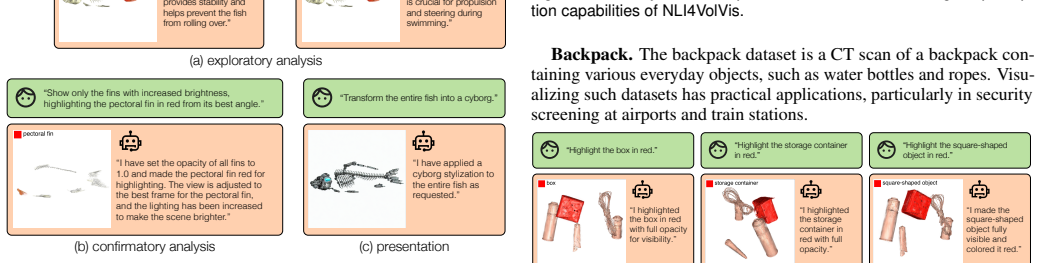
- Case studies illustrate the three visualization goals—exploratory, confirmatory, and presentation—and the user study reports a high natural-language usage rate, suggesting that most users prefer speaking to GUI manipulation.
Reading between the lines
- If the CLIP-alignment assumption holds broadly, the architecture could be transferred to other scientific fields—such as seismic or flow visualization—by swapping the segmentation strategy, because the rest of the pipeline is method-agnostic.
- The acknowledged absence of automatic validation for function-calling outputs suggests a concrete safeguard: a threshold on CLIP similarity or a verification step that rejects queries with no plausible match would prevent the misleading visualizations the paper admits occur for out-of-scope queries.
- A direct comparison of top-k entropy view selection against random view selection, holding everything else fixed, would isolate how much of the query-retrieval accuracy comes from the entropy-guided encoding rather than from CLIP itself.
- The small user study leaves open whether the high natural-language usage rate reflects the interface's merits or the novelty of the system for participants; a longitudinal study with repeated sessions would test whether the preference persists.
Editorial analysis
A structured set of objections, weighed in public.
Referee Report
Summary. The paper proposes NLI4VolVis, a natural-language interaction system for volume visualization that combines multi-view semantic segmentation, CLIP-based open-vocabulary embeddings, editable 3D Gaussian splatting (iVR-GS), and a hierarchical multi-agent LLM architecture with function-calling tools. The system supports open-vocabulary object querying, real-time scene editing, best-view selection, and 2D stylization. It is evaluated through case studies on eight volumetric datasets and a user study with eight participants, with additional ablations on segmentation methods, LLM latency, stylization, and the top-k view-selection parameter.
Significance. The integration of semantic segmentation, editable 3DGS, and LLM agents is a timely and potentially useful contribution that could make volume visualization more accessible to non-experts. The authors ship a demo, source code, and detailed case-study material, and they report real-time rendering speeds above 100 FPS. However, the central open-vocabulary retrieval mechanism is not validated as a retrieval task, and the user study lacks a baseline and statistical rigor; these gaps currently limit the strength of the claims 'enables users to explore, query, and edit volumetric scenes using natural language' and 'improved accessibility and usability.' If the retrieval evaluation and user-study controls are added, the contribution would be substantially strengthened.
major comments (4)
- [§3.2, Eq. (1)] The open-vocabulary querying step, which is the load-bearing component of the entire pipeline, is never evaluated as a retrieval task. Appendix §4 only reports the mean cosine similarity between each component's top-k CLIP embedding and its ground-truth label while varying k; it does not test whether unseen user paraphrases retrieve the correct component, nor does it include negative or out-of-scope queries. Section 5 explicitly concedes that for queries unrelated to the scene the module 'still computes the CLIP similarity... and returns the top match,' so there is no rejection mechanism. Because every downstream edit, view change, and stylization depends on the object identified by Eq. (1), the paper should add a retrieval evaluation with paraphrases, distractor queries, and out-of-scope queries across the eight datasets, reporting top-1/top-k accuracy and an appropriate rejection or validation mechanism.
- [§4.2, Table 3] The user study has eight participants, no control or baseline condition, and no statistical significance testing. The abstract's claim of 'improved accessibility and usability' rests on Likert ratings (Fig. 10) that are not compared against any existing VolVis tool or a GUI-only condition. Moreover, 'knowledge QA accuracy' (8.75/9) measures the LLM's answer correctness, not whether the highlighting or rendering matched the participant's intent; thus a systematic failure in the open-vocabulary retrieval would not be visible in the reported metrics. At minimum, the paper should add a baseline comparison or an objective task-success criterion (e.g., whether the correct component was selected) and report per-task accuracy.
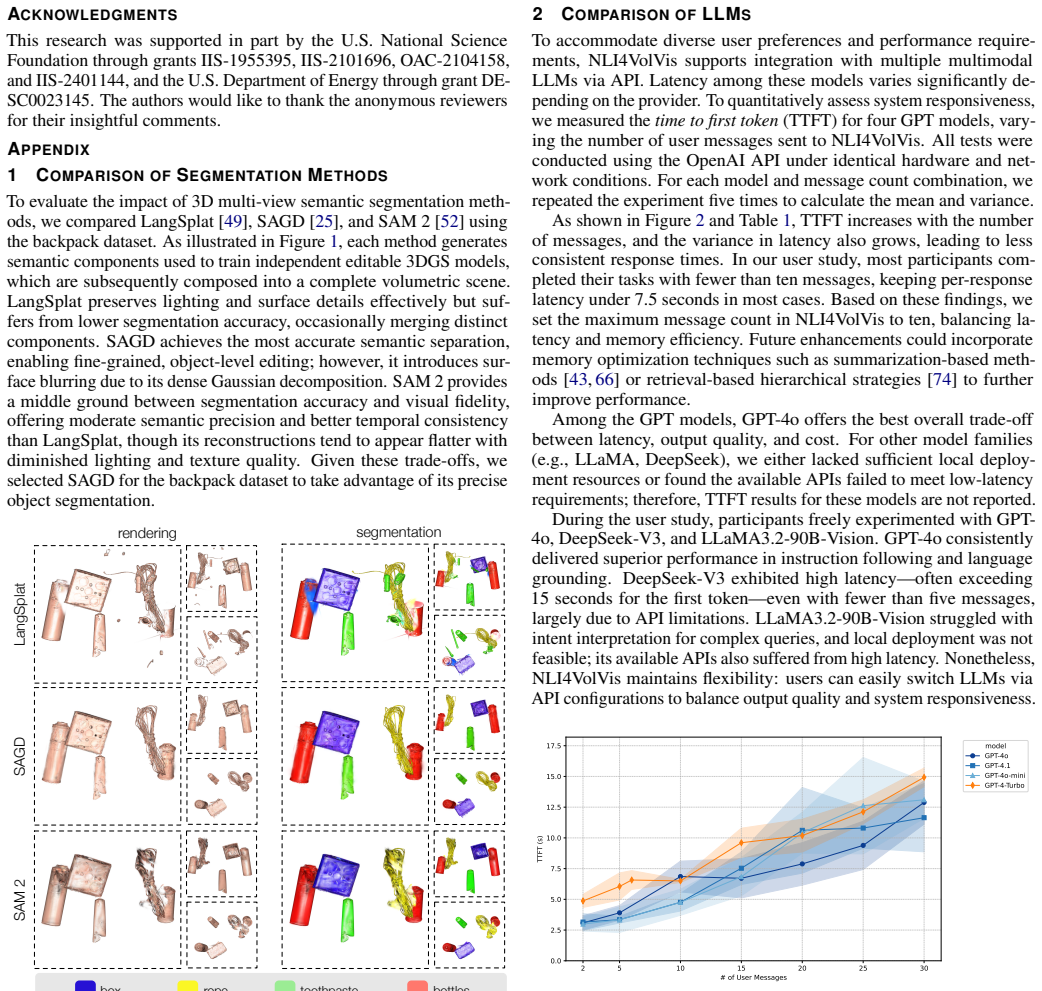
- [Table 2 and Appendix §1] The per-dataset segmentation method in Table 2 is chosen as the 'optimal' method after comparing LangSplat, SAGD, and SAM 2 on the backpack dataset (Appendix §1). This post hoc selection means the eight-dataset demonstration does not establish that the pipeline generalizes without per-dataset human tuning. The paper should either fix the segmentation method across datasets or report results for all three methods on all datasets so that the robustness claim is credible.
- [§4.1, backpack case study] The backpack example in Fig. 8, where the same object is highlighted for queries 'the box,' 'the storage container,' and 'the square-shaped object,' is the only evidence for paraphrase robustness, and it is anecdotal. No quantitative retrieval results are given for this or any other dataset, so the claim that NLI4VolVis 'accurately interprets user intent' for vague references is not supported. Please report retrieval accuracy for multiple paraphrases per component, ideally for all datasets.
minor comments (5)
- [Eq. (3)] There is a typo in the text preceding Eq. (3): '2D Gaussians alone the ray' should be 'along the ray.'
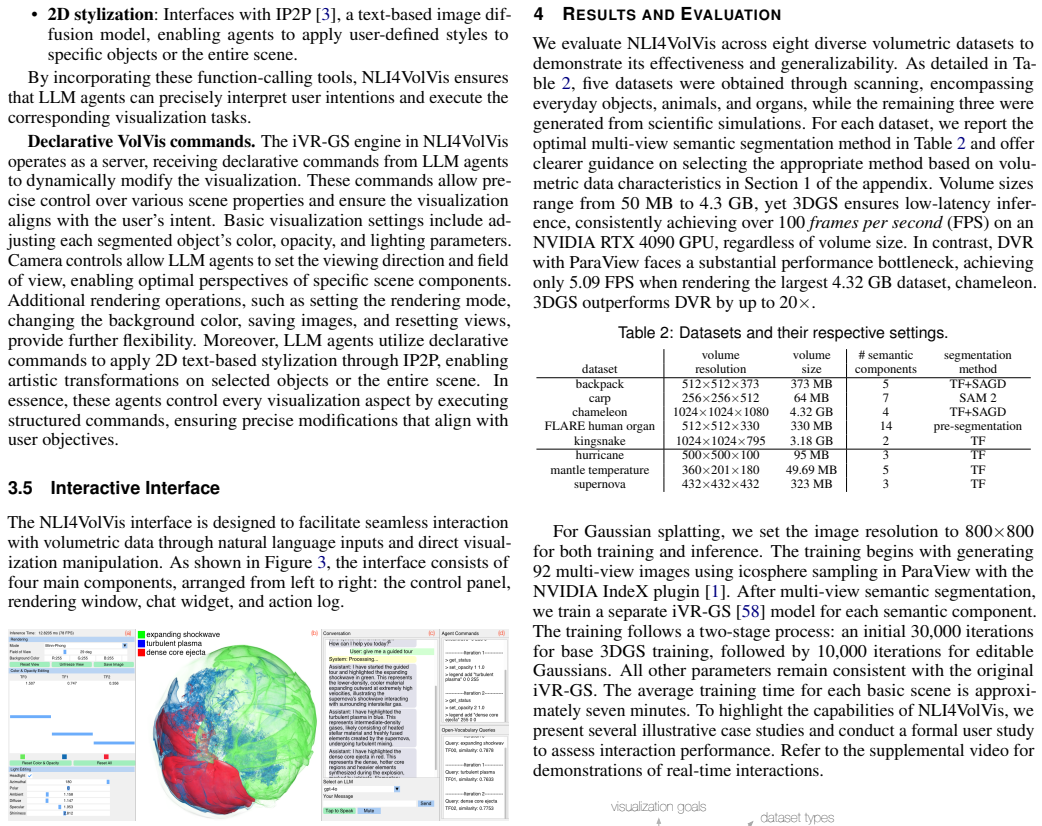
- [Fig. 3 caption] The caption lists '(a) panel,' which is incomplete; it should read '(a) control panel' to match the text.
- [§3.2] The entropy formula H(I) = -∑ p_i log p_i uses 'probability (normalized opacity value),' but it is unclear how the opacity channel is normalized and whether p_i=0 is handled. Please define the normalization explicitly.
- [Appendix §4, Table 2] The reported variances in Table 2 are on the order of 0.0003, which is suspiciously small and likely reflects averaging over components; please report the underlying distribution (e.g., per-component similarities) so readers can assess the variation.
- [§4.2] The task counts are inconsistent: the text says 23 tasks and '14 tasks required at least one interaction (excluding knowledge QA tasks),' but the relationship between these numbers and the 3+9+4+1+1+5 task breakdown is not explained. Please clarify the task inventory and the definition of 'effective NL interactions.'
Circularity Check
No significant circularity: the paper's claims rest on component integration and an independent user study, not on a derivation that reduces to its own inputs.
full rationale
NLI4VolVis is a systems paper; its central claims are validated by case studies and an eight-participant user study rather than by a mathematical derivation. The only load-bearing inference step is open-vocabulary object retrieval via CLIP cosine similarity (Eq. 1). This is an algorithmic selection rule, not a result derived from the system's own outputs: the object embeddings are computed from rendered views and labels, the query embedding comes from the user's text, and selecting the maximum cosine similarity is the definition of the retrieval operation, not a tautology. The appendix ablation (Table 2) measures CLIP similarity to ground-truth labels as a sanity check of the embedding; even though it does not validate user paraphrase retrieval, the absence of that validation is an evaluation gap, not circularity. The reuse of iVR-GS [58], a prior work by two of the three authors, is component reuse: the paper does not re-derive iVR-GS or claim its editability as a new result, and iVR-GS is published independently. No equation is shown to equal its own premise, no fitted parameter is renamed as a prediction, and no uniqueness argument is imported from self-citation.
Assumptions & free parameters
free parameters (6)
- top-k frame count k =
recommended 5-10 (ablation: k>=3 stable)
- number of multi-view images =
92 per dataset
- iVR-GS training iterations =
30,000 base + 10,000 editable
- maximum LLM message count =
10
- per-dataset segmentation method =
TF+SAGD, SAM2, pre-segmentation, TF, etc.
- preset transfer function =
one hand-tuned TF per dataset
assumptions (6)
- domain assumption CLIP embeddings of rendered alpha-only selected views of a segmented component align semantically with natural-language queries, so cosine similarity is a reliable match signal.
- domain assumption Opacity-channel entropy is a good measure of frame informativeness for CLIP embedding, so top-k highest entropy frames are the best views.
- domain assumption A preset ParaView transfer function can expose all semantic structures users will want to query or edit.
- domain assumption Editable iVR-GS models trained per segmented component faithfully reproduce and compose the volume scene.
- domain assumption LLM agents with function-calling tools correctly translate user intents into declarative VolVis commands.
- domain assumption User study participants (N=8) are a representative enough sample to support claims of improved accessibility and usability.
Cite this review
Pith. "Pith review of NLI4VolVis: Natural Language Interaction for Volume Visualization via LLM Multi-Agents and Editable 3D Gaussian Splatting." pith.science (2026). https://pith.science/paper/PXD42GNX
@misc{pith2026250712621,
  author       = {Pith},
  title        = {Pith review of: NLI4VolVis: Natural Language Interaction for Volume Visualization via LLM Multi-Agents and Editable 3D Gaussian Splatting},
  year         = {2026},
  howpublished = {\url{https://pith.science/paper/PXD42GNX}},
  note         = {Machine review of arXiv:2507.12621}
}
read the original abstract
Traditional volume visualization (VolVis) methods, like direct volume rendering, suffer from rigid transfer function designs and high computational costs. Although novel view synthesis approaches enhance rendering efficiency, they require additional learning effort for non-experts and lack support for semantic-level interaction. To bridge this gap, we propose NLI4VolVis, an interactive system that enables users to explore, query, and edit volumetric scenes using natural language. NLI4VolVis integrates multi-view semantic segmentation and vision-language models to extract and understand semantic components in a scene. We introduce a multi-agent large language model architecture equipped with extensive function-calling tools to interpret user intents and execute visualization tasks. The agents leverage external tools and declarative VolVis commands to interact with the VolVis engine powered by 3D editable Gaussians, enabling open-vocabulary object querying, real-time scene editing, best-view selection, and 2D stylization. We validate our system through case studies and a user study, highlighting its improved accessibility and usability in volumetric data exploration. We strongly recommend readers check our case studies, demo video, and source code at https://nli4volvis.github.io/.
Figures


Figures from the paper (7 more)





Forward citations
Cited by 4 Pith papers
-
Efficient Compression of Structured and Unstructured Volumes via Learned 3D Gaussian Representation
An explicit model using learned 3D Gaussians for volume compression encodes geometry explicitly and outperforms implicit neural representations on unstructured volumes with faster training.
-
Clarify Before Executing: A Self-Evolving Agent for Resolving Intent Asymmetry in 3D Tool Orchestration
A clarification-first 3D agent, trained by simulated multi-turn dialogue, reaches 60.4% and 43.3% success on single- and multi-step 3D tool tasks, more than doubling prior baselines.
-
VVGT: Visual Volume-Grounded Transformer
VVGT is a dual-transformer network with Volume Geometry Forcing that maps volumetric data to 3D Gaussian primitives for accurate ray-based rendering without per-scene optimization.
-
Toward Distributed 3D Gaussian Splatting for High-Resolution Isosurface Visualization
Multi-GPU 3D Gaussian splatting, adapted from Grendel-GS, trains isosurface visualizations up to 5.6x faster and handles larger datasets than a single A100 GPU.
Reference graph
Works this paper leans on
-
[1]
https://gitlab.kitware.com/ paraview/paraview
ParaView NVIDIA IndeX plugin. https://gitlab.kitware.com/ paraview/paraview. Accessed: 2025-03-13. 6
work page 2025
- [2]
- [3]
-
[4]
S. Bruckner and M. E. Gröller. Style transfer functions for illustrative volume rendering. Computer Graphics Forum, 26(3):715–724, 2007. doi: 10.1111/J.1467-8659.2007.01095.X 1
arXiv 2007
-
[5]
J. J. Caban and P. Rheingans. Texture-based transfer functions for direct volume rendering. IEEE Transactions on Visualization and Computer Graphics, 14(6):1364–1371, 2008. doi: 10.1109/TVCG.2008.169 1
-
[6]
M. Chen, I. Laina, and A. Vedaldi. DGE: Direct Gaussian 3D editing by consistent multi-view editing. In Proceedings of European Conference on Computer Vision, pp. 74–92, 2024. doi: 10.1007/978-3-031-72904-1_5 7
-
[9]
C. D. Correa and K.-L. Ma. Size-based transfer functions: A new volume exploration technique. IEEE Transactions on Visualization and Computer Graphics, 14(6):1380–1387, 2008. doi: 10.1109/TVCG.2008.162 1
-
[10]
B. Fei, J. Xu, R. Zhang, Q. Zhou, W. Yang, and Y . He. 3D Gaussian splatting as new era: A survey. IEEE Transactions on Visualization and Computer Graphics, 2024. Accepted. doi: 10.1109/TVCG.2024.3397828 1
arXiv 2024
Show all 75 references
-
[11]
Fridovich-Keil, A
S. Fridovich-Keil, A. Yu, M. Tancik, Q. Chen, B. Recht, and A. Kanazawa. Plenoxels: Radiance fields without neural networks. In Proceedings of IEEE/CVF Conference on Computer Vision and Pattern Recognition, pp. 5491–5500, 2022. doi: 10.1109/CVPR52688.2022.00542 2
2022
-
[13]
P. Gu, J. Han, D. Z. Chen, and C. Wang. Reconstructing unsteady flow data from representative streamlines via diffusion and deep learning based denoising. IEEE Computer Graphics and Applications, 41(6):111–121,
-
[14]
P. Gu, J. Han, D. Z. Chen, and C. Wang. Scalar2Vec: Translating scalar fields to vector fields via deep learning. In Proceedings of IEEE Pacific Vi- sualization Symposium, pp. 31–40, 2022. doi: 10.1109/PACIFICVIS53943 .2022.00012 2
2022
- [15]
- [16]
-
[17]
Z. Guo, S. Cheng, H. Wang, S. Liang, Y . Qin, P. Li, Z. Liu, M. Sun, and Y . Liu. StableToolBench: Towards stable large-scale benchmarking on tool learning of large language models. In Proceedings of ACL Conference (Findings), pp. 11143–11156, 2024. doi: 10.18653/v1/2024.findi...
2024 doi
-
[18]
Han and C
J. Han and C. Wang. TSR-VFD: Generating temporal super-resolution for unsteady vector field data. Computers & Graphics, 103:168–179, 2022. doi: 10.1016/J.CAG.2022.02.001 2
2022 doi
-
[19]
Han and C
J. Han and C. Wang. VCNet: A generative model for volume completion. Visual Informatics, 6(2):62–73, 2022. doi: 10.1016/J.VISINF.2022.04. 004 2
2022 doi
-
[20]
Han and C
J. Han and C. Wang. CoordNet: Data generation and visualization gen- eration for time-varying volumes via a coordinate-based neural network. IEEE Transactions on Visualization and Computer Graphics, 29(12):4951– 4963, 2023. doi: 10.1109/TVCG.2022.3197203 2
2023
-
[22]
W. He, J. Wang, H. Guo, K.-C. Wang, H.-W. Shen, M. Raj, Y . S. G. Nashed, and T. Peterka. InSituNet: Deep image synthesis for parameter space exploration of ensemble simulations. IEEE Transactions on Visualization and Computer Graphics, 26(1):23–33, 2020. doi: 10.1109/TVCG.201...
2020 doi
-
[23]
X. He, Y . Tao, S. Yang, H. Dai, and H. Lin. voxel2vec: A natural lan- guage processing approach to learning distributed representations for sci- entific data. IEEE Transactions on Visualization and Computer Graphics, 29(10):4296–4311, 2023. doi: 10.1109/TVCG.2022.3189094 4
2023
-
[24]
F. Hong, C. Liu, and X. Yuan. DNN-V olVis: Interactive volume visualiza- tion supported by deep neural network. In Proceedings of IEEE Pacific Visualization Symposium, pp. 282–291, 2019. doi: 10.1109/PacificVis. 2019.00041 2
2019
- [25]
-
[26]
Huang, Y
J. Huang, Y . Xi, J. Hu, and J. Tao. FlowNL: Asking the flow data in natural languages. IEEE Transactions on Visualization and Computer Graphics, 29(1):1200–1210, 2023. doi: 10.1109/TVCG.2022.3209453 2
2023
-
[28]
Ji and H.-W
G. Ji and H.-W. Shen. Dynamic view selection for time-varying volumes. IEEE Transactions on Visualization and Computer Graphics, 12(5):1109– 1116, 2006. doi: 10.1109/TVCG.2006.137 4
2006 doi
- [29]
-
[30]
Kerbl, G
B. Kerbl, G. Kopanas, T. Leimkühler, and G. Drettakis. 3D Gaussian splatting for real-time radiance field rendering. ACM Transactions on Graphics, 42(4):139:1–139:14, 2023. doi: 10.1145/3592433 2, 5
2023 doi
-
[32]
G. L. Kindlmann, R. T. Whitaker, T. Tasdizen, and T. Möller. Curvature- based transfer functions for direct volume rendering: Methods and appli- cations. In Proceedings of IEEE Visualization Conference, pp. 513–520,
-
[33]
Kirillov, E
A. Kirillov, E. Mintun, N. Ravi, H. Mao, C. Rolland, L. Gustafson, T. Xiao, S. Whitehead, A. C. Berg, W.-Y . Lo, et al. Segment anything. In Pro- ceedings of IEEE/CVF International Conference on Computer Vision, pp. 4015–4026, 2023. doi: 10.1109/ICCV51070.2023.00371 3, 4
2023
-
[34]
J. M. Kniss, G. L. Kindlmann, and C. D. Hansen. Interactive volume ren- dering using multi-dimensional transfer functions and direct manipulation widgets. In Proceedings of IEEE Visualization Conference, pp. 255–262,
-
[35]
H. Lam, M. Tory, and T. Munzner. Bridging from goals to tasks with design study analysis reports. IEEE Transactions on Visualization and Computer Graphics, 24(1):435–445, 2018. doi: 10.1109/TVCG.2017. 2744319 6
2018 doi
- [36]
-
[37]
S. Liu, H. Miao, and P.-T. Bremer. ParaView-MCP: An autonomous visualization agent with direct tool use. arXiv preprint arXiv:2505.07064,
-
[38]
S. Liu, H. Miao, Z. Li, M. L. Olson, V . Pascucci, and P.-T. Bremer. A V A: Towards autonomous visualization agents through visual perception-driven decision-making. Computer Graphics Forum, 43(3):e15093, 2024. doi: 10.1111/cgf.15093 2, 3, 5
2024 doi
-
[39]
Ljung, J
P. Ljung, J. Krüger, E. Groller, M. Hadwiger, C. D. Hansen, and A. Yn- nerman. State of the art in transfer functions for direct volume rendering. Computer Graphics Forum, 35(3):669–691, 2016. doi: 10.1111/cgf.12934 1, 4
2016 doi
-
[40]
Y . Lu, P. Gu, and C. Wang. FCNR: Fast compressive neural representation of visualization images. In Proceedings of IEEE VIS Conference (Short Papers), pp. 31–35, 2024. doi: 10.1109/VIS55277.2024.00014 2
2024
-
[41]
T. Luo, C. Huang, L. Shen, B. Li, S. Shen, W. Zeng, N. Tang, and Y . Luo. nvBench 2.0: A benchmark for natural language to visualization under ambiguity. arXiv preprint arXiv:2503.12880, 2025. doi: 10.48550/arXiv. 2503.12880 9
2025 doi
-
[42]
J. Ma, Y . Zhang, S. Gu, C. Ge, S. Ma, A. Young, C. Zhu, X. Yang, K. Meng, Z. Huang, et al. Unleashing the strengths of unlabelled data in deep learning-assisted pan-cancer abdominal organ quantification: The FLARE22 challenge. The Lancet Digital Health, 6(11):e815–e826, 2024....
2024 doi
-
[43]
Maharana, D.-H
A. Maharana, D.-H. Lee, S. Tulyakov, M. Bansal, F. Barbieri, and Y . Fang. Evaluating very long-term conversational memory of LLM agents. In Proceedings of the Annual Meeting of the Association for Computational Linguistics, pp. 13851–13870, 2024. doi: 10.18653/v1/2024.acl-lon...
2024 doi
-
[44]
Mallick, O
T. Mallick, O. Yildiz, D. Lenz, and T. Peterka. ChatVis: Automating scientific visualization with a large language model. In Proceedings of ACM/IEEE SC Workshops, pp. 49–55, 2024. doi: 10.1109/SCW63240. 2024.00014 2, 3
2024
-
[45]
Mildenhall, P
B. Mildenhall, P. P. Srinivasan, M. Tancik, J. T. Barron, R. Ramamoorthi, and R. Ng. NeRF: Representing scenes as neural radiance fields for view synthesis. In Proceedings of European Conference on Computer Vision, pp. 405–421, 2020. doi: 10.1007/978-3-030-58452-8_24 2
2020 doi
-
[46]
Müller, A
T. Müller, A. Evans, C. Schied, and A. Keller. Instant neural graphics primitives with a multiresolution hash encoding. ACM Transactions on Graphics, 41(4):102:1–102:15, 2022. doi: 10.1145/3528223.3530127 2
2022
- [47]
-
[48]
Poux and R
F. Poux and R. Billen. V oxel-based 3D point cloud semantic segmentation: Unsupervised geometric and relationship featuring vs deep learning meth- ods. ISPRS International Journal of Geo-Information, 8(5):213:1–213:34,
-
[49]
M. Qin, W. Li, J. Zhou, H. Wang, and H. Pfister. LangSplat: 3D language Gaussian splatting. In Proceedings of IEEE/CVF Conference on Computer Vision and Pattern Recognition, pp. 20051–20060, 2024. doi: 10.1109/ CVPR52733.2024.01895 2, 3, 4, 10
2024
-
[50]
Y . Qin, S. Hu, Y . Lin, W. Chen, N. Ding, G. Cui, Z. Zeng, X. Zhou, Y . Huang, C. Xiao, et al. Tool learning with foundation models. ACM Computing Surveys, 57(4):101:1–101:40, 2024. doi: 10.1145/3704435 5
2024 doi
-
[51]
Radford, J
A. Radford, J. W. Kim, C. Hallacy, A. Ramesh, G. Goh, S. Agarwal, G. Sastry, A. Askell, P. Mishkin, J. Clark, et al. Learning transferable visual models from natural language supervision. In Proceedings of International Conference on Machine Learning, pp. 8748–8763, 2021. 3, 4
2021
- [52]
-
[53]
L. Shen, E. Shen, Y . Luo, X. Yang, X. Hu, X. Zhang, Z. Tai, and J. Wang. Towards natural language interfaces for data visualization: A survey.IEEE Transactions on Visualization and Computer Graphics, 29(6):3121–3144,
-
[54]
K. Tang, K. Ai, J. Han, and C. Wang. TexGS-V olVis: Expressive scene editing for volume visualization via textured Gaussian splatting. IEEE Transactions on Visualization and Computer Graphics, 32(1), 2026. Ac- cepted. 2
2026
-
[55]
Tang and C
K. Tang and C. Wang. ECNR: Efficient compressive neural representation of time-varying volumetric datasets. In Proceedings of IEEE Pacific Visu- alization Conference, pp. 72–81, 2024. doi: 10.1109/PACIFICVIS60374. 2024.00017 2
2024
-
[56]
Tang and C
K. Tang and C. Wang. STSR-INR: Spatiotemporal super-resolution for time-varying multivariate volumetric data via implicit neural representa- tion. Computers & Graphics, 119:103874, 2024. doi: 10.1016/J.CAG. 2024.01.001 2
2024 doi
-
[57]
Tang and C
K. Tang and C. Wang. StyleRF-V olVis: Style transfer of neural radiance fields for expressive volume visualization.IEEE Transactions on Visualiza- tion and Computer Graphics, 31(1):613–623, 2025. doi: 10.1109/TVCG. 2024.3456342 2, 4
2025
-
[58]
K. Tang, S. Yao, and C. Wang. iVR-GS: Inverse volume rendering for explorable visualization via editable 3D Gaussian splatting. IEEE Trans- actions on Visualization and Computer Graphics, 31(6):3783–3795, 2025. doi: 10.1109/TVCG.2025.3567121 2, 3, 4, 5, 6
2025
- [59]
-
[60]
Vachha and A
C. Vachha and A. Haque. Instruct-GS2GS: Editing 3D Gaussian splats with instructions. https://instruct-gs2gs.github.io/, 2024. 7
2024
-
[61]
V oigt, O
H. V oigt, O. Alacam, M. Meuschke, K. Lawonn, and S. Zarrieß. The why and the how: A survey on natural language interaction in visualization. In Proceedings of NAACL Conference: Human Language Technologies, pp. 348–374, 2022. doi: 10.18653/v1/2022.naacl-main.27 2
2022 doi
-
[62]
Wang and J
C. Wang and J. Han. DL4SciVis: A state-of-the-art survey on deep learning for scientific visualization. IEEE Transactions on Visualization and Computer Graphics, 29(8):3714–3733, 2023. doi: 10.1109/TVCG. 2022.3167896 2
2023
-
[63]
L. Wang, C. Ma, X. Feng, Z. Zhang, H. Yang, J. Zhang, Z. Chen, J. Tang, X. Chen, Y . Lin, et al. A survey on large language model based autonomous agents. Frontiers of Computer Science, 18(6):186345, 2024. doi: 10.1007/ s11704-024-40231-1 3
2024
-
[64]
Y . Wu, J. Meng, H. Li, C. Wu, Y . Shi, X. Cheng, C. Zhao, H. Feng, E. Ding, J. Wang, et al. OpenGaussian: Towards point-level 3D Gaussian-based open vocabulary understanding. In Proceedings of Advances in Neural Information Processing Systems, pp. 19114–19138, 2024. 3
2024
-
[65]
Y . Wu, Y . Wan, H. Zhang, Y . Sui, W. Wei, W. Zhao, G. Xu, and H. Jin. Automated data visualization from natural language via large language models: An exploratory study. Proceedings of the ACM on Management of Data, 2(3):115, 2024. doi: 10.1145/3654992 2
2024 doi
-
[66]
J. Xu, A. Szlam, and J. Weston. Beyond goldfish memory: Long-term open-domain conversation. In Proceedings of the Annual Meeting of the Association for Computational Linguistics, pp. 5180–5197, 2022. doi: 10. 18653/v1/2022.acl-long.356 9, 10
2022
-
[67]
M. Yang, K. Tang, and C. Wang. Meta-INR: Efficient encoding of volumet- ric data via meta-learning implicit neural representation. In Proceedings of IEEE Pacific Visualization Conference (Visualization Notes), pp. 246–251,
-
[68]
S. Yao, J. Han, and C. Wang. GMT: A deep learning approach to general- ized multivariate translation for scientific data analysis and visualization. Computers & Graphics, 112:92–104, 2023. doi: 10.1016/J.CAG.2023.04. 002 2
2023 doi
-
[69]
S. Yao, Y . Lu, and C. Wang. ViSNeRF: Efficient multidimensional neural radiance field representation for visualization synthesis of dynamic volu- metric scenes. In Proceedings of IEEE Pacific Visualization Conference, pp. 235–245, 2025. doi: 10.1109/PacificVis64226.2025.00029 2, 4
2025
-
[70]
Yao and C
S. Yao and C. Wang. ReV olVE: Neural reconstruction of volumes for visualization enhancement of direct volume rendering. Computers & Graphics, 2025. Accepted. 4
2025
-
[71]
Yao and C
S. Yao and C. Wang. V olSegGS: V olumetric segmentation of dynamic visualization scenes using deformable Gaussian splatting. IEEE Transac- tions on Visualization and Computer Graphics, 32(1), 2026. Accepted. 2
2026
-
[72]
M. Ye, M. Danelljan, F. Yu, and L. Ke. Gaussian Grouping: Segment and edit anything in 3D scenes. In Proceedings of European Conference on Computer Vision, 2024. doi: 10.1007/978-3-031-73397-0_10 3
2024 doi
-
[73]
Yu and C
B. Yu and C. T. Silva. FlowSense: A natural language interface for visual data exploration within a dataflow system. IEEE Transactions on Visualization and Computer Graphics, 26(1):1–11, 2020. doi: 10.1109/ tvcg.2019.2934668 2
2020
-
[75]
S. Zhi, T. Laidlow, S. Leutenegger, and A. J. Davison. In-place scene labelling and understanding with implicit scene representation. In Pro- ceedings of IEEE/CVF International Conference on Computer Vision, pp. 15818–15827, 2021. doi: 10.1109/ICCV48922.2021.01554 3
2021
-
[81]
Zhang, Y
T. Zhang, Y . Liu, B. Li, Z. Zeng, P. Wang, Y . You, C. Miao, and L. Cui. History-aware hierarchical transformer for multi-session open-domain dia- logue system. In Proceeding of Findings of the Association for Computa- tional Linguistics: EMNLP, pp. 3395–3407, 2022. doi: 10.1...
2022 doi
-
[2001]
doi: 10.1109/VISUAL.2001.964519 1
2001
-
[2003]
doi: 10.1109/VISUAL.2003.1250414 1
2003 arXiv
-
[2019]
doi: 10.3390/ijgi8050213 4
-
[2021]
doi: 10.1109/MCG.2021.3089627 2
2021
-
[2023]
doi: 10.1109/tvcg.2022.3148007 2
2022
- [2025]
Reviewed August 6, 2026 · model on record in the stance chip above.
Discussion (0). Sign in to comment.