REVIEW 2 major objections 5 minor 1 cited by
Augmented Lagrangian methods produce cutting-edge magnetic coils for stellarator fusion reactors
T0 review · 2 major / 5 minor · reviewed 2026-08-06 · deepseek-v4-flash
Pith's one-line read An augmented Lagrangian optimizer for stellarator coils satisfies all engineering constraints in one run and beats published coil sets on five reactor concepts.
desk verdict Solid methods paper with an overreaching Pareto-optimal claim and missing artifacts; worth refereeing after the claims and reproducibility are tightened. read the letter →
The pith
A machine-rendered reading of the paper's core claim, the machinery that carries it, and where it could break.
The reading
What carries the argument
The load-bearing mechanism is the augmented Lagrangian function $L_A(x,\lambda,\mu)=f(x)-\lambda^\top c(x)+\frac{1}{2}\|\sqrt{\mu}\circ c(x)\|^2$, with $c(x)$ gathering all engineering constraints—squared flux, coil-plasma distance, coil-coil distance, total length, curvature, mean squared curvature, linking number, and forces. The Lagrange multipliers $\lambda$ are updated automatically from the current constraint violations, replacing user-chosen weights, and the penalty parameters $\mu$ increase only when a constraint is still violated, which avoids the need for infinite weights. The inner minimization is done by a limited-memory quasi-Newton solver, and gradients are computed through analytic derivatives and automatic differentiation. Treating the normalized squared flux as an inequality constraint with a small threshold is what lets the optimizer satisfy field accuracy and then improve manufacturability.
What would settle it
Run the augmented Lagrangian coil optimizer on the quasi-axisymmetric test case from many random coil seeds and multiplier initializations with identical bounds, and check whether any run lands strictly below the reported force-versus-field-accuracy front at the same total coil length; a single such run would break the Pareto-optimality claim.
Extended reading notes
Core claim
The central claim is that an augmented Lagrangian formulation makes stellarator coil optimization tractable without manual weighting, and that it produces Pareto-optimal coil sets which in various ways outperform published designs. The method replaces the usual weighted objective $f(x)+\sum_l \omega_l c_l(x)$ with $L_A(x,\lambda,\mu)=f(x)-\lambda^\top c(x)+\frac{1}{2}\|\sqrt{\mu}\circ c(x)\|^2$, where the vector $c(x)$ collects all equality and inequality constraints, $\lambda$ are Lagrange multipliers updated from constraint violations, and $\mu$ are penalty parameters that grow only when a constraint remains violated. A defining choice is to put the normalized squared flux $f_{SF}$ into the constraints as $\max(f_{SF}-10^{-6},0)^2$ instead of keeping it as the objective, so that once the field is accurate enough the optimizer spends its remaining freedom improving engineering metrics. The paper verifies the approach on five configurations: it maps and extends a previously reported QA force-versus-accuracy Pareto front, finds four- and five-coil QH and W7-X alternatives that beat their published baselines, proposes Stellaris alternatives with up to 29% lower forces, and produces a four-coil HSX design with lower curvature and better clearance than the built six-coil set.
Load-bearing premise
The load-bearing premise is that the inner limited-memory quasi-Newton minimization of this nonconvex problem finds a genuinely good—effectively global—minimum, since the paper gives no optimality certificate and does not vary the random multiplier initialization; if the solver is trapped in a local basin, the reported Pareto-optimal and outperformance claims may not survive.
Editorial extensions
If this is right
- Designers can specify physically meaningful bounds (e.g., minimum coil-plasma distance for a blanket, maximum curvature and force) and receive a feasible coil set in one run, with no manual weight tuning.
- Known Pareto fronts can be mapped cheaply: the QA case recovers and extends a front that previously required 8,500 supercomputer optimization runs, with each new run taking about 40 minutes on a single CPU core.
- Fewer coils per half-field period become viable: four-coil solutions for the QH, W7-X, and HSX configurations match or improve on the published five- or six-coil baselines in most metrics, increasing plasma access.
- For reactor-scale quasi-isodynamic concepts, the method generates alternatives with roughly 29% lower peak forces and improved engineering metrics relative to the published coil set.
- The same formalism transfers across QA, QH, and QI symmetries and to already-built devices, indicating it is a general stage-II coil design tool rather than a configuration-specific fix.
Reading between the lines
- A natural next test is to benchmark against the same standard weighted method after expert weight tuning or a global search, since the 20-run random-weight baseline may understate how well the conventional approach can perform when given comparable effort.
- Because the squared-flux threshold creates slack that the optimizer converts into engineering improvements, the same 'constraint-first' trick could be adapted to other ill-posed inverse design problems where a small tolerance on the primary objective is acceptable in exchange for manufacturability.
- If the method is as robust as reported, the practical bottleneck in stellarator coil design shifts from choosing weights to choosing the physical bounds and to ensuring the inner solver escapes local minima; multi-start studies across random seeds would make the Pareto-optimality claim testable.
- The reported comparison suggests a concrete prediction: with identical bounds, the augmented Lagrangian method should require far fewer function evaluations than a weight-scan approach to reach the same constraint-feasible region; a recorded timing study would quantify the gain.
Editorial analysis
A structured set of objections, weighed in public.
Referee Report
Summary. The paper presents an augmented Lagrangian (AL) method for stellarator coil optimization within the SIMSOPT framework. Instead of minimizing a weighted sum of physical and engineering objectives, the method moves the squared-flux error and all engineering penalties into equality and inequality constraints, sets the objective to a dummy f(x)=0, and automatically updates Lagrange multipliers and penalty parameters. The authors demonstrate on the Landreman-Paul QA equilibrium that one AL run satisfies all eight engineering constraints while 20 randomly weighted standard runs each violate at least one constraint, and they then report alternative coil sets for QA, QH, Stellaris/SQuID, W7-X, and HSX configurations, claiming in the abstract that the resulting solutions are Pareto-optimal and outperform published coil sets.
Significance. If the claims are properly scoped, the work is practically valuable: it removes manual weight tuning, avoids large parameter scans for feasibility, and produces quantitatively documented alternative coil sets even for two built devices (W7-X and HSX). The implementation in the open-source SIMSOPT framework and the concrete comparisons against previously published coil sets are strengths, and the reported engineering metrics are falsifiable. However, the central 'Pareto-optimal' claim is not supported by the formulation as written, because with a dummy objective the AL scheme is a constraint-satisfaction method rather than a multiobjective optimizer. The paper's most defensible contribution is a robust method for finding feasible, high-quality coil sets that improve on published designs in specific metrics, and the claims should be revised to match that scope.
major comments (2)
- [II C, Eq. (4); abstract] The abstract's central claim that 'we find Pareto-optimal coil solutions' is not supported by the algorithm as posed in Section II C. With f(x)=0, the augmented Lagrangian in Eq. (4) reduces to a pure constraint-satisfaction objective, and any returned feasible point is a KKT point of 'minimize 0 subject to c(x)=0' rather than a nondominated point of a multiobjective problem. The QA comparison against the prior 41-point Pareto front in Figure 2 is empirical evidence for that specific two-objective trade-off, but Tables III-VI compare each new design against a single published coil set, which does not establish the absence of a dominating feasible design. Please either replace 'Pareto-optimal' with a feasibility/improvement claim or add a formal dominance check, e.g., by comparing against a large representative scan or a stated multiobjective formulation, for each of the five configurations.
- [II B, Figure 1] The initialization of lambda_0 as a single sample from a uniform distribution on [0,1], combined with a local L-BFGS-B solver for the nonconvex inner minimization, means that the reported single-run success in Figure 1 and the specific designs in Section III may depend on the random seed and initial coil state. Since the headline result is that one AL run can satisfy all constraints while randomly weighted standard runs fail, please report results over several lambda_0 and x_0 initializations (or at least multiple seeds) to demonstrate that the outcome is robust rather than a favorable draw.
minor comments (5)
- [II B, algorithm pseudocode] The initialization line 'eta_0 <- 1/mubar_0.1 0' is not typeset correctly; please provide the intended formula for eta_0.
- [III B, Table III] The text states that the four-coil solution is 'as good, or better, in every engineering metric' than the Wiedman solution, but Table III shows that configuration #1 has a lower minimum coil-coil distance (0.8 m vs 1.09 m), a higher maximum curvature (1.0 m^-1 vs 0.77 m^-1), and a larger HTS length (320 km vs 284.5 km). Please rephrase to acknowledge these trade-offs.
- [III C, Table IV] The statement that configuration #1 has forces that 'appear 5% larger' than Proxima conflicts with Table IV, where configuration #1 reports a maximum force of 0.79 MN/m versus 0.9 MN/m for Proxima, i.e., about 12% smaller; please correct the direction or clarify the comparison base.
- [II C, Tables II-VI] The tables report field accuracy as <B.n>/<B> and max(B.n/B), while Section II C defines f_SF as a normalized squared flux; please state the relationship between these quantities and specify which metric is imposed as the constraint in each optimization run.
- [III C, Table IV] The phrase '8m/turn shorter coils' is inconsistent with Table IV, where the total length decreases from 138 m to 130 m; please clarify whether the reduction is per coil, per half-field period, or total.
Circularity Check
No circular derivation found: the augmented Lagrangian method is benchmarked against external coil sets, with only a non-load-bearing self-citation and an unsupported-but-not-circular Pareto-optimality claim.
full rationale
Section II constructs the method from Eq. (4), and Section II C explicitly replaces the objective with a dummy function and moves squared flux into the constraints, while Eq. (7) defines the engineering metrics as standard, parameter-free functions with stated physical bounds. The comparisons in Section III are measured against externally published coil sets (Wechsung et al., Wiedman et al., Proxima/Stellaris, W7-X CAD, HSX CAD), not against quantities fitted by the new method. The one self-citation, Kaptanoglu et al. [45], is used as an independent prior 8,500-run numerical scan for the QA Pareto front and is cross-checked against Wechsung et al.; it functions as a benchmark rather than as a load-bearing derivation step. The main legitimate criticism is that the label 'Pareto-optimal' for the non-QA cases exceeds what the dummy-objective augmented Lagrangian formulation can certify, since the inner L-BFGS-B minimization only drives constraint violations toward zero; however, this is an overclaim of support rather than a circular reduction of the reported results to the method's inputs, so no circularity step is scored.
Assumptions & free parameters
free parameters (4)
- Squared-flux tolerance (f_SF threshold) =
1e-6 (Section II C); Table I lists 1e-5 as sufficient for reactor scale
- Engineering constraint bounds (d_cs0, d_cc0, L0, kappa0, K0, F0) =
Varying per case; Table I gives e.g. 1.3 m, 0.7 m, 150-200 m, 1/m, 0.5/m, 0.5 MN/m
- AL hyperparameters (mu0, tau, eta_tol, omega_tol) =
Not numerically specified in the paper
- Fourier truncation order M =
M=19 in the method comparison; not stated for the five device runs
assumptions (6)
- domain assumption The augmented Lagrangian update rules converge for the nonconvex, nonsmooth coil optimization problem as implemented with L-BFGS-B.
- domain assumption A filamentary coil model with Fourier-series curves and Biot-Savart fields is an adequate representation for comparing coil feasibility and field accuracy.
- domain assumption The target plasma boundaries taken from prior papers (Landreman-Paul, SQuID, W7-X, HSX) are valid fixed targets, and reducing B·n on those surfaces preserves the relevant confinement properties.
- domain assumption The two-term quasisymmetry metric (Appendix A) is an acceptable surrogate for confinement quality in QA/QH comparisons.
- ad hoc to paper Using a dummy objective f=0 inside the augmented Lagrangian still drives squared flux to acceptable values because the squared flux is enforced as a constraint.
- domain assumption The comparison to published coil sets is fair because the same target surfaces and metric definitions are used.
Cite this review
Pith. "Pith review of Augmented Lagrangian methods produce cutting-edge magnetic coils for stellarator fusion reactors." pith.science (2026). https://pith.science/paper/R723WREK
@misc{pith2026250712681,
  author       = {Pith},
  title        = {Pith review of: Augmented Lagrangian methods produce cutting-edge magnetic coils for stellarator fusion reactors},
  year         = {2026},
  howpublished = {\url{https://pith.science/paper/R723WREK}},
  note         = {Machine review of arXiv:2507.12681}
}
read the original abstract
Finding feasible coils for stellarator fusion devices is a critical challenge of realizing this concept for future power plants. Current design efforts struggle to navigate the highly nonconvex optimization landscape, spend considerable resources scanning the parameter space, and may produce suboptimal coils. In this work, we present an augmented Lagrangian approach to tackle the ill-posed problem of coil optimization. We illustrate its effectiveness and versatility by generating coils for five stellarators with very different symmetries and magnetic field shaping. In all cases, we find Pareto-optimal coil solutions that in various ways outperform published coil sets.
Figures


Figures from the paper (9 more)




Forward citations
Cited by 1 Pith paper
-
Towards joint optimization of stellarator coils and support structures
Differentiable FEA (coil-fem) enables joint optimization of stellarator coil geometry and support clamps, yielding ~2.4× lower RMS von Mises stress at similar field error versus a fixed-support baseline.
Reference graph
Works this paper leans on
-
[1]
F. C. Schuller, Disruptions in tokamaks, Plasma Physics and Controlled Fusion37, A135 (1995)
work page 1995
- [2]
-
[3]
P. Helander, C. D. Beidler, T. M. Bird, M. Drevlak, Y. Feng, R. Hatzky, F. Jenko, R. Kleiber, J. H. E. Proll, Y. Turkin, and P. Xanthopoulos, Stellarator and tokamak plasmas: a comparison, Plasma Physics and Controlled Fusion54, 124009 (2012)
work page 2012
-
[4]
G. Grieger, W. Lotz, P. Merkel, J. N¨ uhrenberg, J. Sapper, E. Strumberger, H. Wobig, R. Burhenn, V. Erckmann, U. Gasparino, L. Giannone, H. J. Hartfuss, R. Jaenicke, G. K¨ uhner, H. Ringler, A. Weller, F. Wagner, the W7-X Team, and the W7-AS Team, Physics optimization of stel- larators, Physics of Fluids B: Plasma Physics4, 2081 (1992), https://pubs.aip....
work page 1992
-
[5]
T. Klinger, C. Baylard, C. Beidler, J. Boscary, H. Bosch, A. Dinklage, D. Hartmann, P. Helander, H. Maßberg, A. Peacock, T. Pedersen, T. Rummel, F. Schauer, L. We- gener, and R. Wolf, Towards assembly completion and preparation of experimental campaigns of Wendelstein 7-X in the perspective of a path to a stellarator fu- sion power plant, Fusion Engineeri...
work page 2013
-
[6]
F. Anderson, A. Almagri, D. Anderson, P. Matthews, J. Talmadge, and J. Shohet, Helically symmetric experi- ment, (hsx) goals, design and status, Fusion Technology 27, p. 273–277. (1995)
work page 1995
-
[7]
S. P. Hirshman and J. C. Whitson, Steepest- descent moment method for three-dimensional mag- netohydrodynamic equilibria, The Physics of Fluids 26, 3553 (1983), https://pubs.aip.org/aip/pfl/article- pdf/26/12/3553/12590952/3553 1 online.pdf
work page 1983
-
[8]
J. N¨ uhrenberg and R. Zille, Quasi-helically symmetric toroidal stellarators, Physics Letters A129, 113 (1988)
work page 1988
Show all 65 references
-
[9]
Landreman and E
M. Landreman and E. Paul, Magnetic fields with precise quasisymmetry for plasma confinement, Phys. Rev. Lett. 128, 035001 (2022)
2022
-
[10]
D. W. Dudt and E. Kolemen, Desc: A stellara- tor equilibrium solver, Physics of Plasmas27, 102513 (2020), https://pubs.aip.org/aip/pop/article- pdf/doi/10.1063/5.0020743/15926767/102513 1 online.pdf
2020 doi
-
[11]
Imbert-G´ erard, E
L.-M. Imbert-G´ erard, E. J. Paul, and A. M. Wright, An Introduction to Stellarators: From Magnetic Fields to Symmetries and Optimization(Society for Indus- trial and Applied Mathematics, Philadelphia, PA, 2024) https://epubs.siam.org/doi/pdf/10.1137/1.9781611978223
2024 doi
-
[12]
Erckmann, H.-J
V. Erckmann, H.-J. Hartfuss, M. Kick, H. Renner, J. Sapper, F. Schauer, E. Speth, F. Wesner, F. Wag- ner, M. Wanner, A. Weller, and H. Wobig, The w7- x project: scientific basis and technical realization, in 17th IEEE/NPSS Symposium Fusion Engineering (Cat. No.97CH36131), Vol....
1997
-
[13]
Strykowsky, T
R. Strykowsky, T. Brown, J. Chrzanowski, M. Cole, P. Heitzenroeder, G. Neilson, D. Rej, and M. Viol, En- gineering cost & schedule lessons learned on ncsx, in 2009 23rd IEEE/NPSS Symposium on Fusion Engineer- ing(2009) pp. 1–4
2009
-
[14]
Bosch, R
H.-S. Bosch, R. Brakel, T. Braeuer, V. Bykov, P. van Eeten, J.-H. Feist, F. F¨ ullenbach, M. Gasparotto, H. Grote, T. Klinger, H. Laqua, M. Nagel, D. Naujoks, M. Otte, K. Risse, T. Rummel, J. Schacht, A. Spring, T. Sunn Pedersen, R. Vilbrandt, L. Wegener, A. Werner, R. Wolf, J...
2017
-
[15]
Wechsung, A
F. Wechsung, A. Giuliani, M. Landreman, A. Cerfon, and G. Stadler, Single-stage gradient-based stellarator coil design: stochastic optimization, Nuclear Fusion62, 076034 (2022)
2022
-
[16]
Giuliani, Direct stellarator coil design using global op- timization: application to a comprehensive exploration of quasi-axisymmetric devices, Journal of Plasma Physics 16 FIG
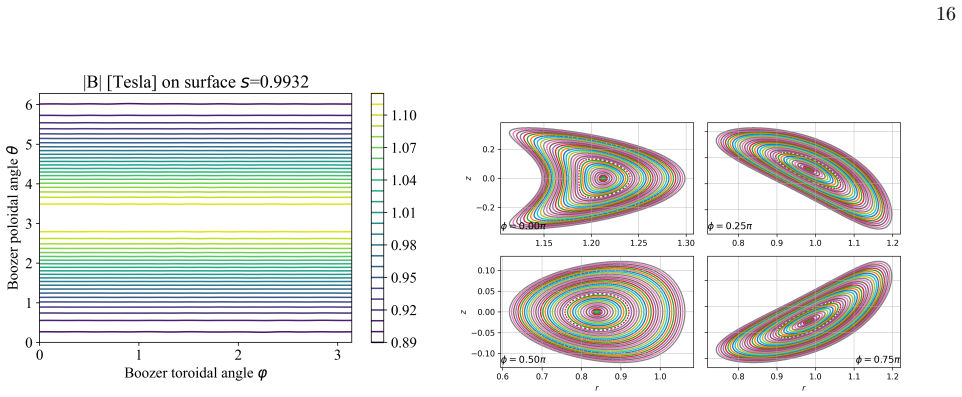
A. Giuliani, Direct stellarator coil design using global op- timization: application to a comprehensive exploration of quasi-axisymmetric devices, Journal of Plasma Physics 16 FIG. 8. (Left) Boozer plot of the AL25 configuration showing the quality of the quasi-symmetry of the...
2024
-
[17]
R. Wu, T. Kruger, and C. Swanson, Planar coil opti- mization for the Eos stellarator using sparse regression, Plasma Physics and Controlled Fusion67, 035019 (2025)
2025
-
[18]
Jorge, A
R. Jorge, A. Giuliani, and J. Loizu, Simplified and flex- ible coils for stellarators using single-stage optimization, Physics of Plasmas31, 112501 (2024)
2024
-
[19]
Suzuki, J
Y. Suzuki, J. Huang, N. Wang, and Y. Ding, Design of simple stellarator using tilted toroidal field coils, Fusion Engineering and Design173, 112843 (2021)
2021
-
[20]
L. Fu, E. J. Paul, A. A. Kaptanoglu, and A. Bhattachar- jee, Global stellarator coil optimization with quadratic constraints and objectives, Nuclear Fusion65, 026045 (2025)
2025
-
[21]
Drevlak, Optimization of heterogenous magnet sys- tems, 12th International Stellarator Workshop, Madison, WI (1999)
M. Drevlak, Optimization of heterogenous magnet sys- tems, 12th International Stellarator Workshop, Madison, WI (1999)
1999
-
[22]
Pomphrey, L
N. Pomphrey, L. Berry, A. Boozer, A. Brooks, R. Hatcher, S. Hirshman, L.-P. Ku, W. Miner, H. Myn- ick, W. Reiersen, D. Strickler, and P. Valanju, Innova- tions in compact stellarator coil design, Nuclear Fusion 41, 339 (2001)
2001
-
[23]
D. J. Strickler, L. A. Berry, and S. P. H. and, Designing coils for compact stellarators, Fusion Science and Tech- nology41, 107 (2002), https://doi.org/10.13182/FST02- A206
2002 doi
-
[24]
Brown, J
T. Brown, J. Breslau, D. Gates, N. Pomphrey, and A. Zolfaghari, Engineering optimization of stellarator coils lead to improvements in device maintenance, in2015 IEEE 26th Symposium on Fusion Engineering (SOFE) (2015) pp. 1–6
2015
-
[25]
Lion, J.-C
J. Lion, J.-C. Angl` es, L. Bonauer, A. Ba˜ n´ on Navarro, S. Cadena Ceron, R. Davies, M. Drevlak, N. Foppi- ani, J. Geiger, A. Goodman, W. Guo, E. Guiraud, F. Hern´ andez, S. Henneberg, R. Herrero, C. Hintze, H. H¨ ochter, J. Jelonnek, F. Jenko, R. Jorge, M. Kaiser, M. Kubie,...
2025
-
[26]
D. T. Anderson, J. M. Canik, C. C. Hegna, and C. M. Mowry, A comprehensive, unified baseline physics design for the type one energy stellarator fusion pilot power plant, ‘Infinity Two’, Journal of Plasma Physics91, e65 (2025)
2025
-
[27]
Gates, S
D. Gates, S. Aslam, B. Berzin, P. Bonofiglo, A. Cote, D. Dudt, E. Flom, D. Fort, A. Koen, T. Kruger, S. Ku- mar, M. Martin, A. Ottaviano, S. Pasmann, P. Romano, C. Swanson, L. Tang, E. Winkler, and R. Wu, Stellarator fusion systems enabled by arrays of planar coils, Nuclear Fu...
2025
-
[28]
Volpe, Renaissance Fusion Technologies,https:// renfusion.eu/technology(2023), accessed: 1 October 2023
F. Volpe, Renaissance Fusion Technologies,https:// renfusion.eu/technology(2023), accessed: 1 October 2023
2023
-
[29]
Miyazawa and T
J. Miyazawa and T. Goto, Development of steady-state fusion reactor by Helical Fusion, Physics of Plasmas 30, 050601 (2023), https://pubs.aip.org/aip/pop/article- pdf/doi/10.1063/5.0145222/19997113/050601 1 5.0145222.pdf
2023 doi
-
[30]
Goodman, K
A. Goodman, K. Camacho Mata, S. Henneberg, R. Jorge, M. Landreman, G. Plunk, H. Smith, R. Mackenbach, C. Beidler, and P. Helander, Constructing precisely quasi-isodynamic magnetic fields, Journal of Plasma Physics89, 905890504 (2023)
2023
-
[31]
D. W. Dudt, A. G. Goodman, R. Conlin, D. Panici, and E. Kolemen, Magnetic fields with general omnigenity, Journal of Plasma Physics90, 905900120 (2024)
2024
-
[32]
J. L. Velasco, I. Calvo, F. J. Escoto, E. S´ anchez, H. Thienpondt, and F. I. Parra, Piecewise omnigenous stellarators, Phys. Rev. Lett.133, 185101 (2024)
2024
-
[33]
Landreman and P
M. Landreman and P. J. Catto, Omnigenity as generalized quasisymmetry, Physics of Plasmas19, 056103 (2012), https://pubs.aip.org/aip/pop/article- pdf/doi/10.1063/1.3693187/13988448/056103 1 online.pdf
2012 doi
-
[34]
A. G. Goodman, P. Xanthopoulos, G. G. Plunk, H. Smith, C. N¨ uhrenberg, C. D. Beidler, S. A. Hen- neberg, G. Roberg-Clark, M. Drevlak, and P. Helander, Quasi-isodynamic stellarators with low turbulence as fu- sion reactor candidates, PRX Energy3, 023010 (2024)
2024
-
[35]
R. Nies, E. J. Paul, D. Panici, S. R. Hudson, and A. Bhat- tacharjee, Exploration of the parameter space of qua- sisymmetric stellarator vacuum fields through adjoint optimisation, Journal of Plasma Physics90, 905900620 (2024)
2024
-
[36]
Landreman, Mapping the space of quasisymmetric stellarators using optimized near-axis expansion, Journal of Plasma Physics88, 905880616 (2022)
M. Landreman, Mapping the space of quasisymmetric stellarators using optimized near-axis expansion, Journal of Plasma Physics88, 905880616 (2022). 20
2022
-
[37]
Landreman, B
M. Landreman, B. Medasani, F. Wechsung, A. Giuliani, R. Jorge, and C. Zhu, SIMSOPT: A flexible framework for stellarator optimization, Journal of Open Source Soft- ware6, 3525 (2021)
2021
-
[38]
Merkel, Solution of stellarator boundary value prob- lems with external currents, Nuclear Fusion27, 867 (1987)
P. Merkel, Solution of stellarator boundary value prob- lems with external currents, Nuclear Fusion27, 867 (1987)
1987
-
[39]
Landreman, An improved current potential method for fast computation of stellarator coil shapes, Nuclear Fusion57, 046003 (2017)
M. Landreman, An improved current potential method for fast computation of stellarator coil shapes, Nuclear Fusion57, 046003 (2017)
2017
-
[40]
Conlin, P
R. Conlin, P. Kim, D. W. Dudt, D. Panici, and E. Kole- men, Stellarator optimization with constraints, Journal of Plasma Physics90, 905900501 (2024)
2024
-
[41]
A. R. Conn, N. I. M. Gould, and P. L. Toint,Trust-Region Methods, MPS/SIAM Series on Optimization (Society for Industrial and Applied Mathematics (SIAM), Philadel- phia, PA, 2000)
2000
-
[42]
Nocedal and S
J. Nocedal and S. J. Wright,Numerical Optimization, 2nd ed. (Springer Science & Business Media, 2006)
2006
-
[43]
D. C. Liu and J. Nocedal, On the limited memory BFGS method for large scale optimization, Mathematical pro- gramming45, 503 (1989)
1989
-
[44]
C. Zhu, S. R. Hudson, Y. Song, and Y. Wan, New method to design stellarator coils without the winding surface, Nuclear Fusion58, 016008 (2017)
2017
-
[45]
A. A. Kaptanoglu, A. Wiedman, J. Halpern, S. Hurwitz, E. J. Paul, and M. Landreman, Reactor-scale stellarators with force and torque minimized dipole coils, Nuclear Fusion65, 046029 (2025)
2025
-
[46]
Z. S. Hartwig, R. F. Vieira, B. N. Sorbom, R. A. Bad- cock, M. Bajko, W. K. Beck, B. Castaldo, C. L. Craighill, M. Davies, J. Estrada,et al., VIPER: an industrially scal- able high-current high-temperature superconductor ca- ble, Superconductor Science and Technology33, 11LT01 (2020)
2020
-
[47]
Z. Zhao, P. Moore, and L. Chiesa, Structural modeling of REBCO VIPER cable for high-field magnet applications, IEEE Transactions on Applied Superconductivity32, 1 (2022)
2022
-
[48]
N. Riva, R. Granetz, R. Vieira, A. Hubbard, A. Pfeiffer, P. Harris, C. Chamberlain, Z. Hartwig, A. Watterson, D. Anderson,et al., Development of the first non-planar REBCO stellarator coil using VIPER cable, Supercon- ductor Science and Technology36, 105001 (2023)
2023
-
[49]
Hurwitz, M
S. Hurwitz, M. Landreman, and T. M. Antonsen, Effi- cient calculation of the self-magnetic field, self-force, and self-inductance for electromagnetic coils, IEEE Transac- tions on Magnetics60, 1 (2024)
2024
-
[50]
Robin and F
R. Robin and F. A. Volpe, Minimization of magnetic forces on stellarator coils, Nuclear Fusion62, 086041 (2022)
2022
-
[51]
Guinchard, S
S. Guinchard, S. R. Hudson, and E. J. Paul, Including the vacuum energy in stellarator coil design, Plasma Physics and Controlled Fusion67, 035028 (2025)
2025
-
[52]
Hurwitz, M
S. Hurwitz, M. Landreman, P. Huslage, and A. Kap- tanoglu, Electromagnetic coil optimization for reduced Lorentz forces, Nuclear Fusion65, 056044 (2025)
2025
-
[53]
Najmabadi, A
F. Najmabadi, A. R. Raffray, S. I. Abdel-Khalik, L. Bromberg, L. Crosatti, L. El-Guebaly, P. R. Garabe- dian, A. A. Grossman, D. Henderson, A. Ibrahim, T. Ihli, T. B. Kaiser, B. Kiedrowski, L. P. Ku, J. F. Lyon, R. Maingi, S. Malang, C. Martin, T. K. Mau, B. Merrill, R. L. Moo...
2008
-
[54]
Spong, J
D. Spong, J. Harris, A. Ware, S. Hirshman, and L. Berry, Shear flow generation in stellarators—configurational variations, Nuclear Fusion47, 626 (2007)
2007
-
[55]
Wiedman, S
A. Wiedman, S. Buller, and M. Landreman, Coil opti- mization for quasi-helically symmetric stellarator con- figurations, Journal of Plasma Physics90, 905900307 (2024)
2024
-
[56]
Helander and J
P. Helander and J. N¨ uhrenberg, Bootstrap current and neoclassical transport in quasi-isodynamic stellarators, Plasma Physics and Controlled Fusion51, 055004 (2009)
2009
-
[57]
Helander, Theory of plasma confinement in non- axisymmetric magnetic fields, Reports on Progress in Physics77, 087001 (2014)
P. Helander, Theory of plasma confinement in non- axisymmetric magnetic fields, Reports on Progress in Physics77, 087001 (2014)
2014
-
[58]
H. E. Mynick, N. Pomphrey, and P. Xanthopoulos, Op- timizing stellarators for turbulent transport, Phys. Rev. Lett.105, 095004 (2010)
2010
-
[59]
Proll, G
J. Proll, G. Plunk, B. Faber, T. G¨ orler, P. Helander, I. McKinney, M. Pueschel, H. Smith, and P. Xanthopou- los, Turbulence mitigation in maximum-J stellarators with electron-density gradient, Journal of Plasma Physics 88, 905880112 (2022)
2022
-
[60]
and Geiger, J
Helander, P. and Geiger, J. and Maaßberg, H., On the bootstrap current in stellarators and tokamaks, Physics of Plasmas18, 092505 (2011)
2011
-
[61]
Beidler, G
C. Beidler, G. Grieger, F. Herrnegger, E. Harmeyer, J. Kisslinger, W. Lotz, H. Maassberg, P. Merkel, J. Nuhrenberg, F. Rau,et al., Physics and engineering design for Wendelstein VII-X, Fusion Technology; (USA) 17:1(1990)
1990
-
[62]
T. S. Pedersen, M. Otte, S. Lazerson,et al., Confirmation of the topology of the Wendelstein 7-X magnetic field to better than 1:100,000, Nature Communications7, 13493 (2016)
2016
-
[63]
S. P. Gerhardt, J. N. Talmadge, J. M. Canik, and D. T. Anderson, Measurements and mod- eling of plasma flow damping in the Helically Symmetric eXperiment, Physics of Plasmas12, 056116 (2005), https://pubs.aip.org/aip/pop/article- pdf/doi/10.1063/1.1876293/13509317/056116 1 online.pdf
2005 doi
-
[64]
J. M. Canik, D. T. Anderson, F. S. B. Anderson, C. Clark, K. M. Likin, J. N. Talmadge, and K. Zhai, Re- duced particle and heat transport with quasisymmetry in the Helically Symmetric Experiment, Physics of Plasmas 14, 056107 (2007), https://pubs.aip.org/aip/pop/article- pdf/d...
2007 doi
-
[65]
Rodr ´ ıguez, E
E. Rodr ´ ıguez, E. Paul, and A. Bhattacharjee, Measures of quasisymmetry for stellarators, Journal of Plasma Physics88, 905880109 (2022)
2022
Reviewed August 6, 2026 · model on record in the stance chip above.
Discussion (0). Continue with ORCID to comment.