REVIEW 3 major objections 6 minor 298 references
Fine-structure Line Atlas for Multi-wavelength Extragalactic Study (FLAMES) III: [C II] as Tracer, Crisis of SFR, [O III]/[C II] at High-z, New Answers and New Questions
T0 review · 3 major / 6 minor · reviewed 2026-08-06 · deepseek-v4-flash
Pith's one-line read The [C ii] 'deficit' is a universal gas-line deficit driven by infrared luminosity, breaking the standard dust-corrected SFR calibration.
desk verdict A valuable empirical challenge to SFR calibrations in dusty galaxies, with the H-alpha deficit claim resting on extinction corrections that deserve a sensitivity analysis. read the letter →
The pith
A machine-rendered reading of the paper's core claim, the machinery that carries it, and where it could break.
The reading
What carries the argument
The load-bearing object is the abundance-corrected [C ii] neutral fraction of Eq. 1, which uses the observed [C ii]/[N ii] ratio together with the carbon-to-nitrogen ratio (approximated as $\mathrm{C/N} = (\mathrm{C/O})_\odot \times (\mathrm{O/N})$ with solar C/O) and PyNeb emissivities to convert line ratios into $f_{\rm [C\,II],neutral}$. This single correction collapses the previously reported spread in neutral fraction (from roughly 50% in metal-rich systems to above 95% in dwarfs) to a narrow range around 80% and makes [N ii]/[C ii] a tracer of N/O. The companion machinery is the empirical scaling of each FIR line luminosity against extinction-corrected H$\alpha$ and O/H, whose slopes reproduce the theoretical emissivity ratios, and the 'deficit-to-deficit' correlations between $L_{\rm [C\,II]}/L_{\rm IR}$ and every other line-to-IR ratio, which identify $L_{\rm IR}$ (as tracked by the dust-color temperature $S_{60}/S_{100}$) as the common denominator driving all of the deficits.
What would settle it
Measure the ionized-gas luminosity of IR-luminous galaxies with an extinction correction that does not depend on the Balmer decrement, for example Pa$\alpha$ or Br$\alpha$ recombination lines from JWST/NIRSpec or free-free radio continuum, and check whether the corrected line-to-$L_{\rm IR}$ ratio still declines by 1–2 dex for $L_{\rm IR} \gtrsim 10^{11}\,L_\odot$. A parallel discriminator is to compare core-collapse supernova rates, a line- and dust-independent SFR, against $L_{\rm IR}$-based and line-based SFRs in the same systems: if SFR scales with $L_{\rm IR}$ the IR 'excess' scenario fails, and if it scales with the lines the ionized-gas 'deficit' scenario fails.
Extended reading notes
Core claim
After correcting the classic [C ii]/[N ii] method for estimating the [C ii] neutral fraction for the order-of-magnitude variation in nitrogen-to-oxygen abundance across galaxy populations, the inferred neutral fraction converges to roughly 80% for all galaxy types, making [N ii]/[C ii] practically a tracer of N/O rather than of neutral-gas fraction. The same abundance logic turns FIR fine-structure line-to-H$\alpha$ ratios into linear metallicity indicators whose fitted slopes match theoretical emissivity ratios. The central discovery is that the [C ii] 'deficit' is one face of a universal deficit: all neutral and ionized gas lines, including extinction-corrected H$\alpha$, follow tightly correlated 'deficit-to-deficit' trends, and the common denominator is $L_{\rm IR}$ as traced by dust temperature. This rules out metallicity, excitation state, neutral fraction, density, and extinction as primary causes, and it breaks the obscuration-corrected SFR calibration for IR-luminous galaxies. The paper quantifies the breakdown with a new metallicity-dependent [C ii] SFR calibration, $\mathrm{SFR}_{\rm [C\,II]} = 2.59\,(L_{\rm [C\,II]}/10^8\,L_\odot)\,(\mathrm{O/H}/10^{-3.31})^{-1}\,M_\odot\,\mathrm{yr}^{-1}$, and shows that under the IR 'excess' scenario the standard $L_{\rm IR}$-based SFRs would need to be revised downward by factors up to 100.
Load-bearing premise
The claim that the deficit is universal and that the SFR calibration is broken rests on literature Balmer-decrement extinction corrections for H$\alpha$, and if those corrections are systematically biased for the dust-richest, most IR-luminous galaxies that drive the deficit, the universal gas-line deficit and the gas-dust dichotomy would be partly an artifact of the correction method.
Editorial extensions
If this is right
- SFRs of the most luminous dusty galaxies—U/LIRGs, high-z DSFGs, and QSO hosts—should be treated as unvalidated under the standard obscuration-corrected calibration, and under the IR 'excess' scenario they could be too high by up to a factor of 100.
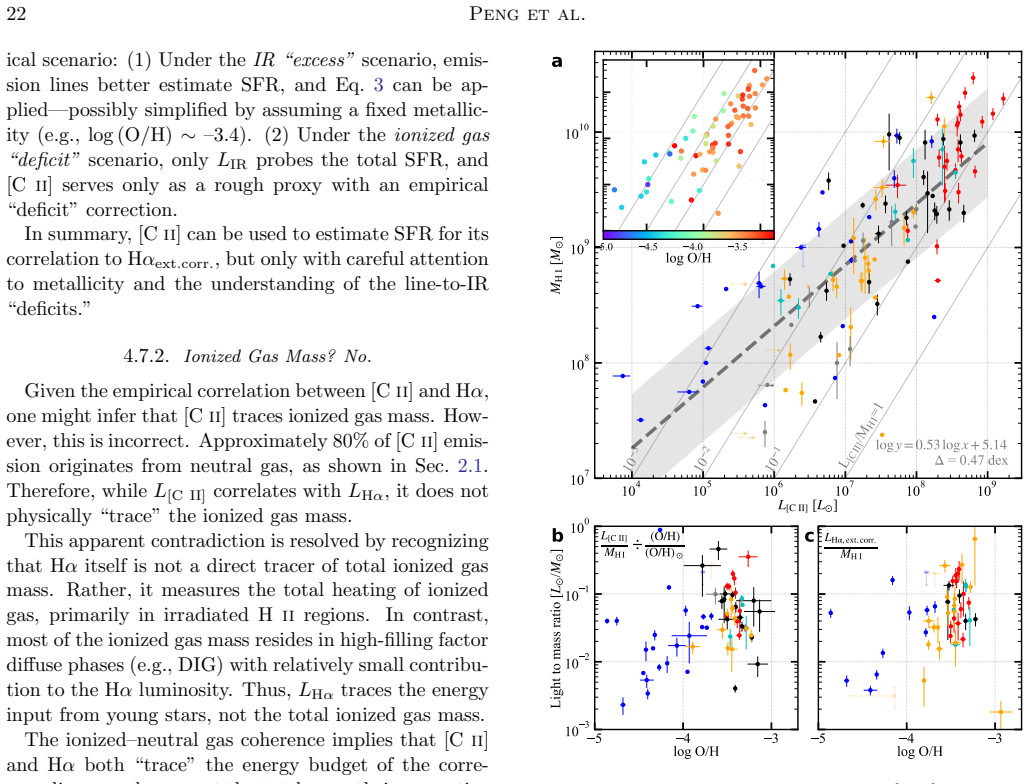
- There is no single universal [C ii]–SFR relation; the conversion must be scaled by metallicity, which naturally explains the offsets among previously published [C ii] calibrations and the faintness of [C ii] in early-universe galaxies.
- [C ii] line-intensity mapping experiments aimed at cosmic star-formation history must fold in the metallicity suppression of [C ii] in low-mass reionization-epoch galaxies, which diminishes their expected contribution to the intensity signal.
- Classical PDR models should not be applied to galaxy-integrated FIR data without independent cross-checks, because PDR-based mechanisms cannot produce the simultaneous suppression of ionized-gas lines like [N ii] and H$\alpha$ seen in the universal deficit.
- High-z LBG/LAEs do not show intrinsically elevated [O iii]88/[C ii] relative to local dwarfs; the apparent offset is an artifact of comparing at fixed SFR without accounting for the redshift evolution of the mass–metallicity and star-forming main-sequence relations.
- Faint or absent [C ii] in very high-redshift galaxies need not require exotic carbon depletion or IMF variations; the metallicity-dependent calibration already predicts weak [C ii] in the metal-poor systems that dominate the early universe.
Reading between the lines
- If the universal deficit is real, a corollary is that the 'extreme starburst' interpretation of high-z DSFGs may be softened toward more modest SFRs, with knock-on consequences for inferred gas depletion timescales, feedback energetics, and the cosmic SFR density at its peak epoch.
- The gas–dust dichotomy suggests a spatially testable prediction: within individual dusty galaxies, the line-to-continuum deficit should be concentrated where dust is hottest, so resolved ALMA/JWST maps should show $L_{\rm line}/L_{\rm IR}$ declining specifically in regions of high $S_{60}/S_{100}$.
- Core-collapse supernova rates, measurable with upcoming time-domain surveys, provide a line- and dust-independent SFR benchmark: if they track line-based SFRs in nearby U/LIRGs, the IR 'excess' branch wins, whereas if they track $L_{\rm IR}$-based SFRs, the ionized-gas 'deficit' branch wins and [C ii] calibrations need a deficit correction.
- The near-universal 80% neutral fraction, if confirmed by resolved [C ii]/[N ii] mapping, implies that integrated [C ii] emission reports the shared radiation budget of the ISM rather than PDR conditions, so interpreting high-z [C ii] detections as direct star-formation beacons should be done with explicit abundance and excitation caveats.
Editorial analysis
A structured set of objections, weighed in public.
Referee Report
Summary. This paper, the third in the FLAMES series, uses the comprehensive FIR fine-structure line catalogs from Papers I and II to revisit the origin and diagnostic use of [C ii], the nature of the 'deficit' phenomenon, and the reliability of SFR calibrations in dusty galaxies. The authors argue that (i) after correcting for N/O abundance variations, the neutral fraction of [C ii] is approximately 80% with little systematic variation across galaxy types; (ii) FIR FSL-to-Hα ratios are tight linear functions of metallicity, making [C ii] and [O iii]88 potential abundance indicators; (iii) the [C ii] 'deficit' is part of a universal deficit affecting all neutral and ionized gas lines, including extinction-corrected Hα, and is driven by dust temperature and an anomalous LIR; (iv) this universal deficit implies a breakdown of obscuration-corrected SFR calibrations, with SFRs potentially overestimated by up to a factor of 100 in the most IR-luminous systems; (v) [C ii] is a metallicity-dependent SFR tracer rather than a gas-mass tracer; and (vi) several apparent high-z anomalies, such as elevated [O iii]/[C ii] in LBG/LAEs, can be explained by redshift evolution of scaling relations, while enhanced oxygen lines in dusty systems may reflect AGN activity. The paper also critically re-examines the applicability of PDR models to galaxy-integrated data and proposes five heuristic scenarios for the gas-dust dichotomy.
Significance. If the empirical correlations hold, this paper provides a valuable synthesis: it offers a clean abundance-corrected prescription for the [C ii] neutral fraction, a simple metallicity scaling for FSL/Hα, a convincing demonstration that the Kennicutt et al. (2009) IR-corrected Hα calibration was calibrated on a sample that preferentially excludes IR-luminous outliers (Fig. 13), and a coherent explanation of several high-z line-ratio offsets in terms of known evolution of scaling relations. The strongest claim—that obscuration-corrected SFR calibrations break down by factors up to 100 for IR-luminous dusty galaxies—is consequential and falsifiable, but as discussed below it is conditional on the reliability of literature Balmer-decrement extinction corrections. The paper's strengths include its explicit handling of abundance effects, its use of a very broad multi-wavelength dataset, and its candid admission that several proposed scenarios are heuristic; these features make the paper a useful reference even where its conclusions are debated.
major comments (3)
- [§3.2, §4.5] The claim that extinction-corrected Hα exhibits an intrinsic 'deficit' and that the parallel Hα and [C ii] deficits 'rule out ... extinction effects' is load-bearing for the universal-deficit and SFR-crisis conclusions, but the analysis relies on literature Balmer-decrement corrections. In the U/LIRGs that drive the deficit, these corrections are the least reliable: for clumpy or mixed gas-dust geometries, the Balmer decrement is luminosity-weighted toward lightly obscured sightlines, so E(B-V) and hence L_Hα,ext.corr are systematically underestimated. This could manufacture an Hα deficit and contribute to the apparent gas-dust dichotomy even if the gas is intrinsically normal. The [C ii] deficit does not remove this concern unless the extinction corrections are shown to be unbiased. I request a sensitivity test using an independent extinction tracer (e.g., Paα or Brγ, or free-free radio continuum) for a subset of the IR-luminous galaxies, or a clearly worded softening of the claim that the Hα deficit is independent of extinction-correction systematics.
- [§2.2, Fig. 3] The linear fits supporting the central claim that FIR FSL/Hα traces metallicity exclude galaxies with log(O/H) > -3.75, with the stated reason being an ionization-turnover effect in [O iii]88. This post hoc subsample cut, applied to all four lines, means the metallicity dependence is not demonstrated across the full abundance range probed by the data. Since this same scaling is later used as the basis for the metallicity-dependent [C ii]-SFR calibration in §4.7.1, the restricted range and the treatment of the metal-rich branch need to be stated explicitly in the fitting description and in the abstract; ideally the authors should fit a model that includes the turnover rather than excluding the data.
- [§4.7.1, Eq. 3] Equation (3) is presented as a new metallicity-dependent [C ii]-SFR calibration, but it is a re-expression of the same L[C ii]/Hα–O/H fit shown in Fig. 3(a), converted to SFR through the Murphy et al. (2011) Hα-to-SFR relation. It is therefore a fitted calibration, not an independent prediction. Moreover, the 'theoretical expectation' dotted line in Fig. 15 uses f[C II],neutral = 0.8, which was estimated from the same sample in Sec. 2.1 and then recycled into the emissivity calculation, so the agreement with the fit is partly built in. This does not invalidate Eq. 3 as an empirical calibrator, but the paper should not present the agreement as independent confirmation; I recommend reporting the calibration directly in L[C II]–SFR space with propagated uncertainties and with the covariance between the fitted normalization and the assumed f[C II],neutral.
minor comments (6)
- [§2.2] The notation 'Hαext.corr.' is defined in the text, but the figures abbreviate it inconsistently (e.g., 'H ext. corr' in Figs. 2, 3, 5); please define the abbreviation once in the caption and use it consistently.
- [§3.1, Fig. 4] The [O i]145 and [N ii]122 panels contain many upper limits, but the text states that these lines 'show good agreement' with the [C ii] deficit trend; please state how upper limits were treated in the scatter estimates and whether the quoted scatters include them.
- [§4.8.2] The phrase 'mischaracterized as a deficit' and the claim that the De Looze et al. (2014) fits have a 'power index 0.16' should be checked; the exponent seems to refer to a secondary fit and could be misread as a slope of the [O iii]/[C ii]–SFR relation.
- [Fig. 12] The five-panel schematic in Fig. 12 is very dense and difficult to read at journal page size; a table summarizing the scenarios, their physical mechanisms, and their observational consequences would be more effective for the reader.
- [Throughout] There are numerous typographical errors and garbled sentences, e.g., 'discuseed' (§4.8), 'ragions' for 'regions' (§4.2), 'caueses' (§4.8.3), 'manly' for 'mainly' (§4.3), and 'characterzied' (Summary); a careful proofreading pass is needed.
- [§4.4.2] The energetic feasibility argument against the cirrus scenario would be strengthened by a quantitative comparison: the authors state that evolved stars would need to exceed L_IR ~ 10^14 L_sun, but they do not show the implied stellar-mass constraint or cite a specific model that rules it out.
Circularity Check
Mild circularity: the f[C II],neutral ≈ 0.8 value is reused to compute the 'expected' [C ii]/Hα ratio, then cited as an independent confirmation; the headline universal-deficit and SFR-crisis claims are empirical and not circular.
-
fitted input called prediction
[Sec. 2.2 (Fig. 3) and Sec. 4.1]
"Similarly, the fitted [C ii]/Hα/(O/H) ratio of 10^{3.21} is consistent with the expected value, derived using ε[C II],e−/αB,Hα/(1−f[C II],neutral) ∗ (C/O)⊙ = 10^{3.35}, where εe− denotes the emissivity in ionized gas for [C ii] assuming the aforementioned conditions. We adopt f[C II],neutral = 0.8 as estimated in the previous section. ... This interpretation is further supported by the remarkably consistent [C ii] neutral fraction (f[C II],neutral), as derived independently from both [C ii]/[N ii] and [C ii]/Hα ratios (see Sec. 2.1 and 2.2)."
The expected [C ii]/Hα ratio is not an independent prediction: it is computed by inserting f[C II],neutral = 0.8 into the emissivity formula, and 0.8 is the median obtained from Eq. 1 using [C ii]/[N ii] and N/O in the preceding section. The agreement with the fitted [C ii]/Hα–O/H relation is therefore a self-consistency check, and presenting it as derived independently from both [C ii]/[N ii] and [C ii]/Hα reuses the [C ii]/[N ii] output as input. The confirmation partly reduces to its own construction. This affects the supporting ionized–neutral coherence inference, not the main empirical deficit claim, which is based on separate line-to-LIR comparisons.
full rationale
The only concrete circular step is the f[C II],neutral ≈ 0.8 self-consistency check: Eq. 1 yields 0.8 from [C ii]/[N ii] and N/O, Sec. 2.2 uses that same 0.8 to compute an expected [C ii]/Hα ratio, and Sec. 4.1 calls the agreement an independent derivation. That is a fitted input recycled as confirmation. The central claims are not circular: the universal line deficit is an empirical pattern in measured line-to-LIR ratios; the Hα deficit uses literature Balmer-decrement-corrected luminosities; and the inference that a corrected-tracer deficit rules out extinction effects depends on those corrections being unbiased. That dependency is a systematic-error risk for the Hα part of the argument, not a definitional reduction, so by the stated rules it is not counted as circularity here. Equation (3) is explicitly derived from the Fig. 3 fits and the Murphy et al. (2011) Hα-to-SFR conversion, making it a calibration of an empirical relation rather than a prediction of an independent quantity. The series cites Paper I and Paper II for data and models, but those are supporting empirical and model inputs, not uniqueness or ansatz-carrying citations that force the conclusion. Overall, the deficit and gas–dust dichotomy are empirical syntheses with independent content; only the f ≈ 0.8 independent-confirmation claim is partially circular, so a score of 3 is appropriate.
Assumptions & free parameters
free parameters (7)
- [O III]88/H-alpha scaling normalization =
10^3.59
- [C II]/H-alpha scaling normalization =
10^3.21
- [O I]63/H-alpha scaling normalization =
10^2.91
- [O I]145/H-alpha scaling normalization =
10^1.82
- [C II] neutral fraction =
0.8
- Electron temperature and density for PyNeb emissivities =
Te=10^4 K, ne=50 cm^-3
- SFR[C II] normalization =
2.59
assumptions (5)
- domain assumption The carbon-to-oxygen abundance ratio is constant and equal to the solar value (C/O)=10^-0.26 across all galaxy types.
- domain assumption N/O abundances measured from optical lines are reliable for the full galaxy sample.
- domain assumption Extinction-corrected H-alpha luminosities from the literature are accurate for IR-luminous and dusty galaxies.
- domain assumption PyNeb collisional excitation at Te=10^4 K and ne=50 cm^-3 describes galaxy-integrated FIR line emission.
- ad hoc to paper The ionization turnover justifies excluding galaxies with log(O/H) > -3.75 from the linear fits.
Cite this review
Pith. "Pith review of Fine-structure Line Atlas for Multi-wavelength Extragalactic Study (FLAMES) III: [C II] as Tracer, Crisis of SFR, [O III]/[C II] at High-z, New Answers and New Questions." pith.science (2026). https://pith.science/paper/FJEEDUAE
@misc{pith2026250712896,
  author       = {Pith},
  title        = {Pith review of: Fine-structure Line Atlas for Multi-wavelength Extragalactic Study (FLAMES) III: [C II] as Tracer, Crisis of SFR, [O III]/[C II] at High-z, New Answers and New Questions},
  year         = {2026},
  howpublished = {\url{https://pith.science/paper/FJEEDUAE}},
  note         = {Machine review of arXiv:2507.12896}
}
abstract
In the final paper of this series, we discuss new perspectives and challenges in the study of interstellar medium (ISM), leveraging comprehensive catalogs and physical insights presented in our previous papers. We focus on key questions of far-infrared (FIR) fine-structure lines (FSLs): their origins, diagnostic value, and implications of correlations. Our analysis reveals a strong dependence on elemental abundance, so that FSL/H$\alpha$ traces metallicity, [N II]/[C II] traces N/O, and $\sim$80% of [C II] emission arises from neutral gas without systematic variations. We conclude a coherence exists between the emissions from ionized and neutral gases regarding energy sources and distribution. We argue that [C II] is physically a metallicity-dependent star formation rate (SFR) tracer, while its correlations with atomic or molecular gas masses are secondary. Crucially, the [C II] ``deficit'' is only part of a universal ``deficit'' problem that shows in all neutral and ionized gas lines including extinction-corrected H$\alpha$, caused by infrared (IR) luminosities and characterized by a dichotomy in gas and dust behaviors. This universal ``deficit'' marks a breakdown of the obscuration-corrected star-formation rate (SFR) calibration and imperils SFR estimates. We argue that it is caused by either IR ``excess'' or ionized gas ``deficit'', and present possible scenarios. A renewed picture of ISM structure is needed to reconcile with ionized--neutral gas coherence, metallicity dependence, and gas--dust dichotomy. We also discuss differences of FIR FSL at high redshifts: the offset in ``deficit'' trends, the similar [O III]/[C II] in metal-poor galaxies, and elevated [O III]/[C II] in dusty galaxies.
Figures


Figures from the paper (16 more)




Reference graph
Works this paper leans on
-
[1]
Hoof, P. A. M. 2009, ApJ, 701, 1147, doi: 10.1088/0004-637X/701/2/1147
-
[2]
Abel, N. P., Ferland, G. J., Shaw, G., & van Hoof, P. A. M. 2005, ApJS, 161, 65, doi: 10.1086/432913
doi:10.1086/432913 2005
-
[3]
Abel, N. P., Sarma, A. P., Troland, T. H., & Ferland, G. J. 2007, ApJ, 662, 1024, doi: 10.1086/517987
doi:10.1086/517987 2007
-
[4]
B., Fujimoto, S., Finlator, K., et al
Akins, H. B., Fujimoto, S., Finlator, K., et al. 2022, ApJ, 934, 64, doi: 10.3847/1538-4357/ac795b
-
[5]
2025, arXiv e-prints, arXiv:2501.10508, doi: 10.48550/arXiv.2501.10508
Algera, H., Rowland, L., Stefanon, M., et al. 2025, arXiv e-prints, arXiv:2501.10508, doi: 10.48550/arXiv.2501.10508
-
[6]
Algera, H. S. B., Inami, H., De Looze, I., et al. 2024a, MNRAS, 533, 3098, doi: 10.1093/mnras/stae1994
-
[7]
Algera, H. S. B., Inami, H., Sommovigo, L., et al. 2024b, MNRAS, 527, 6867, doi: 10.1093/mnras/stad3111 ´Alvarez-M´ arquez, J., Crespo G´ omez, A., Colina, L., et al. 2023, A&A, 671, A105, doi: 10.1051/0004-6361/202245400 ´Alvarez-M´ arquez, J., Colina, L., Crespo G´ omez, A., et al. 2024, A&A, 686, A85, doi: 10.1051/0004-6361/202347946
-
[8]
Amvrosiadis, A., Lange, S., Nightingale, J. W., et al. 2025, MNRAS, 537, 1163, doi: 10.1093/mnras/staf048
Show all 298 references
-
[9]
H., & Martini, P
Andrews, B. H., & Martini, P. 2013, ApJ, 765, 140, doi: 10.1088/0004-637X/765/2/140
2013 doi
-
[10]
2008, A&A, 491, 747, doi: 10.1051/0004-6361:200810482
Ao, Y., Weiß, A., Downes, D., et al. 2008, A&A, 491, 747, doi: 10.1051/0004-6361:200810482
2008 doi
-
[11]
2008, A&A, 491, 173, doi: 10.1051/0004-6361:200810628
Aravena, M., Bertoldi, F., Schinnerer, E., et al. 2008, A&A, 491, 173, doi: 10.1051/0004-6361:200810628
2008 doi
-
[12]
S., Bethermin, M., et al
Aravena, M., Spilker, J. S., Bethermin, M., et al. 2016, MNRAS, 457, 4406, doi: 10.1093/mnras/stw275
2016 doi
-
[13]
2024, A&A, 688, A146, doi: 10.1051/0004-6361/202348824 Astropy Collaboration, Robitaille, T
Arribas, S., Perna, M., Rodr ´ ıguez Del Pino, B., et al. 2024, A&A, 688, A146, doi: 10.1051/0004-6361/202348824 Astropy Collaboration, Robitaille, T. P., Tollerud, E. J., et al. 2013, A&A, 558, A33, doi: 10.1051/0004-6361/201322068 Astropy Collaboration, Price-Whelan, A. M., ...
2024 doi
-
[14]
Bakx, T. J. L. C., Tamura, Y., Hashimoto, T., et al. 2020, MNRAS, 493, 4294, doi: 10.1093/mnras/staa509
2020 doi
-
[15]
Bakx, T. J. L. C., Sommovigo, L., Carniani, S., et al. 2021, MNRAS, 508, L58, doi: 10.1093/mnrasl/slab104
2021 doi
-
[16]
Bakx, T. J. L. C., Zavala, J. A., Mitsuhashi, I., et al. 2023, MNRAS, 519, 5076, doi: 10.1093/mnras/stac3723
2023 doi
-
[17]
Bakx, T. J. L. C., Algera, H. S. B., Venemans, B., et al. 2024, MNRAS, 532, 2270, doi: 10.1093/mnras/stae1613
2024 doi
- [18]
-
[19]
L., Capak, P
Barisic, I., Faisst, A. L., Capak, P. L., et al. 2017, ApJ, 845, 41, doi: 10.3847/1538-4357/aa7eda
2017 doi
-
[20]
J., et al
Beelen, A., Cox, P., Benford, D. J., et al. 2006, ApJ, 642, 694, doi: 10.1086/500636 Beir˜ ao, P., Appleton, P. N., Brandl, B. R., et al. 2009, ApJ, 693, 1650, doi: 10.1088/0004-637X/693/2/1650
2006 doi
-
[21]
2022, A&A, 659, A26, doi: 10.1051/0004-6361/202141859 B´ ethermin, M., De Breuck, C., Gullberg, B., et al
Belfiore, F., Santoro, F., Groves, B., et al. 2022, A&A, 659, A26, doi: 10.1051/0004-6361/202141859 B´ ethermin, M., De Breuck, C., Gullberg, B., et al. 2016, A&A, 586, L7, doi: 10.1051/0004-6361/201527739 B´ ethermin, M., Fudamoto, Y., Ginolfi, M., et al. 2020, A&A, 643, A2, ...
2022 doi
-
[22]
K., Hashimoto, T., et al
Binggeli, C., Inoue, A. K., Hashimoto, T., et al. 2021, A&A, 646, A26, doi: 10.1051/0004-6361/202038180
2021 doi
-
[23]
E., Hutchison, T
Birkin, J. E., Hutchison, T. A., Welch, B., et al. 2023, ApJ, 958, 64, doi: 10.3847/1538-4357/acf712
2023 doi
- [24]
-
[25]
2018, A&A, 617, A82, doi: 10.1051/0004-6361/201833249
Bischetti, M., Piconcelli, E., Feruglio, C., et al. 2018, A&A, 617, A82, doi: 10.1051/0004-6361/201833249
2018 doi
-
[26]
2024, ApJ, 970, 9, doi: 10.3847/1538-4357/ad4a77
Bischetti, M., Choi, H., Fiore, F., et al. 2024, ApJ, 970, 9, doi: 10.3847/1538-4357/ad4a77
2024 doi
-
[27]
W., Dey, A., et al
Borys, C., Blain, A. W., Dey, A., et al. 2006, ApJ, 636, 134, doi: 10.1086/497983
2006 doi
-
[28]
Bosman, S. E. I., ´Alvarez-M´ arquez, J., Colina, L., et al. 2024, Nature Astronomy, 8, 1054, doi: 10.1038/s41550-024-02273-0 FLAMES III: New Answers and New Questions 31
2024 doi
-
[29]
J., Smit, R., Schouws, S., et al
Bouwens, R. J., Smit, R., Schouws, S., et al. 2022, ApJ, 931, 160, doi: 10.3847/1538-4357/ac5a4a
2022 doi
-
[30]
Bowler, R. A. A., Bourne, N., Dunlop, J. S., McLure, R. J., & McLeod, D. J. 2018, MNRAS, 481, 1631, doi: 10.1093/mnras/sty2368
2018 doi
-
[31]
Bowler, R. A. A., Cullen, F., McLure, R. J., Dunlop, J. S., & Avison, A. 2022, MNRAS, 510, 5088, doi: 10.1093/mnras/stab3744 Bradaˇ c, M., Garcia-Appadoo, D., Huang, K.-H., et al. 2017, ApJL, 836, L2, doi: 10.3847/2041-8213/836/1/L2
2022 doi
-
[32]
D., Bouwens, R
Bradley, L. D., Bouwens, R. J., Zitrin, A., et al. 2012, ApJ, 747, 3, doi: 10.1088/0004-637X/747/1/3
2012 doi
-
[33]
R., Dale, D
Brauher, J. R., Dale, D. A., & Helou, G. 2008, ApJS, 178, 280, doi: 10.1086/590249
2008 doi
-
[34]
J., Saxena, A., Cameron, A
Bunker, A. J., Saxena, A., Cameron, A. J., et al. 2023, A&A, 677, A88, doi: 10.1051/0004-6361/202346159
2023 doi
-
[35]
J., Katz, H., Rey, M
Cameron, A. J., Katz, H., Rey, M. P., & Saxena, A. 2023, MNRAS, 523, 3516, doi: 10.1093/mnras/stad1579
2023 doi
-
[36]
L., Riechers, D., Scoville, N
Capak, P. L., Riechers, D., Scoville, N. Z., et al. 2011, Nature, 470, 233, doi: 10.1038/nature09681
2011 doi
-
[37]
L., Carilli, C., Jones, G., et al
Capak, P. L., Carilli, C., Jones, G., et al. 2015, Nature, 522, 455, doi: 10.1038/nature14500
2015 doi
-
[38]
L., Riechers, D., Walter, F., et al
Carilli, C. L., Riechers, D., Walter, F., et al. 2013, ApJ, 763, 120, doi: 10.1088/0004-637X/763/2/120
2013 doi
-
[39]
2018a, ApJL, 854, L7, doi: 10.3847/2041-8213/aaab45
Carniani, S., Maiolino, R., Smit, R., & Amor ´ ın, R. 2018a, ApJL, 854, L7, doi: 10.3847/2041-8213/aaab45
-
[40]
2013, A&A, 559, A29, doi: 10.1051/0004-6361/201322320
Carniani, S., Marconi, A., Biggs, A., et al. 2013, A&A, 559, A29, doi: 10.1051/0004-6361/201322320
2013 doi
-
[41]
2017, A&A, 605, A42, doi: 10.1051/0004-6361/201630366
Carniani, S., Maiolino, R., Pallottini, A., et al. 2017, A&A, 605, A42, doi: 10.1051/0004-6361/201630366
2017 doi
-
[42]
2018b, MNRAS, 478, 1170, doi: 10.1093/mnras/sty1088
Carniani, S., Maiolino, R., Amorin, R., et al. 2018b, MNRAS, 478, 1170, doi: 10.1093/mnras/sty1088
-
[43]
2020, MNRAS, 499, 5136, doi: 10.1093/mnras/staa3178
Carniani, S., Ferrara, A., Maiolino, R., et al. 2020, MNRAS, 499, 5136, doi: 10.1093/mnras/staa3178
2020 doi
-
[44]
2024, Nature, 633, 318, doi: 10.1038/s41586-024-07860-9
Carniani, S., Hainline, K., D’Eugenio, F., et al. 2024, Nature, 633, 318, doi: 10.1038/s41586-024-07860-9
2024 doi
-
[45]
2024, A&A, 689, A106, doi: 10.1051/0004-6361/202450332
Casavecchia, B., Maio, U., P´ eroux, C., & Ciardi, B. 2024, A&A, 689, A106, doi: 10.1051/0004-6361/202450332
2024 doi
-
[46]
2024, ApJ, 972, 143, doi: 10.3847/1538-4357/ad5f88
Castellano, M., Napolitano, L., Fontana, A., et al. 2024, ApJ, 972, 143, doi: 10.3847/1538-4357/ad5f88
2024 doi
-
[47]
1984, A&A, 137, 1
Caux, E., Serra, G., Gispert, R., et al. 1984, A&A, 137, 1
1984
-
[48]
2023, ApJ, 943, 142, doi: 10.3847/1538-4357/acac96
Chandar, R., Caputo, M., Linden, S., et al. 2023, ApJ, 943, 142, doi: 10.3847/1538-4357/acac96
2023 doi
-
[49]
2022, Nature Astronomy, 6, 844, doi: 10.1038/s41550-022-01679-y
Chartab, N., Cooray, A., Ma, J., et al. 2022, Nature Astronomy, 6, 844, doi: 10.1038/s41550-022-01679-y
2022 doi
-
[50]
2020, ApJ, 898, 33, doi: 10.3847/1538-4357/ab980b
Cheng, C., Cao, X., Lu, N., et al. 2020, ApJ, 898, 33, doi: 10.3847/1538-4357/ab980b
2020 doi
-
[51]
2015, A&A, 574, A14, doi: 10.1051/0004-6361/201424980
Cicone, C., Maiolino, R., Gallerani, S., et al. 2015, A&A, 574, A14, doi: 10.1051/0004-6361/201424980
2015 doi
-
[52]
2016, AJ, 151, 14, doi: 10.3847/0004-6256/151/1/14
Cigan, P., Young, L., Cormier, D., et al. 2016, AJ, 151, 14, doi: 10.3847/0004-6256/151/1/14
2016 doi
-
[53]
Clark, C. J. R., Verstocken, S., Bianchi, S., et al. 2018, A&A, 609, A37, doi: 10.1051/0004-6361/201731419
2018 doi
-
[54]
D., et al
Combes, F., Rex, M., Rawle, T. D., et al. 2012, A&A, 538, L4, doi: 10.1051/0004-6361/201118750
2012 doi
-
[55]
D., et al
Conley, A., Cooray, A., Vieira, J. D., et al. 2011, ApJL, 732, L35, doi: 10.1088/2041-8205/732/2/L35
2011 doi
-
[56]
Coppin, K. E. K., Danielson, A. L. R., Geach, J. E., et al. 2012, MNRAS, 427, 520, doi: 10.1111/j.1365-2966.2012.21977.x
2012
-
[57]
C., Lebouteiller, V., et al
Cormier, D., Madden, S. C., Lebouteiller, V., et al. 2015, A&A, 578, A53, doi: 10.1051/0004-6361/201425207
2015 doi
-
[58]
P., Hony, S., et al
Cormier, D., Abel, N. P., Hony, S., et al. 2019, A&A, 626, A23, doi: 10.1051/0004-6361/201834457
2019 doi
-
[59]
L., Hu, E
Cowie, L. L., Hu, E. M., & Songaila, A. 2011, ApJL, 735, L38, doi: 10.1088/2041-8205/735/2/L38
2011 doi
-
[60]
G., et al
Cox, P., Omont, A., Djorgovski, S. G., et al. 2002, A&A, 387, 406, doi: 10.1051/0004-6361:20020382
2002 doi
-
[61]
2011, ApJ, 740, 63, doi: 10.1088/0004-637X/740/2/63
Cox, P., Krips, M., Neri, R., et al. 2011, ApJ, 740, 63, doi: 10.1088/0004-637X/740/2/63
2011 doi
-
[62]
V., Smith, J
Croxall, K. V., Smith, J. D., Pellegrini, E., et al. 2017, ApJ, 845, 96, doi: 10.3847/1538-4357/aa8035
2017 doi
-
[63]
Cunningham, D. J. M., Chapman, S. C., Aravena, M., et al. 2020, MNRAS, 494, 4090, doi: 10.1093/mnras/staa820
2020 doi
-
[64]
2024, A&A, 684, A75, doi: 10.1051/0004-6361/202346698 de Blok, W
Curti, M., Maiolino, R., Curtis-Lake, E., et al. 2024, A&A, 684, A75, doi: 10.1051/0004-6361/202346698 de Blok, W. J. G., Walter, F., Smith, J. D. T., et al. 2016, AJ, 152, 51, doi: 10.3847/0004-6256/152/2/51 De Breuck, C., Maiolino, R., Caselli, P., et al. 2011, A&A, 530, L8,...
2024 doi
-
[65]
2014, ApJL, 782, L17, doi: 10.1088/2041-8205/782/2/L17
Decarli, R., Walter, F., Carilli, C., et al. 2014, ApJL, 782, L17, doi: 10.1088/2041-8205/782/2/L17
2014 doi
-
[66]
P., et al
Decarli, R., Walter, F., Venemans, B. P., et al. 2017, Nature, 545, 457, doi: 10.1038/nature22358 —. 2018, ApJ, 854, 97, doi: 10.3847/1538-4357/aaa5aa
2017 doi
-
[67]
2022, A&A, 662, A60, doi: 10.1051/0004-6361/202142871
Decarli, R., Pensabene, A., Venemans, B., et al. 2022, A&A, 662, A60, doi: 10.1051/0004-6361/202142871
2022 doi
-
[68]
2023, A&A, 673, A157, doi: 10.1051/0004-6361/202245674 Della Bruna, L., Adamo, A., Bik, A., et al
Decarli, R., Pensabene, A., Diaz-Santos, T., et al. 2023, A&A, 673, A157, doi: 10.1051/0004-6361/202245674 Della Bruna, L., Adamo, A., Bik, A., et al. 2020, A&A, 635, A134, doi: 10.1051/0004-6361/201937173 32 Peng et al
2023 doi
-
[69]
2015, A&A, 577, A50, doi: 10.1051/0004-6361/201424661 D ´ ıaz-Santos, T., Assef, R
Dessauges-Zavadsky, M., Zamojski, M., Schaerer, D., et al. 2015, A&A, 577, A50, doi: 10.1051/0004-6361/201424661 D ´ ıaz-Santos, T., Assef, R. J., Blain, A. W., et al. 2016, ApJL, 816, L6, doi: 10.3847/2041-8205/816/1/L6 D ´ ıaz-Santos, T., Armus, L., Charmandaris, V., et al. ...
2015 doi
-
[70]
Dimaratos, A., Cormier, D., Bigiel, F., & Madden, S. C. 2015, A&A, 580, A135, doi: 10.1051/0004-6361/201526447
2015 doi
-
[71]
J., & Shaver, P
Downes, D., Neri, R., Wiklind, T., Wilner, D. J., & Shaver, P. A. 1999a, ApJL, 513, L1, doi: 10.1086/311896
- [72]
-
[73]
Draine, B. T. 2011a, Physics of the Interstellar and Intergalactic Medium —. 2011b, ApJ, 732, 100, doi: 10.1088/0004-637X/732/2/100
- [74]
-
[75]
T., Dale, D
Draine, B. T., Dale, D. A., Bendo, G., et al. 2007, ApJ, 663, 866, doi: 10.1086/518306
2007 doi
-
[76]
A., Crone Odekon, M., et al
Durbala, A., Finn, R. A., Crone Odekon, M., et al. 2020, AJ, 160, 271, doi: 10.3847/1538-3881/abc018
2020 doi
-
[77]
G., & Pagel, B
Edmunds, M. G., & Pagel, B. E. J. 1978, MNRAS, 185, 77P, doi: 10.1093/mnras/185.1.77P
1978 doi
-
[78]
F., Decarli, R., et al
Eilers, A.-C., Hennawi, J. F., Decarli, R., et al. 2020, ApJ, 900, 37, doi: 10.3847/1538-4357/aba52e
2020 doi
-
[79]
A., Yue, M., et al
Eilers, A.-C., Simcoe, R. A., Yue, M., et al. 2023, ApJ, 950, 68, doi: 10.3847/1538-4357/acd776
2023 doi
-
[80]
P., Lyu, J., et al
Endsley, R., Stark, D. P., Lyu, J., et al. 2023, MNRAS, 520, 4609, doi: 10.1093/mnras/stad266
2023 doi
-
[81]
W., Rieke, G
Engelbracht, C. W., Rieke, G. H., Gordon, K. D., et al. 2008, ApJ, 678, 804, doi: 10.1086/529513
2008 doi
-
[82]
S., Solomon, P
Evans, A. S., Solomon, P. M., Tacconi, L. J., Vavilkin, T., & Downes, D. 2006, AJ, 132, 2398, doi: 10.1086/508416
2006 doi
-
[83]
S., Baker, A
Fadely, R., Allam, S. S., Baker, A. J., et al. 2010, ApJ, 723, 729, doi: 10.1088/0004-637X/723/1/729
2010 doi
-
[84]
L., Fudamoto, Y., Oesch, P
Faisst, A. L., Fudamoto, Y., Oesch, P. A., et al. 2020, MNRAS, 498, 4192, doi: 10.1093/mnras/staa2545
2020 doi
-
[85]
D., et al
Falkendal, T., De Breuck, C., Lehnert, M. D., et al. 2019, A&A, 621, A27, doi: 10.1051/0004-6361/201732485
2019 doi
-
[86]
Farrah, D., Bernard-Salas, J., Spoon, H. W. W., et al. 2007, ApJ, 667, 149, doi: 10.1086/520834
2007 doi
-
[87]
Farrah, D., Lebouteiller, V., Spoon, H. W. W., et al. 2013, ApJ, 776, 38, doi: 10.1088/0004-637X/776/1/38
2013 doi
-
[88]
Hunter, D. A. 1996, AJ, 111, 2265, doi: 10.1086/117961
1996 doi
-
[89]
2015, ApJ, 806, 260, doi: 10.1088/0004-637X/806/2/260
Ferkinhoff, C., Brisbin, D., Nikola, T., et al. 2015, ApJ, 806, 260, doi: 10.1088/0004-637X/806/2/260
2015 doi
-
[90]
2010, ApJL, 714, L147, doi: 10.1088/2041-8205/714/1/L147
Ferkinhoff, C., Hailey-Dunsheath, S., Nikola, T., et al. 2010, ApJL, 714, L147, doi: 10.1088/2041-8205/714/1/L147
2010 doi
-
[91]
2011, ApJL, 740, L29, doi: 10.1088/2041-8205/740/1/L29 Fern´ andez Aranda, R., D ´ ıaz Santos, T., Hatziminaoglou, E., et al
Ferkinhoff, C., Brisbin, D., Nikola, T., et al. 2011, ApJL, 740, L29, doi: 10.1088/2041-8205/740/1/L29 Fern´ andez Aranda, R., D ´ ıaz Santos, T., Hatziminaoglou, E., et al. 2024, A&A, 682, A166, doi: 10.1051/0004-6361/202347869 Fern´ andez-Ontiveros, J. A., Spinoglio, L., Per...
2011 doi
-
[92]
L., Papovich, C., Rudnick, G., et al
Finkelstein, S. L., Papovich, C., Rudnick, G., et al. 2009, ApJ, 700, 376, doi: 10.1088/0004-637X/700/1/376
2009 doi
-
[93]
P., Gonz´ alez-Alfonso, E., et al
Fischer, J., Abel, N. P., Gonz´ alez-Alfonso, E., et al. 2014, ApJ, 795, 117, doi: 10.1088/0004-637X/795/2/117 F¨ orster Schreiber, N. M., & Wuyts, S. 2020, ARA&A, 58, 661, doi: 10.1146/annurev-astro-032620-021910
2014 doi
-
[94]
2021, A&A, 647, A194, doi: 10.1051/0004-6361/202039807
Fraternali, F., Karim, A., Magnelli, B., et al. 2021, A&A, 647, A194, doi: 10.1051/0004-6361/202039807
2021 doi
-
[95]
T., Ivison, R
Frayer, D. T., Ivison, R. J., Scoville, N. Z., et al. 1999, ApJL, 514, L13, doi: 10.1086/311940
1999 doi
-
[96]
2013, Nature, 498, 338, doi: 10.1038/nature12184
Fu, H., Cooray, A., Feruglio, C., et al. 2013, Nature, 498, 338, doi: 10.1038/nature12184
2013 doi
-
[97]
A., Schouws, S., et al
Fudamoto, Y., Oesch, P. A., Schouws, S., et al. 2021, Nature, 597, 489, doi: 10.1038/s41586-021-03846-z
2021 doi
-
[98]
A., Walter, F., et al
Fudamoto, Y., Oesch, P. A., Walter, F., et al. 2024a, MNRAS, 530, 340, doi: 10.1093/mnras/stae556
-
[99]
K., Coe, D., et al
Fudamoto, Y., Inoue, A. K., Coe, D., et al. 2024b, ApJ, 961, 71, doi: 10.3847/1538-4357/ad0f95
- [100]
-
[101]
2019, ApJ, 887, 107, doi: 10.3847/1538-4357/ab480f
Fujimoto, S., Ouchi, M., Ferrara, A., et al. 2019, ApJ, 887, 107, doi: 10.3847/1538-4357/ab480f
2019 doi
-
[102]
2021, ApJ, 911, 99, doi: 10.3847/1538-4357/abd7ec
Fujimoto, S., Oguri, M., Brammer, G., et al. 2021, ApJ, 911, 99, doi: 10.3847/1538-4357/abd7ec
2021 doi
-
[103]
B., Watson, D., et al
Fujimoto, S., Brammer, G. B., Watson, D., et al. 2022, Nature, 604, 261, doi: 10.1038/s41586-022-04454-1
2022 doi
-
[104]
2024a, ApJ, 964, 146, doi: 10.3847/1538-4357/ad235c
Fujimoto, S., Ouchi, M., Nakajima, K., et al. 2024a, ApJ, 964, 146, doi: 10.3847/1538-4357/ad235c
- [105]
-
[106]
2025, ApJS, 278, 45, doi: 10.3847/1538-4365/adc677
Fujimoto, S., Bezanson, R., Labbe, I., et al. 2025, ApJS, 278, 45, doi: 10.3847/1538-4365/adc677
2025 doi
-
[107]
2012, A&A, 543, A114, doi: 10.1051/0004-6361/201118705 FLAMES III: New Answers and New Questions 33
Gallerani, S., Neri, R., Maiolino, R., et al. 2012, A&A, 543, A114, doi: 10.1051/0004-6361/201118705 FLAMES III: New Answers and New Questions 33
2012 doi
-
[108]
E., Narayanan, D., Matsuda, Y., et al
Geach, J. E., Narayanan, D., Matsuda, Y., et al. 2016, ApJ, 832, 37, doi: 10.3847/0004-637X/832/1/37
2016 doi
-
[109]
D., Ivison, R
George, R. D., Ivison, R. J., Hopwood, R., et al. 2013, MNRAS, 436, L99, doi: 10.1093/mnrasl/slt122
2013 doi
-
[110]
R., et al
Gerin, M., Ruaud, M., Goicoechea, J. R., et al. 2015, A&A, 573, A30, doi: 10.1051/0004-6361/201424349
2015 doi
-
[111]
M., & Graham, J
Gilbert, A. M., & Graham, J. R. 2007, ApJ, 668, 168, doi: 10.1086/520910 Gim´ enez-Arteaga, C., Brammer, G. B., Marchesini, D., et al. 2022, ApJS, 263, 17, doi: 10.3847/1538-4365/ac958c Gim´ enez-Arteaga, C., Fujimoto, S., Valentino, F., et al. 2024, A&A, 686, A63, doi: 10.105...
2007 doi
-
[112]
C., B´ ethermin, M., et al
Ginolfi, M., Jones, G. C., B´ ethermin, M., et al. 2020, A&A, 643, A7, doi: 10.1051/0004-6361/202038284
2020 doi
-
[113]
2023, ApJ, 943, 151, doi: 10.3847/1538-4357/aca53f
Giulietti, M., Lapi, A., Massardi, M., et al. 2023, ApJ, 943, 151, doi: 10.3847/1538-4357/aca53f
2023 doi
-
[114]
L., et al
Glazer, K., Brad˘ ac, M., Sanders, R. L., et al. 2024, MNRAS, 531, 945, doi: 10.1093/mnras/stae1178 G´ omez-Guijarro, C., Toft, S., Karim, A., et al. 2018, ApJ, 856, 121, doi: 10.3847/1538-4357/aab206
2024 doi
-
[115]
D., et al
Gullberg, B., De Breuck, C., Vieira, J. D., et al. 2015, MNRAS, 449, 2883, doi: 10.1093/mnras/stv372
2015 doi
-
[116]
M., Smail, I., et al
Gullberg, B., Swinbank, A. M., Smail, I., et al. 2018, ApJ, 859, 12, doi: 10.3847/1538-4357/aabe8c
2018 doi
-
[117]
2023, A&A, 676, A89, doi: 10.1051/0004-6361/202346449
Gururajan, G., Bethermin, M., Sulzenauer, N., et al. 2023, A&A, 676, A89, doi: 10.1051/0004-6361/202346449
2023 doi
-
[118]
J., et al
Hailey-Dunsheath, S., Nikola, T., Stacey, G. J., et al. 2010, ApJL, 714, L162, doi: 10.1088/2041-8205/714/1/L162
2010 doi
-
[119]
N., Shapley, A
Hainline, K. N., Shapley, A. E., Kornei, K. A., et al. 2009, ApJ, 701, 52, doi: 10.1088/0004-637X/701/1/52
2009 doi
-
[120]
K., et al
Harikane, Y., Ouchi, M., Inoue, A. K., et al. 2020, ApJ, 896, 93, doi: 10.3847/1538-4357/ab94bd
2020 doi
-
[121]
L., Ellis, R., et al
Harikane, Y., Sanders, R. L., Ellis, R., et al. 2025, arXiv e-prints, arXiv:2505.09186, doi: 10.48550/arXiv.2505.09186
2025 doi
-
[122]
S., et al
Harshan, A., Tripodi, R., Martis, N. S., et al. 2024, ApJL, 977, L36, doi: 10.3847/2041-8213/ad9741
2024 doi
-
[123]
K., Tamura, Y., et al
Hashimoto, T., Inoue, A. K., Tamura, Y., et al. 2019a, PASJ, 71, 109, doi: 10.1093/pasj/psz094
-
[124]
2018, Nature, 557, 392, doi: 10.1038/s41586-018-0117-z
Hashimoto, T., Laporte, N., Mawatari, K., et al. 2018, Nature, 557, 392, doi: 10.1038/s41586-018-0117-z
2018 doi
-
[125]
K., Mawatari, K., et al
Hashimoto, T., Inoue, A. K., Mawatari, K., et al. 2019b, PASJ, 71, 71, doi: 10.1093/pasj/psz049
-
[126]
2023, ApJL, 955, L2, doi: 10.3847/2041-8213/acf57c
Hashimoto, T., ´Alvarez-M´ arquez, J., Fudamoto, Y., et al. 2023, ApJL, 955, L2, doi: 10.3847/2041-8213/acf57c
2023 doi
-
[127]
P., Giovanelli, R., Kent, B
Haynes, M. P., Giovanelli, R., Kent, B. R., et al. 2018, ApJ, 861, 49, doi: 10.3847/1538-4357/aac956
2018 doi
-
[128]
Madden, S. C. 2021, ApJ, 922, 147, doi: 10.3847/1538-4357/ac2231
2021 doi
-
[129]
E., Gim´ enez-Arteaga, C., Fujimoto, S., et al
Heintz, K. E., Gim´ enez-Arteaga, C., Fujimoto, S., et al. 2023, ApJL, 944, L30, doi: 10.3847/2041-8213/acb2cf
2023 doi
-
[130]
Henry, R. B. C., Edmunds, M. G., & K¨ oppen, J. 2000, ApJ, 541, 660, doi: 10.1086/309471
2000 doi
-
[131]
J., Oesch, P
Herard-Demanche, T., Bouwens, R. J., Oesch, P. A., et al. 2025, MNRAS, 537, 788, doi: 10.1093/mnras/staf030
2025 doi
-
[132]
D., Wolfire, M
Herrera-Camus, R., Bolatto, A. D., Wolfire, M. G., et al. 2015, ApJ, 800, 1, doi: 10.1088/0004-637X/800/1/1
2015 doi
-
[133]
D., et al
Herrera-Camus, R., Bolatto, A., Smith, J. D., et al. 2016, ApJ, 826, 175, doi: 10.3847/0004-637X/826/2/175
2016 doi
-
[134]
2018a, ApJ, 861, 95, doi: 10.3847/1538-4357/aac0f9 —
Herrera-Camus, R., Sturm, E., Graci´ a-Carpio, J., et al. 2018a, ApJ, 861, 95, doi: 10.3847/1538-4357/aac0f9 —. 2018b, ApJ, 861, 94, doi: 10.3847/1538-4357/aac0f6
-
[135]
2021, A&A, 649, A31, doi: 10.1051/0004-6361/202039704
Herrera-Camus, R., F¨ orster Schreiber, N., Genzel, R., et al. 2021, A&A, 649, A31, doi: 10.1051/0004-6361/202039704
2021 doi
-
[136]
M., Price, S
Herrera-Camus, R., F¨ orster Schreiber, N. M., Price, S. H., et al. 2022, A&A, 665, L8, doi: 10.1051/0004-6361/202142562
2022 doi
-
[137]
2022, ApJ, 941, 62, doi: 10.3847/1538-4357/aca097
Ricken, O. 2022, ApJ, 941, 62, doi: 10.3847/1538-4357/aca097
2022 doi
-
[138]
J., Takahashi, T., & Tielens, A
Hollenbach, D. J., Takahashi, T., & Tielens, A. G. G. M. 1991, ApJ, 377, 192, doi: 10.1086/170347
1991 doi
-
[139]
J., & Tielens, A
Hollenbach, D. J., & Tielens, A. G. G. M. 1997, ARA&A, 35, 179, doi: 10.1146/annurev.astro.35.1.179
1997 doi
-
[140]
H., Armus, L., Mazzarella, J
Howell, J. H., Armus, L., Mazzarella, J. M., et al. 2010, ApJ, 715, 572, doi: 10.1088/0004-637X/715/1/572
2010 doi
-
[141]
C., et al
Huang, K.-H., Bradaˇ c, M., Lemaux, B. C., et al. 2016, ApJ, 817, 11, doi: 10.3847/0004-637X/817/1/11
2016 doi
-
[142]
K., & Hirashita, H
Hunt, L. K., & Hirashita, H. 2009, A&A, 507, 1327, doi: 10.1051/0004-6361/200912020
2009 doi
-
[143]
Hygate, A. P. S., Hodge, J. A., da Cunha, E., et al. 2023, MNRAS, 524, 1775, doi: 10.1093/mnras/stad1212
2023 doi
-
[144]
2021, MNRAS, 507, 3830, doi: 10.1093/mnras/stab2376
Iani, E., Zanella, A., Vernet, J., et al. 2021, MNRAS, 507, 3830, doi: 10.1093/mnras/stab2376
2021 doi
-
[145]
2025, A&A, 693, A237, doi: 10.1051/0004-6361/202451811
Ikeda, R., Tadaki, K.-i., Mitsuhashi, I., et al. 2025, A&A, 693, A237, doi: 10.1051/0004-6361/202451811
2025 doi
-
[146]
Inami, H., Algera, H. S. B., Schouws, S., et al. 2022, MNRAS, 515, 3126, doi: 10.1093/mnras/stac1779
2022 doi
-
[147]
Inoue, A. K. 2002, ApJ, 570, 688, doi: 10.1086/339788
2002 doi
-
[148]
K., Hashimoto, T., Chihara, H., & Koike, C
Inoue, A. K., Hashimoto, T., Chihara, H., & Koike, C. 2020, MNRAS, 495, 1577, doi: 10.1093/mnras/staa1203
2020 doi
-
[149]
K., Tamura, Y., Matsuo, H., et al
Inoue, A. K., Tamura, Y., Matsuo, H., et al. 2016, Science, 352, 1559, doi: 10.1126/science.aaf0714
2016 doi
-
[150]
S., Elvis, M., et al
Iono, D., Yun, M. S., Elvis, M., et al. 2006, ApJL, 645, L97, doi: 10.1086/506344
2006 doi
-
[151]
S., Aretxaga, I., et al
Iono, D., Yun, M. S., Aretxaga, I., et al. 2016, ApJL, 829, L10, doi: 10.3847/2041-8205/829/1/L10
2016 doi
-
[152]
2025, PASJ, 77, 139, doi: 10.1093/pasj/psae105 34 Peng et al
Ishii, N., Hashimoto, T., Ferkinhoff, C., et al. 2025, PASJ, 77, 139, doi: 10.1093/pasj/psae105 34 Peng et al
2025 doi
-
[153]
Ishiki, S., Okamoto, T., & Inoue, A. K. 2018, MNRAS, 474, 1935, doi: 10.1093/mnras/stx2833
2018 doi
-
[154]
P., Rosenberg, M
Israel, F. P., Rosenberg, M. J. F., & van der Werf, P. 2015, A&A, 578, A95, doi: 10.1051/0004-6361/201425175
2015 doi
-
[155]
J., Swinbank, A
Ivison, R. J., Swinbank, A. M., Swinyard, B., et al. 2010, A&A, 518, L35, doi: 10.1051/0004-6361/201014548
2010 doi
-
[156]
J., Swinbank, A
Ivison, R. J., Swinbank, A. M., Smail, I., et al. 2013, ApJ, 772, 137, doi: 10.1088/0004-637X/772/2/137
2013 doi
-
[157]
J., Lewis, A
Ivison, R. J., Lewis, A. J. R., Weiss, A., et al. 2016, ApJ, 832, 78, doi: 10.3847/0004-637X/832/1/78
2016 doi
-
[158]
2018, PASJ, 70, 36, doi: 10.1093/pasj/psy026
Izumi, T., Onoue, M., Shirakata, H., et al. 2018, PASJ, 70, 36, doi: 10.1093/pasj/psy026
2018 doi
-
[159]
2019, PASJ, 71, 111, doi: 10.1093/pasj/psz096 —
Izumi, T., Onoue, M., Matsuoka, Y., et al. 2019, PASJ, 71, 111, doi: 10.1093/pasj/psz096 —. 2021a, ApJ, 908, 235, doi: 10.3847/1538-4357/abd7ef
2019 doi
-
[160]
2021b, ApJ, 914, 36, doi: 10.3847/1538-4357/abf6dc
Izumi, T., Matsuoka, Y., Fujimoto, S., et al. 2021b, ApJ, 914, 36, doi: 10.3847/1538-4357/abf6dc
-
[161]
2024, MNRAS, 535, 881, doi: 10.1093/mnras/stae2375 Jim´ enez-Andrade, E
Ji, X., ¨Ubler, H., Maiolino, R., et al. 2024, MNRAS, 535, 881, doi: 10.1093/mnras/stae2375 Jim´ enez-Andrade, E. F., Zavala, J. A., Magnelli, B., et al. 2020, ApJ, 890, 171, doi: 10.3847/1538-4357/ab6dec
2024 doi
-
[162]
2017a, A&A, 602, A46, doi: 10.1051/0004-6361/201630225
Verstraete, L. 2017a, A&A, 602, A46, doi: 10.1051/0004-6361/201630225
-
[163]
C., Willott, C
Jones, G. C., Willott, C. J., Carilli, C. L., et al. 2017b, ApJ, 845, 175, doi: 10.3847/1538-4357/aa7d0d
-
[165]
C., Bowler, R., Bunker, A
Jones, G. C., Bowler, R., Bunker, A. J., et al. 2024b, arXiv e-prints, arXiv:2412.15027, doi: 10.48550/arXiv.2412.15027
-
[166]
C., ¨Ubler, H., Perna, M., et al
Jones, G. C., ¨Ubler, H., Perna, M., et al. 2024c, A&A, 682, A122, doi: 10.1051/0004-6361/202347838
-
[167]
C., Bunker, A
Jones, G. C., Bunker, A. J., Telikova, K., et al. 2025, MNRAS, 540, 3311, doi: 10.1093/mnras/staf899
2025 doi
-
[168]
K., Vlemmings, W., et al
Kade, K., Knudsen, K. K., Vlemmings, W., et al. 2023, A&A, 673, A116, doi: 10.1051/0004-6361/202141839
2023 doi
-
[169]
R., & Conley, A
Kamenetzky, J., Rangwala, N., Glenn, J., Maloney, P. R., & Conley, A. 2016, ApJ, 829, 93, doi: 10.3847/0004-637X/829/2/93
2016 doi
-
[170]
R., & Carilli, C
Kanekar, N., Wagg, J., Chary, R. R., & Carilli, C. L. 2013, ApJL, 771, L20, doi: 10.1088/2041-8205/771/2/L20
2013 doi
-
[171]
2022, A&A, 659, A12, doi: 10.1051/0004-6361/202141293
Karoumpis, C., Magnelli, B., Romano-D ´ ıaz, E., Haslbauer, M., & Bertoldi, F. 2022, A&A, 659, A12, doi: 10.1051/0004-6361/202141293
2022 doi
-
[172]
J., et al
Kashikawa, N., Ishizaki, Y., Willott, C. J., et al. 2015, ApJ, 798, 28, doi: 10.1088/0004-637X/798/1/28
2015 doi
-
[173]
J., Simcoe, R
Kashino, D., Lilly, S. J., Simcoe, R. A., et al. 2023, Nature, 617, 261, doi: 10.1038/s41586-023-05901-3
2023 doi
-
[174]
2022, MNRAS, 510, 5603, doi: 10.1093/mnras/stac028
Katz, H., Rosdahl, J., Kimm, T., et al. 2022, MNRAS, 510, 5603, doi: 10.1093/mnras/stac028
2022 doi
-
[175]
Luhman, M. L. 1999, ApJ, 527, 795, doi: 10.1086/308102
1999 doi
-
[176]
Kennicutt, R. C., J. 1984, ApJ, 287, 116, doi: 10.1086/162669
1984 doi
-
[177]
2009, ApJ, 703, 1672, doi: 10.1088/0004-637X/703/2/1672
Kennicutt, Robert C., J., Hao, C.-N., Calzetti, D., et al. 2009, ApJ, 703, 1672, doi: 10.1088/0004-637X/703/2/1672
2009 doi
-
[178]
C., & Evans, N
Kennicutt, R. C., & Evans, N. J. 2012, ARA&A, 50, 531, doi: 10.1146/annurev-astro-081811-125610
2012 doi
-
[179]
J., Nicholls, D
Kewley, L. J., Nicholls, D. C., & Sutherland, R. S. 2019, ARA&A, 57, 511, doi: 10.1146/annurev-astro-081817-051832
2019 doi
-
[180]
2022, A&A, 664, A39, doi: 10.1051/0004-6361/202243660
Khusanova, Y., Ba˜ nados, E., Mazzucchelli, C., et al. 2022, A&A, 664, A39, doi: 10.1051/0004-6361/202243660
2022 doi
-
[181]
2023, MNRAS, 521, 2526, doi: 10.1093/mnras/stad687
Killi, M., Watson, D., Fujimoto, S., et al. 2023, MNRAS, 521, 2526, doi: 10.1093/mnras/stad687
2023 doi
-
[182]
2025, arXiv e-prints, arXiv:2504.03156, doi: 10.48550/arXiv.2504.03156
Kiyota, T., Ouchi, M., Xu, Y., et al. 2025, arXiv e-prints, arXiv:2504.03156, doi: 10.48550/arXiv.2504.03156
2025 doi
-
[183]
K., Richard, J., Kneib, J.-P., et al
Knudsen, K. K., Richard, J., Kneib, J.-P., et al. 2016, MNRAS, 462, L6, doi: 10.1093/mnrasl/slw114
2016 doi
-
[184]
K., Watson, D., Frayer, D., et al
Knudsen, K. K., Watson, D., Frayer, D., et al. 2017, MNRAS, 466, 138, doi: 10.1093/mnras/stw3066
2017 doi
-
[185]
2025, A&A, 695, A201, doi: 10.1051/0004-6361/202452374 K¨ onig, S., Greve, T
Kolupuri, S., Decarli, R., Neri, R., et al. 2025, A&A, 695, A201, doi: 10.1051/0004-6361/202452374 K¨ onig, S., Greve, T. R., Seymour, N., et al. 2012, in Journal of Physics Conference Series, Vol. 372, Journal of Physics Conference Series (IOP), 012064, doi: 10.1088/1742-6596...
2025 doi
-
[186]
S., Staveley-Smith, L., Kilborn, V
Koribalski, B. S., Staveley-Smith, L., Kilborn, V. A., et al. 2004, AJ, 128, 16, doi: 10.1086/421744
2004 doi
-
[187]
2018, ApJ, 867, 140, doi: 10.3847/1538-4357/aae394
Lamarche, C., Verma, A., Vishwas, A., et al. 2018, ApJ, 867, 140, doi: 10.3847/1538-4357/aae394
2018 doi
-
[188]
S., Posses, A., Aravena, M., et al
Lambert, T. S., Posses, A., Aravena, M., et al. 2023, MNRAS, 518, 3183, doi: 10.1093/mnras/stac3016
2023 doi
-
[189]
D., Goldsmith, P
Langer, W. D., Goldsmith, P. F., Pineda, J. L., et al. 2015, A&A, 576, A1, doi: 10.1051/0004-6361/201425360
2015 doi
-
[190]
D., & Pineda, J
Langer, W. D., & Pineda, J. L. 2015, A&A, 580, A5, doi: 10.1051/0004-6361/201525950
2015 doi
-
[191]
D., Velusamy, T., Pineda, J
Langer, W. D., Velusamy, T., Pineda, J. L., et al. 2010, A&A, 521, L17, doi: 10.1051/0004-6361/201015088
2010 doi
-
[192]
D., Pineda, J
Langer, W. D., Pineda, J. L., Goldsmith, P. F., et al. 2021, A&A, 651, A59, doi: 10.1051/0004-6361/202040223
2021 doi
-
[193]
C., Young, L
Lapham, R. C., Young, L. M., & Crocker, A. 2017, ApJ, 840, 51, doi: 10.3847/1538-4357/aa6d83
2017 doi
-
[194]
A., Ellis, R
Laporte, N., Meyer, R. A., Ellis, R. S., et al. 2021a, MNRAS, 505, 3336, doi: 10.1093/mnras/stab1239
-
[195]
S., et al
Laporte, N., Katz, H., Ellis, R. S., et al. 2019, MNRAS, 487, L81, doi: 10.1093/mnrasl/slz094 FLAMES III: New Answers and New Questions 35
2019 doi
-
[196]
S., et al
Laporte, N., Zitrin, A., Ellis, R. S., et al. 2021b, MNRAS, 505, 4838, doi: 10.1093/mnras/stab191 Le F` evre, O., B´ ethermin, M., Faisst, A., et al. 2020, A&A, 643, A1, doi: 10.1051/0004-6361/201936965
2020 doi
-
[197]
D., Cannon, J
Lee, H., Skillman, E. D., Cannon, J. M., et al. 2006, ApJ, 647, 970, doi: 10.1086/505573
2006 doi
-
[198]
2024, ApJ, 972, 111, doi: 10.3847/1538-4357/ad5be5
Lee, K., Akiyama, M., Kohno, K., et al. 2024, ApJ, 972, 111, doi: 10.3847/1538-4357/ad5be5
2024 doi
-
[199]
M., Nagao, T., De Breuck, C., et al
Lee, M. M., Nagao, T., De Breuck, C., et al. 2019, ApJL, 883, L29, doi: 10.3847/2041-8213/ab412e —. 2021, ApJ, 913, 41, doi: 10.3847/1538-4357/abe7ea
2019 doi
-
[200]
M., Fraternali, F., et al
Lelli, F., Di Teodoro, E. M., Fraternali, F., et al. 2021, Science, 371, 713, doi: 10.1126/science.abc1893
2021 doi
-
[201]
Li, A., & Draine, B. T. 2001, ApJ, 554, 778, doi: 10.1086/323147
2001 doi
-
[202]
P., Walter, F., et al
Li, J., Venemans, B. P., Walter, F., et al. 2022, ApJ, 930, 27, doi: 10.3847/1538-4357/ac61d7
2022 doi
-
[203]
2020, ApJ, 900, 131, doi: 10.3847/1538-4357/ababac
Li, J., Wang, R., Cox, P., et al. 2020, ApJ, 900, 131, doi: 10.3847/1538-4357/ababac
2020 doi
-
[204]
2024, ApJ, 976, 70, doi: 10.3847/1538-4357/ad7fee
Li, J., Da Cunha, E., Gonz´ alez-L´ opez, J., et al. 2024, ApJ, 976, 70, doi: 10.3847/1538-4357/ad7fee
2024 doi
-
[205]
S., et al
Lin, H., Buckley-Geer, E., Allam, S. S., et al. 2009, ApJ, 699, 1242, doi: 10.1088/0004-637X/699/2/1242
2009 doi
-
[206]
C., Marrone, D
Litke, K. C., Marrone, D. P., Spilker, J. S., et al. 2019, ApJ, 870, 80, doi: 10.3847/1538-4357/aaf057
2019 doi
-
[207]
C., Marrone, D
Litke, K. C., Marrone, D. P., Aravena, M., et al. 2022, ApJ, 928, 179, doi: 10.3847/1538-4357/ac58f9 —. 2023, ApJ, 949, 87, doi: 10.3847/1538-4357/acc93a
2022 doi
-
[208]
2019, ApJS, 244, 40, doi: 10.3847/1538-4365/ab42da
Liu, D., Lang, P., Magnelli, B., et al. 2019, ApJS, 244, 40, doi: 10.3847/1538-4365/ab42da
2019 doi
-
[209]
2024, A&A, 685, A121, doi: 10.1051/0004-6361/202348535 Lonsdale Persson, C
Loiacono, F., Decarli, R., Mignoli, M., et al. 2024, A&A, 685, A121, doi: 10.1051/0004-6361/202348535 Lonsdale Persson, C. J., & Helou, G. 1987, ApJ, 314, 513, doi: 10.1086/165082
2024 doi
-
[210]
2017a, ApJS, 230, 1, doi: 10.3847/1538-4365/aa6476 —
Lu, N., Zhao, Y., D ´ ıaz-Santos, T., et al. 2017a, ApJS, 230, 1, doi: 10.3847/1538-4365/aa6476 —. 2017b, ApJL, 842, L16, doi: 10.3847/2041-8213/aa77fc
-
[211]
2018, ApJ, 864, 38, doi: 10.3847/1538-4357/aad3c9
Lu, N., Cao, T., D ´ ıaz-Santos, T., et al. 2018, ApJ, 864, 38, doi: 10.3847/1538-4357/aad3c9
2018 doi
-
[212]
L., Satyapal, S., Fischer, J., et al
Luhman, M. L., Satyapal, S., Fischer, J., et al. 2003, ApJ, 594, 758, doi: 10.1086/376965
2003 doi
-
[213]
Luridiana, V., Morisset, C., & Shaw, R. A. 2015, A&A, 573, A42, doi: 10.1051/0004-6361/201323152
2015 doi
-
[214]
J., et al
Lutz, D., Sturm, E., Tacconi, L. J., et al. 2007, ApJL, 661, L25, doi: 10.1086/518537
2007 doi
-
[215]
2024, ApJ, 975, 87, doi: 10.3847/1538-4357/ad7b32
Ma, Z., Sun, B., Cheng, C., et al. 2024, ApJ, 975, 87, doi: 10.3847/1538-4357/ad7b32
2024 doi
-
[216]
C., Geis, N., Genzel, R., et al
Madden, S. C., Geis, N., Genzel, R., et al. 1993, ApJ, 407, 579, doi: 10.1086/172539
1993 doi
- [217]
-
[218]
C., R´ emy-Ruyer, A., Galametz, M., et al
Madden, S. C., R´ emy-Ruyer, A., Galametz, M., et al. 2013, PASP, 125, 600, doi: 10.1086/671138
2013 doi
-
[219]
C., Cormier, D., Hony, S., et al
Madden, S. C., Cormier, D., Hony, S., et al. 2020, A&A, 643, A141, doi: 10.1051/0004-6361/202038860
2020 doi
-
[220]
E., Rigopoulou, D., Hopwood, R., et al
Magdis, G. E., Rigopoulou, D., Hopwood, R., et al. 2014, ApJ, 796, 63, doi: 10.1088/0004-637X/796/1/63
2014 doi
-
[221]
2009, A&A, 500, L1, doi: 10.1051/0004-6361/200912265
Maiolino, R., Caselli, P., Nagao, T., et al. 2009, A&A, 500, L1, doi: 10.1051/0004-6361/200912265
2009 doi
-
[222]
2005, A&A, 440, L51, doi: 10.1051/0004-6361:200500165
Maiolino, R., Cox, P., Caselli, P., et al. 2005, A&A, 440, L51, doi: 10.1051/0004-6361:200500165
2005 doi
-
[223]
2012, MNRAS, 425, L66, doi: 10.1111/j.1745-3933.2012.01303.x
Maiolino, R., Gallerani, S., Neri, R., et al. 2012, MNRAS, 425, L66, doi: 10.1111/j.1745-3933.2012.01303.x
2012
-
[224]
2015, MNRAS, 452, 54, doi: 10.1093/mnras/stv1194
Maiolino, R., Carniani, S., Fontana, A., et al. 2015, MNRAS, 452, 54, doi: 10.1093/mnras/stv1194
2015 doi
-
[225]
J., Hollenbach, D., et al
Malhotra, S., Kaufman, M. J., Hollenbach, D., et al. 2001, ApJ, 561, 766, doi: 10.1086/323046
2001 doi
-
[226]
E., Finkelstein, K., et al
Malhotra, S., Rhoads, J. E., Finkelstein, K., et al. 2017, ApJ, 835, 110, doi: 10.3847/1538-4357/835/1/110
2017 doi
-
[227]
2024, MNRAS, 533, 2488, doi: 10.1093/mnras/stae1971 —
Marconcini, C., D’Eugenio, F., Maiolino, R., et al. 2024, MNRAS, 533, 2488, doi: 10.1093/mnras/stae1971 —. 2025, A&A, 699, A154, doi: 10.1051/0004-6361/202452994
2024 doi
-
[228]
P., Spilker, J
Marrone, D. P., Spilker, J. S., Hayward, C. C., et al. 2018, Nature, 553, 51, doi: 10.1038/nature24629
2018 doi
-
[229]
A., Perna, M., Willott, C
Marshall, M. A., Perna, M., Willott, C. J., et al. 2023, A&A, 678, A191, doi: 10.1051/0004-6361/202346113
2023 doi
-
[230]
2016, ApJ, 828, 26, doi: 10.3847/0004-637X/828/1/26
Matsuoka, Y., Onoue, M., Kashikawa, N., et al. 2016, ApJ, 828, 26, doi: 10.3847/0004-637X/828/1/26
2016 doi
-
[231]
2018a, ApJS, 237, 5, doi: 10.3847/1538-4365/aac724
Matsuoka, Y., Iwasawa, K., Onoue, M., et al. 2018a, ApJS, 237, 5, doi: 10.3847/1538-4365/aac724
-
[232]
2018b, PASJ, 70, S35, doi: 10.1093/pasj/psx046 —
Matsuoka, Y., Onoue, M., Kashikawa, N., et al. 2018b, PASJ, 70, S35, doi: 10.1093/pasj/psx046 —. 2019, ApJL, 872, L2, doi: 10.3847/2041-8213/ab0216
2019 doi
-
[233]
2017, ApJ, 851, 145, doi: 10.3847/1538-4357/aa9931
Matthee, J., Sobral, D., Boone, F., et al. 2017, ApJ, 851, 145, doi: 10.3847/1538-4357/aa9931
2017 doi
-
[234]
A., et al
Matthee, J., Sobral, D., Boogaard, L. A., et al. 2019, ApJ, 881, 124, doi: 10.3847/1538-4357/ab2f81
2019 doi
-
[235]
P., et al
Mazzucchelli, C., Ba˜ nados, E., Venemans, B. P., et al. 2017, ApJ, 849, 91, doi: 10.3847/1538-4357/aa9185
2017 doi
-
[236]
2025, A&A, 694, A171, doi: 10.1051/0004-6361/202451290
Mazzucchelli, C., Decarli, R., Belladitta, S., et al. 2025, A&A, 694, A171, doi: 10.1051/0004-6361/202451290
2025 doi
-
[237]
C., Rosenthal, L
McKinney, J., Hayward, C. C., Rosenthal, L. J., et al. 2021, ApJ, 921, 55, doi: 10.3847/1538-4357/ac185f
2021 doi
-
[238]
2014, A&A, 568, A92, doi: 10.1051/0004-6361/201424410 36 Peng et al
Messias, H., Dye, S., Nagar, N., et al. 2014, A&A, 568, A92, doi: 10.1051/0004-6361/201424410 36 Peng et al
2014 doi
-
[239]
2025, ApJ, 980, 20, doi: 10.3847/1538-4357/ada351
Walter, F. 2025, ApJ, 980, 20, doi: 10.3847/1538-4357/ada351
2025 doi
-
[240]
A., Walter, F., Cicone, C., et al
Meyer, R. A., Walter, F., Cicone, C., et al. 2022, ApJ, 927, 152, doi: 10.3847/1538-4357/ac4e94
2022 doi
-
[241]
B., Chapman, S
Miller, T. B., Chapman, S. C., Aravena, M., et al. 2018, Nature, 556, 469, doi: 10.1038/s41586-018-0025-2
2018 doi
-
[242]
2021, ApJ, 907, 122, doi: 10.3847/1538-4357/abcc72
Mitsuhashi, I., Matsuda, Y., Smail, I., et al. 2021, ApJ, 907, 122, doi: 10.3847/1538-4357/abcc72
2021 doi
-
[243]
2024, A&A, 690, A197, doi: 10.1051/0004-6361/202348782
Mitsuhashi, I., Tadaki, K.-i., Ikeda, R., et al. 2024, A&A, 690, A197, doi: 10.1051/0004-6361/202348782
2024 doi
- [244]
-
[245]
J., Smit, R., Schaerer, D., et al
Molyneux, S. J., Smit, R., Schaerer, D., et al. 2022, MNRAS, 512, 535, doi: 10.1093/mnras/stac557
2022 doi
-
[246]
2023, ApJL, 947, L24, doi: 10.3847/2041-8213/acb99e
Morishita, T., Roberts-Borsani, G., Treu, T., et al. 2023, ApJL, 947, L24, doi: 10.3847/2041-8213/acb99e
2023 doi
-
[248]
Moustakas, J., & Kennicutt, Jr., R. C. 2006b, ApJS, 164, 81, doi: 10.1086/500971
-
[249]
J., Condon, J
Murphy, E. J., Condon, J. J., Schinnerer, E., et al. 2011, ApJ, 737, 67, doi: 10.1088/0004-637X/737/2/67
2011 doi
-
[250]
2012, A&A, 542, L34, doi: 10.1051/0004-6361/201219518
Nagao, T., Maiolino, R., De Breuck, C., et al. 2012, A&A, 542, L34, doi: 10.1051/0004-6361/201219518
2012 doi
-
[251]
2023, ApJS, 269, 33, doi: 10.3847/1538-4365/acd556
Nakajima, K., Ouchi, M., Isobe, Y., et al. 2023, ApJS, 269, 33, doi: 10.3847/1538-4365/acd556
2023 doi
-
[252]
X., et al
Neeleman, M., Kanekar, N., Prochaska, J. X., et al. 2017, Science, 355, 1285, doi: 10.1126/science.aal1737
2017 doi
-
[253]
X., Rafelski, M
Neeleman, M., Kanekar, N., Prochaska, J. X., Rafelski, M. A., & Carilli, C. L. 2019a, ApJL, 870, L19, doi: 10.3847/2041-8213/aaf871
-
[254]
X., Kanekar, N., & Rafelski, M
Neeleman, M., Prochaska, J. X., Kanekar, N., & Rafelski, M. 2020, Nature, 581, 269, doi: 10.1038/s41586-020-2276-y
2020 doi
-
[255]
2019b, ApJ, 882, 10, doi: 10.3847/1538-4357/ab2ed3
Neeleman, M., Ba˜ nados, E., Walter, F., et al. 2019b, ApJ, 882, 10, doi: 10.3847/1538-4357/ab2ed3
-
[256]
2014, A&A, 562, A35, doi: 10.1051/0004-6361/201322528
Neri, R., Downes, D., Cox, P., & Walter, F. 2014, A&A, 562, A35, doi: 10.1051/0004-6361/201322528
2014 doi
-
[257]
2019, ApJ, 881, 63, doi: 10.3847/1538-4357/ab2beb
Novak, M., Ba˜ nados, E., Decarli, R., et al. 2019, ApJ, 881, 63, doi: 10.3847/1538-4357/ab2beb
2019 doi
-
[258]
E., Parshley, S
Oberst, T. E., Parshley, S. C., Stacey, G. J., et al. 2006, ApJL, 652, L125, doi: 10.1086/510289
2006 doi
-
[259]
B., & Tielens, A
Ochsendorf, B. B., & Tielens, A. G. G. M. 2015, A&A, 576, A2, doi: 10.1051/0004-6361/201424799
2015 doi
-
[260]
A., Brammer, G., van Dokkum, P
Oesch, P. A., Brammer, G., van Dokkum, P. G., et al. 2016, ApJ, 819, 129, doi: 10.3847/0004-637X/819/2/129
2016 doi
-
[261]
N., & Whysong, D
Ogle, P., Antonucci, R., Appleton, P. N., & Whysong, D. 2007, ApJ, 668, 699, doi: 10.1086/521334
2007 doi
-
[262]
2010, ApJ, 724, 1193, doi: 10.1088/0004-637X/724/2/1193
Ogle, P., Boulanger, F., Guillard, P., et al. 2010, ApJ, 724, 1193, doi: 10.1088/0004-637X/724/2/1193
2010 doi
-
[263]
2001, A&A, 374, 371, doi: 10.1051/0004-6361:20010721
Omont, A., Cox, P., Bertoldi, F., et al. 2001, A&A, 374, 371, doi: 10.1051/0004-6361:20010721
2001 doi
-
[264]
2012, ApJ, 744, 83, doi: 10.1088/0004-637X/744/2/83
Ono, Y., Ouchi, M., Mobasher, B., et al. 2012, ApJ, 744, 83, doi: 10.1088/0004-637X/744/2/83
2012 doi
-
[265]
Osterbrock, D. E. 1989, Astrophysics of gaseous nebulae and active galactic nuclei
1989
-
[266]
2014, ApJ, 792, 34, doi: 10.1088/0004-637X/792/1/34
Ota, K., Walter, F., Ohta, K., et al. 2014, ApJ, 792, 34, doi: 10.1088/0004-637X/792/1/34
2014 doi
-
[267]
J., Dunne, L., et al
Oteo, I., Ivison, R. J., Dunne, L., et al. 2016, ApJ, 827, 34, doi: 10.3847/0004-637X/827/1/34
2016 doi
-
[268]
2013, ApJ, 778, 102, doi: 10.1088/0004-637X/778/2/102
Ouchi, M., Ellis, R., Ono, Y., et al. 2013, ApJ, 778, 102, doi: 10.1088/0004-637X/778/2/102
2013 doi
-
[269]
2009, ApJ, 697, 452, doi: 10.1088/0004-637X/697/1/452
Oyabu, S., Kawara, K., Tsuzuki, Y., et al. 2009, ApJ, 697, 452, doi: 10.1088/0004-637X/697/1/452
2009 doi
-
[270]
Xilouris, E. M. 2010, ApJ, 715, 775, doi: 10.1088/0004-637X/715/2/775
2010 doi
-
[271]
2025, A&A, 695, A6, doi: 10.1051/0004-6361/202451692
Parlanti, E., Carniani, S., Venturi, G., et al. 2025, A&A, 695, A6, doi: 10.1051/0004-6361/202451692
2025 doi
-
[272]
Capak, P. L. 2019, ApJ, 882, 168, doi: 10.3847/1538-4357/ab3a46
2019 doi
-
[273]
A., Capak, P
Pavesi, R., Riechers, D. A., Capak, P. L., et al. 2016, ApJ, 832, 151, doi: 10.3847/0004-637X/832/2/151
2016 doi
-
[274]
A., Sharon, C
Pavesi, R., Riechers, D. A., Sharon, C. E., et al. 2018, ApJ, 861, 43, doi: 10.3847/1538-4357/aac6b6
2018 doi
-
[275]
2025, arXiv e-prints, arXiv:2507.10702
Peng, B., Lamarche, C., Ball, C., et al. 2025, arXiv e-prints, arXiv:2507.10702. https://arxiv.org/abs/2507.10702
2025 arXiv
-
[276]
2025, Fine-structure Line Atlas for Multi-wavelength Extragalactic Study (FLAMES) II: Photoionization Model View of Ionized to Neutral Gas Emission
Peng, B., Vishwas, A., Lamarche, C., et al. 2025, Fine-structure Line Atlas for Multi-wavelength Extragalactic Study (FLAMES) II: Photoionization Model View of Ionized to Neutral Gas Emission. https://arxiv.org/abs/2507.11829
2025 arXiv
-
[277]
J., et al
Peng, B., Lamarche, C., Stacey, G. J., et al. 2021, ApJ, 908, 166, doi: 10.3847/1538-4357/abd4e2
2021 doi
-
[278]
2023, ApJL, 944, L36, doi: 10.3847/2041-8213/acb59c
Peng, B., Vishwas, A., Stacey, G., et al. 2023, ApJL, 944, L36, doi: 10.3847/2041-8213/acb59c
2023 doi
-
[279]
2021, A&A, 652, A66, doi: 10.1051/0004-6361/202039696
Pensabene, A., Decarli, R., Ba˜ nados, E., et al. 2021, A&A, 652, A66, doi: 10.1051/0004-6361/202039696
2021 doi
-
[280]
2011, ApJ, 743, 132, doi: 10.1088/0004-637X/743/2/132
Pentericci, L., Fontana, A., Vanzella, E., et al. 2011, ApJ, 743, 132, doi: 10.1088/0004-637X/743/2/132
2011 doi
-
[281]
2016, ApJL, 829, L11, doi: 10.3847/2041-8205/829/1/L11
Pentericci, L., Carniani, S., Castellano, M., et al. 2016, ApJL, 829, L11, doi: 10.3847/2041-8205/829/1/L11
2016 doi
-
[282]
Petrosian, V., Silk, J., & Field, G. B. 1972, ApJL, 177, L69, doi: 10.1086/181054
1972 doi
-
[283]
2004, A&A, 428, L21, doi: 10.1051/0004-6361:200400096 FLAMES III: New Answers and New Questions 37
Pety, J., Beelen, A., Cox, P., et al. 2004, A&A, 428, L21, doi: 10.1051/0004-6361:200400096 FLAMES III: New Answers and New Questions 37
2004 doi
-
[284]
S., Thuan, T
Pilyugin, L. S., Thuan, T. X., & V ´ ılchez, J. M. 2003, A&A, 397, 487, doi: 10.1051/0004-6361:20021458
2003 doi
-
[285]
L., Langer, W
Pineda, J. L., Langer, W. D., Velusamy, T., & Goldsmith, P. F. 2013, A&A, 554, A103, doi: 10.1051/0004-6361/201321188 Piqueras L´ opez, J., Colina, L., Arribas, S.,
2013 doi
-
[286]
2016, A&A, 590, A67, doi: 10.1051/0004-6361/201527671
Pereira-Santaella, M., & Alonso-Herrero, A. 2016, A&A, 590, A67, doi: 10.1051/0004-6361/201527671
2016 doi
-
[287]
2017, ApJ, 838, 137, doi: 10.3847/1538-4357/aa6573
Pope, A., Monta˜ na, A., Battisti, A., et al. 2017, ApJ, 838, 137, doi: 10.3847/1538-4357/aa6573
2017 doi
-
[288]
2023, ApJL, 951, L46, doi: 10.3847/2041-8213/acdf5a
Pope, A., McKinney, J., Kamieneski, P., et al. 2023, ApJL, 951, L46, doi: 10.3847/2041-8213/acdf5a
2023 doi
-
[289]
2023, MNRAS, 519, 1526, doi: 10.1093/mnras/stac3214
Popesso, P., Concas, A., Cresci, G., et al. 2023, MNRAS, 519, 1526, doi: 10.1093/mnras/stac3214
2023 doi
-
[290]
2023, A&A, 669, L8, doi: 10.1051/0004-6361/202244831
Popping, G. 2023, A&A, 669, L8, doi: 10.1051/0004-6361/202244831
2023 doi
- [291]
-
[292]
C., Aravena, M., Gonz´ alez-L´ opez, J., et al
Posses, A. C., Aravena, M., Gonz´ alez-L´ opez, J., et al. 2023, A&A, 669, A46, doi: 10.1051/0004-6361/202243399
2023 doi
-
[293]
D., Egami, E., Bussmann, R
Rawle, T. D., Egami, E., Bussmann, R. S., et al. 2014, ApJ, 783, 59, doi: 10.1088/0004-637X/783/1/59
2014 doi
-
[294]
W., Fudamoto, Y., Inoue, A
Ren, Y. W., Fudamoto, Y., Inoue, A. K., et al. 2023, ApJ, 945, 69, doi: 10.3847/1538-4357/acb8ab
2023 doi
-
[295]
D., Spilker, J
Reuter, C., Vieira, J. D., Spilker, J. S., et al. 2020, ApJ, 902, 78, doi: 10.3847/1538-4357/abb599
2020 doi
-
[296]
2011a, MNRAS, 413, 643, doi: 10.1111/j.1365-2966.2010.18161.x
Richard, J., Jones, T., Ellis, R., et al. 2011a, MNRAS, 413, 643, doi: 10.1111/j.1365-2966.2010.18161.x
2010
-
[297]
2011b, MNRAS, 414, L31, doi: 10.1111/j.1745-3933.2011.01050.x
Richard, J., Kneib, J.-P., Ebeling, H., et al. 2011b, MNRAS, 414, L31, doi: 10.1111/j.1745-3933.2011.01050.x
2011
-
[298]
A., Bradford, C
Riechers, D. A., Bradford, C. M., Clements, D. L., et al. 2013, Nature, 496, 329, doi: 10.1038/nature12050
2013 doi
-
[299]
A., Carilli, C
Riechers, D. A., Carilli, C. L., Capak, P. L., et al. 2014, ApJ, 796, 84, doi: 10.1088/0004-637X/796/2/84
2014 doi
-
[300]
A., Hodge, J
Riechers, D. A., Hodge, J. A., Pavesi, R., et al. 2020, ApJ, 895, 81, doi: 10.3847/1538-4357/ab8c48
2020 doi
Reviewed August 6, 2026 · model on record in the stance chip above.
Discussion (0). Sign in to comment.