REVIEW 6 minor 1 cited by
Exercises for A Hyper-Catalan Series Solution to Polynomial Equations, and the Geode
T0 review · 0 major / 6 minor · reviewed 2026-08-06 · deepseek-v4-flash
Pith's one-line read This exercise collection re-derives the hyper-Catalan series solution to polynomial equations and extends it to the Tutrank and Geode arrays.
desk verdict A careful exercise companion that re-derives the hyper-Catalan formula and adds two modest new arrays; the math is sound and honestly presented, but it is not a standalone research paper. read the letter →
The pith
A machine-rendered reading of the paper's core claim, the machinery that carries it, and where it could break.
The reading
What carries the argument
The central object is the multiset equation $T = \{\,|\,\} + \nabla(T,T)$ together with the weight map $\Psi$ and the multiplicative identity $\Psi(\nabla(M_1,M_2)) = t\,\Psi(M_1)\Psi(M_2)$ (and its $k$-ary generalizations). Applying $\Psi$ converts the combinatorial decomposition of triagons into the algebraic equation $T = 1 + t\,T^2$; the $k$-ary version yields $S = 1 + t_2 S^2 + t_3 S^3 + \cdots$, whose zero is the hyper-Catalan series. The same identity is what later justifies the Tutrank and Geode constructions.
What would settle it
Compute $\Psi(\nabla(M_1,M_2))$ and $t\,\Psi(M_1)\Psi(M_2)$ for two small explicit multisets of triagons using the weight $\psi$ as defined in the parent paper; any pair where equality fails would invalidate the combinatorial translation. Alternatively, substitute the computed series $\alpha = \sum C_m t^m$ into $0 = 1 - \alpha + \sum_{k\ge 2} t_k \alpha^k$ for a random choice of $t_k$ and check whether the coefficient of each $t^m$ vanishes — a single nonvanishing coefficient would refute the formula.
Extended reading notes
Core claim
The paper's central claim is that the hyper-Catalan numbers $C_m = \frac{(E_m-1)!}{(V_m-1)!\,m!}$ — indexed by vectors $m = (m_2, m_3, \ldots)$ with $E_m = 1 + \sum k m_k$, $V_m = 2 + \sum (k-1) m_k$, and $m! = \prod m_k!$ — are the coefficients of the unique formal power series solution $\alpha = \sum_m C_m t^m$ to $0 = 1 - \alpha + \sum_{k\ge 2} t_k \alpha^k$. Because the substitution $t_k = c_0^{k-1} c_k / c_1^k$ maps this geometric polynomial to the general polynomial $f(x) = c_0 - c_1 x + \sum_{k\ge 2} c_k x^k$, the same series solves any such polynomial equation, giving $x = \sum_m C_m\, c_0^{V_m-1} c^m / c_1^{E_m}$. The exercises establish this by three routes: the combinatorial multiset identity $T = \{\,|\,\} + \nabla(T,T)$ with a weight map $\Psi$ satisfying $\Psi(\nabla(M_1,M_2)) = t\,\Psi(M_1)\Psi(M_2)$; the polygon-dissection count; and Lagrange inversion. They then push the same generating-function idea further, exhibiting the Tutrank array, its quotient the Geode array, and a recurrence that computes hyper-Catalan entries from smaller ones.
Load-bearing premise
The derivation assumes the weight rule $\Psi(\nabla(M_1,M_2)) = t\,\Psi(M_1)\Psi(M_2)$, imported from the parent paper, holds for all multisets of triagons (and the analogous $k$-ary rule for subdigons); if this multiplicativity fails, the multiset equation $T = \{\,|\,\} + \nabla(T,T)$ would not become $T = 1 + t\,T^2$ and the whole series solution would not follow.
Editorial extensions
If this is right
- Any polynomial $f(x)=c_0-c_1x+\sum_{k\ge2} c_k x^k$ with $c_0,c_1\ne 0$ has its small root given by a single universal series whose coefficients are the hyper-Catalan numbers $C_m=\frac{(E_m-1)!}{(V_m-1)!\,m!}$, making the solution formula uniform across degrees.
- The same series recovers the Catalan numbers (quadratic case), the Fuss numbers (trinomial case), the Little Schröder and Riordan numbers, and the Cayley array as specializations of one generating function.
- The hyper-Catalan recurrence $C_m=\sum_{j\ge2}\sum_{\sum n k_n=m-\vec e_j,\ \sum k_n=j}\binom{j}{k}\prod C_n^{k_n}$ generates all entries from $C_{\emptyset}=1$ without invoking the factorial formula, giving a practical computational route.
- The Tutrank array, whose generator includes a two-gon variable $t_1$, contains the hyper-Catalans as the $t_1=0$ slice, and its edge layering produces polynomials rather than power series; the Geode array, defined by $(T-1)/\sum t_i$, inherits an integer recurrence in terms of hyper-Catalans.
- Through the multiparameter Fuss–Catalan numbers, the series solution extends to powers $f^r$ of the root, with coefficients $\frac{r(r-2+E_m)!}{m!\,(r-2+V_m)!}$, so the result covers fractional exponents as well.
Reading between the lines
- Because the argument is formal, the same coefficient formula should hold for power series over any commutative ring in which binomial coefficients are defined, suggesting the root series can be evaluated for matrix or operator polynomials — a testable extension the paper does not pursue.
- The weight-multiplicativity identity is the true axiom: any other dissection grammar whose gluing rule multiplies weights by $t^k$ would yield a structurally identical solution series, so the hyper-Catalan formula is one instance of a general combinatorial–algebraic template.
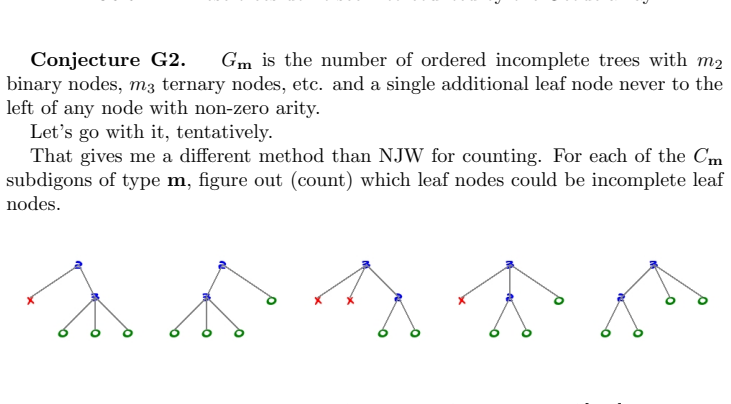
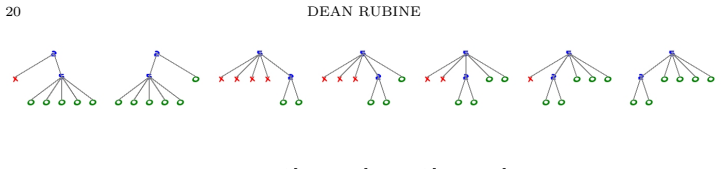
- The exercises leave the paper's Geode conjecture unresolved: the naive 'single additional leaf node' interpretation fails for $G[3,1]$, and finding a modified depth or ordering condition that reproduces entries like $G[1,2]=110$ is a concrete open problem.
- The fractional-exponent Fuss–Catalan connection suggests the hyper-Catalan formula may be the integer-exponent case of a solution to polynomial equations with fractional powers; testing whether the series with non-integer $r$ solves the corresponding equation in a Puiseux sense would confirm the generalization.
Editorial analysis
A structured set of objections, weighed in public.
Referee Report
Summary. This manuscript is a companion to Wildberger and Rubine's paper 'A Hyper-Catalan Series Solution to Polynomial Equations, and the Geode' (WR). It collects 25 exercises with solutions that unpack the main derivations of WR: the quadratic/Catalan case (Exercises 1–2), the multiset weight identity (Exercises 3–4), the substitution yielding the series zero of general polynomial equations (Exercises 5 and 8), the hyper-Catalan coefficient formula (Exercises 9, 14, 20, and 23), a Lagrange-inversion derivation (Exercise 13), generating-function projections to Little Schröder, Riordan, and Cayley arrays (Exercises 16–19), explicit face-layer verification (Exercise 11), and an investigation of Wildberger's Geode conjecture on counting ordered incomplete trees (Exercise 21). The paper makes modest original contributions: the Tutrank array with closed form T[m1; m] = binom(m1 + E_m - 1, m1) C_m (Exercise 20) and a disproof of two natural generalizations of the Geode tree-counting conjecture (Exercise 21).
Significance. As a companion to WR, this paper succeeds in making the central derivations accessible and verifiable. Strengths include: (i) explicit coefficient check in Exercise 11 to four face layers; (ii) careful exponent bookkeeping in Exercise 9 connecting Schuetz–Whieldon's lemma to the hyper-Catalan formula; (iii) a self-contained Lagrange-inversion derivation (Exercise 13); (iv) reproducible Python/SymPy code for the arrays (Exercise 22); and (v) honest reporting that Conjectures G2 and G3 fail, with the explicit counterexample G[3,1] = 288 vs. 316 for G3. The one unproved general identity (the face-layer identity beyond F = 4) is explicitly flagged as an open question, so the manuscript does not overclaim. If the journal accepts expository/companion pieces, this is a useful and reliable supplement.
minor comments (6)
- [Exercise 6] The statement of the exercise is missing the factor Ψ(M1) on the right-hand side: it reads Ψ(∇k(M1,...,Mk)) = tk Ψ(M2)···Ψ(Mk), whereas the solution correctly gives tk Ψ(M1)Ψ(M2)···Ψ(Mk). Please correct the statement, as this is an exercise paper whose value depends on accurate statements.
- [Exercise 11] In the face-layer table, several coefficients appear with transposed subscripts: in the f^3 row the second column shows '5t3^2' where the context requires 5t2^3, and the f^4 row has '56 t3^2 t3' for what should be 56 t2^3 t3. These appear to be typographical only, since the displayed equality still holds, but they should be fixed.
- [Exercise 13] The Lagrange-inversion solution introduces t1 = 1/α inside R(α), which is not a formal power series in α. The subsequent algebra cancels the α^{k1} factor against t1^{k1}, so the computation is valid, but this should be explained as a formal device; otherwise the identity R(α) = 1 + t2 α^2 + ... is not literally a series in α.
- [Exercise 12] The 'solution' consists of the single sentence 'You're on your own here.' While the exercise is open-ended, the paper is titled 'Exercises with Solutions'; consider adding a hint about OEIS search techniques or a brief example of a slice already present.
- [Exercise 18] There is an internal note in the solution ('Wait. Why are these the shifted Riodan numbers? ...') that appears to be a working note left in the text; it and the typo 'Riodan' should be removed before publication.
- [Exercise 21] The text refers to 'cyan Ys' in a figure to indicate excluded nodes; in black-and-white printing this color cue is lost. Please replace the color with a distinct symbol or add a legend.
Circularity Check
No significant circularity: the central coefficient formula is independently re-derived from Schuetz–Whieldon and Gessel; self-citations are contextual and not load-bearing.
full rationale
This is an exercises supplement to Wildberger–Rubine, so using WR theorems as starting points is the stated purpose rather than a circularity. The central formula C_m = (E_m−1)!/((V_m−1)! m!) is not obtained by assuming itself: Exercise 9 applies the external Schuetz–Whieldon dissection lemma with a parameter substitution, and Exercise 13 derives the same formula from Gessel's Lagrange-inversion formulation, with the unusual t1 = 1/α device acting only as a formal bookkeeping slack variable rather than as an assumption of the answer. Exercise 23 independently recovers C_m from Mane's multiparameter Fuss–Catalan formula. The WR Theorem 1 and 3 citations in Exercises 5, 8, and 10 are algebraic substitutions or restatements, not self-supporting derivations of the main claim; Exercise 10's one-line 'By WR Theorem 3' is a recreational verification, not a load-bearing step. Self-citations to the author's followup [10] supply the Geode recurrence used to fill computational tables and are checked against known values; they are not used to derive the central hyper-Catalan identity. The admitted failure of the Geode tree conjectures in Exercise 21 further shows the counts are not being made to match by construction. No equation in the paper is equivalent by definition to its input, and no prediction reduces to a fitted parameter. Score 1 reflects minor reliance on prior self-authored results that is contextual rather than load-bearing.
Assumptions & free parameters
assumptions (5)
- domain assumption Additivity and multiplicativity of the weight function Ψ with ψ(∇(r,s)) = t ψ(r)ψ(s) and its k-ary analogue.
- domain assumption WR Theorem 3: α = S[t2,t3,...] = Σ C_m t^m is the formal power series zero of g(α) = 1 - α + Σ_{k≥2} t_k α^k.
- standard math Euler characteristic relation V_m - E_m + F_m = 1 for subdigons/tubdigons.
- standard math Gessel's Lagrange inversion formula [3]: [x^n]φ(f(x)) = (1/n)[α^{n-1}]φ'(α)R(α)^n.
- standard math Fine's identity and the multinomial theorem.
invented entities (3)
-
Tutrank array T_k
-
Jumbo Geode J[t1,t2,...]
-
tubdigons
Cite this review
Pith. "Pith review of Exercises for A Hyper-Catalan Series Solution to Polynomial Equations, and the Geode." pith.science (2026). https://pith.science/paper/AR7IFMOO
@misc{pith2026250713045,
  author       = {Pith},
  title        = {Pith review of: Exercises for A Hyper-Catalan Series Solution to Polynomial Equations, and the Geode},
  year         = {2026},
  howpublished = {\url{https://pith.science/paper/AR7IFMOO}},
  note         = {Machine review of arXiv:2507.13045}
}
read the original abstract
We present exercises with solutions related to A Hyper-Catalan Series Solution to Polynomial Equations, and the Geode.
Figures


Figures from the paper (7 more)



Forward citations
Cited by 1 Pith paper
-
Ordered trees and the Geode
The coefficients of the Geode power series count leaves that appear before any internal node in the post-order traversal of ordered trees.
Reference graph
Works this paper leans on
-
[1]
N. J. Fine,Basic Hypergeometric Series and Applications, Mathematical Surveys and Mono- graphs, vol. 27, 1988
work page 1988
-
[2]
Nicolas Fuss,Solutio quaestionis, quot modis polygonum n laterum in polygona m laterum, per diagonales resolui queat [Solution to the Question: In how many ways can a polygon with n sides be resolved by its diagonals?], Nova Acta Acad. Sci. Imp. Pet.9 (1795), 243-251
-
[3]
Gessel,Lagrange Inversion, Journal of Combinatorial Theory, Series A144 (2016), 212-249
Ira M. Gessel,Lagrange Inversion, Journal of Combinatorial Theory, Series A144 (2016), 212-249. Fifty Years of the Journal of Combinatorial Theory
work page 2016
-
[4]
Germain Kreweras,Sur les partitions non croisees d’un cycle, Discrete Mathematics1 (1972), no. 4, 333-350
work page 1972
-
[5]
Earnshaw,On the Non-crossing Partitions of a Cycle,
Germain Kreweras and Berton A. Earnshaw,On the Non-crossing Partitions of a Cycle,
-
[6]
J.H. Lambert, Observationes Variae in Mathesin Puram [Various Observations in Pure Math], Acta Helvetica Physico-Mathematico-Anatomico-Botanico-Medica3 (1758), 128-168
-
[7]
S. R. Mane,Multiparameter Fuss–Catalan numbers with application to algebraic equations, arXiv.org/pdf/1607.04144, 2016
work page Pith review arXiv 2016
-
[8]
OEIS Foundation Inc.,The On-Line Encyclopedia of Integer Sequences, 2024
work page 2024
Show all 14 references
-
[9]
Raney, Functional composition patterns and power series reversion, Trans am math soc 94 (1960), 441-451
George N. Raney, Functional composition patterns and power series reversion, Trans am math soc 94 (1960), 441-451
1960
-
[10]
arXiv.org/abs/2507.04552
Dean Rubine, Hyper-Catalan and Geode Recurrences and Three Conjectures of Wildberger (2025). arXiv.org/abs/2507.04552
2025 arXiv
-
[11]
2, 223 - 236
Alison Schuetz and Gwyn Whieldon,Polygonal dissections and reversions of series, Involve 9 (2016), no. 2, 223 - 236
2016
-
[12]
W. T. Tutte,The number of planted plane trees with a given partition, Am math mon71 (1964), no. 3, 272–277
1964
-
[13]
N. J. Wildberger and Dean Rubine,A Hyper-Catalan Series Solution to Polynomial Equa- tions, and the Geode, The American Mathematical Monthly132 (2025), no. 5, 383–402
2025
-
[2005]
English translation of Kreweras, 1972 [4]
1972
Reviewed August 6, 2026 · model on record in the stance chip above.
Discussion (0). Continue with ORCID to comment.