REVIEW 3 major objections 5 minor 2 cited by
A Torus Remnant Revealed by the Infrared Echo of Tidal Disruption Event AT 2019qiz: Implications for the Missing Energy and Quasiperiodic Eruption Formation
T0 review · 3 major / 5 minor · reviewed 2026-08-06 · deepseek-v4-flash
Pith's one-line read The infrared echo of tidal disruption event AT 2019qiz is best explained by dust in a thin torus with inner radius greater than 1.2 parsecs, implying a remnant of a recently faded active galactic nucleus and revealing that most of the…
desk verdict AT 2019qiz's IR echo is a real parsec-scale story, but the R > 1.2 pc headline is an artifact of a shaky top-1% cutoff; the robust geometric floor is 0.68 pc, and the central conclusions survive in weakened form. read the letter →
The pith
A machine-rendered reading of the paper's core claim, the machinery that carries it, and where it could break.
The reading
What carries the argument
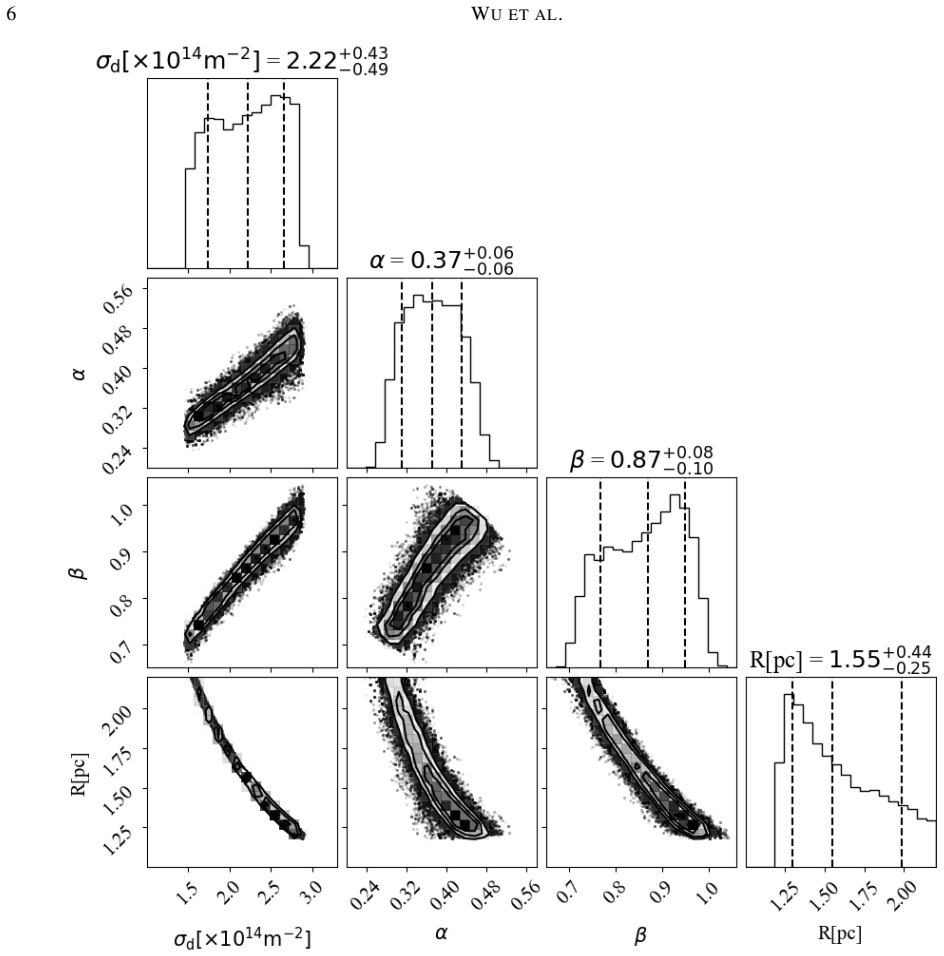
The engine of the argument is a light-travel-time echo model of a thin, inclined dust torus. The flare is treated as a delta function in time, and the delay $\tau = (R/c)(1-\cos\theta')$ controls which parts of the torus the observer sees illuminated at each epoch; as time passes, the iso-delay surface sweeps out an ever larger area of the torus, producing a slow rise and then a plateau. The observed flux is computed from the intersection area of the torus with the iso-delay surface, the Planck function at the measured dust temperature, and the grain absorption efficiency. With the temperature fixed by the W1/W2 color, the free parameters are the surface density, the inclination angle $\alpha$, the half-opening angle $\beta$, and the inner radius $R$, and the last five epochs are fitted with Markov Chain Monte Carlo sampling to give the $R > 1.2\,\mathrm{pc}$ lower limit and the required bolometric luminosity.
What would settle it
If the mid-infrared light curve can be caught in decline, the turnover time gives an independent measure of the inner radius: for $R\sim1.2\,\mathrm{pc}$ the model predicts the plateau will end roughly four years after the flare, so a much earlier or much later turnover would falsify the fitted torus geometry.
Extended reading notes
Core claim
The central discovery is that the unusually long infrared rise of AT 2019qiz is the echo of the optical/ultraviolet flare from a well-defined dust structure rather than a slowly brightening source. Modeling the last five epochs, during which the dust temperature is constant, with a thin, inclined torus gives a lower limit on the torus inner radius of $R \gtrsim 1.2\,\mathrm{pc}$, consistent across silicate, silicon carbide, and graphite grains, with a hard light-travel-time floor of $0.68\,\mathrm{pc}$. For a $\sim10^6\,M_\odot$ black hole the usual dust sublimation radius is at most $\sim0.1\,\mathrm{pc}$, so the dust must be a leftover, or remnant, of a torus whose inner part has disappeared after the AGN faded. The same model demands a peak bolometric luminosity of at least $6.6\times10^{44}$, $9.5\times10^{44}$, and $1.0\times10^{44}\,\mathrm{erg\,s^{-1}}$ for silicate, silicon carbide, and graphite grains respectively, all well above the $2.7\times10^{43}\,\mathrm{erg\,s^{-1}}$ optical-UV blackbody peak—so most of the flare's energy was emitted in the extreme-ultraviolet band that the echo reprocesses.
Load-bearing premise
The load-bearing assumption is that the slow infrared rise is purely a geometric light-travel-time echo from a thin dust ring at a single constant temperature, with the optical/ultraviolet flare treated as an instantaneous pulse; if the heating source itself brightened gradually over years, or the emitting dust spans a range of radii and temperatures, the inferred 1.2 parsec inner radius would be too large, although the 0.68 parsec light-travel floor is more robust.
Editorial extensions
If this is right
- If the torus remnant interpretation is right, AT 2019qiz shows that dusty tori survive for roughly $10^4$ years after an AGN switches off, with the inner dust falling inward and disappearing faster than the outer dust.
- The echo-based peak luminosity lower limit ($\gtrsim6.6\times10^{44}\,\mathrm{erg\,s^{-1}}$ for silicate dust) makes the peak of AT 2019qiz super-Eddington, with most energy hidden in the extreme ultraviolet, supporting the missing-energy solution for TDEs.
- Because the only two optical TDEs with detected QPEs—AT 2019qiz and AT2022upj—are both infrared-bright with parsec-scale dust, the paper predicts that QPEs should preferentially follow IR-bright TDEs, and that monitoring such TDEs at X-ray wavelengths is an efficient way to find new QPEs.
- The early infrared bump and the declining dust temperature in the first four epochs point to an additional dust component inside the torus, possibly along the line of sight, that the thin-ring model does not include.
- Future mid-infrared observations of the decline phase, with NEO Surveyor or Roman, will turn the current lower limit on the inner radius into a precise measurement and constrain the opening angle and inclination.
Reading between the lines
- The same light-travel-time reasoning could be applied to other slowly rising IR-bright TDEs to infer parsec-scale dust radii; if several show radii well beyond the sublimation radius, the recently faded AGN population would be established as common rather than exceptional.
- If the missing extreme-ultraviolet energy is real, then optical-UV blackbody fits systematically underestimate TDE bolometric luminosities, which would shift TDE rates, Eddington ratios, and the luminosity function, implying that many apparently sub-Eddington TDEs are actually super-Eddington.
- A testable extension is to search for extended emission-line regions and other faded-AGN signatures in the hosts of IR-bright TDEs; finding them in a larger sample would tie the torus remnant directly to the TDE/QPE sequence.
- If the infrared echo peaks long after the optical flare, archival surveys such as WISE can be used retrospectively to identify TDEs that occurred before optical surveys caught them, effectively extending the TDE census.
Editorial analysis
A structured set of objections, weighed in public.
Referee Report
Summary. The paper analyzes the WISE/NEOWISE mid-infrared light curve of the tidal disruption event AT 2019qiz. The IR emission rises steadily for ~4 years and then plateaus, with a roughly constant dust temperature over the last five epochs. The authors construct a thin, inclined dust torus model and fit the last five epochs to infer an inner torus radius R > 1.2 pc. They interpret this large radius as a remnant of a recently faded AGN torus, connecting the source to the broader TDE-QPE unified scenario. They further use the dust echo to derive lower limits on the peak bolometric luminosity of the TDE, finding values (6.6, 9.5, 1.0) × 10^44 erg/s for silicate, SiC, and graphite grains, respectively, all much larger than the observed optical-UV peak, which they attribute to missing EUV energy. The paper also argues that IR-bright TDEs are preferential hosts for QPEs, citing AT2022upj and SDSSJ1335+0728.
Significance. If the large inner radius is robust, this work provides a new piece of evidence for the existence of parsec-scale torus remnants around recently faded AGNs and strengthens the proposed link between IR-bright TDEs and QPEs. The geometric lower-limit argument (R > 0.68 pc, Eq. 4) is simple, transparent, and independent of the detailed dust model, and it already places the echoing dust far outside the ~0.1 pc sublimation radius expected for a 10^6 M_sun black hole. The missing-energy interpretation is also timely and important. The paper is clearly written and makes explicit the degeneracy in its model. However, the headline quantitative claim of R > 1.2 pc rests on a non-standard statistical procedure that, as the authors themselves state in §3.2, is 'not used for uncertainty estimation' but then is used to define a 'lower limitation'. This undermines the precision of the central claim and needs to be fixed with a proper profile-likelihood or posterior-based interval.
major comments (3)
- [§3.2] The quoted lower limit R > 1.2 pc is not a statistically valid confidence bound. The authors select the top 1% of posterior samples by likelihood and take the minimum R among them, explicitly discarding the 90% credible interval because it contains low-likelihood samples. This conditions on good fits and ignores posterior mass, so it is neither a frequentist confidence interval nor a Bayesian credible interval. Given the acknowledged degeneracy among R, α, β, and σ_d (the text compares the situation to 'two equations ... for three unknowns'), the correct procedure is to compute a profile likelihood in R, maximizing over the other parameters, and then derive a likelihood-ratio-based lower limit. The paper should report this profile and the resulting confidence bound, and should also state what fraction of the posterior mass lies below 1.2 pc. If the profile-likelihood lower limit is closer to the geometric floor of 0.68 pc (Eq. 4), the headline claim '>1.2 pc' must be revised.
- [§3.1] The prolonged IR rise is modeled assuming the OUV flare is a delta function, the torus is geometrically thin, and the dust temperature is constant over the fitted epochs. The early bump and the decreasing temperature over the first four epochs are excluded from the fit. These assumptions can bias the inferred radius upward: if the heating source itself brightens over years, or if the emitting dust spans a range of radii and temperatures, the light-travel-time interpretation of the rise is not unique. The robust model-independent result is R_min = c(t_max - t_peak)/2 = 0.68 pc (Eq. 4), which does not rely on these assumptions. To support the specific claim R > 1.2 pc, the authors should demonstrate robustness by convolving the actual OUV light curve (e.g., Hammerstein et al. 2023) with the echo model and by testing a radial dust distribution with a temperature gradient. At minimum, a finite-width pulse test should be shown.
- [§4.2] The peak bolometric lower limits are derived from Eq. (15) using R = 1.2 pc and therefore inherit the statistical uncertainty of the R estimate. Since the grain equilibrium condition gives L_bol ∝ R² at fixed dust temperature and composition, reducing the lower limit from 1.2 pc to 0.68 pc would lower the quoted L_peak values by a factor of about 0.32. This would still leave the silicate and SiC limits above the observed OUV peak of 2.7×10^43 erg/s, so the missing-energy conclusion may survive, but the quantitative claim changes materially. The paper should provide a sensitivity analysis of L_peak as a function of R and clearly distinguish the pulse luminosity L_pulse computed from Eq. (15) from the actual peak luminosity; the sentence 'the peak bolometric luminosity Lpeak ~ 1.4 Lpeak' is self-referential and should read L_peak ≈ 1.4 L_pulse.
minor comments (5)
- [Abstract] The abstract states 'resulting in an inner radius >1.2 pc' without mentioning that this is a model-dependent lower limit based on the last five epochs and a non-standard statistical selection; the model-independent geometric limit is 0.68 pc and should be cited as the firm floor.
- [§3.2] The sentence 'The posterior samples are well within the prior boundaries and are sufficiently distant from the edges' is misleading because Rmin is the lower boundary of the prior; the authors should specify that the top-1% selected samples are not at this edge.
- [Figure 5] The shaded bands in Figure 5 show the spread of the top-1% high-likelihood samples, not the posterior predictive distribution; the caption should state this explicitly to avoid misinterpretation.
- [Table 1] The table headers use 'lower limitation' and 'upper limitation'; these should be 'lower limit' and 'upper limit', and column (4) 'logσ_d max' should be clarified as the upper limit on the surface density from the same top-1% selection.
- [Equation (16)] The notation in Eq. (16) and the surrounding text is confusing: 'Lpeak' is used for both the pulse luminosity from Eq. (15) and the true peak luminosity, leading to the self-referential 'Lpeak ~ 1.4 Lpeak'. Use two distinct symbols, e.g., L_pulse and L_peak.
Circularity Check
No significant circularity: the torus radius and bolometric luminosity are inferred from light-travel-time geometry and energy balance, not from the model inputs.
full rationale
The derivation chain is self-contained and does not reduce to its own inputs by construction. Dust temperatures are measured directly from the W1/W2 color ratio via Eq. (1); the inner radius is constrained by light-travel-time geometry (Eqs. 2-4) and by the fitted torus geometry (Eq. 9); and the bolometric luminosity is then derived from energy balance (Eq. 15) using the fitted radius and the measured dust temperature, rather than being a fitted parameter. The self-citations to Dou et al. (2017) and Jiang et al. (2025) are methodological precedents for the dust-echo model, not unique or load-bearing justifications, and the EELR evidence from Xiong et al. (2025) is independent observational support. The paper itself acknowledges the alpha-beta-R degeneracy and explicitly states that its lower limit is taken from high-likelihood samples; that is a statistical robustness concern, not a circular reduction of the conclusion to an input assumption. The missing-energy claim depends on stated model assumptions (delta-function OUV pulse, single-temperature thin torus), but those assumptions do not reappear as the derived output, so no circular step can be exhibited.
Assumptions & free parameters
free parameters (4)
- R (inner radius of torus) =
lower limit ~1.17-1.18 pc
- alpha (angle between torus axis and line of sight) =
upper limit ~26 degrees
- beta (half-opening angle of torus) =
upper limit ~56 degrees
- sigma_d (dust surface density) =
log sigma_d ~ 10.5-17.4 depending on grain type and size
assumptions (6)
- domain assumption The OUV flare is treated as a delta function in time.
- domain assumption The dust is a thin, uniform torus with a single inner radius R and half-opening angle beta.
- domain assumption Dust grains are spherical, single-composition, single-size, with Qabs from Laor and Draine (1993).
- domain assumption The dust is optically thin to its own infrared emission and reaches thermal equilibrium instantly.
- domain assumption The last five epochs have constant dust temperature and are fit without the early bump.
- domain assumption The spectral shape of the heating radiation is the OUV blackbody from Hammerstein et al. (2023).
Cite this review
Pith. "Pith review of A Torus Remnant Revealed by the Infrared Echo of Tidal Disruption Event AT 2019qiz: Implications for the Missing Energy and Quasiperiodic Eruption Formation." pith.science (2026). https://pith.science/paper/T5I3IAYN
@misc{pith2026250713251,
  author       = {Pith},
  title        = {Pith review of: A Torus Remnant Revealed by the Infrared Echo of Tidal Disruption Event AT 2019qiz: Implications for the Missing Energy and Quasiperiodic Eruption Formation},
  year         = {2026},
  howpublished = {\url{https://pith.science/paper/T5I3IAYN}},
  note         = {Machine review of arXiv:2507.13251}
}
abstract
AT 2019qiz is the first standard optical tidal disruption event (TDE) with detection of X-ray quasi-periodic eruptions (QPEs), providing strong evidence for TDE-QPE association. Moreover, it belongs to the rare subset of optical TDEs with prominent infrared (IR) echoes revealed by the multi-epoch photometry from the Wide-field Infrared Survey Explorer (WISE). The IR light curve shows an early bump, followed by a steady rise until the second-to-last epoch, after which it appears to enter a plateau phase. The dust temperature decreased until the fourth epoch and remains approximately constant for the subsequent five epochs. We have fitted the last five epochs using a convex dust ring model, resulting in an inner radius $>1.2$pc. Such a large radius greatly exceeds the inner radius of the active galactic nuclei (AGN) torus for a $10^6\,M_{\odot}$ black hole and thus could be a torus remnant with the inner part having vanished, further supporting the unified scenario of recently faded AGNs, TDEs, and QPEs. Consequently, a connection between QPEs and IR-bright TDEs is naturally expected. Moreover, the echo requires at least a peak bolometric luminosity of $(6.6, 9.5, 1.0)\times 10^{44} \,\text{erg}\,\text{s}^{-1}$ assuming silicate, silicon carbide, and graphite dust grains, respectively, all of which are significantly higher than the peak optical blackbody luminosity. It adds to the accumulating evidence that the missing energy of TDEs may lie in the unobservable extreme UV. This work highlights the unique value of IR echoes in the study of TDEs and QPEs, and a promising prospect in the era of the Near-Earth Object (NEO) Surveyor, the successor to WISE.
Figures


Figures from the paper (3 more)


Forward citations
Cited by 2 Pith papers
-
Uncertainty-Aware Tidal Disruption Event Classification : A Host-Agnostic Probabilistic Random Forest Approach
Uncertainty-aware Probabilistic Random Forest on 11 photometric light-curve features classifies TDEs without host data more stably than XGBoost and recovers 14 new candidates from ZTF.
-
Extreme Mass Ratio Inspirals in Light of Quasi-periodic Eruptions: Milli-Hertz Gravitational Wave Background
QPE observations yield EMRI rates of 2.88e-6 (stellar) and 6.07e-6 (black hole) per galaxy per year, with only black hole EMRIs potentially exceeding LISA sensitivity in the 1-10 mHz band.
Reference graph
Works this paper leans on
-
[1]
2021, Nature, 592, 704, doi: 10.1038/s41586-021-03394-6 Balokovi´c, M., Brightman, M., Harrison, F
Arcodia, R., Merloni, A., Nandra, K., et al. 2021, Nature, 592, 704, doi: 10.1038/s41586-021-03394-6 Balokovi´c, M., Brightman, M., Harrison, F. A., et al. 2018, ApJ, 854, 42, doi: 10.3847/1538-4357/aaa7eb
-
[2]
Beckert, T., & Duschl, W. J. 2004, A&A, 426, 445, doi: 10.1051/0004-6361:20040336
-
[3]
2025, ApJL, 983, L39, doi: 10.3847/2041-8213/adc2f8
Chakraborty, J., Kara, E., Arcodia, R., et al. 2025, ApJL, 983, L39, doi: 10.3847/2041-8213/adc2f8
-
[4]
Chan, C.-H., & Krolik, J. H. 2016, ApJ, 825, 67, doi: 10.3847/0004-637X/825/1/67
-
[5]
2017, ApJL, 841, L8, doi: 10.3847/2041-8213/aa7130
Dou, L., Wang, T., Yan, L., et al. 2017, ApJL, 841, L8, doi: 10.3847/2041-8213/aa7130
-
[6]
Elitzur, M., & Ho, L. C. 2009, ApJL, 701, L91, doi: 10.1088/0004-637X/701/2/L91
-
[7]
2006, ApJL, 648, L101, doi: 10.1086/508158
Elitzur, M., & Shlosman, I. 2006, ApJL, 648, L101, doi: 10.1086/508158
doi:10.1086/508158 2006
-
[8]
Emmering, R. T., Blandford, R. D., & Shlosman, I. 1992, ApJ, 385, 460, doi: 10.1086/170955
doi:10.1086/170955 1992
Show all 74 references
-
[9]
W., Lang, D., & Goodman, J
Foreman-Mackey, D., Hogg, D. W., Lang, D., & Goodman, J. 2013, PASP, 125, 306, doi: 10.1086/670067
2013 doi
-
[10]
2021, ARA&A, 59, 21, doi: 10.1146/annurev-astro-111720-030029
Gezari, S. 2021, ARA&A, 59, 21, doi: 10.1146/annurev-astro-111720-030029
2021 doi
- [11]
-
[12]
T., & Morris, S
Hamann, F., Korista, K. T., & Morris, S. L. 1993, ApJ, 415, 541, doi: 10.1086/173185
1993 doi
-
[13]
2023, ApJ, 942, 9, doi: 10.3847/1538-4357/aca283 Hernández-García, L., Chakraborty, J., Sánchez-Sáez, P., et al
Hammerstein, E., van Velzen, S., Gezari, S., et al. 2023, ApJ, 942, 9, doi: 10.3847/1538-4357/aca283 Hernández-García, L., Chakraborty, J., Sánchez-Sáez, P., et al. 2025, Nature Astronomy, 9, 895, doi: 10.1038/s41550-025-02523-9
2023 doi
-
[14]
2016, MNRAS, 458, 816, doi: 10.1093/mnras/stw289
Murray, N. 2016, MNRAS, 458, 816, doi: 10.1093/mnras/stw289
2016 doi
-
[15]
M., Kim, W.-T., et al
Hsieh, P.-Y ., Koch, P. M., Kim, W.-T., et al. 2021, ApJ, 913, 94, doi: 10.3847/1538-4357/abf4cd
2021 doi
-
[16]
2016, ApJL, 828, L14, doi: 10.3847/2041-8205/828/1/L14
Jiang, N., Dou, L., Wang, T., et al. 2016, ApJL, 828, L14, doi: 10.3847/2041-8205/828/1/L14
2016 doi
-
[17]
Jiang, N., Luo, D., Zhu, J., & Cutri, R. M. 2025, ApJL, 980, L17, doi: 10.3847/2041-8213/adaeb9
2025 doi
-
[18]
2025, ApJL, 983, L18, doi: 10.3847/2041-8213/adc456
Jiang, N., & Pan, Z. 2025, ApJL, 983, L18, doi: 10.3847/2041-8213/adc456
2025 doi
-
[19]
2021a, ApJ, 911, 31, doi: 10.3847/1538-4357/abe772
Jiang, N., Wang, T., Hu, X., et al. 2021a, ApJ, 911, 31, doi: 10.3847/1538-4357/abe772
-
[20]
2019, ApJ, 871, 15, doi: 10.3847/1538-4357/aaf6b2
Jiang, N., Wang, T., Mou, G., et al. 2019, ApJ, 871, 15, doi: 10.3847/1538-4357/aaf6b2
2019 doi
-
[21]
2021b, ApJS, 252, 32, doi: 10.3847/1538-4365/abd1dc
Jiang, N., Wang, T., Dou, L., et al. 2021b, ApJS, 252, 32, doi: 10.3847/1538-4365/abd1dc
-
[22]
2007, A&A, 470, 11, doi: 10.1051/0004-6361:20066068
Karas, V ., & Šubr, L. 2007, A&A, 470, 11, doi: 10.1051/0004-6361:20066068
2007 doi
-
[23]
Kaur, K., & Stone, N. C. 2025, ApJ, 979, 172, doi: 10.3847/1538-4357/ad9b86
2025 doi
-
[24]
F., Meiron, Y ., Shukirgaliyev, B., et al
Kennedy, G. F., Meiron, Y ., Shukirgaliyev, B., et al. 2016, MNRAS, 460, 240, doi: 10.1093/mnras/stw908
2016 doi
-
[25]
Konigl, A., & Kartje, J. F. 1994, ApJ, 434, 446, doi: 10.1086/174746
1994 doi
-
[26]
2014, ApJ, 788, 159, doi: 10.1088/0004-637X/788/2/159
Koshida, S., Minezaki, T., Yoshii, Y ., et al. 2014, ApJ, 788, 159, doi: 10.1088/0004-637X/788/2/159
2014 doi
-
[27]
Krolik, J. H. 2007, ApJ, 661, 52, doi: 10.1086/515432
2007 doi
-
[28]
H., & Begelman, M
Krolik, J. H., & Begelman, M. C. 1988, ApJ, 329, 702, doi: 10.1086/166414
1988 doi
-
[29]
Laor, A., & Draine, B. T. 1993, ApJ, 402, 441, doi: 10.1086/172149
1993 doi
-
[30]
M., Stacey, G
Latvakoski, H. M., Stacey, G. J., Gull, G. E., & Hayward, T. L. 1999, ApJ, 511, 761, doi: 10.1086/306689
1999 doi
-
[31]
M., Herter, T
Lau, R. M., Herter, T. L., Morris, M. R., Becklin, E. E., & Adams, J. D. 2013, ApJ, 775, 37, doi: 10.1088/0004-637X/775/1/37
2013 doi
-
[32]
2022, ApJL, 939, L33, doi: 10.3847/2041-8213/ac9c63
Lin, Z., Jiang, N., Kong, X., et al. 2022, ApJL, 939, L33, doi: 10.3847/2041-8213/ac9c63
2022 doi
-
[33]
Linial, I., & Metzger, B. D. 2023, ApJ, 957, 34, doi: 10.3847/1538-4357/acf65b
2023 doi
-
[34]
2018, ApJ, 865, 128, doi: 10.3847/1538-4357/aad54a
Lu, W., & Kumar, P. 2018, ApJ, 865, 128, doi: 10.3847/1538-4357/aad54a
2018 doi
-
[35]
Lu, W., Kumar, P., & Evans, N. J. 2016, MNRAS, 458, 575, doi: 10.1093/mnras/stw307
2016 doi
-
[36]
H., & Smith, P
Lyu, J., Rieke, G. H., & Smith, P. S. 2019, ApJ, 886, 33, doi: 10.3847/1538-4357/ab481d
2019 doi
-
[37]
M., et al
Mainzer, A., Bauer, J., Cutri, R. M., et al. 2014, ApJ, 792, 30, doi: 10.1088/0004-637X/792/1/30
2014 doi
-
[38]
2007, A&A, 468, 979, doi: 10.1051/0004-6361:20077252
Maiolino, R., Shemmer, O., Imanishi, M., et al. 2007, A&A, 468, 979, doi: 10.1051/0004-6361:20077252
2007 doi
-
[39]
J., Laher, R
Masci, F. J., Laher, R. R., Rusholme, B., et al. 2019, PASP, 131, 018003, doi: 10.1088/1538-3873/aae8ac
2019 doi
- [40]
-
[41]
D., Giustini, M., et al
Miniutti, G., Saxton, R. D., Giustini, M., et al. 2019, Nature, 573, 381, doi: 10.1038/s41586-019-1556-x
2019 doi
-
[42]
2009, ApJ, 705, 298, doi: 10.1088/0004-637X/705/1/298
Mor, R., Netzer, H., & Elitzur, M. 2009, ApJ, 705, 298, doi: 10.1088/0004-637X/705/1/298
2009 doi
-
[43]
2025, A&A, 695, A228, doi: 10.1051/0004-6361/202451340
Necker, J., Graikou, E., Kowalski, M., et al. 2025, A&A, 695, A228, doi: 10.1051/0004-6361/202451340
2025 doi
-
[44]
A., et al
Newsome, M., Arcavi, I., Howell, D. A., et al. 2024, ApJ, 977, 258, doi: 10.3847/1538-4357/ad8a69
2024 doi
-
[45]
R., et al
Nicholl, M., Wevers, T., Oates, S. R., et al. 2020, MNRAS, 499, 482, doi: 10.1093/mnras/staa2824 18 WU ET AL
2020 doi
-
[46]
R., Mummery, A., et al
Nicholl, M., Pasham, D. R., Mummery, A., et al. 2024, Nature, 634, 804, doi: 10.1038/s41586-024-08023-6
2024 doi
-
[47]
2021, PhRvD, 103, 103018, doi: 10.1103/PhysRevD.103.103018
Pan, Z., & Yang, H. 2021, PhRvD, 103, 103018, doi: 10.1103/PhysRevD.103.103018
2021 doi
- [48]
-
[49]
2023, A&A, 669, A140, doi: 10.1051/0004-6361/202244623
Petrushevska, T., Leloudas, G., Ili´c, D., et al. 2023, A&A, 669, A140, doi: 10.1051/0004-6361/202244623
2023 doi
-
[50]
Rees, M. J. 1988, Nature, 333, 523, doi: 10.1038/333523a0
1988 doi
-
[51]
M., Mattila, S., Efstathiou, A., et al
Reynolds, T. M., Mattila, S., Efstathiou, A., et al. 2022, A&A, 664, A158, doi: 10.1051/0004-6361/202243289
2022 doi
-
[52]
Roming, P. W. A., Kennedy, T. E., Mason, K. O., et al. 2005, SSRv, 120, 95, doi: 10.1007/s11214-005-5095-4
2005 doi
-
[53]
G., Lawrence, A., Elvis, M., et al
Roseboom, I. G., Lawrence, A., Elvis, M., et al. 2013, MNRAS, 429, 1494, doi: 10.1093/mnras/sts441 Sánchez-Sáez, P., Hernández-García, L., Bernal, S., et al. 2024, A&A, 688, A157, doi: 10.1051/0004-6361/202347957
2013 doi
-
[54]
2009, MNRAS, 393, 759, doi: 10.1111/j.1365-2966.2008.14220.x
Schartmann, M., Meisenheimer, K., Klahr, H., et al. 2009, MNRAS, 393, 759, doi: 10.1111/j.1365-2966.2008.14220.x
2009
-
[55]
2023, MNRAS, 525, 1568, doi: 10.1093/mnras/stad2270
Short, P., Lawrence, A., Nicholl, M., et al. 2023, MNRAS, 525, 1568, doi: 10.1093/mnras/stad2270
2023 doi
- [56]
-
[57]
2016, MNRAS, 458, 2288, doi: 10.1093/mnras/stw444
Stalevski, M., Ricci, C., Ueda, Y ., et al. 2016, MNRAS, 458, 2288, doi: 10.1093/mnras/stw444
2016 doi
-
[58]
2006, ApJ, 639, 46, doi: 10.1086/499326
Suganuma, M., Yoshii, Y ., Kobayashi, Y ., et al. 2006, ApJ, 639, 46, doi: 10.1086/499326
2006 doi
- [59]
-
[60]
2012, ApJ, 758, 66, doi: 10.1088/0004-637X/758/1/66 —
Wada, K. 2012, ApJ, 758, 66, doi: 10.1088/0004-637X/758/1/66 —. 2015, ApJ, 812, 82, doi: 10.1088/0004-637X/812/1/82
2012 doi
-
[61]
Wada, K., & Norman, C. A. 2002, ApJL, 566, L21, doi: 10.1086/339438
2002 doi
-
[62]
2024, ApJ, 960, 69, doi: 10.3847/1538-4357/ad0bfb
Wang, M., Ma, Y ., Wu, Q., & Jiang, N. 2024, ApJ, 960, 69, doi: 10.3847/1538-4357/ad0bfb
2024 doi
-
[63]
2022, ApJL, 930, L4, doi: 10.3847/2041-8213/ac6670
Wang, Y ., Jiang, N., Wang, T., et al. 2022, ApJL, 930, L4, doi: 10.3847/2041-8213/ac6670
2022 doi
-
[64]
Wevers, T., & French, K. D. 2024, ApJL, 969, L17, doi: 10.3847/2041-8213/ad5725
2024 doi
-
[65]
R., Jalan, P., Rakshit, S., & Arcodia, R
Wevers, T., Pasham, D. R., Jalan, P., Rakshit, S., & Arcodia, R. 2022, A&A, 659, L2, doi: 10.1051/0004-6361/202243143
2022 doi
-
[66]
D., Zabludoff, A
Wevers, T., French, K. D., Zabludoff, A. I., et al. 2024, ApJL, 970, L23, doi: 10.3847/2041-8213/ad5f1b
2024 doi
-
[67]
2019, ApJ, 876, 137, doi: 10.3847/1538-4357/ab17d5
Williamson, D., Hönig, S., & Venanzi, M. 2019, ApJ, 876, 137, doi: 10.3847/1538-4357/ab17d5
2019 doi
-
[68]
L., Eisenhardt, P
Wright, E. L., Eisenhardt, P. R. M., Mainzer, A. K., et al. 2010, AJ, 140, 1868, doi: 10.1088/0004-6256/140/6/1868
2010 doi
-
[69]
2025, arXiv e-prints, arXiv:2503.19722
Xiong, Y ., Jiang, N., Pan, Z., Hao, L., & Li, Z. 2025, arXiv e-prints, arXiv:2503.19722. https://arxiv.org/abs/2503.19722
2025 arXiv
-
[70]
2023, ApJL, 955, L6, doi: 10.3847/2041-8213/acf216
Yao, Y ., Ravi, V ., Gezari, S., et al. 2023, ApJL, 955, L6, doi: 10.3847/2041-8213/acf216
2023 doi
-
[71]
2024, ApJ, 969, 136, doi: 10.3847/1538-4357/ad50a9
Yuan, C., Winter, W., & Lunardini, C. 2024, ApJ, 969, 136, doi: 10.3847/1538-4357/ad50a9
2024 doi
-
[72]
2024a, Phys
Zhou, C., Huang, L., Guo, K., Li, Y .-P., & Pan, Z. 2024a, Phys. Rev. D, 109, 103031, doi: 10.1103/PhysRevD.109.103031
-
[73]
2025, ApJ, 985, 242, doi: 10.3847/1538-4357/adcee2
Zhou, C., Zeng, Y ., & Pan, Z. 2025, ApJ, 985, 242, doi: 10.3847/1538-4357/adcee2
2025 doi
-
[74]
2024b, Phys
Zhou, C., Zhong, B., Zeng, Y ., Huang, L., & Pan, Z. 2024b, Phys. Rev. D, 110, 083019, doi: 10.1103/PhysRevD.110.083019
Reviewed August 6, 2026 · model on record in the stance chip above.
Discussion (0). Sign in to comment.