mNARX+: A surrogate model for complex dynamical systems using manifold-NARX and automatic feature selection
Pith reviewed 2026-05-19 04:23 UTC · model grok-4.3
The pith
mNARX+ automates construction of manifold-NARX surrogates for complex dynamical systems by selecting temporal features from residual correlations.
A machine-rendered reading of the paper's core claim, the machinery that carries it, and where it could break.
Core claim
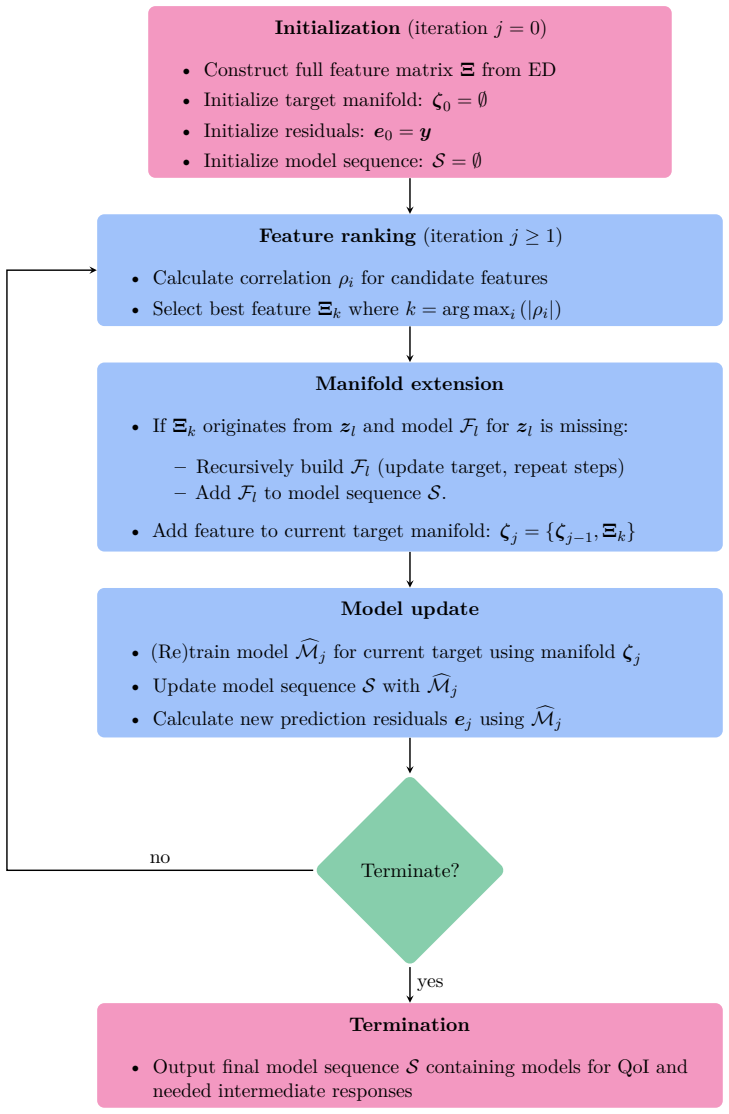
The mNARX+ algorithm employs a data-driven recursive procedure that sequentially chooses temporal features according to their correlation with the residuals of the present model, thereby automatically determining the critical auxiliary quantities and the sequence in which they should be modeled within the manifold-NARX framework.
What carries the argument
The recursive sequential selection of temporal features by correlation with current prediction residuals, which builds the ordered sequence of auxiliary models inside the mNARX structure.
If this is right
- Surrogate models for systems exhibiting strong hysteresis can be constructed without manually specifying the auxiliary quantities.
- Complex engineering simulators, such as aero-servo-elastic wind-turbine models, yield stable long-term predictions after automated feature ordering.
- The overall construction of mNARX models becomes largely independent of prior expert knowledge about the system dynamics.
- The same residual-correlation loop can be repeated until the desired prediction accuracy is reached on held-out data.
Where Pith is reading between the lines
- The same selection logic could be applied to other classes of nonlinear systems where the correct causal ordering of states is not obvious from first principles.
- Integration with statistical regularization techniques might further guard against selecting spurious features when data are noisy.
- Once automated, the approach opens the possibility of embedding mNARX surrogates inside real-time control loops for systems whose full physics remain only partially known.
Load-bearing premise
That sequentially selecting temporal features by their correlation with current model residuals will reliably identify the most critical auxiliary quantities and their correct causal ordering without missing key interactions or causing model instability.
What would settle it
Applying mNARX+ to the Bouc-Wen oscillator and observing either an ordering of selected features that contradicts the known physical causal structure or long-term predictions that become unstable would falsify the claim that the procedure systematically produces accurate and stable surrogates.
Figures


read the original abstract
We propose an automatic approach for manifold nonlinear autoregressive with exogenous inputs (mNARX) modeling that leverages the feature-based structure of functional-NARX (F-NARX) modeling. This novel approach, termed mNARX+, preserves the key strength of the mNARX framework, which is its expressivity allowing it to model complex dynamical systems, while simultaneously addressing a key limitation: the heavy reliance on domain expertise to identify relevant auxiliary quantities and their causal ordering. Our method employs a data-driven, recursive algorithm that automates the construction of the mNARX model sequence. It operates by sequentially selecting temporal features based on their correlation with the model prediction residuals, thereby automatically identifying the most critical auxiliary quantities and the order in which they should be modeled. This procedure significantly reduces the need for prior system knowledge. We demonstrate the effectiveness of the mNARX+ algorithm on two case studies: a Bouc-Wen oscillator with strong hysteresis and a complex aero-servo-elastic wind turbine simulator. The results show that the algorithm provides a systematic, data-driven method for creating accurate and stable surrogate models for complex dynamical systems.
Editorial analysis
A structured set of objections, weighed in public.
Referee Report
Summary. The paper introduces mNARX+, an automated extension of manifold nonlinear autoregressive with exogenous inputs (mNARX) modeling. It employs a recursive, data-driven algorithm that sequentially selects temporal features according to their correlation with successive model prediction residuals, thereby identifying critical auxiliary quantities and their causal ordering without heavy reliance on domain expertise. The method is demonstrated on a Bouc-Wen oscillator with strong hysteresis and a complex aero-servo-elastic wind turbine simulator, with the central claim that it yields accurate and stable surrogate models for complex dynamical systems.
Significance. If the residual-correlation selection procedure can be shown to reliably recover necessary nonlinear interactions and causal orderings, the approach would meaningfully reduce the expert knowledge barrier in constructing expressive surrogate models, with potential utility in structural dynamics, control systems, and renewable energy applications.
major comments (2)
- [Methods (algorithm description)] The central automation claim rests on the greedy univariate correlation-based selection (described in the methods). No order-sensitivity ablations, exhaustive-search baselines, or analysis of failure modes (e.g., spurious early correlations or missed joint nonlinear effects) are provided; this directly affects whether the discovered ordering supports stable closed-loop surrogates in the Bouc-Wen hysteresis and wind-turbine coupling cases.
- [Numerical results / case studies] The results section asserts accuracy and stability for the two case studies but reports no quantitative metrics (error norms, R² values, or closed-loop stability certificates) nor comparisons against standard NARX or manual mNARX baselines; without these, support for the claim that the automated procedure produces reliable surrogates cannot be fully assessed.
minor comments (1)
- [Abstract] The abstract states that results 'demonstrate accuracy and stability' but provides no numerical values or baseline comparisons; adding a brief quantitative summary would improve clarity.
Simulated Author's Rebuttal
We thank the referee for the constructive and detailed comments. We address each major comment below, indicating where revisions will be made to strengthen the manuscript.
read point-by-point responses
-
Referee: [Methods (algorithm description)] The central automation claim rests on the greedy univariate correlation-based selection (described in the methods). No order-sensitivity ablations, exhaustive-search baselines, or analysis of failure modes (e.g., spurious early correlations or missed joint nonlinear effects) are provided; this directly affects whether the discovered ordering supports stable closed-loop surrogates in the Bouc-Wen hysteresis and wind-turbine coupling cases.
Authors: The mNARX+ procedure uses greedy univariate correlation with successive residuals precisely to enable automation without requiring exhaustive enumeration of feature subsets, which would be intractable for the high-dimensional candidate pools arising in these systems. The sequential residual-driven selection is intended to surface the most immediately explanatory auxiliary quantities first, thereby reducing the impact of early spurious correlations. In both the Bouc-Wen and wind-turbine examples the resulting orderings produce long-term closed-loop stability, as shown by the multi-step prediction trajectories. We nevertheless agree that an explicit sensitivity study would be valuable; the revised manuscript will therefore add a dedicated subsection discussing the limitations of the greedy heuristic together with a limited order-permutation experiment on the two case studies. revision: partial
-
Referee: [Numerical results / case studies] The results section asserts accuracy and stability for the two case studies but reports no quantitative metrics (error norms, R² values, or closed-loop stability certificates) nor comparisons against standard NARX or manual mNARX baselines; without these, support for the claim that the automated procedure produces reliable surrogates cannot be fully assessed.
Authors: We accept that the current results section relies primarily on visual inspection of time-series predictions and error plots. To provide a more quantitative basis for the claims of accuracy and stability, the revised manuscript will include tables reporting RMSE and NRMSE values, R² scores for both open- and closed-loop predictions, and direct numerical comparisons against a standard NARX model as well as a manually constructed mNARX model for each case study. revision: yes
Circularity Check
No significant circularity in the mNARX+ derivation chain
full rationale
The paper describes a data-driven recursive algorithm that sequentially selects temporal features by their correlation with successive model residuals to automate auxiliary quantity identification and ordering. This procedure is presented as an empirical, greedy selection process whose outputs (selected features and model sequence) are not equivalent by construction to any fitted parameters or prior definitions inside the method. No self-definitional loops, fitted inputs relabeled as predictions, or load-bearing self-citations that reduce the central claim to unverified prior results are identifiable from the provided text. The mNARX framework is referenced as a preserved strength but the novel automation step stands as an independent algorithmic proposal validated on external case studies (Bouc-Wen and wind turbine), keeping the derivation self-contained.
Axiom & Free-Parameter Ledger
Reference graph
Works this paper leans on
-
[1]
Abbas, N. J., D. S. Zalkind, L. Pao, and A. Wright (2022). A reference open-source controller for fixed and floating offshore wind turbines. Wind Energy Science\/ 7\/ (1), 53--73
work page 2022
-
[2]
Azarhoosh, Z. and M. Ilchi Ghazaan (2025). A review of recent advances in surrogate models for uncertainty quantification of high-dimensional engineering applications. Computer Methods in Applied Mechanics and Engineering\/ 433\/ (117508)
work page 2025
-
[3]
Bhattacharyya, B., E. Jacquelin, and D. Brizard (2020). A Kriging – NARX model for uncertainty quantification of nonlinear stochastic dynamical systems in time domain. Journal of Engineering Mechanics\/ 146\/ (7)
work page 2020
-
[4]
Billings, S. A. (2013). Nonlinear system identification: NARMAX methods in the time, frequency, and spatio-temporal domains . Chichester, West Sussex, United Kingdom: John Wiley & Sons, Inc
work page 2013
-
[5]
Blatman, G. and B. Sudret (2010). An adaptive algorithm to build up sparse polynomial chaos expansions for stochastic finite element analysis. Probabilistic Engineering Mechanics\/ 25\/ (2), 183--197
work page 2010
-
[6]
Chandra, S., V. Matsagar, and S. Marburg (2023). Stochastic dynamic analysis of composite plates in thermal environments using nonlinear autoregressive model with exogenous input in polynomial chaos expansion surrogate. Computer Methods in Applied Mechanics and Engineering\/ 416\/ (116303)
work page 2023
-
[7]
Cheng, K., I. Papaioannou, M. Lyu, and D. Straub (2025). State space Kriging model for emulating complex nonlinear dynamical systems under stochastic excitation. Computer Methods in Applied Mechanics and Engineering\/ 442\/ (117987)
work page 2025
-
[8]
Chiras, N., C. Evans, and D. Rees (2001). Nonlinear gas turbine modeling using NARMAX structures. IEEE Transactions on Instrumentation and Measurement\/ 50\/ (4), 893--898
work page 2001
- [9]
-
[10]
Deshmukh, A. P. and J. T. Allison (2017). Design of dynamic systems using surrogate models of derivative functions. Journal of Mechanical Design\/ 139\/ (10), 101402
work page 2017
- [11]
-
[12]
Gao, Y., S. Liu, F. Li, and Z. Liu (2016). Fault detection and diagnosis method for cooling dehumidifier based on LS-SVM NARX model. International Journal of Refrigeration\/ 61 , 69--81
work page 2016
-
[13]
Garg, S., H. Gupta, and S. Chakraborty (2022). Assessment of DeepONet for reliability analysis of stochastic nonlinear dynamical systems. arXiv:2201.13145
-
[14]
Hu, Z., J. Fang, R. Zheng, M. Li, B. Gao, and L. Zhang (2024). Efficient model predictive control of boiler coal combustion based on NARX neutral network. Journal of Process Control\/ 134 , 103158
work page 2024
-
[15]
International standard IEC 61400-1 ed
IEC (2019). International standard IEC 61400-1 ed. 4. wind turbines -- part 1: Design requirements. IEC 61400-1 Ed. 3\/
work page 2019
-
[16]
Jolliffe, I. T. (2002). Principal component analysis . Springer-Verlag
work page 2002
-
[17]
Jonkman, J. (2009). Turbsim user's guide: Version 1.50. Technical report, National Renewable Energy Laboratory
work page 2009
-
[18]
Jonkman, J., S. Butterfield, W. Musial, and G. Scott (2009). Definition of a 5- MW reference wind turbine for offshore system development. Technical report, National Renewable Energy Laboratory
work page 2009
-
[19]
Kendall, M. G. (1938). A new measure of rank correlation. Biometrika\/ 30 , 81--93
work page 1938
-
[20]
Kim, Y. (2015). Prediction of the dynamic response of a slender marine structure under an irregular ocean wave using the NARX -based quadratic Volterra series. Applied Ocean Research\/ 49 , 42--56
work page 2015
-
[21]
Langeron, Y., K. T. Huynh, and A. Grall (2021). A root location-based framework for degradation modeling of dynamic systems with predictive maintenance perspective. Proceedings of the Institution of Mechanical Engineers, Part O: Journal of Risk and Reliability\/ 235\/ (2), 253--267
work page 2021
-
[22]
Levin, A. and K. Narendra (1996). Control of nonlinear dynamical systems using neural networks. II . Observability , identification, and control. IEEE Transactions on Neural Networks\/ 7\/ (1), 30--42
work page 1996
-
[23]
Li, B., W.-C. Chuang, and S. M. J. Spence (2021). Response estimation of multi-degree-of-freedom nonlinear stochastic structural systems through metamodeling. Journal of Engineering Mechanics\/ 147\/ (11)
work page 2021
-
[24]
Mai, C. V. (2016). Polynomial chaos expansions for uncertain dynamical systems: Applications in earthquake engineering . Doctoral thesis, ETH Zurich
work page 2016
-
[25]
Mai, C.-V., M. D. Spiridonakos, E. Chatzi, and B. Sudret (2016). Surrogate modeling for stochastic dynamical systems by combining nonlinear autoregressive with exogeneous input models and polynomial chaos expansions. International Journal for Uncertainty Quantification\/ 6\/ (4), 313--339
work page 2016
-
[26]
Mattson, S. G. and S. M. Pandit (2006). Statistical moments of autoregressive model residuals for damage localisation. Mechanical Systems and Signal Processing\/ 20\/ (3), 627--645
work page 2006
-
[27]
Openfast documentation, release v2.5.0
NREL (2021). Openfast documentation, release v2.5.0. Technical report, National Renewable Energy Laboratory
work page 2021
-
[28]
Pearson, K. (1895). Note on regression and inheritance in the case of two parents. Proceedings of the Royal Society of London\/ 58\/ (347-352), 240--242
-
[29]
Ramin, V. P., H. G. Amin, and N. Alireza (2023). An investigation of the performance of the ANN method for predicting the base shear and overturning moment time-series datasets of an offshore jacket structure. International Journal of Sustainable Construction Engineering and Technology\/ 14\/ (4), 79–93
work page 2023
-
[30]
Rezaeian, S. and A. D. Kiureghian (2010). Simulation of synthetic ground motions for specified earthquake and site characteristics. Earthquake Engineering & Structural Dynamics\/ 39\/ (10), 1155--1180
work page 2010
-
[31]
Samsuri, N. A., S. A. Raman, and T. M. Y. S. Tuan Ya (2023). Evaluation of NARX network performance on the maintenance application of rotating machines. In ICPER 2020 , pp.\ 593--609. Springer Nature Singapore
work page 2023
-
[32]
Schär, S., S. Marelli, and B. Sudret (2024). Emulating the dynamics of complex systems using autoregressive models on manifolds ( mNARX ). Mechanical Systems and Signal Processing\/ 208\/ (110956)
work page 2024
-
[33]
Schär, S., S. Marelli, and B. Sudret (2025). Surrogate modeling with functional nonlinear autoregressive models ( F-NARX ). Reliability Engineering & System Safety\/ 264\/ (111276)
work page 2025
-
[34]
Spiridonakos, M. D. and E. N. Chatzi (2015). Metamodeling of nonlinear structural systems with parametric uncertainty subject to stochastic dynamic excitation. Earthquakes and Structures\/ 8\/ (4), 915--934
work page 2015
-
[35]
Tibshirani, R. (1996). Regression shrinkage and selection via the Lasso . Journal of the Royal Statistical Society. Series B (Methodological)\/ 58\/ (1), 267--288
work page 1996
-
[36]
Wunsch, A., T. Liesch, and S. Broda (2018). Forecasting groundwater levels using nonlinear autoregressive networks with exogenous input ( NARX ). Journal of Hydrology\/ 567 , 743--758
work page 2018
-
[37]
Yetkin, M. and Y. Kim (2019). Time series prediction of mooring line top tension by the NARX and volterra model. Applied Ocean Research\/ 88 , 170--186
work page 2019
-
[38]
Yu, C., Y.-P. Zhu, H. Luo, Z. Luo, and L. Li (2023). Design assessments of complex systems based on design oriented modelling and uncertainty analysis. Mechanical Systems and Signal Processing\/ 188 , 109988
work page 2023
-
[39]
Zhang, L., S. Draycott, and P. Stansby (2024). System identification and generalisation of elastic mooring line forces on a multi-float wave energy converter platform in steep irregular waves. Mechanical Systems and Signal Processing\/ 214 , 111259
work page 2024
-
[40]
Zhang, Y., Y. Dong, and M. Beer (2024). rLSTM-AE for dimension reduction and its application to active learning-based dynamic reliability analysis. Mechanical Systems and Signal Processing\/ 215\/ (111426)
work page 2024
-
[41]
Zhou, J. and J. Li (2023). An efficient time-variant reliability analysis strategy embedding the NARX neural network of response characteristics prediction into probability density evolution method. Mechanical Systems and Signal Processing\/ 200\/ (110516)
work page 2023
discussion (0)
Sign in with ORCID, Apple, or X to comment. Anyone can read and Pith papers without signing in.