REVIEW 3 major objections 5 minor 27 references
Crystal Collimation Cleaning Measurements with 6.5 TeV protons in the LHC
T0 review · 3 major / 5 minor · reviewed 2026-08-06 · deepseek-v4-flash
Pith's one-line read The paper claims that replacing the amorphous primary collimator with a bent silicon crystal in the vertical plane improves LHC halo cleaning by a factor of about 3 to 10 in the dispersion suppressor regions at 6.5 TeV, and that the…
desk verdict Solid measured comparison of LHC crystal versus standard collimation, but the vertical improvement claim including Q7 is softer than the conclusion suggests. read the letter →
The pith
A machine-rendered reading of the paper's core claim, the machinery that carries it, and where it could break.
The reading
What carries the argument
The load-bearing mechanism is planar channeling in a short bent silicon crystal: protons entering nearly parallel to the crystal planes are captured in the interplanar electrostatic potential and coherently deflected by the crystal's full bending angle, so the crystal intercepts halo weakly while a downstream secondary collimator absorbs the deflected flux. The comparison machinery is the leakage ratio, built from loss maps in which every beam-loss-monitor signal is normalized by the instantaneous beam-loss flux rather than by the primary-collimator signal, because the crystal itself no longer produces a loss signal proportional to intercepted particles. The crystal's orientation is set by an interferometer-based goniometer, and the expected loss patterns are generated with the SixTrack tracking code plus a Monte-Carlo crystal routine.
What would settle it
A full Monte Carlo simulation that tracks hadronic showers and energy deposition from the upstream TCLAs to the Q7 beam-loss monitors, seeded by the SixTrack loss patterns, would settle it: if the predicted Q7 leakage does not reach the measured values, the shower hypothesis and the quantitative gain would need revision; if it does, the measured leakage ratios become directly interpretable.
Extended reading notes
Core claim
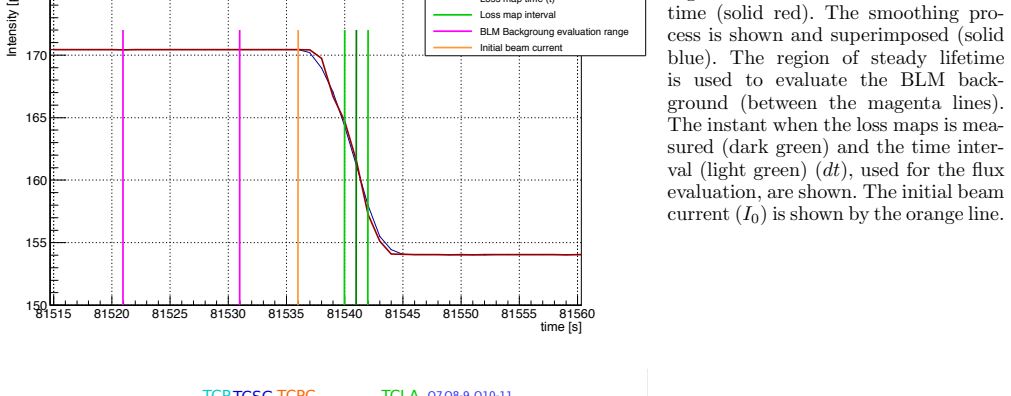
At collision energy with 6.5 TeV protons in Beam 1, replacing the amorphous primary collimator with a channeling-oriented bent crystal changes where and how much halo is lost. The paper's central quantitative result is a set of leakage ratios, defined as the standard-system leakage factor divided by the crystal-system leakage factor in each machine region; a ratio above 1 means the crystal cleans better. For the vertical crystal configuration V-1, the ratios are 3.49 at Q7, 16.43 at Q8-9, 11.25 at Q10-11 and 31.05 at IR3, corresponding to the quoted factor-3-to-10 improvement in the dispersion suppressor and roughly a factor-30 reduction at the momentum-cleaning collimator. The horizontal crystal gives a slight improvement only in some leakage clusters, and the paper explains the difference by the horizontal crystal's bending radius being closer to the critical radius, which increases dechanneling of particles at small deflection angles. A control run with the crystal oriented as an amorphous material is worse than standard collimation in every region, confirming that the gain comes from coherent channeling rather than from the mere presence of the crystal.
Load-bearing premise
The comparison assumes that loss maps taken under forced white-noise excitation and normalized by beam flux reflect real operational halo cleaning, and that simulated proton-loss locations can be compared with beam-loss-monitor signals before hadronic showers and energy deposition are folded in.
Editorial extensions
If this is right
- If the vertical-plane result holds in operation, crystal collimation can reduce the thermal load on the LHC's superconducting magnets in the IR7 dispersion suppressor by a factor of 3 to 10 relative to the standard system.
- The Q7 leakage, if it is caused by hadronic showers from upstream TCLAs, would be a separate inefficiency that standard off-momentum arguments miss, and it sets a floor on how much cleaning improvement is visible until those showers are intercepted.
- Configurations with fewer secondary collimators downstream of the crystal degrade dispersion-suppressor cleaning, so the full TCSG family is a required part of a working crystal-collimation scheme.
- A simulation chain that models energy deposition and hadronic showers, using the SixTrack loss patterns as input, is needed before measured leakage ratios can be compared quantitatively with predictions.
Reading between the lines
- If the shower hypothesis for Q7 is right, adding local shielding or repositioning the upstream TCLAs could recover most of the missing horizontal-plane gain, a step the paper does not itself propose.
- The measured vertical-plane advantage comes from loss maps taken under fast white-noise excitation; a test with natural halo diffusion or with slower excitation would show whether the factor 3 to 10 persists in steady-state operation.
- Because the horizontal crystal's performance is tied to its bending radius being near the critical value, crystal curvature can be treated as a design parameter: a crystal with the vertical crystal's larger radius should show smaller dechanneling and better horizontal cleaning.
- The flux-normalization method uncouples loss-map comparison from the primary-device signal, so it could be reused to benchmark any future non-intercepting or low-interception primary element against the standard collimation system.
Editorial analysis
A structured set of objections, weighed in public.
Referee Report
Summary. The paper reports measurements of crystal-assisted collimation cleaning performance at the LHC with 6.5 TeV protons, comparing normalized loss maps for standard collimation and for crystal-based configurations in the horizontal and vertical planes. The leakage ratios in Table 2 indicate that the vertical crystal improves cleaning in the IR7 dispersion suppressor and in IR3, while the horizontal crystal yields only slight improvements. The measurements are compared qualitatively with SixTrack simulations, with the paper explicitly acknowledging that measured BLM leakages are not directly comparable to simulated proton loss patterns because hadronic showers are not modeled.
Significance. If confirmed, the vertical-plane result is practically relevant for the HL-LHC era, since it suggests that a crystal primary collimator can reduce cold-aperture losses in the IR7 dispersion suppressor by factors of 3-10. The paper's strengths are the unique beam-loss data from a collider at top energy, the systematic scan of collimator configurations, the absence of fitted parameters, and the explicit statement of the simulation-comparison limitation. However, the central vertical-plane claim is currently stronger than the evidence: the Q7 component is not established as a local cleaning improvement, and the simulated leakage ratios are presented without uncertainties despite the paper's own caveat that measurements and simulations are not directly comparable.
major comments (3)
- [Section 5, Table 2] The vertical-plane statement that "an improvement by a factor 3 is observed in all the regions" rests on the Q7 leakage ratio of 3.49 ± 1.54, but Section 4 states that no particle is lost in Q7 in SixTrack and that hadronic showers are not accounted for. Section 5 itself hypothesizes that the measured Q7 losses are produced by hadronic showers from the upstream TCLAs. Without a quantitative shower/energy-deposition simulation, the Q7 ratio cannot be interpreted as a measured local cleaning inefficiency; it could reflect BLM response to shower background. Please either benchmark this channel or restrict the "all DS regions" claim to Q8-9 and Q10-11.
- [Table 2, Sections 5 and 6] The simulated leakage ratios are listed without any uncertainties, and Section 6 concedes that "the measured leakages are still not directly comparable with simulations." Nevertheless, Section 5 claims for V-1 that simulation expectations are within the measurement error bars except for IR6. Without statistical or parametric uncertainties for the SixTrack ratios, this quantitative agreement statement is not supported. Provide uncertainties for the simulated ratios, or rephrase the comparison as qualitative agreement.
- [Table 2, vertical V-1 row] The uncertainties on several key vertical measurements are large: Q8-9 is 16.43 ± 9.60 and IR3 is 31.05 ± 21.53. These uncertainties should be propagated into the conclusions; for example, the Q8-9 factor of 10 is only marginally inconsistent with a factor of 2 at the 1σ level, and IR3 is consistent with a wide range of improvements. The paper's summary statements should be based on the confidence intervals, not solely on the central values.
minor comments (5)
- [Section 5] The sentence "The simulated cleaning ratios, between standard and crystal collimation, are reported in Tab. 1" should refer to Table 2, not Table 1.
- [Figure 4 caption] The caption contains a duplicated word: "shown for for the full ring" should read "shown for the full ring."
- [Section 2] The phrase "the necessary information to built LMs" should read "to build LMs."
- [Section 5] In the vertical-plane discussion, "For the vertical crystal Cfg#1 an improvement by a factor 3 is observed in all the regions" is missing the word "of" after "factor."
- [Section 5] The sentence "In the simulation is expected to be 10 times better than standard collimation, while it is observed to have the same performance" is grammatically incomplete; the subject of the expectation should be made explicit.
Circularity Check
No significant circularity: measured leakage ratios are independent of the simulation and no fitted parameter is renamed as a prediction.
full rationale
The paper's central quantities, the leakage ratios in Table 2, are ratios of measured BLM loss-map leakage factors for standard versus crystal collimation, normalized to beam flux. These are direct experimental observables, not outputs of any fitted model or of the SixTrack simulations. SixTrack is used only as a comparison tool, and the paper explicitly states that the computed loss pattern and the BLM signals are only approximately comparable and that 'the measured leakages are still not directly comparable with simulations' (Section 6). No parameter is fitted to the leakage data and then reused as a prediction. The self-citations ([9], [10], [15], [22]-[25]) refer to the normalization procedure, prior crystal-collimation layouts, an explanation of the horizontal crystal's reduced deflection efficiency, and the independently benchmarked SixTrack crystal routine; none of these defines the measured leakage ratios in terms of the conclusions being drawn. The acknowledged limitation that Q7 losses are absent in simulation and are hypothesized to arise from hadronic showers is a validation gap or correctness risk, not a circular substitution of input for output.
Assumptions & free parameters
assumptions (4)
- domain assumption White-noise excitation produces beam losses representative of the operational halo distribution.
- domain assumption BLM signals are proportional to local particle losses, and normalizing by beam flux makes standard and crystal loss maps comparable.
- domain assumption SixTrack proton loss patterns can be compared with BLM signals if the loss distribution patterns are equal.
- domain assumption The horizontal crystal curvature radius is close to the critical value and 20 percent smaller than the vertical one, as reported in reference [15].
Cite this review
Pith. "Pith review of Crystal Collimation Cleaning Measurements with 6.5 TeV protons in the LHC." pith.science (2026). https://pith.science/paper/NFIQN3LG
@misc{pith2026250713315,
  author       = {Pith},
  title        = {Pith review of: Crystal Collimation Cleaning Measurements with 6.5 TeV protons in the LHC},
  year         = {2026},
  howpublished = {\url{https://pith.science/paper/NFIQN3LG}},
  note         = {Machine review of arXiv:2507.13315}
}
read the original abstract
Safe disposal of beam halo is a fundamental requirement of modern superconductive hadron colliders to reduce thermal load on magnets and background to experimental detectors. In the CERN Large Hadron Collider (LHC) a multistage system fully compliant with the needs of the baseline operation was build. At a later stage, two short bent crystals were interleaved to the devices for betatron collimation to investigate efficiency enhancement of the halo disposal when inserting them as primary stages of the collimation hierarchy. Each crystal was mounted on a high--accuracy angular actuator, called goniometer, and installed in the clockwise Beam 1, one for the horizontal and one for the vertical plane. In this paper, measurements of the cleaning performance at collision energy with and without inserting crystals in the standard collimation schemes are discussed; the results are compared to theoretical expectations.
Figures


Figures from the paper (3 more)


Reference graph
Works this paper leans on
-
[1]
R.W. Assmann, O. Aberle, G. Bellodi, A. Bertarelli, C. Bracco, H. Braun, M. Brugger, S. Calatroni, R. Chamizo, A. Dal- locchio, B. Dehning, A. Ferrari, P. Gander, A. Grudiev, E.B. Holzer, J.B. Jeanneret, J.M. Jim´ enez, M. Jonker, Y. Kadi, K. Kershaw0, J. Lendaro, J. Lettry, R. Losito, M. Magistris, A. Masi, M. Mayer, E. M´ etral, R. Perret, C. Rathjen, S...
work page 2006
-
[2]
G. Valentino, D. Mirarchi, S. Redaelli, E. Quaranta, J. Wagner, R. Kwee, B. Salvachua, P. Hermes, A. Rossi, H. Garcia, et al., (2016)
work page 2016
- [3]
-
[4]
V.M. Biryukov, Y. Chesnokov, V.I. Kotov, Crystal channeling and its application at high–energy accelerators(Springer Science & Business Media, 2013)
work page 2013
-
[5]
A.M. Taratin, Phys. Part. Nucl. 29, 437 (1998). DOI 10.1134/1.953085
-
[6]
Scandale, Modern Physics Letters A 27(06), 1230007 (2012)
W. Scandale, Modern Physics Letters A 27(06), 1230007 (2012)
work page 2012
-
[7]
R.W. Assmann, S. Redaelli, W. Scandale, Optics study for a possible crystal-based collimation system for the LHC. Tech. rep. (2006). URL https://cds.cern.ch/record/972334. Revised version submitted on 2006-09-15 14:33:57
work page 2006
-
[8]
D. Mirarchi, G. Hall, S. Redaelli, W. Scandale, The European Physical Journal C 77(6), 424 (2017). DOI 10.1140/epjc/ s10052-017-4985-4. URL https://doi.org/10.1140/epjc/s10052-017-4985-4
doi:10.1140/epjc/ 2017
Show all 27 references
-
[9]
Scandale, G
W. Scandale, G. Arduini, M. Butcher, F. Cerutti, M. Garattini, S. Gilardoni, A. Lechner, R. Losito, A. Masi, D. Mirarchi, et al., Physics Letters B 758, 129 (2016)
2016
-
[10]
Rossi, Experimental Assessment of Crystal Collimation at the Large Hadron Collider
R. Rossi, Experimental Assessment of Crystal Collimation at the Large Hadron Collider. Ph.D. thesis, La Sapienza, University of Rome (2017). URL https://cds.cern.ch/record/2644175. Presented 26 Jan 2018
2017
-
[11]
Redaelli, R
S. Redaelli, R. Bruce, A. Lechner, A. Mereghetti, Collimation system. Tech. rep. (2020) #### Page 10 of 10 #####################
2020
-
[12]
Martinez, A
N.F. Martinez, A. Abramov, G. Azzopardi, A. Gorzawski, E. Belli, C. Boscolo-Meneguolo, R. Bruce, M. D’Andrea, M. Di Castro, M. Fiascaris, et al., in Proc. of the 2019 Evian Workshop on LHC Beam Operations(2019), pp. 149–164
2019
-
[13]
Holzer, B
E.B. Holzer, B. Dehning, E. Effnger, J. Emery, V. Grishin, C. Hajdu, S. Jackson, C. Kurfuerst, A. Marsili, M. Misiowiec, M. Nagel, E.N.D. Busto, A. Nordt, C. Roderick, M. Sapinski, C. Zamantzas, Phys. Procedia 37, 2055 (2012). DOI 10.1016/j.phpro.2012.04.110. URL https://cds.c...
2012
-
[14]
W. Hofle. Progress in transverse feedbacks and related diagnostics for hadron machines (2013)
2013
-
[15]
Rossi, D
R. Rossi, D. Mirarchi, S. Redaelli, S. Walter. Dechanneling Population at Extreme Crystal Bending with 6.5 TeV Proton Beam. URL https://cds.cern.ch/record/2931866
-
[16]
Scandale, UA9 Report for 2013
W. Scandale, UA9 Report for 2013. Tech. Rep. CERN-SPSC-2013-031, CERN, Geneva (2013). URL http://cds.cern. ch/record/1611329
2013
-
[17]
Butcher, A
M. Butcher, A. Giustiniani, R. Losito, A. Masi, in IECON 2015 - 41st Annual Conference of the IEEE Industrial Electronics Society (2015), pp. 003,887–003,892. DOI 10.1109/IECON.2015.7392706
2015
-
[18]
Belohrad, J
D. Belohrad, J. Gras, L. Jensen, O. Jones, M. Ludwig, P. Odier, J. Savioz, S. Thoulet, (2010). URL https://cds.cern. ch/record/1271732
2010
-
[19]
Schmidt, CERN, Geneva, Switzerland, Rep
F. Schmidt, CERN, Geneva, Switzerland, Rep. CERN/SL/94-56-AP (1994)
1994
-
[20]
Robert-Demolaize, R
G. Robert-Demolaize, R. Assmann, S. Redaelli, F. Schmidt, in Particle Accelerator Conference, 2005. PAC 2005. Proceedings of the (IEEE, 2005), pp. 4084–4086
2005
-
[21]
URL https://madx.web.cern.ch/madx/
Mad–x website. URL https://madx.web.cern.ch/madx/
-
[22]
Previtali, Performance evaluation of a crystal-enhanced collimation system for the lhc
V. Previtali, Performance evaluation of a crystal-enhanced collimation system for the lhc. Ph.D. thesis, EPFL (2010)
2010
-
[23]
Mirarchi, G
D. Mirarchi, G. Hall, S. Redaelli, W. Scandale, Nuclear Instruments and Methods in Physics Research Section B: Beam Interactions with Materials and Atoms 355, 378 (2015)
2015
-
[24]
Mirarchi, S
D. Mirarchi, S. Redaelli, W. Scandale. Crystal implementation in sixtrack for proton beams (2018)
2018
-
[25]
Mirarchi, Vol
D. Mirarchi, Vol. 31 - Crystal Collimation for LHC. Ph.D. thesis, Imperial College, London (2015). URL http: //inspirehep.net/record/1429402/files/fulltext__U_6hB.pdf
2015
-
[26]
Skordis, R
E. Skordis, R. Bruce, F. Cerutti, A. Ferrari, P. Hermes, A. Lechner, A. Mereghetti, P. Ortega, S. Redaelli, V. Vlachoudis, p. TUPTY046 (2015). URL https://cds.cern.ch/record/2141844
2015
-
[27]
Scandale, G
W. Scandale, G. Arduini, M. Butcher, F. Cerutti, M. Garattini, S. Gilardoni, A. Lechner, R. Losito, A. Masi, A. Mereghetti, E. Metral, D. Mirarchi, S. Montesano, S. Redaelli, R. Rossi, P. Schoofs, G. Smirnov, E. Bagli, L. Bandiera, S. Baricordi, P. Dalpiaz, G. Germogli, V. Gui...
2015
Reviewed August 6, 2026 · model on record in the stance chip above.
Discussion (0). Sign in to comment.