Correlations of error terms for weighted prime counting functions
Pith reviewed 2026-05-19 03:43 UTC · model grok-4.3
The pith
Persistent inequalities between normalized error terms of prime counting functions are equivalent to the Riemann hypothesis.
A machine-rendered reading of the paper's core claim, the machinery that carries it, and where it could break.
Core claim
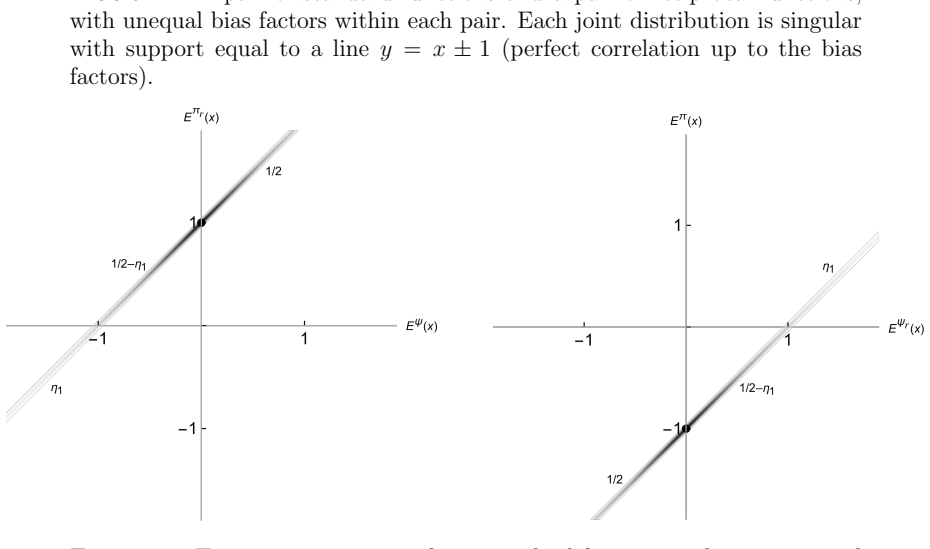
The paper shows that for certain pairs of normalized error terms, such as those associated with ψ(x) and the weighted sum involving Λ(n)/n, the inequality between them holds for all sufficiently large x if and only if the Riemann hypothesis is true. Assuming both the Riemann hypothesis and the linear independence of the positive imaginary parts of the zeta zeros, the authors calculate that the logarithmic density of the set where two specific error terms have the same sign is approximately 0.9865.
What carries the argument
The normalized error terms of the prime counting functions ψ(x), θ(x), π(x) and the Mertens weighted versions π_r(x), π_ℓ(x), together with their joint logarithmic distributions derived from the explicit formulae involving the zeros of the zeta function.
If this is right
- If the Riemann hypothesis holds, then specific pairs of these error terms satisfy one always exceeding the other for large x.
- The logarithmic densities for sign combinations of the error terms can be computed to high precision under the linear independence assumption.
- These correlations supply finer information about the joint behavior than the separate limiting distributions of each error term.
- The approach applies to other pairs among the standard and weighted prime counting functions.
Where Pith is reading between the lines
- Numerical checks of the inequalities at extremely large x values could serve as an independent test for the Riemann hypothesis distinct from direct zero-finding methods.
- The same correlation techniques might extend to error terms arising from other L-functions and their associated hypotheses.
- The reported density near 0.9865 indicates strong but incomplete sign agreement, which could be compared against predictions from random matrix models of zeta zeros.
Load-bearing premise
The equivalence between the persistent inequalities and the Riemann hypothesis relies on the explicit formulae expressing the error terms as sums over the zeros of the zeta function.
What would settle it
A sufficiently large x at which one error term in a claimed pair exceeds the other would either falsify the equivalence or show that the Riemann hypothesis is false.
Figures



read the original abstract
Standard prime-number counting functions, such as $\psi(x)$, $\theta(x)$, and $\pi(x)$, have error terms with limiting logarithmic distributions once suitably normalized. The same is true of weighted versions of those sums, like $\pi_r(x) = \sum_{p\le x} \frac1p$ and $\pi_\ell(x) = \sum_{p\le x} \log(1-\frac1p)^{-1}$, that were studied by Mertens. These limiting distributions are all identical, but passing to the limit loses information about how these error terms are correlated with one another. In this paper, we examine these correlations, showing, for example, that persistent inequalities between certain pairs of normalized error terms are equivalent to the Riemann hypothesis (RH). Assuming both RH and LI, the linear independence of the positive imaginary parts of the zeros of $\zeta(s)$, we calculate the logarithmic densities of the set of real numbers for which two different error terms have prescribed signs. For example, we conditionally show that $\psi(x) - x$ and $\sum_{n\le x} \frac{\Lambda(n)}n - (\log x - C_0)$ have the same sign on a set of logarithmic density $\approx 0.9865$.
Editorial analysis
A structured set of objections, weighed in public.
Referee Report
Summary. The paper examines correlations between normalized error terms of standard prime-counting functions (e.g., ψ(x) − x) and weighted versions (e.g., ∑_{n≤x} Λ(n)/n − (log x − C_0)). It claims that persistent inequalities between certain pairs of these normalized errors are equivalent to the Riemann hypothesis. Assuming both RH and the linear independence of positive imaginary parts of ζ-zeros (LI), it computes logarithmic densities of sets where the errors have prescribed signs, including a conditional density ≈0.9865 for same-sign agreement on the cited pair.
Significance. If the equivalence holds, the work supplies a new structural characterization of RH via sign persistence of correlated error terms, extending known limiting logarithmic distributions to joint behavior. The conditional density calculations provide quantitative, falsifiable predictions under RH+LI that could be tested numerically or via further analytic work. Credit is due for focusing on correlations lost in the marginal limits and for the explicit numerical example.
major comments (1)
- [Abstract / equivalence claim] Abstract and equivalence theorem: the claim that persistent inequality (e.g., E_1(x) > E_2(x) for all sufficiently large x) is equivalent to RH requires showing that any zero ρ with Re(ρ) > 1/2 produces a sign violation along a sequence x → ∞. The explicit formulae differ—the first error receives a leading term ∼ x^ρ/ρ while the second (arising from the Dirichlet series −ζ′/ζ(s+1)) receives ∼ x^{ρ−1}/(ρ−1). After any normalization that equalizes the RH-scale amplitudes (division by x^{1/2} or rms factor), the off-line contribution to the second term is smaller by a factor ∼ x^{-1}. The manuscript must verify explicitly that this scaling difference, together with the chosen definition of persistence, still forces a sign change; otherwise the contradiction step fails.
minor comments (2)
- [Numerical results] The numerical density is stated as ≈0.9865; supplying additional digits, the precise truncation of the zero sum, and the integration method used to obtain the density would aid reproducibility.
- [Notation and definitions] Define the precise normalizations (including any rms or logarithmic factors) for the error terms E_1(x) and E_2(x) at the first appearance, before the equivalence statements.
Simulated Author's Rebuttal
We thank the referee for the careful reading and for highlighting the need to make the contradiction argument fully explicit in the equivalence theorem. We address the concern directly below.
read point-by-point responses
-
Referee: Abstract and equivalence theorem: the claim that persistent inequality (e.g., E_1(x) > E_2(x) for all sufficiently large x) is equivalent to RH requires showing that any zero ρ with Re(ρ) > 1/2 produces a sign violation along a sequence x → ∞. The explicit formulae differ—the first error receives a leading term ∼ x^ρ/ρ while the second (arising from the Dirichlet series −ζ′/ζ(s+1)) receives ∼ x^{ρ−1}/(ρ−1). After any normalization that equalizes the RH-scale amplitudes (division by x^{1/2} or rms factor), the off-line contribution to the second term is smaller by a factor ∼ x^{-1}. The manuscript must verify explicitly that this scaling difference, together with the chosen definition of persistence, still forces a sign change; otherwise the contradiction step fails.
Authors: The normalizations are chosen individually for each error term so that both have comparable (O(1)) amplitudes under RH. Specifically, the normalized first error is (ψ(x) − x)/x^{1/2}, while the normalized second error is x^{1/2} ⋅ (∑_{n≤x} Λ(n)/n − (log x − C_0)). Under this choice the contribution of an off-line zero ρ with Re(ρ) = σ > 1/2 is of order x^{σ−1/2} in both normalized quantities: the second receives the extra factor x^{1/2} ⋅ x^{ρ−1} = x^{ρ−1/2}. The leading coefficients 1/ρ and 1/(ρ−1) are nonzero and linearly independent over the reals for any such ρ, so their combination in the difference does not vanish. Consequently the dominant oscillatory term grows without bound and changes sign along a suitable sequence x_n → ∞ (chosen so that the argument t log x aligns with the phase that drives the difference negative). This forces infinitely many violations of the persistent inequality. We will revise the manuscript to include an explicit verification of these coefficients and the choice of sequence in the proof of the equivalence. revision: yes
Circularity Check
No circularity: equivalence and densities derived from explicit formulae under external assumptions
full rationale
The paper's central claims rest on explicit formulae for the weighted prime-counting error terms, followed by analysis of their correlations and sign patterns. The equivalence of persistent inequalities to RH is obtained by showing that an off-line zero would violate the inequality for a sequence of x tending to infinity, using the differing contributions in the explicit formulae; this is a direct analytic argument rather than a reduction to fitted parameters or self-referential definitions. The logarithmic densities (e.g., ≈0.9865) are computed conditionally on the external conjectures RH and LI, which are stated as assumptions and not derived inside the paper. No self-citation is load-bearing for the main results, no ansatz is smuggled via prior work, and no known empirical pattern is merely renamed. The derivation chain is therefore self-contained against external benchmarks and does not collapse by construction.
Axiom & Free-Parameter Ledger
axioms (2)
- domain assumption Riemann hypothesis
- domain assumption Linear independence of the positive imaginary parts of the zeros of ζ(s) (LI)
Reference graph
Works this paper leans on
-
[1]
M. Abramowitz and I. A. Stegun. Handbook of mathematical functions with formulas, graphs, and mathematical tables, volume No. 55 of National Bureau of Standards Applied Mathematics Series . U. S. Government Printing Office, Washington, DC, 1964
work page 1964
- [2]
-
[3]
C. Bays and R. H. Hudson. A new bound for the smallest x with π(x) > li(x). Math. Comp. , 69(231):1285–1296, 2000
work page 2000
-
[4]
J. B¨ uthe. On the first sign change in Mertens’ theorem. Acta Arith., 171(2):183–195, 2015
work page 2015
-
[5]
P. Dusart. In´ egalit´ es explicites pourψ(X), θ(X), π(X) et les nombres premiers. C. R. Math. Acad. Sci. Soc. R. Can. , 21(2):53–59, 1999
work page 1999
-
[6]
A. Feuerverger and G. Martin. Biases in the Shanks–R´ enyi prime number race. Experimental Mathe- matics, 9(4):535–570, 2000
work page 2000
- [7]
-
[8]
J. P. S. Lay. Sign changes in Mertens’ first and second theorems, 2015. arXiv URL: https://arxiv. org/abs/1505.03589
work page internal anchor Pith review Pith/arXiv arXiv 2015
-
[9]
J. E. Littlewood. Sur la distribution des nombres premiers. Comptes Rendus de l’Acad. Sci. Paris , 158:1869–1872, 1914
work page 1914
-
[10]
G. Martin and N. Ng. Inclusive prime number races. Trans. Amer. Math. Soc. , 373(5):3561–3607, 2020
work page 2020
-
[11]
H. L. Montgomery and R. C. Vaughan. Multiplicative Number Theory I: Classical Theory . Cambridge Studies in Advanced Mathematics. Cambridge University Press, 2006
work page 2006
-
[12]
D. J. Platt and T. S. Trudgian. On the first sign change of θ(x) − x. Math. Comp. , 85(299):1539–1547, 2016
work page 2016
-
[13]
G. Robin. Sur l’ordre maximum de la fonction somme des diviseurs. In Seminar on number theory, Paris 1981–82 (Paris, 1981/1982) , volume 38 of Progr. Math., pages 233–244. Birkh¨ auser Boston, Boston, MA, 1983
work page 1981
-
[14]
M. O. Rubinstein and P. Sarnak. Chebyshev’s bias. Exp. Math. , 3:173–197, 1994
work page 1994
-
[15]
Szeg˝ o.Orthogonal polynomials
G. Szeg˝ o.Orthogonal polynomials . American Mathematical Society, Providence, R.I., fourth edition,
-
[16]
American Mathematical Society, Colloquium Publications, Vol. XXIII
- [17]
-
[18]
A. Wintner. On the asymptotic distribution of the remainder term of the prime-number theorem. Amer. J. Math. , 57(3):534–538, 1935. Department of Mathematics, University of Chicago, Chicago, IL, 60637, USA Email address : shbhatta100@gmail.com Department of Mathematics, University of British Columbia, V ancouver, BC, V6T 1Z2, Canada Email address : gerg@m...
work page 1935
discussion (0)
Sign in with ORCID, Apple, or X to comment. Anyone can read and Pith papers without signing in.