Thin filaments in Hele-Shaw cells
Pith reviewed 2026-05-19 04:08 UTC · model grok-4.3
The pith
Thin circular filaments in Hele-Shaw cells grow only when their initial radius exceeds a critical value and can evolve into translating pinned circles.
A machine-rendered reading of the paper's core claim, the machinery that carries it, and where it could break.
Core claim
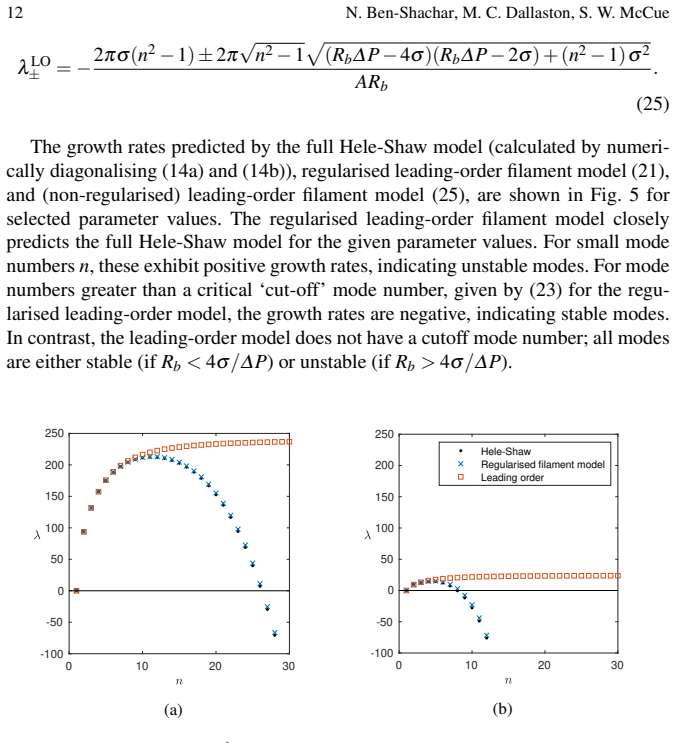
Using a recently derived filament model, the stability of fluid filaments in Hele-Shaw cells, driven by a constant pressure gradient, is studied. It is found that thin circular filaments grow if their initial radius exceeds a dimensionless critical radius. Further, linear stability of the axisymmetric solution reveals that all modes are stable for twice this critical radius, with modes becoming unstable for larger radii. A translating circular solution is found for asymptotically large radius, termed a 'pinned circle'. These are thought to describe the observed non-linear growth of filament into circular-like solutions. The solutions exhibit a finite-time blow up in the pinned circle radius,
What carries the argument
The linear stability analysis of the axisymmetric solution inside the filament model, which tracks growth or decay of shape perturbations around circular filaments and identifies the transition to unstable modes.
If this is right
- Circular filaments with initial radius above the critical value expand over time.
- All shape perturbation modes remain stable when the filament radius is below twice the critical value.
- Perturbation modes grow when the radius exceeds twice the critical value.
- A translating pinned-circle solution exists at asymptotically large radii.
- The radius of the pinned circle diverges in finite time because the circle sheds mass.
Where Pith is reading between the lines
- The identified thresholds may help predict when filaments in porous-media flows transition from stable growth to breakup or merging.
- Mass shedding from pinned circles could generate secondary droplets or thinner filaments downstream in the same cell.
- The model predictions could be tested by comparing against direct numerical simulations of the full Hele-Shaw equations at the reported critical radii.
Load-bearing premise
The recently derived filament model remains valid for thin filaments under constant pressure gradient in the Hele-Shaw geometry.
What would settle it
An experiment that initializes thin circular filaments of different starting radii in a Hele-Shaw cell and records whether growth occurs only above the predicted critical radius while circular shapes persist up to twice that radius before deforming.
Figures




read the original abstract
Using a recently derived filament model, the stability of fluid filaments in Hele-Shaw cells, driven by a constant pressure gradient, is studied. It is found that thin circular filaments grow if their initial radius exceeds a dimensionless critical radius. Further, linear stability of the axisymmetric solution reveals that all modes are stable for twice this critical radius, with modes becoming unstable for larger radii. A translating circular solution is found for asymptotically large radius, termed a `pinned circle'. These are thought to describe the observed non-linear growth of filament into circular-like solutions. The solutions exhibit a finite-time blow up in the pinned circle radius, attributed to the circle shedding mass as it grows. This report presents the results of a project undertaken by the first author at the Matrix Workshop Instabilities in Porous Media, April 3-23, 2024, under the supervision of the other authors.
Editorial analysis
A structured set of objections, weighed in public.
Referee Report
Summary. The paper applies a recently derived filament model to analyze the stability of thin fluid filaments in Hele-Shaw cells driven by a constant pressure gradient. It reports that circular filaments grow when their initial radius exceeds a dimensionless critical value. Linear stability analysis of the axisymmetric solution indicates that all modes are stable at twice the critical radius, with instability for larger radii. An asymptotic translating circular solution, termed the 'pinned circle', is identified for large radii and exhibits finite-time blow-up attributed to mass shedding.
Significance. If the derivations and model assumptions hold, the work provides analytical progress on filament stability and nonlinear evolution in pressure-driven Hele-Shaw flows. The critical radius thresholds and pinned-circle solution offer concrete, potentially falsifiable predictions that could connect to experimental observations of circular-like growth. The approach leverages an existing filament model to obtain explicit stability results and asymptotic behaviors.
major comments (3)
- The central claim that all modes are stable for twice the critical radius (abstract) requires the explicit dispersion relation or linearized eigenvalue problem from the filament model equations; without these, the threshold cannot be independently verified and remains load-bearing for the stability conclusion.
- The finite-time blow-up of the pinned-circle radius, attributed to mass shedding (abstract and asymptotic analysis), needs the governing ODE for the radius evolution and the mass-conservation statement to confirm the mechanism; this is central to the large-radius translating solution.
- The analysis assumes the filament model remains valid throughout the thin-filament regime under constant pressure gradient (weakest assumption noted in review); without error estimates or direct comparison to the full Hele-Shaw equations in the relevant limit, applicability for the reported radii is not established.
minor comments (2)
- The abstract states that the pinned-circle solutions 'are thought to describe the observed non-linear growth'; adding a specific citation to experimental filament observations in Hele-Shaw cells would clarify the link.
- The origin and key assumptions of the 'recently derived filament model' should be restated briefly with equation numbers for self-contained reading.
Simulated Author's Rebuttal
We thank the referee for their careful reading of the manuscript and for the constructive major comments. We respond to each point below and indicate the revisions planned for the next version of the paper.
read point-by-point responses
-
Referee: The central claim that all modes are stable for twice the critical radius (abstract) requires the explicit dispersion relation or linearized eigenvalue problem from the filament model equations; without these, the threshold cannot be independently verified and remains load-bearing for the stability conclusion.
Authors: We agree that the explicit dispersion relation strengthens the presentation. The linear stability analysis in Section 3 linearizes the filament model around the axisymmetric base state and yields a dispersion relation for the perturbation growth rates. To allow independent verification, we will add the full linearized eigenvalue problem and the resulting dispersion relation as a new appendix in the revised manuscript. revision: yes
-
Referee: The finite-time blow-up of the pinned-circle radius, attributed to mass shedding (abstract and asymptotic analysis), needs the governing ODE for the radius evolution and the mass-conservation statement to confirm the mechanism; this is central to the large-radius translating solution.
Authors: We accept this suggestion. The pinned-circle solution is obtained by inserting a large-radius translating circular ansatz into the filament model, producing an ODE for the radius together with a mass-conservation relation that incorporates shedding. In the revision we will state both the governing ODE and the mass-conservation statement explicitly in the asymptotic-analysis section and show how they produce the finite-time blow-up. revision: yes
-
Referee: The analysis assumes the filament model remains valid throughout the thin-filament regime under constant pressure gradient (weakest assumption noted in review); without error estimates or direct comparison to the full Hele-Shaw equations in the relevant limit, applicability for the reported radii is not established.
Authors: The filament model is taken from the recent derivation cited in the manuscript, where the thin-filament and constant-pressure-gradient asymptotics are justified. We will expand the introduction and conclusions to include a clearer discussion of the model's validity regime and its limitations, with explicit reference to the error estimates contained in the derivation paper. A direct numerical comparison with the full Hele-Shaw equations lies outside the present scope but is noted as a natural direction for future work. revision: partial
Circularity Check
No significant circularity; derivations independent of inputs
full rationale
The paper applies a previously derived filament model (cited as recent prior work) to new stability analysis and solution constructions for thin filaments under constant pressure gradient. The dimensionless critical radius for growth of circular filaments, the factor-of-two threshold for linear stability of all modes, and the existence of the translating 'pinned circle' solution with finite-time blow-up are obtained by solving the governing equations of that model (axisymmetric reduction, linearization, and asymptotic large-radius analysis). These steps do not reduce to redefinitions or refits of the model's own parameters; the model assumptions are external to the present derivations and the results are falsifiable against the model's dynamics. No self-definitional loops, fitted-input predictions, or load-bearing self-citation chains appear in the reported chain.
Axiom & Free-Parameter Ledger
free parameters (1)
- dimensionless critical radius
axioms (1)
- domain assumption The recently derived filament model accurately captures the dynamics of thin filaments in a Hele-Shaw cell under constant pressure gradient.
Lean theorems connected to this paper
-
IndisputableMonolith/Foundation/DimensionForcing.leanreality_from_one_distinction unclear?
unclearRelation between the paper passage and the cited Recognition theorem.
thin circular filaments grow if their initial radius exceeds a dimensionless critical radius Rc = 2σ/ΔP; all modes stable for Rb < 2Rc
-
IndisputableMonolith/Cost/FunctionalEquation.leanwashburn_uniqueness_aczel unclear?
unclearRelation between the paper passage and the cited Recognition theorem.
pinned circle solution R(t) = R(0)t0/(t0-t) with mass shedding
What do these tags mean?
- matches
- The paper's claim is directly supported by a theorem in the formal canon.
- supports
- The theorem supports part of the paper's argument, but the paper may add assumptions or extra steps.
- extends
- The paper goes beyond the formal theorem; the theorem is a base layer rather than the whole result.
- uses
- The paper appears to rely on the theorem as machinery.
- contradicts
- The paper's claim conflicts with a theorem or certificate in the canon.
- unclear
- Pith found a possible connection, but the passage is too broad, indirect, or ambiguous to say the theorem truly supports the claim.
Reference graph
Works this paper leans on
-
[1]
Anjos, P.H.A., Li, S.: Weakly nonlinear analysis of the Saffman-Taylor problem in a radially spreading fluid annulus. Phys. Rev. Fluids 5, 054,002 (2020). DOI 10.1103/PhysRevFluids.5.054002
-
[2]
Cardoso, S.S.S., Woods, A.W.: The formation of drops through viscous instability. J. Fluid Mech. 289, 351–378 (1995). DOI 10.1017/S0022112095001364
-
[3]
Crowdy, D., Tanveer, S.: The effect of finiteness in the Saffman–Taylor viscous fingering prob- lem. J. Stat. Phys. 114(5), 1501–1536 (2004). DOI 10.1023/B:JOSS.0000013962.78542.33
-
[4]
Dallaston, M.C., Jackson, M.J.W., Morrow, L.C., McCue, S.W.: Two-interface and thin fil- ament approximation in Hele–Shaw channel flow. J. Fluid Mech. 988, A31 (2024). DOI 10.1017/jfm.2024.456
-
[5]
Dallaston, M.C., McCue, S.W.: New exact solutions for Hele-Shaw flow in doubly connected regions. Phys. Fluids 24(5), 052,101 (2012). DOI 10.1063/1.4711274
-
[6]
Farmer, C., Howison, S.: The motion of a viscous filament in a porous medium or Hele–Shaw cell: a physical realisation of the Cauchy–Riemann equations. Appl. Math. Lett. 19(4), 356– 361 (2006). DOI https://doi.org/10.1016/j.aml.2005.06.007
-
[7]
Flaig, F., Fr ¨ager, T., Kaufmann, M., Vall´ee, T., Fricke, H., M¨uller, M.: How to find the perfect application pattern for adhesively bonded joints? J. Adv. Join. Proc. 8, 100,147 (2023). DOI https://doi.org/10.1016/j.jajp.2023.100147
-
[8]
Gin, C., Daripa, P.: Stability results on radial porous media and Hele-Shaw flows with variable viscosity between two moving interfaces. IMA J. Appl. Math. 86(2), 294–319 (2021). DOI 10.1093/imamat/hxab001
-
[9]
Gin, C., Daripa, P.: Time-dependent injection strategies for multilayer Hele-Shaw and porous media flows. Phys. Rev. Fluids 6, 033,901 (2021). DOI 10.1103/PhysRevFluids.6.033901
-
[10]
Kampitsis, A.E., Kostorz, W.J., Muggeridge, A.H., Jackson, M.D.: The life span and dynamics of immiscible viscous fingering in rectilinear displacements. Phys. Fluids 33(9), 096,608 (2021). DOI 10.1063/5.0064955
-
[11]
Morrow, L.C., De Cock, N., McCue, S.W.: Viscous fingering patterns for Hele-Shaw flow in a doubly connected geometry driven by a pressure differential or rotation. Phys. Rev. Fluids 8, 014,001 (2023). DOI 10.1103/PhysRevFluids.8.014001
-
[12]
Morrow, L.C., Moroney, T.J., Dallaston, M.C., McCue, S.W.: A review of one-phase Hele- Shaw flows and a level-set method for nonstandard configurations. ANZIAM J. 63(3), 269– 307 (2021). DOI 10.1017/S144618112100033X
-
[13]
Paterson, L.: Radial fingering in a Hele Shaw cell. J. Fluid Mec. 113, 513–529 (1981). DOI 10.1017/S0022112081003613
-
[14]
Ward, T., White, A.R.: Gas-driven displacement of a liquid in a partially filled radial Hele- Shaw cell. Phys. Rev. E 83, 046,316 (2011). DOI 10.1103/PhysRevE.83.046316
-
[15]
Zhao, M., Anjos, P.H.A., Lowengrub, J., Li, S.: Pattern formation of the three-layer Saffman- Taylor problem in a radial Hele-Shaw cell. Phys. Rev. Fluids 5, 124,005 (2020). DOI 10.1103/PhysRevFluids.5.124005
discussion (0)
Sign in with ORCID, Apple, or X to comment. Anyone can read and Pith papers without signing in.