REVIEW 3 major objections 6 minor 118 references
Evolutionary Period Changes for 25 X-ray Binaries and the Measurement of an Empirical Universal Law for Angular Momentum Loss in Accreting Binaries
T0 review · 3 major / 6 minor · reviewed 2026-08-06 · deepseek-v4-flash
Pith's one-line read This paper measures orbital period changes for 25 X-ray binaries and, combined with 52 cataclysmic variables, derives an empirical power-law law for angular momentum loss that it claims is universal across accreting binaries.
desk verdict A valuable Pdot catalog that refutes magnetic braking, but the claimed universal AML law is a same-sample fit whose Mdot exponent is likely contaminated by correlated errors. read the letter →
The pith
A machine-rendered reading of the paper's core claim, the machinery that carries it, and where it could break.
The reading
What carries the argument
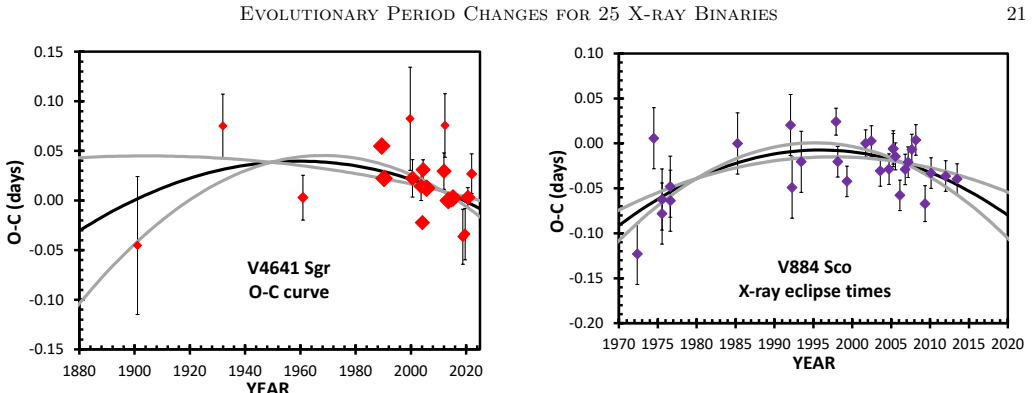
The central tool is the O−C diagram: plots of observed minus calculated eclipse or minimum times fitted with parabolas, whose curvature gives the steady period change $\dot P$. Equations 1–11 then subtract the well-known gravitational-radiation contribution $\dot P_{\rm GR}$ and the mass-transfer contribution $\dot P_{\rm mt}$ from the measured $\dot P$ to isolate the residual $\dot P_{\rm AML}$. Equation 14 converts the resulting 84 measures into a chi-square fit of a power law in $P$, $M_{\rm prim}$, $M_{\rm comp}$, and $\dot M$, producing the fitted exponents in Table 8. The load-bearing step is treating the residual $\dot P_{\rm AML}$ as a real extra angular-momentum-loss signal rather than an artifact of uncertain accretion rates.
What would settle it
Take a system with period near 0.5 day whose masses are measured by eclipses and radial velocities and whose accretion rate is measured independently from X-ray luminosity and a Gaia distance. If its $\dot P$ differs from the Equation 16 prediction by more than the propagated uncertainties, or if a decade-long change in $\dot M$ does not produce the predicted power-law change in $\dot{P}_{\rm AML}$, the universal law would be falsified.
Extended reading notes
Core claim
The central claim is that the dominant angular momentum loss in accreting binaries is empirically $\dot{P}_{\rm AML} = -1500\times 10^{-12}\, P^{1.29} M_{\rm prim}^{2.75} M_{\rm comp}^{-1.00} \dot{M}_{-8}^{0.43}$ for periods from 0.13 to 1.0 days, with separate fitted power laws for binaries below the period gap and for binaries with $P>1$ day. The same 77 systems show that magnetic braking predictions are wrong by more than an order of magnitude for most systems. The paper concludes that the unknown AML mechanism is controlled by the accretion process, because $\dot{P}_{\rm AML}$ rises with accretion rate, and that the empirical family of laws can stand as a universal description of binary evolution until a physical mechanism is identified.
Load-bearing premise
The fitted law assumes that the accretion rates and wind-capture efficiencies in Table 6 are accurate enough, despite uncertainties of roughly a factor of ten in $\dot M$ and poorly known wind efficiencies, that the residual $\dot{P}_{\rm AML}$ after subtracting GR and mass transfer is a real signal rather than an artifact of those errors.
Editorial extensions
If this is right
- The magnetic braking model's single evolutionary track is contradicted: 7 of 8 X-ray binaries with main-sequence companions and most cataclysmic variables deviate from its predictions by orders of magnitude.
- Evolution and population-synthesis calculations can replace the magnetic braking recipe with Equations 15–16, which reproduce the observed $\dot{P}_{\rm AML}$ scatter to about 0.33 dex.
- Because $\dot{P}_{\rm AML}$ depends on the accretion rate, the dominant loss mechanism must live in the accretion flow, stream, or boundary layer, not in the companion's magnetic wind.
- Below the period gap, at least 6 of 18 systems show a non-zero $\dot{P}_{\rm AML}$, so gravitational radiation alone does not drive those binaries.
- The period gap and minimum period, long cited as successes of magnetic braking, are no longer evidence for that mechanism.
Reading between the lines
- If Equation 16 is causal, systems whose accretion rate changes sharply, like the recurrent nova U Sco after its 2010 eruption, should show a corresponding power-law change in $\dot{P}_{\rm AML}$; the paper reports such a jump but leaves it unexplained, so watching the next eruption would directly test the $\dot{M}^{0.43}$ term.
- The steep positive exponent on $M_{\rm prim}$ predicts that, at equal period and accretion rate, binaries with more massive white dwarfs or neutron stars lose orbital angular momentum faster; this is a testable ranking within existing eclipsing systems.
- If the universal law holds, the minimum period and period gap of cataclysmic variables should be derivable from Equations 15–16 rather than from magnetic braking physics, making the observed period distribution an independent check on the fitted exponents.
Editorial analysis
A structured set of objections, weighed in public.
Referee Report
Summary. This paper assembles eclipse and minimum-light timings for 25 X-ray binaries, measures or collects their secular orbital period derivatives, and combines them with 52 cataclysmic variables from the author's prior work. After subtracting gravitational-radiation and mass-transfer contributions (Eqs. 2, 9-11), it forms 84 Pdot_AML values for 77 systems, uses them to test magnetic braking and related AML prescriptions, and finds large discrepancies with the MBM. The paper then fits power laws in P, Mprim, Mcomp, and Mdot to Pdot_AML (Eq. 14), reports three 'universal' empirical AML laws (Eqs. 15-16 and Table 8), and claims these describe the actual evolution of all 77 XRBs and CVs.
Significance. The O-C measurements are a substantial and welcome contribution, especially the long-baseline timing for Sco X-1, Her X-1, and V4641 Sgr, the TESS-based timings, and the careful discussion of systematic jitter in several systems. If the AML-law result survives scrutiny, it would provide an empirically based replacement for the MBM. However, the headline universal law is a least-squares fit to the same systems it claims to describe, and the construction of Pdot_AML from the same Mdot that later serves as a regressor creates a serious correlated-error concern. The paper is therefore significant as a measurement paper and as a falsification test of MBM, but the universal-law claim is not yet established.
major comments (3)
- [Sec. 8.2 / Eq. (16), with Sec. 5, Eqs. (2), (10), (14)] The headline Mdot exponent (δ=0.43) may be an artifact of regressing a constructed residual on the same noisy Mdot used to construct it. Pdot_AML is defined by subtracting a mass-transfer term that is linear in Mdot (Eq. 10), and log Mdot is then one of the regressors in Eq. (14). With Mdot uncertainties of 'typically like a factor of ten' as stated in Section 5, an overestimate of Mdot makes the subtracted Pdot_mt too large and drives Pdot_AML more negative, while an underestimate drives it less negative; this built-in anti-correlation can produce a positive δ and can also bias β and γ through q=Mcomp/Mprim even when the true AML has no Mdot dependence. Adding a 0.25-dex systematic error changes the scatter but not the central-value bias, so a reduced chi-square near unity does not validate the law. Please add a synthetic-error test (simulate data with a true Pdot_AML independent of Mdot, add factor-ten Mdot errors, and show that the fitting procedure recovers δ=0) or an errors-in-variables / orthogonal regression treatment.
- [Table 8 / Sec. 8.2] The claim of a 'universal' law is not supported by a fit to the same 77 systems from which the law was derived. No out-of-sample or cross-validated test is presented, so the statement that Eqs. (15)-(16) are 'the best representations of the actual evolution for all 77' is a goodness-of-fit restatement, not a predictive test. Additionally, the abstract promises a third law for P>1.0 day, but Table 8 contains only the below-gap fit, the 0.13-1.0 day fit, the HMXB/IMXB fit, and an all-systems fit; long-period CVs such as U Sco, V394 CrA, and T CrB appear only in the 'All' row. The paper either needs to present the dedicated P>1.0-day fit or revise the abstract's claim of three laws.
- [Sec. 8.1 / Table 6] The statistical treatment of the fit is under-specified. The text states that a systematic error of 0.25 dex is adopted for all binary groups to bring reduced chi-square near unity, but for the below-gap fit the reduced chi-square is 0.4 after this addition, indicating that the error budget is overestimated rather than calibrated. Table 6 reports the last-column acceptable ranges for Pdot_AML as asymmetric, yet the fitting section does not say how these asymmetric errors are converted into sigma, nor how the factor-ten Mdot uncertainties and the poorly known wind-capture efficiencies epsilon are propagated into the parameter errors quoted in Table 8. Please replace the ad hoc systematic with a transparent likelihood or Monte Carlo propagation, and report the sensitivity of α, β, γ, δ to the assumed Mdot and epsilon errors.
minor comments (6)
- [Abstract / Eq. (16)] The units of Pdot_AML, P, masses, and Mdot are only given in the text; the abstract's 'in appropriate units' is too terse for a headline equation.
- [Table 6] The 'k' and 'kk' shorthand in the Pdot columns is nonstandard and should be defined in the table caption or replaced by explicit powers of ten.
- [Sec. 5, Eq. (11)] The reduction of Eq. (11) to Eq. (10) for epsilon=1 is not shown; a short check would help readers verify that the wind and RLOF cases are consistent.
- [Sec. 8.1] The term 'jerks' is introduced for fast O-C kinks; since this is not a standard term, define it at first use.
- [Table 8] Chi-square values are quoted without the number of degrees of freedom in the table; the text gives some reduced values, but the table should state the dof explicitly.
- [Sec. 7.2] The comparison of 50 measures for 44 systems should state explicitly whether the multiple inter-eruption intervals are treated as independent in the statistical tests.
Circularity Check
The Mdot exponent of the 'universal' AML law is partly self-definitional: Pdot_AML is built by subtracting a term linear in the same Mdot that is later used as a regressor, so the claimed accretion-driven AML is not independently measured.
-
self definitional
[Section 5 (Eqs. 2, 10); Section 7.6; Section 8.2 (Eqs. 14, 16); Table 8]
"The accretion rates are often poorly known, with the real uncertainties typically like a factor of ten. ... ˙PAML = ˙P − ˙PGR − ˙Pmt. (2) ... ˙Pmt = 3P (1 − q) ˙MRLOF Mcomp . (10) ... ˙PAML = −CP αM β prim M γ comp ˙M δ −8. (14) ... That ˙PAML is approximately proportional to ˙M is telling us that the AML mechanism is driven by the physics of the accretion."
For every RLOF system, Eq. 10 makes Pdot_AML = Pdot − Pdot_GR − 3P(1−q)Mdot/Mcomp, so the dependent variable is a decreasing function of Mdot by construction, before any physics. The same Table 6 Mdot then serves as the regressor in Eq. 14; the fitted δ = +0.43 (Eq. 16; +0.87 below the Gap, Eq. 15) is unavoidably shaped by that defining subtraction plus correlated Mdot errors. The paper concedes Mdot is uncertain 'typically like a factor of ten' and wind ϵ is 'only poorly known from theory'; overestimating Mdot pushes Pdot_AML negative, underestimating it pushes Pdot_AML positive, biasing δ positive even if the true extra AML has no Mdot dependence. Reduced chi-square near unity removes scatter, not this central-value bias.
full rationale
The 25 XRB Pdot measures are original O−C timing analyses and the 52 CV measures are published eclipse/pulse timings; these are data, so the paper's self-citations (Schaefer 2023, 2024) are not load-bearing circularity under the hard rules. The MBM and its exponents are attributed to external works (Rappaport et al. 1983; Knigge et al. 2011; Paxton et al. 2015), so the rejection of MBM is a data-vs-model comparison, not a self-citation chain. The universal law (Eqs. 15–16) is explicitly an empirical fit to Eq. 14, so the P and mass exponents are genuine, if noisy, descriptions of the constructed residuals. What is circular is the Mdot dependence: Pdot_AML is defined by subtracting Pdot_mt ∝ Mdot (Eq. 10) from the observed Pdot, and the regression of the result on the same Mdot (Eq. 14) necessarily manufactures a positive δ unless Mdot errors are negligible; the paper states they are a factor of ten. The same construction underlies the below-gap 'proof' of nonzero Pdot_AML (Section 8.1), whose chi-square comparison cannot distinguish a real AML from a biased subtraction. The paper never performs the synthetic-error test that would settle whether δ = 0.43 survives. Some independent content remains (the P^1.29 envelope, the mass exponents, three positive-Pdot_AML outliers), so this is partial, not total, circularity: score 6.
Assumptions & free parameters
free parameters (7)
- Prefactor C for the 0.13-1.0 day law =
1500 (+1630/-520) x 10^-12
- Power-law exponents for the 0.13-1.0 day law =
alpha=1.29, beta=2.75, gamma=-1.00, delta=0.43
- Below-gap prefactor and exponents =
C=110, alpha=0.50, beta=-0.3, gamma=-0.5, delta=0.87
- HMXB/IMXB prefactor and exponents =
C=10500, alpha=1.43, beta=-0.9, gamma=-0.4, delta=0.1
- Ad hoc systematic scatter =
0.25 in log10 Pdot_AML
- Wind capture efficiency epsilon =
0.0001-0.01, with 0.004-0.00004 for disk cases
- Jitter errors for individual O-C fits =
0.00027 days for KV UMa, 0.007 days for Her X-1
assumptions (6)
- standard math The gravitational radiation contribution is exactly Equation 9, the standard Peters formula for point masses.
- domain assumption Conservative Roche lobe overflow mass transfer with Pdot_mt = 3P(1-q) Mdot_RLOF/Mcomp applies to CVs and LMXBs.
- domain assumption Wind accretion can be represented by a single capture efficiency epsilon in Equation 11.
- domain assumption O-C curvature measures steady evolutionary Pdot, with bumps and jerks treated as zero-centered noise.
- domain assumption Accretion-rate estimates are independent of the measured Pdot and accurate enough for subtraction.
- ad hoc to paper The period-range split into below-gap, 0.13-1.0 day, and longer periods is physically meaningful.
Cite this review
Pith. "Pith review of Evolutionary Period Changes for 25 X-ray Binaries and the Measurement of an Empirical Universal Law for Angular Momentum Loss in Accreting Binaries." pith.science (2026). https://pith.science/paper/25AQB3LN
@misc{pith2026250713515,
  author       = {Pith},
  title        = {Pith review of: Evolutionary Period Changes for 25 X-ray Binaries and the Measurement of an Empirical Universal Law for Angular Momentum Loss in Accreting Binaries},
  year         = {2026},
  howpublished = {\url{https://pith.science/paper/25AQB3LN}},
  note         = {Machine review of arXiv:2507.13515}
}
abstract
I measure and collect timings of phase markers (like eclipse times) for the orbits of 25 X-ray binaries (XRBs) so as to calculate the steady evolutionary period change ($\dot{P}$). I combine these with my observed $\dot{P}$ measures from 52 cataclysmic variables (CVs). Further, I subtract out the contributions from gravitational radiation ($\dot{P}_{\rm GR}$) and mass transfer ($\dot{P}_{\rm mt}$), deriving the period change from the residual unknown angular momentum loss ($\dot{P}_{\rm AML}$=$\dot{P}$-$\dot{P}_{\rm GR}$-$\dot{P}_{\rm mt}$). I have $\dot{P}_{\rm AML}$ measures for 77 XRBs and CVs, with these being direct measures of the driver of binary evolution. The venerable Magnetic Braking Model (MBM) of binary evolution has its most fundamental predictions tested, with most systems having predictions wrong by over one order-of-magnitude. Other proposed mechanisms to explain the AML also fail, so we are left with no known mechanism that dominates the AML. An alternative path to the AML law is empirical, where my $\dot{P}_{\rm AML}$ measures are fitted to a power-law involving the fundamental binary properties. With this, the dominant AML law for systems with orbital periods ($P$) from 0.13--1.0 days is $\dot{P}_{\rm AML} = -1500\times10^{-12} P^{1.29} M_{\rm prim}^{2.75} M_{\rm comp}^{-1.00}\dot{M}^{0.43}_{-8}$, in appropriate units. Similar AML laws for binaries below the Period Gap and for binaries with $P$$>$1.0 day are derived. These three AML laws are of good accuracy and are the best representations of the actual evolution for all 77 XRBs and CVs of all classes, so the three taken together can be called `universal'.
Figures


Figures from the paper (17 more)




Reference graph
Works this paper leans on
-
[1]
A., Hintzen, P., & Levy, S
Abt, H. A., Hintzen, P., & Levy, S. G. 1977, ApJ, 213, 815
1977
-
[2]
& Wilson, J
Africano, J. & Wilson, J. 1976, PASP, 88, 8
1976
-
[3]
I., & Cherepashchuk, A
Antokhin, I. I., & Cherepashchuk, A. M. 2019, ApJ, 871, 244
2019
-
[4]
Applegate, J. H. 1992, ApJ, 385, 621
1992
-
[5]
2022, ApJ, 937, 125
Bachetti, M., Heida, M., Maccarone, T., et al. 2022, ApJ, 937, 125
2022
-
[6]
Barsukova, E., Goranskij, V., & Kroll, P. 2014, Astroplate 2014 conference, Prague, see arXiv 1410.2055
work page Pith review arXiv 2014
-
[7]
M., & Venimore, C
Bateson, F. M., & Venimore, C. W. 1984, Pub. Variable Star Section of RASNZ, 11, 35
1984
-
[8]
J., Robinson, E
Bayless, A. J., Robinson, E. L., Hynes, R. I., Ashcraft, T. A., & Cornell, M. 2010, ApJ, 709, 251
2010
Show all 118 references
-
[9]
C., Kulkarni, S
Bellm, E. C., Kulkarni, S. R., Barlow, T., et al. 2019, PASP, 131, 18002
2019
-
[10]
E., Lyuty, V
Brocksopp, C., Tarasov, A. E., Lyuty, V. M., Roche, & P. 1999, A&A, 343, 861
1999
-
[11]
1973, ApJ, 179, L129
Brucato, R., & Kristian, J. 1973, ApJ, 179, L129
1973
-
[12]
J., & Zappala, R
Brucato, R. J., & Zappala, R. R. 1974, ApJ, 189, L71
1974
-
[13]
Brumback, M. C. 2022, ApJ, 926, 187
2022
-
[14]
Canalizo, G., Koenigsberger ,G., Pena, D., & Ruiz, E., 1995, Rev. Mex. A. Ap., 31, 63
1995
-
[15]
A., dos Anjos, R
Carvalho, G. A., dos Anjos, R. C., Coelho, et al., 2022, ApJ, 940, 90
2022
-
[16]
2015, A&A, 583, 108
Chen, W.-C., & Li, X.-D. 2015, A&A, 583, 108
2015
-
[17]
M., Kovalenko, V
Cherepashchuk, A. M., Kovalenko, V. M., Kovalenko, O. N., & Mironov, A. V. 1974, Peremenny Zvezdy, 19, 305
1974
-
[18]
2023, ApJ, 951, 42
Chou, Y., & Jhang, Y.-W. 2023, ApJ, 951, 42
2023
-
[19]
Davidson, K., & Ostriker, J. P. 1973, ApJ, 179, 585
1973
-
[20]
T., Ray, P
Degenaar, N., Wolff, M. T., Ray, P. S., et al. 2011, MNRAS, 412, 1409
2011
-
[21]
2018, A&A, 617, 26
Dubus, G., Otulakowska-Hypka, M., & Lasota, J.-P. 2018, A&A, 617, 26
2018
-
[22]
2007, AJ, 134, 262
Echevarria, J., de la Fuente, E., & Castero, R. 2007, AJ, 134, 262
2007
-
[23]
2015, A&A, 577, 130
Falanga, M., Bozzo, E., Lutovinov, A., et al. 2015, A&A, 577, 130
2015
-
[24]
2023, in Handbook of X-ray and Gamma-ray Astrophysics, eds
Fornasini, F., Antoniou, V., & Dubus, G. 2023, in Handbook of X-ray and Gamma-ray Astrophysics, eds. C. Bambi, A. Santangelo, Springer, Singapore, pp. 1–55
2023
-
[25]
2002, Accretion Power in Astrophysics
Frank, J., King, A., & Raine, D. 2002, Accretion Power in Astrophysics. Cambridge University Press, Cambridge G¨ ansicke, B. T., Dillon, M., Southworth, J., et al. 2009, MNRAS, 397, 2170 Evolutionary Period Changes for 25 X-ray Binaries 49
2002
-
[26]
R., Bolton, C
Gies, D. R., Bolton, C. T. 1982, ApJ, 260, 240
1982
-
[27]
R., Bolton, C
Gies, D. R., Bolton, C. T., Thomson, J. R., et al. 2003, ApJ, 583, 424 G´ omez, L. G., & Rueda, J. A. 2017, PhysRevD, 96, 63001 Gonz´ alez Hern´ andez, J. I., Rebolo, R., & Casares, J. 2014, MNRAS, 438, L21 Gonz´ alez Hern´ andez, J. I., Suarez-Andres, L., Rebolo, R., & Casare...
2003
-
[28]
Goranskij, V. P. 2001, IBVS, 5068
2001
-
[29]
B., Rothschild, R
Hemphill, P. B., Rothschild, R. E., Cheatham, D. M., et al. 2019, ApJ, 873, 62
2019
-
[30]
1974, MNRAS, 168, 543
Hilditch, R.W., & Hill, G. 1974, MNRAS, 168, 543
1974
-
[31]
I., & Britt, C
Hynes, R. I., & Britt, C. T. 2012, ApJ, 755, 66
2012
-
[32]
I., Mauche, C
Hynes, R. I., Mauche, C. W., Haswell, C. A., et al. 2000, ApJ, 539, L37
2000
-
[33]
I., Schaefer, B
Hynes, R. I., Schaefer, B. E., Baum, Z. A., et al. 2016, MNRAS, 459, 3596
2016
-
[34]
F., Di Salvo, T., et al
Iaria, R., Gambino, A. F., Di Salvo, T., et al. 2018, MNRAS, 473, 3490
2018
-
[35]
F., et al
Iaria, R., Sanna, A., Di Salvo, T., Gambino, A. F., et al. 2021, A&A, 646, A120
2021
-
[36]
2023, ApJ, 942, L40
Illiano, G., Papitto, A., Sanna, A., Bult, P., et al. 2023, ApJ, 942, L40
2023
-
[37]
2016, MNRAS, 461, 816
Islam, N., & Paul, B. 2016, MNRAS, 461, 816
2016
-
[38]
2010, MNRAS, 409, 755
Jain, C., Paul, B., & Dutta, A. 2010, MNRAS, 409, 755
2010
-
[39]
& Dutta, A
Jain, C., Paul, B., Sharma, R., Jaleel, A. & Dutta, A. 2017, MNRAS, 468, L118
2017
-
[40]
2022, MNRAS, 517, 2131
Jain, C., Sharma, R., & Paul, B. 2022, MNRAS, 517, 2131
2022
-
[41]
2024, MNRAS, 529, 4056
Jain, C., Sharma, R., & Paul, B. 2024, MNRAS, 529, 4056
2024
-
[42]
2012, ApJ, 759, 124
Camero-Arranz, A. 2012, ApJ, 759, 124
2012
-
[43]
2024, Galaxy, 12, 80
Jiang, J. 2024, Galaxy, 12, 80
2024
-
[44]
2009, A&A, 507, 617
Johanssen, T. 2009, A&A, 507, 617
2009
-
[45]
A., Voloshina, I
Karitskaya, E. A., Voloshina, I. B., Goranskii, V. P., et al. 2001, Astron. Rep., 45, 350
2001
-
[46]
C., Karitskaya, E
Kemp, J. C., Karitskaya, E. A., Kumsiashvili, M. I., et al. 1987, Sov. Astron. 31, 170
1987
-
[47]
Khaliullin, Kh. F. 1975, Sov. Astron. Letters, 1, 59
1975
-
[48]
L., Mould, M., Steeghs, D., et al
Killestein, T. L., Mould, M., Steeghs, D., et al. 2023, MNRAS, 520, 5317
2023
-
[49]
2023, A&A, 675, A135
Klawin, M., Doroshenko, V., Santangelo, A., et al. 2023, A&A, 675, A135
2023
-
[50]
2011, ApJS, 194, 28 (K2011)
Knigge, C., Baraffe, I., & Patterson, J. 2011, ApJS, 194, 28 (K2011)
2011
-
[51]
2021, A&A, 652, A95
Kretschmar, P., El Mellah, I., Mart ´ ınez-N´ u˜ nez, S., et al. 2021, A&A, 652, A95
2021
-
[52]
Kurochkin, N. E. 1972, PZ, 18, 425
1972
-
[53]
Petterson, J. A. 1976, A&A, 49, 327
1976
-
[54]
Balucinska-Church, M., & Church, M. J. 1998, MNRAS, 301, 285
1998
-
[55]
LaSala, J., & Thorstensen, J. R. 1985, AJ, 90, 2077
1985
-
[56]
A., & Abdallah, M
Leahy, D. A., & Abdallah, M. H. 2014, ApJ, 793, 79
2014
-
[57]
Radostitz, J. V. 1976, ApJ, 205, 855
1976
-
[58]
M., Rappaport, S
Levine, A. M., Rappaport, S. A., & Zojcheski, G. 2000, ApJ, 541, L194 Lindstrøm, C., Griffin, J., Kiss, L. L., et al. 2005, MNRAS, 363, 882
2000
-
[59]
Z., van Paradijs, J., & van den Heuvel, E
Liu, Q. Z., van Paradijs, J., & van den Heuvel, E. P. J. 2007, A&A, 469, 807
2007
-
[60]
2021, MNRAS, 505, 677
Liu, W., Qian, S., Zhi, Q., et al. 2021, MNRAS, 505, 677
2021
-
[61]
2023, JHEAp, 38, 32
Liu, W., & Wang, W. 2023, JHEAp, 38, 32
2023
-
[62]
Lyutyi, V. M. 1985, Sov. Astron., 29, 429
1985
-
[63]
M., Syunyaev, R
Lyutyi, V. M., Syunyaev, R. A., & Cherepashchuk, A. M. 1973, Sov. Astron., 17, 1
1973
-
[64]
D., Buxton, M., et al
MacDonald, J., Bailyn, C. D., Buxton, M., et al. 2014, ApJ, 784, 2 Mart ´ ınez-Chicharro, M., Grinberg, V., Torrej´ on, J. M., et al. 2021, MNRAS, 501, 5646
2014
-
[65]
O., Hawkins, F
Mason, K. O., Hawkins, F. J., Sanford, P. W., Murdin, P., & Savage, A. 1974, ApJ, 192, L65
1974
-
[66]
M., Iaria, R., Di Salvo, T., et al
Mazzola, S. M., Iaria, R., Di Salvo, T., et al. 2019, A&A, 625, L12
2019
-
[67]
E., Garcia, M
McClintock, J. E., Garcia, M. R., Caldwell, N., et al. 2001, ApJ, 551, L147
2001
-
[68]
E., & Remillard, R
McClintock, J. E., & Remillard, R. A., 1986, ApJ, 308, 110
1986
-
[69]
J., & Hynes, R
Mikles, V. J., & Hynes, R. I., 2012, ApJ, 750, 132
2012
-
[70]
Miller-Jones, J. C. A., Bahramian, A., Orosz, J. A. 2021, Science, 371, 1046
2021
-
[71]
V., Lutovinov, A
Molkov, S. V., Lutovinov, A. A., & Falanga, M. 2015, Astron. Letters, 41, 562
2015
-
[72]
R., Hollands, M., et al
Munday, J., Marsh, T. R., Hollands, M., et al. 2023, MNRAS, 518, 5123 Mu˜ noz-Darias, T., Torres, M. A. P., Garcia, M. R. 2018, MNRAS, 479, 3987
2023
-
[73]
Ninkov, Z., Walker, G. A. H., & Yang, S. 1987, ApJ, 321, 425
1987
-
[74]
A., Bailyn, C
Orosz, J. A., Bailyn, C. D., Remillard, R. A., McClintock, J. E., & Foltz, C. B. 1994, ApJ, 436, 848
1994
-
[75]
A., Kuulkers, E., van der Klis, M., et al
Orosz, J. A., Kuulkers, E., van der Klis, M., et al. 2001, ApJ, 555, 489
2001
-
[76]
A., McClintock, J
Orosz, J. A., McClintock, J. E., Aufdenberg, J. P., et al. 2011, ApJ, 742, 84 Paczy´ nski, B., & Sienkiewicz, R. 1983, ApJ, 268, 825
2011
-
[77]
1995, A&A, 295, L17 50 Schaefer
Pajdosz, G. 1995, A&A, 295, L17 50 Schaefer
1995
-
[78]
F., G¨ ansicke, B
Pala, A. F., G¨ ansicke, B. T., Belloni, D., et al. 2022, MNRAS, 510, 6110
2022
-
[79]
2015, PhysRevD, 92, 123530
Pani, P. 2015, PhysRevD, 92, 123530
2015
-
[80]
1984, ApJS, 54, 443
Patterson, J. 1984, ApJS, 54, 443
1984
-
[81]
2022, ApJ, 924, 27
Patterson, J., Kemp, J., Monard, B., et al. 2022, ApJ, 924, 27
2022
-
[82]
2019, Proc
Patterson, J., Kemp, J., Vanmunster, T., et al. 2019, Proc. 38th Annual Conf. Soc. Astronomical Sciences, eds R. K. Buchheim et al., Society for Astronomical Sciences, Rancho Cucamonga, CA, 25-30
2019
-
[83]
2015, ApJS, 220, 15
Paxton, B., Marchant, P., Schwab, J., et al. 2015, ApJS, 220, 15
2015
-
[84]
B., & Kenyon, S
Perets, H. B., & Kenyon, S. J. 2013, ApJ, 764, 169
2013
-
[85]
Peuten, M., Brockamp, M., K¨ upper, A. H. W. & Kroupa, P. 2014, ApJ, 795, 116 Pojmanski G. 1997, Acta Astron., 47, 467
2014
-
[86]
2017, MNRAS, 473, 2304
Ponti, G., Bianchi, S., Munos-Darias, T., et al. 2017, MNRAS, 473, 2304
2017
-
[87]
2017, MNRAS, 464, 840
Ponti, G., De, K., Munoz-Darias, T., Stella, L., & Nandra, K. 2017, MNRAS, 464, 840
2017
-
[88]
2012, ApJ, 747, 4
Prodan, S., & Murray, N. 2012, ApJ, 747, 4
2012
-
[89]
2010, MNRAS, 401, 1532
Raichur, H., & Paul, B. 2010, MNRAS, 401, 1532
2010
-
[90]
C., & Webbink, R
Rappaport, S., Joss, P. C., & Webbink, R. F. 1982, ApJ, 254, 616
1982
-
[91]
Rappaport, S., Verbunt, F., & Joss, P. C. 1983, ApJ, 275, 713
1983
-
[92]
A., McClintock, J
Remillard, R. A., McClintock, J. E., & Bailyn, C. D. 1992, ApJ, 399, L145
1992
-
[93]
R., Winn, J
Ricker, G. R., Winn, J. N., Vanderspek, R., et al. 2015, Jour. Astron. Telescopes Instr. Systems, 1, 014003
2015
-
[94]
1992, A&A, 259, 159 Rodr ´ ıguez-Gil, P., G¨ ansicke, B
Ritter, H., & Kolb, U. 1992, A&A, 259, 159 Rodr ´ ıguez-Gil, P., G¨ ansicke, B. T., Barwig, H., et al. 2004, A&A, 424, 647 R¨ ossiger, S., & Luthardt ,R., 1988, Mitteilungen ver¨ anderlicher Sterne, 11, 177
1992
-
[95]
Sazonov, A. N. 2011, Astron. Reports, 55, 230
2011
-
[96]
Schaefer, B. E. 2023, MNRAS, 525, 785
2023
-
[97]
Schaefer, B. E. 2024, ApJ, 966, 155
2024
-
[98]
E., Pagnotta, A., & Shara, M
Schaefer, B. E., Pagnotta, A., & Shara, M. M. 2010, ApJ, 708, 381
2010
-
[99]
E., & Patterson, J
Schaefer, B. E., & Patterson, J. O. 1983, ApJ, 268, 710
1983
-
[100]
R., Zorotovic, M., & Wijnen, T
Schreiber, M. R., Zorotovic, M., & Wijnen, T. P. G. 2016, MNRAS, 455, L16
2016
-
[101]
K., & Popper, D
Seyfert, C. K., & Popper, D. M. 1941, ApJ, 93, 461
1941
-
[102]
Shklovskii, I. S. 1970, SvA, 13, 562
1970
-
[103]
2016, Contrib
Shugarov, S., Katysheva, N., Chochol, D., et al. 2016, Contrib. Astron. Obs. Skalnate Pleso, 46, 5
2016
-
[104]
E., Margon, B., & Conti, P
Smith, H. E., Margon, B., & Conti, P. S. 1973, ApJ, 179, L125
1973
-
[105]
W., Gies, D
Sowers, J. W., Gies, D. R., Bagnuolo Jr., W. G., Shafter, & A. W., Wiemker, R., 1998, ApJ, 506, 424
1998
-
[106]
2009, A&A, 500, 883
Staubert, R., Klochkov, D., & Wilms, J. 2009, A&A, 500, 883
2009
-
[107]
1996, MNRAS, 279, 581
Stehle, R., Ritter, H., & Kolb, U. 1996, MNRAS, 279, 581
1996
-
[108]
Tang, S., Grindlay, J., Los, E., & Servillat, M., 2013, PASP, 125, 857 van Genderen, A. M. 1977, A&ASupp, 28, 119
2013
-
[109]
P., & Bailyn, C
Wachter, S., Smale, A. P., & Bailyn, C. 2000, ApJ, 534, 367
2000
-
[110]
Walker, E. N. & Quintanilla, A. R. 1978, MNRAS, 182, 315
1978
-
[111]
A., Bozzo, E., & Tsygankov, S
Walter, R., Lutovinov, A. A., Bozzo, E., & Tsygankov, S. 2015, A&ARv, 23, 2
2015
-
[112]
1987, MNRAS, 227, 23
Warner, B. 1987, MNRAS, 227, 23
1987
-
[113]
L., & Murdin, P
Webster, B. L., & Murdin, P. 1972, Nature, 235, 37
1972
-
[114]
J., & Cesco, C
Wesselink, A. J., & Cesco, C. 1972, IBVS, 667
1972
-
[115]
T., Ray, P
Wolff, M. T., Ray, P. S., Wood, K. S., & Hertz, P. L. 2009, ApJS, 183, 156
2009
-
[116]
2019, ApJ, 887, 201
Xing, Z.-P., & Li, X.-D. 2019, ApJ, 887, 201
2019
-
[117]
A., Miko lajewska, J., & Belczy´ nski, K., 2013, MNRAS, 429, 791
Zdziarski, A. A., Miko lajewska, J., & Belczy´ nski, K., 2013, MNRAS, 429, 791
2013
-
[118]
2002, MNRAS, 333, 791
Zurita, C., Casares, J., Shahbaz, T., et al. 2002, MNRAS, 333, 791
2002
Reviewed August 6, 2026 · model on record in the stance chip above.
Discussion (0). Continue with ORCID to comment.