REVIEW 4 major objections 4 minor 35 references
Temporal Adaptation of Pre-trained Foundation Models for Music Structure Analysis
T0 review · 4 major / 4 minor · reviewed 2026-08-06 · deepseek-v4-flash
Pith's one-line read By fine-tuning a pre-trained music foundation model with longer audio windows and coarser temporal resolution, this paper shows that a full song can be analyzed in a single forward pass while improving section labeling accuracy and…
desk verdict Useful fine-tuning protocol with a real ACC gain, but the abstract overclaims boundary improvements that the paper's own RWC results contradict. read the letter →
The pith
A machine-rendered reading of the paper's core claim, the machinery that carries it, and where it could break.
The reading
What carries the argument
Temporal adaptation combines two strategies: audio window extension, which sets the fine-tuning input longer than the 30-second pre-training window (up to 270 seconds), and low-resolution adaptation, which increases the Mel-spectrogram hop length from the pre-training value $h$ to $N \cdot h$, reducing the temporal sequence length by an integer factor $N$. This lets a 150-second window at $N=3$ cost roughly the same as a 50-second window at $N=1$ while tripling the receptive field. A contrastive loss, which pulls average embeddings of same-label sections together and pushes different-label sections apart, acts as a regularizer and adds small consistent accuracy gains.
What would settle it
Train the same model under identical settings but replace the pre-trained Conformer backbone with a randomly initialized one; if the random backbone matches the ACC and HR3F gains, then the improvements come from temporal adaptation alone rather than from the pre-trained representation. Alternatively, run the method on songs whose sections consistently exceed 60 seconds in duration: if accuracy no longer rises as the fine-tuning window grows past 50 seconds, the claimed receptive-field benefit is bounded exactly where global structure matters most.
Extended reading notes
Core claim
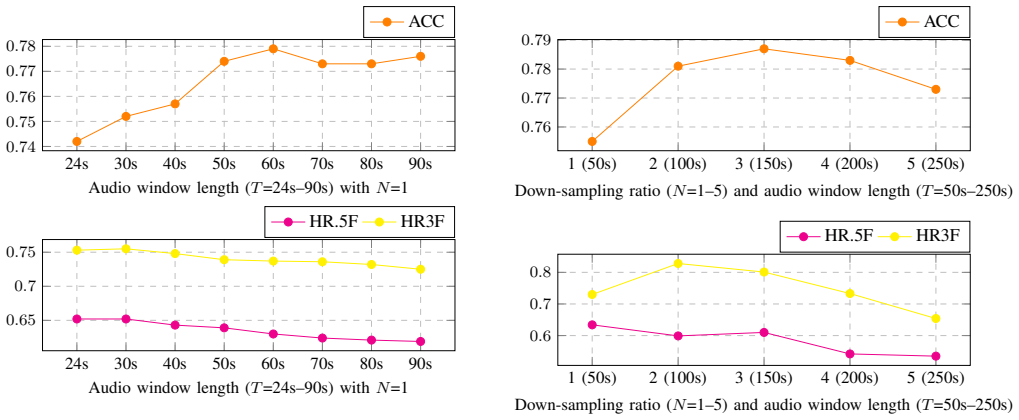
The paper establishes that fine-tuning with audio windows far longer than the pre-training window, together with temporally downsampled spectrograms, improves structural function prediction and boundary detection at 3-second tolerance. In 8-fold cross-validation on Harmonix, the best configurations reach ACC 0.787 and HR3F 0.826, both statistically significant against the MusicFM baseline; cross-dataset results remain competitive or state-of-the-art. The key trade-off, which the paper reports explicitly, is that strict 0.5-second boundary hit rate drops under coarse temporal resolution, and accuracy gains from longer windows diminish beyond about 50 seconds because of a transfer gap between pre-training and fine-tuning conditions.
Load-bearing premise
That a model pre-trained on 30-second clips at full temporal detail will still learn well when fine-tuned on clips up to nine times longer and with three times less temporal detail, with no special support for the new input sizes.
Editorial extensions
If this is right
- Full-song processing yields roughly 10 percent absolute accuracy improvement over window-based baselines on the Harmonix Set.
- Downsampling ratios of 2 or 3 balance function accuracy and boundary precision; ratios of 4 or 5 degrade boundary hit rates sharply.
- Temporal adaptation lets the model process up to nine times longer audio under similar memory constraints, making single-pass whole-song analysis feasible.
- Longer windows improve accuracy but gains saturate beyond roughly 50 seconds, so window length and downsampling ratio should be chosen jointly.
- Contrastive learning contributes a consistent, marginal accuracy improvement across all tested configurations.
Reading between the lines
- If temporal adaptation generalizes, the same recipe of extending windows and lowering temporal resolution could benefit other music-level tasks, such as long-form audio tagging or cover-song detection, where global context matters more than fine-grained detail.
- The HR.5F drop suggests a possible ceiling: a hybrid head that combines low-resolution global features with a high-resolution local branch might recover strict boundary precision while keeping accuracy gains, a variant the paper does not test.
- The paper's reliance on the backbone's inherent length generalization could be probed directly by comparing against a backbone fine-tuned or adapted with explicit long-context support; if that recovers HR.5F without losing ACC, the transfer gap is the true bottleneck.
- The diminishing returns beyond 50 seconds imply an optimal window-length times resolution budget that likely depends on the distribution of section durations in the target dataset, which the paper does not attempt to derive.
Editorial analysis
A structured set of objections, weighed in public.
Referee Report
Summary. The paper proposes a temporal adaptation strategy for fine-tuning pre-trained music foundation models (specifically MusicFM, a Conformer-based model) on music structure analysis. Two mechanisms are introduced: extending the input audio window beyond the pre-training length (e.g., from 30s to 90–270s) and reducing the temporal resolution of the input Mel-spectrogram by increasing the hop length by an integer factor N. An auxiliary contrastive loss regularizes segment embeddings. Experiments on Harmonix Set and RWC-Pop compare the method with pre-trained and non-pre-trained baselines in cross-validation and cross-dataset settings. The paper reports large gains in frame-wise function accuracy (ACC) and, on Harmonix, in the 3-second boundary hit-rate F-measure (HR3F), while noting a potential degradation on the stricter 0.5-second boundary metric (HR.5F). The central claim in the abstract and conclusion is that temporal adaptation improves both boundary detection and structural function prediction.
Significance. If the claims were fully supported, the paper would make a practical contribution: it shows that a pre-trained music foundation model can be fine-tuned on full-length songs in a single forward pass without additional memory overhead, and it provides a systematic study of the trade-off between window length and temporal resolution. A particular strength is that the MusicFM baseline is re-trained with a probing head under the same data splits as the proposed method, which makes the central comparison fairer than relying entirely on published numbers. The memory/time analysis in Table 3 is also useful. However, the significance is limited by the fact that the paper's own cross-dataset results contradict the 'both boundary detection and structural function prediction' claim, and by the lack of statistical detail behind the word 'significant.' The method does appear to improve ACC and HR3F in the Harmonix cross-validation setting, but the boundary-detection claim needs to be substantially recast or defended with additional analysis.
major comments (4)
- [Section 3.5, Table 2] The abstract and conclusion claim temporal adaptation 'significantly improves both boundary detection and structural function prediction,' but the cross-dataset RWC-Pop results in Table 2 show the opposite for boundary detection: every temporal-adaptation configuration has lower HR.5F than the MusicFM baseline (0.482–0.534 vs 0.636), and three of the four configurations have lower HR3F (0.667–0.788 vs 0.764). The sentence in Section 3.5 that low resolution 'may negatively impact performance on stricter metrics such as HR.5F' understates a consistent degradation on the central boundary metric. Please either provide a boundary-focused analysis that reconciles this with the abstract's 'both' claim, or revise the central claim to state explicitly which metrics improve in which evaluation settings.
- [Section 3.5, Table 1] The Harmonix cross-validation results also fail to support the 'both' claim if HR.5F is considered. The best ACC configurations (150s with N=3 and 180s with N=2) improve ACC and HR3F over MusicFM, but HR.5F drops from 0.640 to 0.610 and 0.601, respectively. The paper should state explicitly that performance on the strict boundary metric is traded off, and ideally report whether this drop is consistent across folds or songs; otherwise the 'improves boundary detection' claim should be restricted to HR3F.
- [Section 3.5, statistical test] The claim of a 'statistically significant' improvement (paired t-test, p<0.05) is not supported by any details: no test statistic, degrees of freedom, per-fold scores, or standard deviations are reported, and the t-test is not applied to HR.5F or to the cross-dataset RWC-Pop results. Without error bars or per-fold/per-song scores, the reader cannot assess the robustness of the ACC and HR3F improvements. Please report variability and apply significance testing to all metrics that are used in the central claim.
- [Section 3.3, Tables 1–2] Several headline comparisons mix evaluation protocols. SpecTNT and Harmonic-CNN are marked as 4-fold cross-validation while Morgan et al., MusicFM, and the proposed method are evaluated with 8-fold cross-validation, and Table 2 relies on numbers reported by the original papers for some baselines. Comparing 4-fold and 8-fold results, or reported values against re-computed values, can inflate apparent gains. Re-training the MusicFM probing head under matched splits is a good step, but the same matched-split treatment should be applied to at least the strongest SOTA baseline (Morgan et al.) before claiming state-of-the-art performance.
minor comments (4)
- [Section 3.6.5] The probing-head ablation references 'Table 3' for the MLP and Transformer head comparison, but Table 3 reports computational cost; the relevant results appear in Figure 5. Please correct the cross-reference.
- [Section 2.4, Eq. (3)] The phrase 'we normalize each by its magnitude' is not defined; it should be specified whether the normalization is per-batch, per-item, or based on a running estimate, as this directly affects reproducibility of the loss combination.
- [Figure 4] The right panel has a single axis label 'HR.5F HR3F' for two plotted curves; please separate the labels or use a legend so the two metrics are visually distinct.
- [Section 3.6.1] The ablation study says it uses 'one fixed pre-split Harmonix Set,' but it is not stated how this split was chosen or whether the same validation procedure was used for model selection as in the main cross-validation; a brief clarification would help.
Circularity Check
No significant circularity: the temporal-adaptation claims are empirical, and no reported quantity is constructed from its own target metric.
full rationale
The paper's derivation chain is an empirical fine-tuning pipeline rather than a formal derivation. Equations (1)-(3) are standard contrastive, weighted-BCE, and normalized composite losses with fixed weights; none of them encodes ACC, HR.5F, or HR3F, so no prediction reduces to its input by construction. The backbone (MusicFM) is an external checkpoint, and the label-smoothing/probing details inherited from Ref. [14] are cited external procedures from prior published work; although one author overlaps, the cited result is not the present paper's target claim and is not used to forbid alternatives or to justify the temporal-adaptation premise. The grid search over window length T and down-sampling ratio N on a fixed split followed by 8-fold cross-validation is model selection rather than fitting a parameter to the reported test metrics; the final numbers are measured on held-out folds. The paper also includes its own caveat in Sec. 3.5 that reduced resolution 'may negatively impact performance on stricter metrics such as HR.5F,' and Table 2 indeed shows lower HR.5F than MusicFM on RWC-Pop; that internal tension is a correctness/consistency concern, not circular reasoning. Because no load-bearing step reduces to its input, the circularity score is 0.
Assumptions & free parameters
free parameters (6)
- audio window length T =
50, 100, 150, 180, 200, 250, 270 seconds
- down-sampling ratio N =
1, 2, 3, 4, 5
- loss weight alpha =
0.1
- loss weight beta =
0.9
- loss weight gamma =
0.1
- contrastive margin m =
1
assumptions (3)
- domain assumption A Conformer encoder pre-trained on 30s windows at full resolution generalizes to inputs up to 270s and to hop lengths up to 3 times larger.
- domain assumption The fixed pre-split of Harmonix Set used for hyperparameter selection is representative enough that configurations chosen on it remain near-optimal on the 8-fold cross-validation partitions.
- domain assumption Baseline numbers taken from original papers are reproducible under the same evaluation protocol.
Cite this review
Pith. "Pith review of Temporal Adaptation of Pre-trained Foundation Models for Music Structure Analysis." pith.science (2026). https://pith.science/paper/2V3I32T7
@misc{pith2026250713572,
  author       = {Pith},
  title        = {Pith review of: Temporal Adaptation of Pre-trained Foundation Models for Music Structure Analysis},
  year         = {2026},
  howpublished = {\url{https://pith.science/paper/2V3I32T7}},
  note         = {Machine review of arXiv:2507.13572}
}
read the original abstract
Audio-based music structure analysis (MSA) is an essential task in Music Information Retrieval that remains challenging due to the complexity and variability of musical form. Recent advances highlight the potential of fine-tuning pre-trained music foundation models for MSA tasks. However, these models are typically trained with high temporal feature resolution and short audio windows, which limits their efficiency and introduces bias when applied to long-form audio. This paper presents a temporal adaptation approach for fine-tuning music foundation models tailored to MSA. Our method enables efficient analysis of full-length songs in a single forward pass by incorporating two key strategies: (1) audio window extension and (2) low-resolution adaptation. Experiments on the Harmonix Set and RWC-Pop datasets show that our method significantly improves both boundary detection and structural function prediction, while maintaining comparable memory usage and inference speed.
Figures


Figures from the paper (1 more)

Reference graph
Works this paper leans on
-
[1]
Lerdahl and R
F. Lerdahl and R. S. Jackendoff, A Generative Theory of Tonal Music, reissue, with a new preface . MIT press, 1996
1996
-
[2]
Learning hierarchical metrical structure beyond measures,
J. Jiang, D. Chin, Y . Zhang, and G. Xia, “Learning hierarchical metrical structure beyond measures,” in Ismir 2022 Hybrid Conference , 2022
work page 2022
-
[3]
Beat tracking by dynamic programming,
D. P. Ellis, “Beat tracking by dynamic programming,” Journal of New Music Research, vol. 36, no. 1, pp. 51–60, 2007
work page 2007
-
[4]
Better beat tracking through robust onset aggregation,
B. McFee and D. Ellis, “Better beat tracking through robust onset aggregation,” in International conference on acoustics, speech and signal processing, ser. ICASSP, 2014
work page 2014
-
[5]
Joint beat and downbeat tracking with recurrent neural networks
S. B ¨ock, F. Krebs, and G. Widmer, “Joint beat and downbeat tracking with recurrent neural networks.” in ISMIR. New York City, 2016, pp. 255–261
work page 2016
-
[6]
Using pairwise link prediction and graph attention networks for music structure analysis,
M. Buisson, B. Mcfee, and S. Essid, “Using pairwise link prediction and graph attention networks for music structure analysis,” in International Society for Music Information Retrieval Conference (ISMIR) , 2024
work page 2024
-
[7]
Automatic audio segmentation using a measure of audio novelty,
J. Foote, “Automatic audio segmentation using a measure of audio novelty,” in IEEE International Conference on Multimedia and Expo (ICME) , vol. 1, 2000, pp. 452–455
work page 2000
-
[8]
Structural segmentation of musical audio by constrained clustering,
M. Levy and M. Sandler, “Structural segmentation of musical audio by constrained clustering,” IEEE transactions on audio, speech, and language processing, vol. 16, no. 2, pp. 318–326, 2008
work page 2008
Show all 35 references
-
[9]
Convex non-negative matrix factorization for automatic music structure identification,
O. Nieto and T. Jehan, “Convex non-negative matrix factorization for automatic music structure identification,” in IEEE International Conference on Acoustics, Speech and Signal Processing (ICASSP) , 2013, pp. 236–240
2013
-
[10]
Music segment similarity using 2d-fourier magnitude coefficients,
O. Nieto and J. P. Bello, “Music segment similarity using 2d-fourier magnitude coefficients,” in IEEE International Conference on Acoustics, Speech and Signal Processing (ICASSP) , 2014, pp. 664–668
2014
-
[11]
Boundary detection in music structure analysis using convolutional neural networks
K. Ullrich, J. Schl ¨uter, and T. Grill, “Boundary detection in music structure analysis using convolutional neural networks.” in International Society for Music Information Retrieval Conference (ISMIR) , 2014, pp. 417–422
2014
-
[12]
Supervised chorus detection for popular music using convolutional neural network and multi-task learning,
J.-C. Wang, J. B. L. Smith, J. Chen, X. Song, and Y . Wang, “Supervised chorus detection for popular music using convolutional neural network and multi-task learning,” in IEEE International Conference on Acoustics, Speech and Signal Processing (ICASSP) , 2021, pp. 566–570
2021
-
[13]
Supervised metric learning for music structure features,
J.-C. Wang, J. B. L. Smith, W.-T. Lu, and X. Song, “Supervised metric learning for music structure features,” in International Society for Music Information Retrieval Conference (ISMIR) , 2021, pp. 730–737
2021
-
[14]
To catch a chorus, verse, intro, or anything else: Analyzing a song with structural functions,
J.-C. Wang, Y .-N. Hung, and J. B. Smith, “To catch a chorus, verse, intro, or anything else: Analyzing a song with structural functions,” in IEEE International Conference on Acoustics, Speech and Signal Processing (ICASSP), 2022, pp. 416–420
2022
-
[15]
Learning multi-level representations for hierarchical music structure analysis,
M. Buisson, B. Mcfee, S. Essid, and H.-C. Crayencour, “Learning multi-level representations for hierarchical music structure analysis,” in International Society for Music Information Retrieval Conference Conference (ISMIR), 2022
2022
-
[16]
MIREX 2013: Structural segmentation,
“MIREX 2013: Structural segmentation,” June 2013, http://www.music- ir.org/mirex/wiki/2013:Structural Segmentation
2013
-
[17]
A meta-analysis of the mirex structure segmentation task,
J. B. Smith and E. Chew, “A meta-analysis of the mirex structure segmentation task,” in International Society for Music Information Retrieval Conference (ISMIR) , 2013
2013
-
[18]
Audio-based music structure analysis: Current trends, open challenges, and applications,
O. Nieto, G. J. Mysore, C.-i. Wang, J. B. Smith, J. Schl ¨uter, T. Grill, and B. McFee, “Audio-based music structure analysis: Current trends, open challenges, and applications,” Transactions of the International Society for Music Information Retrieval , vol. 3, no. 1, 2020
2020
-
[19]
Enhanced hierarchical music structure annotations via feature level similarity fusion,
C. J. Tralie and B. McFee, “Enhanced hierarchical music structure annotations via feature level similarity fusion,” in IEEE International Conference on Acoustics, Speech and Signal Processing (ICASSP) , 2019, pp. 201–205
2019
-
[20]
Music structure boundary detection and labelling by a deconvolution of path-enhanced self-similarity matrix,
T. Cheng, J. B. Smith, and M. Goto, “Music structure boundary detection and labelling by a deconvolution of path-enhanced self-similarity matrix,” in IEEE International Conference on Acoustics, Speech and Signal Processing (ICASSP), 2018, pp. 106–110
2018
-
[21]
Lerch, An introduction to audio content analysis: Music Information Retrieval tasks and applications
A. Lerch, An introduction to audio content analysis: Music Information Retrieval tasks and applications . John Wiley & Sons, 2022
2022
-
[22]
State of the art report: Audio-based music structure analysis
J. Paulus, M. M¨uller, and A. Klapuri, “State of the art report: Audio-based music structure analysis.” in International Society for Music Information Retrieval Conference (ISMIR) . Utrecht, 2010, pp. 625–636
2010
-
[23]
MERT: acoustic music understanding model with large-scale self-supervised training,
Y . Li, R. Yuan, G. Zhang, Y . Ma, X. Chen, H. Yin, C. Xiao, C. Lin, A. Ragni, E. Benetos, N. Gyenge, R. B. Dannenberg, R. Liu, W. Chen, G. Xia, Y . Shi, W. Huang, Z. Wang, Y . Guo, and J. Fu, “MERT: acoustic music understanding model with large-scale self-supervised training,...
2024
-
[24]
A foundation model for music informatics,
M. Won, Y .-N. Hung, and D. Le, “A foundation model for music informatics,” in IEEE International Conference on Acoustics, Speech and Signal Processing (ICASSP) , 2024, pp. 1226–1230
2024
-
[25]
Muq: Self-supervised music representation learning with mel residual vector quantization,
H. Zhu, Y . Zhou, H. Chen, J. Yu, Z. Ma, R. Gu, Y . Luo, W. Tan, and X. Chen, “Muq: Self-supervised music representation learning with mel residual vector quantization,” arXiv preprint arXiv:2501.01108 , 2025
2025 arXiv
-
[26]
Foundation models for music: A survey,
Y . Ma, A. Øland, A. Ragni, B. M. Del Sette, C. Saitis, C. Donahue, C. Lin, C. Plachouras, E. Benetos, E. Shatri et al. , “Foundation models for music: A survey,” arXiv preprint arXiv:2408.14340 , 2024
2024 arXiv
-
[27]
MARBLE: Music Audio Representation Benchmark for Universal Evaluation,
R. Yuan, Y . Ma, Y . Li, G. Zhang, X. Chen, H. Yin, L. Zhuo, Y . Liu, J. Huang, Z. Tian, B. Deng, N. Wang, W. Chen, G. Xia, W. Xue, S. Liu, S. Wang, R. Liu, Y . Guo, and J. Fu, “MARBLE: Music Audio Representation Benchmark for Universal Evaluation,” Jun. 2023
2023
-
[28]
Codified audio language modeling learns useful representations for music information retrieval,
R. Castellon, C. Donahue, and P. Liang, “Codified audio language modeling learns useful representations for music information retrieval,” in International Society for Music Information Retrieval Conference (ISMIR), 2021, pp. 88–96
2021
-
[29]
The Harmonix Set: Beats, Downbeats, and Functional Segment Annotations of Western Popular Music
O. Nieto, M. C. McCallum, M. E. Davies, A. Robertson, A. M. Stark, and E. Egozy, “The Harmonix Set: Beats, Downbeats, and Functional Segment Annotations of Western Popular Music.” in International Society for Music Information Retrieval Conference (ISMIR) , 2019, pp. 565–572
2019
-
[30]
RWC Music Database: Popular, Classical and Jazz Music Databases
M. Goto, H. Hashiguchi, T. Nishimura, and R. Oka, “RWC Music Database: Popular, Classical and Jazz Music Databases.” in International Symposium for Music Information Retrieval (ISMIR) , vol. 2, 2002, pp. 287–288
2002
-
[31]
Conformer: Convolution-augmented transformer for speech recognition,
A. Gulati, J. Qin, C.-C. Chiu, N. Parmar, Y . Zhang, J. Yu, W. Han, S. Wang, Z. Zhang, Y . Wu et al. , “Conformer: Convolution-augmented transformer for speech recognition,” in Proc. Interspeech , 2020, pp. 5036–5040
2020
-
[32]
Focal loss for dense object detection,
T.-Y . Lin, P. Goyal, R. Girshick, K. He, and P. Doll ´ar, “Focal loss for dense object detection,” in Proceedings of the IEEE international conference on computer vision , 2017, pp. 2980–2988
2017
-
[33]
All-in-one metrical and functional structure analysis with neighborhood attentions on demixed audio,
T. Kim and J. Nam, “All-in-one metrical and functional structure analysis with neighborhood attentions on demixed audio,” in 2023 IEEE Workshop on Applications of Signal Processing to Audio and Acoustics (WASPAA) . IEEE, 2023, pp. 1–5
2023
-
[34]
Evaluation of cnn- based automatic music tagging models,
M. Won, A. Ferraro, D. Bogdanov, and X. Serra, “Evaluation of cnn- based automatic music tagging models,” CoRR, vol. abs/2006.00751, 2020
2006 arXiv
-
[35]
SpecTNT: a time-frequency transformer for music audio,
W.-T. Lu, J.-C. Wang, M. Won, K. Choi, and X. Song, “SpecTNT: a time-frequency transformer for music audio,” in International Society for Music Information Retrieval Conference (ISMIR) , 2021, pp. 396–403
2021
Reviewed August 6, 2026 · model on record in the stance chip above.
Discussion (0). Sign in to comment.