REVIEW 2 major objections 6 minor 42 references
Nonlinear Distortion Equalization in Multi-Span Optical Links Via a Feed-Forward Photonic Neural Network
T0 review · 2 major / 6 minor · reviewed 2026-08-06 · deepseek-v4-flash
Pith's one-line read A single integrated photonic chip can equalize both chromatic dispersion and self-phase modulation in IMDD optical links without digital signal processing.
desk verdict In-sample training/eval undermines the headline SPM claims, but the device work is solid and the 100 Gbaud simulations give partial support. read the letter →
The pith
A machine-rendered reading of the paper's core claim, the machinery that carries it, and where it could break.
The reading
What carries the argument
The central object is a feed-forward photonic neural network built as an $N$-tap finite-impulse-response filter with trainable per-tap amplitude $a_i$ and phase $\phi_i$ weights, followed by the square-modulus photodetector acting as the nonlinear activation function. The optical field $x(t)$ is split into $N$ delayed copies spaced by $\Delta t$ and recombined as $y(t)=\sum_{i=1}^{N} x[t-(i-1)\Delta t]\, a_i k_i e^{j\phi_i}$, where $k_i$ are fixed calibrated channel losses. In the linear regime the phase weights alone are trained to approximate the inverse of the fiber's dispersion impulse response; in the nonlinear regime the amplitude weights become essential because they select which delayed samples are recombined, while the photodetector's square-law operation supplies the nonlinearity needed to counteract self-phase modulation. Training uses a particle-swarm optimizer on a two-sample separation loss that maximizes the eye-diagram aperture.
What would settle it
Train the PNN on the periodic PRBS-10 waveform as the paper does, then send a long independent random PAM2 sequence through the 200 km dispersion-limited and 450 km SPM-limited links at 10 Gbaud; if the measured BER exceeds $10^{-3}$ while the periodic training sequence stays below it, the device is correcting a specific distortion pattern rather than the channel.
Extended reading notes
Core claim
On the paper's own terms, the central discovery is that a time-delayed complex perceptron realized in silicon photonics—an 8-tap feed-forward filter with trainable complex weights followed by square-law detection—can correct both linear and nonlinear fiber impairments in IMDD links. In the linear regime, phase-only training synthesizes the inverse of the fiber dispersion impulse response, extending chromatic dispersion compensation from the previously demonstrated 125 km to 200 km. In the nonlinear regime, with dispersion removed after each span, the amplitude weights and the photodetector nonlinearity together restore eye openings for self-phase-modulation-distorted signals up to 450 km, and the measured bit-error-rate profiles move close to back-to-back performance. The optimized eight-tap layout, rescaled to a 5 ps tap delay, is simulated at 100 Gbaud and reports up to 13 dB of BER reduction for SPM and about an order of magnitude for XPM.
Load-bearing premise
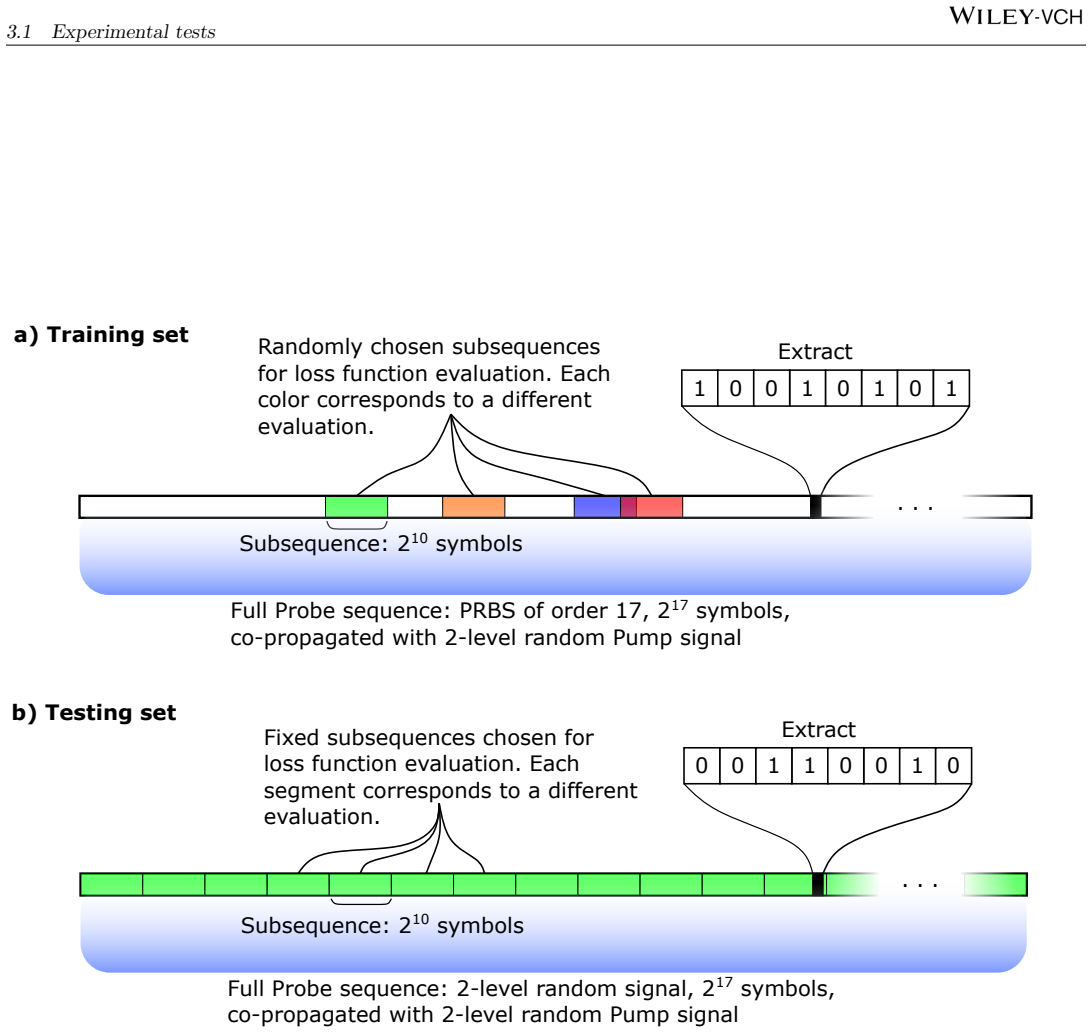
The experimental equalization results are judged on the same periodic PRBS-10 waveform used for training, so the whole 10 Gbaud claim rests on the assumption that equalizing that one 1024-bit pattern also equalizes arbitrary PAM2 data streams.
Editorial extensions
If this is right
- Chromatic dispersion equalization at 10 Gbaud is demonstrated for 200 km with phase-only training, and residual dispersion from a partially compensating dispersion unit is equalized at 450 km.
- Self-phase-modulation-distorted PAM2 signals at 10 Gbaud are equalized up to 450 km, with the BER kept below the $10^{-3}$ pre-FEC threshold and the equalized BER-vs-power profile approaching back-to-back performance.
- The all-optical equalizer consumes about 290 mW of electrical power for its thermal heaters and avoids digital processing latency, at the cost of 18.4-22 dB insertion loss.
- A rescaled 8-tap device with 5 ps tap delay is predicted by simulation to provide up to 13 dB BER reduction for 100 Gbaud SPM and about an order-of-magnitude BER reduction for XPM with an unobserved pump sequence.
- PAM4 signals also show up to an order-of-magnitude BER reduction when the PNN is trained in full amplitude-phase configuration, indicating multi-level modulation formats are within reach.
Reading between the lines
- Because the 10 Gbaud experiment trains and evaluates on the same periodic PRBS-10 waveform, the reported experimental BER gains are not by themselves evidence the equalizer generalizes to arbitrary PAM2 traffic; the paper reintroduces train/test separation only in its 100 Gbaud simulations.
- A realistic deployment path implied by the paper is to train the weights once and then freeze them, which requires that the equalizer stay valid as temperature, laser drift, and fiber conditions change; that stability is not measured here.
- If integrated semiconductor optical amplifiers behave as the paper expects, the 18-22 dB insertion loss could be compensated on-chip, making the photonic network a credible drop-in replacement for DSP equalizers in short-reach transceivers.
- The simulated XPM result suggests a testable generalization: a single photonic network trained with random, unobserved pump patterns may keep working at detunings beyond 50 GHz, because the equalizer only needs probe-history memory rather than knowledge of the pump.
Signed reviews
Editorial analysis
A structured set of objections, weighed in public.
Referee Report
Summary. The paper proposes and experimentally characterizes an integrated silicon photonic feed-forward neural network (PNN) for equalization of IMDD PAM2 signals after multi-span fiber propagation. The PNN is an 8-tap optical FIR filter with tunable amplitude and phase weights, followed by square-law photodetection as the nonlinear activation. Experiments at 10 Gbaud demonstrate chromatic-dispersion equalization up to 200 km and SPM equalization up to 450 km when per-span dispersion compensation is used, with BER restored below the 1e-3 pre-FEC threshold. Simulations at 100 Gbaud, which do separate training and testing sequences, explore scalability to higher baud rates and XPM compensation. The central methodological caveat is that the experimental training and evaluation use the same periodic PRBS-10 sequence, so the reported experimental BER improvements are in-sample measurements.
Significance. If the claims hold, the work is significant: it extends a previously demonstrated photonic CD compensator to nonlinear SPM equalization with a single integrated device, offering a route toward DSP-less IMDD receivers. Strengths include the full experimental validation with eye diagrams and BER maps across several powers and distances, the detailed description of the recirculating-loop setup, and the 100 Gbaud simulation study with a proper training/testing split. The main weakness is that the experimental equalization results are optimized and evaluated on the same periodic waveform, which substantially weakens the claim of general PAM2 equalization; the simulations demonstrate that the authors know how to do an out-of-sample test, but the headline experimental results do not include one.
major comments (2)
- [Section 2.1.1 and Figures 4-6] The experimental equalization results are in-sample. The paper states in Section 2.1.1 that 'the proposed approach has no distinction between the training and testing data set', and all BER values reported in Figures 4-6 are obtained with the same periodic PRBS-10 sequence that is used for PSO training. An equalizer fitted to a single repeated 1024-symbol waveform can exploit sequence-specific artifacts, such as the exact alignment of the acquisition window with the periodic pattern, rather than learning a general input-output mapping for arbitrary PAM2 data. The BER reductions in Figures 5-6, including the sub-1e-3 performance at 450 km, therefore do not establish that the PNN generalizes to arbitrary data. Because the central claim of the paper is that the PNN equalizes PAM2 transmission, this is a load-bearing issue. I recommend adding at least one out-of-sample experimental test, e.g., training on PRBS-10 and testing on a different PRBS or a random sequence of the same length, or, if that is not possible, explicitly reframing the experimental results as sequence-specific proof-of-concept and tempering the generalization claims in the abstract and conclusion.
- [Section 2.1.1, Eq. (3)] The justification that a single PRBS-10 sequence is sufficient for both training and testing rests on the claim that distortions involve at most three adjacent bauds. Eq. (3) is a first-order broadening estimate and does not bound the memory of the nonlinear channel. In the SPM regime, the nonlinear phase accumulated in each span depends on the intensity history over the CD-broadened waveform, and the TDC removes only the linear CD, so the effective distortion memory can extend beyond the 35 ps per-span broadening. Moreover, at 200 km in the linear regime the paper itself quotes a total spread of 240 ps, which exceeds the PNN observation window of 175 ps, so it is not self-evident that the chosen input sequence exposes the PNN to all relevant distortion conditions. The authors should provide direct evidence of the channel-memory assumption, for example by testing on sequences with different lengths or orders, rather than relying on the analytic estimate in Eq. (3).
minor comments (6)
- [Table 2] The sign of β2 is inconsistent: the text in Section 2.1.1 gives β2 = −0.022 ps²/m, while Table 2 lists β2 = 0.022 ps²/m without a minus sign. Please unify the sign convention.
- [Section 5.1] The text contains a typo: 'Plank constant' should be 'Planck constant'.
- [Section 2.1.1] The phrase 'the total symbol time width of 1/B + ΔT = 240 ps' is unclear because the symbol period is 100 ps; the quantity described is the total pulse broadening, not the symbol time width. Please rephrase for clarity.
- [Section 2.1.1 and 3.1] The Particle Swarm Optimizer settings (number of particles, number of iterations, number of restarts, and the loss-function evaluation protocol) are not reported. These details are needed for reproducibility and for assessing the risk of overfitting during training.
- [Figure 9] In the caption of Figure 9, the unitary delay is denoted 't'; please use 'Δt' consistently with Eq. (1) to avoid confusion with time.
- [Section 4] The power consumption statement (290 ± 40 mW) refers only to the thermal heaters; the EDFA used to compensate for the 18.4–22 dB insertion loss is not included in this figure. The phrase 'fully optical signal processing with minimal latency and power consumption' should therefore be qualified.
Circularity Check
Experimental equalization results are trained and evaluated on the same periodic PRBS-10 sequence, so the reported BER improvements are in-sample fits rather than out-of-sample predictions.
-
fitted input called prediction
[Section 2.1.1; results in Section 3.1 (Figures 4-6)]
"The proposed approach has no distinction between the training and testing data set since the chosen input sequence allows the PNN to experience all the observable distortion conditions generated by adjacent symbols."
The PSO optimizer selects the PNN weights by minimizing the separation loss on this fixed 1024-symbol periodic waveform, and the equalized BER profiles and eye diagrams displayed in Figures 4-6 are measured on that same waveform. There is therefore no independent test set: the reported 'equalized' BER is the training-set performance of the fitted weights. Calling this a demonstration of equalization for PAM2 signals reduces to the assertion that this one periodic sequence is representative of all possible data, which is exactly the generalization step that the single-sequence protocol assumes rather than verifies. The 100 Gbaud simulations do separate training and testing, but the headline experimental CD/SPM claims do not.
full rationale
The central experimental claims in the abstract and Section 3.1 (CD equalization to 200 km and SPM equalization to 450 km at 10 Gbaud) rest on measurements in which the PNN weights were trained with PSO on the same periodic PRBS-10 sequence used for the BER evaluation. Section 2.1.1 states explicitly that there is no distinction between training and testing data. The equalized BER values, including null BER replaced by the 2e-6 floor, are therefore in-sample metrics, not out-of-sample predictions; the argument that PRBS-10 covers all relevant 3-baud distortion conditions is a coverage assumption, not an empirical generalization test. This is the fitted-input-called-prediction pattern, not a mathematical self-definition, so I score it 6 rather than higher. The 100 Gbaud simulated SPM/XPM results use separate random training and testing sequences (Section 2.2.1, Figure 3), so those claims carry independent content. Self-citations to prior work [11,13] for the device and separation loss are used to describe methodology, not to supply the equalization result itself, and no uniqueness theorem or renamed-known-result pattern is present.
Assumptions & free parameters
free parameters (5)
- PNN amplitude weights a_i =
varies per scenario (0 to 1)
- PNN phase weights phi_i =
varies per scenario (0 to 2*pi)
- Channel loss factors k_i =
Table 1: 0.0057 to 0.0306
- Thermal noise variance sigma_T^2 =
0.65 mV^2
- Shot noise coefficient sigma_S^2 =
0.05 mV
assumptions (5)
- domain assumption Fiber propagation is modeled by the nonlinear Schrodinger equation solved with the Split-Step Fourier Method.
- ad hoc to paper The square-law photodetector acts as the nonlinear activation function of the PNN, and a single layer of tapped delays plus this nonlinearity is sufficient to compensate SPM distortions.
- domain assumption The PRBS-10 sequence contains all distortion conditions because ISI spans at most three adjacent symbols.
- domain assumption The recirculating fiber loop with a TDC and EDFA faithfully emulates multi-span propagation.
- domain assumption The simulation calibrated at 10 Gbaud remains valid for 100 Gbaud after rescaling bandwidths.
Cite this review
Pith. "Pith review of Nonlinear Distortion Equalization in Multi-Span Optical Links Via a Feed-Forward Photonic Neural Network." pith.science (2026). https://pith.science/paper/TOGDU4AV
@misc{pith2026250713775,
  author       = {Pith},
  title        = {Pith review of: Nonlinear Distortion Equalization in Multi-Span Optical Links Via a Feed-Forward Photonic Neural Network},
  year         = {2026},
  howpublished = {\url{https://pith.science/paper/TOGDU4AV}},
  note         = {Machine review of arXiv:2507.13775}
}
read the original abstract
Linear and nonlinear distortions in optical communication signals are equalized using an integrated feed-forward Photonic Neural Network (PNN). The PNN is based on a linear stage made of an 8-tap Finite Impulse Response (FIR) filter, featuring tunable amplitude and phase weights at each tap, and of a nonlinear stage achieved through the square modulus operation at the end-of-line photodetector. Within an Intensity Modulation/Direct Detection (IMDD) system, the PNN is applied to 2-level Pulse Amplitude Modulated (PAM2) optical signals undergoing multi-span propagation. Each 50 km segment includes fiber transmission, optical power restoration, and optional chromatic dispersion compensation via a Tunable Dispersion Compensator. Positioned at the receiver, the PNN enables fully optical signal processing with minimal latency and power consumption. Experimental validation is conducted using a Silicon-On-Insulator device operating on 10 Gbps signals. It demonstrates chromatic dispersion equalization over distances up to 200 km and self-phase modulation (with dispersion removed) up to 450 km. Simulations explore PNN adaptation for 100 Gbps modulations and its potential for cross-phase modulation equalization.
Figures


Figures from the paper (11 more)


Reference graph
Works this paper leans on
-
[1]
, " * write output.state after.block =
ENTRY address author booktitle chapter edition editor eid howpublished institution isbn issn journal key month note number organization pages publisher school series title type url volume year label INTEGERS output.state before.all mid.sentence after.sentence after.block FUNCTION init.state.consts #0 'before.all := #1 'mid.sentence := #2 'after.sentence :...
-
[2]
" write newline "" before.all 'output.state := FUNCTION n.dashify 't := "" t empty not t #1 #1 substring "-" = t #1 #2 substring "--" = not "--" * t #2 global.max substring 't := t #1 #1 substring "-" = "-" * t #2 global.max substring 't := while if t #1 #1 substring * t #2 global.max substring 't := if while FUNCTION word.in bbl.in capitalize " " * FUNCT...
- [3]
-
[4]
Li, Recent advances in coherent optical communication, Adv
G. Li, Recent advances in coherent optical communication, Adv. Opt. Photon. 2009, 1, 2 279
work page 2009
-
[5]
X. Liu, S. Chandrasekhar, P. J. Winzer, Digital signal processing techniques enabling multi- T b/s superchannel transmission: an overview of recent advances in DSP -enabled superchannels, IEEE Signal Processing Magazine 2014, 31, 2 16
work page 2014
-
[6]
X. Zhou, L. Nelson, Advanced DSP for 400 G b/s and beyond optical networks, Journal of lightwave technology 2014, 32, 16 2716
work page 2014
-
[7]
J. L. Sonntag, J. Stonick, A digital clock and data recovery architecture for multi-gigabit/s binary links, IEEE Journal of Solid-State Circuits 2006, 41, 8 1867
work page 2006
- [8]
Show all 42 references
-
[9]
Huang, Y
L. Huang, Y. Xu, W. Jiang, L. Xue, W. Hu, L. Yi, Performance and C omplexity A nalysis of C onventional and D eep L earning E qualizers for the H igh- S peed IMDD PON , Journal of Lightwave Technology 2022, 40, 14 4528
2022
-
[10]
Agrawal, Chapter 1 - I ntroduction, In Nonlinear F iber O ptics ( F ifth E dition) , Optics and Photonics, 1--25
G. Agrawal, Chapter 1 - I ntroduction, In Nonlinear F iber O ptics ( F ifth E dition) , Optics and Photonics, 1--25. Academic Press, Boston, fifth edition edition, 2013
2013
-
[11]
F. Frey, R. Elschner, J. K. Fischer, Estimation of trends for coherent DSP ASIC power dissipation for different bitrates and transmission reaches, In Photonic Networks; 18. ITG-Symposium. VDE, 2017 1--8
2017
-
[12]
Cheng, C
J. Cheng, C. Xie, Y. Chen, X. Chen, M. Tang, S. Fu, Comparison of C oherent and IMDD T ransceivers for I ntra D atacenter O ptical I nterconnects, In 2019 Optical Fiber Communications Conference and Exhibition (OFC). 2019 1--3
2019
-
[13]
Staffoli, G
E. Staffoli, G. Maddinelli, L. Pavesi, A S ilicon P hotonic N eural N etwork for C hromatic D ispersion C ompensation in 20 G bps PAM4 S ignal at 125 km and its S calability up to 100 G bps, J. Lightwave Technol. 2025, 43, 2 557
2025
-
[14]
Staffoli, M
E. Staffoli, M. Mancinelli, P. Bettotti, L. Pavesi, Equalization of a 10 G bps IMDD signal by a small silicon photonics time delayed neural network, Photon. Res. 2023, 11, 5 878
2023
-
[15]
Staffoli, G
E. Staffoli, G. Maddinelli, M. Mancinelli, P. Bettotti, L. Pavesi, Chromatic dispersion compensation via an all-optical perceptron , In G. Li, K. Nakajima, A. K. Srivastava, editors, Next-Generation Optical Communication: Components, Sub-Systems, and Systems XIII, volume 12894...
2024 doi
-
[16]
P. R. N. Marciano, E. Staffoli, G. Maddinelli, M. S. Coelho, L. C. B. Silva, J. A. L. Silva, M. J. Pontes, M. E. V. Segatto, L. Pavesi, Chromatic D istortion P recompensation in OFDM - B ased O ptical S ystems T hrough an I ntegrated S ilicon P hotonic N eural N etwork, Journa...
2025
-
[17]
C. M. Bishop, N. M. Nasrabadi, Pattern recognition and machine learning, volume 4, chapter 4, Springer, 2006
2006
-
[18]
Mancinelli, D
M. Mancinelli, D. Bazzanella, P. Bettotti, L. Pavesi, A photonic complex perceptron for ultrafast data processing, Scientific Reports 2022, 12, 1 1
2022
-
[19]
R. Hui, K. R. Demarest, C. T. Allen, Cross-phase modulation in multispan WDM optical fiber systems, Journal of lightwave Technology 1999, 17, 6 1018
1999
-
[20]
Agrawal, Chapter 2 - P ulse P ropagation in F ibers, In Nonlinear Fiber Optics (Fifth Edition), Optics and Photonics, 27--56
G. Agrawal, Chapter 2 - P ulse P ropagation in F ibers, In Nonlinear Fiber Optics (Fifth Edition), Optics and Photonics, 27--56. Academic Press, Boston, fifth edition edition, 2013
2013
-
[21]
G. P. Agrawal, Chapter 7 - L oss M anagement, In Fiber‐Optic Communication Systems, 235--275. John Wiley & Sons, Ltd, ISBN 9781119737391, 2021
2021
-
[22]
Chomycz, Optical S ignal to N oise R atio, In Planning Fiber Optics Networks, chapter 3
B. Chomycz, Optical S ignal to N oise R atio, In Planning Fiber Optics Networks, chapter 3. McGraw-Hill, New York, 1st edition, 2009
2009
-
[23]
Efron, Bootstrap methods: another look at the jackknife, In Breakthroughs in statistics: Methodology and distribution, 569--593
B. Efron, Bootstrap methods: another look at the jackknife, In Breakthroughs in statistics: Methodology and distribution, 569--593. Springer, 1992
1992
-
[24]
Ad \`e r, D
H. Ad \`e r, D. Hand, G. Mellenbergh, Advising on R esearch M ethods: A C onsultant's C ompanion , Johannes Van Kessel Publishing, 2008
2008
-
[25]
100 G B A S E Q S F P -100 G M odules D ata S heet --- cisco.com, https://www.cisco.com/c/en/us/products/collateral/interfaces-modules/transceiver-modules/datasheet-c78-736282.html, [Accessed 21-03-2025]
2025
-
[26]
Z. Xu, C. Sun, J. H. Manton, W. Shieh, Joint equalization of linear and nonlinear impairments for pam4 short-reach direct detection systems, IEEE Photonics Technology Letters 2021, 33, 9 425
2021
-
[27]
C isco T ransceiver M odules - C isco 200 G Q S F P 56 C ables and T ransceiver M odules D ata S heet --- cisco.com, https://www.cisco.com/c/en/us/products/collateral/interfaces-modules/transceiver-modules/nb-06-200g-qsfp56-cables-trans-mod-ds-cte-en.html, [Accessed 21-03-2025]
2025
-
[28]
X. Fang, M. Bi, Z. Li, L. Jin, G. Yang, J. Shang, M. Hu, Low complexity deep neural network equalizer based on the multi-source domain transfer learning in IMDD system, Optics Express 2024, 32, 19 33004
2024
-
[29]
D. Li, H. Song, W. Cheng, M. Cheng, S. Fu, M. Tang, D. Liu, L. Deng, Low-complexity equalization scheme for suppressing FFE -enhanced in-band noise and ISI in 100 G bps PAM4 optical IMDD system, Optics letters 2020, 45, 9 2555
2020
-
[30]
H. Wang, P. Torres-Ferrera, G. Rizzelli, V. Ferrero, R. Gaudino, 100 G bps/ C -band CD digital pre-compensated and direct-detection links with simple non-linear compensation, IEEE Photonics Journal 2021, 13, 4 1
2021
-
[31]
C isco T ransceiver M odules - C isco Q S F P - D D 800 T ransceiver M odules D ata S heet --- cisco.com, https://www.cisco.com/c/en/us/products/collateral/interfaces-modules/transceiver-modules/qsfp-dd800-transceiver-modules-ds.html, [Accessed 21-03-2025]
2025
-
[32]
Sackesyn, C
S. Sackesyn, C. Ma, J. Dambre, P. Bienstman, Experimental realization of integrated photonic reservoir computing for nonlinear fiber distortion compensation, Optics Express 2021, 29, 20 30991
2021
-
[33]
S. Wang, N. Fang, L. Wang, Signal recovery based on optoelectronic reservoir computing for high speed optical fiber communication system, Optics Communications 2021, 495 127082
2021
-
[34]
S. Li, S. Pachnicke, Optical equalization using photonic reservoir computing with optical analog signal injection, In Asia Communications and Photonics Conference. Optica Publishing Group, 2019 T4G--5
2019
-
[35]
Est \'e banez, S
I. Est \'e banez, S. Li, J. Schwind, I. Fischer, S. Pachnicke, A. Argyris, 56 GB aud PAM-4 100 km transmission system with photonic processing schemes, Journal of Lightwave Technology 2022, 40, 1 55
2022
-
[36]
Sheng, C
W. Sheng, C. Liu, J. Xiao, L. Sun, Y. Cai, H. Fu, Q. Li, G. Ning Liu, Complex-valued recurrent neural network equalizer with low complexity for a 120- G bps 50-km optical PAM-4 IM/DD system, Optics Express 2024, 32, 16 27624
2024
-
[37]
X. Zuo, L. Pei, B. Bai, J. Wang, J. Zheng, T. Ning, F. Dong, Z. Zhao, Integrated silicon photonic reservoir computing with PSO training algorithm for fiber communication channel equalization, Journal of Lightwave Technology 2023, 41, 18 5841
2023
-
[38]
H. M. Nguyen, K. Igarashi, K. Katoh, K. Kikuchi, Tunable optical equalizer for 40- G bps intensity-modulated signal using PLC -based finite-impulse-response filter, In 36th European Conference and Exhibition on Optical Communication. IEEE, 2010 1--3
2010
-
[39]
G. M. Brodnik, C. Pinho, F. Chang, D. J. Blumenthal, Extended reach 40km transmission of C -band real-time 53.125 G bps PAM-4 enabled with a photonic integrated tunable lattice filter dispersion compensator, In 2018 Optical Fiber Communications Conference and Exposition (OFC)....
2018
-
[40]
Takiguchi, Integrated-optic chromatic dispersion compensator with completely passive operation and wide operational bandwidth, Optics Continuum 2023, 2, 12 2529
K. Takiguchi, Integrated-optic chromatic dispersion compensator with completely passive operation and wide operational bandwidth, Optics Continuum 2023, 2, 12 2529
2023
-
[41]
Meena, K
D. Meena, K. Sarath, F. Francis, E. Dipin, T. Srinivas, Mitigation of EDFA transient effects in variable duty cycle pulsed signals, Defence Technology 2019, 15, 3 276
2019
-
[42]
G. P. Agrawal, Chapter 4 - O ptical R eceivers, In Fiber‐Optic Communication Systems, 128--181. John Wiley & Sons, Ltd, ISBN 9780470918524, 2010
2010
Reviewed August 6, 2026 · model on record in the stance chip above.
Discussion (0). Continue with ORCID to comment.