On two fundamental properties of the zeros of spectrograms of noisy signals
Pith reviewed 2026-05-19 04:16 UTC · model grok-4.3
The pith
Zeros of a noisy spectrogram outline the signal support and form lines between interfering chirps.
A machine-rendered reading of the paper's core claim, the machinery that carries it, and where it could break.
Core claim
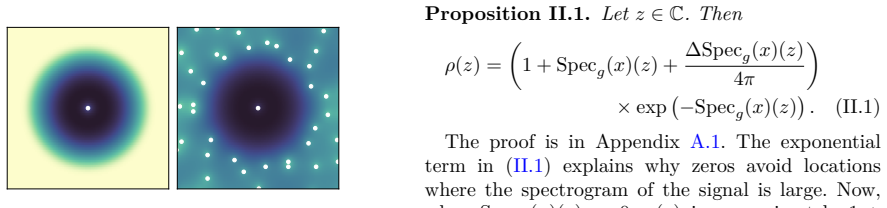
Through computations on simple toy signals, the intensity of zeros in pure noise combined with Rouché's theorem shows that zeros delineate the support of an added signal and form deterministic structures as if trapped by interferences, with the strength of these effects increasing with signal-to-noise ratio; in particular, even nearly superimposed interfering chirps produce visible lines of zeros.
What carries the argument
The intensity formula for zeros of the spectrogram of white Gaussian noise, together with Rouché's theorem applied to the perturbation introduced by a deterministic signal component.
If this is right
- A single chirp or tone produces zeros that systematically avoid its instantaneous frequency curve.
- Interfering chirps create a deterministic line of zeros between their supports even when the chirps are close in frequency.
- The delineation and trapping become more pronounced as the signal-to-noise ratio increases.
- These zero patterns remain visible and structured for nearly superimposed interfering components.
Where Pith is reading between the lines
- Detection algorithms could be built that scan zero patterns for holes or lines instead of thresholding spectrogram energy.
- The same intensity and Rouché arguments might be tested on other quadratic time-frequency representations beyond the spectrogram.
- Numerical experiments on real recorded signals would show how far the toy-model predictions carry over when the noise is not perfectly white.
Load-bearing premise
That the zero distributions and analytic properties derived for the chosen simple toy signals extend in a representative way to arbitrary signals in white Gaussian noise.
What would settle it
Compute the zeros of the spectrogram for a sum of several random-phase tones or a more complex waveform and check whether the predicted avoidance of the signal support and formation of interference lines still appear at moderate SNR.
Figures


read the original abstract
The spatial distribution of the zeros of the spectrogram is significantly altered when a signal is added to white Gaussian noise. The zeros tend to delineate the support of the signal, and deterministic structures form in the presence of interference, as if the zeros were trapped. While sophisticated methods have been proposed to detect signals as holes in the pattern of spectrogram zeros, few formal arguments have been made to support the delineation and trapping effects. Through detailed computations for simple toy signals, we show that two basic mathematical arguments, the intensity of zeros and Rouch\'e's theorem, allow discussing delineation and trapping, and the influence of parameters like the signal-to-noise ratio. In particular, interfering chirps, even nearly superimposed, yield an easy-to-detect deterministic structure among zeros.
Editorial analysis
A structured set of objections, weighed in public.
Referee Report
Summary. The manuscript claims that the zeros of spectrograms of signals in additive white Gaussian noise tend to delineate the time-frequency support of the signal and form deterministic structures (trapping) in the presence of interference. It argues that these effects, along with their dependence on signal-to-noise ratio, can be explained using the known intensity formula for zeros of Gaussian analytic functions together with Rouché's theorem, and demonstrates the arguments through explicit computations on simple toy signals such as pure tones and single or interfering linear chirps.
Significance. If the central claims hold, the work supplies a concrete mathematical grounding, based on classical complex analysis, for the empirical observation that spectrogram zeros can be used to detect signals as 'holes' in the zero pattern. The explicit calculations on toy signals and direct invocation of Rouché's theorem constitute a strength, as they avoid fitted parameters and provide falsifiable predictions for the chosen examples. The approach could support more principled zero-based detection algorithms in time-frequency signal processing.
major comments (2)
- [§4] §4 (Rouché's theorem application to interfering chirps): the deterministic zero structure is derived for the specific case of two nearly superimposed linear chirps by showing local dominance inside a suitable contour; however, the manuscript provides no general argument that the same contour-integral conditions or expected zero densities remain controlled when the signal has non-linear or multi-component time-frequency support.
- [§3] §3 (zero-intensity formulas): the intensity is computed explicitly for the toy signals and used to explain delineation; yet the text invokes these formulas to discuss general signals in white Gaussian noise without a theorem establishing that the local analytic dominance or the Poisson-like statistics transfer outside the linear-chirp or tone regime.
minor comments (2)
- [Abstract] The abstract states that the arguments 'allow discussing delineation and trapping' for signals in noise, but the scope of the claims versus the toy-signal demonstrations could be stated more precisely to avoid over-generalization.
- [§2] Notation for the window function and the analytic extension of the spectrogram is introduced without a dedicated preliminary section; a short paragraph recalling the definition of the Bargmann transform or the associated Gaussian analytic function would improve readability.
Simulated Author's Rebuttal
We thank the referee for the careful reading and for highlighting the strengths of the explicit calculations on toy signals. We agree that the manuscript develops its arguments in detail only for the chosen toy signals and will revise the text to clarify the limited scope, removing any implication of general theorems. We respond to the major comments below.
read point-by-point responses
-
Referee: [§4] §4 (Rouché's theorem application to interfering chirps): the deterministic zero structure is derived for the specific case of two nearly superimposed linear chirps by showing local dominance inside a suitable contour; however, the manuscript provides no general argument that the same contour-integral conditions or expected zero densities remain controlled when the signal has non-linear or multi-component time-frequency support.
Authors: We agree that the Rouché-based derivation of the deterministic zero structure is carried out explicitly only for two nearly superimposed linear chirps. The manuscript contains no general argument or theorem guaranteeing that the same contour-integral dominance conditions or zero-density control extend to non-linear or arbitrary multi-component time-frequency supports. In the revised manuscript we will edit §4 to state clearly that the example is illustrative of the trapping phenomenon under the stated assumptions, and that extending the method to general signals is an open direction for future work. revision: yes
-
Referee: [§3] §3 (zero-intensity formulas): the intensity is computed explicitly for the toy signals and used to explain delineation; yet the text invokes these formulas to discuss general signals in white Gaussian noise without a theorem establishing that the local analytic dominance or the Poisson-like statistics transfer outside the linear-chirp or tone regime.
Authors: We concur that the explicit intensity computations and the resulting explanation of delineation are performed for the toy signals (pure tones and linear chirps). Although the underlying zero-intensity formula for Gaussian analytic functions is general, the manuscript does not supply a theorem showing that local analytic dominance or Poisson-like statistics transfer rigorously to signals outside this regime. We will revise §3 to restrict the discussion of delineation to the computed examples and to note explicitly that a general transfer result is not provided. revision: yes
Circularity Check
No circularity: standard theorems applied directly to explicit toy-signal calculations
full rationale
The paper derives its claims about zero delineation and trapping by applying the classical intensity formula for zeros of Gaussian analytic functions and Rouche's theorem to explicit spectrogram expressions for simple toy signals (tones, single chirps, and interfering chirps) in white Gaussian noise. These steps consist of direct substitution into known results from complex analysis followed by algebraic simplification and contour integration; no parameters are fitted to data and then relabeled as predictions, no self-definitional loops appear in the equations, and no load-bearing uniqueness theorems or ansatzes are imported via self-citation. The central arguments therefore remain independent of the target conclusions and rest on externally verifiable mathematical identities.
Axiom & Free-Parameter Ledger
axioms (2)
- standard math Rouche's theorem applies to the analytic function formed by the noisy spectrogram inside suitable contours in the time-frequency plane.
- standard math The intensity of zeros for the spectrogram of white Gaussian noise follows the known formula from the literature on Gaussian analytic functions.
Lean theorems connected to this paper
-
IndisputableMonolith/Cost/FunctionalEquation.leanwashburn_uniqueness_aczel (J-cost uniqueness) unclear?
unclearRelation between the paper passage and the cited Recognition theorem.
ρ(z) = (1 + Specg(x)(z) + ΔSpecg(x)(z)/4π) exp(−Specg(x)(z)) (Prop II.1); Rouche on closed curve C where Spec(x) ≫ Spec(ξ) preserves zero count (Prop A.1)
-
IndisputableMonolith/Foundation/AlexanderDuality.leanalexander_duality_circle_linking (D=3 forcing) unclear?
unclearRelation between the paper passage and the cited Recognition theorem.
Applications to Hermite functions hk and linear chirps; trapping inside B(0,√(k/π)) with high probability for large γ (Prop III.2)
What do these tags mean?
- matches
- The paper's claim is directly supported by a theorem in the formal canon.
- supports
- The theorem supports part of the paper's argument, but the paper may add assumptions or extra steps.
- extends
- The paper goes beyond the formal theorem; the theorem is a base layer rather than the whole result.
- uses
- The paper appears to rely on the theorem as machinery.
- contradicts
- The paper's claim conflicts with a theorem or certificate in the canon.
- unclear
- Pith found a possible connection, but the passage is too broad, indirect, or ambiguous to say the theorem truly supports the claim.
Reference graph
Works this paper leans on
-
[1]
11em plus .33em minus .07em 4000 4000 100 4000 4000 500 `\.=1000 = #1 \@IEEEnotcompsoconly \@IEEEcompsoconly #1 * [1] 0pt [0pt][0pt] #1 * [1] 0pt [0pt][0pt] #1 * \| ** #1 \@IEEEauthorblockNstyle \@IEEEcompsocnotconfonly \@IEEEauthorblockAstyle \@IEEEcompsocnotconfonly \@IEEEcompsocconfonly \@IEEEauthordefaulttextstyle \@IEEEcompsocnotconfonly \@IEEEauthor...
-
[2]
L.D. Abreu. Local maxima of white noise spectrograms and gaussian entire functions. Journal of Fourier Analysis and Applications , 28, 06 2022
work page 2022
-
[3]
R. Bardenet, J. Flamant, and P. Chainais. On the zeros of the spectrogram of white noise. Applied and Computational Harmonic Analysis , 2018
work page 2018
-
[4]
R. Bardenet and A. Hardy. Time-frequency transforms of white noises and G aussian analytic functions. Applied and Computational Harmonic Analysis , 2019
work page 2019
- [5]
-
[6]
L. Cohen. Time-frequency analysis , volume 778. Prentice Hall PTR Englewood Cliffs, NJ:, 1995
work page 1995
-
[7]
L.A. Escudero, N.D. Feldheim, G. Koliander, and J.L. Romero. Efficient computation of the zeros of the bargmann transform under additive white noise. Foundations of Computational Mathematics
- [8]
- [9]
-
[10]
G.B. Folland. Harmonic Analysis in Phase Space . Princeton University Press, 1989
work page 1989
- [11]
-
[12]
o chenig. Foundations of time-frequency analysis . Birkh\
K. Gr \"o chenig. Foundations of time-frequency analysis . Birkh\" a user, 2001
work page 2001
- [13]
-
[14]
One or two ridges? an exact mode separation condition for the gabor transform
Sylvain Meignen, Nils Laurent, and Thomas Oberlin. One or two ridges? an exact mode separation condition for the gabor transform. IEEE Signal Processing Letters , 29:2507--2511, 2022
work page 2022
-
[15]
J. M. Miramont, F. Auger, M. A. Colominas, N. Laurent, and S. Meignen. Unsupervised classification of the spectrogram zeros with an application to signal detection and denoising. Signal Processing , 2024
work page 2024
- [16]
-
[17]
B. Pascal and R. Bardenet. Stochastic Geometry: Percolation, Tesselations, Gaussian Fields and Point Processes , chapter Point Processes and Spatial Statistics in Time-Frequency Analysis. CEMPI Lecture notes in mathematics. Springer, 2025
work page 2025
-
[18]
W. Rudin. Real and complex analysis . McGraw-Hill, Inc., 1987
work page 1987
-
[19]
J.-M. Aza \"i s and M. Wschebor. Level sets and extrema of random processes and fields . Wiley & Sons , 2009
work page 2009
-
[20]
R. Feng. Correlations between zeros and critical points of random analytic functions. Trans. Amer. Math. Soc. , 371(8):5247--5265, 2019
work page 2019
discussion (0)
Sign in with ORCID, Apple, or X to comment. Anyone can read and Pith papers without signing in.