REVIEW 3 major objections 4 minor 82 references
Towards Next Generation Data Engineering Pipelines
T0 review · 3 major / 4 minor · reviewed 2026-08-06 · deepseek-v4-flash
Pith's one-line read The paper argues that next-generation data engineering pipelines can be made autonomous by combining optimized composition, continuous self-monitoring, and automatic adaptation.
desk verdict A coherent, honest vision paper for self-optimizing and self-adapting data pipelines, but the underspecified data-quality metric makes the central claim untestable for now. read the letter →
The pith
A machine-rendered reading of the paper's core claim, the machinery that carries it, and where it could break.
The reading
What carries the argument
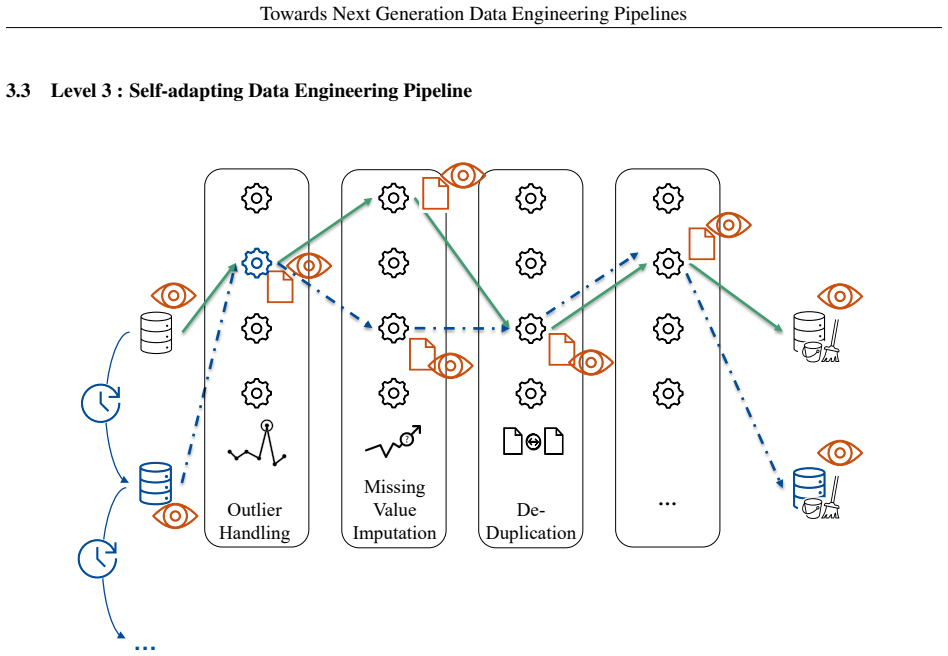
The central mechanism is the trio of profiles and their diffs: the data profile (a configurable set of descriptive statistics over schema, distributions, and property types), the error profile (a record of error types and positions, produced with the CheDDaR framework), and the pipeline profile (an abstract, technology-independent JSON description of operators, parameters, and ordering). Data profile diffs, error profile diffs, and pipeline profile diffs are the comparison layer that lets the system detect change, decide whether adaptation is needed, and record how the pipeline changed. The adaptation process itself follows a MAPE-K-style loop decomposed into change interpretation, adaptation analysis, and propagation and evaluation, with a schema version graph and schema modification operation inference for structural changes.
What would settle it
Construct a benchmark dataset and two cleaning pipelines that receive identical scores under the proposed data-quality metric but produce measurably different results in a downstream task, such as classification accuracy on the cleaned data; if such a pair exists, the premise that optimization for data quality is independent of the analysis objective fails.
Extended reading notes
Core claim
The paper's central claim is that the gap between today's data engineering pipelines and fully autonomous ones can be closed by defining three levels of capability. Level 1, optimized pipelines, selects and orders cleaning operators (missing-value imputation, interval-violation repair, deduplication) from a large search space using rule-based pruning and cost-based search, with the objective of maximizing output data quality rather than fitting a downstream model. Level 2, self-aware pipelines, instruments every operator so that input, intermediate, and output data are summarized as data profiles; comparing profiles across batches yields profile diffs that expose distribution shifts, schema evolution, and new error patterns. Level 3, self-adapting pipelines, interprets those diffs as independent change steps, selects adaptation operations (reconfiguring an operator, renaming a property, replacing an algorithm, or rerunning full optimization when change is too drastic), propagates them through pipeline-profile diffs, and evaluates the result. The paper proposes a system architecture in which a profile registry and schema version graph store all metadata, and technology-specific adapters translate abstract pipeline profiles into executable pipelines.
Load-bearing premise
The whole vision rests on the existence of a data quality metric that can rank any pipeline's output independently of the downstream analysis and that can be computed over a large search space; the paper itself states that such a metric is still an open research question.
Editorial extensions
If this is right
- If all three levels are realized, the resulting system can keep delivering high-quality data without human intervention when upstream data changes schema or value distribution.
- Pipeline optimization independent of downstream analysis would let data-preparation teams produce reusable cleaned datasets for multiple analysis objectives.
- Continuous profiling and diffing makes root-cause analysis of data errors and pipeline failures more targeted, and alerts data engineers to significant changes.
- Self-adaptation, triggered by detected significant change, prevents pipeline crashes and semantically incorrect outputs caused by schema renames or distribution shifts.
- The architecture's adapter-based design means the abstract pipeline profile can be deployed in different technologies, such as Python scripts or Airflow DAGs, without changing the monitoring or adaptation logic.
Reading between the lines
- A testable extension is to benchmark whether a single data-quality metric can rank pipelines consistently across different downstream tasks; if two pipelines tie on data quality but differ on downstream performance, the independence premise needs refinement.
- The three-level pyramid suggests a maturity model for data engineering tooling: existing orchestrators already provide Level 0, so vendors could incrementally add profiling and adaptation features rather than build a new system from scratch.
- Data profile diffs could be reused beyond pipelines as a general change-detection primitive for data contracts between organizations, not just within one pipeline.
- The use of large language models for schema-ambiguity resolution and contextualization of new properties is speculative but testable: comparing LLM-based adaptation choices against human expert choices on a benchmark of schema-evolution scenarios would give early evidence.
Editorial analysis
A structured set of objections, weighed in public.
Referee Report
Summary. The paper proposes a three-level vision for next-generation data engineering pipelines: (1) optimized pipelines that automatically select and order data-cleaning operators to maximize output data quality, (2) self-aware pipelines that continuously build data, error, and pipeline profiles and detect significant changes via profile diffs, and (3) self-adapting pipelines that interpret, plan, and propagate adaptations in response to structural and semantic changes such as schema renames or distribution shifts. The authors instantiate the vision with an eye-tracking running example, describe rule-based and cost-based optimization steps for Level 1, monitoring and profile abstractions for Level 2, a three-phase MAPE-K-like adaptation process for Level 3, and a system architecture centered on a profile registry and schema version graph. The paper explicitly enumerates open research challenges for each level and states that the data quality metric required for the optimization objective does not yet exist.
Significance. The vision is significant if realizable: it targets the well-documented cost of data preparation and the practical problem that pipelines degrade silently when upstream data evolves. The paper's strengths are its clean three-level taxonomy, the consistent running example, and the honest identification of the open problems, especially the absence of a data quality metric, which is correctly placed as the linchpin of both pipeline optimization and adaptation evaluation. The proposed profile/diff-based architecture provides a useful vocabulary for future work. At the same time, the paper is a position paper: no empirical or formal validation is provided, and the key feasibility determinants—a quality metric, formalized operator constraints, and semantic-correctness evaluation—are explicitly open. External evaluation of the prior components (CheDDaR, data profiles, ALPINE, SMO inference) is absent. The contribution is therefore a research agenda whose central claims can be accepted only conditionally on future results.
major comments (3)
- [Section 3.1.3 and 3.1.4] The paper states in Section 3.1.3 that 'A suitable metric is still an open research question' and in Section 3.1.4 that 'Such a metric does not yet exist.' This means the central objective of Level 1 is undefined. Because Level 3 also uses data quality to evaluate adaptations (Section 3.3.3) and the conclusion claims the system 'leads to the best possible data quality at all times,' the entire proposal hinges on a quantity that is not defined. Concretely, the paper should specify at least a family of usable quality metrics or a formal evaluation protocol and show how the cost-based optimizer would use it; otherwise the central claims are not falsifiable.
- [Section 3.1.1 and 3.1.4] The rule-based optimization step assumes that operator constraints such as 'mean value imputation → permitted data types: numerical' can be found, formalized, and efficiently linked to data profiles, but the paper itself identifies this as an open research question. This is load-bearing because the feasibility of the search-space reduction, and therefore of the subsequent cost-based optimization, depends on it. A minimal test would be a small constraint language and a benchmark showing that it prunes the search space without excluding optimal pipelines.
- [Section 3.3.3 and Section 4] The evaluation of self-adaptation is not well-defined. The paper states that evaluating functionality is trivial but semantic correctness is 'very hard,' and Section 4 concedes that probabilistic choices may need human judgment. Without ground truth or a probabilistic objective with explicit thresholds, the system cannot determine whether an adaptation improved data quality, making the Level 3 autonomy claim untestable. The authors should either define an evaluation protocol with injected changes and known ground truth or explicitly limit the automated claim to functional, non-semantic adaptation.
minor comments (4)
- [Section 3.1] The search-space formula 'PN i=0 xi!' in Section 3.1 is not readable; based on the 11! = 39,916,800 example, the intended count appears to be the number of permutations of the selected operators, so the formula should be written as (Σ x_i)! or equivalent and introduced clearly.
- [Section 3.3.2] The text 'as presented in Scetion 3.1.4' contains a typo and should read 'Section 3.1.4'.
- [Section 3.3] The phrase 'We envision diverse types offailures' should be 'We envision diverse types of failures.'
- [Section 3.2.2] The sentence 'An example would if a property which yielded no missing values at design time suddenly does deliver any values' is missing a word after 'would' and 'any' is ambiguous; it should likely read 'An example would be if a property ... suddenly does deliver values.'
Circularity Check
No significant circularity: the paper is a vision/position paper that openly defers its load-bearing evaluation metric and adaptation-correctness checks to future research, and no claimed prediction reduces to its inputs by construction.
full rationale
The paper contains no derivation chain whose output is equivalent to its input by construction. Its central claim is a proposed three-level roadmap (optimized, self-aware, self-adapting pipelines) with the components explicitly labeled as research challenges rather than completed results. The metric needed to rank pipelines is admittedly missing: Section 3.1.3 states 'A suitable metric is still an open research question' and Section 3.1.4 repeats that 'Such a metric does not yet exist.' Likewise, Section 3.3.3 admits that 'evaluating the semantic correctness is very hard' after an adaptation. These are openly stated limitations, not circular reductions. The paper does rely on several self-citations for component ideas (CheDDaR, data profile diffs, SMO inference, ALPINE pipeline profiles, the decision tree for schema robustness), but in each case the citation supplies a proposed building block or prior concept, not a result that is then re-labeled as a prediction of this paper. No fitted parameter is renamed as a prediction, no uniqueness theorem is imported from the authors' prior work to forbid alternatives, and no known empirical pattern is repackaged solely under new coordinates. The absence of external benchmarks is a weakness in empirical support, but the hard rule for circularity requires exhibiting a specific reduction to the paper's own inputs, and none is present. The correct verdict is therefore no significant circularity.
Assumptions & free parameters
assumptions (5)
- domain assumption A single data quality metric exists and can rank pipeline outputs independently of downstream analysis.
- domain assumption Operator constraints and best practices can be formalized and efficiently linked to data profiles.
- domain assumption Significant changes in data and operators are reliably detectable by comparing data profiles and diffs.
- domain assumption Automatic adaptations preserve semantic correctness.
- domain assumption The pipeline search space can be pruned to a tractable size while still containing the global optimum.
invented entities (6)
-
Data profile (DP)
-
Error profile (EP)
-
Pipeline profile (PP)
-
Profile diff (DPD/EPD/PPD)
-
Schema version graph
-
Profile registry
Cite this review
Pith. "Pith review of Towards Next Generation Data Engineering Pipelines." pith.science (2026). https://pith.science/paper/ZQDOTVR6
@misc{pith2026250713892,
  author       = {Pith},
  title        = {Pith review of: Towards Next Generation Data Engineering Pipelines},
  year         = {2026},
  howpublished = {\url{https://pith.science/paper/ZQDOTVR6}},
  note         = {Machine review of arXiv:2507.13892}
}
read the original abstract
Data engineering pipelines are a widespread way to provide high-quality data for all kinds of data science applications. However, numerous challenges still remain in the composition and operation of such pipelines. Data engineering pipelines do not always deliver high-quality data. By default, they are also not reactive to changes. When new data is coming in which deviates from prior data, the pipeline could crash or output undesired results. We therefore envision three levels of next generation data engineering pipelines: optimized data pipelines, self-aware data pipelines, and self-adapting data pipelines. Pipeline optimization addresses the composition of operators and their parametrization in order to achieve the highest possible data quality. Self-aware data engineering pipelines enable a continuous monitoring of its current state, notifying data engineers on significant changes. Self-adapting data engineering pipelines are then even able to automatically react to those changes. We propose approaches to achieve each of these levels.
Figures


Figures from the paper (9 more)



Reference graph
Works this paper leans on
-
[1]
Four Generations in Data Engineering for Data Science
Meike Klettke and Uta St \" o rl. Four Generations in Data Engineering for Data Science . Datenbank-Spektrum, 22 0 (1): 0 59--66, 2022. doi:10.1007/S13222-021-00399-3
-
[2]
The Challenges of Data Quality and Data Quality Assessment in the Big Data Era
Li Cai and Yangyong Zhu. The Challenges of Data Quality and Data Quality Assessment in the Big Data Era . Data Sci. J., 14: 0 2, 2015. doi:10.5334/DSJ-2015-002
-
[3]
Valerie Restat, Gerrit Boerner, Andr \' e Conrad, and Uta St \" o rl. GouDa - generation of universal data sets: improving analysis and evaluation of data preparation pipelines . In DEEM@SIGMOD, pages 2:1--2:6. ACM , 2022. doi:10.1145/3533028.3533311
arXiv 2022
-
[4]
Ihab F. Ilyas and Xu Chu. Data Cleaning , volume 28 of ACM Books . ACM , 2019. doi:10.1145/3310205
-
[5]
DERM: A reference model for data engineering
Daniel Tebernum, Marcel Altendeitering, and Falk Howar. DERM: A reference model for data engineering. In DATA , pages 165--175. SCITEPRESS , 2021. doi:10.5220/0010517301650175
-
[6]
A Survey of Big Data Pipeline Orchestration Tools from the Perspective of the DataCloud Project
Mihhail Matskin, Shirin Tahmasebi, Amirhossein Layegh, Amir Hossein Payberah, Aleena Thomas, Nikolay Nikolov, and Dumitru Roman. A Survey of Big Data Pipeline Orchestration Tools from the Perspective of the DataCloud Project . In DAMDID/RCDL (Supplementary Proceedings) , volume 3036 of CEUR Workshop Proceedings , pages 63--78. CEUR-WS.org, 2021. URL https...
2021
-
[7]
Self-Awareness as a Prerequisite for Self-Adaptivity in Computing Systems
Ana Petrovska. Self-Awareness as a Prerequisite for Self-Adaptivity in Computing Systems . In ACSOS-C , pages 146--149. IEEE , 2021. doi:10.1109/ACSOS-C52956.2021.00039
arXiv 2021
-
[8]
Data Processing Pipeline for Eye-Tracking Analysis
Jennifer Landes, Sonja K \" o ppl, and Meike Klettke. Data Processing Pipeline for Eye-Tracking Analysis . In GvDB, volume 3710 of CEUR Workshop Proceedings , pages 35--42. CEUR-WS.org, 2024. URL https://ceur-ws.org/Vol-3710/paper6.pdf
2024
Show all 82 references
-
[9]
A unified representation and transformation of multi-model data using category theory
Pavel Koupil and Irena Holubov \' a . A unified representation and transformation of multi-model data using category theory . J. Big Data, 9 0 (1): 0 61, 2022. doi:10.1186/S40537-022-00613-3
2022 doi
-
[10]
Data Engineering for Data Science: Two Sides of the Same Coin
Oscar Romero and Robert Wrembel. Data Engineering for Data Science: Two Sides of the Same Coin . In DaWaK, volume 12393 of Lecture Notes in Computer Science, pages 157--166. Springer, 2020. doi:10.1007/978-3-030-59065-9\_13
2020 doi
-
[11]
The Art and Practice of Data Science Pipelines: A Comprehensive Study of Data Science Pipelines In Theory, In-The-Small, and In-The-Large
Sumon Biswas, Mohammad Wardat, and Hridesh Rajan. The Art and Practice of Data Science Pipelines: A Comprehensive Study of Data Science Pipelines In Theory, In-The-Small, and In-The-Large . In ICSE , pages 2091--2103. ACM , 2022. doi:10.1145/3510003.3510057
2022
-
[12]
What About the Data? A Mapping Study on Data Engineering for AI Systems
Petra Heck. What About the Data? A Mapping Study on Data Engineering for AI Systems . In CAIN , pages 43--52. ACM , 2024. doi:10.1145/3644815.3644954
2024
-
[13]
NIST Big Data Interoperability Framework: Volume 1, Definitions
Wo Chang and Nancy Grady. NIST Big Data Interoperability Framework: Volume 1, Definitions . Technical report, National Institute of Standards and Technology, 2019
2019
-
[14]
Challenging Big Data Engineering: Positioning of Current and Future Development
Matthias Volk, Daniel Staegemann, Matthias Pohl, and Klaus Turowski. Challenging Big Data Engineering: Positioning of Current and Future Development . In IoTBDS, pages 351--358. SciTePress, 2019. doi:10.5220/0007748803510358
2019 doi
-
[15]
Atkinson, Michelle Galea, Tan Fong Ang, Paul Martin, and Jano I
Chee Sun Liew, Malcolm P. Atkinson, Michelle Galea, Tan Fong Ang, Paul Martin, and Jano I. van Hemert. Scientific Workflows: Moving Across Paradigms . ACM Comput. Surv. , 49 0 (4): 0 66:1--66:39, 2017. doi:10.1145/3012429
2017 doi
-
[16]
Mahadi Hassan, Micah J
Shubhra Kanti Karmaker Santu, Md. Mahadi Hassan, Micah J. Smith, Lei Xu, Chengxiang Zhai, and Kalyan Veeramachaneni. AutoML to Date and Beyond: Challenges and Opportunities . ACM Comput. Surv. , 54 0 (8): 0 175:1--175:36, 2022. doi:10.1145/3470918
2022 doi
-
[17]
Parameswaran
Doris Xin, Eva Yiwei Wu, Doris Jung Lin Lee, Niloufar Salehi, and Aditya G. Parameswaran. Whither AutoML ? Understanding the Role of Automation in Machine Learning Workflows . In CHI , pages 83:1--83:16. ACM , 2021. doi:10.1145/3411764.3445306
2021
-
[18]
Franklin, Ken Goldberg, and Eugene Wu
Sanjay Krishnan, Michael J. Franklin, Ken Goldberg, and Eugene Wu. BoostClean: Automated Error Detection and Repair for Machine Learning . CoRR, abs/1711.01299, 2017. URL http://arxiv.org/abs/1711.01299
2017 arXiv
-
[19]
Ilyas, and Christopher R \' e
Theodoros Rekatsinas, Xu Chu, Ihab F. Ilyas, and Christopher R \' e . HoloClean: Holistic Data Repairs with Probabilistic Inference . Proc. VLDB Endow. , 10 0 (11): 0 1190--1201, 2017. doi:10.14778/3137628.3137631
2017
-
[20]
Baran: Effective Error Correction via a Unified Context Representation and Transfer Learning
Mohammad Mahdavi and Ziawasch Abedjan. Baran: Effective Error Correction via a Unified Context Representation and Transfer Learning . Proc. VLDB Endow. , 13 0 (11): 0 1948--1961, 2020. URL http://www.vldb.org/pvldb/vol13/p1948-mahdavi.pdf
1948
-
[21]
Ilyas, Mourad Ouzzani, Paolo Papotti, Nan Tang, and Yin Ye
Xu Chu, John Morcos, Ihab F. Ilyas, Mourad Ouzzani, Paolo Papotti, Nan Tang, and Yin Ye. KATARA: A Data Cleaning System Powered by Knowledge Bases and Crowdsourcing . In SIGMOD Conference , pages 1247--1261. ACM , 2015. doi:10.1145/2723372.2749431
2015
-
[22]
Data Preparation: A Survey of Commercial Tools
Mazhar Hameed and Felix Naumann. Data Preparation: A Survey of Commercial Tools . SIGMOD Rec. , 49 0 (3): 0 18--29, 2020. doi:10.1145/3444831.3444835
2020
-
[23]
Ilyas, Mourad Ouzzani, Paolo Papotti, Michael Stonebraker, and Nan Tang
Ziawasch Abedjan, Xu Chu, Dong Deng, Raul Castro Fernandez, Ihab F. Ilyas, Mourad Ouzzani, Paolo Papotti, Michael Stonebraker, and Nan Tang. Detecting Data Errors: Where are we and what needs to be done? Proc. VLDB Endow. , 9 0 (12): 0 993--1004, 2016. doi:10.14778/2994509.2994518
2016
-
[24]
SAGA: A Scalable Framework for Optimizing Data Cleaning Pipelines for Machine Learning Applications
Shafaq Siddiqi, Roman Kern, and Matthias Boehm. SAGA: A Scalable Framework for Optimizing Data Cleaning Pipelines for Machine Learning Applications . Proc. ACM Manag. Data , 1 0 (3): 0 218:1--218:26, 2023. doi:10.1145/3617338
2023 doi
-
[25]
Lindstaedt, Arnab Phani, Benjamin Rath, Berthold Reinwald, Shafaq Siddiqui, and Sebastian Benjamin Wrede
Matthias Boehm, Iulian Antonov, Sebastian Baunsgaard, Mark Dokter, Robert Ginth \" o r, Kevin Innerebner, Florijan Klezin, Stefanie N. Lindstaedt, Arnab Phani, Benjamin Rath, Berthold Reinwald, Shafaq Siddiqui, and Sebastian Benjamin Wrede. SystemDS : A Declarative Machine Lea...
2020
-
[26]
From Cleaning before ML to Cleaning for ML
Felix Neutatz, Binger Chen, Ziawasch Abedjan, and Eugene Wu. From Cleaning before ML to Cleaning for ML . IEEE Data Eng. Bull. , 44 0 (1): 0 24--41, 2021. URL http://sites.computer.org/debull/A21mar/p24.pdf
2021
-
[27]
Paritosh, and Lora Aroyo
Nithya Sambasivan, Shivani Kapania, Hannah Highfill, Diana Akrong, Praveen K. Paritosh, and Lora Aroyo. Everyone wants to do the model work, not the data work": Data Cascades in High-Stakes AI . In CHI , pages 39:1--39:15. ACM , 2021. doi:10.1145/3411764.3445518
2021
-
[28]
Wang, Henry B
Richard Y. Wang, Henry B. Kon, and Stuart E. Madnick. Data Quality Requirements Analysis and Modeling . In ICDE , pages 670--677. IEEE Computer Society, 1993. doi:10.1109/ICDE.1993.344012
1993
-
[29]
Wang, Veda C
Richard Y. Wang, Veda C. Storey, and Christopher P. Firth. A Framework for Analysis of Data Quality Research . IEEE Trans. Knowl. Data Eng. , 7 0 (4): 0 623--640, 1995. doi:10.1109/69.404034
1995 doi
-
[30]
Blake and Paul Mangiameli
Roger H. Blake and Paul Mangiameli. The Effects and Interactions of Data Quality and Problem Complexity on Classification . ACM J. Data Inf. Qual. , 2 0 (2): 0 8:1--8:28, 2011. doi:10.1145/1891879.1891881
2011
-
[31]
Requirements for Data Quality Metrics
Bernd Heinrich, Diana Hristova, Mathias Klier, Alexander Schiller, and Michael Szubartowicz. Requirements for Data Quality Metrics . ACM J. Data Inf. Qual. , 9 0 (2): 0 12:1--12:32, 2018. doi:10.1145/3148238
2018 doi
-
[32]
Automating Large-Scale Data Quality Verification
Sebastian Schelter, Dustin Lange, Philipp Schmidt, Meltem Celikel, Felix Bie mann, and Andreas Grafberger. Automating Large-Scale Data Quality Verification . Proc. VLDB Endow. , 11 0 (12): 0 1781--1794, 2018. doi:10.14778/3229863.3229867
2018
-
[33]
An Advanced Big Data Quality Framework Based on Weighted Metrics
Widad Elouataoui, Imane El Alaoui, Saida El Mendili, and Youssef Gahi. An Advanced Big Data Quality Framework Based on Weighted Metrics . Big Data Cogn. Comput., 6 0 (4): 0 153, 2022. doi:10.3390/BDCC6040153
2022 doi
-
[34]
Ilyas, and Theodoros Rekatsinas
Alireza Heidari, Joshua McGrath, Ihab F. Ilyas, and Theodoros Rekatsinas. HoloDetect: Few-Shot Learning for Error Detection . In SIGMOD Conference , pages 829--846. ACM , 2019. doi:10.1145/3299869.3319888
2019
-
[35]
Raha: A Configuration-Free Error Detection System
Mohammad Mahdavi, Ziawasch Abedjan, Raul Castro Fernandez, Samuel Madden, Mourad Ouzzani, Michael Stonebraker, and Nan Tang. Raha: A Configuration-Free Error Detection System . In SIGMOD Conference , pages 865--882. ACM , 2019. doi:10.1145/3299869.3324956
2019
-
[36]
Exploratory Training: When Annonators Learn About Data
Rajesh Shrestha, Omeed Habibelahian, Arash Termehchy, and Paolo Papotti. Exploratory Training: When Annonators Learn About Data . Proc. ACM Manag. Data , 1 0 (2): 0 135:1--135:25, 2023. doi:10.1145/3589280
2023 doi
-
[37]
Visual Interactive Creation, Customization, and Analysis of Data Quality Metrics
Christian Bors, Theresia Gschwandtner, Simone Kriglstein, Silvia Miksch, and Margit Pohl. Visual Interactive Creation, Customization, and Analysis of Data Quality Metrics . ACM J. Data Inf. Qual. , 10 0 (1): 0 3:1--3:26, 2018. doi:10.1145/3190578
2018 doi
-
[38]
o rl. FAIR is not enough - A Metrics Framework to ensure Data Quality through Data Preparation . In BTW , volume P-331 of LNI , pages 917--929. Gesellschaft f \
Valerie Restat, Meike Klettke, and Uta St \" o rl. FAIR is not enough - A Metrics Framework to ensure Data Quality through Data Preparation . In BTW , volume P-331 of LNI , pages 917--929. Gesellschaft f \" u r Informatik e.V., 2023. doi:10.18420/BTW2023-61
2023 doi
-
[39]
a mper, Ralf Diestelk \
Indra Diestelk \" a mper, Ralf Diestelk \" a mper, and Valerie Restat. CheDDaR: Checking Data - Data Quality Report . In BTW , volume P-361 of LNI , pages 1055--1067. Gesellschaft f \" u r Informatik e.V., 2025. doi:10.18420/BTW2025-70
2025 doi
-
[40]
noWorkflow: Capturing and Analyzing Provenance of Scripts
Leonardo Murta, Vanessa Braganholo, Fernando Chirigati, David Koop, and Juliana Freire. noWorkflow: Capturing and Analyzing Provenance of Scripts . In IPAW , volume 8628 of Lecture Notes in Computer Science, pages 71--83. Springer, 2014. doi:10.1007/978-3-319-16462-5\_6
2014 doi
-
[41]
Capturing and querying fine-grained provenance of preprocessing pipelines in data science
Adriane Chapman, Paolo Missier, Giulia Simonelli, and Riccardo Torlone. Capturing and querying fine-grained provenance of preprocessing pipelines in data science. Proc. VLDB Endow. , 14 0 (4): 0 507--520, 2020. doi:10.14778/3436905.3436911
2020
-
[42]
Data distribution debugging in machine learning pipelines
Stefan Grafberger, Paul Groth, Julia Stoyanovich, and Sebastian Schelter. Data distribution debugging in machine learning pipelines . VLDB J. , 31 0 (5): 0 1103--1126, 2022. doi:10.1007/S00778-021-00726-W
2022 doi
-
[43]
Fair preprocessing: towards understanding compositional fairness of data transformers in machine learning pipeline
Sumon Biswas and Hridesh Rajan. Fair preprocessing: towards understanding compositional fairness of data transformers in machine learning pipeline . In ESEC/SIGSOFT FSE , pages 981--993. ACM , 2021. doi:10.1145/3468264.3468536
2021
-
[44]
Towards Explaining the Effects of Data Preprocessing on Machine Learning
Carlos Vladimiro Gonzalez Zelaya. Towards Explaining the Effects of Data Preprocessing on Machine Learning . In ICDE , pages 2086--2090. IEEE , 2019. doi:10.1109/ICDE.2019.00245
2019
-
[45]
Dead or Alive: Continuous Data Profiling for Interactive Data Science
Will Epperson, Vaishnavi Gorantla, Dominik Moritz, and Adam Perer. Dead or Alive: Continuous Data Profiling for Interactive Data Science . IEEE Trans. Vis. Comput. Graph. , 30 0 (1): 0 197--207, 2024. doi:10.1109/TVCG.2023.3327367
2024
-
[46]
Data Profiling
Ziawasch Abedjan. Data Profiling . In Encyclopedia of Big Data Technologies. Springer, 2019. doi:10.1007/978-3-319-63962-8\_8-1
2019 doi
-
[48]
Auto-Validate by-History: Auto-Program Data Quality Constraints to Validate Recurring Data Pipelines
Dezhan Tu, Yeye He, Weiwei Cui, Song Ge, Haidong Zhang, Shi Han, Dongmei Zhang, and Surajit Chaudhuri. Auto-Validate by-History: Auto-Program Data Quality Constraints to Validate Recurring Data Pipelines . In KDD , pages 4991--5003. ACM , 2023. doi:10.1145/3580305.3599776
2023
-
[49]
Parameswaran
Shreya Shankar, Labib Fawaz, Karl Gyllstrom, and Aditya G. Parameswaran. Automatic and Precise Data Validation for Machine Learning . In CIKM , pages 2198--2207. ACM , 2023. doi:10.1145/3583780.3614786
2023
-
[50]
A DaQL to Monitor Data Quality in Machine Learning Applications
Lisa Ehrlinger, Verena Haunschmid, Davide Palazzini, and Christian Lettner. A DaQL to Monitor Data Quality in Machine Learning Applications . In DEXA (1) , volume 11706 of Lecture Notes in Computer Science, pages 227--237. Springer, 2019. doi:10.1007/978-3-030-27615-7\_17
2019 doi
-
[51]
DaQL 2.0: Measure Data Quality based on Entity Models
Christian Lettner, Reinhard Stumptner, Werner Fragner, Franz Rauchenzauner, and Lisa Ehrlinger. DaQL 2.0: Measure Data Quality based on Entity Models . In ISM , volume 180 of Procedia Computer Science, pages 772--777. Elsevier, 2020. doi:10.1016/J.PROCS.2021.01.327
2020 doi
-
[52]
Real-Time Monitoring of Data Pipelines: Exploring and Experimentally Proving that the Continuous Monitoring in Data Pipelines Reduces Cost and Elevates Quality
Shammy Narayanan, Maheswari S, and Prisha Zephan. Real-Time Monitoring of Data Pipelines: Exploring and Experimentally Proving that the Continuous Monitoring in Data Pipelines Reduces Cost and Elevates Quality . ICST Transactions on Scalable Information Systems, 2024
2024
-
[53]
Schuler, Jitin Singla, Brinda Vallat, Kate L
Robert E. Schuler, Jitin Singla, Brinda Vallat, Kate L. White, Helen M. Berman, and Carl Kesselman. Database Evolution, by Scientists, for Scientists: A Case Study . In e-Science, pages 1--10. IEEE , 2023. doi:10.1109/E-SCIENCE58273.2023.10254872
2023
-
[54]
An Empirical Study on the Design and Evolution of NoSQL Database Schemas
Stefanie Scherzinger and Sebastian Sidortschuck. An Empirical Study on the Design and Evolution of NoSQL Database Schemas . In ER , volume 12400 of Lecture Notes in Computer Science, pages 441--455. Springer, 2020. doi:10.1007/978-3-030-62522-1\_33
2020 doi
-
[55]
Schema Evolution in Wikipedia - Toward a Web Information System Benchmark
Carlo Curino, Hyun Jin Moon, Letizia Tanca, and Carlo Zaniolo. Schema Evolution in Wikipedia - Toward a Web Information System Benchmark . In ICEIS (1) , pages 323--332, 2008
2008
-
[56]
Self-healing and self-repairing technologies
Regina Frei, Richard McWilliam, Benjamin Derrick, Alan Purvis, Asutosh Tiwari, and Giovanna Di Marzo Serugendo. Self-healing and self-repairing technologies . The International Journal of Advanced Manufacturing Technology, 69: 0 1033--1061, 2013. URL https://api.semanticschola...
2013
-
[57]
DeBinelle: Semantic Patches for Coupled Database-Application Evolution
Stefanie Scherzinger, Wolfgang Mauerer, and Haridimos Kondylakis. DeBinelle: Semantic Patches for Coupled Database-Application Evolution . In ICDE , pages 2697--2700. IEEE , 2021. doi:10.1109/ICDE51399.2021.00307
2021
-
[58]
Schuler and Carl Kesselman
Robert E. Schuler and Carl Kesselman. Managing Database-Application Co-Evolution in a Scientific Data Ecosystem . In e-Science, pages 214--224. IEEE , 2022. doi:10.1109/ESCIENCE55777.2022.00035
2022
-
[59]
Understanding Uncertainty in Self-adaptive Systems
Radu Calinescu, Raffaela Mirandola, Diego Perez - Palacin, and Danny Weyns. Understanding Uncertainty in Self-adaptive Systems . In ACSOS , pages 242--251. IEEE , 2020. doi:10.1109/ACSOS49614.2020.00047
2020
-
[60]
Uncertainty in Self-Adaptive Systems: A Research Community Perspective
Sara Mahdavi - Hezavehi, Danny Weyns, Paris Avgeriou, Radu Calinescu, Raffaela Mirandola, and Diego Perez - Palacin. Uncertainty in Self-Adaptive Systems: A Research Community Perspective . CoRR, abs/2103.02717, 2021. URL https://arxiv.org/abs/2103.02717
2021 arXiv
-
[61]
o rl, Daniel M \
Meike Klettke, Hannes Awolin, Uta St \" o rl, Daniel M \" u ller, and Stefanie Scherzinger. Uncovering the Evolution History of Data Lakes . In IEEE BigData , pages 2462--2471. IEEE Computer Society, 2017. doi:10.1109/BIGDATA.2017.8258204
2017
-
[62]
Reducing Ambiguity in Json Schema Discovery
William Spoth, Oliver Kennedy, Ying Lu, Beda Christoph Hammerschmidt, and Zhen Hua Liu. Reducing Ambiguity in Json Schema Discovery . In SIGMOD Conference , pages 1732--1744. ACM , 2021. doi:10.1145/3448016.3452801
2021
- [63]
-
[64]
Control-Theoretical Software Adaptation: A Systematic Literature Review
Stepan Shevtsov, Mihaly Berekmeri, Danny Weyns, and Martina Maggio. Control-Theoretical Software Adaptation: A Systematic Literature Review . IEEE Trans. Software Eng. , 44 0 (8): 0 784--810, 2018. doi:10.1109/TSE.2017.2704579
2018
-
[65]
Agent-Driven Automatic Software Improvement
Fernando Vallecillos Ruiz. Agent-Driven Automatic Software Improvement . In EASE , pages 470--475. ACM , 2024. doi:10.1145/3661167.3661171
2024
-
[66]
Fuzzy Self-Adaptation of Mission-Critical Software Under Uncertainty
Qiliang Yang, Jian Lu, XianPing Tao, Xiaoxing Ma, Jianchun Xing, and Wei Song. Fuzzy Self-Adaptation of Mission-Critical Software Under Uncertainty . J. Comput. Sci. Technol., 28 0 (1): 0 165--187, 2013. doi:10.1007/S11390-013-1321-9
2013 doi
-
[67]
Towards Evolution Capabilities in Data Pipelines
Kevin Kramer. Towards Evolution Capabilities in Data Pipelines . In GvDB, volume 3714 of CEUR Workshop Proceedings . CEUR-WS.org, 2023. URL https://ceur-ws.org/Vol-3714/paper7.pdf
2023
-
[68]
Franklin, and Eugene Wu
Sanjay Krishnan, Daniel Haas, Michael J. Franklin, and Eugene Wu. Towards reliable interactive data cleaning: a user survey and recommendations . In HILDA@SIGMOD, page 9. ACM , 2016. doi:10.1145/2939502.2939511
2016
-
[69]
What can Data-Centric AI Learn from Data and ML Engineering? CoRR, abs/2112.06439, 2021
Neoklis Polyzotis and Matei Zaharia. What can Data-Centric AI Learn from Data and ML Engineering? CoRR, abs/2112.06439, 2021. URL https://arxiv.org/abs/2112.06439
2021 arXiv
-
[70]
Johnson, Gyorgy Simon, and Constantin Aliferis
Steven G. Johnson, Gyorgy Simon, and Constantin Aliferis. Data Preparation, Transforms, Quality, and Management, pages 377--413. Springer International Publishing, 2024. doi:10.1007/978-3-031-39355-6_8
2024 doi
-
[71]
Towards an End-to-End Data Quality Optimizer
Valerie Restat, Meike Klettke, and Uta St \" o rl. Towards an End-to-End Data Quality Optimizer . In ICDEW , pages 262--266. IEEE , 2024. doi:10.1109/ICDEW61823.2024.00039
2024
-
[72]
Empirical comparison of supervised learning techniques for missing value imputation
Chih - Fong Tsai and Ya - Han Hu. Empirical comparison of supervised learning techniques for missing value imputation . Knowl. Inf. Syst., 64 0 (4): 0 1047--1075, 2022. doi:10.1007/S10115-022-01661-0
2022 doi
-
[73]
Kamrul Hasan, Md
Md. Kamrul Hasan, Md. Ashraful Alam, Shidhartho Roy, Aishwariya Dutta, Md. Tasnim Jawad, and Sunanda Das. Missing value imputation affects the performance of machine learning: A review and analysis of the literature (2010–2021) . Informatics in Medicine Unlocked, 27: 0 100799, 2021
2010
-
[74]
o rl. ALPINE: Abstract Language for Pipeline Integration and Execution . In BTW Workshops , volume P-363 of LNI , pages 207--217. Gesellschaft f \
Valerie Restat and Uta St \" o rl. ALPINE: Abstract Language for Pipeline Integration and Execution . In BTW Workshops , volume P-363 of LNI , pages 207--217. Gesellschaft f \" u r Informatik e.V., 2025. doi:10.18420/BTW2025-125
2025 doi
-
[75]
Towards machine learning-aware data validation
Sebastian Strasser. Towards machine learning-aware data validation . In GvDB, volume 3710 of CEUR Workshop Proceedings , pages 29--34. CEUR-WS.org, 2024. URL https://ceur-ws.org/Vol-3710/paper5.pdf
2024
-
[76]
Transparent Data Preprocessing for Machine Learning
Sebastian Strasser and Meike Klettke. Transparent Data Preprocessing for Machine Learning . In HILDA@SIGMOD, pages 1--6. ACM , 2024. doi:10.1145/3665939.3665960
2024
-
[77]
Breunig, Hans - Peter Kriegel, Raymond T
Markus M. Breunig, Hans - Peter Kriegel, Raymond T. Ng, and J \" o rg Sander. LOF: Identifying Density-Based Local Outliers . In SIGMOD Conference , pages 93--104. ACM , 2000. doi:10.1145/342009.335388
-
[78]
Kramer, Valerie Restat, and Uta St \" o rl
Kevin M. Kramer, Valerie Restat, and Uta St \" o rl. Evolving gracefully: Building robust and self-adaptive data cleaning pipelines for schema evolution and uncertainty. In VLDB Workshops . VLDB.org, 2025. Accepted for publication
2025
-
[79]
Kephart and David M
Jeffrey O. Kephart and David M. Chess. The Vision of Autonomic Computing . Computer, 36 0 (1): 0 41--50, 2003. doi:10.1109/MC.2003.1160055
2003 arXiv
-
[80]
A Survey on Application of Knowledge Graph
Xiaohan Zou. A Survey on Application of Knowledge Graph . Journal of Physics: Conference Series, 1487, 2020. URL https://api.semanticscholar.org/CorpusID:216342059
2020
- [81]
-
[82]
Towards Taming the Adaptivity Problem - Formalizing Poly-/MultiStore Topology Descriptions
Daniel Glake, Felix Kiehn, Mareike Schmidt, and Norbert Ritter. Towards Taming the Adaptivity Problem - Formalizing Poly-/MultiStore Topology Descriptions . In SummerSOC, volume 1429 of Communications in Computer and Information Science, pages 83--99. Springer, 2021. doi:10.10...
2021 doi
-
[83]
Schema Extraction and Structural Outlier Detection for JSON-based NoSQL Data Stores
Meike Klettke, Uta St \" o rl, and Stefanie Scherzinger. Schema Extraction and Structural Outlier Detection for JSON-based NoSQL Data Stores . In BTW , volume P-241 of LNI , pages 425--444. GI , 2015. URL https://dl.gi.de/handle/20.500.12116/2420
2015
Reviewed August 6, 2026 · model on record in the stance chip above.
Discussion (0). Continue with ORCID to comment.