REVIEW 2 major objections 5 minor 3 references
More counterexamples to Lagrangian Poincar\'e recurrence in dimension four
T0 review · 2 major / 5 minor · reviewed 2026-08-06 · deepseek-v4-flash
Pith's one-line read The paper constructs, in every non-monotone toric symplectic four-manifold of dimension four, a Hamiltonian diffeomorphism and a Lagrangian torus whose forward orbit never intersects the torus.
desk verdict Extends Lagrangian recurrence counterexamples to all non-monotone toric four-manifolds, but the proof depends on an unproved width condition and on the author's unpublished nodal-tangle preprint. read the letter →
The pith
A machine-rendered reading of the paper's core claim, the machinery that carries it, and where it could break.
The reading
What carries the argument
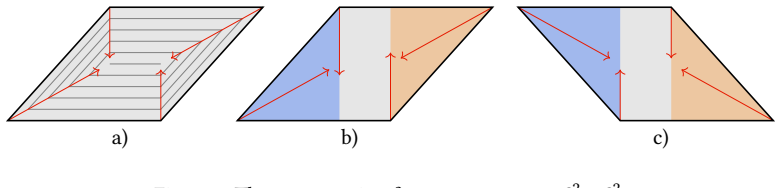
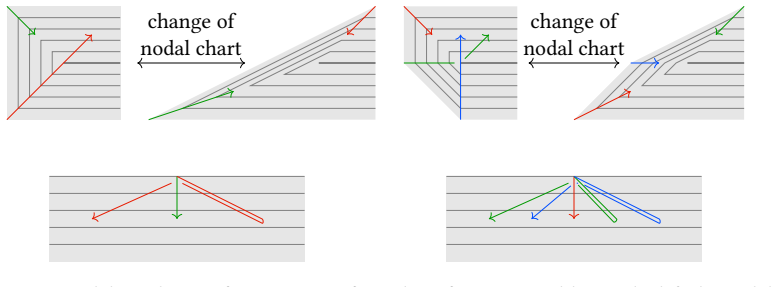
The central object is the nodal integral affine base $(B_0, \mathfrak{N}_0)$ of an almost toric fibration: the usual Delzant polygon data plus a choice of hat and parked nodes, with a height function $\mathcal{F}$ measuring integral affine distance to the boundary. The load-bearing identity is the level-set length formula $g(h) = 2w - k(M-h) + \sum_i \min\{h - \alpha_i, 0\}$, where $w$ is the width of the hat, $M$ is the maximum height, $k$ is a constant determined by the hat class, and $\alpha_i$ are the heights of the parked nodes. A nodal tangle that slides nodes and modifies the hat produces a second base $(B_1, \mathfrak{N}_1)$ that is integral affine isomorphic to the first through an explicit shear-and-reglue map, and the supporting theorem lifts this isomorphism to a genuine symplectomorphism of the total space. The induced map translates fibers along the closed level sets, and the irrationality of $g(h)/(2(M-h))$ is what forces the Lagrangian orbit never to close up.
What would settle it
Pick a non-monotone toric symplectic four-manifold whose Delzant polygon is small enough to check by hand and test the two load-bearing inputs: verify whether the shear-plus-reglue map is a true integral affine isomorphism at the ridge $\Delta_M$, and compute the hat width $w$; a single manifold where the map has a corner singularity or $w=0$ would show that the construction does not cover all non-monotone cases.
Extended reading notes
Core claim
On the author's own terms, the central claim is: for every non-monotone toric symplectic four-manifold $X$ there exists a Lagrangian torus $L \subset X$ and a Hamiltonian diffeomorphism $\psi$ of $X$ such that $\psi^n(L) \cap L = \emptyset$ for all $n \in \mathbb{N}$. The manifold is described by a nodal integral affine base $(B_0, \mathfrak{N}_0)$ with height function $\mathcal{F}$; after a nodal tangle that slides parked nodes and modifies the hat, the new base $(B_1, \mathfrak{N}_1)$ is integral affine isomorphic to the original via a map composed of a shear and a triangle cut-and-reglue. Using a lift theorem from the author's companion preprint, this base isomorphism becomes a symplectomorphism $\psi$, which acts on the fibers above a level set as translation by integral affine distance $2(M-h)$. Since the level set has integral affine length $g(h) = 2w - k(M-h) + \sum_i \min\{h - \alpha_i, 0\}$, choosing $h$ with $g(h)/(2(M-h))$ irrational makes the iterates $\psi^n(\pi_0^{-1}(x))$ pairwise disjoint from the starting fiber; finiteness of the symplectic mapping class group then gives a Hamiltonian iterate, namely $\psi^m$ for some $m$, which still satisfies $(\psi^m)^n(L) \cap L = \emptyset$ for all $n$. This directly covers the previously missing non-monotone $S^2 \times S^2$ and critical blow-up cases.
Load-bearing premise
The construction leans on the unpublished theorem that an integral affine isomorphism between nodal bases always lifts to a symplectomorphism, together with the unverified assumption that every non-monotone toric four-manifold has a hat of positive width, so if either gives way the claimed all-non-monotone counterexamples are not established.
Editorial extensions
If this is right
- The previous exceptional cases—non-monotone $S^2 \times S^2$ with unequal factor areas, and the one- or two-fold blow-ups of such products at size $c = \min\{a,b\}/2$—now also admit Hamiltonian counterexamples to Lagrangian Poincar\'e recurrence.
- In every non-monotone toric symplectic four-manifold, the constructed Lagrangian torus is a fibre of an almost toric fibration, so the non-recurrence occurs on a geometrically natural Lagrangian rather than an exotic one.
- Because the symplectic mapping class group is finite in these manifolds, the power $\psi^m$ actually lies in $\mathrm{Ham}(X)$, so the counterexample can be taken Hamiltonian even though the raw map $\psi$ is only a symplectomorphism.
- The arithmetic condition $g(h)/(2(M-h))$ irrational is open, so each manifold covered by the construction yields many non-returning Lagrangian fibres, one for each admissible irrational ratio.
Reading between the lines
- A natural extension would be to formulate the same height-function and irrational-rotation mechanism in higher-dimensional toric manifolds, provided corresponding integral affine bases with closed level sets and integral affine automorphisms exist; the paper does not address this.
- The completeness of the all-non-monotone statement currently depends on the unpublished companion theorem [3, Theorem 2.26]; a self-contained proof of that lift theorem would remove the main external dependency.
- A direct test of the construction is to compute the hat width $w$ for every Delzant polygon of the claimed class; if some non-monotone polygon forces $w=0$, the note's general assumption \'suppose $w>0$\' would miss that case.
Editorial analysis
A structured set of objections, weighed in public.
Referee Report
Summary. This note claims to extend counterexamples to Lagrangian Poincaré recurrence in dimension four to all non-monotone toric symplectic four-manifolds. It constructs a Hamiltonian diffeomorphism ψ and a Lagrangian torus L such that ψ^n(L)∩L=∅ for all n≥0. The construction uses nodal integral affine bases and nodal tangles. Section 1 treats non-monotone S^2×S^2 explicitly: starting from the base B0 of the almost toric fibration, the author performs nodal slides to obtain B1, defines an integral affine isomorphism τ:B0→B1, and invokes Theorem 2.26 of [3] to lift τ to a symplectomorphism ψ. Section 2 generalizes this to a nodal integral affine surface (B0,𝔑0) of canonical type (H,M,α_1,…,α_n), assuming the hat H has positive width w>0. The author again constructs a nodal tangle and an integral affine isomorphism τ, lifts it via [3, Theorem 2.26], and selects Lagrangian tori over levels where the ratio g(h)/(2(M-h)) is irrational. The paper concludes by using finiteness of the symplectic mapping class group to pass from a symplectomorphism to a Hamiltonian diffeomorphism.
Significance. If correct, the result would close the remaining cases 2 and 3 from [2, Remark 3.2] and establish that Lagrangian Poincaré recurrence fails for every non-monotone toric symplectic four-manifold, a substantial strengthening of the earlier construction. The note is concise and well illustrated, with explicit formulas for level-set lengths and a clear geometric mechanism. However, two load-bearing points prevent the result from being fully established as written: the construction depends on an unproved theorem from the author's unpublished preprint [3], and the positive-width hat hypothesis is not shown to hold for all non-monotone manifolds. With those gaps filled, the result would be a significant contribution to the study of Lagrangian dynamics on rational toric manifolds.
major comments (2)
- [Section 2, 'Suppose that the hat H has width w>0' (page 3)] The abstract promises counterexamples for all non-monotone toric symplectic four-manifolds, but the construction in Section 2 is carried out only under the hypothesis that the canonical hat H has positive width w>0. Figure 3 explicitly displays zero-width hats for each type A–E, and the text does not explain why a non-monotone manifold must have a canonical representative with w>0, or how to modify a zero-width representative without changing the symplectic manifold. If some non-monotone manifolds admit only zero-width canonical hats, the supplied construction does not apply to them, and the earlier construction in [2] was already stated to exclude cases 2 and 3. Thus the 'all non-monotone' claim is not established as written. The author should either prove that every non-monotone toric four-manifold admits a base with w>0, or restrict the stated theorem and explain how the remaining zero-width cases are handled.
- [Section 1 and Section 2, use of [3, Theorem 2.26]] The map that produces the desired symplectomorphism ψ is obtained entirely from [3, Theorem 2.26], which asserts that an integral affine isomorphism between nodal integral affine bases lifts to a symplectomorphism fitting the stated diagram. This theorem is not stated or proved in the note, and [3] is an unpublished preprint, so the note is conditional on an external result whose proof the reader cannot check. Since Theorem 2.26 is load-bearing for both the S^2×S^2 case (Section 1) and the general case (Section 2), the author should include the precise statement, a proof or sketch, or clearly restrict the note to depend on [3] only as a published reference; as it stands, the main theorem cannot be independently verified from this note alone.
minor comments (5)
- [Page 1, paragraph after abstract] The text says 'than repeat the construction' and should say 'then repeat the construction'.
- [Section 1, paragraph after Figure 1] The notation t· for the ℝ-action on B0∖ℱ^{-1}(M) is used without definition; please specify that it denotes the flow along the level-set circle in the chosen clockwise direction.
- [Section 1, level-set length formula] The formula 'integral affine length 2w+8(M−h)' uses w, but w is introduced in this section only as a parameter in the symplectic form; please state explicitly that this w is also the hat width appearing in the length formula.
- [Section 2, definition of f] The sentence 'Let f:B0∖(ℓ∪Δ_M)→R^2 be the length of the straight line segment...' is linguistically garbled; it should say 'Let f(x) be the length of the straight line segment...' and specify that f takes values in R.
- [Figure 3 caption] The caption labels hats with 'A , w=0' etc.; the spacing and comma placement should be cleaned up for readability.
Circularity Check
No circular reduction found; the construction depends heavily on the author's own unpublished [3] for the lifting theorem, and the 'all non-monotone' claim has an unproved positive-width assumption.
full rationale
I traced the derivation chain: the paper constructs nodal integral affine bases B0 and B1, an integral affine isomorphism tau identifying them, and then invokes [3, Theorem 2.26] to lift tau to a symplectomorphism psi. The non-recurrence conclusion follows from the irrationality of g(h)/(2(M-h)) along level sets, which is a generic choice, not a fitted parameter. The construction does not define the Lagrangian L or the diffeomorphism psi in terms of the desired conclusion, and no equation in the paper reduces a predicted quantity to an input by definition. The main structural weaknesses are not circularity: (1) the central lifting theorem and the nodal base classification are imported from the author's own unpublished preprint [3] rather than proved in the note, which is heavy self-citation and a support risk, but [3] is cited as an independent tool with stated assumptions rather than as the target result; (2) Section 2 assumes 'Suppose that the hat H has width w > 0' and Figure 3 explicitly lists hats with w=0, while the note never proves that every non-monotone toric four-manifold admits a canonical representative with positive width, so the advertised extension to 'all non-monotone' toric four-manifolds is not fully established. These are correctness/completeness gaps, not circular reductions, and the final score of 2 reflects the heavy self-citation dependence rather than an equation-level circularity.
Assumptions & free parameters
assumptions (5)
- domain assumption [3, Theorem 2.26]: integral affine isomorphism of nodal bases lifts to a symplectomorphism of total spaces
- domain assumption [3, Proposition 3.17]: every toric symplectic four-manifold admits a nodal base of canonical type
- domain assumption [3, Definition 2.30]: existence of a lift of the nodal tangle supported on a given region
- domain assumption [1, Corollary 4.6]: the symplectic mapping class group of X is finite
- ad hoc to paper The hat H has width w > 0
Cite this review
Pith. "Pith review of More counterexamples to Lagrangian Poincar\'e recurrence in dimension four." pith.science (2026). https://pith.science/paper/KCRCEKKS
@misc{pith2026250713924,
  author       = {Pith},
  title        = {Pith review of: More counterexamples to Lagrangian Poincar\'e recurrence in dimension four},
  year         = {2026},
  howpublished = {\url{https://pith.science/paper/KCRCEKKS}},
  note         = {Machine review of arXiv:2507.13924}
}
read the original abstract
In earlier work, we constructed counterexamples to Lagrangian Poincar\'e recurrence for many toric symplectic four manifolds. Here we provide a few more examples extending the family of counterexamples to include all non-monotone toric symplectic four manifolds. This work has been incorporated into arXiv:2506.23754v2 Section 3.3
Figures


Figures from the paper (1 more)
Reference graph
Works this paper leans on
-
[2]
A counterexample to Lagrangian Poincaré recurrence in dimension four
Joel Schmitz. A counterexample to Lagrangian Poincaré recurrence in dimension four . Preprint, arXiv:2410.24102. To appear in Compositio Mathematica. 2024
-
[3]
Joel Schmitz. Nodal tangles. Preprint, arXiv:2506.23754. 2025. 5
work page Pith review arXiv 2025
-
[1]
Symplectic Torelli groups of rational surfaces
Jun Li, Tian-Jun Li, and Weiwei Wu. Symplectic Torelli groups of rational surfaces . Preprint, arXiv:2212.01873. 2022
arXiv 2022
Reviewed August 6, 2026 · model on record in the stance chip above.
Discussion (0). Continue with ORCID to comment.