A combination theorem for the twist conjecture for Artin groups
Pith reviewed 2026-05-19 03:57 UTC · model grok-4.3
The pith
The twist conjecture for Artin groups reduces to the case of defining graphs without separating vertices.
A machine-rendered reading of the paper's core claim, the machinery that carries it, and where it could break.
Core claim
We reduce a strong version of the twist conjecture for Artin groups to Artin groups whose defining graphs have no separating vertices. This produces new examples of Artin groups satisfying the conjecture, and sheds more light on the isomorphism problem for Artin groups. Along the way we also prove a combination result for the ribbon property for vertices.
What carries the argument
The combination theorem for the ribbon property for vertices that glues reduced cases across separating vertices without new obstructions.
If this is right
- New examples of Artin groups satisfy the twist conjecture.
- The isomorphism problem for Artin groups receives additional insight.
- The conjecture holds in general if it holds for graphs without separating vertices.
Where Pith is reading between the lines
- Future checks of the conjecture can focus on the reduced case of graphs without separating vertices.
- The combination method may extend to related conjectures on Artin groups or similar graph-based group constructions.
Load-bearing premise
The combination theorem for the ribbon property for vertices holds and can be applied to glue the reduced cases back to the general Artin group without introducing new obstructions.
What would settle it
An Artin group with a separating vertex in its defining graph that violates the twist conjecture while all its reduced sub-groups without separating vertices satisfy it.
Figures
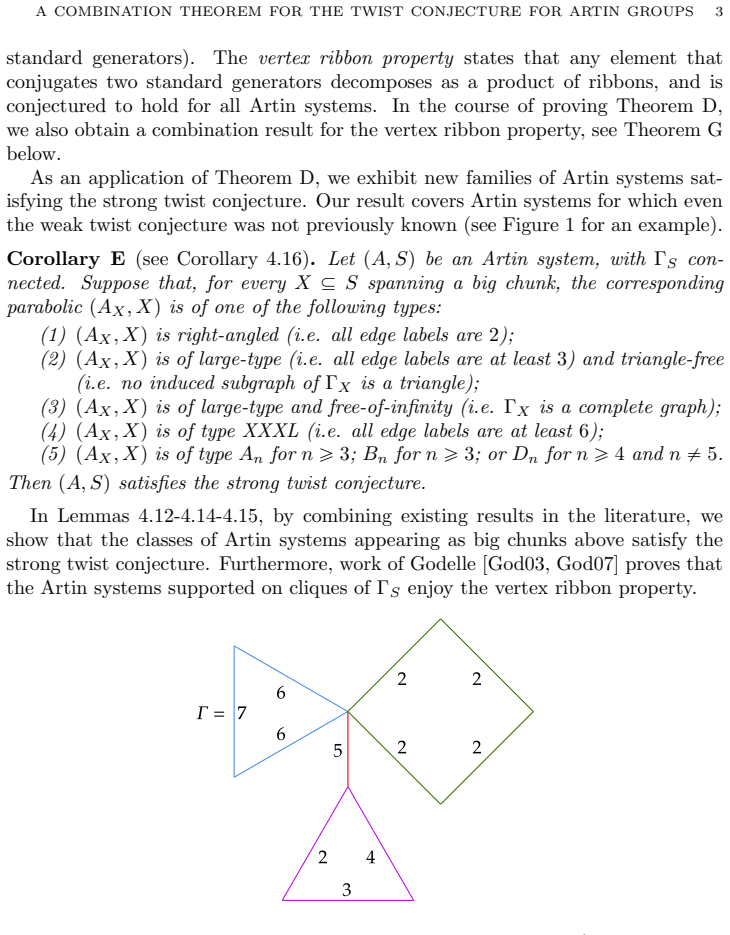


read the original abstract
We reduce a strong version of the twist conjecture for Artin groups to Artin groups whose defining graphs have no separating vertices. This produces new examples of Artin groups satisfying the conjecture, and sheds more light on the isomorphism problem for Artin groups. Along the way we also prove a combination result for the ribbon property for vertices.
Editorial analysis
A structured set of objections, weighed in public.
Referee Report
Summary. The manuscript reduces a strong version of the twist conjecture for Artin groups to the case of defining graphs with no separating vertices. The reduction is achieved by establishing a combination theorem for the ribbon property for vertices, which is used to glue local solutions across separating vertices. The work also produces new examples of Artin groups satisfying the conjecture and discusses implications for the isomorphism problem.
Significance. If the combination theorem is established without gaps, the reduction is a meaningful advance: it narrows the twist conjecture to a technically simpler class of graphs and supplies concrete new examples. The ribbon-property combination result itself is a useful technical tool that may apply to other questions about automorphisms and centralizers in Artin groups.
major comments (1)
- [combination theorem section] The section presenting the combination theorem: the argument that the ribbon property for vertices controls global twist behavior and prevents new obstructions (such as non-twist automorphisms arising from the gluing maps or vertex stabilizers) is load-bearing for the reduction claim; an explicit verification that the relevant centralizer and fixed-point conditions are preserved under the gluing would make the reduction fully rigorous.
minor comments (2)
- [abstract] The abstract refers to 'a strong version' of the twist conjecture without a brief reminder of its precise statement; adding one sentence or a reference to the exact formulation would help readers.
- [introduction] Notation for the defining graph and its separating vertices is introduced early; a small diagram or explicit example of a graph with a separating vertex would improve accessibility.
Simulated Author's Rebuttal
We thank the referee for their careful reading and constructive comments. We appreciate the positive evaluation of the significance of the reduction and the new examples. We address the single major comment below.
read point-by-point responses
-
Referee: The section presenting the combination theorem: the argument that the ribbon property for vertices controls global twist behavior and prevents new obstructions (such as non-twist automorphisms arising from the gluing maps or vertex stabilizers) is load-bearing for the reduction claim; an explicit verification that the relevant centralizer and fixed-point conditions are preserved under the gluing would make the reduction fully rigorous.
Authors: We agree that making the preservation of centralizer and fixed-point conditions under gluing fully explicit will strengthen the rigor of the argument. In the revised version we will add a short dedicated paragraph (or subsection) immediately after the statement of the combination theorem. This paragraph will verify, step by step, that the ribbon property for vertices implies the required centralizer containment and fixed-point set equality for the images of the gluing maps and for the vertex stabilizers. The verification will show directly that no new non-twist automorphisms can arise at the gluing loci, thereby confirming that local ribbon solutions extend to a global solution without introducing obstructions. We believe this addition will address the referee's concern without altering the overall structure or length of the section. revision: yes
Circularity Check
Derivation self-contained via independent combination theorem
full rationale
The paper states it reduces a strong version of the twist conjecture to Artin groups with no separating vertices by proving a combination result for the ribbon property for vertices. This is a standard proof strategy that decomposes the problem and glues solutions, relying on the definitions of Artin groups, the conjecture, and the ribbon property rather than any self-definitional loop, fitted parameter renamed as prediction, or load-bearing self-citation chain. No equations or steps in the provided abstract reduce the central claim to its own inputs by construction, so the argument remains externally falsifiable and self-contained.
Axiom & Free-Parameter Ledger
Lean theorems connected to this paper
-
IndisputableMonolith/Foundation/RealityFromDistinction.leanreality_from_one_distinction unclear?
unclearRelation between the paper passage and the cited Recognition theorem.
We reduce a strong version of the twist conjecture for Artin groups to Artin groups whose defining graphs have no separating vertices... combination result for the ribbon property for vertices (Theorem D, Corollary 4.9, Proposition 4.7)
What do these tags mean?
- matches
- The paper's claim is directly supported by a theorem in the formal canon.
- supports
- The theorem supports part of the paper's argument, but the paper may add assumptions or extra steps.
- extends
- The paper goes beyond the formal theorem; the theorem is a base layer rather than the whole result.
- uses
- The paper appears to rely on the theorem as machinery.
- contradicts
- The paper's claim conflicts with a theorem or certificate in the canon.
- unclear
- Pith found a possible connection, but the passage is too broad, indirect, or ambiguous to say the theorem truly supports the claim.
Reference graph
Works this paper leans on
-
[1]
Covering theory for graphs of groups
Hyman Bass. Covering theory for graphs of groups. J. Pure Appl. Algebra , 89(1-2):3--47, 1993
work page 1993
-
[2]
Andreas Baudisch. Subgroups of semifree groups. Acta Mathematica Hungarica , 38(1-4):19--28, 1981
work page 1981
-
[3]
McCammond, Bernhard M\"uhlherr, and Walter D
Noel Brady, Jonathan P. McCammond, Bernhard M\"uhlherr, and Walter D. Neumann. Rigidity of C oxeter groups and A rtin groups. In Proceedings of the C onference on G eometric and C ombinatorial G roup T heory, P art I ( H aifa, 2000) , volume 94, pages 91--109, 2002
work page 2000
-
[4]
Homomorphisms between XL -type Artin groups
Mart \' n Blufstein, Alexandre Martin, and Nicolas Vaskou. Homomorphisms between XL -type Artin groups. Preprint, arXiv :2410.19091 [math. GR ] (2024), 2024
-
[5]
Parabolic subgroups inside parabolic subgroups of Artin groups
Mart \' n Blufstein and Luis Paris. Parabolic subgroups inside parabolic subgroups of Artin groups. Proceedings of the American Mathematical Society , 151(04):1519--1526, 2023
work page 2023
-
[6]
Artin - Gruppen und Coxeter - Gruppen
Egbert Brieskorn and Kyoji Saito. Artin - Gruppen und Coxeter - Gruppen . Invent. Math. , 17:245--271, 1972
work page 1972
-
[7]
Automorphism groups of some affine and finite type A rtin groups
Ruth Charney and John Crisp. Automorphism groups of some affine and finite type A rtin groups. Mathematical Research Letters , 12:321--333, 2005
work page 2005
-
[8]
Problems related to Artin groups
Ruth Charney. Problems related to Artin groups. American Institute of Mathematics , 2016
work page 2016
-
[9]
Endomorphisms of Artin groups of type d, 2024
Fabrice Castel and Luis Paris. Endomorphisms of Artin groups of type d, 2024
work page 2024
-
[10]
Automorphisms and abstract commensurators of 2--dimensional Artin groups
John Crisp. Automorphisms and abstract commensurators of 2--dimensional Artin groups. Geometry & Topology , 9(3):1381--1441, 2005
work page 2005
-
[11]
M. Dehn. \"U ber unendliche diskontinuierliche Gruppen . Math. Ann. , 71:116--144, 1912
work page 1912
-
[12]
The automorphism groups of the braid groups
Joan L Dyer and Edna K Grossman. The automorphism groups of the braid groups. American Journal of Mathematics , 103(6):1151--1169, 1981
work page 1981
-
[13]
Carl Droms. Isomorphisms of graph groups. Proceedings of the American Mathematical Society , 100(3):407--408, 1987
work page 1987
-
[14]
Deformation and rigidity of simplicial group actions on trees
Max Forester. Deformation and rigidity of simplicial group actions on trees. Geometry & Topology , 6:219--267, 08 2001
work page 2001
-
[15]
F. A. Garside. The braid group and other groups. Q. J. Math., Oxf. II. Ser. , 20:235--254, 1969
work page 1969
-
[16]
N. D. Gilbert, J. Howie, V. Metaftsis, and E. Raptis. Tree actions of automorphism groups. J. Group Theory , 3(2):213--223, 2000
work page 2000
-
[17]
Vincent Guirardel and Gilbert Levitt. Deformation spaces of trees. Groups Geom. Dyn. , 1(2):135--181, 2007
work page 2007
-
[18]
JSJ decompositions of groups , volume 395 of Ast \'e risque
Vincent Guirardel and Gilbert Levitt. JSJ decompositions of groups , volume 395 of Ast \'e risque . Paris: Soci \'e t \'e Math \'e matique de France (SMF), 2017
work page 2017
-
[19]
Normalisateurs et groupes d' Artin - Tits de type sph\'erique
Eddy Godelle. Normalisateurs et groupes d' Artin - Tits de type sph\'erique. Journal of Algebra , 269(1), 2003
work page 2003
-
[20]
Artin -- Tits groups with CAT(0) Deligne complex
Eddy Godelle. Artin -- Tits groups with CAT(0) Deligne complex. Journal of Pure and Applied Algebra , 208(1):39--52, 2007
work page 2007
-
[21]
JSJ splittings for all Artin groups
Oli Jones, Giorgio Mangioni, and Giovanni Sartori. JSJ splittings for all Artin groups. ArXiv preprint arXiv:2506.17157 , 2025
-
[22]
Type VF for outer automorphism groups of large-type Artin groups
Oli Jones. Type VF for outer automorphism groups of large-type Artin groups. Preprint, arXiv :2410.17129 [math. GR ] (2024), 2024
-
[23]
A generating set for the automorphism group of a graph group
Michael R Laurence. A generating set for the automorphism group of a graph group. Journal of the London Mathematical Society , 52(2):318--334, 1995
work page 1995
-
[24]
Johanna Mangahas. The ping-pong lemma. In Office hours with a geometric group theorist , pages 85--105. Princeton, NJ: Princeton University Press, 2017
work page 2017
-
[25]
The isomorphism problem for Coxeter groups
Bernhard M \"u hlherr. The isomorphism problem for Coxeter groups. In The Coxeter legacy. Reflections and projections , pages 1--15. Providence, RI: American Mathematical Society (AMS), 2006
work page 2006
-
[26]
Characterising large-type Artin groups
Alexandre Martin and Nicolas Vaskou. Characterising large-type Artin groups. Bull. Lond. Math. Soc. , 56(11):3346--3357, 2024
work page 2024
-
[27]
Parabolic subgroups of A rtin groups
Luis Paris. Parabolic subgroups of A rtin groups. J. Algebra , 196(2):369--399, 1997
work page 1997
-
[28]
Artin groups of spherical type up to isomorphism
Luis Paris. Artin groups of spherical type up to isomorphism. J. Algebra , 281(2):666--678, 2004
work page 2004
-
[29]
Endomorphisms of Artin groups of type B _n
Luis Paris and Ignat Soroko. Endomorphisms of Artin groups of type B _n . Journal of Algebra , 2025
work page 2025
-
[30]
John G. Ratcliffe and Steven T. Tschantz. Chordal Coxeter groups. Geom. Dedicata , 136:57--77, 2008
work page 2008
-
[31]
John G. Ratcliffe and Steven T. Tschantz. J SJ decompositions of C oxeter groups over FA subgroups. Topology Proc. , 42:57--72, 2013
work page 2013
-
[32]
Herman Servatius. Automorphisms of graph groups. J. Algebra , 126(1):34--60, 1989
work page 1989
-
[33]
Jean-Pierre Serre. Trees. Transl . from the French by John Stillwell . Springer Monogr. Math. Berlin: Springer, corrected 2nd printing of the 1980 original edition, 2003
work page 1980
-
[34]
Artin groups of types F_4 and H_4 are not commensurable with that of type D_4
Ignat Soroko. Artin groups of types F_4 and H_4 are not commensurable with that of type D_4 . Topology and its Applications , 300:107770, 2021
work page 2021
-
[35]
The isomorphism problem for large-type Artin groups
Nicolas Vaskou. The isomorphism problem for large-type Artin groups. Preprint, arXiv :2201.08329 [math. GR ] (2022), 2022
-
[36]
Automorphisms of large-type free-of-infinity Artin groups
Nicolas Vaskou. Automorphisms of large-type free-of-infinity Artin groups. Geom. Dedicata , 219(1):20, 2025. Id/No 16
work page 2025
-
[37]
The homotopy type of complex hyperplane complements
Harm Van der Lek. The homotopy type of complex hyperplane complements . PhD thesis, Katholieke Universiteit te Nijmegen, 1983
work page 1983
discussion (0)
Sign in with ORCID, Apple, or X to comment. Anyone can read and Pith papers without signing in.