REVIEW 3 major objections 5 minor 17 references
White paper: Towards Human-centric and Sustainable 6G Services -- the fortiss Research Perspective
T0 review · 3 major / 5 minor · reviewed 2026-08-06 · deepseek-v4-flash
Pith's one-line read 6G will be defined by AI-native orchestration, semantic communication, and sustainability, the paper argues.
desk verdict A clear, well-organized institutional roadmap that restates the 6G consensus; the only real new content is fortiss's project mapping, and the green-6G pillar lacks the net-energy analysis the paper itself identifies as needed. read the letter →
The pith
A machine-rendered reading of the paper's core claim, the machinery that carries it, and where it could break.
The reading
What carries the argument
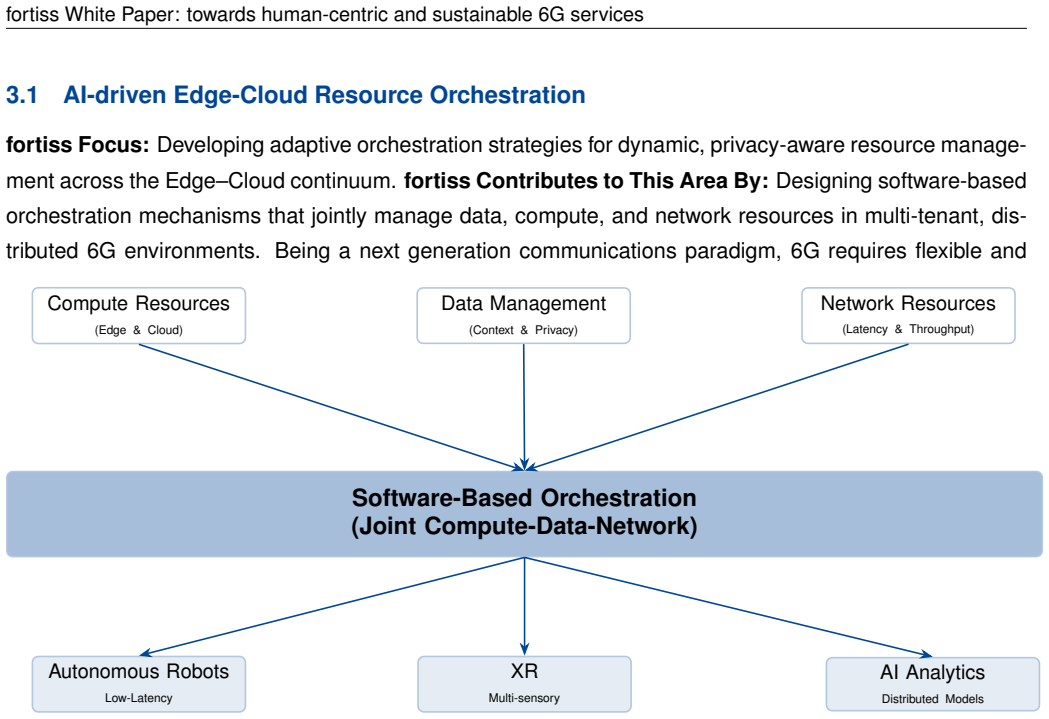
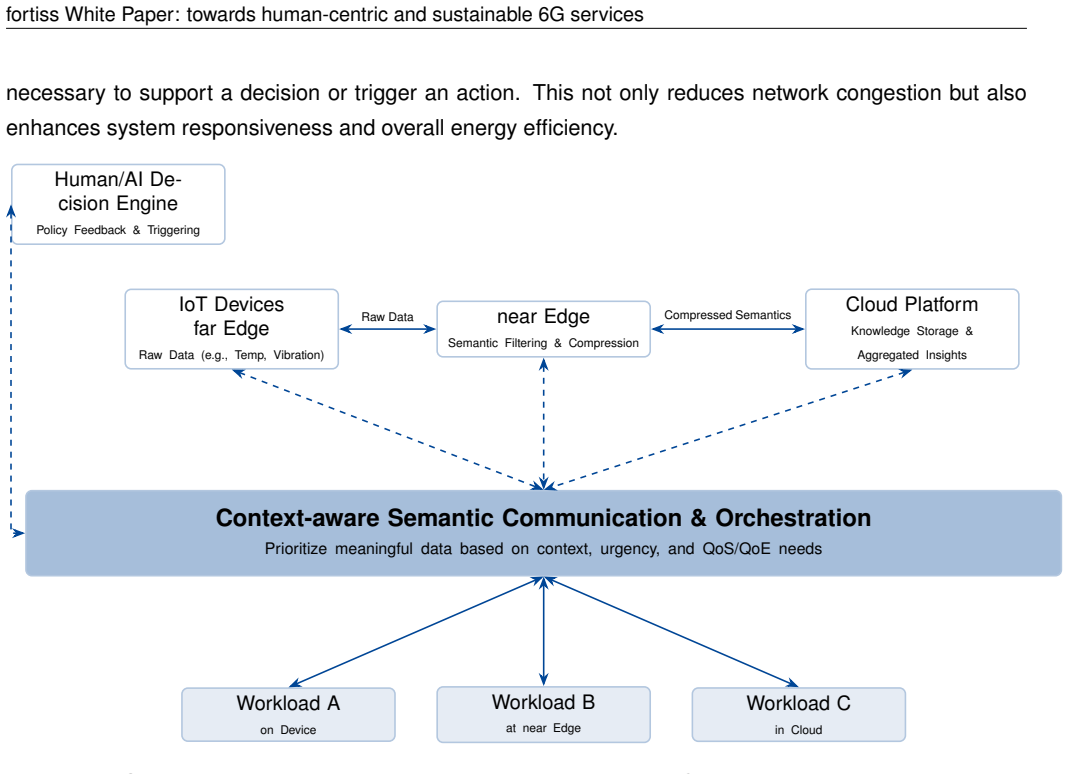
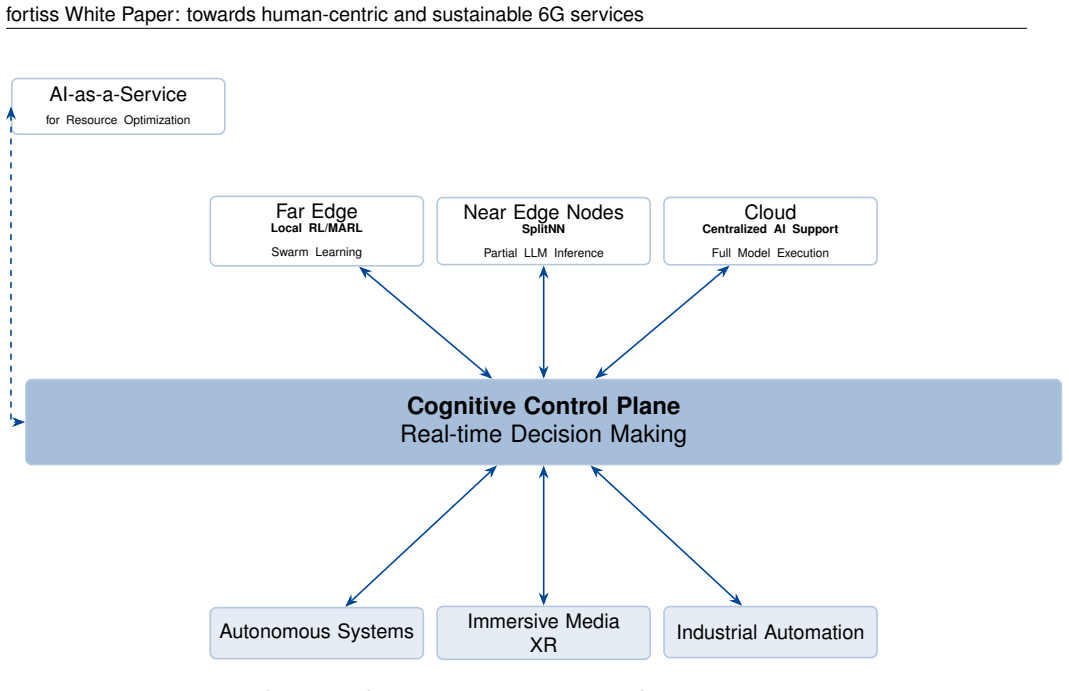
The central object is the edge–cloud continuum: a shared substrate spanning far-edge IoT devices, near-edge nodes, and cloud data centers. On top of it sits the paper's key mechanism, joint compute-data-network orchestration, in which an AI-driven controller allocates computation, data access, and connectivity together rather than as separate silos. Two supporting mechanisms carry the argument: semantic communication, which transmits the meaning or intent of data instead of raw bits to cut redundancy, and energy-aware orchestration, which places workloads according to real-time energy and CO2 metrics. The paper also relies on a decentralized cognitive control plane powered by distributed learning—swarm learning, split neural networks, multi-agent reinforcement learning—to keep the system autonomous and scalable.
What would settle it
Build a realistic edge–cloud testbed running the proposed energy-aware QoS orchestration under the paper's target workloads—dense IoT telemetry and XR traffic—and compare end-to-end energy use and latency against a conventional centralized orchestration baseline. If the semantic-communication layer cannot reduce transmitted bytes or energy by a measurable margin while preserving task accuracy, or if the energy-aware orchestration does not beat the baseline under load, the central claim that these enablers are necessary for a sustainable 6G would be undercut.
Extended reading notes
Core claim
In the paper's own terms, 6G will 'redefine digital connectivity by integrating cognitive intelligence, decentralized orchestration, and sustainability-driven architectures.' The core claim is that meeting the 2030 use cases called out by the global 6G vision—immersive communication, AI-integrated communication, hyper-reliable low-latency links, ubiquitous massive connectivity, and integrated sensing—requires a software-defined, AI-driven substrate that jointly manages compute, data, and network resources across a continuum from far-edge devices to cloud data centers. The authors argue that the decisive enablers are the ones they research: cognitive decentralized orchestration, energy-aware quality-of-service models, semantic communication that filters data by context and intent, a decentralized cognitive control plane using distributed learning, network-as-a-sensor capabilities, and human-in-the-loop design that keeps AI transparent and trustworthy. The paper presents these as required pillars for a human-centric and sustainable 6G, not merely a faster one.
Load-bearing premise
The load-bearing premise is that AI-driven, software-defined orchestration, semantic communication, and energy-aware models can deliver the latency, reliability, and energy gains 6G needs by 2030; the paper asserts this without measurements, simulations, or independent validation.
Editorial extensions
If this is right
- Network management would move from centralized cloud control to a decentralized, AI-native control plane capable of local, real-time decisions at the edge.
- Energy efficiency would become a first-class quality-of-service dimension, letting networks track and report the carbon footprint of specific services and steer workloads accordingly.
- Semantic communication would let dense IoT deployments transmit only decision-relevant information, reducing bandwidth and energy use while preserving task-level quality.
- The standardization roadmap the paper surveys, from Release 19 through Release 21, would need to adopt software-defined orchestration, semantic awareness, and energy-aware QoS as core architectural features rather than optional additions.
- Human-centric requirements—explainability, human-in-the-loop oversight, and safeguards against over-reliance—would have to be built into the AI functions that control spectrum, orchestration, and service provisioning.
Reading between the lines
- The paper's own logic implies that 6G key performance indicators should include sustainability and trust metrics (energy per bit, carbon per service, explanation fidelity) alongside throughput and latency; the paper names these goals but stops short of proposing concrete metrics.
- The promised bandwidth and energy savings of semantic communication are testable today: in an industrial IoT anomaly-detection setting, one could measure how much transmitted volume and energy drop when raw streams are replaced by context-filtered semantics while keeping detection accuracy fixed.
- The decentralized-learning strand suggests that privacy-preserving 6G could keep raw data at the edge by using swarm or split learning, but the paper does not quantify the communication overhead these methods add, which is a natural next measurement.
- The AI-assisted software-engineering angle could turn the scarcity of 6G training data into a research opportunity: the standards gap offers a natural setting to study how coding assistants behave when the target domain is underrepresented in their training corpora.
Editorial analysis
A structured set of objections, weighed in public.
Referee Report
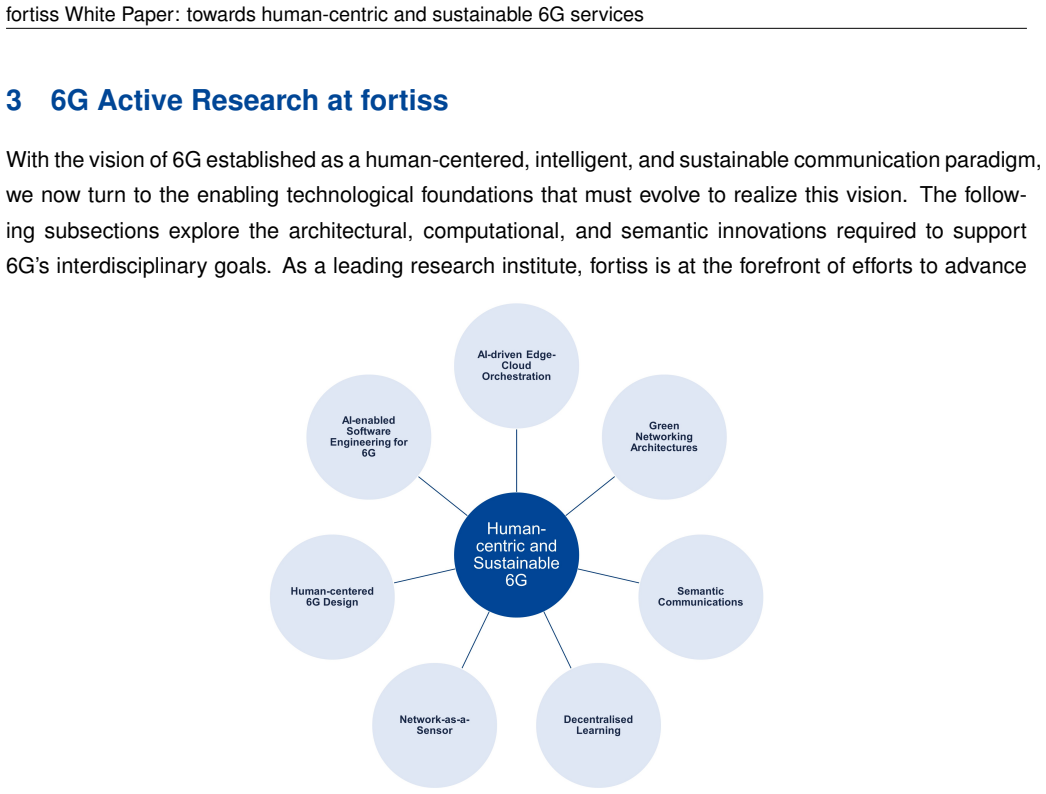
Summary. This white paper from fortiss (Munich) presents the institute's research perspective on 6G, arguing that 6G will be defined by cognitive intelligence, decentralized orchestration, and sustainability-driven architectures. It surveys the ITU-R IMT-2030 vision and the 3GPP Release 19–21 timeline, identifies key challenges (AI energy consumption, data scarcity, security, privacy, TN–NTN integration), and describes seven ongoing fortiss research areas: AI-driven edge-cloud orchestration, green networking, semantic communications, decentralized learning, network-as-a-sensor, human-centered design, and AI-enabled software engineering. The paper also lists fortiss's participation in 6G-IA, NetworldEurope, one6G, CONASENSE, and DIA, and concludes with a vision toward 2030 summarized in a table of research pillars, expected impacts, and a call to action.
Significance. If accepted as a position/vision paper, the work usefully organizes a large body of 6G standardization material and explicitly connects it to a research institute's portfolio. Its strengths are the clear coverage of 3GPP Release 19–21 features, the explicit mapping to IMT-2030 use cases, the transparent acknowledgment in Section 2.3 that real-time AI energy demand may conflict with sustainability goals, and the reproducible pointers to public project artifacts such as CODECO and the IETF energy-aware Differentiated Services draft. However, the paper's load-bearing assertions—that the listed fortiss approaches will 'enable' or 'ensure' a human-centric, sustainable 6G—are not supported by measurements, simulations, or independent evaluations. The central claims are programmatic rather than demonstrated, and at least one pillar (green networking) is contradicted in net terms by the paper's own energy warning. The paper is therefore better judged as a strategic roadmap than as a technical research result; as a roadmap, it would benefit from clearer separation of vision, ongoing work, and evidence.
major comments (3)
- [Section 3.1, 3.3, 3.4, and Table 2] The sustainability pillar is internally inconsistent without a net-energy analysis. Section 2.3 correctly warns that 'Real-time AI-driven operations demand substantial computational resources, which may conflict with 6G's sustainability goals,' yet Section 3.2 and Table 2 claim that MARL-based workload placement, energy-aware QoS, and CO2 monitoring will yield 'Green 6G networks reducing carbon footprint.' The paper never quantifies or even qualitatively bounds the energy cost of the AI decision-making layer (training, inference, split learning, monitoring) against the energy saved by semantic filtering and workload placement. Without a break-even argument or testbed/simulation results, the central claim that fortiss research enables sustainable 6G is unsupported. This is load-bearing and should be addressed by either providing quantitative evidence or by explicitly reframing the contribution as a research direction rather than an achieved outcome.
- [Executive Summary and Section 5] The manuscript repeatedly asserts that specific fortiss technologies 'will enable' 6G capabilities without presenting any evaluation. For example, Section 3.1 describes CODECO-based orchestration as a significant contribution, Section 3.3 presents semantic communication architectures for IIoT, and Section 3.4 proposes decentralized learning and split inference for a cognitive control plane; in each case, no measurements, KPIs, or comparisons to existing baselines are provided. The expected-impact column of Table 2 ('Enhanced performance, reliability, and real-time service provisioning', 'self-learning, self-optimizing', etc.) is similarly unquantified. Because the paper's credibility as a research contribution rests on the premise that these fortiss areas are the right enablers for 6G, the claims should either be backed by concrete evidence or be explicitly labeled as research hypotheses rather than achieved results.
- [Section 5 and Table 2] The central claim that '6G will redefine digital connectivity by integrating cognitive intelligence, decentralized orchestration, and sustainability-driven architectures' is presented as a fact rather than as one possible vision. Section 5 amplifies this with statements such as 'Greenness by design is central to fortiss’ 6G research' and 'decentralized computing, federated AI, decentralized learning, and dynamic energy-aware orchestration will be key enablers of green 6G networks.' For a white paper, such forward-looking statements are acceptable, but they should be clearly framed as predictions or strategic positions, not as established outcomes. The paper would be strengthened by an explicit discussion of alternative 6G visions and by evidence that these enablers are necessary or sufficient, rather than merely plausible.
minor comments (5)
- [Section 4 and Figure 11] The text 'fortiss is a key contributor to the international 6G landscape (rf. to Figure )' contains an incomplete reference to a figure; the figure number should be supplied.
- [Various] There are many typographical errors, including 'represnted' (Section 2.3), 'reorese' (Figure 6 caption), 'and and' (Section 5), 'Fortiss' vs. 'fortiss' inconsistency, 'GitHub Co-pilot' (should be 'GitHub Copilot'), and 'experts experts' (Section 4.5). A careful proofreading pass is needed.
- [Section 3.6 and 3.7] Section 3.6 states 'Some of our researches demonstrate...' but provides no citation to the supporting work, and Section 3.7 asserts that AI coding assistants 'are proven to be useful' without a reference. Please add citations or remove the unsupported claims.
- [Executive Summary and Section 5] The Executive Summary promises that the paper 'concludes with strategic enablers and open research questions,' but no explicit list of open research questions appears in Sections 5–6. Either add such a list or adjust the summary to describe what the paper actually provides.
- [Table 2] The expected impact for 'Human-centered 6G design' is given as 'Enable human-centric design of 6G,' which is tautological and does not convey a concrete outcome; please improve.
Circularity Check
No circular reasoning: the white paper is a vision and research-position statement; self-citations describe ongoing projects and are not used to derive any predictive result.
full rationale
This white paper does not derive predictive results from fitted parameters, uniqueness theorems, or self-cited formal results. It is a position statement describing fortiss's 6G research direction. The central claims, such as "6G is set to redefine digital connectivity by integrating cognitive intelligence, decentralized orchestration, and sustainability-driven architectures," are articulated as a vision, not as conclusions obtained from the paper's own equations. The few self-citations, e.g., [10] for the CODECO orchestration framework and [12] for the Energy-aware Differentiated Services proposal, are used only to point to existing or ongoing work as context; they are not invoked as proof of the paper's claims. No 'prediction' is statistically forced, no input quantity is renamed as an output, and no uniqueness or ansatz is smuggled in through prior fortiss work. The skeptic's concern about an unquantified net-energy argument is a validity or evidence concern, not a circularity concern, because the paper makes no quantitative derivation. Therefore, no circular step can be exhibited, and the appropriate score is 0.
Assumptions & free parameters
assumptions (2)
- domain assumption 6G will launch commercially around 2030 based on ITU-R IMT-2030 and 3GPP Release 21 timelines
- ad hoc to paper The described fortiss research areas will be key enablers for 6G
Cite this review
Pith. "Pith review of White paper: Towards Human-centric and Sustainable 6G Services -- the fortiss Research Perspective." pith.science (2026). https://pith.science/paper/AR4YWOOR
@misc{pith2026250714209,
  author       = {Pith},
  title        = {Pith review of: White paper: Towards Human-centric and Sustainable 6G Services -- the fortiss Research Perspective},
  year         = {2026},
  howpublished = {\url{https://pith.science/paper/AR4YWOOR}},
  note         = {Machine review of arXiv:2507.14209}
}
read the original abstract
As a leading research institute in software-intensive systems, fortiss is actively shaping the vision of Sixth Generation Mobile Communication (6G). Our mission is to ensure that 6G technologies go beyond technical advancements and are aligned with societal needs. fortiss plays a key role in 6G initiatives worldwide, including contributions to standardization bodies and collaborative Research and Development programs. We focus on software-defined, AI-enabled, and sustainable communication services that prioritize human values and long-term impact. 6G will redefine digital connectivity through cognitive intelligence, decentralized orchestration, and sustainability-oriented architectures. As expectations rise for ultra-reliable low-latency communication (URLLC) and personalized digital services, 6G must outperform prior generations. It will rely on AI-native networking, Edge-Cloud resource orchestration, and energy-aware data frameworks, ensuring both technical performance and societal relevance. This white paper presents the fortiss vision for a human-centric, sustainable, and AI-integrated 6G network. It outlines key research domains such as semantic communication, green orchestration, and distributed AI, all linked to societal and technological challenges. The white paper is aimed at researchers, industry experts, policymakers, and developers. It articulates the strategic direction and contributions of fortiss to 6G, emphasizing responsible innovation and interdisciplinary collaboration toward a meaningful 2030 vision.
Figures


Figures from the paper (8 more)



Reference graph
Works this paper leans on
-
[1]
U. B. Shukurillaevich, R. O. Sattorivich, and R. U. Amrillojonovich, “5G technology evolution,” in 2019 International Conference on Information Science and Communications Technologies (ICISCT). IEEE, 2019, pp. 1–5
work page 2019
-
[2]
The impact of 5G on the evolution of intelligent automation and industry digitization,
M. Attaran, “The impact of 5G on the evolution of intelligent automation and industry digitization,” Journal of ambient intelligence and humanized computing, vol. 14, no. 5, pp. 5977–5993, 2023
work page 2023
-
[3]
6G: The Intelligent Network of Everything–A Comprehensive Vision, Survey, and Tutorial,
H. Pennanen, T. H ¨anninen, O. Tervo, A. T ¨olli, and M. Latva-aho, “6G: The Intelligent Network of Everything–A Comprehensive Vision, Survey, and Tutorial,”arXiv e-prints, pp. arXiv–2407, 2024
work page 2024
-
[4]
Multisensory metaverse-6G: A new paradigm of commerce and education,
M. H. Alsamhi, A. Hawbani, S. Kumar, and S. H. Alsamhi, “Multisensory metaverse-6G: A new paradigm of commerce and education,” IEEE Access, 2024
work page 2024
-
[5]
The ITU Vision and Framework for 6G: Scenarios, Capabilities and Enablers
R. Liu, L. Zhang, R. Y .-N. Li, and M. D. Renzo, “The ITU Vision and Framework for 6G: Scenarios, Capabilities and Enablers,” 2025. [Online]. Available: https://arxiv.org/abs/2305.13887
work page Pith review arXiv 2025
-
[6]
Ambient IoT: A missing link in 3GPP IoT devices landscape,
M. M. Butt, N. R. Mangalvedhe, N. K. Pratas, J. Harrebek, J. Kimionis, M. Tayyab, O.-E. Barbu, R. Rata- suk, and B. Vejlgaard, “Ambient IoT: A missing link in 3GPP IoT devices landscape,” IEEE Internet of Things magazine, vol. 7, no. 2, pp. 85–92, 2024
work page 2024
-
[7]
S. N. K. Veedu, M. Mozaffari, A. H ¨oglund, E. A. Y avuz, T. Tirronen, J. Bergman, and Y .-P . E. Wang, “Toward smaller and lower-cost 5G devices with longer battery life: An overview of 3GPP release 17 RedCap,” IEEE Communications Standards Magazine, vol. 6, no. 3, pp. 84–90, 2022
work page 2022
-
[8]
M. Banafaa, I. Shayea, J. Din, M. H. Azmi, A. Alashbi, Y . I. Daradkeh, and A. Alhammadi, “6G mobile communication technology: Requirements, targets, applications, challenges, advantages, and oppor- tunities,” Alexandria Engineering Journal, vol. 64, pp. 245–274, 2023
work page 2023
Show all 17 references
-
[9]
A survey on brain-computer interface-inspired communications: opportunities and challenges,
H. Hu, Z. Wang, X. Zhao, R. Li, A. Li, Y . Si, J. Wang, T. Zhou, and T. Xu, “A survey on brain-computer interface-inspired communications: opportunities and challenges,” IEEE Communications Surveys & Tutorials, 2024. 31 fortiss White Paper: towards human-centric and sustainabl...
2024
-
[10]
A framework for cognitive, decentralized container or- chestration,
R. C. Sofia, J. Salomon, S. Ferlin-Reiter, L. Garc ´es-Erice, P . Urbanetz, H. Mueller, R. Touma, A. Es- pinosa, L. M. Contreras, V. Theodorou et al., “A framework for cognitive, decentralized container or- chestration,” IEEE Access, 2024
2024
-
[11]
C Sofia and J
R. C Sofia and J. Soldatos, Shaping the Future of IoT with Edge Intelligence: How Edge Computing Enables the Next Generation of IoT Applications. Taylor & Francis, 2024
2024
-
[12]
Energy-aware Differentiated Services (EA-DS),
R. Sofia and D. Ali, “Energy-aware Differentiated Services (EA-DS),” Internet Engineering Task Force, Internet-Draft, IETF GREEN proposal draft-sofia-green-energy-aware-diffserv-00, July 2025, active. [Online]. Available: https://datatracker.ietf.org/doc/draft-sofia-green-ener...
2025
-
[13]
Artificial intelligence as a service: classification and research directions,
S. Lins, K. D. Pandl, H. Teigeler, S. Thiebes, C. Bayer, and A. Sunyaev, “Artificial intelligence as a service: classification and research directions,” Business & Information Systems Engineering, vol. 63, pp. 441–456, 2021
2021
-
[14]
Distributed swarm learning for edge internet of things,
Y . Wang, Z. Tian, X. Fan, Z. Cai, C. Nowzari, and K. Zeng, “Distributed swarm learning for edge internet of things,” IEEE Communications Magazine, 2024
2024
-
[15]
End-to-end evaluation of federated learning and split learning for internet of things,
Y . Gao, M. Kim, S. Abuadbba, Y . Kim, C. Thapa, K. Kim, S. A. Camtepe, H. Kim, and S. Nepal, “End-to-end evaluation of federated learning and split learning for internet of things,” arXiv preprint arXiv:2003.13376, 2020
2003 arXiv
-
[16]
LLM Agents as 6G Orches- trator: A Paradigm for Task-Oriented Physical-Layer Automation,
Z. Xiao, C. Y e, Y . Hu, H. Yuan, Y . Huang, Y . Feng, L. Cai, and J. Chang, “LLM Agents as 6G Orches- trator: A Paradigm for Task-Oriented Physical-Layer Automation,” arXiv preprint arXiv:2410.03688 , 2024
2024 arXiv
-
[17]
Pushing large language models to the 6g edge: Vision, challenges, and opportunities,
Z. Lin, G. Qu, Q. Chen, X. Chen, Z. Chen, and K. Huang, “Pushing large language models to the 6g edge: Vision, challenges, and opportunities,” arXiv preprint arXiv:2309.16739, 2023. 32 fortiss White Paper: towards human-centric and sustainable 6G services List of Acronyms 6G S...
2023 arXiv
Reviewed August 6, 2026 · model on record in the stance chip above.
Discussion (0). Sign in to comment.