REVIEW 3 major objections 7 minor 73 references
A New Perspective of the Meese-Rogoff Puzzle: Application of Sparse Dynamic Shrinkage
T0 review · 3 major / 7 minor · reviewed 2026-08-06 · deepseek-v4-flash
Pith's one-line read The paper proposes the Markov Switching Dynamic Shrinkage Process (MSDSP), a time-varying-parameter prior that lets each coefficient switch exactly to zero or shrink to a constant, and reports that economic models equipped with it beat…
desk verdict The MSDSP model is a real methodological contribution, but the paper's headline empirical claim rests on an unstated standardization choice that could leak future information. read the letter →
The pith
A machine-rendered reading of the paper's core claim, the machinery that carries it, and where it could break.
The reading
What carries the argument
The load-bearing object is the MSDSP equation system: for each coefficient $i$, $\beta_{it}=s_{it}\tilde\beta_{it}$ with $s_{it}\in\{0,1\}$ following an independent two-state Markov chain, and the shadow coefficient $\tilde\beta_{it}$ following a random walk $\tilde\beta_{it}=\tilde\beta_{i,t-1}+\omega_{it}$ with $\omega_{it}\sim N(0,\exp(h_{it}))$. The log-volatility $h_{it}$ follows an AR(1) process with innovations from the Z-distribution, whose heavy negative tail drives $\exp(h_{it})$ to zero so that the shadow coefficient is 'shrunken' to a constant; the Markov chain is what gives the exact zero state that DSP alone lacks. This combination lets one data-driven mechanism deliver sparsity, dynamic shrinkage, and structural change simultaneously. The empirical application uses a direct $h$-step-ahead version of the model, replacing $y_t$ by $y_{t+h}$ with covariates $x_t$, so predictive distributions are built without forecasting the predictors.
What would settle it
Recompute the out-of-sample LPDR, CRPS, and RMSFE for the GBP/USD application after standardizing each predictor recursively with moments computed only up to the forecast origin, and check whether every MSDSP model still beats the random walk with stochastic volatility at all horizons; if the original tables were built with full-sample standardization, the reported dominance may shrink or disappear. Inspecting the replication code for whether the standardization step uses full-sample moments would settle the question directly.
Extended reading notes
Core claim
On the paper's own terms, the central discovery is that the Meese–Rogoff puzzle can be overturned by giving each predictor in an economic exchange-rate model its own 'off switch.' The MSDSP nests the Dynamic Shrinkage Process of Kowal et al. (2019) by adding a two-state Markov chain per coefficient: in state 0 the coefficient is exactly zero (sparsity), and in state 1 it evolves as a random walk whose innovation variance can shrink to near zero, so the coefficient can be constant, gradually changing, or abruptly shifting. In the GBP/USD out-of-sample evaluation from November 2000 to June 2017, every economic model equipped with MSDSP beats the stochastic-volatility random walk benchmark on log predictive density ratio, CRPS, and RMSFE, while the same models with constant coefficients or with DSP alone do not; the MSDSP-PPP model is reported to strongly dominate the random walk at all horizons. In model assembly, treating each model's predictive mean as data and letting MSDSP govern the combination weights yields better log predictive likelihood, CRPS, and RMSFE than dynamic Bayesian predictive synthesis.
Load-bearing premise
The empirical comparison assumes that the standardization of all predictor variables to mean 0 and variance 1 uses only information available at each forecast origin; the paper does not state whether this is recursive or full-sample, and full-sample standardization would let future data leak into the 'out-of-sample' predictions.
Editorial extensions
If this is right
- If the paper's central claim is right, the Meese–Rogoff puzzle should be restated: constant-coefficient economic models fail against the random walk, but the same fundamentals models with sparse, time-varying coefficients can win.
- The MSDSP specification makes the 'off switch' state a structural feature, so forecasts come with an interpretable record of when each fundamental mattered; this could guide which economic relationships are alive at a given date.
- The success of MSDSP-PPP in particular implies that purchasing-power-parity deviations have predictive content for the exchange rate once the relationship is allowed to be intermittently active.
- Because the MSDSP assembly outperforms standard dynamic Bayesian predictive synthesis while using only point predictions, cheap two-stage sparse combination could be applied to larger model pools without heavy distributional inputs.
- The same qualitative conclusions are reported to extend to the Canadian dollar and Japanese yen exchange rates in the paper's appendix, suggesting the result is not specific to GBP/USD.
Reading between the lines
- Inference: the same switch-on/switch-off mechanism should transfer to other macroeconomic forecasting settings where predictors matter only in some episodes, such as inflation or output-gap forecasting; the paper does not test this.
- Inference: if the standardization used full-sample moments, the headline comparison could be optimistic; a recursive-standardization robustness check would cleanly separate the MSDSP mechanism from any look-ahead leakage.
- Inference: one could test whether the MSDSP's advantage comes mainly from the exact zero state or from the dynamic shrinkage by comparing it with a model that uses an independent Bernoulli switch rather than a Markov chain, isolating the role of regime persistence.
- Inference: an extension the paper leaves open is feeding full predictive densities, not just predictive means, into the MSDSP assembly; if that works, the two-stage cost saving could be combined with density information.
Editorial analysis
A structured set of objections, weighed in public.
Referee Report
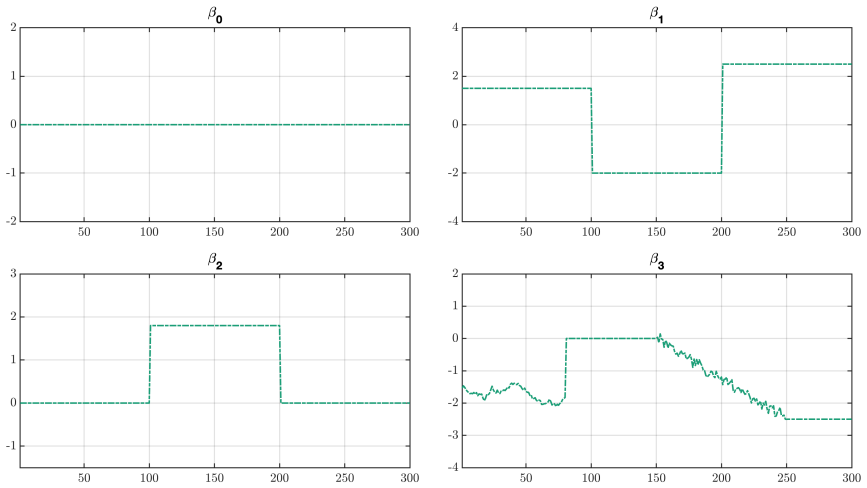
Summary. The paper proposes a Markov Switching Dynamic Shrinkage Process (MSDSP) that extends the Dynamic Shrinkage Process of Kowal et al. (2019) by attaching independent two-state Markov processes to each coefficient, allowing a time-varying parameter to switch between exact zero (sparsity) and a DSP-driven path that permits shrinkage toward constancy as well as gradual and abrupt change; the measurement equation is a linear regression with stochastic volatility. The authors provide an MCMC scheme based on Polya-gamma and normal-mixture augmentation and report two simulation designs in which the MSDSP recovers zero and non-zero regimes with tighter credible intervals than the DSP. The empirical application revisits the Meese-Rogoff puzzle: MSDSP and DSP versions of seven economic models (IRP, Taylor rule, PPP, monetary model, and oil/gold/copper commodity models) are evaluated against random-walk benchmarks with stochastic volatility for GBP/USD over 1990-2017, with out-of-sample evaluation from Nov 2000 to Jun 2017. The paper reports that MSDSP versions achieve positive log predictive density ratios (about 2.2 to 6.0), lower CRPS, RMSFE ratios near 0.98, and top ranks in model confidence sets, while linear and DSP versions generally underperform the random walk. A two-stage model-assembly extension applies MSDSP to the weights of a Bayesian predictive synthesis and is reported to dominate dynamic Bayesian predictive synthesis.
Significance. The contribution is potentially important. The MSDSP is a natural and coherent unification of sparsity, shrinkage, and structural change in a single state-space prior, and it nests the DSP and standard TVP specifications; the simulation results provide honest evidence that the model can separate zero regimes from active regimes, which the DSP alone cannot do. The empirical exercise follows the Rossi (2013) benchmark taxonomy rather than a bespoke design, and the evaluation uses five complementary criteria (LPDR, CRPS, RMSFE, tail coverage, and model confidence sets). Credit is also due for reporting the unfavorable Diebold-Mariano results explicitly rather than suppressing them, for making the direct h-step-ahead scheme clear, and for the scalable two-stage assembly method. However, the headline empirical finding is only as good as the out-of-sample protocol, and the current manuscript does not specify whether the standardization in Section 4.3 is recursive or full-sample; this is the main reason the result cannot be accepted as it stands.
major comments (3)
- [§4.3 (Data Description); §4.1 (Competing Economic Models)] Section 4.3 states 'All variables are standardized to have a mean of 0 and a variance of 1' without saying whether the standardization is recursive (using only data available up to the forecast origin) or full-sample. If full-sample moments are used, the realized target y_{t+h} is normalized using its own future mean and variance, and the covariates (including the PPP regressor p_t - p*_t - e_t) are normalized using values observed after time t; this mechanically contaminates the out-of-sample predictive likelihoods, CRPS, coverage rates, and RMSFE in Tables 3-6 in a way that can differentially favor the covariate-bearing economic models over the random walk. The sentence in Section 4.1 that predictions are 'out-of-sample by using expanding' describes the parameter-estimation window, not the transformation, and Section 4.4, which is cited for details, contains only results rather than the protocol. The authors must state explicitly whether standardization is recursive and, if it was full-sample, redo the entire evaluation with recursive moments; the paper currently provides no code with which to resolve this ambiguity.
- [§4.4.2 (Point Forecasts), Table 5] The point-forecast claim is weaker than the text suggests. The RMSFE ratios in Table 5 are all close to unity (roughly 0.97-0.99 for MSDSP), and the authors report that pairwise Diebold-Mariano tests 'did not achieve many significant result'. The joint Wilcoxon test pools 84 statistics (7 models times 12 horizons) that are highly dependent across horizons and models, so the reported p-value of 0.0000 is not a reliable basis for the conclusion that the MSDSP is 'systematically' superior in point forecasts. The authors should either temper the RMSFE-based conclusions, provide a multiple-testing correction, or report the distribution of the individual DM statistics so that the reader can judge the strength of the point-forecast evidence.
- [§5.4 (Model Assembly Results), Table 8] The text claims that 'the point forecast (RMSFE) from MSDSP is better than the random walk when h > 9', but Table 8 shows the opposite at h=9 (1.0104 versus 0.9902) and at h=12 (0.9886 versus 0.9848); only h=10 and h=11 are better. Moreover, the MSDSP assembly has worse LPL and CRPS than the RW-SV at every horizon (for example, LPL -142.4 versus -140.0 at h=1), so the summary sentence 'slightly worse ... at short horizons but tends to improve at longer horizons' misrepresents the reported results. The claim that the MSDSP assembly 'consistently beat' DBPS is supported by Table 8, but the comparison against the random walk should be restated to match the numbers.
minor comments (7)
- [§2.1, §2.3, §2.4, §3.2, §4.3, §4.4.2, §4.4.3 (typos/presentation)] The manuscript contains numerous typos and grammatical slips that should be corrected: 'resprentation' in §2.3, 'daws' in §2.4, 'Markow' in §2.2, 'As in Case 2' should be 'As in Case 1' in §3.2, 'the cases ofthe Canadian dollar' in §4.3, 'benchmerk' in §4.4.2, and 'eliminated form the confidence set' in §4.4.3; Section 5.3 also contains the unfinished sentence 'and thus the structure of the model weights ωt It cannot be inferred without input from the base models'.
- [§4.2, Eq. (15)] The left-hand side 'log(p(Y_{T0+h:T}|I_{T0}, M))' suggests conditioning only on the initial information set I_{T0}, while the definition is a sum of log predictive densities that condition on I_t at each t; please align the notation with the recursive updating scheme.
- [§2.1, Eq. (8), Table 1] The Z-distribution shape parameters α_h and β_h are not listed in Table 1 and no fixed values or priors are given in the main text; because the shrinkage behavior of the DSP depends on these shapes, the authors should state how they are set in both the simulations and the application.
- [§4.4.1, Table 6] The tail-coverage comparisons use 200 out-of-sample observations, so the standard error of a nominal 2.5% coverage rate is roughly one percentage point; differences such as 1.5% versus 2.5% are within sampling noise, and the text should not describe such differences as decisive without uncertainty quantification.
- [§5.1, §5.2 (Model Assembly)] The comparison between the MSDSP assembly, which inputs a single point prediction per model, and the full DBPS, which inputs predictive distributions, is not entirely apples-to-apples; please acknowledge in the text that the two procedures use different information inputs, and optionally add a point-input DBPS variant for a cleaner comparison.
- [§2.1, Eq. (9)] For the assembly application (p = 8), the assumption that all Markov switching processes are independent is substantive; at least a brief discussion of this restriction or a sensitivity exercise with a common state process would be informative.
- [General (reproducibility)] No data availability statement or replication code is provided; given that the empirical claim is the centerpiece of the paper, the authors should make the code and the precise recursive standardization and estimation protocol available as part of the revision.
Circularity Check
No significant circularity: the paper's central claim is an out-of-sample forecasting comparison against an external random-walk benchmark, and its proposed MSDSP is a new model rather than a relabeling of the target result.
full rationale
The derivation chain is not circular. The MSDSP is constructed as a state-space extension (Eqs. 4-9) with Markov switching sparsity and the DSP of Kowal et al. (2019); its empirical contribution is evaluated by recursive out-of-sample predictive distributions (Eq. 12) relative to RW-SV, an external benchmark. Parameters are estimated on expanding windows and predictions are scored on held-out periods, so the LPDR/CRPS/RMSFE results in Tables 3-5 are not forced by construction. The claim that the MSDSP version of each economic model performs best is an empirical outcome, not a definitional equality; the MSDSP nests simpler models, but nesting alone does not guarantee superior out-of-sample scores. No load-bearing self-citation appears: the cited DSP (Kowal et al. 2019) and BPS (McAlinn and West 2019) are prior external methods, and the co-authored citation to Dufays et al. (2021) is only a related-work comparison, not a premise of the results. The manuscript itself flags limitations that are correctness concerns rather than circularity: footnote 2 calls the contemporaneous forecasts "a pseudo prediction... not a fair comparison," and Section 4.4.2 admits that pairwise DM tests "did not achieve many significant result." The standardization statement in Section 4.3 ("All variables are standardized to have a mean of 0 and a variance of 1") is ambiguous about recursive versus full-sample moments; if full-sample moments were used, this would be a data-leakage flaw, but the paper provides no evidence that this occurred, and the ambiguity does not constitute a circular reduction of the forecasting claim to its inputs.
Assumptions & free parameters
free parameters (3)
- Z-distribution shape parameters α_h, β_h
- Prior hyperparameters for μ_i, φ_i, σ_g^2, transition probabilities
- BPS discount factor =
set as in McAlinn and West (2019)
assumptions (3)
- standard math Bayesian inference via MCMC with Polya-gamma and SV mixture representations
- domain assumption The economic models (IRP, TR, PPP, MON) are linear in covariates with time-varying coefficients
- ad hoc to paper Independence of the p Markov switching processes
Cite this review
Pith. "Pith review of A New Perspective of the Meese-Rogoff Puzzle: Application of Sparse Dynamic Shrinkage." pith.science (2026). https://pith.science/paper/T6PJUM5D
@misc{pith2026250714408,
  author       = {Pith},
  title        = {Pith review of: A New Perspective of the Meese-Rogoff Puzzle: Application of Sparse Dynamic Shrinkage},
  year         = {2026},
  howpublished = {\url{https://pith.science/paper/T6PJUM5D}},
  note         = {Machine review of arXiv:2507.14408}
}
read the original abstract
We propose the Markov Switching Dynamic Shrinkage process (MSDSP), nesting the Dynamic Shrinkage Process (DSP) of Kowal et al. (2019). We revisit the Meese-Rogoff puzzle (Meese and Rogoff, 1983a,b, 1988) by applying the MSDSP to the economic models deemed inferior to the random walk model for exchange rate predictions. The flexibility of the MSDSP model captures the possibility of zero coefficients (sparsity), constant coefficient (dynamic shrinkage), as well as sudden and gradual parameter movements (structural change) in the time-varying parameter model setting. We also apply MSDSP in the context of Bayesian predictive synthesis (BPS) (McAlinn and West, 2019), where dynamic combination schemes exploit the information from the alternative economic models. Our analysis provide a new perspective to the Meese-Rogoff puzzle, illustrating that the economic models, enhanced with the parameter flexibility of the MSDSP, produce predictive distributions that are superior to the random walk model, even when stochastic volatility is considered.
Figures


Reference graph
Works this paper leans on
-
[1]
Aastveit, K. A., Cross, J. L., and van Dijk, H. K. (2023). Quantifying time-varying forecast uncertainty and risk for the real price of oil. Journal of business & economic statistics: a publication of the American Statistical Association , 41(2):523--537
work page 2023
-
[2]
Aguilar, O. and West, M. (2000). Bayesian dynamic factor models and portfolio allocation. Journal of Business & Economic Statistics , 18(3):338--357
work page 2000
-
[3]
Aristidou, C., Lee, K., and Shields, K. (2022a). Fundamentals, regimes and exchange rate forecasts: Insights from a meta exchange rate model. Journal of International Money and Finance , 123(102601):102601
work page 2022
-
[4]
Aristidou, C., Lee, K., and Shields, K. (2022b). A meta model analysis of exchange rate determination. In Essays in Honor of M. Hashem Pesaran: Prediction and Macro Modeling , Advances in econometrics, pages 199--215. Emerald Publishing Limited
work page 2022
-
[5]
Barndorff-Nielsen, O., Kent, J., and S rensen, M. (1982). Normal Variance-Mean mixtures and z distributions. International statistical review = Revue internationale de statistique , 50(2):145--159
work page 1982
-
[6]
Bernardi, M., Bianchi, D., and Bianco, N. (2023). Dynamic variable selection in high-dimensional predictive regressions. arXiv preprint arXiv:2304.07096
work page Pith review arXiv 2023
-
[7]
Bernardi, M. and Catania, L. (2018). The model confidence set package for R . International Journal of Computational Economics and Econometrics , 8(2):144--158
work page 2018
-
[8]
Breiman, L. (1996). Bagging predictors. Machine Learning , 24(2):123--140
work page 1996
Show all 73 references
-
[9]
P., Korobilis, D., and Ribeiro, P
Byrne, J. P., Korobilis, D., and Ribeiro, P. J. (2016). Exchange rate predictability in a changing world. Journal of International Money and Finance , 62:1--24
2016
-
[10]
and De Leo, P
Candian, G. and De Leo, P. (2023). Imperfect exchange rate expectations. Review of Economics and Statistics , pages 1--46
2023
-
[11]
Canova, F. (1993). Modelling and forecasting exchange rates with a bayesian time-varying coefficient model. Journal of Economic Dynamics and Control , 17(1-2):233--261
1993
-
[12]
C asta, M. (2024). Forecasting nominal exchange rates using a dynamic model averaging framework. Heliyon , 10(20)
2024
-
[13]
Chan, J. C. and Eisenstat, E. (2018). Bayesian model comparison for time-varying parameter vars with stochastic volatility. Journal of applied econometrics , 33(4):509--532
2018
-
[14]
C., Koop, G., and Yu, X
Chan, J. C., Koop, G., and Yu, X. (2024). Large order-invariant bayesian vars with stochastic volatility. Journal of Business & Economic Statistics , 42(2):825--837
2024
-
[15]
D., Pascual, A
Cheung, Y.-W., Chinn, M. D., Pascual, A. G., and Zhang, Y. (2019). Exchange rate prediction redux: New models, new data, new currencies. Journal of International Money and Finance , 95:332--362
2019
-
[16]
B., and Schorfheide, F
Del Negro, M., Hasegawa, R. B., and Schorfheide, F. (2016). Dynamic prediction pools: An investigation of financial frictions and forecasting performance. Journal of Econometrics , 192(2):391--405
2016
-
[17]
Della Corte, P., Sarno, L., and Tsiakas, I. (2009). An economic evaluation of empirical exchange rate models. The review of financial studies , 22(9):3491--3530
2009
-
[18]
Dietterich, T. G. (2000). Ensemble methods in machine learning. In Multiple Classifier Systems , pages 1--15, Berlin, Heidelberg. Springer Berlin Heidelberg
2000
-
[19]
V., and Song, Y
Dufays, A., Li, Z., Rombouts, J. V., and Song, Y. (2021). Sparse change-point var models. Journal of Applied Econometrics , 36(6):703--727
2021
-
[20]
Engel, C. (1994). Can the markov switching model forecast exchange rates? Journal of international economics , 36(1-2):151--165
1994
-
[21]
Engel, C., Lee, D., Liu, C., Liu, C., and Wu, S. P. Y. (2019). The uncovered interest parity puzzle, exchange rate forecasting, and taylor rules. Journal of International Money and Finance , 95:317--331
2019
-
[22]
Fang, S., Wei, Y., and Wang, S. (2024). 30 years of exchange rate analysis and forecasting: a bibliometric review. Journal of Economic Surveys , 38(3):973--1007
2024
-
[23]
Ferraro, D., Rogoff, K., and Rossi, B. (2015). Can oil prices forecast exchange rates? an empirical analysis of the relationship between commodity prices and exchange rates. Journal of International Money and Finance , 54:116--141
2015
-
[24]
George, E. I. and McCulloch, R. E. (1997). Approaches for bayesian variable selection. Statistica sinica , pages 339--373
1997
-
[25]
and Amisano, G
Geweke, J. and Amisano, G. (2010). Comparing and evaluating bayesian predictive distributions of asset returns. International journal of forecasting , 26(2):216--230
2010
-
[26]
and Amisano, G
Geweke, J. and Amisano, G. (2011). Optimal prediction pools. Journal of Econometrics , 164(1):130--141
2011
-
[27]
and Raftery, A
Gneiting, T. and Raftery, A. E. (2007). Strictly proper scoring rules, prediction, and estimation. Journal of the American statistical Association , 102(477):359--378
2007
-
[28]
Hahn, P. R. and Carvalho, C. M. (2015). Decoupling shrinkage and selection in bayesian linear models: A posterior summary perspective. Journal of the American Statistical Association , 110(509):435--448
2015
-
[29]
Hall, S. G. and Mitchell, J. (2007). Combining density forecasts. International journal of forecasting , 23(1):1--13
2007
-
[30]
R., Lunde, A., and Nason, J
Hansen, P. R., Lunde, A., and Nason, J. M. (2011). The model confidence set. Econometrica: journal of the Econometric Society , 79(2):453--497
2011
-
[31]
Harrison, P. J. and Stevens, C. F. (1976). Bayesian forecasting. Journal of the Royal Statistical Society Series B: Statistical Methodology , 38(3):205--228
1976
-
[32]
Hauzenberger, N., Huber, F., and Koop, G. (2024). Dynamic shrinkage priors for large time-varying parameter regressions using scalable markov chain monte carlo methods. Studies in Nonlinear Dynamics & Econometrics , 28(2):201--225
2024
-
[33]
Huber, F., Koop, G., and Onorante, L. (2021). Inducing sparsity and shrinkage in time-varying parameter models. Journal of Business & Economic Statistics , 39(3):669--683
2021
-
[34]
M., and Yang, Q
Jin, X., Maheu, J. M., and Yang, Q. (2022). Infinite markov pooling of predictive distributions. Journal of econometrics , 228(2):302--321
2022
-
[35]
Johnson, M. C. (2017). Bayesian predictive synthesis: Forecast calibration and combination . PhD thesis, Duke University
2017
-
[36]
and Primiceri, G
Justiniano, A. and Primiceri, G. E. (2008). The time-varying volatility of macroeconomic fluctuations. American Economic Review , 98(3):604--641
2008
-
[37]
and Griffin, J
Kalli, M. and Griffin, J. E. (2014). Time-varying sparsity in dynamic regression models. Journal of Econometrics , 178(2):779--793
2014
-
[38]
Kalman, R. E. (1960). A new approach to linear filtering and prediction problems
1960
-
[39]
Kass, R. E. and Raftery, A. E. (1995). Bayes factors. Journal of the American Statistical Association , 90(430):773--795
1995
-
[40]
and Fr \"u hwirth-Schnatter, S
Knaus, P. and Fr \"u hwirth-Schnatter, S. (2023). The dynamic triple gamma prior as a shrinkage process prior for time-varying parameter models. arXiv preprint arXiv:2312.10487
2023 arXiv
-
[41]
R., Matteson, D
Kowal, D. R., Matteson, D. S., and Ruppert, D. (2019). Dynamic shrinkage processes. Journal of the Royal Statistical Society Series B: Statistical Methodology , 81(4):781--804
2019
-
[42]
F., McCulloch, R
Lopes, H. F., McCulloch, R. E., and Tsay, R. S. (2022). Parsimony inducing priors for large scale state--space models. Journal of Econometrics , 230(1):39--61
2022
-
[43]
Mark, N. C. (1995). Exchange rates and fundamentals: Evidence on long-horizon predictability. The American Economic Review , pages 201--218
1995
-
[44]
A., Nakajima, J., and West, M
McAlinn, K., Aastveit, K. A., Nakajima, J., and West, M. (2020a). Multivariate bayesian predictive synthesis in macroeconomic forecasting. Journal of the American Statistical Association , 115(531):1092--1110
2020
-
[45]
A., Nakajima, J., and West, M
McAlinn, K., Aastveit, K. A., Nakajima, J., and West, M. (2020b). Multivariate bayesian predictive synthesis in macroeconomic forecasting. Journal of the American Statistical Association , 115(531):1092--1110
2020
-
[46]
and West, M
McAlinn, K. and West, M. (2019). Dynamic bayesian predictive synthesis in time series forecasting. Journal of econometrics , 210(1):155--169
2019
-
[47]
Meese, R. A. and Rogoff, K. (1983a). Empirical exchange rate models of the seventies: Do they fit out of sample? Journal of International Economics , 14(1-2):3--24
1983
-
[48]
Meese, R. A. and Rogoff, K. (1983b). The out-of-sample failure of empirical exchange rate models: Sampling error or misspecification? Exchange Rates and International Macroeconomics , pages 67--112
1983
-
[49]
Meese, R. A. and Rogoff, K. (1988). Was it real? the exchange rate-interest differential relation over the modern floating-rate period. The Journal of Finance , 43(4):933--948
1988
-
[50]
and Papell, D
Molodtsova, T. and Papell, D. H. (2009). Out-of-sample exchange rate predictability with taylor rule fundamentals. Journal of international economics , 77(2):167--180
2009
-
[51]
and Sunder-Plassmann, L
Mumtaz, H. and Sunder-Plassmann, L. (2013). Time-varying dynamics of the real exchange rate: An empirical analysis. Journal of applied econometrics , 28(3):498--525
2013
-
[52]
A., Nikmah, T
Muslim, M. A., Nikmah, T. L., Pertiwi, D. A. A., Subhan, Jumanto, Dasril, Y., and Iswanto (2023). New model combination meta-learner to improve accuracy prediction p2p lending with stacking ensemble learning. Intelligent Systems with Applications , 18:200204
2023
-
[53]
Nakajima, J. (2011). Time-varying parameter var model with stochastic volatility: An overview of methodology and empirical applications. Monetary and Economic Studies , 29:107--142
2011
-
[54]
and West, M
Nakajima, J. and West, M. (2013). Bayesian analysis of latent threshold dynamic models. Journal of Business & Economic Statistics , 31(2):151--164
2013
-
[55]
P., Cevik, M., Wahab, M., and Basar, A
Neghab, D. P., Cevik, M., Wahab, M., and Basar, A. (2024). Explaining exchange rate forecasts with macroeconomic fundamentals using interpretive machine learning. Computational Economics , pages 1--43
2024
-
[56]
and Prodan, R
Nikolsko-Rzhevskyy, A. and Prodan, R. (2012). Markov switching and exchange rate predictability. International journal of forecasting , 28(2):353--365
2012
-
[57]
Omori, Y., Chib, S., Shephard, N., and Nakajima, J. (2007). Stochastic volatility with leverage: Fast and efficient likelihood inference. Journal of Econometrics , 140(2):425--449
2007
-
[58]
G., Scott, J
Polson, N. G., Scott, J. G., and Windle, J. (2013). Bayesian inference for logistic models using p \'o lya--gamma latent variables. Journal of the American statistical Association , 108(504):1339--1349
2013
-
[59]
and West, M
Prado, R. and West, M. (2010). Time series: Modeling, computation, and inference . Chapman & Hall/CRC Texts in Statistical Science. Chapman & Hall/CRC, Philadelphia, PA
2010
-
[60]
Primiceri, G. E. (2005). Time varying structural vector autoregressions and monetary policy. The Review of economic studies , 72(3):821--852
2005
-
[61]
and Zaytsev, A
Proscura, P. and Zaytsev, A. (2022). Effective training-time stacking for ensembling of deep neural networks
2022
-
[62]
Rapach, D. E. and Wohar, M. E. (2002). Testing the monetary model of exchange rate determination: new evidence from a century of data. Journal of International Economics , 58(2):359--385
2002
-
[63]
and McAlinn, K
Rockova, V. and McAlinn, K. (2021). Dynamic variable selection with spike-and-slab process priors. Bayesian Analysis , 16(1):233--269
2021
-
[64]
Rossi, B. (2013). Exchange rate predictability. Journal of economic literature , 51(4):1063--1119
2013
-
[65]
and West, M
Tallman, E. and West, M. (2024a). Bayesian predictive decision synthesis. Journal of the Royal Statistical Society Series B: Statistical Methodology , 86(2):340--363
2024
-
[66]
and West, M
Tallman, E. and West, M. (2024b). Bayesian predictive decision synthesis. Journal of the Royal Statistical Society. Series B, Statistical methodology , 86(2):340--363
2024
-
[67]
Uribe, P. W. and Lopes, H. F. (2020). Dynamic sparsity on dynamic regression models. arXiv preprint arXiv:2009.14131
2020 arXiv
-
[68]
Waggoner, D. F. and Zha, T. (2012). Confronting model misspecification in macroeconomics. Journal of Econometrics , 171(2):167--184
2012
-
[69]
and Harrison, J
West, M. and Harrison, J. (1997). Bayesian forecasting and dynamic models . Springer Series in Statistics. Springer, New York, NY, 2 edition
1997
-
[70]
and Harrison, J
West, M. and Harrison, J. (2006). Bayesian forecasting and dynamic models . Springer Science & Business Media
2006
-
[71]
Wolff, C. C. (1987). Time-varying parameters and the out-of-sample forecasting performance of structural exchange rate models. Journal of Business & Economic Statistics , 5(1):87--97
1987
-
[72]
Wolpert, D. H. (1992). Stacked generalization. Neural Networks , 5(2):241--259
1992
-
[73]
Wright, J. H. (2008). Bayesian model averaging and exchange rate forecasts. Journal of Econometrics , 146(2):329--341
2008
Reviewed August 6, 2026 · model on record in the stance chip above.
Discussion (0). Continue with ORCID to comment.